
A Guide to Performance Based Lead Generation
Picture this: you hire a top-tier salesperson, but you only pay them a commission after they bring you a genuinely interested customer. They don’t get a dime just for showing up or making a few calls.
That’s the essence of performance based lead generation. It’s a marketing model where you stop paying for effort and start paying for actual, tangible results.
Why Paying for Results Is the Future of Marketing

Most traditional advertising has you paying for exposure - things like clicks, impressions, or airtime - whether or not they turn into a real business opportunity. You could pour thousands into a billboard or a digital ad campaign and end up with nothing but a spike in unqualified traffic. It’s like paying that salesperson their full salary even if they never book a single meeting.
Performance based lead generation flips that whole idea on its head. Instead of paying for potential, you’re paying for proof. It’s a simple shift, but it has massive implications for your marketing strategy and your bottom line.
Performance Based vs Traditional Marketing Models
The core difference boils down to what you’re actually paying for. In one model, you’re buying access and attention. In the other, you’re buying outcomes.
Let’s break it down.
| Metric | Traditional Marketing (Pay For) | Performance Based Marketing (Pay For) |
|---|---|---|
| PPC/PPM | Clicks or Impressions | A specific action (e.g., form submission) |
| SEO/Content | Content creation, backlinks, retainers | A qualified lead or a scheduled meeting |
| Social Media | Ad spend, community management hours | A direct inquiry from a target customer |
| Billboards/Print | Ad placement and space | N/A (Cannot be performance-based) |
This table shows a clear shift. With performance marketing, the financial risk moves from you to the marketing partner. They have to deliver to get paid.
Shifting from Quantity to Quality
The real magic of a performance model is how it automatically focuses everyone on quality. When your marketing partner only gets paid for delivering a specific result - like a qualified lead or a booked appointment - their interests are perfectly aligned with yours.
They are now financially motivated to weed out the tire-kickers and time-wasters. They have to deliver prospects who actually match your ideal customer profile.
This forced focus on quality brings some serious advantages to your business:
-
Minimized Financial Risk: You’re no longer burning cash on ad campaigns that don’t work. Your budget is tied directly to acquiring real opportunities.
-
Predictable ROI: You know the exact cost per qualified lead or appointment. This makes calculating your return on investment incredibly simple and reliable.
-
Improved Sales Efficiency: Your sales team stops wasting time chasing down cold, uninterested contacts. Instead, they get to focus their energy on closing deals with warm, pre-vetted prospects.
How It Works in Practice
Let’s get practical. Imagine a software company partners with an agency. They agree to a deal: the agency gets paid $250 for every qualified demo it books with a decision-maker at a company with over 50 employees.
The agency then handles all the outreach, nurturing, and scheduling. The software company doesn’t pay a cent until a prospect who meets those exact criteria actually shows up for the demo. This is a super common and effective model for SaaS lead generation because it prioritizes high-value conversations.
This results-first approach is why lead generation is the top priority for marketers everywhere. A staggering 91% rank it as their main goal. It makes sense, too, when you consider that marketing-sourced leads can drive anywhere from 11% to over 50% of a company’s total revenue.
Ultimately, performance based lead generation isn’t just another pricing model; it’s a true strategic partnership. It builds an accountable marketing engine where both you and your partner are locked in on the same goal: growing your business with high-quality leads that actually convert. It turns marketing from a cost center into a predictable revenue driver.
Choosing Your Performance Marketing Model
Once you’ve decided to go with a performance-based lead generation strategy, you’ve got another big decision to make: how are you going to pay for it? Not all payment models are the same, and the best one for you really boils down to your business goals, how long your sales cycle is, and how much risk you’re comfortable with.
Think of it like setting up a commission structure for a new salesperson. Do you pay them for a promising chat, a confirmed meeting on the calendar, or only when the deal is officially closed?
Each model ties your partner’s success to a different part of your sales funnel. Get this choice right, and you’ll be paying for the results that truly move the needle for your business.
Cost Per Lead (CPL)
The Cost Per Lead model is probably the most straightforward way to dip your toes into performance marketing. It’s simple: you pay a flat fee for every single lead that checks a few boxes you’ve predefined. This could be someone filling out a contact form, downloading an e-book, or signing up for your newsletter.
What you’re buying here is information, not necessarily immediate intent. For instance, a marketing agency might agree to pay $50 for any lead that comes from a healthcare company with over 100 employees. The criteria are all about demographics and company details, making CPL a great fit if your main goal is to build a big audience at the top of your funnel to nurture over time.
The biggest upside is that it’s predictable and can fill your pipeline fast. The catch? These leads might fit your ideal customer profile on paper, but they might have very low interest in buying anything right now. They’re curious, but they’re not yet committed.
Cost Per Appointment (CPAp)
Moving a little deeper into the funnel, we have the Cost Per Appointment model. With this setup, you only open your wallet when a qualified lead is actually scheduled for a meeting, demo, or consultation with your sales team. This is a serious step up in quality from a basic CPL model.
Picture a SaaS company paying an agency $300 for every qualified demo they book with a VP of Operations. The agency’s job isn’t just to find a name and an email; they have to engage and warm up that contact until they agree to a real conversation. This model puts the focus squarely on confirmed interest and active engagement.
This approach is powerful because it builds a solid bridge between your marketing efforts and your sales team. You’re not just buying a contact - you’re buying a scheduled, high-value conversation that your sales reps can jump right into. It makes everyone far more efficient.
Cost Per Acquisition (CPA)
Cost Per Acquisition - often called Cost Per Sale - is the ultimate pay-for-performance model. Under this structure, you pay your partner only after a lead they delivered turns into a paying customer. This is the lowest-risk option you can find because payment is tied directly to cold, hard revenue.
This model is super common in B2C e-commerce where the journey from ‘interested’ to ‘customer’ is short and sweet. An online store might pay an affiliate partner 10% of the first purchase a new customer makes. For B2B businesses with long, complex sales cycles, this can be a nightmare to track, which is why many agencies steer clear. To learn more about navigating those longer sales cycles, check out our guide on B2B lead generation that actually works.
Revenue Share
The Revenue Share model is less of a service and more of a true partnership. Instead of a one-off payment, your partner gets a slice of the revenue from the customers they bring you, on an ongoing basis. This could be a percentage of a monthly subscription or a cut of future sales over a set period.
For example, a subscription software company might give a partner 15% of the monthly recurring revenue (MRR) for the entire first year of a new customer’s contract. This structure aligns everyone’s incentives around long-term value, not just the initial win. The partner is now motivated to find customers who won’t just buy, but who will be successful, happy, and stick around for the long haul.
Picking the right model comes down to knowing what you value most. Are you after a huge audience (CPL), quality sales conversations (CPAp), quick sales (CPA), or sustainable, long-term customer relationships (Revenue Share)?
The Real Pros and Cons of Paying for Performance

The idea of only paying for actual results sounds like a business owner’s dream. A performance-based lead generation model seems to take all the guesswork and financial risk out of your marketing spend. While it’s a powerful approach, it’s definitely not a magic bullet. It’s critical to understand both the incredible benefits and the potential traps before you jump in.
Right away, paying for performance creates a powerful alignment between you and your marketing partner. Their success is now directly wired to your success - a huge shift from the old retainer models. But this shared destiny also comes with its own unique set of challenges you need to navigate carefully. Let’s get real about the pros and cons.
The Upside of Performance Marketing
The most obvious benefit of a pay-for-performance model is how much it slashes your financial risk. You’re no longer just throwing money at campaigns and hoping for the best. You’re investing in a guaranteed outcome, whether that’s a qualified lead, a booked meeting, or a closed deal.
This simple shift unlocks a few key advantages:
-
Predictable ROI: When you know the exact cost per lead or appointment, calculating your return on investment becomes dead simple. This kind of predictability is a massive asset for budgeting and forecasting your growth.
-
Access to Specialization: Performance-based agencies are experts at what they do. They have to be - their revenue depends on it. You get to tap into their specialized tools, data, and expertise without the massive overhead of building an in-house team from the ground up.
-
Guaranteed Quality (with a catch): The agency only gets paid for leads that meet your pre-agreed criteria. This gives them a serious financial incentive to filter out the tire-kickers and time-wasters. The result? Your sales team spends less time digging for gold and more time closing deals.
This model forces everyone to focus on what actually matters: outcomes. You stop paying for fuzzy activities like clicks or impressions and start paying for tangible business opportunities. It makes every single dollar in your marketing budget accountable.
The Downside and Potential Pitfalls
While the benefits are compelling, this approach isn’t without its challenges. The biggest risk by far is the quality of the leads you receive, especially if your definitions aren’t crystal clear and strictly enforced.
If you don’t have proper guardrails in place, you could easily find yourself paying for leads that technically check a box but have zero real intent to buy anything from you. Here are some of the main drawbacks to watch out for:
-
Higher Cost Per Lead: A single performance-based lead will almost always cost more upfront than a lead from a traditional campaign. You’re paying a premium for the agency to absorb the risk, do all the qualification work, and guarantee the result.
-
Risk of Low-Quality Leads: If the definition of a “qualified lead” is too loose, some providers might be tempted to push through low-intent contacts just to hit their quota. This is exactly why a rock-solid Service Level Agreement (SLA) is completely non-negotiable.
-
Dependency on Robust Tracking: This model lives and dies by data. You absolutely need a reliable system (like a CRM) to track every lead from the moment it comes in all the way to the final sale. Without it, you can’t validate the agency’s performance or even prove your ROI.
Making the Right Decision
Ultimately, deciding whether to use a performance-based lead generation model comes down to your company’s readiness. You need a crystal-clear understanding of your ideal customer, a solid sales process to handle the opportunities, and the right systems to track everything from start to finish.
For B2B companies, a well-structured performance model is essential for growth. If you’re interested in diving deeper, our guide on effective lead generation in B2B offers more specific insights. When it’s set up correctly, paying for performance can become a powerful engine for predictable, scalable growth.
How to Launch Your First Performance Campaign
Alright, let’s move from theory to action. This is where performance based lead generation really starts to pay off. Firing up your first campaign isn’t about crossing your fingers and hoping for the best. It takes a structured, deliberate approach to build a machine that delivers predictable, high-quality results from day one.
Think of it like building a high-performance engine. You wouldn’t just toss a bunch of parts together and expect it to roar to life. You’d carefully select each component, assemble them with precision, and set up a system to monitor its output.
Step 1: Define Your “Qualified Lead”
Before you can pay for a result, you have to define exactly what that result looks like. This is, without a doubt, the single most important step. A fuzzy definition of a “qualified lead” is a surefire way to burn cash on leads that are technically valid but completely useless to your sales team.
Get your sales team in a room and hammer out a non-negotiable checklist. What specific, objective criteria must a prospect meet to be considered a real opportunity?
-
Demographics: Are you targeting a specific company size, industry, or geographic location?
-
Firmographics: Do you need them to fall within certain revenue brackets or use a particular tech stack?
-
Job Titles: Who are the decision-makers you absolutely must speak with (e.g., VP of Marketing, Head of Operations)?
-
Pain Points: What specific business challenges must the lead be facing for your solution to even be relevant?
The goal here is to create a definition so crystal clear that there’s zero room for interpretation. A lead either checks every single box, or it’s not qualified. Period. This clarity protects your budget and, just as importantly, respects your sales team’s time.
Step 2: Establish Robust Tracking and Validation
You can’t manage what you don’t measure. A performance campaign lives and dies by your ability to track a lead from its very first touchpoint all the way to a closed deal. This means you need a reliable Customer Relationship Management (CRM) system to be your single source of truth.
When a new lead comes in from your partner, your internal process should kick in immediately. This validation workflow confirms two things: first, that the lead actually meets your predefined criteria, and second, that their contact information is accurate. This simple step saves you from paying for bad data or unqualified contacts.
Step 3: Craft an Ironclad Service Level Agreement
Your Service Level Agreement (SLA) is the contract that governs the entire relationship. It’s not just a formality - it’s your primary tool for managing expectations and holding everyone accountable. A well-written SLA should spell out every detail of the arrangement.
Here’s what your SLA absolutely must include:
-
The Exact Definition of a Qualified Lead: Copy and paste the checklist from Step 1 directly into the contract. No ambiguity.
-
The Payment Model and Rate: Specify whether it’s Cost Per Lead (CPL) or Cost Per Appointment (CPAp), along with the exact dollar amount.
-
The Lead Validation Process: Detail the timeframe your team has to accept or reject a lead (e.g., within 48 hours).
-
Reporting Requirements: Define how and when your partner will report back on performance.
This infographic shows the basic flow from capture to conversion that your SLA and tracking systems will manage.
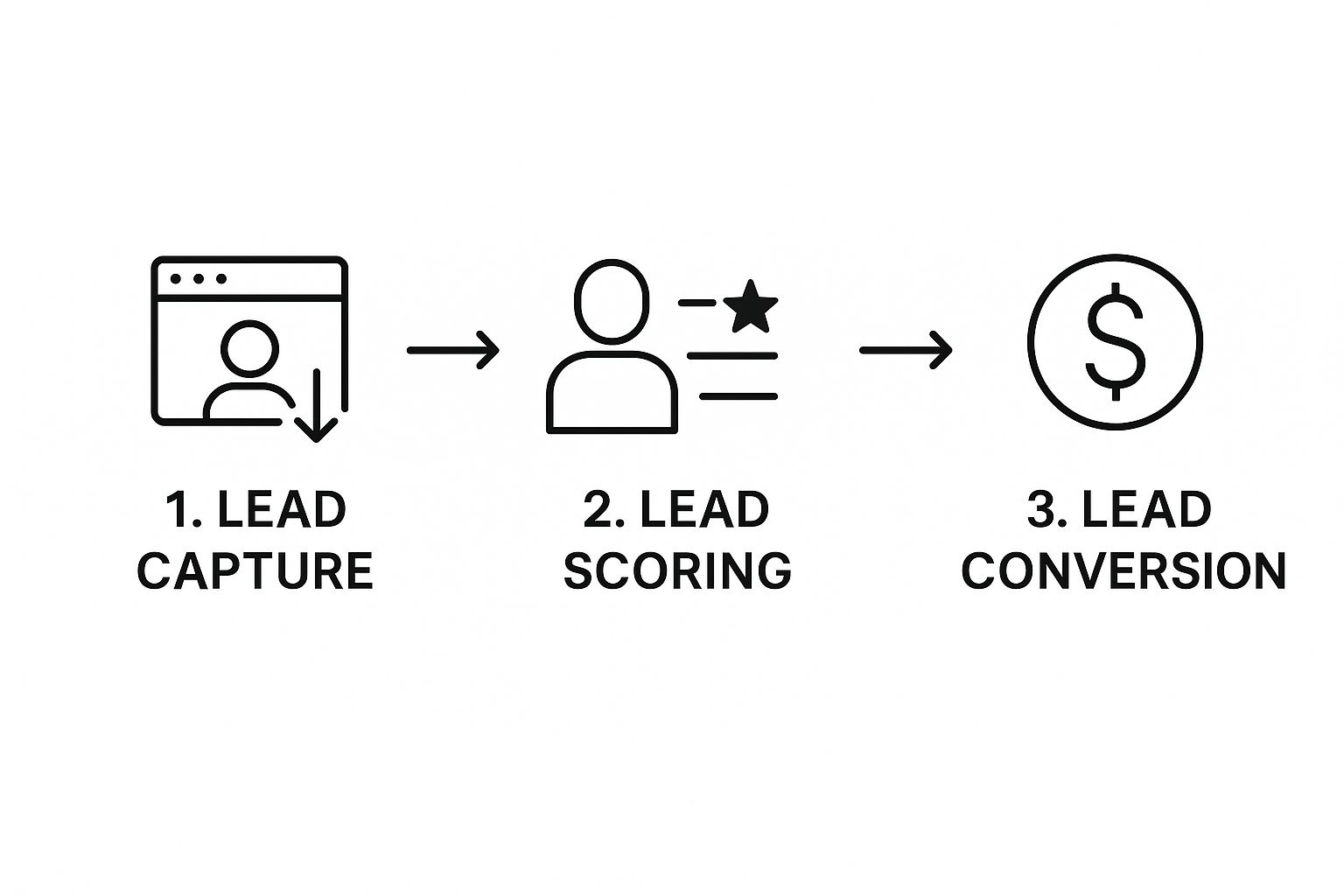
It’s a simple visualization, but it highlights how a lead moves through distinct stages. Each stage needs verification before moving to the next - that’s the core of a successful performance model.
Step 4: Choose the Right Partner and Channels
With your framework locked in, it’s time to find the right partner. Look for agencies or providers who have a proven track record in your specific niche. Don’t be shy - ask for case studies and references. A good partner will be just as invested in defining lead quality as you are because their own revenue depends on it.
Your partner will likely use a mix of channels. Content marketing is a fantastic engine for performance models, often proving much more efficient than old-school outbound tactics. In fact, businesses that publish 16 or more blogs per month can generate 4.5 times more leads because valuable content naturally attracts and pre-qualifies prospects.
While content pulls people in, sometimes you need to push your message out. For a more proactive approach, you might also want to learn how to use cold emails to get more customers, as it can be a highly effective channel within a broader performance campaign.
Finally, remember that launching the campaign is just the start. The real key to long-term success is creating a continuous feedback loop with your partner. Set up regular meetings to review lead quality, discuss what’s working, and tweak your targeting. This is how you turn a good campaign into a great one.
The Only Metrics That Matter for Success

When you’re running a performance based lead generation campaign, it’s incredibly easy to get lost in a sea of data. You can track clicks, open rates, and a dozen other “vanity metrics.” But when your money is on the line, only a handful of key performance indicators (KPIs) actually tell you if you’re winning or losing.
Focusing on these core metrics cuts right through the noise. It helps you see beyond just the number of leads you’re getting and reveals how much real revenue those leads are bringing in. This is the crucial difference between just being busy and actually being profitable.
Beyond Lead Volume to Business Impact
The first, most important shift is to move from a quantity-over-quality mindset to the reverse. A massive pile of leads means absolutely nothing if none of them ever buy anything.
True success is measured by how smoothly leads travel through your sales funnel and become paying customers. This means you need to look at the numbers that directly connect your marketing spend to your sales results.
Below are the KPIs that give you a crystal-clear picture of your campaign’s real performance. They measure efficiency, profitability, and long-term value, arming you with the data you need to have productive conversations with your marketing partner. To dig deeper into this, you can check out our guide on essential lead generation KPIs.
Your Core Performance Dashboard
Think of these four metrics as the gauges on your business dashboard. Forget everything else for a moment. If these look good, your engine is running well.
-
Lead-to-Close Rate: This is the ultimate test of lead quality. It’s the raw percentage of leads that actually become paying customers. If this number is low, it’s a massive red flag that there’s a disconnect between what marketing calls “qualified” and what your sales team can actually close.
-
Cost Per Qualified Lead (CPQL): While Cost Per Lead (CPL) is a common metric, CPQL is where the real insight is. This calculates your cost to get a lead that your sales team has reviewed and given a thumbs-up. This tells you how efficiently your partner is delivering opportunities that have a real shot at closing.
-
Return on Ad Spend (ROAS): This one is pure profitability. It directly compares the revenue you’ve made from the campaign to what you spent. A high ROAS is the ultimate proof that your investment is paying for itself, hopefully many times over.
-
Customer Lifetime Value (CLV): This is your forward-looking crystal ball. CLV estimates the total revenue you can expect to earn from a single customer over the entire course of your relationship. When you bring in high-CLV customers through performance marketing, it dramatically boosts long-term profitability and can justify a higher upfront cost to get them.
Tracking these specific KPIs is vital because it moves the conversation beyond “How many leads did we get?” to “How much revenue did we generate?” It aligns marketing and sales around the shared goal of profitable growth, which is the entire point of a performance-based model.
Essential Performance Lead Generation KPIs
To make it even clearer, here’s a quick rundown of these metrics in a table. This is your cheat sheet for measuring what truly drives business growth.
| Metric | How to Calculate It | Why It Matters |
|---|---|---|
| Lead-to-Close Rate | (Number of Closed Deals / Total Number of Leads) x 100 | The definitive measure of lead quality and sales effectiveness. |
| Cost Per Qualified Lead (CPQL) | Total Campaign Spend / Number of Sales-Qualified Leads | Shows how efficiently you’re acquiring leads that have a real chance to convert. |
| Return on Ad Spend (ROAS) | (Revenue from Campaign / Total Campaign Spend) | A direct measure of profitability, showing the dollar return for every dollar spent. |
| Customer Lifetime Value (CLV) | Average Purchase Value x Average Purchase Frequency x Average Customer Lifespan | Predicts the long-term value of a customer, informing how much you can afford to spend to acquire them. |
Watching these numbers closely is what separates the pros from the amateurs. They provide the data needed to not only measure success but also to fine-tune your strategy for maximum impact.
Answering Your Top Questions
Stepping into performance-based lead gen can feel like a big shift, especially if you’re used to traditional marketing retainers. It’s totally normal to have a few questions before you dive in. Let’s tackle some of the most common ones we hear from business owners just like you.
How Is This Different from Affiliate Marketing?
It’s easy to see why people group these two together - both pay for results, right? But they play very different roles in your growth strategy.
Think of affiliate marketing as paying a commission for a final sale. It’s very transactional, usually driven by an individual promoter’s unique link, and is a staple in the B2C world.
Performance-based lead generation, on the other hand, is a much deeper, more strategic partnership. Here, you’re not paying for the final sale. You’re paying an agency for a specific action that happens before the sale, like delivering a highly qualified lead, a booked product demo, or a scheduled consultation. Its entire focus is on consistently filling the top of your sales funnel with genuinely interested prospects, not just closing one-off deals.
What Types of Businesses See the Best Results?
This model isn’t for everyone, but it’s a game-changer for businesses that have their sales process locked down. If you have a solid grip on your numbers - especially your Customer Acquisition Cost (CAC) and Customer Lifetime Value (CLV) - you’re in a great position.
It’s an especially powerful fit for:
-
B2B companies in fields like SaaS, finance, or professional services where the sales cycle is longer.
-
High-ticket B2C industries like home improvement, solar installation, or specialized education.
Basically, if you can clearly define what a “good” lead looks like for your team and you have a system to track that lead all the way to a closed deal, you’re primed for success with this model.
Your best defense against low-quality leads is an ironclad Service Level Agreement (SLA). This contract must explicitly define what a ‘qualified lead’ is, using non-negotiable criteria like job title, company size, budget, or specific needs.
How Do I Avoid Paying for Low-Quality Leads?
This is the million-dollar question, and the answer comes down to setting crystal-clear rules of engagement from day one. Your primary weapon here is that detailed SLA we just mentioned. Treat it as your rulebook - no exceptions.
Beyond that, you absolutely need a solid lead verification process. Your team must have a specific window of time (we recommend 24-48 hours) to check and confirm that each lead actually meets the criteria in the SLA before any payment is made.
Finally, keep the lines of communication wide open. A constant feedback loop with your agency partner is what allows for ongoing adjustments, ensuring the targeting gets sharper and the lead quality continuously improves over time.
Ready to fill your sales pipeline with high-intent meetings, not just leads? At Fypion Marketing, we specialize in performance based lead generation where you only pay for qualified appointments. No retainers, no setup fees - just results. Book a free consultation today and see how we can build your scalable engine for growth.