
Outbound Lead Generation Services for B2B SaaS: 2026 Growth Playbook
Outbound lead generation services for B2B SaaS are essentially expert teams you hire to build a proactive sales pipeline for you. Instead of waiting around for leads to find you through your website or content, these services actively go out and hunt for opportunities, booking qualified sales meetings directly onto your calendar.
Why Predictable Pipeline Growth Is a SaaS Imperative
For any B2B SaaS company, an inconsistent pipeline is the silent killer of growth. If you’re only relying on inbound interest - people downloading an ebook or filling out a contact form - you’re stuck in a reactive cycle. You’ll have feast and famine months. One month, a flood of leads; the next, a desert. That kind of volatility makes it impossible to forecast revenue, scale your sales team, or even just manage your resources effectively.
Think of it this way: Inbound is like setting up a shop and waiting for customers to wander in. Outbound is like taking your best products directly to the people you know need them most. It’s about taking control.
Shifting From Reactive to Proactive Growth
The reality is that building a top-tier outbound program from scratch is incredibly difficult and time-consuming. It demands a unique skillset, an expensive tech stack, and a level of focus that most internal teams just don’t have the bandwidth for. And let’s be honest, asking your highly-paid account executives to spend their days digging for email addresses is a massive waste of their talent. They should be closing deals, not hunting for them.
This is precisely where outbound lead generation services for B2B SaaS come in. They serve as a strategic extension of your team, bringing the expertise, technology, and sheer manpower needed to build that consistent flow of qualified meetings you need.
The goal is to move from a reactive posture to a proactive one, which is the only way to achieve real pipeline predictability.
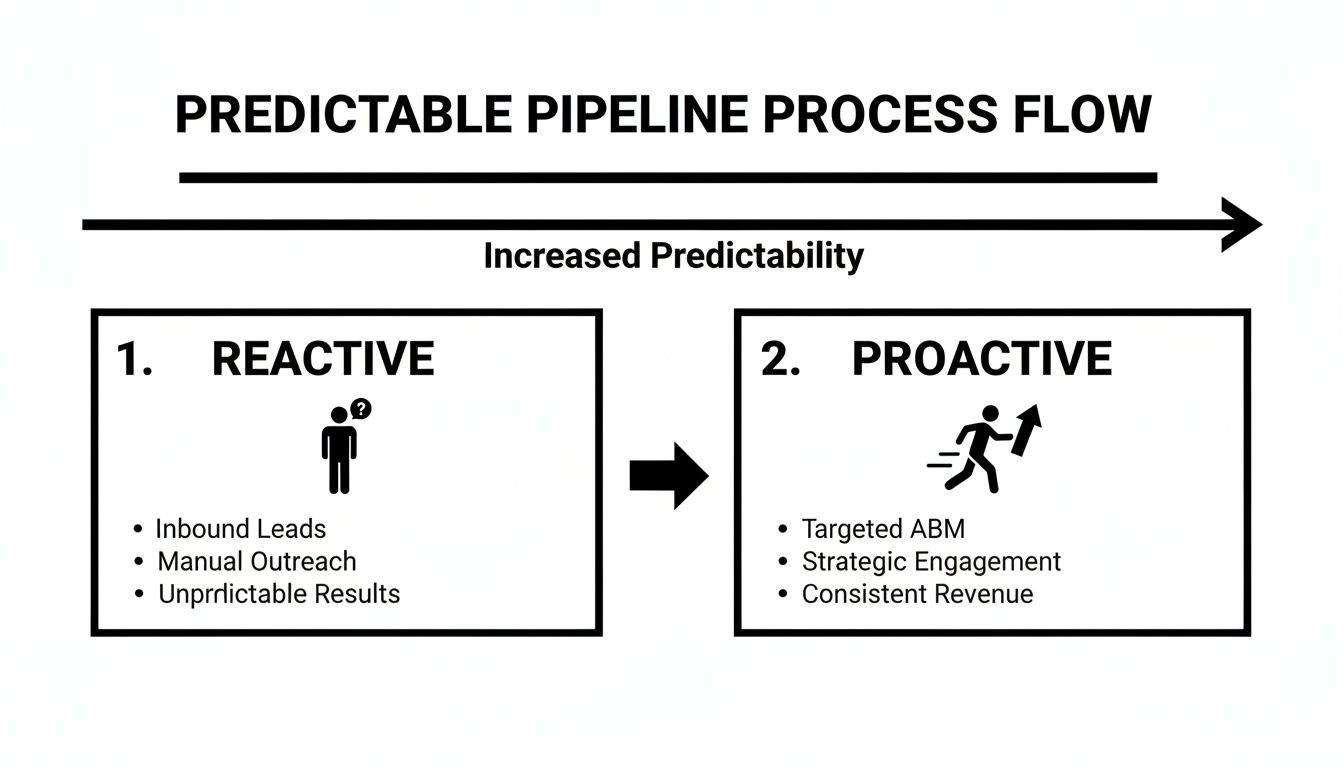
When you partner with a service, you’re outsourcing the heavy lifting of top-of-funnel prospecting. This frees up your internal team to do what they do best: run demos and close business. This model directly solves the pipeline inconsistency that holds so many SaaS companies back, turning what was an unpredictable variable into a reliable, scalable asset.
If you want to go deeper on this, you can learn more about building a sales pipeline with our guide to boosting revenue. Making this strategic shift is absolutely fundamental if you have ambitious growth goals in today’s crowded market.
What a Modern Outbound Partner Actually Does
Let’s clear something up right away. A true outbound partner isn’t some “email blasting” service you hire to spam a list. The game has completely changed. Today, a good partner acts as a strategic extension of your team, building the very foundation of your sales pipeline from the ground up.

Think of it less like hiring a temp and more like bringing on a specialized architect. They don’t just show up with a pile of bricks; they start by understanding exactly what you want to build, create the blueprints, source the right materials, and oversee the entire project.
This is a complete, outsourced growth function. It frees up your most expensive resources - your account executives - to do what they do best: hold high-level conversations and close deals. They shouldn’t be bogged down with the messy, time-sucking work of top-of-funnel prospecting.
The Strategic Blueprint Phase
Everything starts with a deep dive into your business, and I don’t mean filling out a generic form. A top-tier partner will get their hands dirty learning your product, your market, and most critically, your Ideal Customer Profile (ICP).
We’re not just talking about company size and industry. It’s about digging into the real-world pain points, the specific job titles, and the buying triggers that make someone a perfect fit for your SaaS. This is a collaborative process, a real back-and-forth, to nail down a precise ICP that guides every single action that follows.
Building and Verifying the Target List
Once that ICP blueprint is locked in, the work of building the list begins. And forget about buying stale, pre-packaged contact lists - that’s a recipe for disaster. Professional outbound lead generation services for B2B SaaS build hyper-accurate prospect lists from scratch using a mix of tech and good old-fashioned human review.
The process usually looks like this:
-
Data Sourcing: Using multiple premium data tools to pull a raw list of companies and contacts that match the ICP.
-
Manual Verification: Real people then go through the data, cross-referencing sources to make sure titles, roles, and company details are spot on.
-
Email Validation: Finally, they use technical tools to verify every single email address. This is crucial for minimizing bounces and protecting your domain’s sending reputation.
There’s no shortcut here. Your campaign is only as good as your data. As the old saying goes: garbage in, garbage out. A professionally built list ensures your message actually gets delivered.
A well-run campaign is a game-changer for your budget. While the average B2B lead cost in tech can run from $180 to $250, outsourcing cold email can hit meeting rates between 2-7% and slash your cost-per-lead by up to 35%. You can find more stats on this over at Volkart May.
Crafting and Executing Multi-Touch Campaigns
With a clean list ready, your partner will then design the outreach campaign itself. This is so much more than a single email. It’s a multi-touch, multi-channel strategy designed to create a “surround sound” effect that builds familiarity and trust over time.
A solid campaign almost always includes:
-
Personalized Email Sequences: A series of thoughtfully written messages that actually provide value, speak to specific pains, and build a compelling reason for a chat.
-
LinkedIn Engagement: This isn’t just spamming connection requests. It’s interacting with a prospect’s content and sending personalized messages that work in tandem with your emails.
-
Ongoing Optimization: Constantly A/B testing everything - subject lines, the message body, calls-to-action - to improve performance based on real data like open, reply, and positive response rates.
This is what you’re really paying for: the strategic management of a complex workflow. They handle all of it, making sure every prospect gets a relevant, respectful series of touchpoints. You can get a deeper look at what this involves in our guide to outsourced lead generation for B2B growth.
Ultimately, the deliverable isn’t a spreadsheet of contacts or a report on open rates. It’s qualified sales meetings booked directly on your team’s calendar.
The Technology Powering Modern Outreach Campaigns
Great outbound isn’t just about clever writing. Behind every qualified meeting is a surprisingly complex tech stack, an engine room of specialized tools and processes all working together. This is where professional outbound lead generation services for B2B SaaS really earn their keep, managing a technical setup that most companies simply don’t have the time or expertise to build themselves.

Think of it like a Formula 1 car. You see the driver, but their performance depends entirely on the finely tuned engine, aerodynamics, and data analytics happening behind the scenes. In outbound, your message is the driver, but the technology is the high-performance machine ensuring it actually crosses the finish line - the prospect’s primary inbox.
It All Starts With Clean Data
A campaign is only as good as the list it targets. Building a rock-solid contact list is a technical discipline, and it’s the first place where campaigns go wrong. Good services don’t buy stale, overused lists. They build them from the ground up.
This process looks something like this:
-
Data Sourcing Platforms: We start by using premium tools to pull a wide pool of contacts that match your Ideal Customer Profile (ICP).
-
Data Verification Tools: Every single email is then run through validation software. This scrubs out the invalid, outdated, or risky contacts that cause bounces and damage your reputation.
-
Human-in-the-Loop: Finally, researchers manually verify crucial data points, like job titles and company relevance. This human check catches things software can’t.
Getting data hygiene right is non-negotiable. Bad data is the #1 reason campaigns fail, leading to high bounce rates, a torched domain reputation, and a whole lot of wasted effort. We obsess over clean data because it’s the foundation of the entire operation.
The Multi-Channel Symphony
In today’s market, a single cold email is easy to ignore. That’s why the tech stack is designed to create a “surround sound” effect through coordinated, multi-channel outreach. It’s about showing up where your prospects are, making your brand feel present and helpful, not intrusive.
This is a game-changer. Research shows that combining channels like email, LinkedIn, and phone calls can slash the cost per lead by around 31% compared to just using one. Each channel reinforces the others. A phone call is a lot warmer when they’ve already seen a couple of helpful emails from you.
The Technical Art of Email Deliverability Making sure your emails actually land in the primary inbox - not spam - is a technical battle fought behind the scenes. This is probably the most critical, yet least understood, part of outbound tech.
Expert services manage a whole infrastructure dedicated to email deliverability. This isn’t a one-and-done setup; it’s a constant process of management and optimization.
Key parts of deliverability management include:
-
Domain and Inbox Warming: We gradually ramp up the sending volume from new domains and email accounts. This builds a positive reputation with providers like Google and Microsoft.
-
Inbox Rotation: We use multiple sender accounts in a campaign to spread out the sending volume, which avoids raising red flags from any single account sending too many emails.
-
Reputation Management: We’re constantly watching metrics like bounce rates, spam complaints, and engagement to proactively keep all sending domains healthy.
This technical setup is complex and needs specialized know-how. For a deeper dive, check out our step-by-step instructions for the technical setup of cold emailing.
Personalization at Scale With AI
The final piece of the puzzle is using AI and automation to personalize outreach at a scale no human could manage alone. Modern platforms can dynamically insert custom snippets into messages based on a prospect’s industry, role, or even recent company news.
This allows for outreach that feels one-to-one, even when sent to hundreds of people. The tech handles the mechanics of personalization, which frees up strategists to focus on what matters: crafting a compelling message. This blend of human creativity and machine efficiency is what powers high-performing outbound lead generation services for B2B SaaS. It ensures every message is relevant, deliverable, and part of a smart, strategic conversation.
Decoding Pricing Models and Measuring Real ROI
Before you sign any dotted lines, you need to get crystal clear on the money side of things. The costs and expected results of outbound lead generation services for B2B SaaS can seem murky, but it really boils down to a few common ways agencies charge.
Think of it like hiring a contractor to build a deck. You could pay them by the hour no matter how slow they work, pay for the pile of lumber they drop in your yard, or pay only when the deck is finished and you can host a BBQ on it. Each model changes where the risk lies - and who is most motivated to get the job done right.
Common Pricing Structures Explained
Once you start vetting agencies, you’ll run into three main ways they charge. Each one has a different feel for your cash flow and how much risk you’re taking on as the client.
-
Monthly Retainer: This is a fixed fee you pay every month, almost like a salary. It covers the agency’s time and effort, but it isn’t directly tied to the number of meetings they actually book for you. The risk is all on you.
-
Pay-Per-Lead (PPL): With this model, you pay for each “lead” they hand over. The devil is in the details here. A “lead” could be a verified email address or someone who vaguely replied to an email - a far cry from a qualified buyer.
-
Pay-Per-Meeting (PPM): This is a straight-up performance deal. You only pay when a qualified sales meeting is successfully booked and shows up on your calendar. No results, no invoice.
For most B2B SaaS companies, the pay-per-meeting model is the obvious choice. It locks the agency’s financial success directly to your main goal: getting in front of real, interested buyers. You’re not paying for effort or fuzzy metrics; you’re paying for actual sales conversations. You can learn more about how pay-for-performance marketing aligns agencies with real revenue in our deep dive.
The ultimate goal is to tie every dollar spent to a tangible business outcome. Performance-based models force this alignment, ensuring your partner is just as invested in booking qualified meetings as you are.
Focusing on Metrics That Drive Revenue
Once a campaign is live, it’s easy to get lost in a sea of data. Open rates and click-throughs are nice to see, but they’re vanity metrics. They don’t put money in the bank.
Instead, you need to zero in on the KPIs that directly track business impact. These are the numbers that tell you if your investment is actually working.
Key Performance Indicators to Track:
-
Positive Reply Rate: This is the percentage of people who reply with genuine interest. It’s your first real sign that the targeting and messaging are hitting the mark.
-
Meeting Booked Rate (or SQA Rate): This is your money metric. It’s the percentage of total prospects contacted who become a Sales Qualified Appointment (SQA). This is the core deliverable.
-
Cost Per Acquisition (CPA): The ultimate bottom-line number. It’s the total campaign cost divided by the number of new customers you actually closed from those meetings.
Focusing on these KPIs helps you cut through the noise and see what’s really happening. As you’re figuring out pricing and ROI, it’s worth checking a good guide to SaaS profitability metrics like ROI vs. ROAS to get your head around the true financial impact.
Calculating Your True Return on Investment
Measuring true ROI is about more than just the cost per meeting. You have to look at the whole picture, from that first email to a signed contract.
This is where the right partner really proves their worth. For example, one analysis of an outbound campaign showed the cost-per-lead (CPL) dropping from $215 down to an average of $188.11 over nine months. That’s a 12.5% cost reduction.
More importantly, during that same time, the SQL conversion rate jumped from 5.2% to 9.2%. This shows that a great partner doesn’t just set it and forget it; they constantly tweak the campaign to get you better results for less money over time.
How to Pick the Right Outbound Lead Generation Partner

Choosing an outbound partner is probably the biggest decision you’ll make in this entire process. Get it right, and you’ve just plugged a consistent, high-quality meeting machine into your sales pipeline. Get it wrong, and you’ll burn through your budget, tarnish your brand’s reputation, and end up with a folder full of excuses.
To sidestep that disaster, you need to go into your vendor calls prepared. This isn’t about sitting back and listening to a sales pitch. It’s about running a tight evaluation to find a genuine partner. You need to come armed with specific, sharp questions that get past the fluff and show you how they really work.
Think of it like hiring a VP of Sales. You wouldn’t just take their word for it. You’d dig into their track record, their process, and see if they’re a good fit. Apply that same level of rigor here.
Look Under the Hood: How to Vet Their Actual Process
A slick PowerPoint deck is meaningless if the engine driving it is a mess. Your first job is to take apart their methodology. Don’t let them get away with vague talk about “proprietary systems.” You need specifics.
Start by asking how they define your Ideal Customer Profile (ICP). How deep do they actually go? Do they just ask for company size and industry, or are they digging into the real stuff - the pain points, the buying triggers, and the specific people inside the accounts you want to land? A great partner will challenge your own assumptions and bring fresh ideas to the table.
Next, you have to grill them on their data. This is where a lot of agencies completely fall apart.
-
Data Sourcing: Where are they getting their contact info? Are they just pulling from one cheap database, or are they blending data from multiple premium sources like ZoomInfo or Apollo.io?
-
Data Verification: How do they clean and validate their lists? Is there a multi-step process? Do they use human review to make sure the data is actually accurate?
-
List Building: Are they trying to sell you a pre-built, stale list? Or are they building a completely custom list from scratch based on the ICP you both agreed on?
If you’re seeing high bounce rates and terrible deliverability, it almost always comes back to lazy data practices. A truly professional service will be excited to show you how obsessed they are with data quality.
The best partners don’t just book meetings; they tee up real opportunities. You can spot their expertise in how they qualify leads, making sure every person they put on your calendar is actually a good fit and ready to talk business.
Finally, make sure they actually get the B2B SaaS world. The SaaS sales cycle is a different beast. It’s longer, more complex, and all about recurring revenue. An agency that mostly books appointments for local plumbers simply won’t understand the nuances of selling your software. Ask for case studies and let them talk you through campaigns they’ve run for SaaS companies like yours.
The Vendor Evaluation Checklist
To keep things organized and make sure you’re comparing apples to apples, use a checklist. This forces you to cover all the critical bases with every potential partner.
Here’s a simple framework to get you started.
| Evaluation Area | Key Questions to Ask | Ideal Answer / Green Flag |
|---|---|---|
| SaaS Experience | ”Can you share case studies from B2B SaaS clients with a similar ACV to ours?” | They immediately provide specific, relevant examples and can talk fluently about SaaS metrics. |
| ICP & Strategy | ”Walk me through your process for defining and refining our Ideal Customer Profile.” | They describe a collaborative, in-depth discovery process that goes way beyond surface-level firmographics. |
| Data Quality | ”What’s your multi-step process for sourcing, cleaning, and verifying contact data?” | They detail a rigorous process using multiple tools and human checks, emphasizing quality over raw numbers. |
| Messaging & Personalization | ”How do you make sure your outreach feels personal and relevant, not like spam?” | They talk about finding value-driven angles, writing for specific personas, and using research for 1-to-1 personalization. |
| Reporting & Optimization | ”What specific KPIs do you report on, and how often will we meet to review performance?” | They focus on metrics that actually drive revenue (like Positive Replies and SQAs) and suggest a regular strategy call cadence. |
Using a checklist like this helps you make a decision based on facts, not just a gut feeling after a smooth sales call.
Red Flags to Watch For
Knowing what to look for is only half the battle. You also need to know what to run from. Certain things should be immediate deal-breakers.
Be very skeptical of any agency that offers unrealistic guarantees, especially promising a certain number of closed deals. A reputable outbound lead generation service for B2B SaaS knows their job is to control the top of the funnel - booking qualified meetings. They can’t control your sales process.
Other huge red flags include:
-
Relying on a single, cheap data provider.
-
A “set it and forget it” attitude with no talk of ongoing testing and optimization.
-
A lack of transparent reporting or a refusal to share key campaign metrics.
-
Hesitation or pushback when you ask to speak with current or past clients.
-
A pricing model that’s all risk for you (like a massive setup fee with no performance incentives).
Ultimately, trust your gut. If a potential partner seems disorganized, evasive, or more focused on hitting volume quotas than delivering quality, it’s time to walk away. The goal here is a long-term growth partner, not just another vendor.
Building Your Scalable Sales Pipeline Today
If you’re tired of the feast-or-famine cycle that comes from only relying on inbound leads, you’re not alone. Waiting for prospects to find you is a reactive game, and it often leads to missed targets and unpredictable growth. The fastest way to break that cycle and take control is with a dedicated outbound lead generation partner who lives and breathes B2B SaaS.
This isn’t about just handing off a task. It’s about bringing in an expert team to build a predictable system that fills your sales team’s calendar with qualified meetings. This frees up your closers to focus on what they do best: closing deals.
From Strategy to Execution
The real magic happens when your partner works on a performance basis. A pay-per-meeting model is a game-changer because it means their success is tied directly to yours. There’s no risk. You only pay for actual, qualified appointments that show up. Their job isn’t just to send a ton of emails; it’s to book high-quality meetings that perfectly match your criteria.
The bottom line is simple: for a B2B SaaS company that wants to grow, a professionally managed outbound campaign is the most direct path to a sales pipeline you can actually count on. It turns prospecting from a guessing game into a reliable process.
To get this right, you have to lean on strategies that are proven to work. You can explore some B2B lead generation best practices to see how the top players are getting it done. When a dedicated partner executes these principles for you, it can completely change your company’s growth curve. Nailing down your targeting is just as important, and our complete guide to creating a B2B Ideal Customer Profile is the perfect place to start.
Take the Next Step Today
Ready to stop waiting for leads and start building a real pipeline? Let’s have a simple, no-pressure chat.
This isn’t a sales pitch. It’s a strategy call where we can dig into your growth goals, help you refine your Ideal Customer Profile, and show you what a custom outbound plan would look like. Let’s talk about how we can fill your calendar with qualified sales appointments and build the predictable revenue engine your SaaS company deserves.
Your Top Questions, Answered
Jumping into outbound lead generation for your SaaS can bring up a few questions. Let’s clear up the most common ones so you can make the right call for your company.
How Long Until We See Results?
Everyone wants to know how quickly they’ll see meetings pop up. While every campaign has its own pace, the first 30-60 days are all about laying the groundwork. This isn’t dead time; it’s when we handle strategic planning, nail down your ICP, and technically warm up sending domains to make sure our emails actually land in the inbox.
You can expect the first qualified meetings to hit your calendar within 45-90 days. This is when campaigns are live and the initial data starts telling us what’s working. True, predictable growth usually settles in over the first three to six months as we continuously tweak the process based on real-world market feedback.
What Exactly Is a “Qualified Meeting”?
It’s crucial to understand the difference between a “lead” and a “qualified meeting,” because they are worlds apart. A lead might just be a name on a list - potential, maybe, but with no real intent or confirmed fit.
A qualified meeting, which we often call a Sales Qualified Appointment (SQA), is what you’re actually paying for. It’s a confirmed appointment with a decision-maker who matches your Ideal Customer Profile (ICP), gets the basics of what your SaaS does, and has clearly agreed to a call to explore it further. Top-tier services deliver these real conversations, not just lists of unvetted contacts.
Will This Hurt Our Brand Reputation?
This is a big one for SaaS companies, and rightly so. A good outbound partner sees themselves as a protector of your brand, not a risk to it. The entire approach is built on avoiding spammy, volume-based tactics and focusing on respect and relevance.
We make sure of this by:
-
Hyper-Personalizing: Writing messages that speak directly to a prospect’s challenges and role. No generic templates.
-
Offering Value First: Kicking off a conversation by sharing an insight or a potential solution, not just demanding a meeting.
-
Targeting Meticulously: Only reaching out to a hand-picked audience that can genuinely get value from your product.
Done right, a professional service acts as a brand ambassador, building positive awareness in your target market.
Do We Need to Provide Contact Lists?
No, you shouldn’t have to. Any comprehensive outbound lead generation service for B2B SaaS will handle all the list-building from scratch. They use a mix of sophisticated data tools and manual research to find, source, and verify contacts that perfectly match your ICP. This is fundamental to a successful campaign and ensures the data is both accurate and targeted.
Ready to stop waiting for leads and start building a predictable sales pipeline? Fypion Marketing delivers qualified, pay-per-meeting appointments without retainers or setup fees. Book your free strategy call today.