
Appointment Setter Job Description: 2026 Guide & Templates

Most advice about an appointment setter job description gets the role wrong from the first line. It treats the setter like a calendar coordinator with a headset. That approach hires people who can book time, but not people who can protect pipeline quality.
A weak job description creates a weak front end of sales. You get activity without impact. Reps log touches, meetings get booked, and the sales team still complains that the calendar is full of poor-fit conversations. That isn’t a scheduling problem. It’s a qualification problem.
The modern appointment setter sits at the point where outbound either becomes revenue or becomes noise. If your team needs more predictable meetings, cleaner handoffs, and fewer wasted demos, the answer usually isn’t “hire faster.” It’s “define the role better.”
Stop Hiring Setters Start Building Your Pipeline
Calling someone an appointment setter often lowers the standard before the hiring process even starts. The market hears “entry-level admin with phone skills.” Your sales team needs something else. It needs a person who can open conversations, test fit, handle early objections, and pass context to closers without forcing them to start from zero.
That distinction matters. A generic appointment setter job description attracts candidates who focus on volume alone. A strong one attracts candidates who understand that every booked meeting consumes sales capacity. A bad meeting doesn’t just waste half an hour. It damages trust between sales leadership and the outbound team.
The better framing is simple. You’re not hiring a scheduler. You’re hiring the first human checkpoint in pipeline creation.
What outdated job descriptions miss
Most job descriptions overload the tactical side of the role. Call prospects. Send follow-ups. Update CRM. Schedule meetings. Those tasks matter, but they don’t define performance. The job exists to create qualified sales conversations that deserve executive time.
That means your job description should screen for people who can do all of the following:
-
Open conversations cleanly with prospects who didn’t ask to hear from you
-
Qualify basic fit early so weak leads don’t get pushed downstream
-
Capture context in the CRM so account executives don’t repeat discovery
-
Protect the meeting with reminders, confirmations, and rescheduling discipline
-
Work inside a system instead of improvising on every touch
If you build hiring around pipeline design rather than job title semantics, the whole role sharpens. Teams that think this way usually also invest in broader systemic talent intelligence strategies instead of posting a recycled job ad and hoping the right candidate appears.
For teams evaluating whether to build internally or use a partner for B2B lead generation, that same principle applies. Pipeline quality starts with role clarity, not channel selection.
Practical rule: If your appointment setter job description can also describe a receptionist, it isn’t specific enough for B2B outbound.
The Modern Appointment Setter A Strategic Asset
An appointment setter is the ignition system of the revenue engine. Marketing may create awareness and sales may close deals, but the setter turns cold or lightly engaged contacts into real conversations that a closer can act on.
In practice, the role sits between list building and sales opportunity creation. That position makes it operationally important and strategically sensitive. If the setter under-qualifies, closers lose trust. If the setter over-qualifies, pipeline slows down. The job is to manage that tension with judgment.

Where the role sits in the funnel
A modern setter does three things that matter to revenue:
-
Creates first contact through outbound calls, email, and follow-up.
-
Tests fit and intent before the meeting gets on a calendar.
-
Hands off usable context so the next seller can advance the deal.
That sounds simple until you watch weak teams run it. The failure mode is familiar. Marketing generates names, outbound touches go out, appointments get booked, and the sales team discovers that the buyer has no urgency, no authority, or no relevant pain. The setter role exists to reduce that waste.
A useful outside reference is this practical guide to appointment setting, which aligns with how strong teams treat the function as a conversation and qualification discipline, not just a booking task.
What the workforce tells you about the role
The role is large enough and established enough that managers should stop treating it like an afterthought. In the United States, there are over 17,965 appointment setters currently employed, with 73.7% being women, and the average age is 37 years old, according to Zippia’s appointment setter demographics. That points to a real, accessible talent pool rather than a niche position.
It also suggests something practical for hiring managers. This is not a role you staff casually and “figure out later.” You’re hiring from a broad market with a lot of variation in maturity, communication style, and process discipline. Your appointment setter job description has to filter for judgment, not just enthusiasm.
For teams building workflows around AI-assisted enrichment, CRM hygiene, and outbound sequencing, it’s also smart to define what level of tool comfort matters on day one. That’s especially true if your sales motion already depends on AI tools for revenue teams rather than purely manual prospecting.
The best setters don’t just ask, “Can I book time?” They ask, “Should this prospect reach a closer yet?”
Core Responsibilities and Key Performance Indicators
The cleanest way to write an appointment setter job description is to connect each responsibility to a measurable business outcome. If you list tasks without performance standards, candidates read the role as generic support work. If you list metrics without explaining the work behind them, you attract people who chase numbers and damage quality.
A strong job description ties actions to pipeline health.
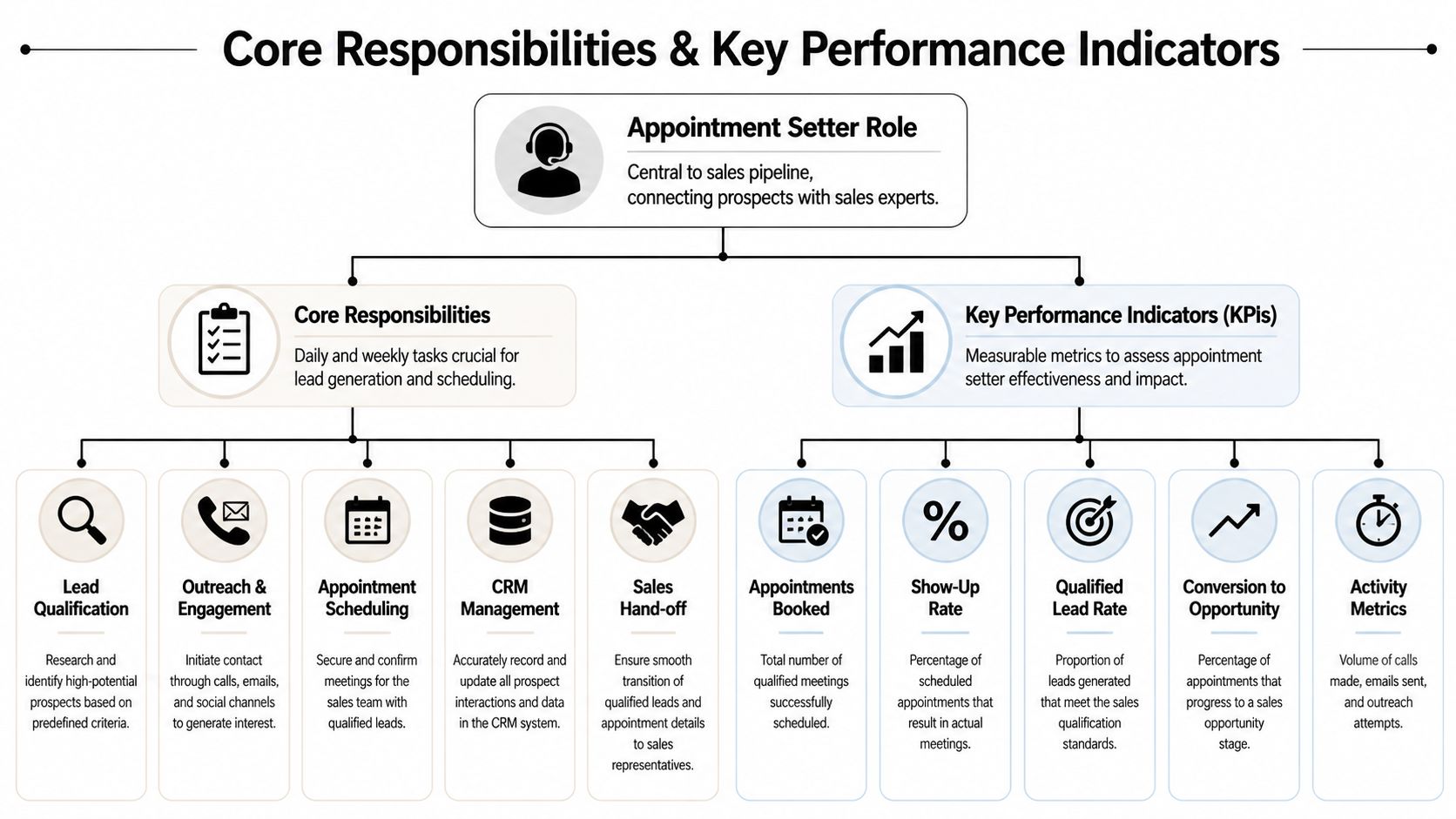
Responsibilities that actually matter
The day-to-day work usually falls into five buckets.
-
Prospect research and list review The setter reviews accounts, confirms buyer titles, and checks for basic fit before outreach starts, allowing bad targeting to be caught early.
-
Outbound execution across channels Calls, emails, and follow-ups create the conversation volume that feeds pipeline. This isn’t blind activity. Good setters adjust messaging based on what they’re hearing.
-
Qualification and objection handling The setter confirms whether the contact matches agreed criteria and whether a meeting makes sense now. This is where consultative skill starts to separate strong reps from script readers.
-
Calendar control and meeting protection Booking is only part of the task. Confirmations, reminders, and reschedules help preserve meeting quality after the yes.
-
CRM accuracy and handoff notes The setter logs what happened, what matters, and what the closer should know before the call.
The KPIs that belong in the role
The minimum performance language should be direct. In B2B lead generation, appointment setters must achieve 8 to 10 qualified outbound calls per hour to sustain pipeline velocity, and top performers maintain 100% CRM logging because incomplete data causes a 35% to 50% drop in follow-up efficacy, according to Medical Staff Relief’s appointment setter position overview.
Those numbers matter because they reveal the shape of the job. It isn’t enough to be personable. The role demands pace and documentation. A rep who talks well but logs poorly creates hidden losses that show up later as missed follow-ups, repeated outreach, or confused handoffs.
A practical KPI stack
Use a scorecard that balances quantity and quality:
| KPI | Why it matters | What good management watches for |
|---|---|---|
| Qualified outbound calls | Shows whether the rep can sustain productive activity | Whether pace stays consistent without degrading conversation quality |
| Appointments booked | Measures output at the calendar level | Whether bookings align with qualification standards |
| Show-up rate | Tests meeting protection and prospect commitment | Whether the rep confirms meetings properly and filters weak intent |
| Qualified lead rate | Protects closers from wasted calls | Whether the rep is pushing volume at the expense of fit |
| CRM completeness | Preserves institutional memory | Whether notes are useful enough for a clean handoff |
Manager note: If a setter hits activity targets but AEs reject the meetings, the problem isn’t motivation. It’s usually qualification criteria, coaching, or a broken definition of “qualified.”
Hard skills and soft skills belong together
A good appointment setter job description should name both. The hard skills include CRM use, task discipline, writing short outbound messages, and managing structured follow-up in platforms like HubSpot, Salesforce, or Pipedrive. If your workflow includes sequence management and inbox coordination, mention that explicitly. Teams hiring for outbound email support should also define whether the role touches campaign execution or only reply handling. That distinction changes the candidate pool.
For managers building outbound around cold email management, this matters even more. The setter often becomes the bridge between written interest and live conversation.
The soft skills are where most hiring teams stay too vague. “Great communicator” isn’t enough. Look for active listening, resilience after rejection, calm objection handling, concise speaking, and coachability under metric pressure. Those traits determine whether the rep can keep quality high while doing repetitive work at speed.
Essential Skills and Compensation Benchmarks
Most hiring managers under-specify the skills and over-simplify the pay. Both mistakes create churn. If the role is framed as light admin work, strong candidates pass. If the pay model ignores the value of qualified meetings, mediocre candidates flood the pipeline.
The skills you can’t leave implied
The first essential requirement is CRM fluency. A setter doesn’t just “know Salesforce” or “have used HubSpot.” They need to log clean notes, maintain status accuracy, and leave a trail another seller can trust. Without that, the team loses continuity between first contact and sales call.
The second is written and verbal precision. The role doesn’t reward long explanations. It rewards short, relevant messaging and calm live conversations. In a B2B motion, the setter has to know when to keep the call moving and when to pause and qualify deeper.
The third is consultative judgment. That’s the missing piece in many job descriptions. The best setters don’t interrogate prospects with a checklist. They guide a short business conversation that reveals fit, timing, and stakeholder relevance.
Compensation needs to reflect output value
Appointment setters in major markets command a base salary range of $29,000 to $70,000 annually, and outsourced qualified B2B appointments can cost $550 to $1,700 each, according to Prospéo’s appointment setter benchmarks. That spread tells you two things.
First, the market already recognizes that booked, qualified conversations have real economic value. Second, your compensation plan should align with the level of autonomy and judgment you expect.
If you’re hiring an entry-level rep to work from a tight script with close management, the lower end of the range may fit. If you want someone to research accounts, manage objections, and protect meeting quality with minimal supervision, you need a stronger offer and a cleaner incentive structure.
Appointment Setter Compensation Benchmarks 2026
| Experience Level | Annual Base Salary Range | Typical Commission Structure | On-Target Earnings (OTE) |
|---|---|---|---|
| Junior | Lower end of the $29,000 to $70,000 market range | Per qualified meeting held or accepted by sales | Base plus variable tied to qualified meeting output |
| Mid-level | Middle of the $29,000 to $70,000 market range | Mix of booked meetings, held meetings, and quality standard attainment | Base plus variable with stronger upside for consistency |
| Senior | Upper end of the $29,000 to $70,000 market range | Variable tied to qualified meetings and downstream opportunity quality | Higher base plus performance pay for quality and reliability |
Four template directions for skill targeting
Here are four practical ways to frame the role before writing the full posting:
-
Junior appointment setter Best when you can train heavily and want coachability over experience.
-
Senior setter or SDR Best when the rep must work independently and improve messaging through field feedback.
-
Remote appointment setter Best when self-management, written updates, and workflow discipline are central.
-
B2B cold email appointment setter Best when live follow-up starts from inbox responses and message interpretation matters as much as calling skill.
Ready-to-Use Appointment Setter Job Description Templates
Hiring teams frequently copy a template, swap the company name, and wonder why the applicant pool looks interchangeable. The problem isn’t the existence of templates. It’s the fact that most of them flatten the role into a list of tasks and remove the performance context that top candidates want to see.
If you want stronger applicants, use a template as a starting point and keep the hiring bar visible. Tools that generate custom hiring descriptions can help with structure, but the differentiator is still your clarity about what the role owns and how success gets judged. If you’re benchmarking how other growth teams frame sales hiring, reviewing examples on a company’s marketing blog about outbound and lead generation can also sharpen your language.
Template one for a junior appointment setter
Role summaryWe’re hiring a junior appointment setter to create qualified first conversations for the sales team. This role is best for someone who is coachable, organized, comfortable with outreach, and motivated by measurable performance.
Responsibilities
-
Conduct outbound outreach across phone and email using approved messaging
-
Research target accounts and confirm buyer relevance before contact
-
Qualify prospects against company criteria
-
Schedule meetings and send confirmations
-
Maintain accurate CRM records after every interaction
Qualifications
-
Clear written and verbal communication
-
Comfort with repetitive outreach and rejection
-
Ability to follow process and take coaching
-
Familiarity with CRM tools is preferred
What success looks likeYou create a steady stream of qualified conversations and leave clean notes that help sales take over confidently.
Template two for a senior appointment setter or SDR
Role summaryWe’re hiring a senior appointment setter to own outbound conversation quality at the top of funnel. This person should be able to work with messaging frameworks, handle objections without sounding scripted, and improve qualification quality over time.
Responsibilities
-
Build and execute outbound sequences across multiple channels
-
Qualify prospects using agreed fit and timing criteria
-
Surface messaging insights from live conversations
-
Protect meeting quality through confirmations and follow-up
-
Partner with account executives on handoff quality
Qualifications
-
Experience in outbound prospecting or sales development
-
Strong CRM discipline
-
Ability to operate independently
-
Confidence in live objection handling
Template three for a remote appointment setter
Role summaryWe’re hiring a remote appointment setter who can work inside a defined outreach system without constant supervision. This role suits someone who communicates clearly in writing, manages their day well, and keeps records current.
Responsibilities
-
Execute daily outreach blocks on schedule
-
Update CRM in real time
-
Coordinate calendars and prospect reminders
-
Flag list quality or messaging issues quickly
-
Share concise updates on outcomes and blockers
Qualifications
-
Strong self-management
-
Reliable written communication
-
Comfort with remote collaboration tools
-
Consistent follow-through
Hiring is part of qualification. If a candidate can’t follow simple application steps, they probably won’t manage a precise outbound workflow either.
Template four for a B2B cold email appointment setter
Role summaryWe’re hiring a setter focused on converting cold email engagement into qualified meetings. This person must read prospect intent carefully, respond with context, and know when to move the conversation to a call.
Responsibilities
-
Review inbound replies from outbound campaigns
-
Separate interest, curiosity, objections, and low-fit responses
-
Write short follow-up replies that advance the conversation
-
Book qualified meetings and prepare handoff notes
-
Keep campaign and contact records accurate
Qualifications
-
Strong business writing
-
Good judgment in qualification
-
Ability to manage inbox-based workflows
-
Familiarity with CRM and scheduling tools
Interview questions that reveal more than the resume
A template is only useful if the hiring process tests the right things. Add questions like these to expose real working style:
-
Resilience test “Tell me about a stretch of repeated rejection. What changed in your approach, and what didn’t?”
-
Process discipline test “Walk me through what you log in the CRM after a short but promising conversation.”
-
Judgment test “When would you avoid booking a meeting even if the prospect sounds polite and interested?”
-
Coachability test “Describe a time a manager changed your script or process. How did you respond?”
The candidates worth hiring usually answer with specifics, not slogans.
How to Hire and Interview Top Appointment Setters
A strong appointment setter job description gets the right people to apply. The interview process decides whether you hire someone who can survive the role and improve it.
A common mistake is overvaluing confidence in the interview and undervaluing process evidence. A polished talker can sound perfect for twenty minutes and still fail in a week of real outbound. You need to test how the person thinks, logs, qualifies, and recovers.

What to screen for before the interview
Resume screening should focus less on titles and more on evidence of role fit. Look for candidates who mention outreach volume, qualification ownership, CRM use, scheduling responsibility, or collaboration with AEs. Customer support or service backgrounds can work well if the candidate shows structure and communication discipline.
Use a short pre-screen task. Ask for a sample follow-up email, a mock voicemail, or a short note they would leave in a CRM after a call. These small tests reveal whether the candidate can be concise and operational.
Questions that surface real performance traits
Good interviews create friction on purpose. The role itself includes pressure, repetition, ambiguity, and rejection. Your questions should reflect that reality.
Try prompts like these:
-
For resilience “You have a rough morning and most prospects brush you off. What does your next hour look like?”
-
For qualification judgment “A prospect says they’re interested but can’t explain why now is the right time. Do you book it?”
-
For objection handling “Give me two different ways you’d respond to ‘We’re already using another vendor.’”
-
For handoff quality “What information must an account executive see before taking the meeting?”
-
For remote discipline “How do you structure outreach, follow-up, and admin so that logging doesn’t pile up?”
A live role-play is worth more than another round of conversational interviewing. Ask the candidate to open a cold call, respond to hesitation, and decide whether to advance the lead. Listen for clarity, pacing, and whether they ask questions that reveal fit.
This walkthrough is useful if you want an example of live sales communication in action:
SaaS teams and agencies should hire differently
The same title can hide very different jobs.
A SaaS company should usually prioritize product comprehension, curiosity, and the ability to speak credibly with buyers who expect a basic grasp of workflow, tools, and business problems. A candidate doesn’t need to be highly technical, but they do need to learn fast and avoid sounding detached from the product.
An agency environment often requires something else. The setter may switch across multiple client offers, buyer personas, and messaging rules. That makes metric discipline, fast context switching, and process consistency more important. The best agency setter often sounds less “salesy” and more operationally sharp.
If you’re deciding whether to build this capability internally or pressure-test your process with outside help, a direct consultation on outbound pipeline design can help clarify what the role should own before you hire.
The best interview answer isn’t “I can talk to anyone.” It’s “Here’s how I decide who deserves a meeting.”
Tailoring the Job Description for SaaS and Agencies
Most appointment setter job descriptions break down in the same place. They describe outreach mechanics and ignore consultative skill. That’s a hiring miss. Existing job descriptions often fail to address the consultative selling skills needed in modern B2B and stay focused on tactical activities, which misses the chance to recruit setters who can perform deeper qualification. That gap matters most in pay-per-meeting models where meeting quality drives ROI, as noted by TalentLyft’s appointment setter job description template.
What a SaaS company should emphasize
A SaaS setter often works closer to product language, workflow pain, and category understanding. The job description should ask for:
-
Technical curiosity so the rep can understand how the product fits into an existing stack
-
Business problem awareness so calls don’t become feature recitals
-
Discovery-minded questioning that uncovers use case, urgency, and team context
-
Clean handoff notes that give the AE a usable starting point
For SaaS, add lines like these to the posting:
-
“Identify whether the prospect has an active operational problem our product category can address.”
-
“Capture current workflow, pain point, and relevant stakeholder context before booking.”
-
“Position the meeting as a focused business conversation, not a generic introduction.”
What an agency should emphasize
An agency setter often works in a higher-variance environment. The role usually spans multiple offers, verticals, and client expectations. The job description should stress:
| Business model | Best emphasis in the job description |
|---|---|
| SaaS company | Product understanding, use-case qualification, stakeholder awareness |
| Agency model | Throughput discipline, adaptability, client-specific qualification, precise handoffs |
In an agency setting, add language like:
-
Manage multiple outbound workflows without losing message accuracy
-
Apply client-specific qualification criteria before advancing a prospect
-
Record conversation context clearly so internal or client-side sales teams can step in immediately
-
Protect meeting quality through confirmations, reminders, and fast rescheduling
The consultative layer to add right now
If your current job description only asks for cold calling, emailing, and scheduling, it’s incomplete. Add requirements that surface real business judgment:
-
Asks diagnostic questions instead of reading a fixed script
-
Identifies decision-maker relevance before booking time
-
Recognizes weak-fit opportunities and disqualifies them early
-
Balances activity with meeting quality instead of maximizing calendar volume
For onboarding, keep the first weeks narrow and observable. Give the rep clear qualification standards, sample call reviews, CRM note expectations, and weekly feedback tied to meeting quality, not just activity. Ongoing management should include call coaching, handoff reviews with AEs, and regular checks on whether “qualified” still means the same thing across the team.
A strong hire in this role doesn’t just add meetings. They improve how the company defines a good opportunity in the first place.
If you want help building a pay-for-performance outbound system instead of guessing at the top of funnel, Fypion Marketing helps B2B companies generate qualified meetings through cold email outreach without upfront fees, retainers, or setup costs.