
Boost ROI: Email List Cleaning Services for 2026
You wrote the sequence. The targeting looked solid. The offer solved a real problem. Then the campaign launched and almost nothing happened.
Frequently, copy is blamed first. Then, subject lines, timing, personalization, or the market are blamed. Sometimes those things are the issue. Often they aren’t. A bad list can bury a good campaign before the first reply has a chance to happen.
That matters even more in performance-based B2B outreach. If you only get paid when meetings get booked, dead addresses aren’t a minor efficiency problem. They’re direct friction between effort and revenue. Email list cleaning services sit right in the middle of that equation because deliverability problems don’t just lower activity. They lower the number of real prospects who ever see your message.
The Silent Campaign Killer You Are Ignoring
A campaign can fail before the first prospect reads a word.
A rep pulls a list from the CRM, launches a sequence, and sees weak results by day two. The offer is still relevant. The copy is serviceable. The primary problem is often older data entering a new campaign. As HubSpot notes in its guide to email marketing strategy, email data decays by about 22.5% every year due to job changes, company moves, and abandoned inboxes.
In a performance-based model, that is not a background problem. It cuts straight into booked meetings and cost-per-meeting. If 20% of the list is stale, your campaign does not just reach fewer people. It gives mailbox providers more reasons to distrust your domain, which lowers the odds that valid prospects even see the emails that follow. Teams trying to improve results usually need both cleaner data and stronger email deliverability services, because list quality and inbox placement rise or fall together.
Why bad data hides in plain sight
A decayed list rarely looks broken inside a spreadsheet. The contact record still has a name, title, company, and what appears to be a real work address. That creates a false sense of security, especially for outbound teams working from scraped data, old event lists, or CRM exports that have not been touched in months.
Mailbox providers do not see a neat spreadsheet. They see bounce patterns, complaint risk, and sending behavior. Once those signals turn negative, your domain starts losing trust. If you think that may already be happening, an email blacklist checker can show whether your infrastructure has started appearing on blocklists.
Before rewriting copy, verify that your list is still worth sending to.
That check matters because the financial hit is easy to underestimate. Every invalid contact absorbs send volume, sequencing time, and follow-up logic that should have gone to a real buyer. For teams paid on meetings, list decay lowers the qualified meeting rate while pushing cost-per-meeting higher. That is the metric that actually matters.
What this means in practice
Dirty data creates three direct problems:
-
More hard bounces: Providers read repeated invalid sends as poor list control.
-
Lower inbox placement: Good contacts become harder to reach after reputation slips.
-
Fewer qualified meetings: Less visibility at the inbox level means fewer replies from the right accounts.
List hygiene protects revenue. It protects sending capacity. It protects the part of outbound economics that clients and operators both care about most, which is how many qualified conversations a campaign can produce from a fixed amount of effort.
What Email List Cleaning Services Actually Do
A cleaning service decides which records are safe to send, which ones need caution, and which ones should never touch your sequence. That decision affects more than deliverability metrics. In performance-based outbound, it shapes how many real opportunities you can create from a fixed list and a fixed sending budget.
The core checks that matter
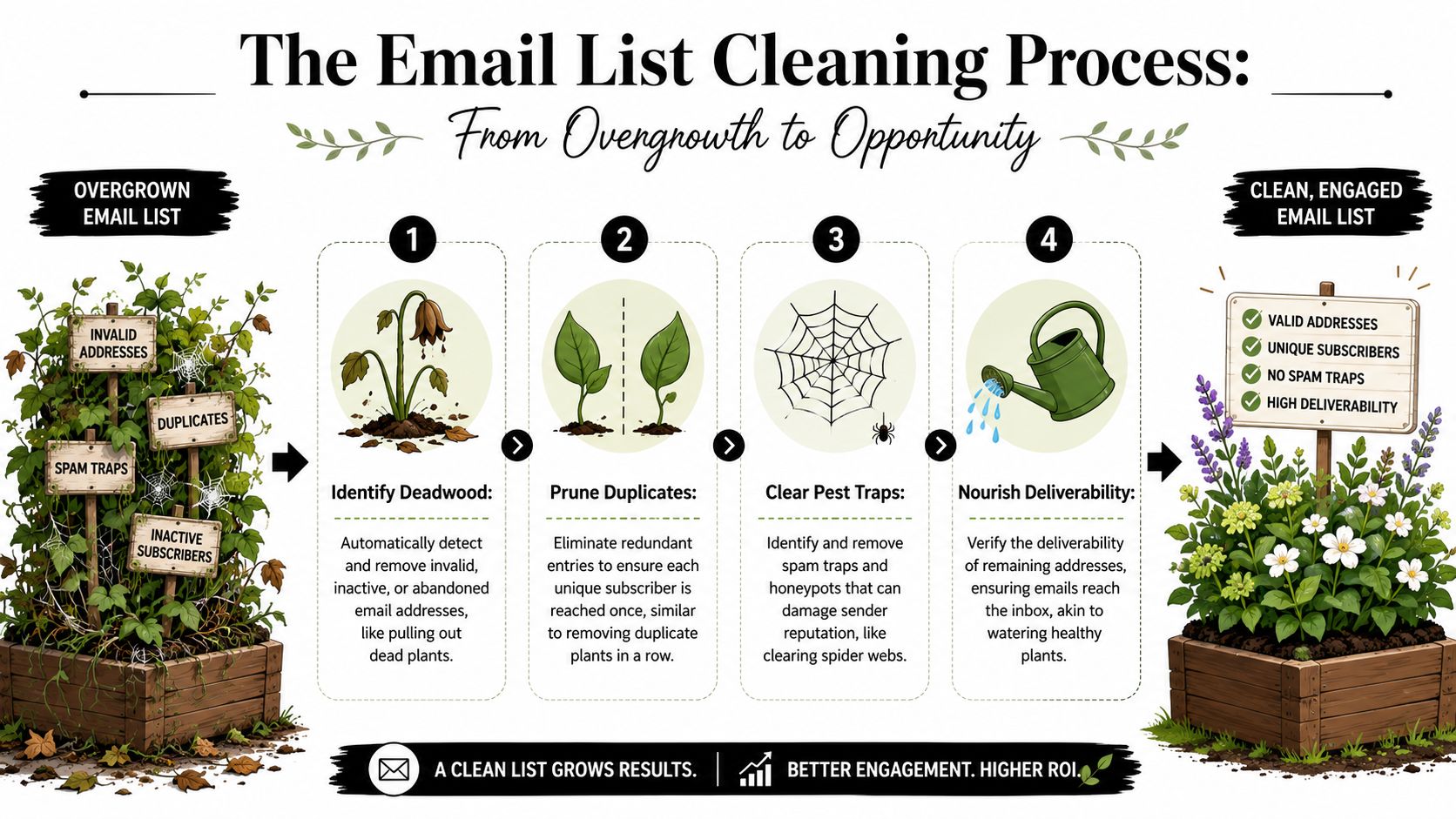
The first pass is basic validation. A provider checks syntax, catches malformed addresses, and flags broken imports. That removes obvious waste, but it does not tell you whether a prospect can successfully receive mail.
The second pass checks the domain. If the domain has no valid MX records or is not set up to accept email, the address is dead on arrival.
The third pass is where the service earns its fee. Better providers verify mailbox reachability through SMTP-level checks and classify records by risk, including catch-all domains, disposable inboxes, role accounts, and likely traps. Mailgun explains this verification approach in its overview of SMTP checks within email validation. For an outbound team, that extra layer is what separates a cosmetic cleanup from a list you can safely put into production.
Basic validators versus real cleaning workflows
A lightweight tool gives you a pass or fail. A stronger service gives you sending decisions.
For B2B outreach, those decisions usually fall into a few categories:
-
Role-based addresses: inboxes like info@, support@, or team@ that may accept mail but rarely map cleanly to a buyer.
-
Accept-all domains: domains that report mail as deliverable even when the mailbox may not exist, which creates uncertainty and requires tighter sending rules.
-
Spam traps and honeypots: addresses that exist to catch poor list acquisition and weak hygiene practices.
-
Duplicates: repeated records that inflate volume, create messy attribution, and can lead to double touches from different reps or sequences.
That classification matters because every category changes expected return. If an address is valid but low-intent, your reply rate may hold up while your qualified meeting rate drops. If a domain is catch-all, you may still send to it, but at lower volume and with closer monitoring. Good cleaning is not only about removing records. It is about deciding where each record belongs in the workflow.
A useful overview of how providers handle different verification scenarios is this write-up on the Icypeas email verification platform. It helps frame the difference between simple validation and deeper list risk analysis.
Where cleaning fits in the stack
Cleaning is one control inside a larger outbound system. It does not replace domain setup, authentication, warmup discipline, inbox placement monitoring, or reply handling. It gives those systems cleaner inputs, which is why teams that care about booked meetings usually pair list verification with a defined email deliverability services process.
The practical standard is simple. A real cleaning workflow checks syntax, domain readiness, mailbox reachability, and send risk. If a provider cannot tell you which records are safe, risky, or not worth touching, it is not helping you protect cost per meeting.
The Business Case For a Clean Email List
Monday morning looks fine on the surface. The campaign sent on schedule, the copy was solid, and the targeting matched your ICP. By Friday, booked meetings are light, reply data is noisy, and nobody can tell whether the problem was the offer, the segment, or the list. That is the business case for list cleaning. It protects the part of outbound that is judged. Qualified meetings produced at an acceptable cost.
Deliverability affects revenue before the sales conversation starts
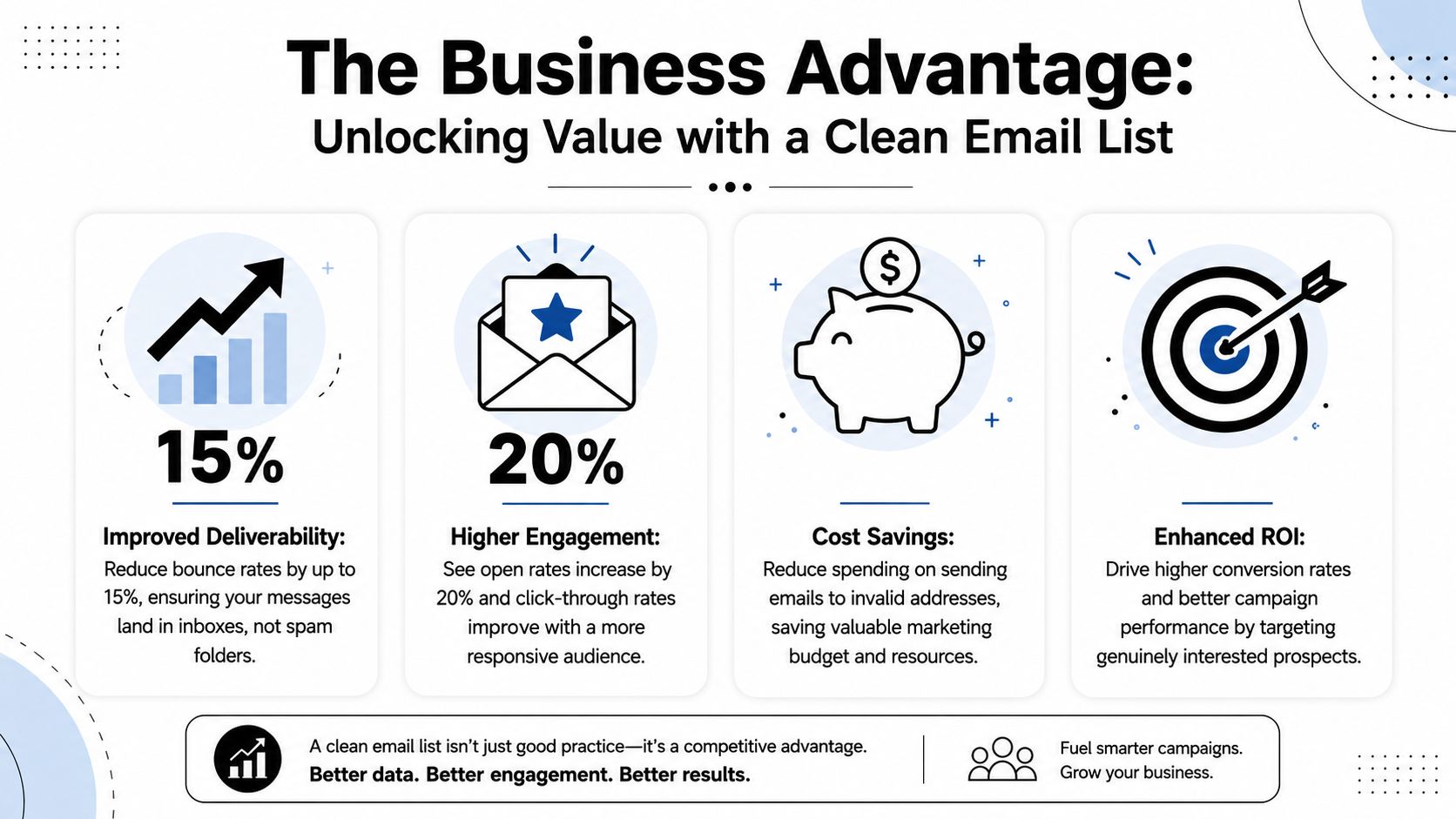
Executives do not care about verification jargon. They care whether outbound turns into pipeline. A clean list improves that equation because inbox access is upstream of every other campaign variable. If the message does not reach the inbox, the subject line, personalization, and CTA never get a fair chance to work.
The financial risk is easy to miss because it shows up as underperformance, not as a line item on an invoice. Bad records create bounces, complaints, and inconsistent placement. Then teams start rewriting copy, changing offers, and rotating domains to solve a problem that started with data quality.
Cleaner data also protects future sending capacity. A list with fewer invalid and risky contacts creates less negative engagement pressure on the infrastructure behind your outreach. That matters for agencies and revenue teams that need stable output every week, not one strong campaign followed by three weeks of recovery.
The real cost is missed meetings
Platform waste is the smaller issue. The larger issue is missed opportunity.
Every bad contact absorbs part of your sending volume, your rep time, and your testing cycle. In a performance-based model, that means fewer chances to reach decision-makers who can turn into qualified meetings. If you get paid on outcomes, list hygiene is tied directly to margin.
A dirty list also makes cost-per-meeting worse in ways teams often fail to measure. Reply rates can look acceptable while qualified meeting rate drops because a chunk of the audience was never reachable, never active, or never the right buyer in the first place. That is why the return on cleaning should be judged by meeting efficiency, not by the cost of verification alone.
Here is the comparison that matters:
| Business effect | Dirty list | Clean list |
|---|---|---|
| Qualified meeting rate | Depressed by unreachable and low-value records | Stronger because more sends reach viable buyers |
| Cost per meeting | Inflated by wasted sends, rep time, and retesting | Lower because output improves from the same workflow |
| Domain health | More likely to weaken after repeated bounces and complaints | More stable and easier to maintain |
| Decision quality | Hard to tell whether the issue is data, copy, or offer | Cleaner read on what is actually working |
Better data improves judgment, not just delivery
List quality changes how accurately a team can evaluate outbound performance. If a segment contains stale records, duplicates, or risky mailboxes, campaign analysis gets distorted. Teams end up fixing the wrong variable.
That shows up fast when outreach is split by vertical, persona, or offer. One segment may look weak because the market is unattractive. It may also look weak because the underlying data was worse from the start. That is why list hygiene and email list segmentation belong in the same operating discussion.
A clean list does not guarantee meetings. It gives your campaign valid inputs, cleaner attribution, and a better shot at turning sends into qualified pipeline.
Calculating ROI for Performance-Based Outreach
Monday starts with a familiar problem. The campaign dashboard says volume is up, but booked meetings are flat, and the client is asking why more sends did not produce more pipeline. In performance-based outreach, that answer often starts with list quality.
Pay-per-result models change the math. The primary question is how much a cleaned list improves qualified meeting rate and how much it lowers cost per meeting. Cost per verified contact matters, but only as a small input into the larger unit economics.

The metric teams fail to connect to revenue
Many outbound teams clean lists to reduce obvious deliverability risk. Far fewer measure whether that cleanup produced more accepted meetings from the same prospect pool. That gap is expensive because it hides the only outcome that matters in a performance contract.
Clients do not buy “verification.” They buy conversations with the right buyers.
A report that says a database was cleaned rarely changes anyone’s mind. A report that shows qualified meeting rate rose from the same campaign structure, while cost per meeting dropped, gives finance, sales leadership, and clients something they can use.
A practical ROI framework
Track list cleaning the same way you track channel efficiency. Measure before and after cleaning across the same audience, offer, and sending setup.
Use four inputs:
-
Delivered prospects: How many contacts were reachable after suppression and verification?
-
Positive reply quality: How many replies came from relevant buyers instead of role accounts, interns, or mismatched contacts?
-
Qualified meeting rate: How many contacted prospects turned into accepted, sales-relevant meetings?
-
Cost per meeting: Total list, tooling, sending, and labor cost divided by qualified meetings booked.
That fourth number is where cleaning proves itself.
A simple example makes the point. If a campaign costs $3,000 to source, verify, send, and manage, and it books 6 qualified meetings, cost per meeting is $500. If the same campaign structure, run against a cleaner list, books 9 qualified meetings at $3,200 total cost, cost per meeting drops to about $356. The cleaning expense added cost at the top of the funnel and still improved margin because more of the workflow reached real buyers.
Where the return actually comes from
The return is rarely just “fewer bounces.” The bigger gain is that good records give the campaign more chances to convert. Reps spend less time chasing dead addresses. Copy gets judged on its actual performance instead of being dragged down by bad data. The team can keep a stable sending environment instead of burning time on recovery work.
That matters even more in multi-touch outbound, where one contact may open an email, reply after a follow-up, and book after a separate nudge from sales. If you want to prove that cleaning changed pipeline output, the measurement model has to connect hygiene to meetings across touches, not only first-response data. That is the same discipline used in multi-touch attribution for outbound and pipeline reporting.
For teams deciding how to execute, there are two common paths. One is to buy a verification tool and build the process internally. The other is to use a delivery partner that already treats list hygiene as part of outbound operations. Fypion Marketing falls into the second group, with list cleaning built into its cold email execution for performance-based campaigns.
An Evaluation Checklist for B2B Cleaning Services
A vendor can show a 99% accuracy claim and still leave you with the wrong records in your sequence.
That is the core buying problem. In B2B outbound, the difference between a useful cleaner and a risky one is not whether it removes obvious junk. It is whether it helps your team decide which contacts are safe to mail, which should be suppressed, and which need a separate policy before they touch your sending domain. That decision affects reply quality, domain stability, and cost per booked meeting.
Questions worth asking before you buy
Use these questions in demos and vendor reviews, and push for a real product walkthrough instead of a slide deck.
-
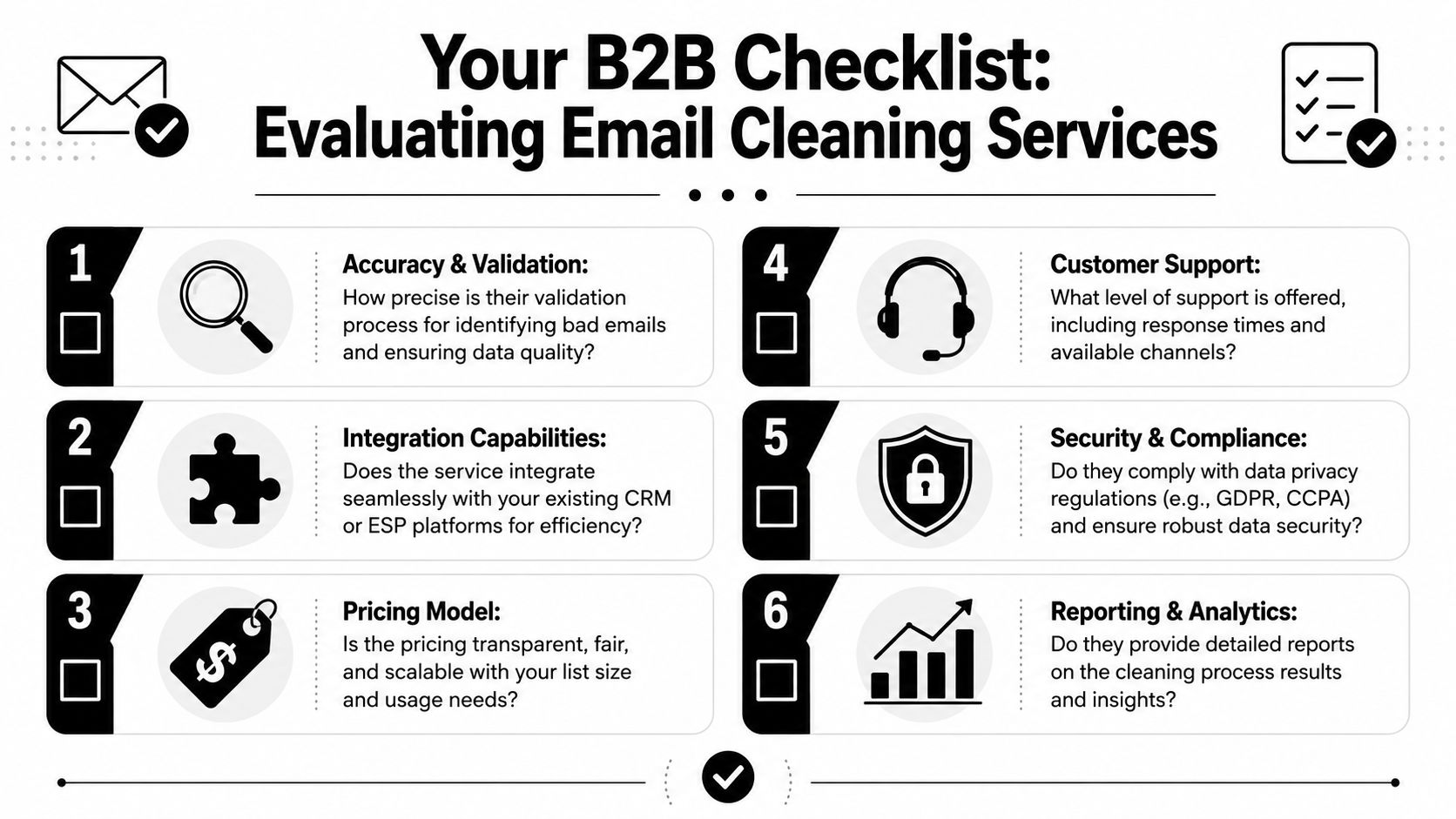
How do you classify risky addresses, not just invalid ones? A binary pass or fail result is not enough for outbound. Ask how the provider treats accept-all domains, role inboxes, temporary addresses, and unknown statuses.
-
How do you identify trap risk and suspicious records? A service that only checks syntax, MX records, and mailbox existence can miss addresses that look deliverable but still create reputation problems.
-
Can we set different suppression rules by use case? Cold outbound, newsletter sends, and reactivation campaigns should not run on the same filtering logic.
-
Do you support both real-time API validation and batch uploads? Outbound teams usually need one process for old data and another for net-new leads.
-
What reporting do we get back? You need reason codes, status categories, and enough detail to defend suppression decisions across ops and sales.
-
How do you handle privacy, storage, and deletion? Contact data is moving through another system. Procurement and legal will care how long it stays there.
Where B2B teams make bad buying decisions
The first mistake is buying for convenience. A cheap validator that returns a cleaned CSV can look good in procurement. It often creates more work for the team that owns results because the output is too shallow to build policy around.
The second mistake is treating all deliverable addresses as equal. They are not. An accept-all domain can be usable, risky, or a waste of send volume depending on the account, the campaign, and how aggressively your team wants to protect sender reputation. Teams that send into those domains regularly should understand the trade-offs involved in how to verify accept-all emails.
The third mistake is skipping edge-case testing. Ask the vendor to run a sample file that includes catch-alls, role accounts, older CRM records, and scraped contacts. Their output will tell you very quickly whether the product is built for real outbound conditions or just surface-level validation.
Ask vendors to show sample outputs for ambiguous records. The categories they return matter more than the headline accuracy claim.
What a strong provider should make easy
For performance-based outreach, a cleaning service should help you protect meeting volume, not just reduce bounce volume.
| Capability | Why it matters |
|---|---|
| Risk segmentation | Lets the team separate safe records from questionable ones instead of mailing everything marked “valid” |
| Policy controls | Makes it possible to suppress, review, or route records differently by campaign type |
| Workflow flexibility | Supports both one-time database cleanup and ongoing validation for new lead flow |
| Usable reporting | Gives campaign managers the evidence to explain why records were mailed, quarantined, or dropped |
| Integration support | Keeps validation tied to the actual outbound process instead of creating another manual export step |
A good provider should also be able to explain what their tool does not solve. That is usually a sign the team understands deliverability risk at an operational level.
If a vendor cannot explain how they handle ambiguous records, or if every answer collapses back to a single “valid” status, keep looking. In outbound, weak classification does not just create dirty data. It raises the cost of every meeting you are trying to book.
Integrating List Cleaning Into Your Cold Email Workflow
A cold email program usually does not fail on launch day. It fails three weeks later, after stale records, form typos, and low-confidence enrichments have already made it into active sequences. By then, the problem is no longer just list quality. It is missed inbox placement, fewer replies, and a higher cost for every meeting the campaign is supposed to produce.
The fix is operational. List cleaning has to sit inside the workflow, not outside it.
Batch cleaning for existing databases
Use batch cleaning before any campaign that starts with stored data. That includes old CRM exports, purchased lists, webinar leads, conference scans, and prospect lists that have been sitting untouched since the last quarter.
The process is straightforward. Upload the file, review how records were classified, suppress addresses that carry clear risk, and only send approved records into the sequencer. That extra review step matters because outbound teams do not get paid for sending volume. They get paid for qualified conversations. Mailing a bigger file is worthless if the bad records drag down inbox placement for the good ones too.
Batch cleaning also gives operations and campaign managers a chance to quarantine uncertain contacts instead of forcing a yes or no decision on every record.
Real-time verification for new lead flow
Real-time verification belongs at the point where new data enters the system. If leads come in through forms, enrichment tools, scraper outputs, or manual prospecting, verify them before they touch an active campaign.
This is the model I prefer for always-on outbound teams because it stops decay before it spreads. One unchecked source can subtly contaminate a clean sending environment. A weekly import from a weak provider, or a VA copying leads with small formatting errors, is enough to create a bounce problem that shows up later as lower reply volume.
For performance-based outreach, that matters more than the hygiene metric itself. The essential question is whether validation protects qualified meeting rate and keeps cost-per-meeting in range.
A practical workflow usually looks like this:
-
Run bulk validation on older lists before launch: Treat stored or imported data as unverified until it has been checked.
-
Verify new contacts on entry: Stop bad records before they stack up in the CRM or sequencer.
-
Separate uncertain records from approved ones: Put them into review queues, alternate channels, or manual research instead of mixing them into the main send.
-
Keep validation tied to sending infrastructure: Pair it with domain setup, mailbox management, and email authentication protocols so list quality and deliverability are handled together.
The threshold teams cross by accident
High bounce rates can get a domain throttled or filtered, which is why Google’s Email Sender Guidelines tell senders to keep spam rates low and follow authentication and list hygiene practices closely: https://support.google.com/a/answer/81126
The operational mistake is simple. Teams clean once, assume the problem is solved, and keep feeding unchecked records into the system. Then a campaign underperforms, even though the copy was solid and the targeting looked right on paper.
That is why I treat cleaning as a recurring control, not a one-time project. In a performance model, the payoff is not “fewer bad emails” in the abstract. The payoff is more reachable prospects, steadier inbox placement, more qualified meetings, and a lower cost to produce each one.
Frequently Asked Questions About Email List Hygiene
How often should a B2B list be cleaned
Clean before any major outbound push. Clean after big imports. If your team adds leads continuously, use real-time verification so you aren’t relying on occasional catch-up work.
Are free tools enough
Free tools can be useful for spot checks. They’re usually not enough for serious outbound programs because they often provide limited risk detail and weaker workflow controls. For B2B campaigns, classification quality matters as much as convenience.
What’s the difference between a hard bounce and a soft bounce
A hard bounce means the address is not deliverable in a lasting way, such as a mailbox that doesn’t exist. A soft bounce is usually temporary, such as a full inbox or a temporary server issue. Hard bounces are the bigger reputation risk for list hygiene decisions.
Won’t cleaning remove leads we could have converted
A good process doesn’t just delete blindly. It separates clearly bad records from uncertain ones so your team can make policy decisions. The goal isn’t to shrink the list for its own sake. The goal is to protect deliverability and focus effort on contacts with a realistic chance of receiving the message.
The wrong lead on a damaged domain costs more than a smaller list with reliable inbox access.
Is cleaning enough to fix deliverability
No. It helps a lot, but it works alongside authentication, sending behavior, domain health, copy quality, and targeting. List hygiene is one of the foundations. It isn’t the whole system.
If your team only wins when qualified meetings get booked, list hygiene should be measured by pipeline output, not by how tidy a spreadsheet looks. Fypion Marketing helps B2B companies run cold email as a performance channel, including the list hygiene work needed to protect sender reputation and keep campaigns focused on real meeting opportunities.