
Cold Calling vs Cold Emailing: Winning B2B Strategy 2026
When you stack up cold calling against cold emailing, the data makes a strong case for one clear winner in terms of scalability and pure efficiency: cold emailing. While picking up the phone gives you that immediate, direct line of contact, its high cost and depressingly low connect rates make it a tough sell as a primary strategy. Cold emailing, on the other hand, is simply a more cost-effective, scalable, and less intrusive way to start a conversation with today’s B2B prospects.
Cold Calling vs Cold Emailing Your Definitive Answer
When you’re trying to choose between cold calling and cold emailing, the real goal isn’t just to make contact. It’s to build a predictable, repeatable pipeline that fuels your company’s growth. Both methods can have a place in your sales toolkit, but how they work, what they cost, and how prospects react to them are worlds apart. Getting a handle on these differences is the first step to building a winning outreach strategy.
The fundamental split really comes down to permission versus interruption. A cold call is an interruption - you’re demanding a prospect’s attention right now. A cold email is more like an invitation; you’re offering information that the prospect can look at whenever it suits them. In a world where decision-makers guard their time fiercely, that’s a massive distinction.
A High-Level Comparison
For B2B companies that are serious about growing efficiently, the numbers tell a pretty clear story. Current research shows that cold emails pull in an average reply rate of 3.1%, which looks a lot better than the average 2% connect rate you get with cold calling. The difference in scale is even more dramatic. A single rep can realistically send 50-100 personalized emails in a day, but they’d be hard-pressed to make more than 40-60 meaningful calls in that same time.
To give you a snapshot of how these two channels really measure up, here’s a quick overview of the essential metrics.
Quick Comparison Cold Calling vs Cold Emailing
| Metric | Cold Calling | Cold Emailing |
|---|---|---|
| Scalability | Low (1-to-1) | High (1-to-many) |
| Average Cost Per Outreach | High ($5 - $15) | Low ($0.10 - $0.50) |
| Prospect Disruption | High (Interruptive) | Low (Asynchronous) |
| Data & Analytics | Limited | Comprehensive |
| Buyer Preference (Initial Contact) | Low | High |
This table makes it obvious why modern, scalable sales models are almost always built with an email-first approach. The cost difference alone is staggering.
The visual below really drives home just how massive the cost gap is for a single outreach attempt.
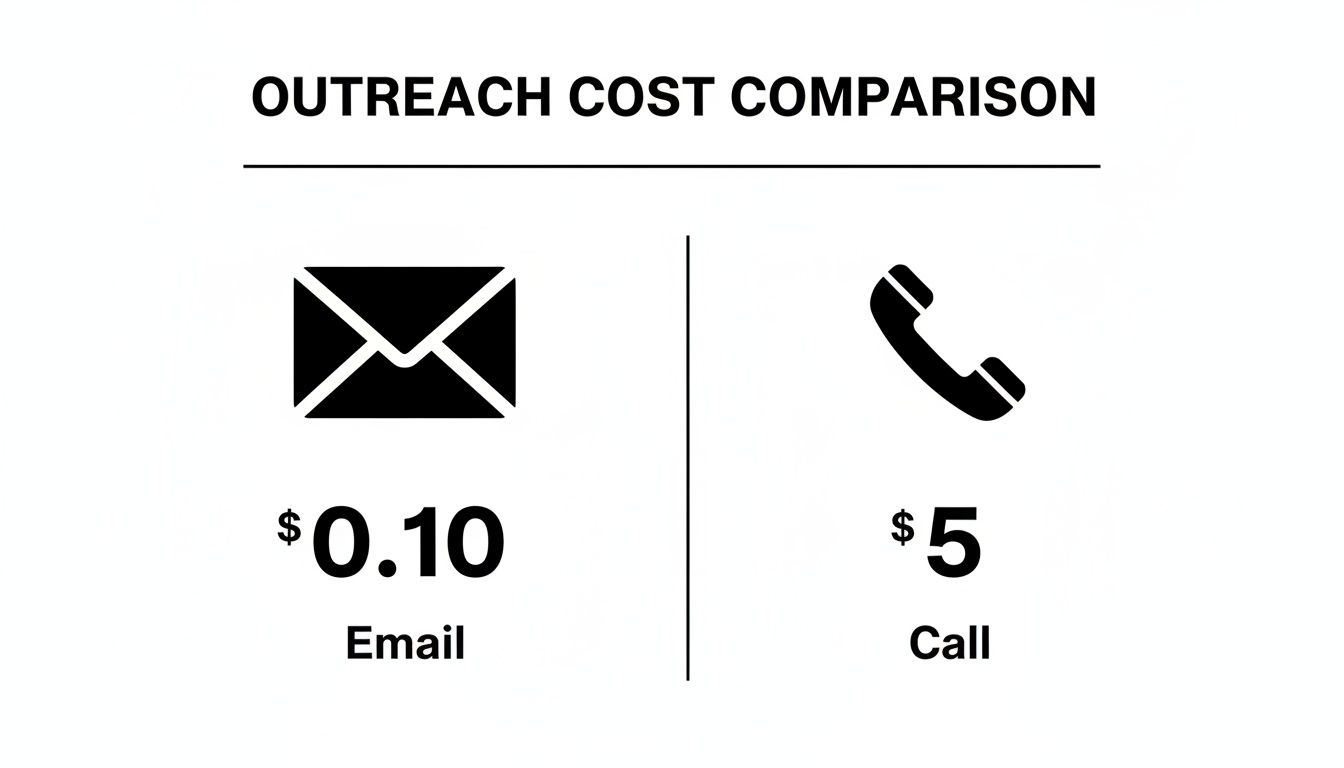
This huge difference in cost is a major reason why effective B2B lead generation models are almost always built on a foundation of email.
The trade-off is straightforward: cold calling aims for an immediate (but very rare) personal connection, while cold emailing is all about scalable, data-driven engagement. For the vast majority of businesses, the second option provides a much more reliable road to consistent growth.
Comparing Response Rates and Conversion Metrics

When you’re deciding between cold calling and cold emailing, it’s easy to get hung up on vanity metrics. The real story is in the conversion numbers - the journey from that first touchpoint to a booked meeting. These paths look completely different for calls versus emails, and understanding that difference is what separates a struggling sales team from one with a predictable pipeline.
For cold calling, the numbers can be pretty grim. We look at two main things: the connect rate (how many calls get a human on the line) and the appointment set rate (how many dials turn into a meeting). A sales rep might feel good about a 2% connect rate, but the percentage that actually becomes a meeting is a fraction of that.
It’s a classic case of spinning your wheels. Your reps can spend all day dialing just to have a few conversations, and even fewer of those will ever lead to a real sales opportunity.
Breaking Down Cold Calling Conversion
The math behind cold calling is just brutal. You start with a massive number of dials, and the funnel gets incredibly narrow, incredibly fast. This is where you really see how inefficient it is for top-of-funnel prospecting.
Let’s walk through a typical few days for a sales development representative (SDR):
-
Dials Made: An SDR grinds out 1,000 dials.
-
Connects: A standard 2% connect rate means they only have 20 actual conversations.
-
Appointments Set: If they’re good, they might convert 10% of those conversations. That leaves them with just 2 booked meetings.
Do the math. That’s roughly 500 dials for a single appointment. The sheer amount of time and effort baked into a call-first strategy is staggering. You’re playing a volume game where the house almost always wins.
A 2026 study just drives the point home. Researchers looked at 6,264 cold calls and found they generated only 19 appointments. That’s a 0.3% success rate from dial-to-meeting. It’s a perfect example of activity not translating to results.
Dissecting Cold Emailing Conversion
Cold email plays a totally different ballgame. The metrics give you a much clearer picture of what’s working. You’re not just looking at a “connect” or “no connect” - you get a whole feedback loop with open rates, reply rates, and, most importantly, positive reply rates.
This is where cold email really shines: generating real, high-quality engagement at a scale you just can’t match with calling. People throw around a 1-5% average response rate, but honestly, that’s just for lazy, un-personalized campaigns. When you do it right, the results are on another level.
We’ve seen well-crafted, targeted campaigns hit response rates of 25% or even higher. Data shows these campaigns convert to booked meetings at a rate of 1.55% for every 100 emails sent. Compare that to cold calling’s average meeting rate of 0.08%, and you’ll see that email is over 19 times more effective. You can dig into the numbers yourself by checking out this complete analysis of sales outreach data.
The True Conversion Power
When you put it side-by-side - how many dials it takes for one appointment versus how many emails - the answer becomes obvious. The data clearly shows why modern sales teams build their growth engines on email, not phone calls.
Let’s put the effort into perspective. To book just 10 appointments, here’s what it would take based on industry averages:
| Channel | Activity Required for 10 Appointments |
|---|---|
| Cold Calling | Approximately 5,000 dials |
| Cold Emailing | Approximately 650 targeted emails |
This table gets to the heart of the debate. Sure, landing a meeting from a cold call feels great in the moment, but the system itself is fundamentally broken for creating repeatable, scalable success. Cold emailing, with its superior metrics and ability to scale, gives you a far more reliable path to building a healthy sales pipeline.
Analyzing the True Cost and Scalability
When you compare cold calling and cold emailing, just looking at the surface-level costs doesn’t tell you the whole story. The real metric to watch is your total cost to acquire a customer and whether you can actually scale your efforts. A single call feels direct, sure, but the resources you burn through make it incredibly hard to build predictable growth.
Cold emailing, on the other hand, is built from the ground up for efficiency. The operating costs are just lower, your outreach potential is massive, and the whole system is designed to scale. This is why B2B companies that care about data are building their growth engines on email.
The Compounded Costs of Cold Calling
The true price of cold calling is so much more than a sales rep’s salary. It’s a strategy loaded with operational friction and a lot of hidden expenses that pile up fast. Every single dial is a big investment in both time and cash.
Just think about the tools you need. Dialer software, phone number data that’s both expensive and often junk, and call tracking systems all have a monthly fee. But the real killer is the labor cost. An average sales development rep (SDR) can easily spend 7-9 minutes on just one call attempt, and that’s including the research and note-taking.
Do the math. That means a rep can only make about 6-9 calls per hour. When you remember how few people actually pick up the phone, your cost for every real conversation goes through the roof. It makes acquiring a single lead painfully expensive.
Cold calling is an activity of diminishing returns. The more you try to scale it by adding headcount, the more your costs inflate without a proportional increase in results. You’re paying for effort, not outcomes.
The Scalable Economics of Cold Emailing
Cold emailing runs on a totally different economic model. Cold calling is a one-to-one, linear slog. Cold emailing is a one-to-many, exponential play. That fundamental difference is what makes it the clear winner for scaling a sales pipeline.
The initial setup involves building a solid infrastructure - automation tools, sending domains, and verification services. Yes, there’s an upfront investment, but your cost per contact plummets as you scale up. Instead of making 6-9 calls in an hour, one rep can send 80-120 personalized emails in that same window.
This efficiency brings your cost per lead way down. For instance, a qualified lead from cold calling might run you anywhere from $35 to $75. A similar lead from a well-executed email campaign? More like $15 to $35. The ROI is undeniable once you start expanding your outreach. It’s a structure that lets agencies offer different models, like the pay-per-meeting pricing we use.
A Clear ROI Breakdown
To really get the financial picture in the cold calling vs. cold emailing debate, let’s lay out the resources for each. The differences in tools, labor, and scalability directly slam your return on investment.
Cold Calling Investment:
-
Labor: The biggest cost is your sales reps’ time - manually dialing, leaving voicemails, and trying to get past gatekeepers.
-
Tools: You’re paying monthly for dialer software, telephony services, and call tracking platforms.
-
Data: Buying accurate phone numbers is expensive, and the lists go bad so fast you have to keep buying more.
Cold Emailing Investment:
-
Labor: Reps focus their time on high-value tasks like building good lists, personalizing copy, and analyzing campaign data - not manual outreach.
-
Tools: Costs include email automation platforms and deliverability tools, which are significantly cheaper per contact.
-
Data: Email verification is cheaper and more accurate, which means less waste and better contact rates.
This comparison points to a clear winner for resource efficiency. Cold emailing cuts out wasted effort and maximizes your chances of engagement. By automating the very top of your funnel, you let your sales team do what they’re paid to do: talk to qualified prospects who are actually interested and close deals. The ability to test messaging, segment audiences, and optimize with real data makes email a much smarter investment for long-term, predictable growth.
Understanding Prospect Receptiveness and Preferences
To really settle the cold call vs. cold email debate, you have to get inside your prospect’s head. Winning outreach isn’t about what’s easiest for you; it’s about respecting their workflow and state of mind. The way a prospect feels when they get a cold call is completely different from how they feel getting a cold email, and that difference is everything.
A cold call is, by its very nature, an interruption. It shatters a person’s focus and demands their immediate attention. While you might occasionally force a conversation this way, you’re far more likely to just create annoyance. In today’s world, an unscheduled call from a number you don’t recognize feels more like an intrusion than an opportunity.
This is precisely why so many calls go straight to voicemail. Decision-makers are fiercely protective of their time and have been trained to screen out any unexpected demands. Your perfectly rehearsed pitch never even gets heard.
The Power of Asynchronous Communication
Cold email works on a totally different principle: it’s an invitation, not an interruption. An email lands quietly in an inbox, letting the prospect engage entirely on their own terms. This asynchronous approach hands control back to the recipient, which is a massive psychological win for building initial trust.
Instead of being ambushed and put on the spot, they can review your message when they have a spare moment. That autonomy immediately lowers their defenses. They can read, think, and decide if they want to reply without feeling cornered, making them much more open to what you have to say.
The core difference is control. A cold call forces a choice: be rude and hang up, or sacrifice your valuable time. A cold email offers a better alternative, letting prospects engage when they’re ready and feel most comfortable.
The data backs this up. Research consistently shows that around 80% of business buyers prefer email for that first contact. This is a loud and clear signal from the market telling you exactly how they want to be approached. When you choose email, you’re aligning with their behavior from the very first touchpoint. You can learn more about how to use these behavioral insights to your advantage with modern AI sales tools.
Why Buyer Preferences Favor Email
The preference for email isn’t just about avoiding a disruptive phone call; it’s also incredibly practical. Busy executives and decision-makers run on efficiency. An email lets them instantly size up your offer and decide on the next step in just a few seconds.
Think about these common situations where email just works better:
-
Sharing Complex Information: An email can easily include links to case studies, product demos, or technical specs that are impossible to explain over a quick call.
-
Forwarding to Colleagues: If you’ve reached the wrong person, an email can be forwarded to the right stakeholder in two clicks. A phone call usually just dies there.
-
Creating a Paper Trail: Email gives both you and the prospect a written record to refer back to. This keeps everything clear and ensures nothing gets lost in translation.
Of course, timing matters. There are certainly best times for cold calling that can slightly bump your success rate. But that doesn’t change the fundamental preference most buyers have for asynchronous communication. By leading with email, you’re showing respect for their time and workflow, setting a professional, positive tone right from the start.
Strategic Scenarios: When to Use Each Channel
Deciding between a cold call and a cold email isn’t just about picking the one with the best stats. It’s about matching your method to your mission. While email gives you a powerful engine for outreach at scale, a smart strategy uses both channels at the right moments. The real key is knowing when to deploy the precision of a phone call versus the broad-net efficiency of an email.
An email-first approach is almost always the foundation. But some situations just flat-out demand the direct, human touch of a call. On the flip side, email is built for creating a predictable sales pipeline, scaling up lead gen, and nurturing prospects over the long haul.
Think of it this way: use email as your primary growth engine and sprinkle in phone calls for high-impact, specific scenarios.
When to Prioritize Cold Calling
Even though it’s time-consuming and doesn’t scale well, cold calling has its place. It’s for when the stakes are high and a personal connection can make or break the deal. It’s a specialized tool, not your everyday hammer. Calls really shine when you need to navigate complex deals where nuance and getting immediate feedback are everything.
You should be cold calling in these specific situations:
-
High-Value Enterprise Deals: When a contract is worth six figures or more, the time investment of a direct conversation is a no-brainer. Building that rapport and handling tricky objections in real-time can be the one thing that gets the deal signed.
-
Following Up with Highly Engaged Leads: Has a prospect opened multiple emails, checked out your pricing page, or downloaded a case study? A well-timed call can seriously speed things up. They’ve already shown you they’re interested; your call is just moving the conversation along.
-
Time-Sensitive Opportunities: If a shift in the market creates an urgent need for what you sell, you can’t afford to sit around waiting for an email reply. A direct call cuts through the noise and can land you a meeting before that window of opportunity slams shut.
A cold call works best when it’s not actually “cold.” Use it as a follow-up for high-value prospects you’ve already warmed up through email or other marketing. This turns it from an annoying interruption into a timely, relevant conversation.
When to Prioritize Cold Emailing
For the vast majority of B2B lead generation, cold email is the undisputed champion. Its ability to scale, low cost, and the fact that modern buyers often prefer it make it the perfect channel for building and nurturing a sales pipeline from scratch. If your goal is predictable, repeatable growth, email is your go-to.
Cold emailing is the better choice for:
-
Scaling SaaS Lead Generation: Email is perfect for reaching a huge number of potential users without breaking the bank. You can introduce your software, share demo links, and book meetings at a scale that calling could never hope to match.
-
Targeting Busy Executives: Let’s be real, decision-makers are incredibly hard to get on the phone. Email lets them look at your pitch on their own time, which respects their schedule and makes a thoughtful response more likely.
-
Securing B2B Appointments Systematically: Email sequences let you test, tweak, and scale your appointment-setting process with surgical precision. With all the data on opens, clicks, and replies, you can build a data-driven machine for filling your sales calendar. For more ideas on crafting your outreach, check out our other posts on the Fypion Marketing blog.
When thinking about your calling strategy, it’s also helpful to look at proven strategies for cold calling in specific industries.
At the end of the day, the “cold calling vs. cold emailing” debate isn’t about picking one and ditching the other. It’s about building your main growth engine with cold email and using cold calling as a tactical, high-impact weapon for the right opportunities.
Implementing a Winning Outreach Strategy
The whole debate between cold calling and cold emailing comes down to one question: how do you build a system that consistently books qualified meetings? The data points to a clear answer. But running a high-performing cold email campaign takes expertise, the right technical setup, and non-stop tweaking - things most teams just don’t have the bandwidth for.
This is where bringing in a specialist makes all the difference. Instead of trying to build and manage an entire outreach engine from scratch, you can plug into a system that’s already dialed in for one purpose: booking sales appointments for your team. The process is straightforward, and it shifts the focus away from just doing activities to getting real results.
Building Your Outreach Engine
A solid partnership always starts with deep-dive research. The first move is a thorough analysis of your market to nail down a precise Ideal Customer Profile (ICP). This goes way beyond basic demographics; it’s about figuring out the specific pain points, business triggers, and buying signals that point to your most valuable potential customers.
Once the ICP is crystal clear, the next step is building a super-targeted contact list and writing personalized messages that speak directly to their problems. This involves a few key things:
-
The Technical Setup: We establish dedicated sending domains and inboxes. This is crucial for protecting your main domain’s reputation and making sure your emails actually land in the inbox.
-
Copywriting and Personalization: Multiple email angles and sequences are developed, then tested and fine-tuned based on what the live campaign data tells us.
-
Campaign Management: We launch, monitor, and optimize every campaign to drive up positive response rates and the quality of appointments booked.
The real game-changer is switching to a performance-based model. When you only pay for qualified, booked meetings that hit your exact criteria, you completely remove the risk. You’re no longer paying for someone to send emails; you’re investing directly in sales opportunities.
A Focus on Performance and Results
This approach turns your lead generation from a cost center into a predictable way to grow. By outsourcing all the complex campaign management, your sales team is freed up to do what they do best: build relationships and close deals. We’ve seen it work time and again, with documented client results like a 220% month-over-month increase in qualified leads. That’s the kind of impact an expert-led system can have.
It’s simply the most efficient path to scaling your sales pipeline. You get to skip all the trial-and-error, the cost, and the time it takes to build an internal function from the ground up. If you want to see how this works in practice, check out our approach to results-driven cold email management and see how we can fill your calendar with high-quality meetings.
Frequently Asked Questions

As you dig into the cold calling vs. cold email debate, a lot of questions come up. Let’s get you some straight answers based on what actually works in B2B sales, so you can fine-tune your outreach and make decisions that drive real results.
Which Channel Is Better for Immediate Feedback?
You’d think a cold call gives you instant feedback, but that idea is a bit of a myth. The connect rate is so incredibly low that you get almost no reliable data. Sure, you might get a “no” on one call, but you have no clue why that “no” happened, and you can’t learn much when you’re only connecting with a handful of people.
Cold email, on the other hand, is a goldmine of actionable data. You can track open rates, click-throughs, and replies across thousands of prospects. This gives you immediate, clear insights into which messages are landing and which ones are falling flat, allowing for much faster and more accurate testing.
Should I Combine Cold Calling and Cold Emailing?
Absolutely, a multi-channel strategy can work wonders - but the order you do things in is crucial. A common tactic is to “warm up” a prospect with a few emails before you even think about picking up the phone. This gives them context and makes a call feel less like an interruption.
For predictable growth and the best use of your resources, though, we always recommend mastering one channel first. Given its better ROI, scalability, and the fact that buyers prefer it, cold email is the clear starting point for most B2B companies. Once you’ve got a solid email system bringing in leads, you can strategically layer in calls for your highest-value targets.
When it comes to cold calling vs. cold emailing, it’s not about “either/or.” It’s about “which one first?” Build your scalable foundation with email, then add calls as a tactical, high-impact tool.
How Much Personalization Do Cold Emails Actually Need?
Generic, copy-paste emails are dead. They get less than a 1% reply rate, and for good reason. Real personalization goes way beyond dropping in a and tag. To actually cut through the noise, you have to prove you’ve done your homework.
This means referencing something specific, like a recent company achievement, a new funding round, a shared connection, or even a post they shared on LinkedIn. This kind of detail - which is completely manageable at scale with the right tools - is what takes reply rates from a dismal 1-2% to over 15%. It shows you’re not just another spammer; you’re a professional who took the time to offer something genuinely relevant.
Ready to scale your pipeline with a proven, performance-based approach? Fypion Marketing specializes in booking qualified meetings for your sales team, so you only pay for results. Learn how we can fill your calendar by visiting fypionmarketing.com.