
Unlock Growth: The Ultimate Cold Outreach Agency Guide 2026

So, you’ve heard about cold outreach agencies, but what do they actually do?
Think of them as a specialized team you bring in to do one thing exceptionally well: fill your sales pipeline with qualified meetings. Instead of just blasting out generic emails, a real pro agency acts as a true extension of your sales team. They handle all the heavy lifting - from the nitty-gritty market research to crafting compelling copy and managing the entire campaign.
Essentially, they are a ready-made engine designed to land interested prospects on your calendar.
What Is a Cold Outreach Agency
Imagine trying to build a new sales pipeline from the ground up. You’d need to hire and train a team of Sales Development Reps (SDRs), sink money into expensive data and automation software, and spend months figuring out the technical mess of email deliverability. It’s a huge undertaking.
A cold outreach agency lets you skip all that. They bring a proven system, a trained team, and the right tools to start booking qualified appointments right away.
It’s a lot like hiring a general contractor to pour the foundation for a new house. You could try to source the concrete, rent the equipment, and learn the engineering yourself. Or, you could bring in an expert crew with their own blueprints and industrial-grade machinery to get it done right, and fast. That’s what a good agency does for your lead generation.
Your Outsourced Prospecting Team
At its heart, an agency takes complete ownership of the entire top-of-funnel sales process. This is so much more than just sending a high volume of emails. Their goal is to free up your account executives to do what they do best: talk to interested buyers and close deals.
A professional agency manages several key functions that are often a massive time-sink for in-house teams.
Here’s what they handle for you:
-
Building the Strategy: It all starts with them getting into the weeds of your business. They dig deep to understand your Ideal Customer Profile (ICP), what makes you different, and where you fit in the market to build a smart, data-driven outreach plan.
-
Setting Up the Tech: The team sets up and warms up brand new domains just for outreach. They configure all the technical bits - SPF, DKIM, DMARC - to make sure your messages actually land in the inbox, not the spam folder.
-
Finding and Vetting Leads: They hunt down and verify contact information for the exact decision-makers you want to talk to. This ensures every email is hyper-targeted and feels relevant to the person receiving it.
-
Writing Copy That Connects: Expert copywriters craft personalized, multi-step email sequences. The goal isn’t to pitch your product; it’s to start a real conversation and earn a meeting.
-
Running and Refining Campaigns: The agency is constantly watching performance, A/B testing everything from subject lines to calls-to-action to make sure the results keep getting better over time.
To give you a clearer picture, here’s a breakdown of what an agency takes off your plate versus what it would look like to manage it yourself.
Cold Outreach Agency Core Functions at a Glance
| Function | Handled by Cold Outreach Agency | Typical In-House Effort |
|---|---|---|
| Strategy & ICP | Deep dive into your business to define the target audience and messaging angles. | Requires significant time from marketing and sales leadership. |
| Technical Setup | Procures, configures, and warms up dedicated sending domains and inboxes. | A complex, time-consuming task for IT or a dedicated RevOps person. |
| List Building | Uses multiple data sources and verification tools to build clean, targeted lead lists. | Often requires expensive data subscriptions and manual list-cleaning. |
| Copywriting | Creates and tests multiple personalized email sequences and follow-ups. | SDRs write their own copy, which can be inconsistent and time-consuming. |
| Campaign Execution | Manages daily sending, inbox replies, and A/B testing across campaigns. | Becomes a full-time job for one or more SDRs. |
| Reporting & Optimization | Provides clear reports on key metrics and continuously refines the strategy. | Data analysis can be scattered and often falls on a sales manager. |
As you can see, the value isn’t just in sending emails - it’s in managing the entire complex system that makes those emails effective.
The Core of the Service
To really get what a cold outreach agency offers, you need to understand the craft itself. Great campaigns are a blend of art and science, demanding both persuasive writing and deep technical know-how. For a closer look at what goes into a winning campaign, check out this excellent A Guide to Cold Email Outreach That Actually Converts.
Ultimately, bringing in an agency is about getting scale, speed, and expertise that’s incredibly difficult and expensive to build from scratch. They deliver a predictable stream of qualified meetings, turning a frustrating, manual task into a reliable growth channel.
For a broader overview of the entire process, you can explore our complete guide to B2B cold outreach for pipeline growth.
The Engine Room: How Agencies Execute Campaigns
A good cold outreach agency isn’t just blasting out emails. Think of it more like a finely tuned engine, a system designed to turn a list of potential customers into a predictable flow of qualified meetings for your sales team. When you lift the hood, you see a process that’s part strategy, part technical wizardry, and part relentless data analysis.
It’s a system built from the ground up to get results.
The whole thing can be broken down into a simple flow, from the initial groundwork to the final booked meeting.
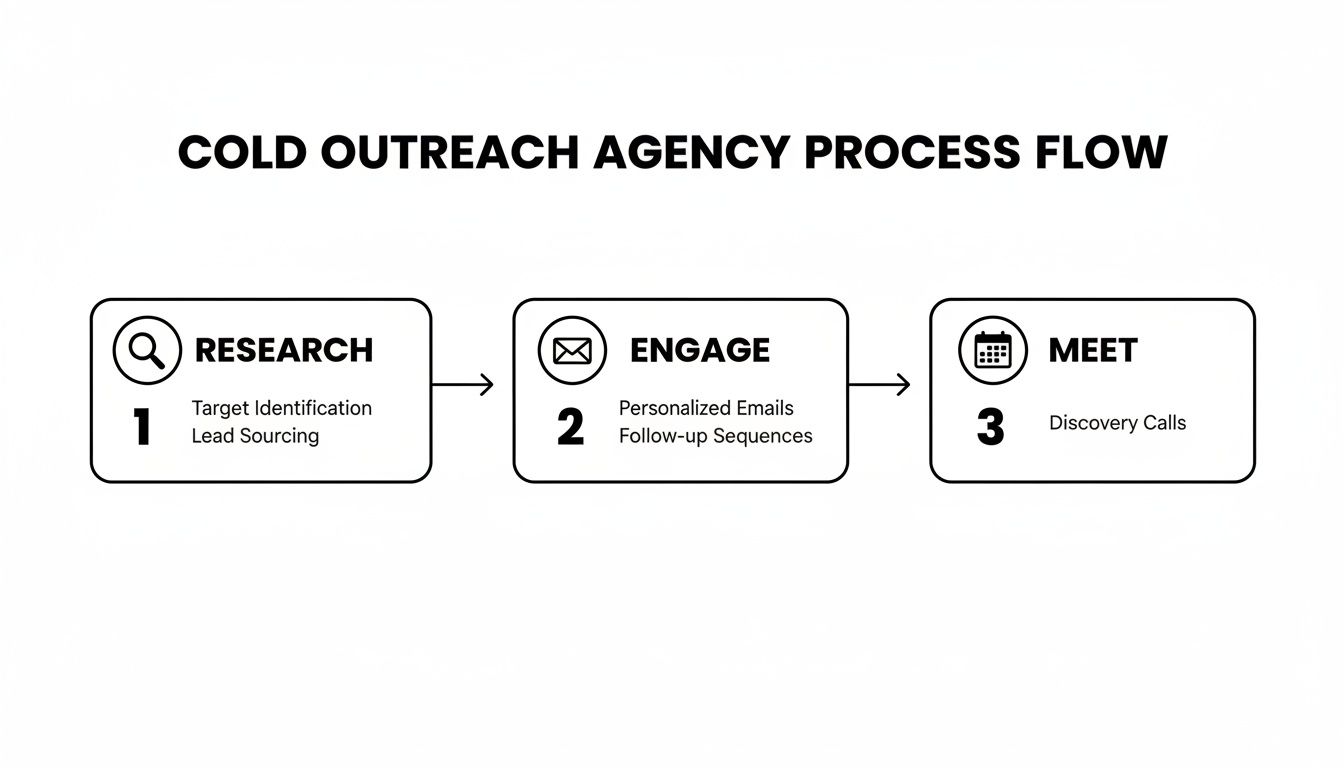
This image boils the agency’s workflow down to three key stages: researching the right people, engaging them with something compelling, and finally, booking the meeting. Every step logically flows into the next, all pointing toward that one goal.
Deep Dive and Technical Foundation
It all starts with a deep discovery phase. The agency needs to get inside your business and truly understand your Ideal Customer Profile (ICP). This is way more than just company size and industry. It’s about digging into the specific pain points, job titles, and internal triggers that scream “perfect-fit customer.” They’ll also dissect your value proposition to figure out the one core message that will actually make this audience sit up and listen.
Once that strategic blueprint is locked in, the work shifts to the technical foundation. This is the unsexy but critical step that most amateurs skip, and it’s the reason their emails end up in spam. Professionals know this setup determines everything.
Key technical setup includes:
-
Domain Warming: The agency will buy and “warm up” new domains just for your outreach. This means sending emails slowly and steadily to build a good reputation with providers like Google and Microsoft, proving you’re not a spammer.
-
DNS Configuration: They’ll meticulously set up the essential records - SPF, DKIM, and DMARC - for these domains. Think of these as digital handshakes that verify to the recipient’s server that your emails are legit.
-
Inbox Management: They create and manage multiple inboxes to handle the sending volume and keep a close eye on deliverability.
This behind-the-scenes work is what ensures your campaigns have the best possible shot at landing in the primary inbox. Hitting 95-98% deliverability is the gold standard for a professional agency.
The Art of List Building and Copywriting
With the infrastructure humming, it’s time to build the contact list. This isn’t about buying some huge, stale list and spraying and praying. It’s a surgical process, sourcing and verifying contacts who perfectly match the ICP we defined earlier.
To build those hyper-targeted lead lists, many agencies use a LinkedIn Profile Scraper to gather accurate data on roles and companies. This is a core part of their strategy, ensuring every email is as relevant as possible.
At the same time, expert copywriters are crafting the email sequences. These aren’t just single emails; they’re multi-touch campaigns designed to build a connection over several weeks. The copy is personal, conversational, and laser-focused on the prospect’s world - not your product features. Every word has a job to do: earn a reply.
An effective cold outreach agency understands that the goal isn’t to make a sale in the first email. The goal is to be so relevant and compelling that the prospect wants to have a conversation. It’s about earning attention, not demanding it.
Ongoing Optimization and Data Analysis
Launching the campaign is just the start. The real magic that separates a professional cold outreach agency from the rest is a relentless focus on data and optimization. The agency is constantly tracking key metrics and running A/B tests to improve every piece of the puzzle.
They’ll test variables like:
-
Subject lines to see what gets opened.
-
Email copy to see what earns a reply.
-
Calls-to-action to find out what actually books meetings.
-
Sending times and days to maximize engagement.
This data-driven approach is non-negotiable for success. While average B2B cold email response rates are often between 1-5%, the top performers can push past 10%. What’s fascinating is that while 58% of replies come from the first email, a massive 42% come from the next 4-7 follow-ups. Knowing this allows an agency to keep the conversation going while your team focuses on closing deals.
By constantly analyzing what’s working and what isn’t, the agency makes small tweaks that add up to big results over time. This is how they turn a good campaign into a great one, delivering that consistent pipeline of meetings you’re paying for. To see how this fits into a bigger picture, check out our guide on outbound cold email SDR-led demand generation.
Decoding Agency Pricing Models
Figuring out how a cold outreach agency charges for its work is a huge deal. The price tag isn’t just an invoice line; it’s a window into the agency’s confidence, how your goals and theirs line up, and where the financial risk really sits.
Not all payment structures are the same. Picking the right one can be the difference between a frustrating money pit and a predictable engine for growth. Let’s walk through the common models you’ll run into.
The Traditional Retainer Model
The classic agency model is the monthly retainer. You pay a set fee, usually somewhere between $3,000 to $10,000+ per month, and the agency runs your campaigns. This gives you a predictable monthly cost and gives the agency stable income.
Think of it like hiring a full-time employee. You’re paying for their effort, time, and access to their tools and knowledge, not necessarily for the immediate results they produce.
A retainer package will typically include:
-
A dedicated team: Your fee pays for the strategists, copywriters, and campaign managers working on your account.
-
Software and data costs: The agency rolls the cost of their tech stack for list building, sending, and tracking into your fee.
-
Defined activities: The contract will likely promise a certain volume of outreach, not a specific number of meetings.
The downside? It’s simple, but all the risk is on you. You pay the full fee whether the campaigns crush it or completely flop. Success hinges entirely on the agency’s skill and honesty, since their paycheck isn’t directly tied to booking you meetings.
The Performance-Based Revolution: Pay Per Meeting
A newer, and frankly, much more interesting model flips the entire script: pay-per-meeting. Here, you only pay the agency when they successfully book a qualified meeting for your sales team. This is the ultimate “put your money where your mouth is” deal.
This isn’t like a salaried employee; it’s like a commission-only salesperson. The agency gets rewarded only when they deliver a concrete result that fills your pipeline.
The pay-per-meeting model forces total alignment. The agency’s financial success is directly tied to your sales team’s calendar. If you don’t get qualified meetings, the agency doesn’t get paid.
This performance-first structure takes almost all the risk off your plate. The cost per meeting can vary a lot depending on your industry and how hard it is to reach your ideal customer, but it’s a predictable expense tied directly to an actual outcome. A professional cold outreach agency that uses this model will hammer out a crystal-clear definition of a “qualified” meeting with you, making sure you only pay for calls with real, potential customers.
Hybrid Models and Setup Fees
Some agencies try to find a middle ground. A hybrid model might have a small monthly retainer to cover their basic costs, plus a lower fee for each meeting they book. It can be a decent compromise, balancing the risk between you and the agency.
Also, keep an eye out for setup fees. Many agencies charge a one-time fee upfront to cover the initial strategy, tech setup, and list building. This is pretty common, but you need to be clear on what you’re getting for that fee. Some of the best performance-based agencies, like Fypion Marketing, have scrapped setup fees altogether to make the partnership 100% performance-driven from day one. You can get a better sense of how different firms structure their deals in this guide to choosing a lead generation agency.
At the end of the day, the right model comes down to your budget and how much risk you’re willing to take on. A retainer is straightforward, but a pay-per-meeting model brings true accountability and locks the agency’s goals firmly onto your own.
Benefits of Partnering with an Outreach Specialist
It’s a fair question: why would a company with its own sales team even think about hiring an outside firm for outreach? You’re already investing in your in-house people, so it can feel redundant.
The truth is, partnering with a cold outreach agency isn’t about replacing your team. It’s like installing a dedicated, pre-built growth engine right into your sales process. Instead of spending months building it from scratch, you get to flip a switch and see qualified meetings pop up on the calendar.
Launch Campaigns in Weeks, Not Months
The most obvious benefit is speed. Building an in-house outreach function is a slow, expensive grind. You have to post jobs, screen candidates, hire, onboard, train them, buy the right software, build lists… and then cross your fingers and hope it all works. This can easily eat up an entire quarter or more before you see a single meeting.
A good agency, on the other hand, already has the team, tools, and proven processes. They can go from your first strategy call to a live campaign in just a few weeks. For any business trying to hit aggressive growth targets, that time saved is a massive advantage.
Access Deep Niche Expertise Instantly
Real, effective cold outreach is so much more than just sending emails. It’s a craft that blends technical know-how, data science, and good old-fashioned persuasive writing. Most sales teams, even great ones, just don’t have this specific skillset.
When you work with a professional agency, you’re hiring a whole team of specialists:
-
Deliverability Experts: These are the technical pros who live and breathe email. They manage domain reputation and navigate spam filters to make sure your messages actually land in the primary inbox, aiming for deliverability rates of 95% or higher.
-
Data Analysts: Their job is to meticulously build and scrub your lead lists. They ensure every single person you contact is a perfect fit for your Ideal Customer Profile (ICP).
-
Expert Copywriters: They’re masters of starting conversations. They write and A/B test compelling, personalized copy that gets replies, not just pitches a product.
Trying to build this level of expertise in-house is not only difficult but also incredibly expensive. An agency gives you instant access to a team that has spent years doing nothing but mastering this one thing.
We once worked with a SaaS company whose account executives were spending 40% of their week just prospecting instead of closing deals. By bringing us in, they freed up their closers to focus entirely on revenue-generating conversations and doubled their sales pipeline in three months.
Achieve Greater Cost-Efficiency and Predictability
An agency fee might look like just another line item on your budget. But when you add up the true cost of hiring an in-house SDR, the math starts to look very different.
An internal SDR comes with a salary, benefits, and commissions, not to mention the costs of software, data subscriptions, and continuous training. All in, you can easily be looking at over $100,000 per year with zero guarantee of results.
An agency offers a predictable, and often performance-based, cost. Models like pay-per-meeting are especially efficient because you only pay for a concrete outcome - a qualified appointment booked with a real decision-maker. This shifts a fixed operational cost to a variable one that’s directly tied to your pipeline, taking a huge amount of risk out of your lead generation investment.
How to Choose the Right Cold Outreach Agency
Hiring someone to handle your outreach is a big deal. Get it right, and you’ve built a growth engine that keeps your sales pipeline full. Get it wrong, and you’ll burn cash, tarnish your brand, and end up with a calendar full of bad meetings.
This isn’t about hiring just another vendor. You’re looking for a strategic partner. A great cold outreach agency acts like a true extension of your team because they’re just as invested in your success as you are. To find that kind of partner, you have to look past the sales pitch and dig into their process, their transparency, and their track record.
Start with Proven Results and Relevance
The very first thing you should ask for is proof. Don’t just take their word for it. You need to see hard evidence that they can get results for a company just like yours. A few generic testimonials on their website won’t cut it.
Look for case studies that are specific and relevant to you:
-
Industry Alignment: Have they actually worked with other B2B SaaS or tech companies? Winning in e-commerce is a completely different ballgame than selling enterprise software.
-
Similar Deal Size: Do they have a history of generating leads for products with a similar price point and sales cycle? The approach for a $5k product is not the same as for a $100k one.
-
Matching Target Audience: Have they successfully reached the same kind of people you need to talk to, like VPs of Engineering or CFOs?
An agency that has already played in your sandbox knows the language, the pain points, and what makes your buyers tick. That experience is priceless and cuts the learning curve way down.
Scrutinize Their Process and Transparency
Any agency worth its salt will have a clear, documented process they’re happy to walk you through. If their methods feel like a “black box” or they get cagey when you ask for details, that’s a massive red flag.
You need to know exactly how they operate.
-
List Building and Data: How do they get their contact lists? Where does the data come from, and how do they verify it? A pro agency will have a multi-step process to check data accuracy and ensure compliance, keeping your spam complaint rate well below the 0.1% mark.
-
Technical Setup: Ask how they plan to protect your domain’s reputation. They should be setting up and warming up brand-new domains just for outreach. This insulates your main business domain from any risk.
-
Copywriting and Personalization: Ask to see some of their email copy. Does it sound like it was written by a human who did their homework, or does it feel like a generic template? Real personalization - way beyond a tag - can easily double your response rates.
The single most important thing to agree on is what makes a meeting “qualified.” Nailing this down prevents arguments later and makes sure you only pay for conversations with real, high-potential prospects.
This definition has to be written right into your contract. It should spell out specific criteria like company size, the prospect’s job title, and their explicit agreement to discuss a certain business need. For a deeper look at this, check out our guide on how to choose a top B2B lead generation agency.
Critical Questions to Ask Any Potential Agency
Once you’re talking to an agency, a good list of questions will help you cut through the sales fluff and see what they’re really made of. These questions are designed to test their expertise and their commitment to quality.
Core Evaluation Questions:
-
“What’s your exact process if a meeting doesn’t meet our agreed-upon quality criteria?” * A good partner will have a clear feedback loop and a plan to fix things immediately. They should never charge you for a meeting that misses the mark.
-
“How do you guarantee high email deliverability and protect our brand?” * Listen for answers that include domain warming, setting up DNS records (SPF, DKIM, DMARC), and inbox rotation. Their goal should be deliverability rates between 95% and 98%.
-
“Can you walk me through your reporting? What metrics do you track, and how often will we see them?” * They should give you regular, clear reports on the metrics that actually matter - like positive reply rates, meetings booked, and show-up rates - not just vanity metrics like open rates.
-
“How much work do you need from our team after we get started?” * This is all about setting expectations. A great agency handles the heavy lifting but will need your team’s feedback on meeting quality to keep refining the targeting.
Choosing the right cold outreach agency is a critical move for scaling your business. If you focus on relevant proof, demand total transparency, and ask the right questions, you can find a partner who will deliver real, measurable results.
Common Questions About Cold Outreach Agencies
Deciding to hire a cold outreach agency is a big step, even when you see the potential upside. It’s completely normal to have some questions - and maybe a healthy dose of skepticism. Let’s tackle the big ones head-on so you can move forward with confidence.
Here are the honest answers to the questions we hear most often from B2B leaders.
Is Cold Email Still Effective in 2026?
Yes, absolutely. You’ve probably heard the rumor that cold email is “dead,” but that’s a myth. What’s actually dead is the old way of doing it: blasting out thousands of generic, impersonal emails and hoping for the best.
Strategic, modern cold email isn’t just effective; it’s one of the most predictable B2B lead generation channels out there.
Success in 2026 and beyond is all about quality over quantity. This is where a professional cold outreach agency shines. They don’t just send emails; they run a sophisticated operation focused on:
-
Hyper-Targeting: Only reaching out to prospects who are a perfect fit for your Ideal Customer Profile (ICP).
-
Deep Personalization: Writing messages that prove they’ve done their homework and understand the prospect’s world.
-
Strategic Follow-Ups: Building multi-step sequences, because most replies don’t come from the first email.
-
Continuous Testing: A/B testing every single part of the campaign - from subject lines to the call-to-action - to squeeze out better results.
The secret is relevance. A highly relevant email that speaks directly to a real business pain will always cut through the noise. That’s the edge an expert agency provides.
What Is a Realistic Number of Meetings to Expect per Month?
This is the million-dollar question, and any agency worth its salt will give you the same answer: it depends. If a firm promises you a specific number without digging into your business first, that’s a huge red flag.
Setting realistic expectations is only possible after looking at a few key factors:
-
Your Industry: Some fields, like cybersecurity, are bombarded with outreach, which naturally leads to lower response rates.
-
Your Target Audience: Getting a meeting with a C-level exec at a Fortune 500 company is a different ballgame than contacting a manager at a mid-sized business.
-
Your Price Point and Offer: A complex, high-ticket enterprise solution requires a much more delicate touch than a simple, low-cost tool.
-
The Total Addressable Market (TAM): If you serve a tiny niche, the total volume of potential meetings is naturally going to be lower.
A good agency starts with a discovery process to understand these variables. For a specialized B2B SaaS product, locking in 5-10 highly qualified meetings a month could be a massive win. For a product with broader appeal, that number might be closer to 20-30+. The goal is a predictable forecast based on data, not empty promises.
How Is a Qualified Meeting Defined?
This might be the single most important question you can ask, especially if you’re considering a pay-per-meeting model. The definition of a “qualified” meeting is the foundation of your entire partnership. It has to be crystal clear and agreed upon before a single email goes out.
Otherwise, you risk paying for appointments with people who have zero chance of ever becoming a customer.
We call these criteria Sales Qualified Appointment (SQA) criteria.
A “qualified” meeting isn’t just a pulse on the other end of a Zoom call. It’s a pre-vetted conversation with a prospect who meets a strict set of criteria, ensuring your sales team’s time is spent only on high-potential opportunities.
For example, your SQA criteria might look something like this. A meeting is only “qualified” if it is with:
-
A VP of Engineering or Director of Product.
-
At a US-based SaaS company with over 100 employees.
-
Who has explicitly agreed to discuss their team’s current developer productivity challenges.
This level of detail creates perfect alignment. The agency knows exactly who to find, and you know you’re only paying for conversations that can actually lead to revenue. To get a better feel for the numbers behind this, check out our guide on the average cold email response rate and what it means for your pipeline.
Will Using an Agency Hurt My Domain Reputation?
This is a smart question and a very common concern. The short answer is no, a professional agency will not hurt your domain reputation - because they won’t be using your main business domain for outreach at all.
Any experienced agency will make protecting your domain their top priority. They build a firewall between their outreach and your day-to-day business by setting up and using completely separate domains.
Here’s how that process works:
-
Procuring New Domains: They’ll buy domains that look similar to yours (like or ).
-
Domain Warming: These new domains are then “warmed up.” They start by sending a few emails a day and slowly ramp up the volume, which builds a positive reputation with providers like Google and Microsoft.
-
Technical Configuration: They handle all the technical details, meticulously setting up records like SPF, DKIM, and DMARC to authenticate the emails and prove they aren’t spam.
-
Constant Monitoring: They keep a close eye on deliverability and spam complaint rates, making adjustments to make sure emails are landing in the primary inbox.
This methodical approach keeps your primary domain () completely pristine and shielded from any and all cold outreach activities.
At Fypion Marketing, we operate on a 100% pay-per-meeting model, ensuring our goals are perfectly aligned with yours. If you’re ready to build a predictable sales pipeline without the risk of retainers or setup fees, let’s talk.