
Master outbound + cold email + sdr-led demand generation in 2026.
Forget the noise about “cold email being dead.” That’s what people say when they don’t know how to do it right.
A scientific, outbound + cold email + SDR-led demand generation strategy is the single most predictable way to scale your B2B pipeline, especially if you’ve already found product-market fit. This isn’t about blasting a generic list and hoping for the best. It’s a disciplined process built on surgical targeting and smart execution.
The Unbeatable Engine of Modern B2B Growth
Think of this not as a campaign, but as a repeatable revenue machine. High-growth B2B companies and agencies like us at Fypion Marketing use a refined model to get results like 220% month-over-month lead growth. Success here isn’t an accident - it’s engineered. You build a system that consistently books qualified meetings on your sales team’s calendar.
This playbook is for sales directors and founders who need to see real pipeline movement now, not six months from now when inbound might kick in. By focusing on a tight process, you create a direct, reliable path straight to your best-fit customers.
The Four Pillars of Predictable Outreach
The whole system stands on four pillars. If one is weak, the entire structure wobbles. You’ll see low reply rates, hit spam folders, and waste a ton of time and money. Get all four right, and you turn cold contacts into warm conversations and closed deals.
-
Surgical ICP Definition: This goes way beyond basic personas. It’s about finding the companies with the exact problem you solve, right now.
-
Hyper-Personalized Messaging: We’re talking about crafting emails that get a response because they speak to a specific, timely pain point for that individual.
-
Flawless Technical Setup: Your brilliant email is useless if it lands in the promotions tab or, even worse, the spam folder. Deliverability is non-negotiable.
-
Intelligent Sequencing: It’s not just about sending follow-ups. It’s a strategic cadence designed to maximize engagement without ever being annoying.
This process flow shows how these four pieces - ICP, messaging, technical setup, and sequencing - fit together to create a smooth, effective SDR-led growth model.
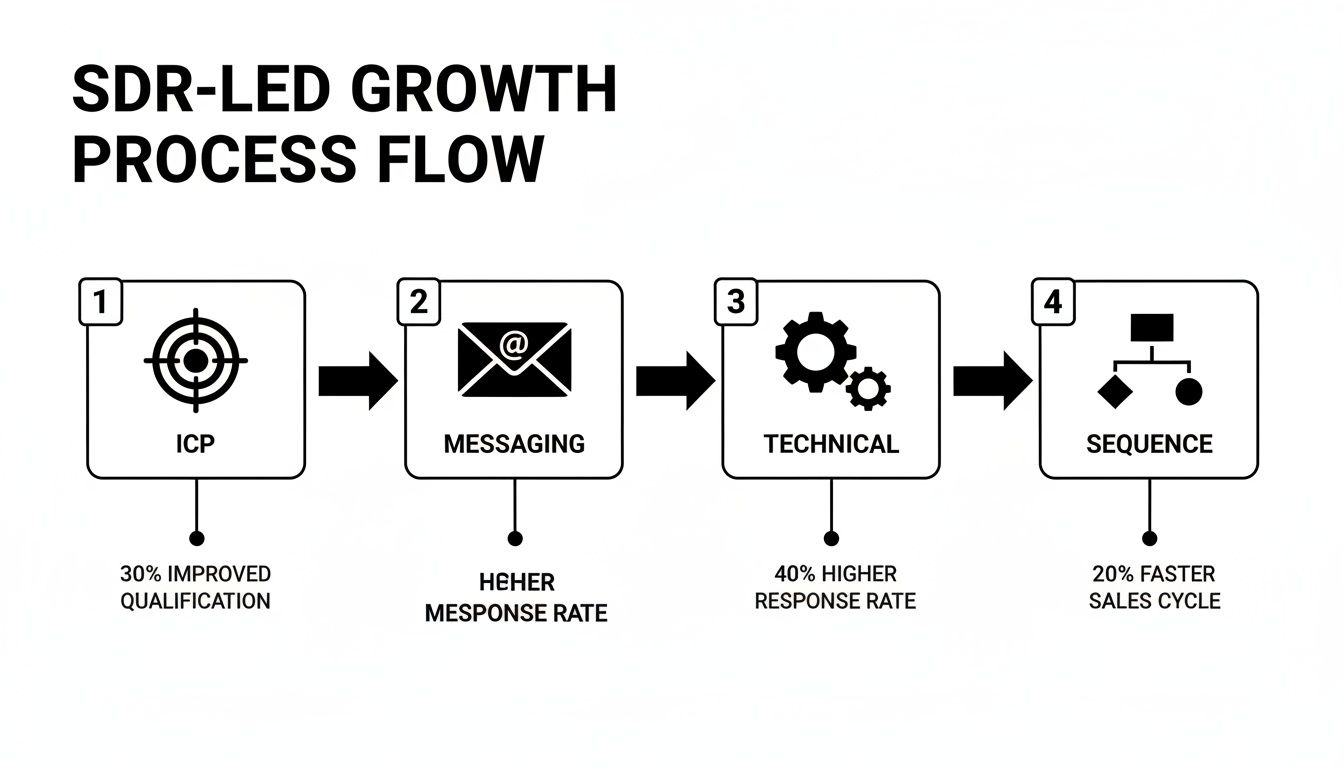
As the visual lays out, it’s a linear progression. Each step builds on the last, creating a powerful and repeatable workflow. Keep in mind, this SDR-led process is the critical first stage. To make sure your hard-won meetings turn into revenue, you also need to master how to create sales funnel strategies to convert that interest into scalable growth.
The goal isn’t just to send emails; it’s to start conversations. Every element, from your target list to your subject line, should be optimized for a single outcome: getting a positive reply from the right person.
Ready to stop guessing and start building a truly dependable sales pipeline? You can see the exact model we use in our complete lead generation blueprint to build a predictable B2B pipeline.
Building Your Foundation for High-Reply Campaigns
Let’s be blunt: your entire outbound strategy lives or dies by who you target. If you get this wrong, the most perfectly crafted email is just digital trash. A truly effective outbound + cold email + SDR-led demand generation program goes way beyond vague buyer personas and builds a surgical Ideal Customer Profile (ICP).
This isn’t just about company size or industry. It’s about finding the exact companies that are feeling the acute pain your solution solves. Before you write a single word, the first real step is to clearly define your ideal customer and get serious about how to find your target audience with precision.
Reverse-Engineer Your Happiest Customers
Your best future customers almost always look a lot like your best current ones. The smartest place to start is by analyzing your happiest, most profitable clients. Who are they, really? Forget the surface-level firmographics for a minute and dig into the nitty-gritty.
What was going on in their business right before they signed with you? Did they just land a new round of funding, hire a new VP of Sales, or launch into a new market? These “trigger events” are pure gold for your SDRs because they create an urgent and relevant reason to reach out right now.
Nailing down these details is how you build a ‘Tier 1’ ICP. This isn’t just some static list of companies; it’s a dynamic profile of organizations with the highest possible chance of becoming a customer.
Gather Actionable Firmographic and Technographic Data
Okay, so you have a clear picture of your ideal customer. Now it’s time to actually build a list of them. This means getting your hands on a mix of firmographic and technographic data points. Your SDRs need a dead-simple, efficient research process so they aren’t wasting hours on prospects who will never buy.
Here are the data points we obsess over:
-
Firmographics: Go deeper than just industry and employee count. Look at annual revenue, specific growth rates, and even the geographic footprint. A SaaS company targeting startups, for example, might focus only on companies with 10-50 employees that raised a Seed or Series A in the last six months.
-
Technographics: What tools are they already using? Knowing they use a direct competitor or even a complementary technology gives your SDRs a powerful, non-generic angle for their emails. Tools like BuiltWith or your data provider can pull back the curtain on a company’s entire tech stack.
-
Buying Signals: This is where the real-time opportunities are. Monitor job boards for key hires (like a “VP of Sales”), funding announcements on Crunchbase, and even negative reviews of your competitors. These signals tell you they have an active need and might be ready for a conversation.
Validate and Verify Your Data
A brilliant ICP and a perfectly researched list are completely worthless if your contact data is bad. It’s that simple. High bounce rates don’t just mean your SDRs are wasting their time; they actively destroy your domain’s sender reputation, which is fatal for any cold email program. Your bounce rate should always be below 3%.
This is exactly why we never, ever rely on a single data provider. The best-in-class approach is to use multiple sources and then run everything through a separate verification tool.
Never trust a list without verification. We cross-reference data from at least two providers (like Apollo.io and ZoomInfo) and then run every single email through a verification service before it enters a campaign sequence. This keeps our deliverability pristine.
Think about the specifics. An e-commerce brand’s ICP might be Direct-to-Consumer companies using Shopify with over $1M in annual revenue. A B2B SaaS company’s ICP, on the other hand, could be tech firms using both Salesforce and HubSpot that just hired their first Head of Marketing. That level of detail is what makes a difference. If you haven’t sorted out your tech setup yet, our guide on how to set up cold email infrastructure for high deliverability is a must-read.
The quality of your list has a direct, measurable impact on your reply rates. While 58% of replies come from that first email, a massive 42% come from follow-ups. And yet, an unbelievable 70% of campaigns don’t even send a single follow-up email. That’s a huge opportunity just left on the table. Building a clean, hyper-targeted list ensures your well-written sequences actually get seen, giving you a shot at engagement with every single touchpoint.
Crafting High-Performing Emails and Sequences That Convert
Once you have that hyper-targeted list of ideal customers, it’s time to send them something they’ll actually read. Make no mistake, the inbox is a battlefield. Success in outbound + cold email + SDR-led demand generation hinges on crafting messages that are sharp, relevant, and unmistakably human.
Any email that’s long, rambling, or all about you is getting deleted in seconds.
The entire game is about writing short, powerful emails that feel one-to-one, even when you’re sending them at scale. This is where you combine proven copywriting frameworks, smart personalization, and a strategic sequence to build an engine that starts real conversations.
Essential Cold Email Copywriting Frameworks
Proven formulas aren’t rigid templates; they’re guides to help you structure your thoughts and make sure your message hits home. We’ve found the most effective cold emails are almost always under 80 words.
Two frameworks consistently deliver for cold outreach:
-
AIDA (Attention, Interest, Desire, Action): This is a marketing classic for a reason. Grab their attention with a personalized hook, build their interest by touching on a relevant pain point, create desire by hinting at your solution’s impact, and then drive them to a clear, low-friction action.
-
PAS (Problem, Agitate, Solution): This one works wonders because it’s all about the prospect’s world. You start by identifying a problem you know they’re facing, agitate it by exploring its negative consequences, and then position your service as the clear and obvious solution.
No matter which framework you lean on, every single email must have one job. It needs to be laser-focused on one idea and one simple call-to-action (CTA).
The biggest mistake we see in cold email is asking for too much, too soon. Never ask to “book a meeting” in the first email. Ask for interest. A simple, “Worth exploring?” is infinitely more effective at getting a reply.
The Power of Hyper-Personalization
Generic emails get what they deserve: generic results, which usually means no results at all. Personalization is what slices through the noise. It proves you’ve done your homework and aren’t just blasting a list you bought for cheap.
This goes way beyond using the tag. Real personalization connects what you do to something specific and timely happening in their world. To get this right and seriously boost your reply rates, you need to master cold email personalization.
Here’s how to make your emails feel like they were written just for one person:
-
Cite a Trigger Event: “Saw on LinkedIn you’re hiring a new sales team. Scaling that quickly often brings challenges with pipeline consistency.”
-
Reference a Competitor: “Noticed you’re using [Competitor Tool]. We help companies like yours solve [Problem] that their platform doesn’t quite address.”
-
Mention Their Content: “Loved your recent article on [Topic]. Your point about [Specific Insight] really resonated, and it’s a big part of how we help leaders apply that thinking to their demand gen.”
This is the kind of detail that turns a cold email into a warm introduction. Your SDRs should have a dedicated block of time every single day just for this kind of deep-dive research.
Building a High-Converting Email Sequence
Here’s the reality: most prospects won’t reply to your first email. That’s why a smart, strategic sequence is absolutely non-negotiable. Persistence is key, but it has to be polite and add value with every single touchpoint.
A high-performing sequence usually involves 4-6 touchpoints spread out over a few weeks. The first email gets all the glory, but a massive chunk of your replies will come from the follow-ups. The numbers don’t lie: while the average cold outreach response rate is around 5.1%, a whopping 42% of all replies come from follow-up emails. You can discover more about B2B outreach trends on sopro.io.
Here’s a sample sequence structure that works:
-
Email 1 (Day 1): Your initial outreach. Keep it personalized, short, and focused on a single pain point with that low-friction CTA.
-
Email 2 (Day 4): The gentle “bump.” This is just a simple reply to your own email, asking if they had a chance to see your previous note.
-
Email 3 (Day 9): Bring new value to the table. Share a quick case study, a relevant resource, or attack the problem from a different angle.
-
Email 4 (Day 16): The breakup email. This is a professional and courteous way to close the loop. It often gets a surprisingly high reply rate from people who were interested but just got busy. Something like: “Since I haven’t heard back, I’ll assume this isn’t a priority right now. If that ever changes, you know where to find me.”
The key is to vary the timing and the content. Every follow-up should feel like a thoughtful nudge, not an automated nag. This methodical approach is how you maximize your chances of starting a conversation without ever burning your list.
SDR Workflows: Where Your Campaign Comes to Life
You can have the best strategy and the sharpest messaging in the world, but without disciplined execution, it all falls apart. The daily grind of your Sales Development Representatives (SDRs) is where your entire outbound + cold email + SDR-led demand generation machine either wins or loses.
A great SDR doesn’t just clock in and start firing off emails. They’re masters of their own time, running their day like a finely tuned operation.
The Power of a Time-Blocked Day
The biggest enemy of SDR productivity is constant context-switching. Jumping from research to writing to answering replies is a recipe for burnout and mediocre results. The pros know this, so they structure their day with dedicated time blocks. Their calendar isn’t a list of suggestions; it’s the law.
So, what does that look like in practice? A schedule built for deep work and high output usually breaks down like this:
-
Morning Block (9 AM - 11 AM) Research & Personalization: This is sacred time. SDRs are digging into their target accounts, looking for trigger events, finding the right people, and writing those killer, hyper-personalized opening lines for their top-tier prospects.
-
Late Morning Block (11 AM - 12 PM) Reply Management & Follow-ups: Time to tackle the inbox. This is when you handle the positive and neutral replies from previous days, answer questions, and nudge interested prospects toward booking that first meeting.
-
Afternoon Block (2 PM - 4 PM) New Outreach & Calling: Now it’s time to launch the new outreach that was prepped in the morning. This is also a perfect window for follow-up calls to people who’ve opened or replied but haven’t booked yet.
This kind of structure stops SDRs from getting stuck in a reactive loop, just answering whatever pops into their inbox. It turns them into proactive pipeline builders. If you’re just setting up this role, it’s worth understanding exactly what an appointment setter does and how they slot into this workflow.
Qualifying Leads Without the Old-School Friction
Not every “yes” is a good “yes.” A huge part of the SDR’s job is to make sure your Account Executives (AEs) are talking to high-potential prospects, not just anyone with a pulse. The old BANT (Budget, Authority, Need, Timeline) framework just doesn’t cut it anymore; it’s too rigid for how people buy today.
A lighter, more conversational version of MEDDIC is a much better fit for SDR qualification:
-
Metrics: What’s the number they are trying to move? (e.g., “We need to increase our lead-to-close ratio by 15%.”)
-
Economic Buyer: Who ultimately signs the check?
-
Decision Criteria: What are the must-haves for any solution they consider?
-
Pain: What’s the real-world business problem that’s making them look for a solution right now?
An SDR isn’t there to close a deal. Their job is to find enough Pain and a potential internal champion to justify an AE’s valuable time. Often, a simple reply confirming a relevant business pain is all the qualification you need to book that first call.
The Art of the SDR to AE Handoff
The moment a meeting gets booked is make-or-break. A sloppy handoff is one of the fastest ways to kill a deal before it even starts. It creates a clunky experience for the prospect, makes the AE look unprepared, and sends your no-show rate through the roof.
The goal is a seamless transition. The prospect should feel like they’re being passed from one expert to another, not starting over from square one. To pull this off, you need a non-negotiable handoff protocol.
Here’s a simple checklist to make sure every handoff is flawless and sets your AE up for success.
SDR to AE Handoff Checklist
| Handoff Step | Responsibility | Key Action/Information |
|---|---|---|
| Meeting Confirmation | SDR | Immediately send the calendar invite with a clear agenda, including all attendees. |
| Internal Handoff | SDR | Pack the CRM with context: the personalization hook, pain points discussed, the full email thread, and any other notes. |
| Pre-Call Prep | AE | Review all CRM notes and the prospect’s LinkedIn profile at least 24 hours before the call. No excuses. |
| Meeting Reminder | SDR/Automation | Send a quick, personalized reminder email the day before to confirm and keep the meeting top of mind. |
Following this process ensures your AE walks into that meeting armed with all the intel they need. They can have a strategic, high-level conversation from the jump, turning a “booked meeting” into a genuine, qualified sales opportunity.
Measuring What Matters to Drive Scalable Growth
A great outbound + cold email + SDR-led demand generation strategy is only as good as the numbers you use to steer it. Without the right data, you’re just guessing. Focusing on the right analytics is what separates a program that fizzles out from a revenue engine that truly scales.
Too many sales directors get hung up on vanity metrics. Let’s be clear: open rates are mostly useless. They’re unreliable and tell you nothing about a prospect’s real intent. It’s time to look past them and dial in on the numbers that actually lead to pipeline and closed deals.
Core Metrics for Your SDR Dashboard
Your analytics dashboard should give you the whole story in a single glance. It needs to track the entire journey, from that first cold email to a held meeting. This isn’t just about keeping SDRs accountable; it’s about spotting bottlenecks in your process before they derail your quarter.
Here are the essential KPIs that we live by:
-
Positive Reply Rate: This is our north star for messaging. We’re not talking about just any reply - we mean clear, positive interest. A healthy positive reply rate, which should be 3-5% or even higher, tells you that your targeting and your copy are resonating.
-
Meeting Booked Rate: This is the direct output of your SDR team’s work. It’s the percentage of prospects you target that turn into a booked discovery call. This metric is a pure measure of their ability to turn interest into a concrete next step.
-
Meeting Held (Show-Up) Rate: A booked meeting means nothing if the prospect ghosts you. Tracking this reveals how solid your handoff process and pre-meeting nurture are. If your show-up rate dips below 80%, it’s a red flag that something is broken in the handoff or that the lead quality is low.
-
Pipeline Generated: This is the one that really counts. It’s the total dollar value of the sales opportunities your SDRs create. This is the number that connects your team’s daily grind directly to revenue and proves the ROI of the whole operation.
Don’t let your team celebrate a high open rate. Celebrate a high positive reply rate. One is a guess, the other is a conversation. One is vanity, the other is pipeline.
These numbers are your foundation. If you want to dig even deeper, check out our guide on the 8 essential lead generation KPIs and metrics for 2026 that every sales director should have on their radar.
The Continuous Optimization Loop
The best outbound teams I’ve seen are never fully satisfied. They are constantly testing, learning, and iterating. This data-driven cycle is how you find those small, consistent wins that compound into massive results over time.
This means you have to run disciplined A/B tests. Don’t just change things on a whim. Isolate one single variable and let the test run until you have a statistically significant result, which for us is a minimum of 1,000 sends per variation.
Your testing roadmap should look something like this:
-
Subject Lines: Try a benefit-driven subject line against one built on curiosity.
-
Body Copy: Pit a super short, punchy email against a longer version with more context.
-
Call-to-Action (CTA): Compare a soft CTA like “Worth a look?” against a more direct ask like “Have time to chat next week?”.
This methodical approach turns your outreach from a guessing game into a science. You stop working on assumptions and start making decisions based on real data. That’s how you build a predictable forecasting model and scale your demand generation with confidence.
Your SDR-Led Outbound Questions Answered
When you’re diving into building an outbound engine fueled by SDRs and cold email, a few key questions always come up. We hear them all the time from sales directors and founders.
Here’s the straight talk on the most common hurdles you’ll face, with answers pulled directly from our experience in the trenches.
How Many Emails Can an SDR Safely Send?
The magic number is between 30 to 50 new, personalized cold emails per SDR, per day. Anything more, and you’re sacrificing quality for a volume game you can’t win.
This isn’t about blasting out as many emails as possible - that’s the fastest way to get your domain torched. The goal is to give your SDR enough breathing room for proper research and genuine personalization. It all starts with a properly warmed-up domain and a slow, deliberate ramp-up schedule to protect that sender reputation.
What Is the Ideal Tech Stack for a New SDR?
You don’t need a bloated, expensive tech stack right out of the gate. Keep it lean and focused on the essentials.
-
Email Sending Tool: Grab a platform like Instantly or Smartlead. They’re built for managing multiple inboxes and automating your sequences.
-
Data Provider: Use a tool like Apollo.io to build your lists. This is where you’ll find contacts that match your ideal customer profile.
-
Verification Service: Don’t even think about skipping this. A service like NeverBounce is non-negotiable for keeping your bounce rate under the critical 3% threshold.
Your tech should support your workflow, not create more work. Master the fundamentals of building a great list and writing a compelling message first. Only add new tools when you hit a specific roadblock that needs solving.
How to Stay Compliant with CAN-SPAM and GDPR in 2026
Compliance feels intimidating, but it’s straightforward if you stick to the rules of the road. For B2B outreach, CAN-SPAM is simple: every single email needs your physical address and an obvious unsubscribe link. No exceptions.
GDPR is all about “legitimate interest.” This is a fancy way of saying your outreach needs to be targeted and genuinely helpful to the person you’re emailing. If you’re solving a real business problem for them, you’re generally in the clear. And, of course, always honor unsubscribe requests instantly and keep your data clean.
Ready to scale your pipeline without the guesswork? Fypion Marketing delivers qualified, sales-ready meetings on a pay-per-performance basis, so you only pay for results. Learn more about our process at Fypion Marketing.