
Your Guide to Hiring a Lead Generation Agency
Think of a lead generation agency as a specialized unit for your sales team. They’re the experts who handle the tough, time-consuming job of finding and qualifying potential customers, so your sales reps can do what they do best: close deals.
They fill the top of your sales funnel, giving your team a steady stream of interested prospects to talk to.
What a Lead Generation Agency Actually Does

Building a predictable sales pipeline is the holy grail for any B2B company. It’s also one of the hardest things to get right. Too many sales directors get stuck in a feast-or-famine cycle, where the lead flow is a rollercoaster of highs and lows.
This is exactly the problem a good lead generation agency solves. They aren’t generalists; they’re masters of one thing: starting conversations with your ideal customers. Your sales team are the closers, but an agency handles the critical, top-of-funnel work that often gets pushed aside.
An Extension of Your Growth Engine
Think about your best salesperson. Their calendar is probably booked solid with demos, follow-ups, and contract talks. The last thing you want is for them to spend half their day digging through LinkedIn or building prospecting lists. Their highest value is in conversations with qualified buyers.
A lead generation agency does that initial heavy lifting. They operate as an extension of your own team, completely dedicated to finding, engaging, and qualifying leads before they ever land on your sales team’s calendar. It’s a smart division of labor that lets everyone play to their strengths.
An agency’s real job is to build a predictable, repeatable system for growth. They turn prospecting from a sporadic, manual chore into a well-oiled machine that consistently feeds your sales pipeline.
This kind of systematic approach is no longer a luxury. The B2B lead generation industry is set to be worth a staggering $295 billion by 2027. This boom is driven by a simple fact: 61% of marketers say generating quality leads is their single biggest challenge.
How They Get Results
A professional agency doesn’t just blast out random emails. They build and run a full-stack strategy from the ground up.
Here’s what that typically involves:
-
Deep Market Research: Pinpointing your Ideal Customer Profile (ICP) and the specific people (buyer personas) you need to talk to.
-
Targeted List Building: Creating clean, accurate lists of decision-makers who fit that exact profile.
-
Technical Campaign Setup: Managing the infrastructure for outreach, like setting up separate domains and email inboxes to protect your primary brand’s reputation and deliverability.
-
Crafting the Message: Writing and testing outreach copy that actually gets read and sparks a reply.
-
Execution and Optimization: Launching the campaigns and obsessively tracking the data to improve response rates and the quality of leads over time.
When you outsource these tasks, you’re not just getting more hands on deck. You’re getting a team with proven processes and deep expertise. Building this kind of capability from scratch in-house is slow and expensive - it means hiring, training, and managing an entirely new team.
For most B2B SaaS companies, partnering with a specialized agency is simply the fastest path to scalable growth. If you want to dive deeper, check out our guide on how B2B lead generation services can help you find your best customers.
Exploring the Main Lead Generation Services
Not every path to a new customer looks the same. A real lead generation agency won’t just throw a generic strategy at you. Instead, they’ll dig into your specific goals, market, and ideal customer to pick the right tool for the job. Getting a handle on these core services is your first step to finding a partner who actually knows what they’re doing.
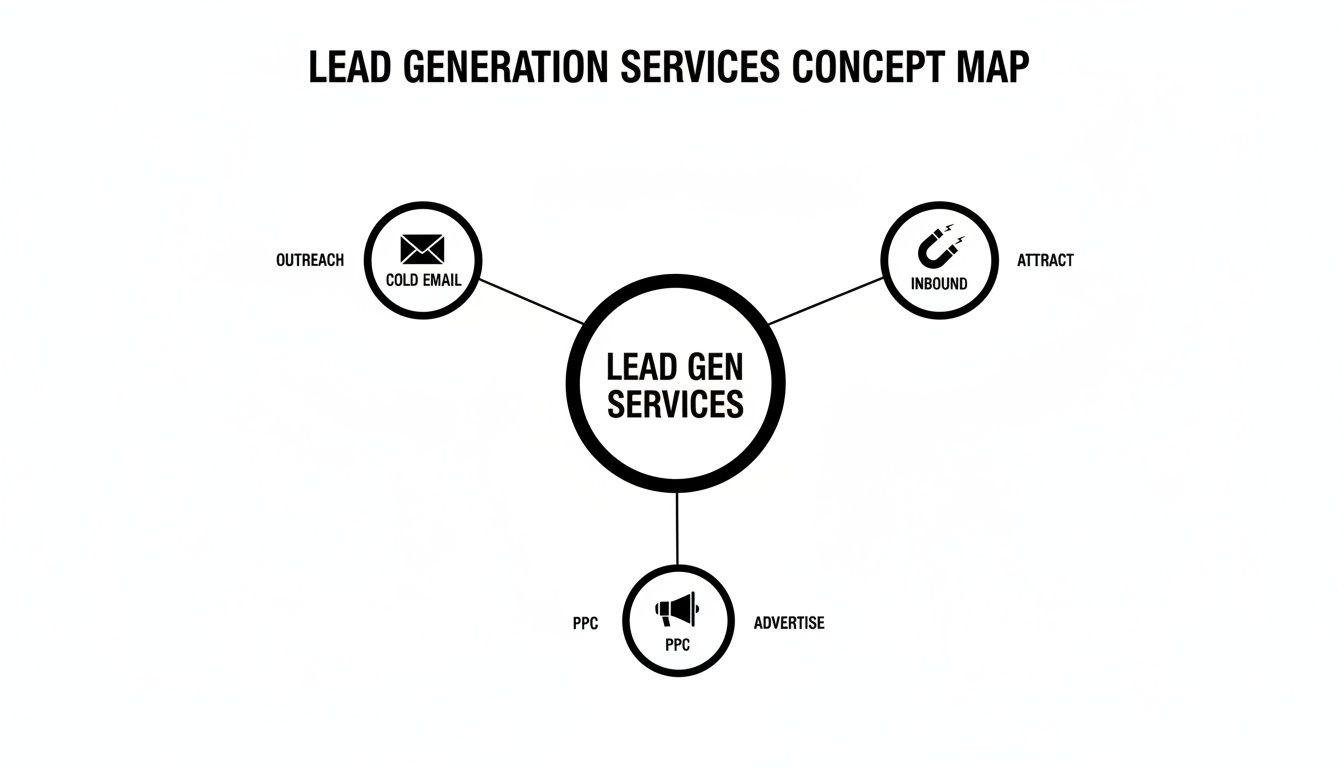
Think of it like fishing. You could cast a massive net into the open ocean and see what you get (that’s your PPC). You could set carefully baited traps along a route you know the big fish travel (cold email). Or, you could create such an irresistible food source that the fish come right to your boat (inbound marketing). Each one works, but the best method depends entirely on what you’re trying to catch.
To help you understand the landscape, we’ve put together a quick comparison of the most common approaches. This table breaks down what each service is, what it’s best for, and how quickly you can expect to see results.
Comparing Common Lead Generation Services
| Service Type | Primary Channel | Best For | Time to Results |
|---|---|---|---|
| Cold Email | B2B SaaS with a clear, defined audience. | Fast (Weeks) | |
| Inbound/SEO | Website & Search Engines | Building long-term authority and trust. | Slow (Months) |
| PPC Ads | Google, Bing | Companies that need leads now. | Immediate (Days) |
| Paid Social | LinkedIn, Facebook, X | Niche targeting and brand awareness. | Fast (Days to Weeks) |
Each of these channels has its place, but the execution is what separates a successful campaign from a money pit. Let’s dive a little deeper into what these services actually involve.
Cold Email Outreach
Cold email is the most direct and, when done right, one of the most powerful B2B strategies out there. This isn’t about spamming a purchased list. It’s a methodical process of finding the right people at the right companies and sending them personalized messages to start a real conversation.
A top-tier agency manages the entire workflow for you:
-
List Building: They don’t buy stale, overused lists. They build custom, verified lists of contacts who fit your Ideal Customer Profile (ICP), making sure you’re only talking to people who matter.
-
Personalization: Messages aren’t just generic templates. They’re tailored with specifics like the prospect’s name, company, and role, often referencing a recent company win or industry trend to show you’ve actually done your homework.
-
Sequence Management: One email is almost never enough. A good agency builds multi-step sequences with smart, automated follow-ups to stay on their radar without being annoying.
This approach is perfect for B2B SaaS companies with a crystal-clear audience. When your sales team needs to talk directly with VPs of Engineering at Series B tech firms, cold email cuts right through the noise. If this is your focus, digging into what appointment setting is will show you how to turn that outreach into actual, qualified meetings.
Inbound Marketing and SEO
While cold email is about going to your customer, inbound is all about attracting them to you. The entire strategy revolves around creating genuinely useful content that solves your prospects’ problems and answers their questions. When they go looking for solutions, they find you.
Inbound marketing is a long-term play. You’re building a powerful brand asset - a “knowledge library” that works for you 24/7, pulling in high-intent leads who are already searching for what you do.
This service usually involves a few key activities:
-
Content Creation: Writing the blog posts, white papers, and case studies that address the exact pain points of your target market.
-
Search Engine Optimization (SEO): Fine-tuning your website and content so you show up on the first page of Google when prospects search for keywords you care about. A staggering 75% of users never click past the first page, so ranking is everything.
-
Lead Capture: Using smart forms, calls-to-action (CTAs), and dedicated landing pages to turn those anonymous website visitors into actual leads.
Inbound is a fantastic fit for businesses where prospects do a lot of research before they buy. It builds trust and establishes your authority over time, delivering highly qualified leads who already view you as an expert.
Pay Per Click Advertising
Pay-per-click (PPC) advertising is the fast lane of lead generation. Platforms like Google Ads let you put your message right in front of people who are actively searching for your product or service at this very moment. You bid on keywords, and you only pay when someone actually clicks your ad.
This method gives you incredible control. You can set precise daily budgets, target specific cities or countries, and see results almost immediately. A good PPC agency will obsess over:
-
Keyword Research: Finding the search terms that signal real buying intent.
-
Ad Copywriting: Writing sharp, compelling ads that people can’t help but click.
-
Landing Page Optimization: Making sure the page they land on is built to convert visitors into leads.
-
Bid Management: Constantly tweaking bids to maximize your return on ad spend (ROAS).
PPC is a killer strategy for companies that need leads quickly and have a clear, high-value offer. If you know a new customer is worth $5,000, you can confidently spend a fraction of that to acquire them through highly targeted ads. Many agencies now even use a lead generation chatbot on these landing pages to engage prospects instantly and drive up conversion rates.
Paid Social Campaigns
Paid social is similar to PPC, but the game is played in a totally different arena. Instead of targeting people based on what they’re searching for, you target them based on who they are - their demographics, interests, job titles, and online behavior on platforms like LinkedIn, Facebook, and X (formerly Twitter).
For B2B, LinkedIn is an absolute powerhouse. A skilled agency can run campaigns that:
-
Promote valuable content to a hand-picked audience of professionals.
-
Send personalized InMail messages directly to key decision-makers.
-
Retarget people who visited your website to keep your brand top-of-mind.
Paid social is incredibly effective for building brand awareness and zeroing in on niche professional audiences that are almost impossible to reach any other way. You get to put your message directly into the feeds where your ideal customers are already scrolling every day.
How Lead Generation Agencies Structure Their Pricing
Figuring out how a lead gen agency charges for its work is just as critical as knowing what they actually do. An agency’s pricing model tells you a lot about their confidence, their process, and most importantly, where the financial risk falls - on your shoulders or theirs.
Getting this right is about more than just the invoice. It’s the foundation of your partnership. The right model ensures everyone is pulling in the same direction, focused on the only thing that matters: real business growth.
Let’s break down the three most common pricing models you’ll come across.
The Monthly Retainer Model
The most old-school approach is the monthly retainer. You pay a flat fee every single month for a pre-agreed scope of work. It’s a familiar structure you’ll see across all kinds of professional services, not just lead generation.
The main upside here is predictability. You know exactly what you’re spending each month, which makes your finance team happy. The agency gets a steady income, so they can assign a dedicated team and resources to your account.
But here’s the rub: the retainer model creates a huge gap between what you pay and what you get. You fork over the same fee whether the agency delivers 50 qualified leads or just 5. They get paid for their effort, not for the outcome.
This structure puts almost all of the financial risk squarely on you.
The Pay Per Lead (PPL) Model
A more results-focused option is the Pay-Per-Lead (PPL) model. With this setup, you pay a set price for every single lead the agency sends your way. On the surface, it sounds like a much better deal since you’re paying for something tangible.
This model can work for high-volume, low-contract-value sales where the main goal is just to stuff the top of your funnel with as many contacts as possible.
The big catch with PPL is how you define a “lead.” If that definition isn’t airtight and ruthlessly enforced, agencies have a huge incentive to focus on quantity over quality. They can just dump a list of contacts on you to hit their quota.
This is how your sales team ends up wasting their days chasing down prospects who are a terrible fit, which kills morale and tanks efficiency. For PPL to have any chance of working, you need a rock-solid, mutually agreed-upon definition of a sales-qualified lead (SQL).
The Pay Per Meeting Model
The most aligned and, frankly, the most logical pricing structure is the Pay-Per-Meeting model. You only pay when an agency successfully books a qualified meeting directly onto your sales team’s calendar. This is performance-based pricing in its purest form.
This model flips the entire risk dynamic. The burden is no longer on you - it’s on the agency to perform. They don’t see a dime until they deliver a genuine sales opportunity that meets your exact criteria. It forces them to be completely bought into your success.
They have to master every part of the process, from outreach to qualification, to get paid.
For a B2B SaaS company, a qualified meeting is the single most valuable asset a lead generation campaign can produce. It’s not just a name in a CRM; it’s a scheduled conversation with a decision-maker who is actively interested in solving a problem you can fix.
The pay-per-meeting model ensures your agency is laser-focused on delivering exactly that. To see how this works in practice, you can learn more about how pay-for-performance marketing aligns agencies with real revenue goals.
Measuring the Metrics That Actually Matter

Success with a lead gen agency isn’t about getting a full inbox - it’s about building a full pipeline. You have to look past the fluffy numbers and focus on what actually moves the needle for your business.
When you bring an agency on board, you’re not paying them for busywork. You’re paying for results. The right Key Performance Indicators (KPIs) show you if the partnership is driving real growth or just spinning its wheels.
Moving Beyond Vanity Metrics
It’s easy to get distracted by big numbers that sound impressive but don’t mean a thing. An agency might brag about sending 10,000 emails, but if none of them lead to a conversation, what have you actually paid for?
You have to know the difference between activity and impact.
-
Activity Metrics: This is the “effort” stuff, like emails sent or calls made. It’s useful for seeing what’s happening, but it doesn’t tell you if it’s working.
-
Impact Metrics: This is about results - qualified meetings booked and pipeline generated. This is where your focus should be.
Focusing on impact forces everyone to work toward the only goal that matters: revenue.
Defining Your Qualified Leads
This is probably the most important step. You and your agency need a crystal-clear, shared definition of what a “qualified” lead is. This is how you avoid the classic problem of getting a list of junk contacts that waste your sales team’s precious time.
You’ll generally deal with two types of leads:
-
Marketing Qualified Lead (MQL): This is someone who has shown some interest, maybe by downloading an ebook. They fit a few basic criteria but aren’t ready to talk to sales yet.
-
Sales Qualified Lead (SQL): This is a contact who has been properly vetted, fits your Ideal Customer Profile (ICP), has a real need, and is ready to have a sales conversation. For most B2B SaaS companies, an SQL is a booked appointment.
The handoff from MQL to SQL is where most agency partnerships fall apart. A great lead generation agency skips the MQL noise and focuses on delivering SQLs - or even better, booked meetings - because that’s what your sales team can actually use.
Core KPIs to Track with Your Agency
Once you agree on what a good lead looks like, tracking the right KPIs becomes simple. These are the numbers that give you a true picture of your campaign’s health and ROI.
-
Appointment Setting Rate: What percentage of positive replies turn into a booked meeting? A high rate here means the agency isn’t just getting interest; they’re converting that interest into a real sales opportunity.
-
Cost Per Acquisition (CPA): This is your total campaign spend divided by the number of new customers you actually sign. It takes a while to measure, but it’s the ultimate test of whether the partnership is profitable.
-
Pipeline Velocity: How fast do leads move from the first touchpoint to a closed deal? A good agency delivers high-intent leads that move through your pipeline faster, shortening your sales cycle.
By focusing on these performance-based KPIs, you build a transparent relationship with your agency that’s all about results. To go even deeper, check out our guide on mastering lead gen KPIs for business growth.
How to Choose the Right Agency Partner

Picking a lead generation agency is a huge decision. Get it right, and you’ve built an engine for predictable growth. Get it wrong, and you’ll burn through your budget with almost nothing to show for it.
Think of it like hiring a key executive. You wouldn’t just glance at their resume and make an offer. You’d dig into their performance, check references, and ask some tough questions to see if they really have what it takes. The same level of diligence applies here.
This isn’t about finding the cheapest option. It’s about finding a partner who has real skin in the game - someone whose success is tied directly to yours.
Look for Specialization and Industry Fit
Generalist agencies that serve everyone are a dime a dozen. For a B2B SaaS company, a specialist is almost always the right call.
An agency that lives and breathes tech will already get you. They’ll understand your buyers, speak your language, and know the nuances of your sales cycle from day one. You won’t have to waste time explaining what ARR is or why selling to a CTO is a completely different ballgame than selling to a marketing manager.
This specialization has a massive impact on results. It means they can write better copy, build smarter prospect lists, and book higher-quality meetings right out of the gate.
A specialized agency has already made the expensive mistakes on someone else’s dime. You’re paying for a refined process, not for them to learn your industry from scratch.
When you’re talking to a potential agency, get straight to the point and ask:
-
What percentage of your clients are in B2B SaaS or tech?
-
Can you show me a few campaigns you’ve run for companies like ours?
-
How do you change your approach for a technical audience versus a business one?
Their answers will tell you everything you need to know about whether they can handle your market.
Verify Their Track Record with Case Studies
Talk is cheap. Results are not. Any agency worth its salt will have case studies and client testimonials ready to go, but you need to do more than just read the highlights.
A good case study isn’t just a glowing review; it’s a story. It should walk you through the client’s problem, the agency’s strategy, how they executed it, and - most importantly - the specific, measurable results.
Look for hard numbers:
-
Meetings Booked: How many qualified appointments did they actually generate each month?
-
Pipeline Value: How much new sales pipeline did their work create?
-
Lead Quality: What was the meeting show-up rate? What percentage turned into real, qualified opportunities?
Even better, ask if you can chat with one or two of their current clients. A quick 15-minute call with a real customer will give you more insight than any polished PDF ever could. If you want to see how different providers compare, it’s worth reviewing a list of the top B2B lead generation agencies for 2025.
Agency Evaluation Checklist
To help you stay organized, use this checklist to compare your options. It’s a simple way to make sure you’re looking at each potential partner through the same lens and not missing any critical details.
| Evaluation Criteria | What to Look For | Red Flags |
|---|---|---|
| Industry Specialization | Deep experience in B2B SaaS or your specific tech niche. They understand your buyer personas and sales cycle. | They are generalists who work with “any business.” They can’t provide relevant client examples. |
| Proven Track Record | Detailed case studies with hard numbers (meetings, pipeline, close rates). Willingness to provide client references. | Vague testimonials without specific metrics. Hesitation to connect you with current clients. |
| Process Transparency | A clear, documented process for everything from research and list-building to outreach and reporting. | They can’t articulate their step-by-step methodology. Their “process” sounds like a black box. |
| Pricing Model Alignment | Performance-based models (pay-per-meeting, rev-share) that align their success with yours. | Pushing for long-term, fixed retainers with no performance guarantees. The risk is all on you. |
| Reporting and Data Access | You get full access to a real-time dashboard and receive regular, easy-to-understand performance reports. | They are cagey about data or provide only high-level summary reports without direct access. |
| Team and Expertise | You know who will be working on your account and they have demonstrable expertise. The sales team isn’t just a front. | You only speak to a slick salesperson and have no access to the actual team that will run your campaigns. |
This isn’t just about ticking boxes. It’s about finding a partner you can trust to become a true extension of your team and drive the kind of growth you’re looking for.
Red Flags to Watch Out For
Knowing what to look for is only half the battle. You also have to know what to run from. Some warning signs practically scream that an agency is more interested in your contract than your results.
Here are four major red flags to keep on your radar:
-
Vague Promises or Guarantees: Be skeptical of anyone promising to “double your revenue in 90 days.” Real lead generation is a methodical process of testing and optimizing, not a magic trick.
-
Lack of a Clear Process: If they can’t walk you through their step-by-step system for finding prospects, reaching out, and qualifying them, it’s because they don’t have one. Pros have a well-oiled machine.
-
No Access to Data: Transparency is non-negotiable. You should have 24/7 access to campaign dashboards and get clear, regular reports. If an agency is secretive about performance metrics, it’s a bad sign.
-
Misaligned Pricing Models: If an agency is hard-selling a long-term retainer with zero performance incentives, all the risk is on you. The best partners, like Fypion, tie their fee directly to the results they deliver, like qualified meetings booked.
Common Questions Before You Hire an Agency
So you’ve done your homework and narrowed down your list of potential agencies. But before you sign on the dotted line, it’s completely normal to have a few last-minute questions. Handing over part of your sales process is a big deal, both in terms of trust and budget.
Let’s cut through the noise and get straight to the practical questions we hear all the time from B2B founders and sales leaders.
How Long Until We Actually See Results?
This is usually the first question out of the gate, and for good reason. The honest answer? It depends. Different strategies bring different results at different times. A well-aimed PPC campaign, for instance, can start bringing in clicks and form fills within a few days. You get that instant feedback loop.
But building a truly predictable pipeline with something like cold email or inbound marketing is more of a long game. The first month is all about testing, learning, and gathering data.
Think of it this way: early metrics like open rates or positive replies are just smoke signals. They tell you you’re heading in the right direction. The results that actually matter - qualified meetings booked on your calendar - really start to stack up in month two and beyond as the agency dials in its approach.
A good partner will be upfront about this. They’ll be clear about the difference between early “activity” and the revenue-driving outcomes you’re actually paying for.
What Is a “Qualified Lead,” Really?
Getting this definition right is one of the most critical parts of the entire partnership. A “lead” can be just a name and an email scraped from a list. A qualified lead, on the other hand, is a person who has been measured against a strict set of criteria that you and the agency agree on before a single email is sent.
This is how you protect your sales team’s time and make sure they’re only talking to people who can realistically buy from you.
Any agency worth its salt will define a qualified lead with crystal-clear parameters, like:
-
Industry: Are they in your target verticals (e.g., FinTech, SaaS, HealthTech)?
-
Company Size: Do they hit your target employee count or annual revenue?
-
Job Title: Is the contact a decision-maker with buying power (e.g., VP of Sales, Head of Engineering)?
-
Need and Intent: Have they shown interest in solving a problem your product fixes?
For a performance-based agency like us, this definition is everything. In a pay-per-meeting model, a lead only becomes “qualified” - and billable - when they check every single one of these boxes and agree to a call.
Does This Mean I Don’t Need My Sales Team Anymore?
Absolutely not. A great agency makes your in-house team more valuable, not redundant. You’re not replacing your closers; you’re giving them an elite support system so they can focus on what they do best.
Think of it like a pro sports team. Your sales reps are the star players who score the goals. The agency is the scouting team that finds the top talent and gets them ready for the big leagues.
This partnership creates a powerful division of labor:
-
The Agency: Owns the entire top of the funnel. They handle the prospecting, the list building, the outreach, and the initial qualification to book the meeting.
-
Your Sales Team: Owns the bottom of the funnel. They step in when a qualified meeting is already on their calendar, dedicating 100% of their time to running demos, building relationships, and closing deals.
This model frees your most expensive resources - your expert sales reps - from the time-sucking grind of cold prospecting. They get to spend their days having high-value conversations instead of digging for email addresses. That’s how you boost efficiency and drive serious revenue.
Ready to stop wasting time on prospecting and start spending it on closing? At Fypion Marketing, we specialize in a pay-per-meeting model that puts all the risk on us. You only pay for qualified meetings booked directly on your sales team’s calendar. Book a free consultation with Fypion Marketing today and see how we can build your pipeline.