
Effective Lead Generation in B2B for Business Growth
Let’s be honest, “B2B lead generation” sounds like a stuffy, corporate buzzword. But what does it actually mean for your business?
Simply put, lead generation in B2B is the art of finding and attracting potential business customers for whatever you sell. It’s the very first, and most critical, step in building a healthy sales pipeline. Instead of just hoping for the phone to ring, you’re systematically identifying companies that have a problem your product or service can fix.
So, What Does B2B Lead Generation Really Mean?
Forget the dry, textbook definitions for a second. Think of it like this: B2B lead generation is like building a sophisticated irrigation system for your business. You’re not just spraying a firehose of marketing messages everywhere and hoping for the best. Instead, you’re building smart, strategic channels that deliver exactly the right amount of attention to your most promising prospects - your future customers.
Done right, this process completely flips the script. Your business goes from one that desperately chases after any potential deal to one that methodically attracts the right kind of opportunities. It’s all about creating a predictable, steady flow of qualified meetings, ensuring your sales team always has a full dance card. In that sense, B2B lead generation isn’t just a marketing task; it’s the engine that powers sustainable growth.
The Sales Funnel: A Practical Map for the Customer Journey
To really get a handle on how this works, we use a simple framework called the sales funnel. This model helps visualize a customer’s journey, starting from the moment they first hear about you all the way to when they sign on the dotted line.
Each stage of this journey requires a different touch to keep their interest and gently guide them toward making a decision.
-
Awareness: This is the top of the funnel. A prospect realizes they have a problem, and your company pops up on their radar as a potential solution.
-
Consideration: Now they’re in the middle, actively digging in. They’re researching options, weighing pros and cons, and sizing you up against your competitors.
-
Decision: Down at the bottom, they’re ready to pull the trigger. They’re just comparing final proposals and offers before making a choice.
This diagram breaks down how these stages create a clear, actionable path for B2B lead generation.
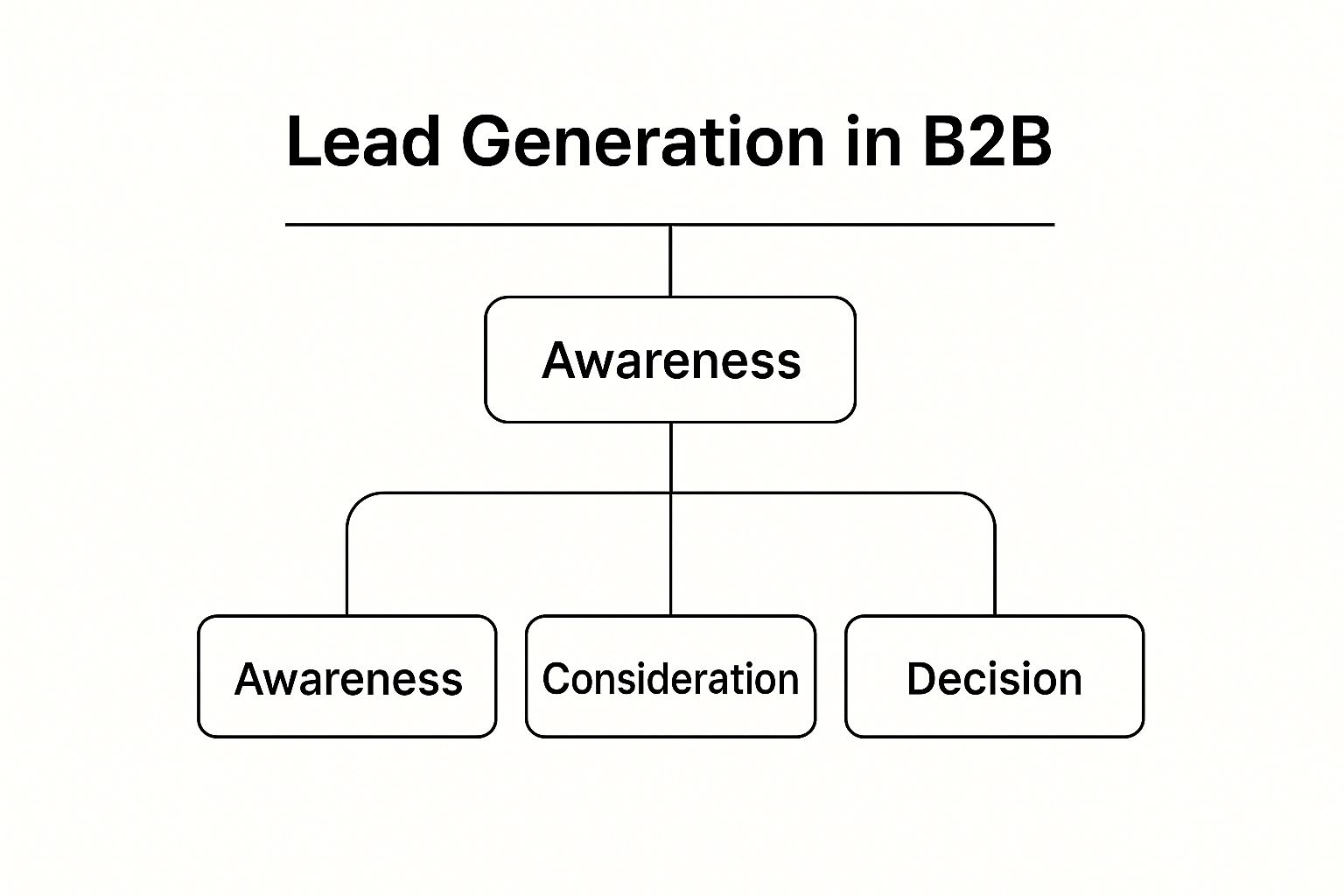
As you can see, the journey from a massive audience to a handful of paying customers is all about refinement. Each stage filters and qualifies prospects, ensuring only the best-fit opportunities make it through to your sales team.
To help you visualize this better, here’s a quick breakdown of how these funnel stages translate into action.
The B2B Lead Generation Funnel at a Glance
This table summarizes the core purpose and common activities at each step of the process.
| Funnel Stage | Primary Goal | Common Activities |
|---|---|---|
| Awareness (Top) | Attract a broad audience and build brand recognition. | Blog posts, social media, SEO, paid ads, webinars. |
| Consideration (Middle) | Nurture interest and demonstrate value. | Case studies, whitepapers, email newsletters, product demos. |
| Decision (Bottom) | Convert interested prospects into sales-ready leads. | Free trials, consultations, customized proposals, pricing pages. |
This structured approach ensures you’re not just generating contacts, but actively guiding them toward a purchase.
Why Strategic Lead Generation Is a Game-Changer
A well-oiled lead generation strategy does a lot more than just fill a spreadsheet with names. It directly fuels your company’s most important goals and carves out a serious competitive advantage. When you nail lead generation, you’re not just selling more; you’re building a rock-solid foundation for long-term success.
The real purpose of B2B lead generation is to build relationships and trust at scale. It’s about delivering the right message to the right person at exactly the right time, turning a flicker of curiosity into a genuine sales opportunity.
This approach positions your company as an authority in your space. By consistently providing value and solving problems, you build the kind of credibility that makes prospects seek you out. Naturally, this leads to much higher-quality leads, since they arrive already understanding what you do and why it matters.
For a much deeper dive into building a winning strategy from the ground up, check out our ultimate playbook for B2B lead generation success.
Ultimately, a strong lead generation system makes your growth predictable. It frees you from relying on sporadic referrals and gives you the confidence to scale your sales efforts, knowing a steady stream of opportunities is always heading your way.
Choosing Your Most Powerful B2B Lead Generation Channels

Alright, you’ve nailed down the “what” and “why” of B2B lead generation. The next, most critical question is, “where?” Not all channels are created equal, and trying to be everywhere at once is a surefire way to burn through your budget with little to show for it. The real secret is to fish where the fish are biting.
Think of your marketing budget and your team’s energy as a limited resource, like water for a garden. You wouldn’t just spray it everywhere and hope for the best. You’d aim the hose directly at the most promising patches of soil. It’s the same idea here - you need to identify and double down on the channels that promise the biggest payoff for your specific industry and audience.
The Big Shift: From Interruption to Invitation
Let’s be honest, the old-school playbook of purely interruptive, “outbound” marketing is gathering dust. While a well-aimed cold email still has its place, today’s B2B buyer is in the driver’s seat. They prefer to do their own homework, actively searching for answers and solutions on their own time.
This change in behavior has made “inbound” channels incredibly powerful. Instead of shouting at potential customers, you’re attracting them by offering genuine value upfront. You’re not pushing a sales pitch; you’re pulling them in with your expertise.
A single, well-researched whitepaper shared on LinkedIn can spark more qualified conversations than a thousand generic cold calls. That’s the magic of meeting buyers where they already are - with something they actually want.
This approach builds trust right from the first click. When a prospect downloads your guide or digs into your case study, they’re not just a lead; they’re someone who has actively raised their hand and shown genuine interest in what you do.
Breaking Down the Top B2B Lead Generation Channels
To build a strategy that can weather any storm, you need a smart mix of channels. The right blend for you will depend entirely on who you’re trying to reach, how long your sales cycle is, and what you’re trying to achieve.
Here’s a look at some of the heavy hitters in B2B today:
-
Content Marketing: This is the bedrock of modern B2B marketing. By creating truly valuable blog posts, case studies, whitepapers, and webinars, you solve your audience’s problems and establish your company as the go-to expert.
-
Search Engine Optimization (SEO): SEO is what makes sure all that great content actually gets seen. When a decision-maker Googles a problem they’re facing, you need to be the first solution they find.
-
LinkedIn & Social Selling: When it comes to B2B, LinkedIn is king. It’s more than a social network; it’s a hub for professional networking, sharing deep industry insights, and starting meaningful conversations with the exact people you want to talk to.
-
Cold Email Outreach: Forget spammy, mass cold calls. We’re talking about hyper-targeted, personalized cold emails. Done right, it’s an incredibly effective way to start direct conversations with a hand-picked list of your dream customers.
The numbers don’t lie. Data shows that lead generation is a top priority for about 50% of marketers, and the average company pulls in nearly 1,900 leads every month. But look closer, and you’ll see where the smart money is going. A whopping 97% of people ignore cold calls. On the flip side, 76% of marketers use content marketing to pull in leads, and 68% say social media is helping them open more doors.
Making the Right Choice for Your Business
So, how do you pick your channels? It starts by getting inside the head of your ideal customer. Ask yourself these simple but powerful questions:
-
Where do they go when they need to solve a professional problem? (Google, industry sites, LinkedIn groups?)
-
What kind of content do they actually value? (Data-heavy reports, quick video tutorials, detailed case studies?)
-
Which social platforms are they using for work? (LinkedIn, Twitter, niche forums?)
The answers give you a clear roadmap. If you’re selling cybersecurity solutions to CTOs, they’re probably all over LinkedIn and love deep, technical whitepapers. A strategy built on SEO-rich blog content and targeted LinkedIn campaigns will crush a generic ad campaign on a consumer platform.
At the end of the day, a winning strategy isn’t just about picking channels from a list. It’s about deeply understanding how to generate B2B leads that actually convert into real, paying customers.
If you think of content marketing as the foundation of B2B, then LinkedIn is the plot of land you build on. It’s way more than just a place to park your resume - it’s a massive, always-on industry conference happening 24/7. Your ideal clients, your future partners, and your biggest fans are all there, actively hunting for real solutions and smart ideas.
The trick isn’t just being on LinkedIn. It’s about turning your profile from a static, passive page into a reliable machine that pumps out high-quality leads. This means you have to treat it like a core part of your lead generation in b2b strategy, not just a place to dump company news once in a while.
First, Nail Your Company Page
Think of your LinkedIn Company Page as your digital storefront. It’s often the very first stop for a potential client who wants to see if you’re the real deal. An empty or stale page is a huge red flag.
Start by treating your page like a landing page you’d spend thousands on. Fill out every single section. Your “About” section needs to speak directly to your ideal customer’s biggest headaches. Your banner image needs to scream your brand. Sprinkle relevant keywords throughout your descriptions so people can actually find you through LinkedIn’s search.
Your Company Page is the central hub for everything you do on LinkedIn. Every post, every comment, and every connection request should ultimately lead people back to this polished, professional, and genuinely helpful home base.
Get this foundational step right, and when prospects land on your page, they’ll immediately get a clear, credible picture of who you are and exactly how you can solve their problems.
Create Content That Actually Stops the Scroll
Just posting to post is a waste of everyone’s time. The name of the game on LinkedIn is to stop the scroll. You’re fighting for the attention of busy professionals, so your content has to deliver instant value, make them curious, or offer a perspective they haven’t heard before.
Here are a few content types that just plain work for B2B on LinkedIn:
-
Strong-Opinion Text Posts: Got a hot take on your industry? Learned a tough lesson? Share it. Behind-the-scenes stories about business challenges do incredibly well.
-
Real-World Case Studies: Nothing sells like results. Tell a story about how you helped a client. Lay out the problem they had, the solution you built, and the real numbers you delivered.
-
Quick-Hit Videos: Use short videos to break down a tricky concept, share a quick tip, or even show a clip from a client testimonial. Video builds a personal connection faster than anything else.
-
Genuinely Useful Resources: Don’t just drop a link to your latest blog post. Frame it around the specific problem your resource solves. This drives clicks and, more importantly, downloads from people who actually need what you have.
This screenshot shows you exactly why B2B marketers are all-in on LinkedIn compared to other platforms.
The data here is crystal clear - a huge chunk of B2B marketers say their best leads come straight from LinkedIn. It’s not just another channel; for many, it’s the channel.
Turn Idle Chatter into Real Opportunity
The numbers don’t lie. Getting good at LinkedIn is simply not optional if you’re serious about B2B marketing. In a recent survey, a stunning 40% of B2B marketers said LinkedIn was their top channel for high-quality leads. Even better, LinkedIn’s own Lead Gen Forms have an average conversion rate of 13%. That’s more than five times what you’d expect from a standard website landing page. You can dive deeper into LinkedIn’s lead generation power with the full statistics here.
This isn’t just about efficiency; it means the time you spend creating content and talking to people is far more likely to turn into actual business. So don’t just post and walk away. Get into the comments - on your own posts and on posts from other influential people in your space. Every thoughtful comment you leave is a mini-demonstration of your expertise, turning people who just scroll by into engaged prospects who want to know more.
Winning High-Value Accounts with ABM Strategies

While casting a wide net with broad lead generation strategies is great for building general awareness, there comes a time when you need to get surgical. You have to trade the net for a spear. This is exactly where Account-Based Marketing (ABM) comes into play. It flips the entire traditional sales funnel upside down, forcing you to focus all your energy on a hand-picked list of high-value accounts before you even think about outreach.
Think of it this way. Traditional lead gen is like throwing a massive public block party and just hoping the right people wander in. ABM, on the other hand, is like planning an exclusive dinner. You personally select your VIPs, find out their favorite foods and music, and send them a custom invitation.
This focused approach to lead generation in B2B means every dollar and every minute is aimed squarely at the companies that can truly move the needle for your business. It’s a deliberate shift from quantity to quality, from breadth to depth.
The Core Pillars of a Successful ABM Program
Pulling off an effective ABM strategy isn’t about launching another marketing campaign; it’s a fundamental change in how you go to market. It requires your teams to be in lockstep.
It all starts with defining your Ideal Customer Profile (ICP). This isn’t some fuzzy, made-up persona. It’s a data-backed blueprint of the companies that are a perfect match for what you sell. You’ll dig into firmographics like their industry, company size, and revenue, and even technographics, like the software they’re already using.
With that blueprint, you build your target account list - a curated roster of companies that fit your ICP to a T. This list becomes the North Star for every single thing your sales and marketing teams do next.
An ABM strategy forces your sales and marketing teams to stop working in silos and start functioning as a single, coordinated revenue team. Marketing creates personalized content for target accounts, and sales uses that content to open doors and have more meaningful conversations.
This tight collaboration is the secret sauce. Instead of marketing just lobbing leads over the fence for sales to chase, both teams are obsessed with the same goal: landing those specific, high-value accounts.
Identifying and Engaging Your Target Accounts
Once you have your target list, the real work begins: deep-dive research. You need to get to know the key players inside each company, understand their specific pain points, and figure out what their strategic goals are. This intelligence is the fuel for making your outreach personal.
Armed with this knowledge, you can build campaigns that feel like they were made just for them. This might look like:
-
Customized Content: Creating a case study that directly mirrors a target account’s industry and its unique challenges.
-
Targeted Ads: Running LinkedIn ad campaigns that are only shown to employees at your handful of target companies.
-
Personalized Outreach: Writing email sequences that reference specific company news, a recent product launch, or an individual’s recent promotion.
The goal is to make every touchpoint feel like a one-to-one conversation, not a one-to-many broadcast. In a world of noise, that’s how you get the attention of busy decision-makers.
ABM and Technology: The Modern Power Couple
Trying to execute ABM at scale without the right tech stack would be a nightmare. Modern tools, especially those using AI and predictive analytics, have become total game-changers for finding and engaging the right accounts with pinpoint accuracy. These platforms sift through mountains of data to identify buying signals, telling you which accounts are actually in the market for a solution like yours right now.
When you get ABM right, the impact is huge. 2024 data shows that strong ABM programs can increase pipeline conversions by up to 14% and boost the MQL-to-sales-accepted lead rate by a massive 25%. The integration of AI and predictive tech helps you analyze those buying signals to deliver perfectly timed, personalized messages, which drives up both lead quality and conversion rates. To see more on what’s working now, you can discover more insights about B2B lead generation on blog.gclb2b.com.
Ultimately, ABM turns lead generation from a numbers game into a strategic hunt. By focusing intensely on the accounts that matter most, you don’t just improve your odds of winning deals - you land bigger contracts and build much stronger, more valuable customer relationships for the long haul.
Measuring the Metrics That Actually Matter
There’s an old saying that goes, “If you don’t measure it, you can’t improve it.” In the world of B2B lead generation, that’s gospel. Without solid data, you’re just navigating in the dark - throwing money at different channels and hoping something, anything, sticks.
So, what should you actually be tracking? Forget vanity metrics like social media likes. We need to focus on the numbers that tell the real story of your pipeline and, ultimately, your business growth.
Think of it like a pilot in a cockpit. Every dial and reading - altitude, speed, fuel level - tells a crucial part of the story. Ignoring one could be disastrous. The same goes for lead generation. Focusing on a single metric while ignoring the others gives you a dangerously incomplete picture of your performance.
Beyond the Basics: Key Performance Indicators
To get a clear view, you need to understand how different key performance indicators (KPIs) work together. These are the core numbers that reveal the true health and efficiency of your entire marketing engine.
Let’s break down the metrics that truly matter.
-
Cost Per Lead (CPL): This is the most straightforward one. It tells you exactly how much you’re spending to get a single lead. You just divide your total campaign cost by the number of leads you generated. A low CPL is great, but it’s completely meaningless on its own.
-
Lead Conversion Rate (LCR): This metric shows what percentage of your leads are actually turning into legitimate sales opportunities. If your CPL is impressively low but your LCR is near zero, you’re just getting really good at generating useless leads. A strong LCR is a sign you’re attracting the right crowd.
-
Customer Lifetime Value (CLV): This is the ultimate metric. It projects the total revenue a single customer will bring to your business over the entire relationship. A high CLV can easily justify a higher initial cost to get that customer in the door.
The most dangerous mistake in B2B lead generation is celebrating a low Cost Per Lead without looking at what happens next. A cheap lead that never converts is more expensive than a qualified lead that costs more upfront but closes into a high-value, long-term customer.
This interconnectedness is everything. You need a low enough CPL to be sustainable, a high enough LCR to keep your sales team busy, and a strong enough CLV to make the whole effort profitable.
Building a Data-Driven Feedback Loop
Once you’re tracking these core metrics, you can build a powerful feedback loop. You’ll start to see which channels - maybe it’s your targeted cold email campaigns or your in-depth LinkedIn content - are delivering not just the most leads, but the most valuable leads.
This data gives you the power to make smarter decisions, shifting your budget and effort toward what’s actually working.
You might find, for example, that your blog posts bring in a high volume of leads with a low CPL, but your account-based marketing (ABM) campaigns deliver fewer leads at a higher Cpl that convert at a much higher rate and have a massive CLV. With that insight, you can balance both strategies for a healthy, robust pipeline.
To give you a clearer picture, here’s a breakdown of the KPIs we watch like a hawk.
Essential B2B Lead Generation KPIs
A breakdown of the key performance indicators used to measure the effectiveness and efficiency of B2B lead generation efforts.
| Metric (KPI) | What It Measures | Industry Benchmark |
|---|---|---|
| Cost Per Lead (CPL) | The total cost to acquire one new lead from a specific campaign or channel. | Varies widely by industry, from $30 to over $400. |
| Lead Conversion Rate (LCR) | The percentage of leads that become qualified sales opportunities (e.g., SQLs). | Averages 2-5% but can be higher for well-targeted campaigns. |
| Customer Lifetime Value (CLV) | The total projected revenue a business can expect from a single customer account. | Should be at least 3x the Customer Acquisition Cost (CAC). |
| Lead-to-Customer Rate | The percentage of total leads that ultimately become paying customers. | Averages around 1% across industries, but highly dependent on lead quality. |
| Time to Conversion | The average time it takes for a lead to become a paying customer. | Can range from a few weeks to 12+ months for complex B2B sales. |
These metrics, when viewed together, give you a 360-degree view of your lead generation engine’s health.
For a deeper dive into these metrics and how they drive success, you can explore our complete guide on the most important lead generation KPIs to boost your marketing success.
Ultimately, mastering your metrics does more than just tweak campaigns. It allows you to confidently justify your marketing budget, show clear ROI to stakeholders, and build a predictable, scalable engine for business growth.
Building a Performance-Driven Lead Generation Engine

Real success with B2B lead generation isn’t about getting good at one thing, like cold email or content. It’s about building a finely-tuned growth machine. Think of all the pieces we’ve talked about - the channels you pick, the accounts you target, the metrics you track - as interlocking gears. When they mesh perfectly, they don’t just spin; they create a powerful, predictable engine for revenue.
It’s the difference between being a short-order cook and an executive chef. The cook can nail one dish at a time. The chef, on the other hand, designs the entire menu, making sure every single element works together to create a cohesive experience. A performance-driven engine is your executive chef, orchestrating every marketing move to deliver one thing: qualified appointments to your sales team.
Adopting this approach changes your entire mindset. You stop thinking of lead generation as just another marketing cost and start seeing it for what it is: a direct, measurable investment in your company’s growth.
The Fypion Marketing Model in Action
Here at Fypion Marketing, we don’t just talk about this philosophy - we live it. Our entire model is built to turn these concepts into a real-world, results-driven system for our partners. We’re not in the business of just handing you a list of names. We build and manage the whole engine that puts sales-ready meetings on the calendar.
This is where the rubber meets the road. It means:
-
Integrated Channel Strategy: We don’t operate in silos. The messages in our cold emails are designed to echo what’s happening in your content and on social media, creating a single, powerful voice.
-
Data-Driven Targeting: We don’t guess who your ideal customers are. We use deep market research to build laser-focused lists, ensuring every outreach has the highest possible chance of landing.
-
Relentless Optimization: We’re constantly watching the data, tweaking copy, adjusting send times, and refining targets based on what the real world tells us. It’s a nonstop process of improvement to squeeze out every possible conversion.
The heart of a performance-driven engine is accountability. Success isn’t measured by fluffy metrics like clicks or opens. It’s measured by the number of qualified appointments that actually happen. This turns lead generation from a gamble into a reliable business asset.
This is how we tie our success directly to yours. You only pay for booked, qualified meetings that fit the exact criteria you give us. It creates a genuine partnership where we’re just as invested in growing your pipeline as you are.
By combining channel expertise, pinpoint targeting, and obsessive data analysis, we build a system that doesn’t just work - it scales. It frees you up to focus on what you’re best at: closing deals and making your customers happy.
To see how we put these principles into action, check out our guide on 9 proven B2B lead generation strategies. This is how you build sustainable, scalable growth.
Your B2B Lead Generation Questions Answered
When you’re deep in the trenches of B2B lead generation, a few practical questions always pop up. How long until we see real results? How do we know it’s time to pivot? Answering these honestly is what separates a decent plan from a great one - it’s how you build something that actually lasts and delivers.
A big one we hear all the time is about the timeline. Unlike B2C, where a sale can happen in minutes, B2B is a marathon, not a sprint. Sales cycles can easily stretch from a few weeks to over a year, so patience isn’t just a virtue; it’s a requirement. As a rule of thumb, you need to give any new strategy at least a full quarter - that’s 90 days - to breathe. Only then will you have enough clean data to see what’s truly working and what’s just noise.
How Do You Know When a Lead Is Ready for Sales?
This is probably the most critical question in the entire process. If you hand off a lead too soon, you’ll just frustrate your sales team with tire-kickers. Wait too long, and you risk losing them to a competitor who moved faster. The whole key is getting everyone to agree on what makes a Marketing Qualified Lead (MQL) versus a Sales Qualified Lead (SQL).
An MQL is someone who’s kicking the tires - they downloaded a whitepaper or watched a webinar. They’re interested, but not necessarily ready to buy. An SQL, on the other hand, has been properly vetted and is showing clear signs they want to make a move.
A lead crosses the bridge from “marketing” to “sales-ready” when their actions shift from general research to active evaluation. Think of someone requesting a demo, repeatedly visiting your pricing page, or flat-out asking to speak with a salesperson.
Nailing down these trigger points is what creates a seamless handoff. It gets marketing and sales speaking the same language and working toward the same goal. To get this right, you absolutely need a solid framework. You can dig deeper into this by exploring proven strategies for how to qualify B2B leads to boost sales.
What Is a Good Lead-to-Customer Rate?
Another common question is about benchmarks. What does “good” even look like? While the numbers can be all over the place depending on your industry, a general benchmark for the overall lead-to-customer rate in B2B hovers around 1%. Now, that might sound shockingly low, but it accounts for the entire journey, from a raw, unqualified name to a signed contract.
Honestly, focusing only on that top-line number can be a distraction.
A much more telling metric is your conversion rate from a qualified lead (SQL) to a customer. A strong number here proves your targeting and qualification process are on point, even if your funnel looks narrow at the top. At the end of the day, the goal isn’t just to stack up leads; it’s to create paying customers.
At Fypion Marketing, we don’t just talk about leads; we build performance-driven engines that put qualified appointments right on your calendar. Your team can stop hunting and start closing. Get a free consultation today.