
How to manage a remote sales team: Pro Tips for Remote Success

When your sales team goes remote, your management style has to evolve. Forget about managing by presence - clocking in and clocking out doesn’t work anymore. The real game is shifting to outcome-driven leadership. It’s all about building a solid system with the right tech, crystal-clear communication, and an unwavering focus on results.
A well-oiled remote operating system gives every rep the support they need and a clear picture of what success looks like.
Building Your Remote Sales Operating System
Transitioning to a remote model is more than just handing out laptops and wishing everyone luck. You’re essentially building a digital headquarters. This “operating system” is your unique blend of technology, processes, and communication norms that lets your team crush their goals from anywhere.
Without this intentional structure, you’re just asking for trouble - think information silos, chaotic workflows, and a team that feels completely disconnected.
A strong foundation starts with the right tech stack. For most B2B agencies I’ve worked with, this boils down to a core set of tools that talk to each other and handle everything from outreach to closing deals.
Here’s a look at the essential technology you’ll need to power a high-performing remote sales team.
Essential Remote Sales Tech Stack
| Tool Category | Purpose | Example Tools |
|---|---|---|
| Customer Relationship Management (CRM) | The single source of truth for all customer data, pipeline health, and rep activity. Non-negotiable. | HubSpot, Salesforce |
| Communication Hub | The virtual sales floor for quick questions, team announcements, and celebrating wins. | Slack, Microsoft Teams |
| Sales Engagement Platform | Automates and tracks outreach sequences to manage a higher volume of prospects efficiently. | Outreach, Salesloft |
| Video Conferencing | The backbone for internal meetings, client demos, and any face-to-face remote interaction. | Zoom, Google Meet |
These tools form the bedrock of your remote operation, keeping everyone aligned and productive.
Establish Clear Communication Protocols
Once your tools are in place, you have to define the rules of the road. If you don’t, you’ll end up with chaos.
Create simple guidelines. For instance, urgent issue? Pick up the phone. Project update? Post it in the designated Slack channel. Formal proposal? That’s what email is for. This clarity cuts down on confusion and the dreaded “Zoom fatigue” by making sure meetings are only for high-value collaboration.
Your goal is to foster an environment of asynchronous productivity. This means empowering reps to do their best work on their own schedule while staying aligned with team goals, rather than forcing constant real-time interaction.
This is how you tap into the massive advantages of remote work. The data backs this up: remote sales reps make 48% more calls per day than their in-office peers. All that time saved from commuting and office chit-chat translates to a 35% increase in average selling time.
Building a system that supports this kind of focused work is the secret to managing a remote team effectively. For a deeper dive into structuring your team for success, check out our guide on sales process optimization to build your revenue machine.
Defining Performance Metrics That Drive Results

When your team is scattered across different locations, you can’t just “manage by walking around.” You have to manage by the numbers. In a remote sales world, clear, data-driven metrics aren’t just a nice-to-have; they’re the absolute foundation for accountability and performance. Without them, you’re flying blind.
It’s tempting to track easy-to-measure activities like calls made or emails sent. But let’s be honest - those are vanity metrics. They might look good on a report, but they don’t tell you if a rep is actually effective or just busy. The real trick is to shift your focus from activity to outcomes.
Prioritizing Outcome-Based KPIs
To really get a grip on remote performance, you need to measure what actually moves the needle. That means building your entire performance framework around KPIs that show real progress through the sales funnel.
Here are the core metrics that I’ve found tell the true story:
-
Qualified Meetings Booked: This is your first real sign of life in prospecting. It proves a rep can not only get a prospect’s attention but also spark enough interest to get a meeting with the right person.
-
Pipeline Velocity: How fast are deals moving from one stage to the next? A healthy velocity tells you a rep is keeping momentum, handling objections, and not letting deals go stale.
-
Average Deal Size: Are your reps closing any deal they can, or are they closing high-value deals? This KPI is crucial for understanding profitability and whether your team is effectively upselling.
-
Win Rate: This is the bottom line. What percentage of opportunities actually turn into paying customers? It’s the clearest reflection of a rep’s ability to close.
When you focus on these kinds of results, you build a culture of ownership. Reps know exactly what they’re responsible for, which gives them the freedom to figure out the best way to hit their numbers.
It turns out remote reps are already wired for this. Research shows that 67% of them report higher productivity from home, and they spend 42% less time on tedious admin tasks. This is a huge reason why 73% of B2B sales are now happening digitally or remotely.
From Data to Development
Tracking the right numbers is just step one. The real magic happens when you use that data to coach and develop your team. Your CRM dashboard should be the single source of truth, giving everyone a transparent, real-time look at performance.
This data completely changes the game for your one-on-one meetings. Instead of a vague, “So, how’s it going?” you can start with, “I noticed your pipeline velocity slowed down this month. Let’s dig into your current deals and see if we can find the bottleneck.” It turns a subjective check-in into an objective, problem-solving session.
Think about it: if a rep is booking a ton of qualified meetings but their win rate is in the gutter, you know the problem isn’t at the top of the funnel. The data points to a breakdown during the demo or closing stages. Now you can offer targeted coaching on negotiation tactics instead of generic sales advice.
To take it a step further, you can get smarter about which leads they’re even chasing. For more on that, check out our guide on how to master B2B lead scoring to boost sales effectiveness.
By grounding everything in clear, outcome-focused metrics, you create a culture of transparency and high accountability. Every single rep knows how their work impacts the bottom line, which is exactly the kind of motivation a remote sales team needs to crush their goals.
Hiring Sales Talent Built for Remote Success
Your remote sales team is only as good as the people on it. Let’s be honest: the traits that make someone a star on a bustling sales floor don’t always translate to success from a home office. If you want to manage a remote sales team effectively, it all starts with hiring people who are built for this environment from day one.
This means you have to shift your hiring criteria. Forget just looking for extroversion and in-person charisma. Instead, you need to be screening for qualities like self-discipline, masterful written communication, and tech fluency. A remote seller has to be a self-starter who can manage their own schedule, build rapport over email and video, and figure out your tech stack without an IT person just down the hall.
Identifying the Right Characteristics
When you’re interviewing candidates, you need to dig deeper than just their sales record. You’re looking for proof of specific, remote-ready skills.
-
Proactive Problem-Solving: Ask them to walk you through a time they faced a big obstacle without a manager or teammate nearby to help. What did they do? Their answer will tell you a lot about their resourcefulness and ability to think on their feet.
-
Exceptional Written Skills: Their application emails and follow-ups are your first clue. During the interview, throw them a scenario: how would you handle a complex negotiation with a client entirely over email? You’re testing for clarity, tone, and persuasion.
-
Internal Motivation: Ask them point-blank how they structure their day when working from home. Look for candidates who already have established routines and a clear system for staying focused. You want people who don’t need a manager hovering over them to be productive.
These traits are non-negotiable for anyone you want to thrive in a remote sales role.
The best remote reps are essentially entrepreneurs running their own book of business. They don’t wait to be told what to do; they see a goal and find the most efficient path to get there, using the tools and autonomy you provide.
Attracting Top Remote Talent
Your secret weapon here is the job description. Don’t just list “remote” as a perk; frame it as a core part of your high-performance culture. You should be highlighting the autonomy, trust, and focus you offer.
This approach gives you a massive competitive edge. Flexibility is a huge draw; a recent study found that 78% of sales professionals say remote options influence their job choices. In fact, 61% would even consider a 10% pay cut for the freedom to work remotely, which gives you access to a wider, more motivated talent pool. Read more about remote sales trends.
By targeting these specific traits and using remote work as a strategic advantage, you can build a team of self-sufficient A-players. For companies also weighing different staffing models, it’s worth exploring your guide to outsourcing inside sales to see how external teams might fit into your strategy.
Creating a Remote Sales Culture That Connects and Motivates
A winning culture isn’t something that just happens within the four walls of an office; it’s the shared heartbeat of your team, the common purpose that keeps everyone aligned. When your team is remote, you can’t rely on those spontaneous water-cooler chats or post-meeting debriefs to build bonds. You have to build that connection intentionally.
If you don’t, you risk creating a team of disconnected freelancers. Your top performers might feel isolated, their morale dips, and suddenly you’re facing retention issues you never saw coming. This is a massive blind spot for managers trying to build a stable, long-term remote sales engine.

Foster Genuine Connection
Your first job is to engineer moments of connection that go beyond the usual sales pipeline reviews. It’s about creating space for both professional collaboration and just plain human interaction.
-
Dedicated “Wins” Channel: Fire up a Slack or Teams channel specifically for celebrating successes. A great cold call, a prospect who raved about a demo, a signed contract - it all goes here. Encourage the whole team to jump in with emojis and congrats. It’s a simple way to replicate the buzz of a sales floor.
-
Virtual Team Building (That Isn’t Awkward): Let’s be honest, forced virtual happy hours can be painful. Instead, try things with a bit more structure, like an online escape room, a trivia contest with small gift card prizes, or a monthly “lunch and learn” where someone teaches a non-work skill for 15 minutes.
-
Peer-to-Peer Recognition: Make it easy for reps to give each other public shout-outs. A simple Slack channel or a tool like Bonusly works wonders. When a colleague gets recognized by a peer for helping close a deal, it means more than you think.
A huge part of this is knowing how to foster a positive workplace culture where people genuinely feel seen and valued for their contributions.
Anchor Your Team in a Shared Mission
Beyond the social stuff, a resilient remote culture is built on a clear, shared purpose. Every single person on your team needs to understand how their daily grind connects to the company’s grand vision.
Talk about the big company-wide goals often. Then, explicitly connect the dots. If the company is aiming to crack a new market, show your reps how their appointment-setting efforts in that vertical are the tip of the spear. This transforms their work from a series of tasks into a meaningful mission. That sense of purpose is what keeps people engaged for the long haul.
This isn’t just fluffy stuff - investing in a strong remote culture has a real ROI. Remote sales teams see 23% lower turnover rates compared to their in-office counterparts. Their average tenure is 3.2 years, while onsite teams stick around for just 2.4 years. For SaaS and tech companies that live and die by a consistent pipeline, that stability is everything.
When you get this right, even highly specialized roles feel like a core part of the team. Speaking of which, if you want to dive deeper into one of the most crucial sales roles, you can learn more about https://www.fypionmarketing.com/post/what-is-an-appointment-setter-why-are-they-key-to-sales.
At the end of the day, a killer culture is what makes your team resilient, motivated, and pulling in the same direction - no matter where they’re logging in from.
Implementing Training That Actually Improves Performance
In sales, if you’re standing still, you’re falling behind. This is especially true when your team is spread out. You can’t just rely on the old “learning by osmosis” from overhearing calls on the sales floor. Training a remote sales team demands a modern, structured approach that builds real skills, not just checks a compliance box.
Without a solid plan, new hires take forever to get up to speed, and even your seasoned reps can slip into bad habits. The goal here is to create ongoing, interactive learning experiences that give your team the skills and the swagger they need to close deals.
Slashing New Hire Ramp-Up Time
First things first: you need a killer virtual onboarding process. A chaotic, disorganized start can completely torpedo a new hire’s momentum and confidence before they even dial their first number. What you need is a structured program that gets them out of the gate and contributing - fast.
This structure is non-negotiable for remote productivity. In fact, research shows that companies with formal virtual onboarding programs cut new hire ramp time by a massive 34%. If you add daily manager check-ins during those first few weeks, you can speed things up by another 28%. This is how businesses see insane results like 220% month-over-month lead growth - they get new reps delivering sooner.
Your onboarding should absolutely include:
-
A Digital Sales Playbook: This is their bible. A central hub with everything they could possibly need - ideal customer profiles, talk tracks, product info, and those all-important competitor battle cards.
-
Tech Stack Deep Dive: Get them hands-on with your CRM and sales engagement tools. They need to master this tech from day one, so don’t just gloss over it.
-
Shadowing Sessions: Let them listen in on live calls with your top performers. There’s no better way to hear what “good” actually sounds like in practice.
Think of remote onboarding as a guided mission, not a content dump. Every day should have clear objectives and learning goals, all building toward a final certification or a mock call that proves they’re ready to fly solo.
Fostering Continuous Skill Development
Onboarding is just the starting line. The best remote sales teams are the ones that never stop sharpening their skills. This means getting away from one-off training events and embracing continuous, bite-sized learning.
One of the most powerful ways to do this is by using call recording software for personalized coaching. Instead of just giving generic advice like “be more confident,” you can pull up a specific call with a rep and pinpoint the exact moment a negotiation went sideways or where their value proposition could have hit harder. It’s surgical, not speculative.
Another great tactic is video role-playing. Have your reps record themselves handling common objections or delivering a new pitch. They can then share the video for feedback from you and their peers. It’s a low-pressure way for them to practice and refine their approach without a live prospect on the line. To really level up their strategic thinking, introduce them to established frameworks like the MEDDIC sales methodology.
These ongoing development efforts are what separate the good from the great, touching everything from that first cold email to navigating a complex, multi-stakeholder deal.
For instance, a well-trained team can see a dramatic improvement in their cold outreach. If you’re looking for practical ways to boost this skill, you might find our guide on 8 cold email templates for sales that boost conversions really helpful.
When you invest in this kind of practical, ongoing training, you’re not just managing a remote team - you’re building a more capable, confident, and ultimately, more successful sales force.
On-Site vs. Remote Sales Training Comparison
Choosing the right training format is key to building a high-performing sales team. While traditional on-site training has its merits, modern remote approaches offer flexibility and scalability that are hard to ignore. Here’s a quick breakdown to help you decide what’s best for your team.
| Feature | On-Site Training | Remote Training |
|---|---|---|
| Interaction | Face-to-face, spontaneous collaboration, strong team bonding. | Virtual breakout rooms, live polls, chat, and collaborative digital whiteboards. |
| Cost | Higher costs due to travel, venue, and accommodation expenses. | More cost-effective; eliminates travel and physical space costs. |
| Flexibility | Less flexible; requires everyone to be in the same place at the same time. | Highly flexible; allows for self-paced learning and asynchronous participation. |
| Scalability | Difficult to scale; limited by physical room capacity. | Easily scalable to accommodate a growing or geographically dispersed team. |
| Technology Reliance | Lower reliance on tech, but can incorporate digital tools. | Highly reliant on stable internet, video conferencing, and learning platforms. |
| Content Delivery | Primarily relies on in-person instructors and printed materials. | Uses a mix of live webinars, pre-recorded videos, interactive modules, and quizzes. |
Ultimately, the best approach might be a hybrid one, combining the engagement of in-person workshops with the convenience and consistency of online modules. The right mix depends on your team’s needs, your budget, and the specific skills you’re trying to build.
Your Remote Sales Leadership Playbook
Let’s shift from theory to what this looks like day-to-day. Managing a remote sales team effectively comes down to execution, and this playbook is your roadmap. It’s all about turning the big ideas into small, actionable steps you can start using right away to build a sales org that’s connected, accountable, and firing on all cylinders.
Think of it as your guide to auditing what’s working (and what’s not), setting goals that actually move the needle, and spotting the early warning signs of a disengaged team. This is how you make abstract strategies tangible and start racking up real wins.
Your Quick Audit Checklist
Before you start changing things, you need a brutally honest look at where you stand. Run through this quick checklist. If you answer “no” to any of these, you’ve just found your first area to improve.
-
KPI Clarity: Does every single rep know their top 3-4 outcome-based KPIs off the top of their head?
-
Tech Mastery: Is your team really using your CRM and sales engagement platform, or just going through the motions?
-
Communication Rhythm: Is there a clear, unwritten rule for when to use Slack vs. email vs. a video call? Or is it chaos?
-
One-on-One Structure: Are your weekly check-ins actually coaching sessions focused on data, or do they just feel like status updates?
-
Recognition Routine: Do you have a dedicated, public space (like a Slack channel) to shout out wins at least once a week?
This simple flow shows how we should think about developing talent from a distance - it’s not just a single training session, but a continuous loop.
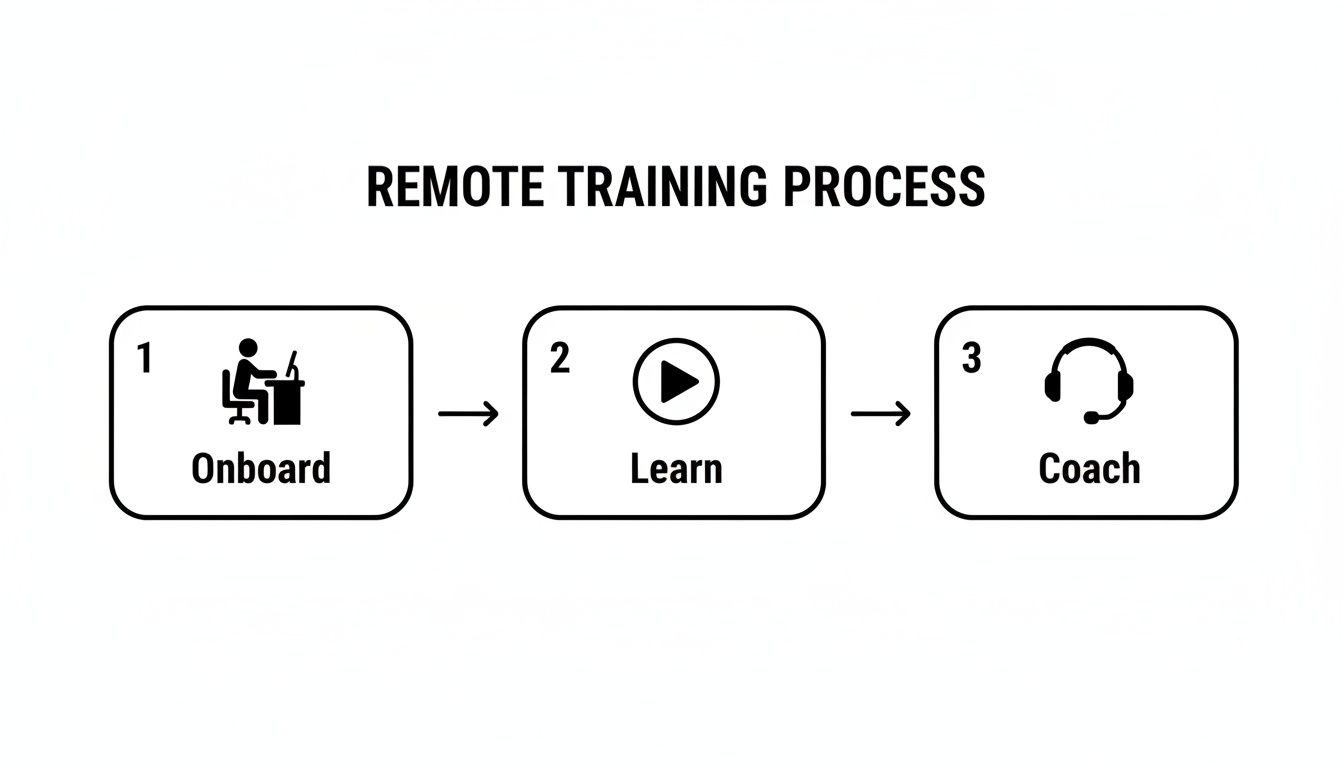
It’s a good reminder that great remote training is never “one and done.” It’s a cycle of onboarding, learning, and constant reinforcement through coaching.
Set Realistic Improvement Goals
Looking at your audit results, don’t try to fix everything at once. That’s a recipe for disaster. Just pick one or two areas and focus on them for the next quarter. This is how you make real, meaningful progress instead of just spinning your wheels.
For instance, if your one-on-ones are all over the place, a solid goal would be: “Implement a standard agenda for all weekly check-ins, dedicating 50% of the time to pipeline strategy and 50% to skill development.” It’s specific, you can measure it, and it directly plugs a hole you found in your audit.
Your main job as a leader is to remove friction. It could be friction from unclear expectations, clunky tech, or a team that feels disconnected. Whatever it is, you smooth the path so your people can run faster.
Finally, keep your eyes peeled for the subtle signs of disengagement. Are reps suddenly quiet in team chats? Are their CRM notes getting sloppy? Has proactive communication dropped off a cliff?
Catching these things early lets you step in and offer support before they snowball into major performance problems. This is what separates a good manager from a great remote leader.
Burning Questions About Managing Remote Sales Teams
When you’re running a remote sales team, a lot of questions pop up. It’s not like the old days where you could just walk the floor. Getting the fundamentals right is the difference between a team that crushes its numbers and one that just drifts apart.
Here are some of the most common hurdles sales leaders run into, along with some straight answers on how to clear them.
How Do You Monitor Productivity Without Becoming a Micromanager?
This is the big one, isn’t it? The key is to stop tracking activity and start focusing on outcomes. Nobody cares about keystrokes or how many hours someone was “online.” What really matters are the KPIs that actually drive revenue - things like qualified meetings booked, pipeline generated, and deals closed.
Your CRM and sales dashboards are your best friends here. When everyone can see the key metrics in real-time, it creates a culture of transparency and self-accountability. Your reps know where they stand, and so do you.
Then, you back that data up with structured, human connection. Your daily stand-ups and weekly one-on-ones become strategic conversations about progress and roadblocks, not interrogations for a status update. This gives your team the freedom to own their results while you get the insights needed to coach them effectively.
The philosophy is simple: trust, but verify with data. You empower your reps by focusing on the ‘what’ (the results) and giving them the autonomy to figure out the ‘how’ (their process). The performance metrics are just your guideposts for coaching.
What Are The Best Ways To Keep A Remote Sales Team Fired Up?
Keeping the fire lit in a remote team comes down to three things: connection, recognition, and purpose. You have to be intentional about all three.
First, you need to build channels for people to just be people. A dedicated Slack channel for celebrating wins is non-negotiable. We also love having optional “water cooler” video calls with no agenda, just a space for the team to chat and connect on a personal level.
Second, get serious about recognition. This doesn’t have to be complicated. Public shout-outs in team meetings are powerful. Performance-based incentives and tangible rewards go a long way, too. The goal is to make sure people feel seen and valued for their hard work.
Finally, you have to constantly tie their daily grind back to the bigger picture. Show your reps how their individual deals contribute to the company’s mission and make a real impact on your customers. Share client success stories, be transparent about company goals in all-hands meetings, and remind them that they’re part of something bigger.
What Are The Most Common Mistakes To Avoid?
The single biggest mistake I see is leaders trying to copy-paste their in-office management style into a remote setting. It just doesn’t work. This is where you get death-by-Zoom-fatigue, a lack of trust that quickly turns into micromanagement, and a failure to set up the right tools for asynchronous work.
Another huge pitfall is letting culture become an afterthought. In an office, culture just kind of happens in the hallways and break rooms. Remotely, you have to build it brick by brick through planned virtual socials, solid recognition programs, and a reliable communication rhythm.
Lastly, don’t fall into the trap of a one-size-fits-all management style. Every person on your team is different. They have unique needs, communication preferences, and motivators. Take the time to build strong individual relationships and adapt your leadership approach for each person.
Ready to stop worrying about lead generation and start focusing on closing deals? Fypion Marketing builds high-performance cold email campaigns that book qualified meetings directly on your calendar - and you only pay for the results you see. Learn more about our pay-per-meeting model and scale your sales pipeline today.