
8 Cold Email Templates for Sales That Boost Conversions
The B2B inbox is a battlefield. Every day, decision-makers are bombarded with generic pitches, making it nearly impossible for legitimate value propositions to break through the noise. The problem isn’t cold email itself; it’s the execution. Generic, self-serving templates are deleted on sight, wasting valuable time and burning potential leads.
This guide moves beyond the basics to provide a strategic blueprint for crafting compelling outreach. We will dissect 8 powerful cold email templates for sales, not just sharing the ‘what’ but explaining the ‘why’ behind their effectiveness. You’ll learn the psychological triggers, personalization tactics, and strategic frameworks that turn a cold outreach into a warm conversation.
Whether you’re a sales development representative (SDR) looking to crush your quota or a founder trying to land those first crucial clients, these battle-tested templates will equip you to capture attention, build credibility, and, most importantly, book more qualified meetings. We’ll provide the templates, the deep strategic analysis, and the actionable steps to adapt them to your unique offer and audience. This ensures your message not only gets opened but gets a response, turning your inbox into a consistent source of revenue.
1. The Problem-Agitation-Solution (PAS) Template
The Problem-Agitation-Solution (PAS) framework is a classic copywriting formula that excels in cold outreach by tapping directly into a prospect’s core challenges. This psychological approach first identifies a known pain point, then intensifies the negative consequences of that problem, and finally presents your offering as the ideal resolution. It’s effective because it builds a powerful narrative arc in just a few sentences, making your solution feel both necessary and timely.

This method moves beyond simply listing features; it frames your product as the answer to a pressing business threat. By agitating the problem, you create a sense of urgency that compels the reader to consider your solution more seriously. This makes it one of the most reliable cold email templates for sales teams aiming to secure meetings.
Strategic Breakdown
-
Problem: Start by stating a specific, relevant pain point you know their role or industry faces. Your research is critical here; a generic problem will get your email deleted.
-
Agitation: This is where you twist the knife. Describe the ripple effects of the problem. Think in terms of wasted time, lost revenue, team frustration, or missed opportunities. This makes the problem feel bigger and more urgent.
-
Solution: Introduce your company or product as the clear, direct path to relief. Frame it as the antidote to the agitation you just described, and conclude with a simple call to action.
Key Insight: The “Agitate” step is what gives this template its power. Don’t just mention the problem; illustrate the cost of inaction. For example, instead of saying “managing projects is hard,” say “when projects lack clear owners, deadlines slip and top talent gets frustrated, risking burnout.”
When to Use This Template
The PAS model is most effective when you have a strong understanding of your Ideal Customer Profile (ICP) and their specific pain points. It is particularly potent for B2B sales where the solution solves a clear operational, financial, or productivity-related issue. Use it to cut through the noise and demonstrate immediate value to busy decision-makers who respond to problem-solving language.
2. The Referral/Mutual Connection Template
Leveraging a mutual connection is the fastest way to turn a cold outreach into a warm introduction. This template immediately establishes credibility and bypasses the typical skepticism prospects have toward unknown senders. By referencing a shared contact or experience, you create an instant sense of familiarity and trust, significantly increasing your chances of getting a response.
This approach works because it taps into the principle of social proof. A recommendation, even an implied one, from a trusted source is far more powerful than any marketing claim you could make about your product. It transforms your message from an unsolicited pitch into a relevant conversation, making it one of the most effective cold email templates for sales professionals who actively network.
Strategic Breakdown
-
The Hook: Start your email by immediately naming the mutual connection or shared context in the first sentence. This is the most important part of the email and should be impossible to miss.
-
The Context: Briefly explain how you know the mutual connection or reference the shared experience (e.g., “we both spoke with Sarah at the marketing conference last week”). This adds legitimacy and clarifies the relationship.
-
The Pivot: Smoothly transition from the connection to the reason for your outreach. Connect their role or company’s goals to why the introduction felt relevant, and then present your value proposition concisely.
Key Insight: Always secure permission from your mutual contact before using their name. A quick message like, “Hi [Name], I noticed you’re connected to [Prospect] and was planning to reach out. Would you be comfortable with me mentioning we’re connected?” protects your relationship and prevents awkward situations.
When to Use This Template
This template is ideal for any situation where you have a pre-existing, even indirect, link to the prospect. It’s particularly powerful for B2B sales professionals using LinkedIn Sales Navigator to identify shared connections, following up after industry events, or leveraging alumni networks. Use this approach to cut through the noise with high-value prospects where a personal touch is critical for initiating a dialogue.
3. The Social Proof/Case Study Template
The Social Proof/Case Study template builds instant credibility by leading with results. Instead of talking about what your product can do, this approach shows what it has done for a similar company. It leverages the psychological principle of social proof, where people are more likely to adopt a solution if they see others, especially peers, have already done so successfully.
This method cuts through the skepticism that often accompanies cold outreach. By presenting concrete data and a success story, you shift from being a salesperson to a credible advisor offering a proven outcome. This makes it one of the most powerful cold email templates for sales when you have strong, quantifiable results to share.
Strategic Breakdown
-
Relevance Hook: Start by mentioning a client you’ve helped who is in the same industry or faces similar challenges as the prospect. Naming a direct competitor or a well-respected brand in their space is highly effective.
-
Quantifiable Result: Immediately present the specific, data-backed outcome you achieved. Use hard numbers, percentages, or concrete metrics like ROI, efficiency gains, or cost savings.
-
Brief Explanation: In one sentence, explain how you achieved this result. This connects the impressive outcome back to your unique solution or process.
-
Low-Friction CTA: Instead of asking for a demo, offer to share the full case study or explain how you did it. This feels less like a sales pitch and more like a valuable offer.
Key Insight: Specificity is your greatest asset. “We helped a B2B SaaS company like yours increase their MQL-to-SQL conversion rate by 42% in Q3” is infinitely more compelling than “We help companies get more qualified leads.”
When to Use This Template
This template is ideal when you have well-documented case studies with impressive metrics. It’s particularly effective for B2B SaaS, marketing agencies, and consulting firms whose value can be clearly demonstrated with data. Use it when targeting prospects in industries where you already have a strong track record. You can see how a marketing agency built a powerful case study for this exact purpose, showcasing how they built a $6-7M pipeline for a client.
4. The Research-Heavy Personalization Template
In a world saturated with automated outreach, the Research-Heavy Personalization template cuts through the noise by proving you’ve done your homework. This approach goes beyond a simple merge tag and demonstrates a genuine understanding of the prospect’s company, recent achievements, or specific role. It signals that you aren’t just blasting a generic message to a list, but have invested time to understand their world.
This method transforms a cold email into a warm, relevant conversation starter. By referencing a specific trigger event, such as a recent funding round, a new product launch, or a key hire, you create an immediate and authentic connection. This makes it one of the most effective cold email templates for sales when targeting high-value accounts where personalization is non-negotiable.
Strategic Breakdown
-
The Hook: Start with a sincere, specific compliment or observation based on your research. This could be congratulating them on a recent award, a new partnership, or a thought-provoking article they published.
-
The Bridge: Seamlessly connect your observation to a challenge or opportunity that logically follows. For example, a new funding round often leads to aggressive hiring and scaling challenges.
-
The Value Proposition: Position your solution as a tool that can help them navigate the very opportunity or challenge you just identified. Frame your offering as a direct enabler of their recent success.
Key Insight: The power of this template lies in its authenticity. The research can’t feel forced or generic. Instead of saying, “I saw your company got funding,” try, “Congratulations on the recent Series B round led by Sequoia; that level of investment is a huge testament to the market’s belief in your vision for AI-driven logistics.”
When to Use This Template
This template is ideal for account-based marketing (ABM) strategies and enterprise sales where the lifetime value of a customer justifies the pre-outreach research. Use it when targeting C-level executives or key decision-makers who receive hundreds of emails daily and will only respond to messages that are hyper-relevant to their immediate priorities. It’s the gold standard for breaking into strategic accounts and building long-term relationships. If you want to dive deeper into this tactic, you can master cold email personalization to boost responses and see your reply rates climb.
5. The Curiosity Gap/Pattern Interrupt Template
The Curiosity Gap/Pattern Interrupt template is designed to do one thing exceptionally well: break through the monotony of a crowded inbox. It leverages a psychological principle where you present intriguing but incomplete information, creating a “gap” that the prospect feels compelled to close. This method disrupts the recipient’s automatic “scan and delete” pattern by using unexpected questions, counterintuitive statements, or unconventional angles.

This approach is less about a direct sales pitch and more about initiating a conversation. By piquing natural curiosity, you encourage opens and replies that might otherwise be ignored. It’s a powerful way to stand out and make your prospect think, making it one of the most creative cold email templates for sales professionals who need to capture the attention of hard-to-reach decision-makers.
Strategic Breakdown
-
Pattern Interrupt: Start your email, especially the subject line and opening sentence, with something that defies expectations. This could be a provocative question, a surprising statistic about their industry, or an unusual metaphor.
-
Create the Gap: Hint at a valuable insight or solution without giving it all away. Frame the information as a discovery that is directly relevant to their business success or challenges.
-
Bridge to Value: Once you have their attention, quickly connect the curiosity hook to your value proposition. Explain how the answer to their newfound curiosity lies in what you offer, and propose a simple next step to learn more.
Key Insight: The success of this template hinges on relevance. Your hook can’t just be random clickbait; it must logically lead to your business solution. For example, a subject line like “A strange thought about your Q4 pipeline” is a pattern interrupt that directly ties into a sales leader’s priorities.
When to Use This Template
The Curiosity Gap is ideal for reaching saturated markets or senior-level executives who have seen every standard pitch. Use it when your value proposition is nuanced or requires a bit more explanation than a simple A-B-C solution. It is especially effective for creative agencies, consultants, and tech startups with an innovative or disruptive product. This template helps you earn a conversation rather than just asking for one.
6. The Direct Value Proposition Template
The Direct Value Proposition template is a no-nonsense approach designed for speed and clarity. It cuts straight to the point, leading with a powerful statement of the specific, measurable outcome your product or service delivers. This method respects the prospect’s time by immediately answering their core question: “What’s in it for me?”
This template bypasses lengthy introductions and gets directly to the core benefit. By presenting a clear, compelling, and quantifiable value proposition upfront, you make an instant impression on busy executives who are trained to look for tangible results. It’s a confident strategy that showcases the strength of your solution without fluff.
Strategic Breakdown
-
Direct Value Lead: Your opening line must be your most compelling, data-backed benefit. For example, “We help B2B tech firms reduce customer churn by an average of 15% in 6 months.” This immediately establishes relevance and credibility.
-
Brief Explanation: In one or two sentences, explain how you achieve this result. This could be a reference to your unique technology, process, or service model. Keep it concise and focused on the mechanism behind the value.
-
Clear Call to Action (CTA): End with a simple, low-friction ask. A question like, “Are you open to a 15-minute call next week to explore how this could apply to [Prospect’s Company]?” works perfectly.
Key Insight: Specificity is your greatest asset with this template. “Increase revenue” is a weak promise. “Our clients see an average 25% increase in qualified leads within the first quarter” is a powerful value proposition that demands attention and makes your claims believable.
When to Use This Template
This is one of the most effective cold email templates for sales when you have strong, quantifiable results and case studies to back up your claims. It’s ideal for outreach to senior-level decision-makers (C-suite, VPs) who are focused on high-level business metrics like revenue, cost savings, and efficiency. If your solution provides a clear, measurable ROI, this direct approach is often the fastest way to secure a meeting. Learning how to use cold emails to get more customers with this method can significantly improve your campaign performance.
7. The Question-Based Engagement Template
The Question-Based Engagement template shifts the focus from pitching to conversing. Instead of leading with a solution, this approach uses insightful, open-ended questions to spark a dialogue. This consultative method positions you as a curious expert rather than an aggressive seller, building trust by showing you want to understand the prospect’s world before you try to change it.
This technique is powerful because it lowers the prospect’s natural defenses. A good question invites collaboration and makes the recipient feel their expertise is valued. It transforms a one-way sales pitch into a two-way diagnostic conversation, making it one of the most effective cold email templates for sales professionals in complex B2B environments. This approach often serves as a powerful primer for a more detailed conversation, which you can learn more about by exploring whether a cold email or cold call is the better next step.
Strategic Breakdown
-
Opener: Start with a brief, personalized observation that gives context to your question. This shows you’ve done your research.
-
The Question: Ask a single, strategic, open-ended question related to their role, a company initiative, or an industry trend. The question should be impossible to answer with a simple “yes” or “no.”
-
The Rationale: Briefly explain why you’re asking. Connect the question to a potential area of value you can provide, without making an explicit pitch. For example, “Asking because we’ve helped similar VPs of Operations solve this.”
-
Call to Action: Your CTA should be soft and conversational, like “Curious to hear your thoughts on this” or “Is this a priority for you in Q3?”
Key Insight: The goal isn’t to get a meeting from the first email; it’s to get a reply. A great question makes the prospect pause and think, making a response feel like a natural continuation of a conversation you just started.
When to Use This Template
This template is ideal for targeting senior-level decision-makers who are often immune to standard sales pitches. It works exceptionally well for professional services, consulting, and companies selling complex or customized solutions where understanding the client’s unique situation is critical. Use it when you want to establish credibility and build a relationship based on mutual discovery rather than a hard sell.
8. The Multi-Touch Sequence Template
The Multi-Touch Sequence Template moves beyond the “one-and-done” cold email, recognizing that building trust and capturing attention often requires persistence. This approach involves a coordinated series of emails, each with a distinct purpose, designed to build familiarity and deliver value over time. Instead of betting everything on a single message, you gradually warm up a prospect through consistent, non-intrusive touchpoints.
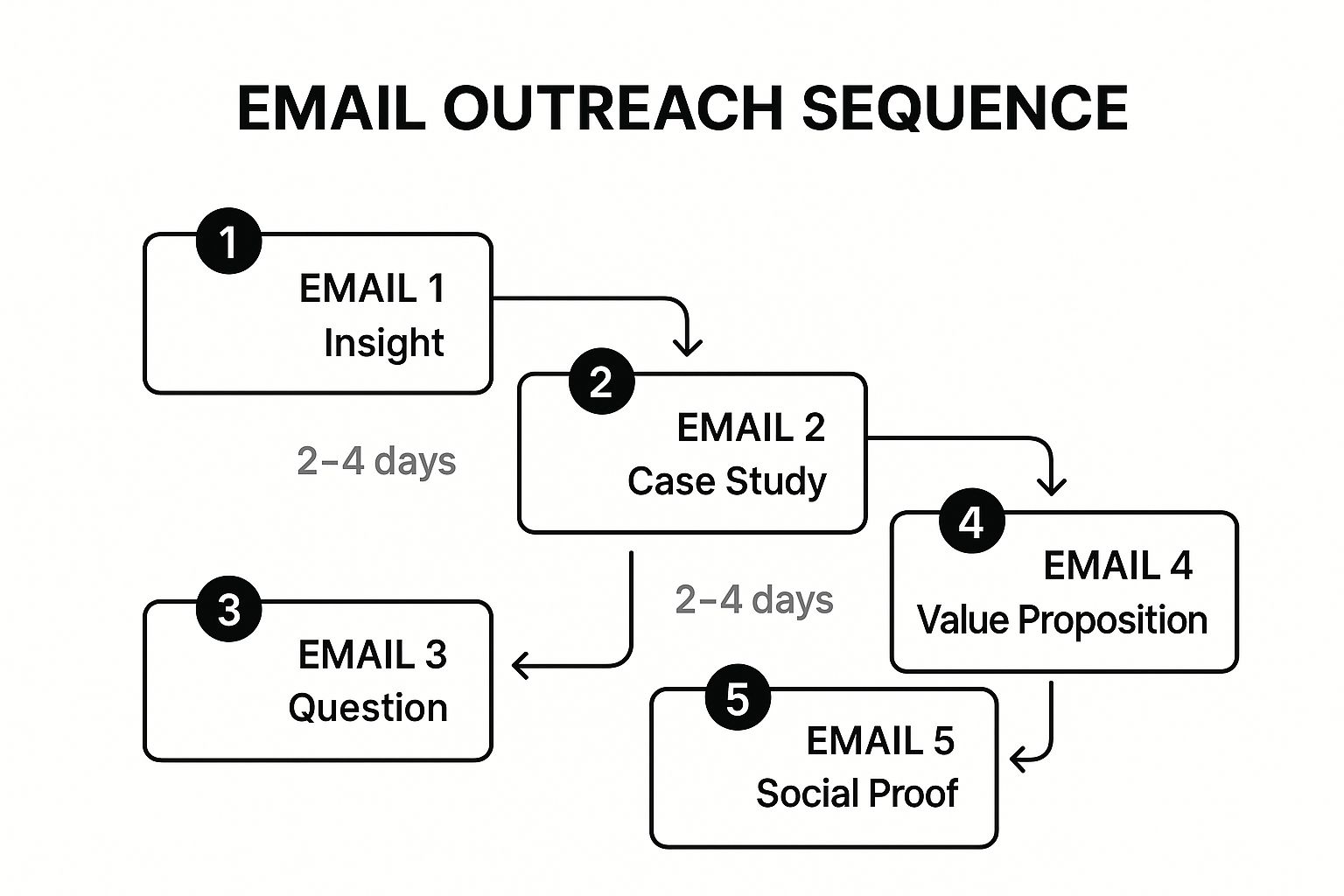
This method is rooted in the marketing principle that it takes multiple impressions before a prospect acts. The infographic above illustrates a typical five-step flow, showing how the content evolves from general insight to a specific value proposition. This progression makes the sequence one of the most strategic cold email templates for sales for nurturing high-value accounts with longer sales cycles.
Strategic Breakdown
-
Email 1: Value-First Opener: Start by sharing a valuable industry insight, a link to a helpful resource, or a relevant statistic. The goal is to be helpful, not to sell.
-
Email 2: Introduce a Case Study: Follow up by connecting that initial insight to a real-world result. Share a concise case study or success story relevant to their business.
-
Email 3: Engage with a Question: Shift from providing information to prompting a response. Ask a thought-provoking question related to the challenges you’ve highlighted.
-
Email 4: The Direct Ask: With context established, you can now present your value proposition and a clear call to action, such as booking a brief call.
-
Email 5: Last-Touch Social Proof: As a final attempt, share a powerful testimonial or social proof to build credibility and prompt a last-chance response.
Key Insight: The power of a sequence lies in its variety and patience. Each email serves a different function. One gives, the next proves, another engages, and only then do you ask. This layered approach respects the prospect’s time and builds a foundation for a meaningful conversation.
When to Use This Template
A multi-touch sequence is ideal for account-based marketing (ABM) or when targeting senior-level decision-makers who are inundated with emails. It’s particularly effective for SaaS companies and B2B services with complex solutions or longer sales cycles where immediate trust is difficult to establish. By spacing emails 2 to 4 days apart and varying the content, you stay top-of-mind without becoming a nuisance. Mastering this approach is a cornerstone of modern outreach; explore these cold email best practices on fypionmarketing.com to scale your efforts effectively.
Cold Email Template Comparison Overview
| Template | Implementation Complexity 🔄 | Resource Requirements 💡 | Expected Outcomes 📊 | Ideal Use Cases 💡 | Key Advantages ⭐ |
|---|---|---|---|---|---|
| Problem-Agitation-Solution (PAS) | Medium | Moderate research needed | 15-25% response rate | Multi-industry, urgency-driven messaging | High engagement from emotional triggers |
| Referral/Mutual Connection | Low | Requires existing network | 30-50% response rate | B2B sales, warm introductions | Builds trust via social proof |
| Social Proof/Case Study | Medium | Access to client results | 20-35% response rate | Industries with measurable outcomes | Demonstrates proven track record |
| Research-Heavy Personalization | High | Time-intensive prospect research | 25-40% response rate | High-value prospects, enterprise sales | Strong emotional connection & relevance |
| Curiosity Gap/Pattern Interrupt | Medium | Creative development | 10-30% response rate | Standout messaging, email-fatigued audiences | High open rates, memorable approach |
| Direct Value Proposition | Low | Minimal research | 12-25% response rate | Executive-level, time-sensitive prospects | Clear, concise communication |
| Question-Based Engagement | Medium | Moderate, consultative research | 18-30% response rate | Complex solutions, consultative sales | Encourages two-way conversation |
| Multi-Touch Sequence | High | Content creation & automation | 35-60% sequence response rate | Long sales cycles, nurturing campaigns | Builds trust over time, higher conversions |
From Template to Pipeline: Activating Your Outreach Strategy
You now possess a powerful arsenal of the best cold email templates for sales. From the psychological urgency of the Problem-Agitation-Solution (PAS) framework to the instant credibility of the Social Proof template, each model is a proven tool for opening doors. We have moved beyond just providing scripts; we’ve dissected the strategy, the psychology, and the specific personalization tactics that transform a generic message into a compelling conversation starter.
The common thread weaving through every successful example is the shift from selling to helping. A high-performing cold email doesn’t just pitch a product; it identifies a specific, well-researched pain point and offers a clear, valuable path toward a solution. This is where the true power of templates lies: not as a rigid script to be copied, but as a strategic foundation upon which to build a genuine, personalized connection.
Core Principles for Sustainable Success
Mastering the art of the cold email requires internalizing a few key principles that we’ve highlighted throughout this guide. Think of these as the unbreakable rules for your outreach campaigns:
-
Personalization is Non-Negotiable: The Research-Heavy template demonstrates this most explicitly, but the principle applies everywhere. A single, specific detail about a prospect’s company, role, or recent activity will outperform a hundred generic emails.
-
Clarity Outweighs Cleverness: Your prospect is busy. The Direct Value Proposition and Question-Based templates succeed because they are brutally efficient. They get straight to the point, respect the reader’s time, and make the “what’s in it for me” immediately obvious.
-
The Follow-Up is Half the Battle: As seen in the Multi-Touch Sequence template, persistence is critical. Most positive replies don’t happen on the first email. A structured, value-driven follow-up strategy is essential for maximizing your efforts and staying top-of-mind without being a nuisance.
Activating Your Strategy: Beyond the Template
Having these cold email templates for sales is your map, but successful execution requires the right vehicle and consistent fuel. Your next steps are to move from theory to action, transforming these frameworks into a predictable pipeline of qualified leads. This involves a dedicated, systematic process.
First, commit to rigorous A/B testing. Don’t just pick a template and hope for the best. Test different subject lines, experiment with various calls to action (CTAs), and measure the performance of different opening lines. Data, not assumptions, should guide your optimization efforts.
Second, ensure your technical foundation is solid. This means setting up your email infrastructure correctly to maximize deliverability and avoid the spam folder. Proper SPF, DKIM, and DMARC records are not optional; they are the bedrock of any serious cold email campaign.
Finally, remember that the goal is not to perfect a single email but to build a scalable outreach system. This system combines deep research, hyper-targeted list building, compelling copy, and relentless testing. It’s a significant operational lift, requiring dedicated time and expertise that many internal teams struggle to maintain consistently. The real challenge is not knowing what to do, but executing it flawlessly day after day.
Struggling to find the time and resources to build and manage a high-performance cold outreach system? At Fypion Marketing, we specialize in executing data-driven, done-for-you cold email campaigns that book qualified meetings for B2B companies like yours. Let us handle the strategy, execution, and optimization so you can focus on closing the deals we generate.