
The Ultimate Playbook: appointment setting for b2b to Convert More Prospects
Gone are the days of B2B appointment setting being a pure numbers game - blasting out high-volume, low-quality emails just to see what sticks. Today, it’s a much sharper, more precise strategy focused on one thing: creating qualified conversations with decision-makers who actually need what you’re selling. This shift from volume to value is what builds a predictable and scalable sales pipeline.
The New Rules of B2B Appointment Setting

You can throw the old playbook out. In a crowded market where decision-makers are bombarded with messages, success now hinges on a conversation-driven approach. The top SaaS and tech companies figured this out a while ago. They prioritize qualified meetings over a packed calendar because they know one great conversation is worth a hundred ignored emails.
This whole strategy is built on a few core pillars that work together to create real engagement and, ultimately, drive revenue.
Key Pillars of a Modern Strategy
-
Deep Audience Intelligence: This is about going way beyond surface-level data. You need to genuinely understand the specific pain points, daily headaches, and strategic goals of the people you’re targeting.
-
Value-Driven Messaging: Once you know their problems, you can craft messages that speak directly to them. Your outreach should offer a clear, compelling solution that feels like a helping hand, not a sales pitch.
-
Multi-Channel Execution: Don’t just live in the inbox. Engaging prospects across different platforms - like email, LinkedIn, and even personalized video - builds familiarity and trust over time.
-
Data-Informed Optimization: You have to use performance metrics to constantly refine your process. This isn’t a “set it and forget it” game. Data shows you what’s working so your efforts get sharper and more effective over time.
Getting this right transforms your outreach from a disruptive annoyance into a welcome solution. To really nail the new rules, it helps to have a solid grasp of a modern playbook for B2B lead generation.
The fundamental shift is from “How many calls can we make?” to “How many valuable conversations can we start?” This mindset change is the foundation for building a predictable pipeline in today’s B2B environment.
The Impact of Technology and Automation
The rise of AI and automation is also shaking things up, giving teams 40-60% efficiency gains without sacrificing the human touch that’s so critical for big deals.
Think about it: AI-powered tools can handle the initial lead qualification, send automated (but smart) follow-ups, and even use chatbots to capture intent before a human ever gets involved. This frees up your reps to do what they do best: talk to qualified prospects and close deals. Companies that outsource this to specialists often see faster sales cycles and more scalable pipelines as a direct result.
This guide will walk you through this entire process, step-by-step. For a broader view of how this all fits together, check out our guide on building a modern B2B marketing strategy.
Building Your Ideal Customer Profile
Winning at appointment setting for B2B starts long before you ever type a single subject line. It all begins with knowing exactly who you’re talking to.
If your outreach feels generic, it’s because it’s trying to speak to everyone at once - and in turn, connects with no one. The secret is building an Ideal Customer Profile (ICP) that digs much deeper than surface-level details like company size or industry.
Think of your ICP as a living document. It should spell out the specific pain points, the day-to-day headaches, and the big-picture goals of your target decision-makers. It’s the blueprint that turns a cold pitch into a genuinely helpful conversation.
Moving Beyond Surface-Level Data
Too many teams stop at job titles and revenue figures. That’s a start, but it doesn’t tell you why someone should care about what you’re offering. The real magic is in the qualitative details.
You need to get a bit nosy. What does a “day in the life” actually look like for them? What software are they already wrestling with? What industry trends are giving them anxiety? Answering these questions is what separates a killer campaign from one that lands in the trash folder.
For example, imagine you’re a cybersecurity SaaS company trying to reach a Chief Technology Officer (CTO). Don’t just list your features. Build a profile that uncovers the real pressures on that CTO - risk mitigation, stressful compliance audits, and tough questions from the board. Your message suddenly becomes about solving those problems, not just selling software.
Gathering Actionable Intelligence
So, where do you find all this juicy information? It’s probably more accessible than you think. A smart mix of digital tools and good old-fashioned digging will get you everything you need.
-
Talk to Your Current Customers: Your best customers are a goldmine of insights. Interview them. Ask why they chose you, what specific problem you solved for them, and what their buying process felt like. The language they use is the exact language you should be using in your outreach.
-
Hang Out in Industry Forums and Communities: Places like Reddit, niche Slack channels, and industry-specific forums are where your prospects go to ask for help and vent about their problems. Lurk in these conversations to get unfiltered intel on their biggest challenges.
-
Master LinkedIn Sales Navigator: This is arguably the most powerful tool out there for B2B targeting. It lets you slice and dice prospect lists by dozens of data points, from company headcount growth to specific keywords they’ve used in their profiles.
Here’s a quick look at how you can use LinkedIn Sales Navigator to build super-specific lead lists that perfectly match your ICP.
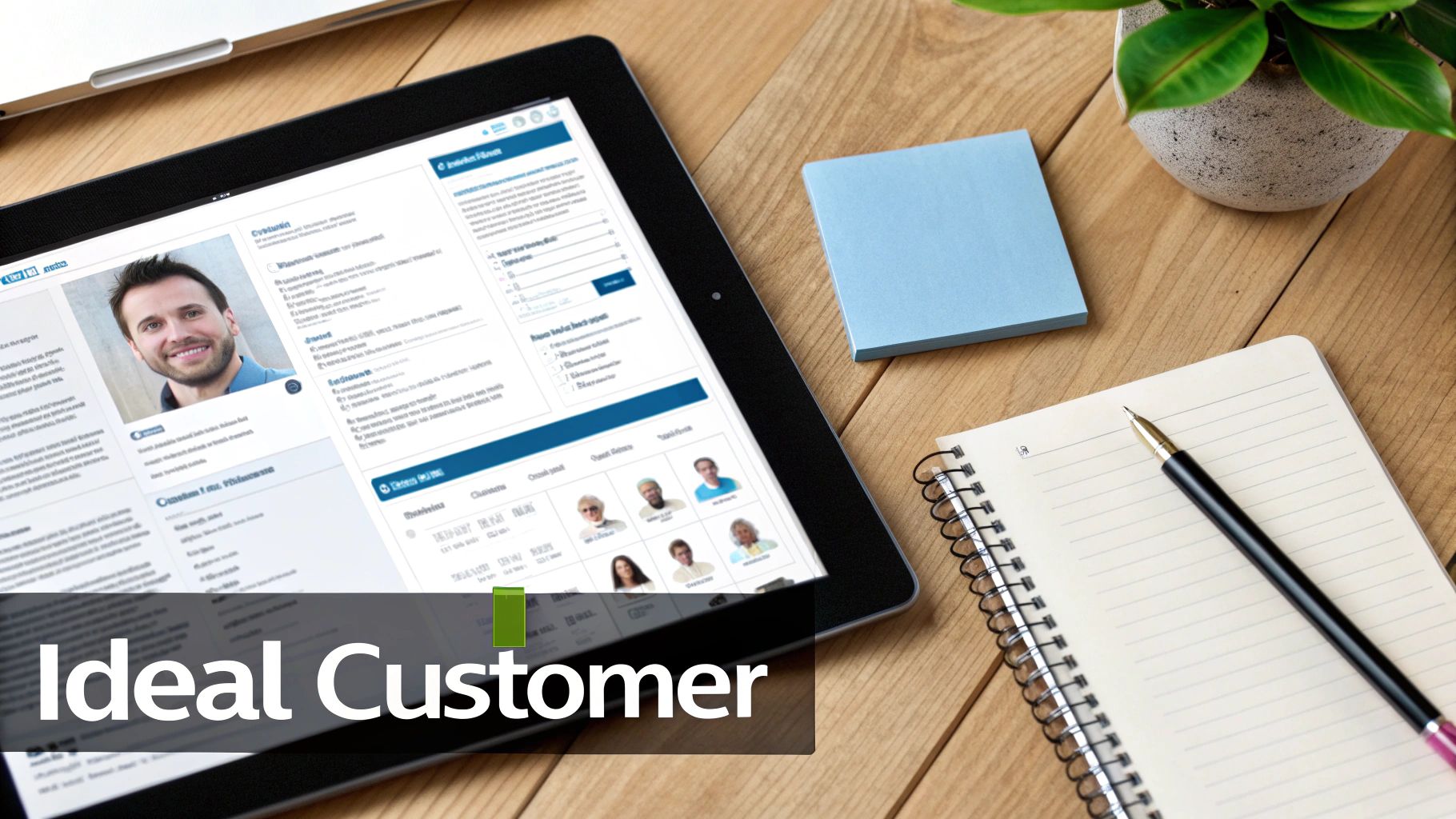
The interface lets you stack different criteria to pinpoint the right people at the right companies, making sure your outreach list is qualified from the get-go.
Turning Profiles into Personas
Once you have all this data, the next step is to consolidate it into a few distinct buyer personas. Give them names, maybe even a backstory. This little trick helps humanize the data, making it way easier for your team to write emails with genuine empathy.
A well-defined ICP is your campaign’s North Star. Every single decision - from the subject line you choose to the call-to-action you include - should be measured against whether it will actually resonate with that specific person.
Let’s say you’re a marketing automation firm trying to book a meeting with a Chief Marketing Officer (CMO). Your ICP research shows this CMO is constantly measured on lead-to-customer conversion rates and team efficiency. With that knowledge, your emails should focus on ROI and making their team’s life easier, not just listing a bunch of software features. This targeted approach is how you get replies.
Putting in this deep prep work is what makes appointment setting for B2B a reliable growth channel, not just a numbers game. If you want to go even deeper, check out our complete guide to building a B2B ideal customer profile. Trust me, the effort you put in here pays off big time down the line.
Crafting Outreach That Actually Gets Replies
You’ve got your Ideal Customer Profile locked in. Now for the hard part: writing a message that actually cuts through the static and gets a reply. In appointment setting for B2B, your outreach copy is everything. A generic, self-serving email is deleted in a blink; a sharp, value-focused one starts a conversation.
The real goal isn’t just to dodge the spam filter - it’s to make your prospect feel like you actually get them. This means shifting your entire mindset from “Here’s what we do” to “Here’s a problem I think you’re facing, and I might have a way to solve it.” Honestly, learning how to write cold emails that get replies is the one skill that separates the top performers from everyone else.
The Anatomy Of A High-Performing Email
Think of your email as a series of small wins. Every single part has a job to do, and if one piece fails, the whole thing falls apart.
-
The Subject Line: Its only job is to get the email opened. That’s it. Forget the clickbait and salesy fluff. Go for curiosity, relevance, or a direct hint of value. “Question about [Prospect’s Company] sales process” is way more compelling than “Revolutionary Sales Software,” right?
-
The Opening Line: This is your moment to prove you’re not just another spammer. Reference a recent company win, a LinkedIn post they wrote, or something specific you noticed. It instantly signals that you’ve done a bit of homework.
-
The Value Proposition: This is the heart of your message. In one or two crystal-clear sentences, connect a pain point you know they have (from your ICP research) to your solution. Ditch the feature list and focus on the outcome.
-
The Call-to-Action (CTA): Make it incredibly easy for them to say yes. Instead of a demanding “When can you meet for 30 minutes?”, try a softer, interest-based CTA like, “Worth a deeper look?” It lowers the barrier and makes hitting “reply” feel less like a commitment.
Moving Beyond Single Touchpoints
If you’re still relying on a single email, you’re setting yourself up for failure. Modern B2B appointment setting is all about multi-touch, multi-channel sequences. Decision-makers are slammed; you have to earn their attention over time.
This isn’t an excuse to spam them on every platform. It’s about building a smart, respectful campaign where each touchpoint adds a little more context.
Here’s what that might look like:
-
Day 1 (Email): Send your initial personalized email, zeroing in on a specific pain point.
-
Day 1 (LinkedIn): Pop over to their profile for a quick view and send a connection request with a short, non-salesy note.
-
Day 3 (Email): Follow up on the first email. Maybe offer something genuinely useful, like a relevant case study or a quick video explaining a concept.
-
Day 5 (LinkedIn): Find a recent post of theirs and leave a thoughtful comment. Engage, don’t sell.
-
Day 7 (Email): Send one last, very concise email with a clear, low-friction CTA.
This way, you’re showing up in a few different places, reinforcing your message without being annoying.
The reality is, getting replies is tougher than ever as decision-makers guard their time. But the best teams are seeing incredible results by obsessing over quality, not quantity. They blend email, phone, and LinkedIn to get the best contact rates, with some elite services hitting show rates over 70-80%.
Personalization At Scale
Look, “personalization” doesn’t mean handwriting every single word of every email. That’s a surefire way to burn out. The real trick is finding that sweet spot between automation and genuine, human customization.
A good way to start is by identifying your “personalization tokens” - those unique little details you can drop into a proven template.
These can be things like:
-
(like a new funding round or product launch)
-
(maybe you attended the same webinar or went to the same university)
You don’t need a dozen of these. Just focusing on one or two highly relevant, custom snippets per email is enough to show the prospect you see them as a person, not just a name on a list. For a much deeper dive, check out our guide on how to master cold email personalization to boost your response rates. It’s how you turn a boring outreach task into a powerful conversation starter.
Effective Outreach Angles for Different B2B Personas
The key to getting a reply is speaking directly to what your prospect actually cares about. A VP of Sales is worried about hitting quota, while a CFO is focused on ROI. You can’t use the same message for both.
This table breaks down how to tailor your value proposition and CTA for different roles you might be targeting.
| Persona (e.g., VP of Sales) | Primary Pain Point | Effective Value Proposition Angle | Example CTA |
|---|---|---|---|
| VP of Sales | Missing revenue targets, inaccurate forecasting | ”We help sales leaders like you get a real-time view of their pipeline, so they can stop guessing and start hitting their numbers." | "Open to seeing how we help VPs of Sales add an extra 15% to their team’s quota?” |
| Head of Marketing | Low MQL to SQL conversion, proving ROI | ”Our approach focuses on generating fewer, but higher-quality leads that your sales team will actually thank you for." | "Curious to see a case study on how we doubled a similar company’s conversion rate in 90 days?” |
| Chief Financial Officer (CFO) | High customer acquisition cost (CAC), unpredictable cash flow | ”We help reduce CAC by up to 30% by streamlining your top-of-funnel process, directly impacting your bottom line." | "Worth exploring if we could model out a similar ROI for [Company]?” |
| Director of Operations | Inefficient processes, siloed teams, wasted resources | ”I saw you’re scaling the ops team. We specialize in creating a single source of truth that cuts down on manual work by 10 hours/week." | "Mind if I share a 2-minute video showing how the platform works?” |
Notice how each angle ties a specific solution to a role-specific problem. This is what it means to write a truly value-driven email.
Executing and Optimizing Your Campaigns
Launching your campaign is just the start. The real work in B2B appointment setting begins when you hit “send” - this is the execution and optimization phase, where you turn raw data into a predictable growth engine. You’re moving from theory to practice, creating a feedback loop that constantly dials in your performance.
First things first: you need to make sure your messages actually land in the inbox. A solid technical setup is non-negotiable. This means properly warming up new domains and managing your sender reputation to stay out of that dreaded spam folder. Even the most brilliant copy is worthless if no one sees it. For a deep dive, check out these step-by-step instructions for a solid technical setup for cold emailing to get started on the right foot.
Modern outreach isn’t just about one channel. It’s a coordinated sequence designed to build familiarity and trust across different platforms.
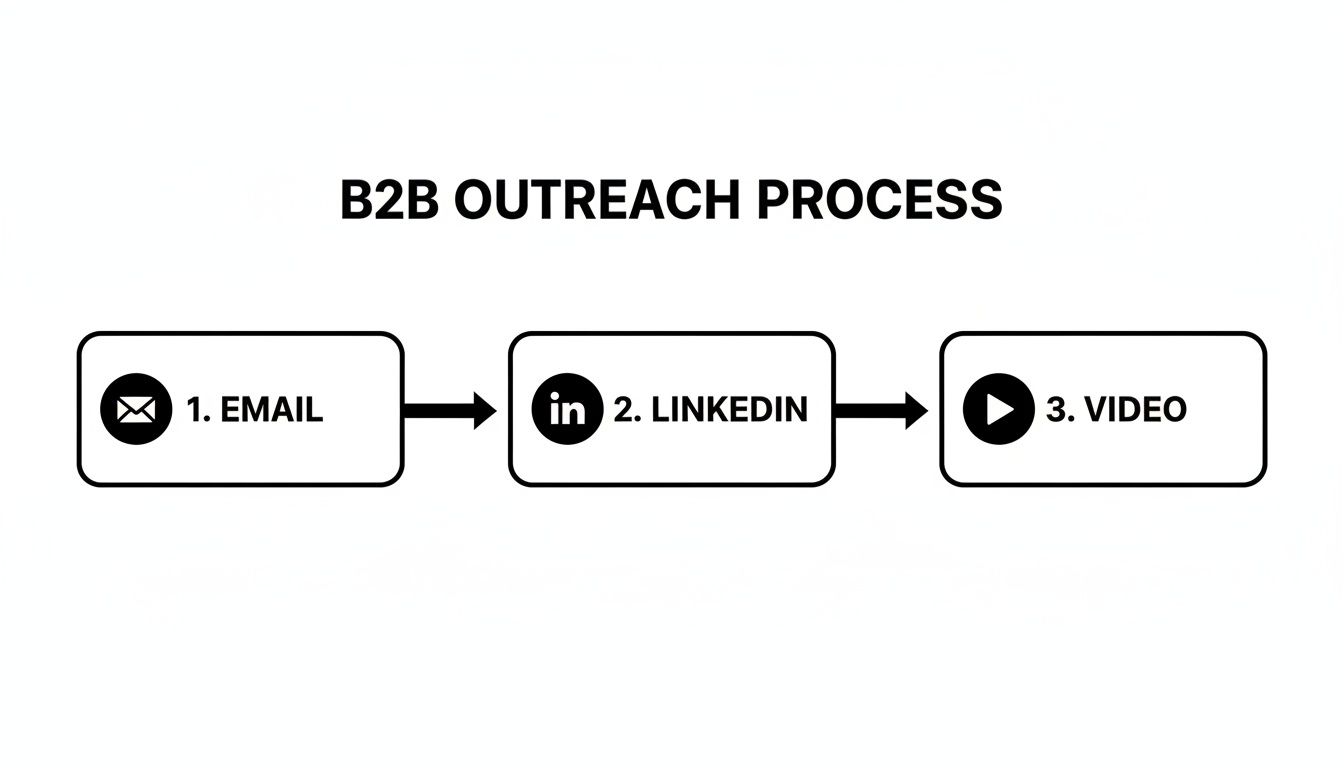
The idea here is simple: engage prospects respectfully where they already are, whether that’s their inbox, their LinkedIn feed, or through a quick personalized video.
Focusing on Metrics That Matter
It’s way too easy to get lost in a sea of data. A lot of teams obsess over “vanity metrics” like open rates, which are notoriously unreliable thanks to privacy changes and tracking inaccuracies. Sure, a decent open rate tells you your subject lines are getting clicks, but it doesn’t tell you if your message is actually hitting home.
Instead, zero in on the key performance indicators (KPIs) that actually point to revenue.
Metrics to Track Closely:
-
Reply Rate: This is your number one indicator of engagement. A low reply rate is a clear sign there’s a disconnect between your message and what your audience cares about.
-
Positive Reply Rate: This one is even better. It filters out all the “not interested” noise and shows you how many prospects are genuinely open to talking. It’s a powerful signal that your value prop is on the right track.
-
Meetings Booked: The ultimate goal. Tracking the number of qualified appointments you set is the clearest measure of success.
-
Meeting Show Rate: A booked meeting doesn’t mean much if the prospect ghosts you. A low show rate can point to problems with your scheduling process or a sign that the prospect doesn’t see enough value to show up.
When you focus on these numbers, you get a much clearer picture of what’s actually working.
The A/B Testing Framework
Optimization is all about systematic testing. If you change everything at once, you’ll have no idea what actually made a difference. The key is to adopt a simple A/B testing framework to isolate variables and let the data guide you.
Pick one element and test it. Just one. Run two versions of your email to a decent-sized chunk of your list and see which one performs better against your main KPI, like positive reply rate.
Common Elements to Test:
-
Subject Lines: Try a straightforward, benefit-driven subject line against one that piques curiosity. Think “Idea for [Company]‘s sales process” vs. “Quick question about your team’s quota.”
-
Value Propositions: Frame your solution from different angles. One version might focus on saving money, while another talks about boosting team efficiency.
-
Calls-to-Action (CTAs): Compare a direct CTA (“Are you free for a 15-minute call next week?”) with a softer, interest-based one (“Mind if I send over a short video explaining how it works?”).
Let’s imagine you’re testing two CTAs. Version A gets a 2% positive reply rate, but Version B gets a 4.5% rate. The data is telling you something important: Version B is far more effective at starting conversations with this specific audience. You’d roll with that CTA and then move on to testing a new variable, like your opening line.
The point of optimization isn’t to find some mythical “perfect” email. It’s to build a continuous process of improvement. Every campaign should teach you something new about your audience, making your next one even more effective.
Interpreting Feedback and Iterating
Not all feedback lives in a spreadsheet. Pay close attention to the actual words prospects use in their replies - even the negative ones.
-
Are people consistently confused about what you do? Your value prop might be unclear.
-
Getting a lot of “not the right person” replies? Your targeting or persona research needs another look.
-
Do prospects tell you they already use a competitor? That’s pure gold. Use it to sharpen your differentiation and counter-arguments.
This kind of qualitative feedback is just as valuable as your metrics. Use it to inform your next round of copy, tweak your Ideal Customer Profile, and adjust your entire strategy. This cycle of executing, measuring, and iterating is what separates stagnant campaigns from the ones that consistently fill the sales pipeline. It’s how B2B appointment setting goes from a guessing game to a repeatable science.
Understanding the Costs and ROI
Every business leader I know needs to justify their investments, especially when it comes to sales. It’s easy to look at B2B appointment setting as just another expense, but that’s the wrong way to think about it. The smart move is to see it as a direct investment in a predictable, scalable sales pipeline. Getting the economics right from the start can make or break your entire growth strategy.
To really get a handle on the ROI, you first have to look at the different ways you can go about it. Each model has its own price tag, its own pros, and its own potential headaches. The best choice for you really depends on where your company is at, how complex your sales cycle is, and frankly, how much risk you’re willing to take on.
Analyzing Different Pricing Models
There’s no one-size-fits-all price for B2B appointment setting. You’ll typically run into one of three main models: building an in-house team, paying an agency a monthly retainer, or a performance-based deal where you pay per meeting.
-
In-House Team: This route gives you the most control. You handle the messaging, the training, all of it. But it’s also the most expensive path, with salaries, benefits, software licenses, and the time it takes to manage everyone. It’s a hefty fixed cost that doesn’t always guarantee you’ll get the meetings you need.
-
Agency Retainer: Working with an agency on retainer gives you instant access to their expertise and tech stack without the HR nightmare. The monthly costs are predictable, which is great for budgeting. The trick is making sure you pick an agency that’s motivated to deliver quality meetings, not just burn through your retainer with busywork.
-
Pay-Per-Meeting: This is getting more and more popular, and for good reason. It ties the agency’s success directly to yours. You only pay for qualified appointments that meet the criteria you’ve both agreed on. It’s a fantastic way to de-risk the whole thing and make sure every dollar you spend is actually generating a real sales conversation.
Here’s the biggest mental shift you need to make: Stop asking, “What does it cost?” Instead, start asking, “What is a qualified meeting with my ideal buyer actually worth?” When a single deal can bring in five or six figures, the cost of getting that first conversation on the books starts to look a lot more reasonable.
Calculating the True Cost Per Appointment
The price of a qualified meeting isn’t a fixed number; it’s influenced by a few things. The more niche your industry is or the higher up the food chain you need to go, the more it’s going to cost. It just takes more work to get a C-level executive’s attention than an office manager’s.
For example, the average cost for a qualified B2B appointment can swing anywhere from $550 to $1,700. A campaign going after small business owners for a simple SaaS product might only be $80 a meeting. But if you’re trying to get time with a CFO at a Fortune 500 company? That could easily top $1,000. The upside is that good performance-driven agencies often build a pipeline 40-60% faster than most in-house teams can, making it a very efficient spend.
The ROI of a Single High-Value Client
This is where the magic really happens. The true power of professional appointment setting becomes crystal clear when you look at the lifetime value (LTV) of a new client.
Let’s walk through a quick, real-world scenario.
Imagine your average client LTV is $50,000, and your sales team closes 1 out of every 10 qualified meetings. You hire an agency that charges $600 for each qualified appointment they set.
To get that one new client, you’d need 10 meetings. The total cost? $6,000. You just spent $6,000 to generate $50,000 in revenue. That’s an ROI of over 8x, and that’s not even counting any referrals or future upsells from that happy new client. Focusing on this kind of efficiency is a key part of how you can reduce customer acquisition cost with proven strategies.
When you shift your focus to the outcome - a pipeline packed with ideal prospects - investing in professional appointment setting becomes one of the smartest and most profitable moves you can make. It turns growth from a game of chance into a predictable, repeatable machine.
Your B2B Appointment Setting Questions, Answered
Even with the best strategy laid out, you’re bound to have questions when you jump into B2B appointment setting. It has a lot of moving parts, and it’s smart to get clear on the details before you commit your time and resources.
Let’s tackle some of the most common questions we hear. My goal is to cut through the noise, set some realistic expectations, and clear up any confusion so you can move forward.
How Is This Different From Telemarketing?
This is a big one, and the difference is huge. Telemarketing is usually a numbers game - high volume, low personalization. Think mass cold calls with the main goal of just getting a brand name out there. It’s all about quantity.
B2B appointment setting is the complete opposite. It’s a highly strategic, targeted effort focused on quality over quantity. The whole point is to qualify leads against a very specific Ideal Customer Profile and only book meetings with decision-makers who have a real, potential need for what you’re selling. It’s not about making noise; it’s about starting valuable sales conversations.
What Kind of Results Can I Realistically Expect?
This always depends on your industry, who you’re targeting (VPs are harder to reach than managers), and how complex your product is. But a well-run campaign should absolutely deliver a steady, predictable flow of qualified meetings. Just remember, it’s a marathon, not a sprint.
Most companies start seeing consistent meetings hit the calendar within 30 to 90 days. That first stretch is all about gathering data, testing your messaging, and fine-tuning the approach.
Here’s what a successful outcome actually looks like:
-
A predictable number of qualified meetings booked every single month.
-
Your sales team spending their time talking to genuinely interested people, not hunting for them.
-
A clear, measurable ROI as those meetings turn into closed deals.
The real measure of success isn’t just counting how many meetings you booked. It’s about pipeline velocity - how fast those appointments turn into legitimate sales opportunities. That’s the true test of a great appointment setting strategy.
Can We Do This In-House or Should We Outsource?
This is probably one of the biggest forks in the road you’ll face. The right call comes down to your team’s current bandwidth, their expertise, and your bigger strategic goals.
Building an in-house team gives you 100% control. This model makes sense if you’re in a super technical niche where deep product knowledge is non-negotiable from the first email, or if you’re only going after a small list of high-value strategic accounts. The downside? It’s a serious investment in hiring, training, managing, and all the tech that goes with it.
Outsourcing to a specialized agency is often the faster, more efficient, and more scalable route. You get instant access to a team that already has the expertise, proven processes, and the right tech stack. This works especially well for companies trying to crack into new markets or scale their pipeline quickly without adding a ton of internal overhead.
Will AI Replace Human Appointment Setters?
It’s tempting to think so, but it’s highly unlikely AI will ever fully replace the human touch, especially in complex B2B sales. AI and automation are incredible for handling scale, analyzing data, and knocking out repetitive tasks, but they can’t replicate the nuance and empathy of a real conversation.
Let’s be honest, buyers - especially at the enterprise level - are tired of robotic outreach. They want to build trust and a genuine relationship. A skilled human is a master at reading between the lines, handling tricky objections, and adapting the conversation on the fly. Algorithms just aren’t there yet.
The future isn’t one or the other; it’s a hybrid model where tech makes people better.
-
AI can handle lead scoring and personalizing outreach at scale.
-
Automation is perfect for streamlining the boring stuff like scheduling and follow-ups.
-
Humans step in for the high-touch interactions, build actual rapport, and close for the meeting.
When you combine them, you get a system that’s way more powerful than either approach could ever be on its own.
Ready to build a predictable sales pipeline without the guesswork? Fypion Marketing specializes in performance-driven B2B appointment setting. You only pay for qualified meetings, which means our success is directly tied to yours. Schedule your free consultation today at https://www.fypionmarketing.com.
Prepared with the Outrank app