
Your Guide to Outsourcing Inside Sales

Let’s be real for a moment. Building a world-class inside sales team from the ground up is a long, expensive, and frankly, risky road. This is why more and more leaders are choosing to outsource inside sales. This isn’t just about saving a few bucks anymore; it’s a strategic move to plug directly into a pool of seasoned talent and sophisticated sales tech you’d otherwise have to build yourself.
Why Smart Companies Outsource Inside Sales
The sales world has changed. If you want to build an internal team, you’re looking at a huge upfront investment in recruiting, training, salaries, benefits, and technology - all before you’ve even closed a single deal. This whole process can become a major bottleneck, especially for fast-growing companies where the current team is already swamped with new leads.
Outsourcing inside sales smashes that bottleneck. You get immediate access to a pre-built sales engine - professionals who are already trained, managed, and armed with the right tools. We’re not just talking about making cold calls. We’re talking about deploying a complete sales function that can handle everything from digging up leads to nurturing them and even closing the deal.
Gaining an Immediate Competitive Edge
Picture a SaaS startup trying to break into a new market. Building their own team could easily eat up a year with hiring, training, and getting everyone up to speed. By outsourcing, that same startup could have a fully functioning team setting qualified meetings within a single quarter. That kind of speed to market is a massive competitive advantage.
The data backs this up, too. Inside sales isn’t some small niche anymore; it’s becoming the dominant force in sales. Projections show that inside sales reps will make up 40% of high-growth B2B sales teams by 2025. That’s a huge leap from just 10% a few years back. On top of that, this model can slash customer acquisition costs by 40% to 90% compared to traditional field sales, making it a no-brainer financially.
To help you visualize the trade-offs, here’s a quick breakdown of what you’re looking at when deciding between keeping things in-house versus bringing on a partner.
In-House vs Outsourced Inside Sales: A Quick Comparison
This table gives a high-level look at building your own inside sales team versus partnering with a specialist, focusing on the key things you need to consider.
| Factor | In-House Team | Outsourced Partner |
|---|---|---|
| Time to Launch | Months to a year (hiring, training, setup) | Weeks (immediate team deployment) |
| Upfront Cost | High (salaries, benefits, tech licenses, recruitment) | Lower (predictable monthly fee) |
| Talent Access | Limited to your hiring capabilities and location | Instant access to specialized, experienced reps |
| Technology | Requires purchasing and managing your own tech stack | Access to a proven, pre-built tech stack |
| Scalability | Rigid and slow (hiring/firing process) | Flexible and fast (scale up or down on demand) |
| Expertise | Developed over time, relies on internal training | Immediate access to industry best practices |
| Management | Requires dedicated internal sales managers | Handled by the outsourced partner |
Ultimately, the choice depends on your company’s stage, resources, and growth goals. While an in-house team gives you total control, an outsourced partner offers speed and expertise that’s tough to match.
Accessing Specialized Talent and Technology
The best outsourcing partners don’t just give you people; they give you a proven system. That system comes packed with:
-
Specialized Expertise: You’re not just getting reps; you’re getting a team that lives and breathes the latest sales tactics, objection handling, and engagement strategies for your specific industry.
-
Advanced Tech Stack: These firms show up ready to go with sophisticated CRMs, AI-powered sales tools, and automation platforms that have been fine-tuned to squeeze the most out of every interaction.
-
Scalability on Demand: Need to ramp up for a product launch or pull back during a slow season? A partner lets you adjust your sales firepower without the HR headaches of hiring and firing.
This access to specialized skills is a true game-changer. Instead of your team getting bogged down in repetitive admin work, they can focus on what really matters. Many businesses find that outsourcing top-of-funnel activities, like prospecting and appointment setting, frees up their in-house closers to do what they do best - bring in the revenue. If that sounds like a good fit, you might want to check out our guide on how to **boost sales with outsourcing lead generation strategies**.
The conversation around outsourcing inside sales has totally changed. It’s no longer a question of “Can we afford to outsource?” It’s now, “Can we afford not to?” The goal isn’t just about saving money. It’s about buying expertise, speed, and scalability that’s nearly impossible to build yourself at the same pace.
Seeing it this way reframes outsourcing from a simple cost-cutting tactic to a core part of your growth engine, setting your business up to scale faster and smarter.
How to Choose the Right Sales Outsourcing Partner

Picking a partner for outsourcing your inside sales is easily the single most important decision you’ll make in this entire journey. Get it right, and you’ve got a true extension of your team, driving real growth. A bad fit, though? That can burn your brand reputation and drain your budget fast.
You’re not just looking for a vendor to check off tasks. You’re hunting for a genuine partner. This means you need a solid playbook for vetting potential firms that goes way beyond their sales pitch and glossy brochures.
Look Beyond Surface-Level Case Studies
Every single outsourcing agency will wave impressive case studies in your face. It’s your job to pick them apart. Don’t get hypnotized by big-name logos or fuzzy success metrics. You need to find proof they have deep expertise in your specific niche or one that’s very similar.
Think about it. If you’re selling complex cybersecurity software to financial institutions, a case study about a simple project management tool for creative agencies is useless. You need to see that they get the specific pain points of your buyers, the jargon of your industry, and the nuances of a long, complicated sales cycle.
So, demand details. Ask them to walk you through a campaign for a company just like yours. Where did they source the leads? What exact messaging did they use? What objections did they run into, and how did they get past them? Going deep like this reveals who’s actually done the work and who’s just talking a good game.
Ask the Tough Questions During Discovery
Your discovery calls are your chance to really put potential partners under the microscope. Your questions shouldn’t be softballs; they need to uncover how they operate, solve problems, and handle things when they go wrong.
Here are a few non-negotiables to add to your list:
-
“Walk me through your process for replacing an underperforming sales rep. What’s that timeline look like, and is there a cost to us?” A solid partner won’t hesitate. They’ll have a clear talent management strategy ready to go.
-
“Show me how you would adapt a sales cadence for our specific buyer persona.” This tests if they can think strategically or if they just run the same generic playbook for everyone.
-
“How do you train your reps on a client’s specific brand voice and company culture?” This is mission-critical for making sure every prospect interaction feels authentic to your brand.
Vague or stumbling answers to these questions are a huge red flag. It tells you everything you need to know about their operational maturity and whether they’re truly committed to being a partner.
Evaluate Their Technology and Cultural Fit
An outsourced team is only as good as its tools and the culture it lives in. Take a look at their tech stack - is it modern and effective? Do they use AI-powered sales tools for things like call analysis or email optimization? Is their CRM setup sophisticated enough to give you the real-time data and transparency you’ll need?
Just as important is the cultural alignment. This team is going to be the voice of your brand. Their work ethic, communication style, and values have to click with yours. If your company is all about collaboration and transparency, a rigid, black-box provider will be a source of constant friction.
The game has changed. Outsourcing inside sales isn’t just a cost-cutting move anymore. A 2024 Deloitte survey found 50% of executives now use outsourcing for front-office functions like sales. The main driver has shifted from saving money to gaining access to specialized talent (42%) and boosting performance (33%). This shows a strategic shift toward using outsourcing for agility and expertise.
This evolution means you’re not just hiring a vendor; you’re investing in a team of specialists. To make sure that expertise is pointed in the right direction, you have to confirm they understand what an ideal customer looks like for you. A clear process for qualifying leads is essential. In fact, our guide on the **7 key criteria for a B2B sales lead qualification checklist** can give you a great framework for this exact conversation with potential partners.
Ultimately, you’re looking for a seamless extension of your company. They should feel like the sales team in the next room, even if they’re halfway around the world. They need to get your mission, believe in your product, and be genuinely invested in seeing you win. Taking the time to find this perfect fit is the best investment you can possibly make.
Crafting a Seamless Onboarding and Integration Plan
You’ve found the right outsourcing partner. Huge congrats. But don’t pop the champagne just yet - the most critical work is just starting. I’ve seen promising partnerships crumble because of a messy, rushed handoff. Long-term success is all about a smart, structured plan to bring your new team into the fold.
The goal? Make them feel like a real part of your company from day one. When reps feel connected and valued, they don’t just sell; they become genuine brand champions. A team left on an island will always sound like they’re just reading a script.
Building a Living, Breathing Knowledge Base
Before anyone picks up the phone, your new team needs a “single source of truth.” Forget about sending a static, 100-page PDF that collects digital dust. You need to build a dynamic, living knowledge base that’s easy to search and actually useful.
Think of this as their lifeline. It should be loaded with everything a rep needs to sound confident and authoritative. Move past basic feature lists and get into what actually matters in a real sales conversation.
Here’s what it absolutely must include:
-
Deep Product Dives: Don’t just explain what it does. Focus on why it matters. Use short video walkthroughs, crisp GIFs, and actual customer success stories to bring the value proposition to life.
-
Rich Buyer Personas: Go beyond job titles. Describe their daily headaches, what they’re trying to achieve, and the specific triggers that make them look for a solution like yours. Give your personas names. Give them personalities.
-
Competitive Battle Cards: Your reps will get hit with the “How are you different from Competitor X?” question. Equip them with clear answers covering the competition’s strengths, their weaknesses, and exactly where your product wins.
-
Objection Handling Guides: Put together a list of the most common objections and provide proven, conversational ways to respond. This isn’t about robotic scripts; it’s about building confidence and ensuring consistency.
Running Training Sessions That Actually Engage
With your knowledge base ready, it’s time for training. Whatever you do, resist the urge to cram everything into a single, marathon-length info-dump. That’s a recipe for glazed-over eyes. Instead, break the training into focused, interactive sessions spread across the first week.
And this isn’t just about product training. Immerse them in your brand. They need to get a feel for your company’s mission, its core values, and its unique voice. If your brand is casual and a bit witty, a team of stiff, overly formal reps will create a bizarre and off-putting experience for your prospects.
This visual breaks down the core functions you can expect an outsourced inside sales team to handle, from that first touchpoint to a confirmed meeting.
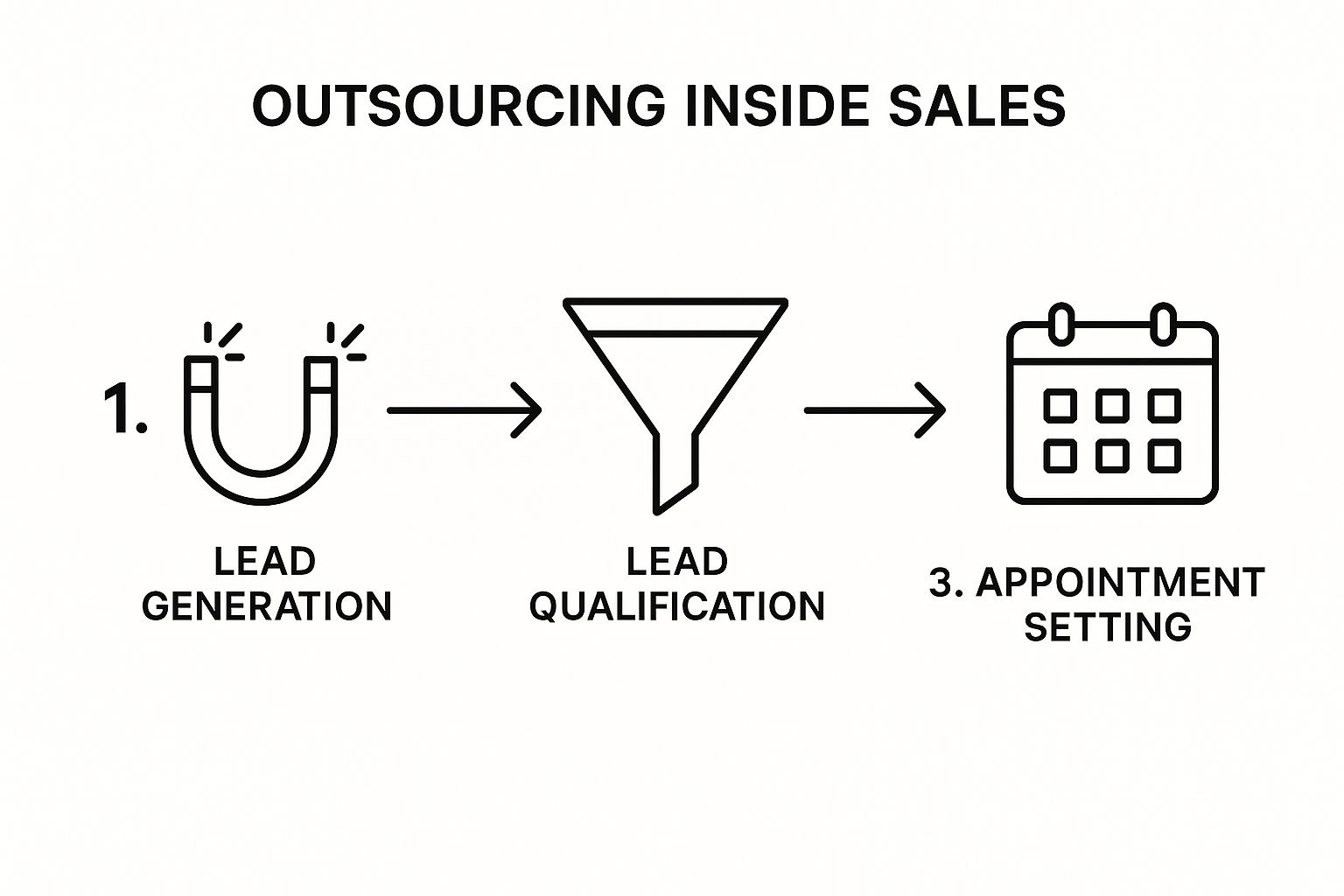
The journey from lead gen to qualification and then to appointment setting shows why these specialized roles work so well. Each stage demands a different skill set, which is exactly why a structured onboarding process is non-negotiable for aligning the team with your goals every step of the way.
Integrating Tech and Communication
A smooth handoff isn’t just about knowledge; it’s about systems and access. Your outsourced team needs the right tools and clear communication lines to work as a single, cohesive unit with your in-house staff.
Technology integration is mandatory. Set them up with their own logins and dedicated views within your CRM. This gives you total transparency and equips them with the context they need for every single conversation. A shared CRM dashboard is the only way to effectively track progress against your KPIs.
One of the biggest mistakes I see is companies treating their outsourced team like a black box. They give them a target and just hope for the best. Real integration requires open lines of communication. A dedicated Slack or Teams channel is one of the simplest and most powerful ways to achieve this.
This channel becomes the central hub for day-to-day collaboration. It’s where your new reps can ask quick questions, get instant feedback on a tough email, and celebrate wins with your entire team. This one simple step does more to build a sense of belonging than almost anything else. It tears down the “us vs. them” wall and reinforces that everyone is pulling in the same direction.
How to Manage Performance and Set Winning KPIs

Alright, you’ve onboarded your outsourced inside sales team. The setup is done. Now the real work begins: managing the partnership to make sure it actually drives revenue.
Managing a remote team you didn’t hire directly requires a completely different playbook. Success comes down to tracking the right things. It’s time to move past old-school vanity metrics and get laser-focused on the key performance indicators (KPIs) that directly impact your bottom line.
Forget obsessing over call dials or emails sent. Sure, those numbers tell you if people are busy, but they don’t tell you if they’re being effective. A rep can make 100 calls and book zero meetings. What good is that? Instead, your performance dashboard needs to be built around metrics that show real progress through the sales funnel. This is how you get true strategic insight into the partnership.
Focusing on Impactful Sales KPIs
The single most effective way to manage an outsourced team is to shift your focus from activities to outcomes. You need to measure the results that actually matter to your bank account. The core question is always: how efficiently is my investment turning into qualified pipeline and closed deals?
I’ve seen too many partnerships fail because they were measuring the wrong things. To avoid that, here are the KPIs that should be front and center in every performance review.
We’ve found that a balanced scorecard approach, looking at activity, pipeline, and financial outcomes, gives the clearest picture of what’s working and what isn’t.
Essential KPIs for Your Outsourced Inside Sales Team
Here’s a breakdown of the key metrics we use to measure performance and ensure a strong ROI for our clients.
| KPI Category | Metric Example | What It Measures |
|---|---|---|
| Activity Quality | Conversation-to-Meeting Rate | Measures what percentage of meaningful conversations turn into a booked meeting. It’s a far better indicator of skill than raw call volume. |
| Pipeline Generation | Sales Qualified Leads (SQLs) Generated | Tracks the number of leads that hit your predefined criteria and are genuinely ready for a sales conversation. This is your primary top-of-funnel output. |
| Conversion Efficiency | Demo-to-Close Rate | Shows the percentage of completed demos that actually convert into paying customers. This is a critical measure of meeting quality. |
| Financial ROI | Customer Acquisition Cost (CAC) | Calculates the total cost of the outsourced service divided by the number of new customers won. This tells you the direct financial return on your investment. |
By tracking these KPIs, you change the conversation from “How busy were you?” to “What impact did you have?” It creates a culture of accountability that’s all about tangible results - exactly what you need when you’re outsourcing.
Structuring Your Communication for Success
Clear, consistent communication is the bedrock of any successful outsourcing relationship. You absolutely need a regular meeting cadence to review performance, give feedback, and stay aligned on strategy. This isn’t about micromanagement; it’s about collaborative leadership.
You have to establish a firm schedule for check-ins. Here’s what works for us:
-
Weekly Tactical Syncs: These should be fast-paced, data-driven meetings. Pull up the dashboard and review the past week’s numbers against your core KPIs. This is the time to dig into challenges reps are facing and brainstorm solutions together. The goal is real-time course correction, not a long-winded report.
-
Monthly Performance Reviews: This is where you zoom out. Take a more strategic look at the trends over the last 30 days. Are SQLs trending up? Is the demo-to-close rate holding steady or dipping? This meeting is all about the bigger picture and the overall health of the partnership.
During these reviews, ask questions that get to the “why” behind the numbers. For instance, if the conversation-to-meeting rate suddenly drops, don’t just point it out. Ask, “What new objections are we hearing this week?” This approach creates a problem-solving environment, not an accusatory one. You can get more ideas for pipeline improvement in our guide to effective outbound lead generation strategies that convert.
The best outsourced partnerships feel like a true extension of your own team. This happens when you stop managing them like a vendor and start leading them like a department. Run joint coaching sessions, share wins publicly, and give constructive feedback that motivates improvement.
When a rep is underperforming, work with your partner’s leadership to roll out a clear and fair performance improvement plan (PIP). A quality partner will already have a solid internal process for this, reinforcing the value they bring in talent management.
Ultimately, leading your outsourced team with this kind of strategic insight is what ensures you get the full value from your investment.
Optimizing and Scaling Your Outsourcing Partnership

So you’ve made it through the first quarter and things are looking good. Don’t pop the champagne just yet. A strong start is fantastic, but it’s just the launchpad for what really matters: sustainable, long-term growth.
Success from here on out is all about continuous improvement and smart scaling. Your initial work was about laying the foundation. Now, it’s time to turn that foundation into a revenue-generating machine. This is where you shift from implementation to pure optimization, where small, data-driven tweaks can create massive compounding returns.
Driving Continuous Performance Improvement
The best outsourcing partners I’ve worked with are never satisfied with the status quo. They’re always hunting for ways to do things better. This isn’t a “set it and forget it” kind of deal. A real partnership means you’re both in the trenches, working together to refine every part of the sales process.
One of the most effective ways to do this is through systematic A/B testing. You can work directly with your partner to test different variables and see what actually moves the needle with your audience.
Here are a few things you should absolutely be testing:
-
Subject Lines: Pit a benefit-driven subject line against a question. See which one gets more opens. It’s a simple test with potentially huge impact.
-
Call-to-Action (CTA): Compare a “soft” CTA, like asking if they’re interested, against a “hard” CTA that asks for a specific meeting time. You might be surprised by the results.
-
Email Cadence: How many touchpoints are too many? What’s the perfect timing between them? Experiment to find that sweet spot between persistence and annoyance.
Another game-changer is AI-powered call analysis. Many of the more advanced firms use tech that dissects sales calls to pinpoint which phrases, questions, and objection-handling tactics actually lead to booked meetings. This gives you hard data to coach reps on what works, taking the guesswork out of the equation.
The most successful partnerships I’ve seen are built on a shared commitment to a test-and-learn mindset. It’s not about pointing fingers when a campaign underperforms; it’s about asking, “What did we learn, and what are we going to test next?” This creates a culture of innovation that constantly pushes results higher.
Knowing When and How to Scale
Once your outsourced team is consistently crushing its targets, the conversation naturally turns to growth. But scaling isn’t just about throwing more reps at the problem. You need a clear, strategic plan to make sure you’re expanding in a way that actually supports your business goals.
So, how do you know it’s time to scale? I look for these green lights:
-
Consistent KPI Achievement: The team is hitting or, even better, blowing past its targets for Sales Qualified Leads (SQLs) or booked meetings.
-
High Lead Quality: Your closers are happy. The meetings being set are with the right people and are converting at a healthy rate.
-
Untapped Market Segments: You’ve identified new territories, industries, or company sizes you want to go after but just don’t have the internal bandwidth.
When you do decide to pull the trigger on scaling, it can look a few different ways. You might add more reps to double down on a territory that’s working well. Or, you could dedicate a new pod of reps to launch a new product. The key is to treat every expansion like a mini-launch, with its own unique goals and dedicated training.
If you’re just starting to think about which services to engage, our list of the 7 best B2B appointment setting services for 2025 is a great place to start your evaluation.
The Importance of Quarterly Business Reviews (QBRs)
A structured Quarterly Business Review (QBR) is absolutely critical for keeping the partnership aligned at a strategic level. This is way more than just another performance check-in; it’s a high-level session with leadership from both your company and your partner’s.
The QBR is your chance to zoom out from the daily metrics and look at the big picture. You’ll review progress against long-term goals, discuss any big shifts in your market or business strategy, and map out the priorities for the next quarter. This regular, high-level alignment is what ensures your investment continues to deliver real strategic value, not just tactical wins.
This trend is part of a much bigger movement. The global outsourcing market is expected to hit around $450 billion by 2025, as more companies look to external experts not just for cost savings, but for specialized skills and a serious efficiency boost.
Common Questions About Outsourcing Inside Sales
Even after seeing all the benefits, making the jump to outsourcing inside sales always brings up some tough, but fair, questions. It’s completely normal for business leaders to have concerns about cost, control, and quality when thinking about handing over such a critical part of their operation.
Let’s get right into the most common questions I hear. My goal is to give you the clarity you need to make the right call for your business.
How Much Does It Really Cost to Outsource Inside Sales?
The honest answer? It varies. A lot. The price tag depends heavily on the firm’s reputation, how experienced their reps are, and the specific pricing model you land on. Usually, you’ll see a few different structures: a flat fee for a dedicated rep, a pay-for-performance deal, or some kind of hybrid.
You can expect to see proposals in the range of $3,000 to over $10,000 per representative per month.
But here’s the mistake most people make: they compare that number directly to an in-house salary. That’s apples to oranges. You have to compare it against the total cost of employment. That’s not just the salary; it’s benefits, payroll taxes, recruiting fees, training time, software licenses, and the cost of a manager’s time.
The real conversation isn’t about the sticker price; it’s about total value and ROI. When you outsource, a huge chunk of those hidden employment costs - like management overhead and the tech stack - get bundled into one predictable monthly fee. Always push for a completely transparent pricing breakdown to avoid any surprises down the road.
Can an Outsourced Team Truly Understand Our Complex Product?
This is probably the most frequent - and most legitimate - concern I come across, especially for companies with technical, niche, or highly specialized products.
Getting this right boils down to two things: the partner you pick and how seriously you take the onboarding process.
A top-tier outsourcing partner will have a battle-tested system for getting their teams fluent in your product, fast. When you’re vetting them, dig into their history. Don’t just accept “B2B experience.” Ask for case studies or references from your specific industry, whether that’s FinTech, enterprise SaaS, or specialized manufacturing.
Once you’ve chosen a partner, the ball is in your court. You have to arm them for success. This means giving them a detailed knowledge base, walking them through live product demos, and building out competitive battle cards. The best partnerships are built on continuous learning and open communication, which ensures your outsourced team can talk about your product with real confidence.
How Do We Maintain Control and Brand Consistency?
Maintaining control isn’t about micromanaging every single call. It’s about setting clear guardrails, providing the right resources, and keeping a firm hand on the overall strategy. You ensure brand consistency by treating your outsourced team like any other internal hire, immersing them in your brand from day one.
Start with the fundamentals: provide strict brand guidelines and a clear brand voice document. You should personally approve all core sales scripts and email templates before they ever see the light of day. This is non-negotiable for keeping the messaging on point.
For day-to-day control, a shared CRM is an absolute must. It gives you a real-time window into every single prospect interaction. That level of transparency is essential. Combine this with weekly sync-up calls and formal Quarterly Business Reviews (QBRs) with the partner’s leadership. This keeps your strategic goals perfectly aligned. You have to think of them as a remote department, not a faceless vendor.
What Happens If a Sales Rep Is Underperforming?
This is a critical question you absolutely must ask every potential partner before you even think about signing a contract. A quality firm will have a clear, documented process for managing sales performance. Frankly, their ability to handle this is a huge part of the value they bring.
Their process should look something like this:
-
Proactive Coaching: They should be the first to spot a problem, using performance data to guide their coaching.
-
Performance Improvement Plans (PIPs): A formal, data-driven plan to help a struggling rep get back on track.
-
Swift Replacement: If the rep doesn’t improve, the firm should have a seamless process for swapping them out with someone better suited for your campaign, usually at no extra cost.
This approach saves you the massive headache and time suck of managing performance issues yourself. You’re paying for their expertise in talent management, after all. This is especially true for specialized roles. For example, understanding what an appointment setter is and why they are key to sales helps clarify the specific skills needed for top-of-funnel success - skills a good partner knows exactly how to recruit and manage for.
Ready to see how a performance-driven approach can fill your sales pipeline without the risk of retainers or setup fees? At Fypion Marketing, our SDR management and inside sales outsourcing service means you only pay for qualified, booked meetings that meet your exact criteria. Schedule a free consultation today and let us build a predictable revenue engine for your business.