
Lead Generation on LinkedIn: A B2B Playbook
You’re probably doing at least some of the right things on LinkedIn already. You post a few times a week. You send connection requests. You comment on industry threads. Maybe your profile looks polished and your team says your content is “getting good engagement.”
But the calendar still isn’t filling with qualified sales meetings.
That gap is where most B2B teams get stuck with lead generation on linkedin. They confuse activity with pipeline. A post gets likes from peers instead of buyers. A connection campaign grows the network but not the opportunity list. A lead magnet collects names, but sales can’t turn those names into conversations.
The fix isn’t more motion. It’s tighter alignment between every LinkedIn action and one outcome: booked meetings with the right accounts.
Why Your LinkedIn Activity Isn’t Generating Meetings
Most underperforming LinkedIn programs have the same problem. They’re optimized for visibility, not conversion. The team celebrates impressions, profile views, and follower growth, while sales asks a simpler question: who booked a call?
That disconnect is expensive because LinkedIn itself isn’t the issue. The platform is still the strongest social channel for B2B demand creation. LinkedIn drives 80% of all B2B leads from social media and generates 277% more leads than Facebook and Twitter combined, according to LinkedIn lead generation statistics compiled by Skrapp.
So if the platform works, why don’t most campaigns produce meetings?
The usual failure points
A weak system usually breaks in one of four places:
-
Wrong audience: You’re attracting broad attention instead of targeting a defined buyer.
-
Wrong profile: Prospects click your name and see a resume, not a reason to talk.
-
Wrong outreach: Messages ask for a meeting before earning any attention.
-
Wrong measurement: Teams track engagement but don’t track movement toward calls.
Practical rule: If an activity on LinkedIn can’t be tied to a booked meeting, a positive sales conversation, or a clear buying signal, it’s probably a distraction.
This is why generic “be active on LinkedIn” advice falls apart in practice. Activity alone doesn’t create pipeline. Sequence does. Positioning does. Follow-up does.
A better model is to treat LinkedIn like a performance channel. Your profile becomes a landing page. Your list becomes a controlled market. Your outreach becomes a meeting engine. Your content becomes a trust filter. If you want a useful outside perspective on message flow and sequencing, these proven LinkedIn outreach strategies are worth reviewing alongside your current process.
The rest of the job is operational discipline. Not more posting. Not more networking for its own sake. More qualified conversations.
Build a Profile That Converts Prospects
A B2B buyer rarely books a meeting from the first touch alone. They click your profile first. That profile needs to answer three questions fast: who do you help, what problem do you solve, and what should they do next?
Treat your profile like a landing page for one audience, not a career archive.

Write a headline for buyers, not recruiters
Most headlines waste the highest-visibility real estate on job titles. “Founder at X” tells the buyer almost nothing. “Helping B2B SaaS teams book qualified demos through outbound systems” gives context immediately.
A strong headline usually includes:
-
Buyer type: Who you serve
-
Outcome: What changes for them
-
Mechanism: How you get there
Compare the difference.
| Weak headline | Stronger headline |
|---|---|
| Founder at Acme | Helping fintech sales teams generate qualified meetings through outbound and LinkedIn prospecting |
| Growth Consultant | I help SaaS companies turn ICP research into booked sales conversations |
| CEO | Marketing Agency |
The goal isn’t to sound clever. It’s to pre-qualify the right people and indirectly deter the wrong ones.
Make the banner carry sales weight
Most banners are decorative. They shouldn’t be.
Your banner should act like above-the-fold page copy. Use short, specific language. Name the market, the problem, and the offer. If you have a simple process, show it visually. If your positioning depends on a sharp value proposition, this guide to a clear value proposition example is a useful reference before you rewrite the banner text.
Use banner copy such as:
-
For SaaS founders: Book more qualified demos from target accounts
-
For RevOps leaders: Turn outbound messaging into a predictable meeting channel
-
For agencies: Build LinkedIn outreach systems tied to sales calls
Don’t clutter it with every service you offer. A crowded banner signals a crowded offer.
Rewrite the About section as sales copy
The About section should read like a good discovery call opener. Start with the buyer’s pain, not your biography. Speak to the operational problem they’re living with.
A practical structure works well:
-
Problem Buyers are active on LinkedIn but struggle to turn that activity into meetings.
-
Why current methods fail Generic posting, untargeted outreach, and weak follow-up create noise.
-
Your method Explain your process in plain language.
-
CTA Invite the right person to start a conversation.
Buyers don’t need your life story. They need evidence that you understand the bottleneck between attention and pipeline.
Add proof without turning the profile into a brochure
Use featured posts, case-style content, call recordings where appropriate, or a short explainer deck. Keep the profile focused on one commercial narrative. If you try to appeal to everyone, nobody sees themselves in it.
For lead generation on linkedin, the profile doesn’t close the deal. It does enough to move a prospect from curiosity to conversation. That’s the conversion standard that matters.
Pinpoint Your Ideal Buyers with Sales Navigator
Bad targeting poisons everything downstream. It gives you weak acceptance rates, low-quality replies, and calendar slots filled with people who were never going to buy. Sales Navigator fixes that only if you use it as a qualification engine, not a bigger search bar.
Start with account filters before contact filters
A common starting point involves job titles. I prefer starting with companies first.
That forces clarity around where your offer works. Industry, company size, geography, and business model usually matter more than job title in isolation. A perfect title inside the wrong company still produces a weak opportunity.
A simple workflow looks like this:
-
Define company criteria: Industry, employee range, region, and account type
-
Exclude bad-fit segments: Students, agencies if you sell to SaaS, tiny firms if your ACV requires larger teams
-
Then layer contact filters: Seniority, function, title variants, and activity signals
If you haven’t tightened your market definition yet, this guide to a B2B ideal customer profile helps before you build lists at scale.
Use title logic like an operator
Job titles are messy. One company uses “Head of Demand Gen.” Another uses “Director of Growth.” Another hides the same responsibility under “VP Marketing.”
That’s why Boolean logic matters. Don’t search one title. Search buying responsibility.
Try structures like:
-
Include: “Head of Marketing” OR “Demand Generation” OR “Growth Marketing”
-
Exclude: “Recruiter” OR “Student” OR “Consultant”
-
Narrow by function: Marketing, Sales, Revenue, Operations depending on your offer
The point is to build a list that sales can utilize, not one that looks large in a spreadsheet.
Spotlights are where list quality improves
The fastest way to waste outreach is messaging inactive users. Sales Navigator’s activity-based filters help trim that waste. Recent posting behavior, role changes, and active engagement often tell you who’s more likely to notice a message and reply.
That matters because message quality and audience receptivity are different variables. If the audience is inactive, you can’t diagnose the messaging properly.
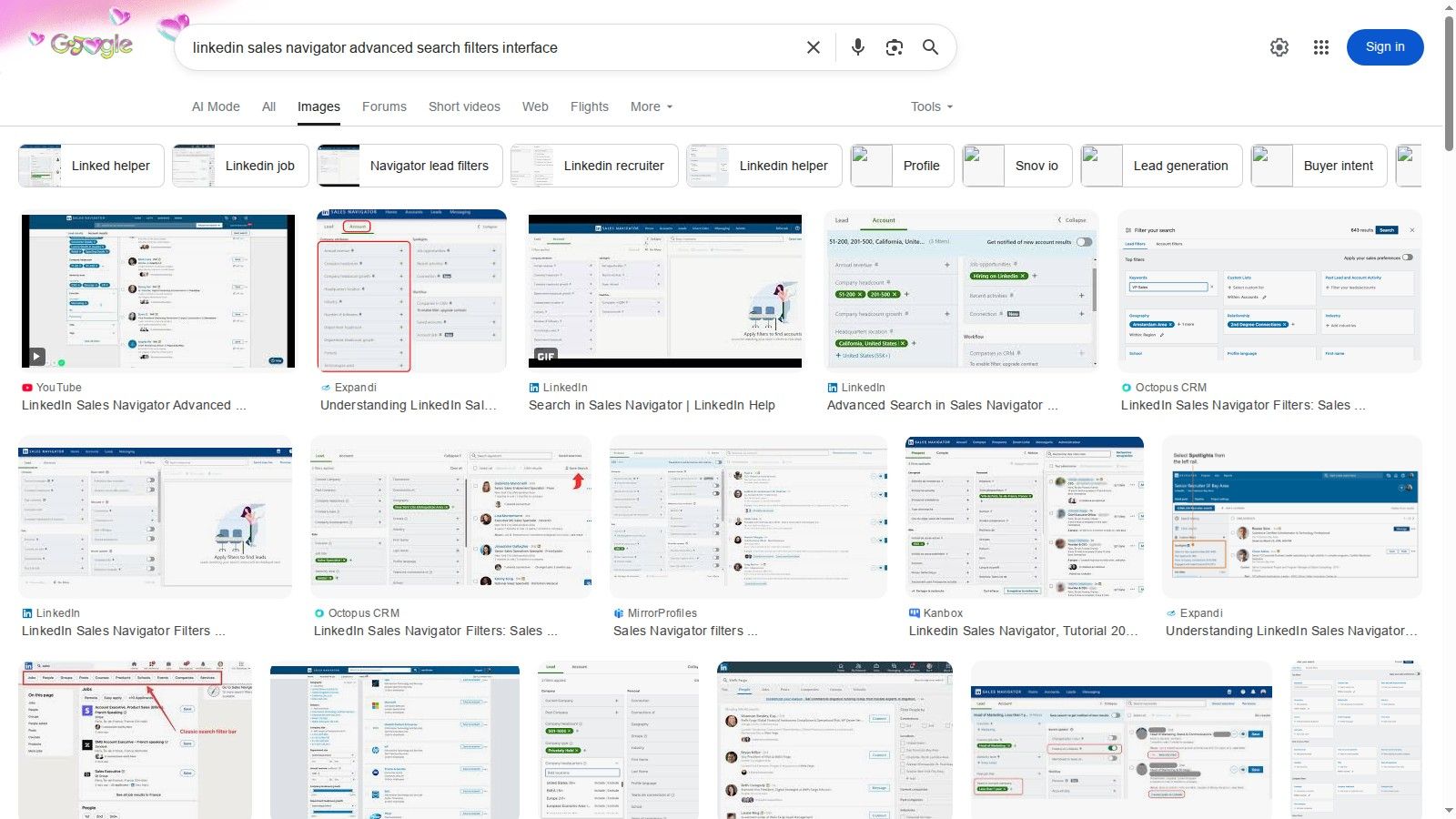
Here’s a useful visual walkthrough of the interface in action:
Build a list of 100, not a universe of 10,000
For lead generation on linkedin, I’d rather see a tightly built list of 100 real buyers than a massive export with weak fit. A focused list lets you inspect profile language, company context, and content themes before outreach starts.
Use this checklist before saving a prospect:
| Check | Why it matters |
|---|---|
| Company fits your offer | Protects meeting quality |
| Role can influence purchase | Reduces wasted conversations |
| Profile shows relevance | Improves personalization |
| Account is active enough to engage | Increases reply odds |
| You know the likely pain point | Makes messaging specific |
A prospect list is not inventory. It’s a hypothesis about who is most likely to book, show, and buy.
Save searches. Review them weekly. Remove poor fits aggressively. List building isn’t admin work. It’s the first conversion step.
Crafting Connection Sequences That Get Replies
Most LinkedIn outreach fails before the first real message. The sender tries to compress the whole sales process into one note. They ask for time too early, talk about themselves too much, and mistake personalization for adding the prospect’s first name.
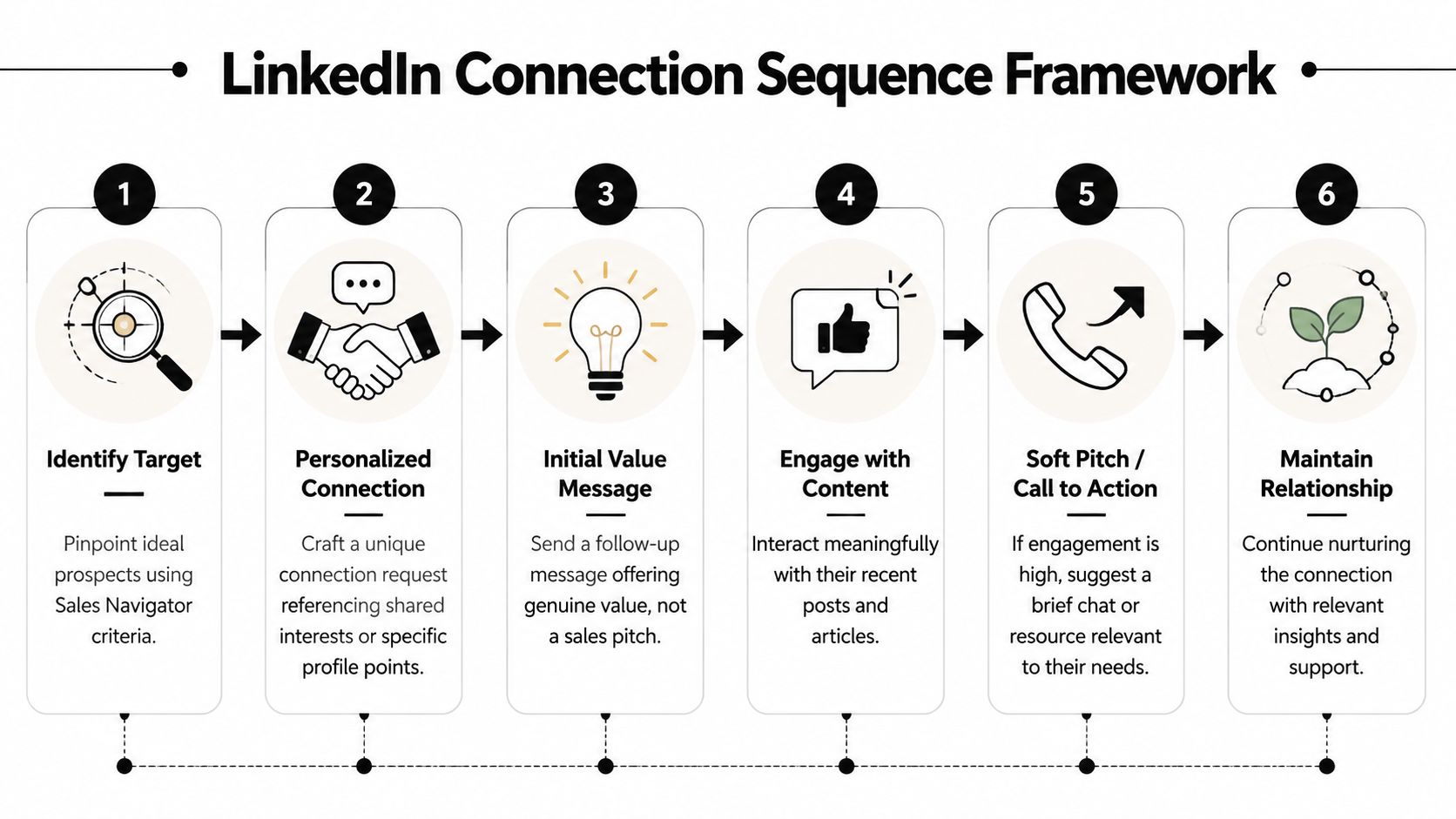
A better sequence warms the conversation in stages.
Set expectations before you send anything
Cold outreach on LinkedIn is not broken, but it has clear ceilings. Cold campaigns typically land at 20 to 35 percent connection acceptance and 5 to 10 percent DM response rates, while a documented personalized 3-step sequence reached a 38 percent connection rate and a 25 percent reply rate, converting 6 customers within one week, based on LinkedIn outreach data compiled by Cclarity.
Those numbers tell you two useful things. First, cold messaging needs precision. Second, sequence quality matters more than sending volume into a bad audience.
A practical 3-step sequence
Let’s use a hypothetical example. You sell a SaaS product to marketing directors at B2B software companies. Your product helps them qualify inbound leads faster.
Step one with no pitch
In many cases, the highest-performing connection request is an empty one. No pitch. No calendar link. No mini-brochure in the note.
Why? Because the request is not the sales conversation. It’s permission to start one.
If you do include text, keep it low-friction:
Saw your work around pipeline growth and wanted to connect.
That’s enough. The only job here is acceptance.
Step two with value, not a meeting ask
Once accepted, send a short follow-up that proves relevance. Don’t explain your company in detail. Point to a problem they already manage.
A framework:
-
Context: Why you reached out
-
Observation: What you see in their market
-
Value: A useful insight, asset, or idea
-
No pressure CTA: Invite a reaction, not a meeting
Example:
Thanks for connecting. I work with B2B marketing teams that get plenty of form fills but still struggle to route qualified leads fast enough for sales. One pattern I keep seeing is that lead volume looks fine, but meeting quality drops because follow-up and qualification aren’t tight. Happy to share the framework we use if that’s useful.
That works because it opens a business conversation without forcing one.
Step three with a soft commercial move
If there’s no reply, follow up after a short gap. Keep the tone calm. No “just bumping this” language.
Example:
One quick follow-up. If improving lead-to-meeting quality is on your list this quarter, I can send a short breakdown of the workflow teams are using to clean up handoff and booking. If not relevant, no worries.
This message gives the prospect an easy out. That matters. Pressure kills reply rates.
Warm beats cold when you can create it
Warm outreach behaves differently. Existing connections, introductions, and prospects who have already engaged with your content are easier to move into meetings. Warm campaigns often earn stronger acceptance, response, and meeting progression than cold ones, which is why your content and engagement strategy should feed your outbound motion instead of sitting apart from it.
Don’t ask, “How do I send more messages?” Ask, “How do I send fewer messages to better-prepared prospects?”
What to personalize and what to standardize
You do not need a fully custom essay for every prospect. You do need relevant inputs.
Personalize these parts:
-
Role context: What their job likely owns
-
Company trigger: A recent launch, hiring trend, or visible growth motion
-
Pain angle: The likely bottleneck tied to your offer
Standardize these parts:
-
Sequence timing
-
Core offer framing
-
CTA style
-
Follow-up logic
That balance keeps the process scalable without sounding manufactured. If you need starting frameworks, a cold LinkedIn message template can help, but treat templates as scaffolding, not copy to paste blindly.
Common sequence mistakes
Here’s where teams lose replies:
-
Front-loading the pitch: Talking about your solution before confirming relevance
-
Overpersonalizing trivia: Commenting on hobbies or schools instead of business context
-
Using long paragraphs: Dense messages look expensive to answer
-
Pushing meetings too early: A reply is the first win. The meeting comes after interest
The best outreach feels easy to engage with. It doesn’t sound automated, but it also doesn’t pretend to be a handwritten letter. It sounds like a competent operator who knows the buyer’s world and respects their inbox.
Develop a Content Strategy for Authority
Most B2B content on LinkedIn is built for applause from peers. That’s why it underperforms commercially. It’s broad, agreeable, and polished enough to earn engagement, but too soft to move a buyer toward a call.
Content should do something more useful than “build awareness.” It should filter in qualified prospects and filter out bad-fit ones.

Aim for authority, not virality
If your ideal buyer is a revenue leader, you do not need half the platform to notice your post. You need the right people to think, “This team understands the problem we’re dealing with.”
That changes what you publish. Instead of writing for maximum reach, write for commercial resonance.
A practical rule is to keep most content educational and only a smaller portion directly offer-driven. Not because asking is bad, but because trust usually has to come first.
Build content pillars from buyer friction
Start with the recurring issues your prospects face before they book meetings with you. Those become your content pillars.
For a B2B service or SaaS company, the pillars often look like this:
-
Pipeline friction: Why opportunities stall before sales conversations
-
Execution mistakes: What teams do that creates low-quality leads
-
Decision guidance: How buyers should evaluate tools, agencies, or systems
-
Proof of thinking: Breakdowns, teardown posts, point-of-view content
The useful test is simple. If a prospect read five of your posts in a row, would they understand what you solve and how you think?
Match format to intent
Different formats do different jobs. Don’t choose format by trend. Choose it by the point you need to make.
| Format | Best use |
|---|---|
| Short text post | Sharp opinion, lesson, contrarian insight |
| Carousel or document post | Frameworks, process breakdowns, checklists |
| Short video | Showing how you think or react to a live issue |
| LinkedIn article | Deeper education for mid-funnel buyers |
If you want to publish longer-form educational pieces inside the platform, this Mallary.ai LinkedIn article guide is a practical walkthrough.
Use give, give, give, ask
This still holds because buyers can smell desperation fast. A good content rhythm gives useful ideas away consistently, then occasionally invites the right next step.
Examples of “give” content:
-
A teardown: Why a common outbound message fails
-
A checklist: Signals that a prospect list is low quality
-
A point of view: Why booked meetings matter more than MQL volume
-
A lesson: What sales teams should fix before buying more top-of-funnel traffic
Then your “ask” can be simple. Invite a conversation, offer a resource, or mention a diagnostic call. The ask works because it follows proof.
Strong content doesn’t convince everyone. It makes the right buyer feel understood.
Organic content is the trust layer
Teams often ask whether they should prioritize organic content or direct outbound. In practice, the stronger answer is both, but for different jobs. Outreach creates targeted conversations. Content increases trust when prospects check you out after that first touch.
That’s why your content should support the same commercial narrative as your profile and messaging. If your outreach talks about meeting quality, your posts should also explore qualification, pipeline leakage, and sales handoff issues. Consistency compounds.
If you’re building a broader organic engine around this, these notes on inbound lead generation are useful because they force the same question LinkedIn should force: what content creates actual buying intent?
A quiet, high-intent audience is worth more than a loud, irrelevant one. On LinkedIn, that distinction is everything.
Integrate LinkedIn with a Full Funnel System
LinkedIn by itself can produce meetings. But its full impact emerges when you stop treating it like a standalone tactic and start using it as one touchpoint inside a full funnel system.
That means combining profile traffic, direct outreach, paid capture, and off-platform follow-up into one operating model.
Use LinkedIn for intent capture, not just conversation
Some prospects will reply to a message. Others will consume content, click an ad, or engage without wanting to chat yet. You need a way to capture that intent while it’s warm.
That’s where native forms matter. LinkedIn lead gen forms average a 13% conversion rate, which is 5.2 times higher than the typical 2.35% landing page average, according to Firebrand’s breakdown of LinkedIn lead gen form performance.
The reason is practical. Autofill removes friction. The user stays on-platform. You get cleaner conversion behavior than you often get from sending people to a separate page too early.
A full funnel operating model
A simple system looks like this:
-
Targeted outreach starts the relationship You connect with qualified prospects and begin a useful conversation.
-
Organic content supports credibility When prospects check your profile, they see proof of competence and point of view.
-
Retargeting or paid distribution captures warmer interest People who engaged but didn’t reply can still convert through content or a lead form.
-
Lead form submissions trigger follow-up Those contacts should move fast into email or sales workflows.
-
Sales qualifies for meeting readiness Not every form fill deserves a call. Filter for fit before the calendar gets messy.
Tools are crucial. Teams typically need workflow support to route, enrich, and follow up properly. If you’re comparing stack options, this overview of lead generation software is a useful starting point.
Don’t isolate channels from each other
One of the biggest mistakes I see is channel tribalism. The LinkedIn team posts content. Paid runs ads. Outbound sends emails. None of them share signals.
That creates a broken buyer experience. A prospect engages with your content, fills a form, then gets a generic cold email that ignores the context. Or they reply on LinkedIn and receive no coordinated follow-up elsewhere.
The better approach is shared sequencing. If someone engages on LinkedIn but doesn’t book, move them into an email nurture with the same positioning. If they submit a lead form, reference the asset or topic they cared about. If they engage repeatedly but stay silent, create a retargeting audience around that behavior.
One option in this category is Fypion Marketing, which runs performance-based outbound programs tied to booked meetings rather than broad lead counts. That model is useful when you want LinkedIn activity and follow-up channels to be accountable to the same commercial outcome.
A lead source is not a pipeline strategy. The pipeline appears when channels share context and sales gets clean handoffs.
Lead generation on linkedin gets much stronger when LinkedIn is the front door, not the entire building.
Measure What Matters and Scale Your Pipeline
You don’t scale LinkedIn by posting more or sending more. You scale it by finding the exact point where the funnel breaks, then fixing one variable at a time.
That requires better metrics than likes and impressions.
Track the metrics that expose bottlenecks
A simple operating dashboard should include:
-
Connection rate: Tells you whether the audience and initial approach are credible
-
Reply rate: Shows whether your first message is worth answering
-
Positive reply rate: Separates any response from actual buying interest
-
Meeting booked rate: The only metric that proves pipeline movement
These are the numbers that let you diagnose reality. If connection rate is weak, your targeting or profile likely needs work. If connections are accepted but replies are low, the message is the problem. If replies happen but meetings don’t, qualification or CTA handling is off.
For a broader framework on revenue-focused reporting, this guide to lead generation KPIs is a good reference.
Test one variable at a time
A/B testing on LinkedIn falls apart when teams change everything at once. Keep the test clean.
Test variables like:
-
Audience slice: One title cluster versus another
-
Connection request style: Empty request versus short contextual note
-
First message angle: Pain-based opener versus observation-based opener
-
CTA: Offer a resource versus ask a qualifying question
Run the test long enough to see a pattern, then keep the winner and move to the next constraint.
If you can’t say what changed, you can’t say what caused the result.
That mindset is what turns lead generation on linkedin from a vague brand exercise into a repeatable meeting channel.
If your team wants LinkedIn tied to real sales outcomes instead of surface-level engagement, Fypion Marketing is one option to consider. They focus on performance-driven B2B lead generation and align execution with qualified booked meetings, which is the standard LinkedIn should be held to in the first place.