
Top 10 Cold Call Companies for B2B Growth in 2026
Your sales pipeline is leaking. The in-house team is juggling follow-ups, demos, proposals, and the daily grind of prospecting. Meanwhile, pipeline targets keep rising, and every voicemail, bad number, or weak fit burns time your closers can’t get back.
That pressure is usually what pushes companies to look at cold call companies. On paper, outsourcing sounds simple. Hand the phones to a specialist, get more meetings, move on. In practice, most buyers get stuck in a noisy market full of agencies selling activity as if activity alone creates revenue.
The harder truth is that cold calling still works, but it works unevenly. The average cold call conversion rate sat around 2.35% in 2025, or roughly one sale per 43 calls, according to Focus Digital’s cold call benchmark analysis. That baseline gets much worse if your brand is unknown, your list is weak, or your offer is expensive. It gets much better when training, targeting, and execution are strong.
So the decision isn’t just which vendor to hire. It’s whether phone-first outbound is the right channel for your sales motion in the first place. For some teams, the better move is to keep calling as a support channel and put primary budget into email or a mixed outbound system. If you’re still sorting out that split, this breakdown on delegating sales support tasks is a useful starting point.
This guide gets to the point. You’ll find ten vetted providers, but more critically, you’ll get a practical framework for choosing one, spotting red flags, and avoiding the expensive mistake of outsourcing the wrong motion.
1. Fypion Marketing
A common outsourcing mistake looks like this. A team assumes it needs more cold calls, signs a monthly calling contract, then learns the problem was weak targeting, unclear messaging, or a sales motion better suited to email first. If I were advising a B2B company that wants to test outbound with less fixed risk, I’d start with Fypion Marketing.
Fypion sits on this list for a reason. It is not a traditional cold calling agency, and that distinction is important because many companies evaluating cold call providers are deciding between channels, pricing models, and levels of execution risk.
Why it stands out
Fypion focuses on cold email and charges for booked, qualified meetings rather than a standard retainer. That changes the buying decision. Instead of paying mainly for activity, you’re paying for a defined outcome, with qualification standards attached.
The practical appeal is the operational coverage. Fypion handles deliverability setup, inbox infrastructure, list building, copy, testing, inbox management, qualification, and optimization. If your team is still sorting out channel fit, their guide on cold calling vs cold emailing is useful context, and their playbook on how to cold contact prospects effectively shows the level of process required to make outbound work.
There’s a real trade-off here. Pay-per-meeting models sound attractive, but they only hold up if the provider has a clear process for defining a qualified meeting and resolving disputes when booked calls miss the mark. Fypion appears to understand that. That gives buyers a cleaner accountability structure than the usual “we sent the volume” reporting you get from weaker vendors.
Practical rule: If a provider gets paid the same for a bad meeting as a good one, calendar volume will usually outrank pipeline quality.
Best fit and trade-offs
Fypion makes the most sense for B2B SaaS, tech, and service companies that already know who they sell to and can close once the right meeting is in front of them. It is a poor fit for B2C offers, loose ICPs, or companies still guessing at message-market fit.
The broader decision framework matters more than the company profile. If your buyers respond well to email, your offer needs context, or your team wants to validate outbound before committing to a phone-heavy motion, Fypion is a sensible starting point. If your market buys through direct conversation, your average deal size is high, or objection handling is the make-or-break step, a dedicated calling firm may be the better choice.
What Fypion does well is reduce the cost of learning. What it will not do is fix a weak offer, bad positioning, or an audience that was never likely to convert from outbound in the first place.
2. SalesRoads
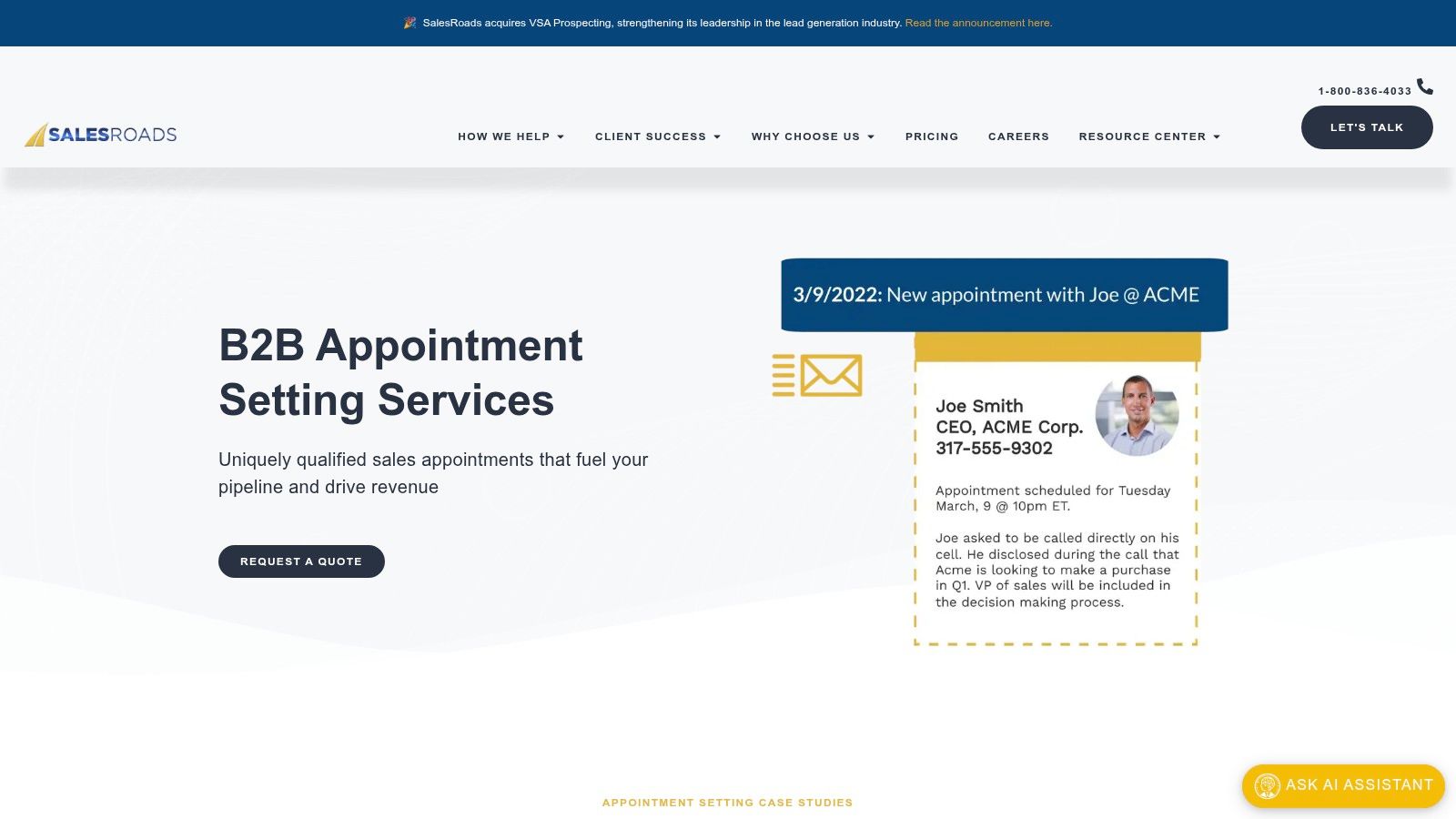
SalesRoads has been around long enough to know what a real outsourced phone program requires. That usually shows up in the structure. They lean into dedicated onshore SDRs, coaching, and custom playbooks rather than trying to sell cold calling as a plug-and-play commodity.
That makes them a strong fit for companies with more complex B2B sales cycles. SaaS, industrial, and technical services teams usually need reps who can handle nuance, not just read scripts and chase a hand-raise.
Where SalesRoads makes sense
Their model is phone-first, but not phone-only. That matters because it generally leads to improved outcomes when calls support a broader touch pattern. If your internal team still needs better prospecting fundamentals, this guide on how to cold contact pairs well with how SalesRoads structures campaigns.
The upside here is process maturity. You’re paying for management, quality control, and a steady operational layer. The downside is the usual one with established US-based firms. Cost will likely be higher than offshore or lighter-weight shops.
SalesRoads is the kind of provider you hire when you want fewer surprises, not the cheapest line item.
Trade-offs to watch
Their model works best when you already know your ICP and can support campaign collaboration. If your targeting is still fuzzy, any agency with dedicated SDR pods will spend the first phase correcting your assumptions.
This is also where many buyers get confused about onshore value. Domestic cold callers can outperform offshore reps by as much as 2x in conversion rate and call quality, according to Scrap.io’s cold calling success rate breakdown. That doesn’t mean every US-based agency wins. It means the onshore premium only pays off when the training and targeting are also solid.
3. SalesHive
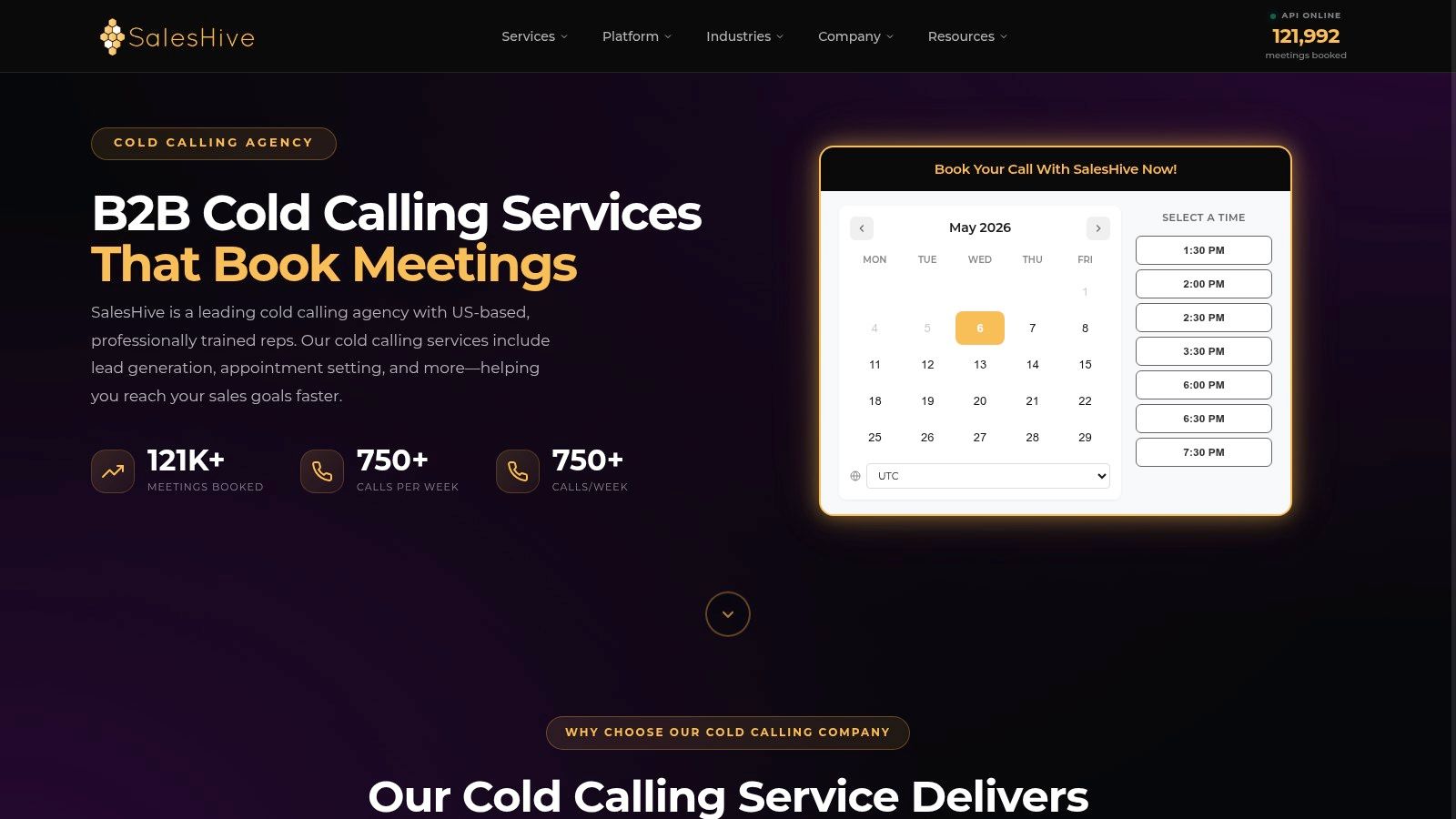
SalesHive is a good option for teams that want calling volume without giving up visibility into the process. They position themselves around US-based reps, technology-assisted dialing, compliance, and weekly optimization loops. That’s a sensible mix for buyers who’ve already been burned by “appointment setting” shops that disappear behind a dashboard.
Their operation looks built for companies that want a high-activity phone engine with stronger process controls than a freelancer model can offer.
What I like about the model
SalesHive’s emphasis on weekly feedback matters more than most buyers realize. Cold calling doesn’t fail only because reps are weak. It often fails because the vendor keeps running a script the market has already rejected.
That’s where they fit well for companies with a narrow but proven offer. Pairing phone velocity with feedback loops gives you a chance to adjust quickly. If you’re comparing agencies more broadly, this look at a lead generation agency model helps frame where phone-first providers sit versus email-led partners.
Here’s the operational issue to pressure-test. Only 32% of prospects answer calls from unknown companies, according to the earlier Cognism benchmark. So if a vendor sells pure volume without strong data, message testing, or callback process, the dialer becomes expensive theater.
What to ask before signing
Use these questions in the sales call:
-
How do scripts change: Ask how often they revise messaging based on objections, not just based on meeting count.
-
How do they handle compliance: Confirm how DNC controls are enforced in the workflow, not just mentioned in pitch decks.
-
How do they score call quality: You want actual QA criteria, not “our managers review calls.”
SalesHive looks strongest when a company already knows who it wants to reach and needs a disciplined team to execute at scale.
4. CIENCE
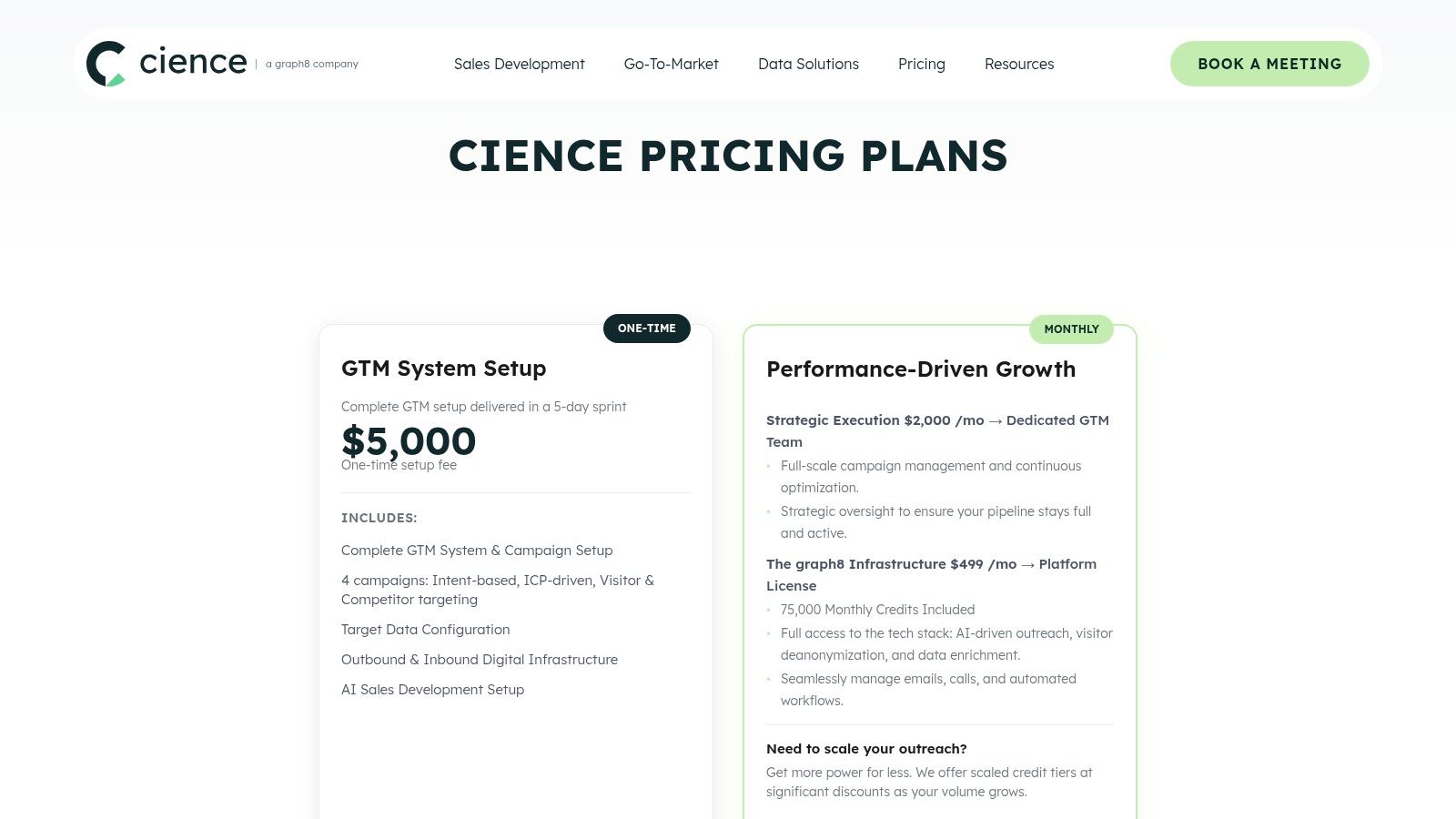
CIENCE is for buyers who want breadth. They combine data operations, SDR support, automation, and multiple pricing structures under one roof. That’s attractive if you’re running outbound as a system rather than buying a narrow appointment-setting service.
They’re also one of the easier vendors to assess commercially because they expose more of the pricing logic than many competitors do. For procurement-minded teams, that transparency is useful.
Who should consider CIENCE
CIENCE fits best when you need flexibility in staffing and operating model. If your team is deciding between embedded outbound support, marketplace-style SDR talent, and more performance-linked structures, they give you several ways to buy.
That said, flexibility can create complexity. The more moving parts in the agreement, the more carefully you need to define ownership across list quality, messaging, qualification, and reporting. Teams exploring B2B sales outsourcing usually underestimate how fast accountability gets muddy once credits, commissions, and platform layers enter the picture.
The real decision point
CIENCE makes more sense when data infrastructure is a top concern. That’s not a side issue in calling. B2B contact data decays at an average of 70.3% annually, and poor data quality costs organizations an average of $12.9 million per year, according to Salesgenie’s cold calling statistics for sales representatives.
If you’re buying a scaled outbound program, data ops isn’t optional. It’s part of the product. CIENCE’s value is strongest when you know that and are prepared to manage the engagement actively. If you want simplicity, a narrower agency may be easier to run.
5. EBQ
EBQ is less of a pure cold calling vendor and more of an outsourced revenue support organization. That distinction matters. Some teams don’t just need callers. They need a stable operating unit that can support SDR work, data, CRM hygiene, marketing assistance, and related execution under one arrangement.
That makes EBQ a practical fit for companies that want embedded capacity rather than a campaign vendor.
Why buyers choose EBQ
The published monthly pricing is a plus. Most cold call companies force a consult before giving any useful commercial signal. EBQ gives buyers enough structure to decide whether the model is even in the budget range.
The second advantage is breadth. If your outbound issue is partly operational, scattered CRM ownership, weak data processes, no clear follow-up discipline, then a more embedded model can clean up the plumbing around outreach instead of just adding activity.
Where the model can break
The trade-off is flexibility. Embedded support is steady, but it’s not as performance-tied as a pay-per-meeting arrangement. If your leadership team only wants to pay for outcomes, EBQ may feel too much like headcount outsourcing.
There’s also a strategic mismatch risk. Companies with strong growth trajectories tend to use cold calling more aggressively. Scrap.io notes that high-growth companies use cold calling 42% more than laggards, and 55% of high-growth companies report cold calling effectiveness in its industry segmentation research cited earlier. EBQ can support that kind of discipline, but only if your team already treats outbound as a repeatable operating function, not a temporary fix.
6. Launch Leads
Launch Leads appeals to buyers who are tired of list burn. That’s one of the most expensive hidden failures in outsourced calling. Agencies promise activity, run through a finite market, and leave you with little to show for the damage.
Launch Leads seems designed to avoid that by forcing more rigor before launch. They put weight on discovery, trigger-event mapping, qualification criteria, and handoff quality.
Why this approach works
The pre-launch discipline is the point. A phone-first campaign fails quickly when the list is broad, the qualification rules are vague, and the reps are told to “book anything interested.” Launch Leads appears to push against that.
That makes them a better fit for companies that care about meeting preparedness as much as meeting count. If your sales team complains that outsourced appointments are weak, this style of provider is worth serious consideration.
Better meetings usually start with fewer names on the list, not more.
What to test in the sales process
Ask them how they define trigger events and what evidence they use to prioritize contacts. That answer will tell you whether they’re strategic or just using nicer language for standard calling.
Timing changes outcomes. Belkins highlights an overlooked but important angle in outsourced calling: signal-based calling tied to real-time prospect behavior can lift connection rates from blind-call norms of 2% to 3% up to 12% to 15% in those triggered moments, as described in Belkins’ analysis of cold calling companies. Launch Leads’ planning-heavy approach makes more sense if it includes that kind of trigger logic rather than generic sequencing.
7. Bandalier
Bandalier is built for teams that want speed, volume, and coaching in the same package. Their positioning leans toward high daily activity, personalized outreach, and fast SDR ramp. That combination can work well when your company already knows the market and just needs more execution horsepower.
This isn’t the vendor for a delicate, low-volume enterprise niche unless targeting is extremely tight. It’s better suited to growth teams that need momentum.
What Bandalier does well
They appear to understand that volume without training falls apart. Intensive onboarding, role-play support, coaching, and quality controls are all signs they know calling performance is a people system, not just a dialing system.
That matters because training is one of the strongest performance levers in cold outreach. Daily training programs can push conversion rates to 9.03%, according to the Focus Digital benchmark cited earlier. You shouldn’t read that as a promise any one agency will hit it. You should read it as proof that coaching quality materially changes the economics of outsourced calling.
Best fit and caution
Bandalier makes sense when your team needs fast campaign throughput and can absorb the meetings operationally. If your closers are already overloaded, adding a high-velocity agency often creates a downstream bottleneck.
Use this lens when evaluating them:
-
Need for speed: Good if market timing matters and you want fast launch plus rep ramp.
-
Need for precision: Risky if your ICP is tiny and every bad contact has real strategic cost.
-
Need for collaboration: Necessary, because volume teams still need strong audience and messaging guidance from the client side.
8. Callbox
Callbox is one of the more operationally mature names in this space for global, multi-channel outbound. They don’t sell calling in isolation. They sell a broader orchestration layer across phone, email, LinkedIn, chat, and events, with lead handoff documentation attached.
That’s useful for companies that need fast deployment and cleaner context passed into the sales team.
Why buyers pick Callbox
The handoff detail is a strength. One of the easiest ways outsourced meetings die is poor transfer of context. If your AE walks into a meeting without the call history, objections, or talk track, the agency may have created activity but not real opportunity.
Callbox seems to understand that gap better than many appointment setters. If you’re comparing firms in this category, this review of B2B appointment setting services helps frame what “good handoff” should mean.
The practical trade-off
Global delivery gives you range, but some buyers want US-only reps for accent, market familiarity, or internal policy reasons. That’s the core decision here.
There’s also a connection-rate argument in favor of stronger data and channel mix. Teams using verified direct-dial numbers can increase connection rates by up to 40%, according to the Cognism benchmark referenced earlier. Callbox’s multi-channel structure can be a plus if they’re pairing those data practices with coordinated outreach, not just layering channels for appearances.
9. Blue Valley Marketing
Blue Valley Marketing feels more like a classic US-based outbound call operation, and that can be a good thing if you value script discipline, QA review, and brand immersion over flashy growth language.
Some companies don’t need a complicated outbound innovation story. They need trained callers who can represent the brand clearly, follow process, and hold a decent business conversation.
Where Blue Valley fits
They’re a strong option for organizations that care about communication clarity and live-call quality monitoring. Manufacturing, financial services, associations, and other industries with more structured buyer conversations often benefit from that steadier style.
The QA emphasis is what stands out. Outsourced calls tend to drift unless someone is actively grading them against standards that matter to your business. Blue Valley’s setup appears built around that management discipline.
What to watch
Heavier process usually means a longer ramp. That’s not bad if you’re protecting a valuable market. It is bad if your leadership team expects meetings next week from a campaign that still needs script development, brand immersion, and review cycles.
Timing should also be part of your diligence. A surprisingly under-discussed issue in outsourced calling is when reps call busy decision-makers. The sales training perspective covered in this video on how to cold call busy people argues that off-pattern timing can matter, especially for executives who are hard to reach during standard office hours. A QA-heavy vendor like Blue Valley is more likely to operationalize timing rules if you push for them.
10. Televerde
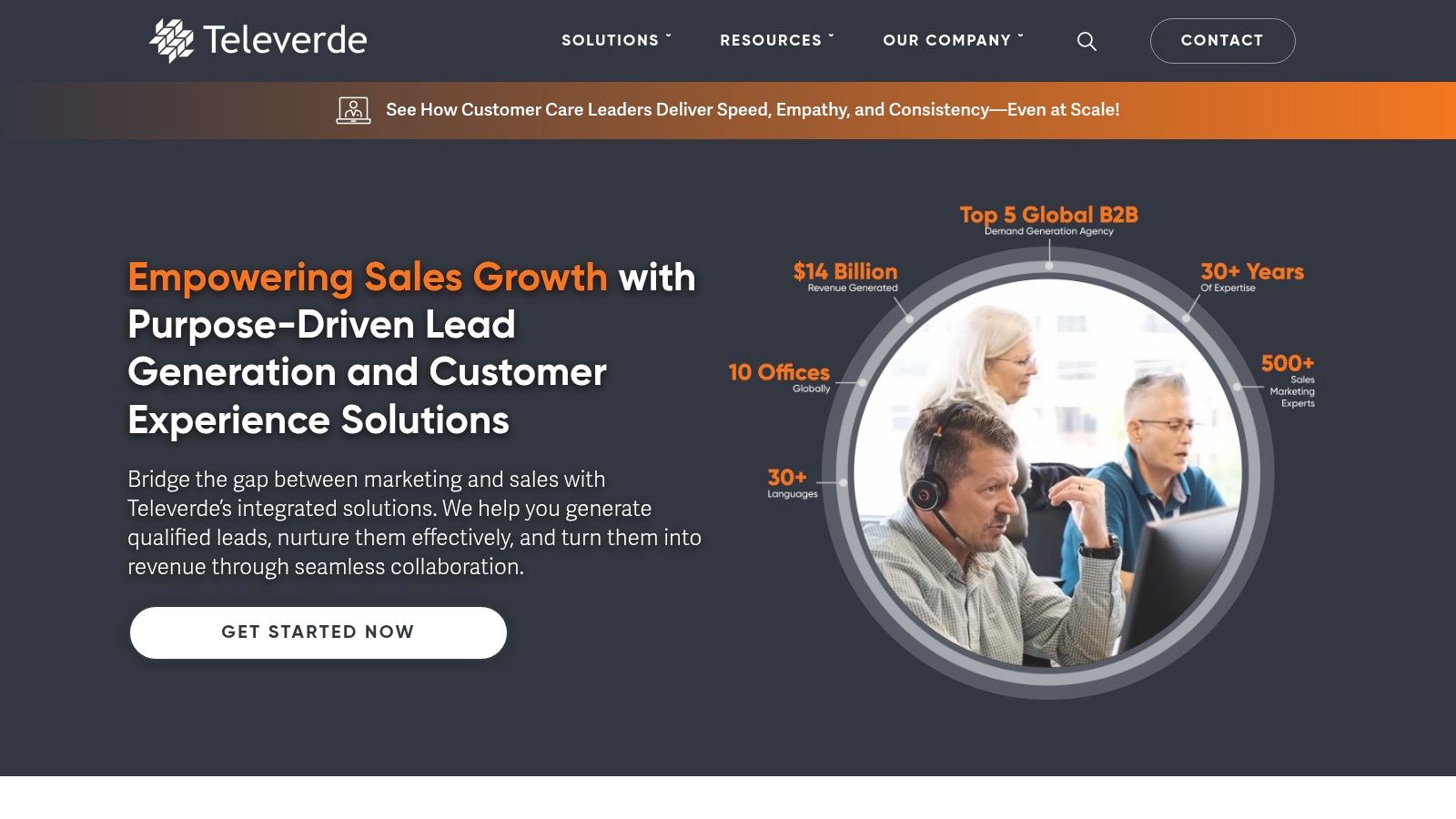
Televerde sits in a different category from smaller appointment-setting shops. This is an enterprise-oriented demand generation and SDR partner with a well-known workforce development model and experience serving large technology brands.
If your company sells into complex buying committees, Televerde is one of the more credible options on this list.
Why enterprise teams consider Televerde
Their structured training model is important. Enterprise outbound breaks when reps can’t handle multiple stakeholders, qualification nuance, and longer buying cycles. Televerde’s positioning suggests they’re equipped for that kind of environment.
Their social impact model is also a genuine differentiator, not a cosmetic one. For some buyers, that matters culturally. For others, it’s secondary to execution. Either way, the training and operational consistency are the true reasons to evaluate them.
Enterprise outbound is less about booking any meeting and more about booking the right conversation at the right buying stage.
The real downside
Minimums and procurement friction are the likely trade-offs. Enterprise-grade partners usually come with more governance, more process, and less flexibility for small tests.
That can still be the right choice if your average deal size supports it. It can be the wrong choice if you’re a smaller B2B company looking for a scrappy pipeline experiment. In that case, a lighter agency or a performance-led email partner will often be easier to prove out.
Top 10 Cold Call Companies Comparison
| Provider | Core offering | 💰 Pricing / Value | ★ Quality & results | 👥 Target audience | ✨ Unique selling points |
|---|---|---|---|---|---|
| Fypion Marketing 🏆 | Performance-first B2B cold‑email lead gen; end‑to‑end campaign management | 💰 Pay-per‑booked qualified meeting; no upfront/retainer; free consult | ★ 4.7★ (17+ clients); 220% MoM lead growth; fast timelines | 👥 B2B firms & SaaS/tech with PMF | ✨ Deliverability expertise; inbox monitoring; dispute guarantee |
| SalesRoads | Phone‑first appointment setting with onshore SDR pods | 💰 Premium; transparent cost guidance | ★ Strong process & management; experienced US teams | 👥 Complex sales (SaaS, industrial, tech) | ✨ Onshore SDR pods + sales coaching; multichannel support |
| SalesHive | US‑based cold calling at scale with AI dialer | 💰 Custom pricing (consult) | ★ Tech-enabled calling; weekly optimization loops | 👥 Teams wanting high‑quality phone volume | ✨ AI power‑dialer; DNC compliance; real‑time analytics |
| CIENCE | Data + SDR services + AI automation at scale | 💰 Tiered options; transparent tiers but complex models | ★ Fast deployment; scalable ops; ROI-aligned options | 👥 Data-heavy, scale‑oriented B2B teams | ✨ Graph8 AI; SDR marketplace; per‑meeting frameworks |
| EBQ | Embedded SDRs + revenue ops and project management | 💰 Published monthly pricing; annual commitments | ★ 15+ yrs playbooks; steady, predictable capacity | 👥 Teams needing embedded monthly SDR capacity | ✨ Ops/CRM integration; consultative oversight |
| Launch Leads | Phone‑centric appointment setting with rigorous pre‑launch work | 💰 Pricing via consult; guided cost ranges | ★ Methodical launches; improved show & qual rates | 👥 Buyers wanting optimized launch & show rates | ✨ Trigger‑event mapping; structured briefing process |
| Bandalier | High‑velocity SDR/BDR teams combining calls + personalized email | 💰 Proposal-based (custom) | ★ Rapid scale with QA & training | 👥 Growth teams needing speed + personalization | ✨ AI role‑plays; clear volume commitments; intensive onboarding |
| Callbox | Global phone‑led, multi‑channel appointment engine | 💰 Pricing via consultation | ★ Fast time‑to‑launch; mature ops for SaaS | 👥 Tech/SaaS programs needing quick global scale | ✨ Detailed lead handoffs; multi‑channel orchestration |
| Blue Valley Marketing | US‑only outbound call center with QA and script development | 💰 Scoped pricing (consult) | ★ Strong QA scoring & compliance focus | 👥 Companies prioritizing US reps & brand alignment | ✨ Brand immersion; QA on every call; compliance emphasis |
| Televerde | Enterprise SDR + demand gen with workforce development model | 💰 Enterprise pricing (higher minimums) | ★ Proven enterprise outcomes; structured training | 👥 Large enterprises with complex buying committees | ✨ Workforce development + measurable social impact |
The Final Dial: Making Your Decision
A team signs with an outbound agency, gets plenty of activity reports, sees calendars fill for two weeks, and then realizes half the meetings were never a fit. That usually traces back to a bad decision made before the first call. The wrong channel, the wrong provider model, or weak qualification standards.
Choose cold call companies the same way you would choose a sales motion. Start with channel fit. Phone-first outbound works when live conversation improves qualification speed, objection handling, and access to buying intent. If your offer needs education, your positioning is still shifting, or your buyers rarely answer direct dials, cold email or a mixed outbound program often gives you a better testing ground.
Vendor selection gets easier once that part is clear.
The next filter is operating model. Some providers act like an extension of your SDR team and work best when you need steady coverage and tight process control. Others are built for fast ramp and high activity. Others perform best when they own more of the stack, including targeting, data, and multi-channel sequencing. The right choice depends on deal size, sales cycle length, follow-up discipline, and how much management time your team can give the program after launch.
Good evaluation calls are straightforward. Ask who owns data quality, how qualification is defined, what happens to no-shows and weak meetings, how scripts are updated, what the rep profile looks like, and what an AE receives at handoff. If answers stay vague and the conversation keeps returning to dial counts, that is usually a warning.
A few red flags show up early. Be cautious with firms that promise fast launch without probing your ICP, offer multi-channel outreach without a clear sequencing rationale, or treat list building as back-office admin. In practice, poor data, weak qualification rules, and sloppy handoffs ruin more outsourced outbound programs than call reluctance ever does.
Outsourcing also does not reduce the need for leadership. It shifts the work. Your team still has to set qualification standards, review messaging, inspect meeting quality, and confirm that sales can follow up fast enough to convert interest into pipeline. The best client-agency relationships are managed closely. They are not left on autopilot.
The strongest providers will welcome that level of scrutiny. They will help you decide whether cold calling belongs in your mix at all, where it should sit relative to cold email, and what success should look like before launch.
Use this list as a decision framework, not a shopping list, and you are far more likely to choose a partner that fits your actual sales motion.
If a full phone-first program feels premature, Fypion Marketing is a reasonable first step, as noted earlier. Their model is built around qualified meetings, with a cold email focus and hands-on support for targeting and deliverability. For B2B teams that want to test outbound with tighter downside and clearer accountability, that structure can make more sense than jumping straight into a calling-heavy engagement.