
Click Through Open Rate: The Ultimate B2B Email Guide

You launch a cold email campaign. The dashboard says opens look healthy. The subject lines seem to be doing their job. But the sales team still asks the only question that matters: why isn’t anyone booking time?
That gap usually comes from measuring the wrong thing.
In B2B outreach, open rate can tell you whether the inbox preview earned attention. It cannot tell you whether the body copy, offer, and CTA created intent. The metric that gets closer to that answer is click through open rate, often shortened to CTOR. It shows what the people who opened your email did next.
When a client tells me, “our opens are fine, but pipeline is thin,” I don’t start by rewriting everything. I look for the break point. If opens are decent but clicks are weak, the problem usually sits inside the message itself: the offer is off, the transition from subject line to body is weak, or the CTA asks for too much too soon. That’s why CTOR is one of the most useful diagnostic metrics in a cold email program.
If you want a broader view of the metrics that matter in email, this guide on email marketing KPIs that actually drive business growth is worth keeping close. CTOR belongs in that small group of numbers that helps you decide what to fix next, not just what to report.
The Hidden Metric That Defines Campaign Success
A lot of teams get trapped by a flattering dashboard.
They see high opens and assume the campaign is close. They tweak send times, test a new sender name, maybe rotate subject lines. Meanwhile, the calendar stays light because the problem isn’t the inbox placement or the subject line anymore. The problem is what happens after the open.
That’s where click through open rate becomes the truth metric.
CTOR measures engagement among the people who already opened the message. It strips away the non-openers and asks a more useful question: once someone gave you a shot, did the email earn enough interest to get a click? In practical terms, that makes CTOR one of the cleanest ways to judge whether your copy, offer, CTA, and email structure are working together.
Practical rule: If opens are strong and CTOR is weak, stop obsessing over the subject line. Fix the body, the offer, or the CTA path.
This matters even more in cold outreach because the margin for error is tiny. Prospects don’t read slowly. They scan. They decide fast. If the email opens with vague positioning, generic pain points, or a buried call to action, they move on.
A good CTOR doesn’t guarantee meetings. But a bad CTOR usually tells you the campaign is leaking intent before the prospect ever reaches your landing page, case study, or booking link.
That’s why strong operators don’t treat CTOR as a vanity metric. They treat it like a pressure gauge. It shows whether message-market fit exists inside the email itself.
CTOR vs CTR vs Open Rate A Clear Breakdown
A campaign can show a healthy open rate and still produce almost no pipeline. That gap is why these three metrics need to be separated clearly, especially now that open data is less reliable than it used to be.
Open rate still has value, but privacy changes have weakened it as a standalone signal. Apple Mail Privacy Protection can inflate opens by preloading email content, which means an “open” may reflect mailbox behavior more than buyer intent. For B2B cold outreach, that makes CTOR more useful because it measures what happened after the email registered as opened, whether that open was highly intentional or privacy-influenced.
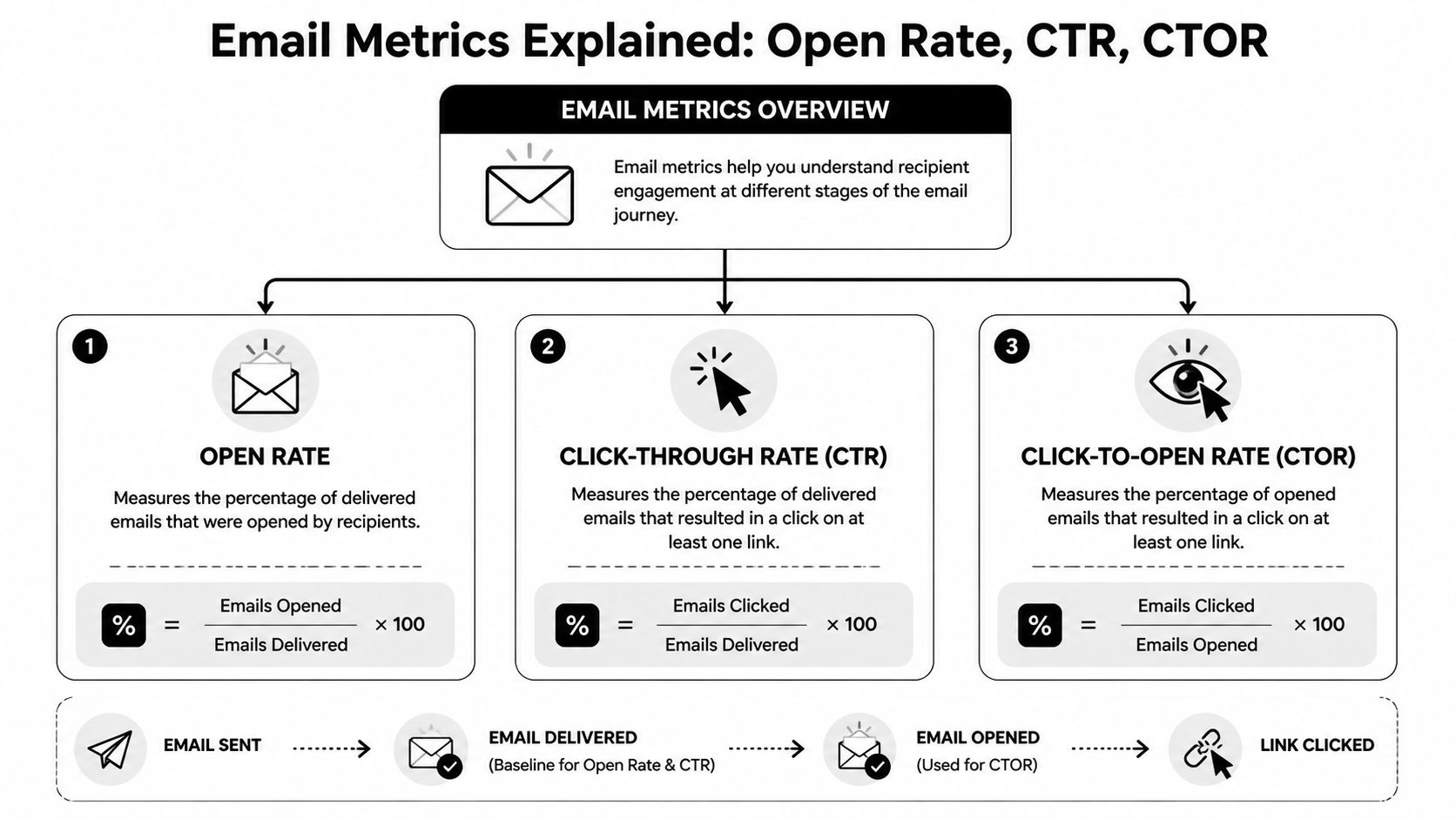
What each metric actually helps you diagnose
-
Open rate is the share of delivered emails that recorded an open. Use it to judge inbox placement, sender recognition, and subject line pull, but treat it cautiously if a large share of your audience uses Apple Mail.
-
CTR is the share of delivered emails that generated a click. Mailchimp’s reference on email marketing click-through rates explains the common reporting approach. CTR is useful for campaign-level performance because it shows how much total traffic the email created.
-
CTOR is the share of opens that generated a click. The formula is (unique clicks / unique opens) × 100. It is the cleaner read on message fit inside the email itself: copy, offer, CTA, and link placement.
The practical difference is simple. CTR answers, “How much traffic did this send create?” CTOR answers, “Once someone opened, did the message give them a reason to act?”
A worked example
Say you send 100,000 emails, record 50,000 opens, and get 1,000 clicks.
| Metric | Formula | Result |
|---|---|---|
| Open rate | opens / sent | 50% |
| CTR | clicks / sent | 1% |
| CTOR | clicks / opens | 2% |
That result changes the diagnosis.
A 1% CTR on its own can point in several directions. Weak list quality, poor inbox placement, soft subject lines, or weak body copy can all contribute. A 2% CTOR is narrower. It suggests the email did get attention, but too few openers found the message convincing enough to click.
That distinction matters more after MPP. If opens are inflated, open rate can flatter a campaign that is not creating real buying intent. CTOR is not perfect either, because it still uses opens in the denominator, but it gives a more actionable read than open rate alone when you are trying to improve the body copy and CTA path.
Use the three metrics together, but do not weight them equally. For cold outbound, open rate is an early signal, CTR is the topline outcome, and CTOR is often the best internal diagnostic for whether the message earns action after attention.
If inbox placement and subject line performance still need work, this guide on how to improve email open rates with simple tactics for higher opens covers the top-of-funnel fixes.
B2B Cold Email CTOR Benchmarks for 2026
A campaign can show a healthy open rate, a decent reply rate, and still underperform on pipeline because the people who opened never took the next step. That is why CTOR deserves its own benchmark in cold outbound. It helps separate attention from action, which matters even more now that privacy features have made open data less reliable.
Broad email benchmarks still have value, but only if you keep the context tight. Newsletter clicks, ecommerce promotions, lifecycle emails, and outbound prospecting produce different click behavior. In B2B cold email, CTOR works best as a directional benchmark you compare by segment, offer, CTA type, and traffic source.
What counts as average and what counts as strong
The practical range for cold outbound is narrower than many published email averages suggest. House lists and opt-in programs usually produce higher engagement because trust already exists. Cold email has to earn that click from scratch.
For that reason, I treat broad-market CTOR studies as background context, not as the target. A cold campaign with a lower CTOR than a warm nurture stream is not automatically underperforming. A cold campaign with a low CTOR relative to similar sends, same audience quality, and same CTA structure usually is.
A useful operating view for 2026 looks like this:
| Metric | Weak | Healthy | Strong |
|---|---|---|---|
| B2B cold email CTOR | Low enough to question message-to-offer fit | In range for a relevant, well-segmented cold send | High enough to suggest the copy and CTA are pulling real intent |
That table stays qualitative on purpose. Once Apple Mail Privacy Protection inflates opens, hard CTOR cutoffs get messy. In accounts with heavy Apple Mail usage, the denominator is noisy, so a campaign can look weaker on CTOR than it really is. In those cases, I put more weight on click quality, reply quality, and conversion after click.
How to benchmark CTOR without misreading privacy-distorted data
Use CTOR to compare like-for-like campaigns.
Compare founder-led emails against other founder-led emails. Compare demo CTA campaigns against other demo CTA campaigns. Compare one ICP against the same ICP after a positioning change. That gives you a cleaner read than stacking your cold outbound against a generic email report built from mixed send types.
It also helps to pair CTOR with adjacent metrics:
-
High opens, weak CTOR: subject line got attention, but the body copy or CTA did not create enough interest to click.
-
Flat opens, stronger CTOR: fewer people opened, but the ones who did found the message relevant.
-
Rising CTOR after segmentation: audience definition improved, even if open data stayed noisy.
-
Strong CTOR, weak downstream conversion: the CTA got curiosity clicks, but the landing page, offer, or booking flow lost intent.
That last point gets missed a lot in lead gen. A high CTOR is useful only if it leads to qualified conversations. If you want a benchmark for that next layer, this guide to average cold email response rate is a better companion metric than open rate alone.
Subject lines still matter, especially in follow-up sequences where the same prospect has seen your name before. If your sequence gets decent clicks once opened but too few opens on later touches, improving follow-up email open rates can raise the top of the funnel without confusing CTOR analysis.
The working rule is simple. Use CTOR as an internal diagnostic benchmark, not as a vanity target. In modern B2B cold outreach, the best benchmark is whether a campaign earns more qualified action than the last comparable send.
Diagnosing a Low Click-To-Open Rate
Low CTOR doesn’t always mean bad copy. Sometimes it means your measurement is lying to you.
That’s the first thing many teams miss. They look at open data as if it’s clean, then they calculate click through open rate from inflated numbers and conclude the email body failed. Sometimes it did. Sometimes the denominator is the problem.
Start with Apple Mail Privacy Protection
Apple’s Mail Privacy Protection, active since 2021, pre-loads tracking pixels on devices that represent 45-60% of the market, which inflates open rates and distorts CTOR, according to Campaign Monitor’s explanation of good email metrics and the impact of privacy changes.
That means CTOR can look artificially worse because the open count has been padded by privacy behavior, not by human engagement.
If your audience includes a lot of Apple Mail users, treat CTOR as directional, not absolute.
In practice, that changes the way you diagnose. Don’t ask only, “why is CTOR low?” Ask, “is the open count trustworthy enough for CTOR to be interpreted at face value?” If the answer is no, move more attention to CTR, reply quality, landing page visits, and booked-meeting behavior.
The common campaign problems that really do hurt CTOR
When the metric is directionally valid, low CTOR usually comes from one of these issues:
-
Subject line to body mismatch. The subject line promises one thing, then the email opens with generic positioning or a hard pivot into a different angle. That creates a micro-bounce inside the message.
-
Weak CTA path. The reader understands the problem but doesn’t know what to do next. A vague “let me know” often underperforms when compared with a clear action tied to a useful next step.
-
Offer friction. Asking for a demo too early can suppress clicks, especially in colder audiences. A case study, short teardown, or focused resource can create a lower-friction bridge.
-
Audience-message mismatch. The copy may be fine for one role and wrong for another. Founders, RevOps leaders, and product marketers often need different proof and different language.
Message control matters. Strong personalization isn’t just inserting a first name. It’s making the first few lines feel native to the recipient’s role, company stage, and likely problem. If you need a sharper framework for that, this guide on mastering cold email personalization to boost responses is useful.
What not to do
Don’t respond to low CTOR by immediately stuffing more links into the email. More links usually create more noise.
Don’t make the copy longer to “explain the value better” either. If the message already opened and still didn’t produce a click, clutter rarely fixes it. Clarity does.
Actionable Strategies to Increase Your CTOR
A campaign can show a healthy open rate and still produce almost no buying action. That gap matters more now because Apple Mail Privacy Protection made opens less reliable as a read on intent. In B2B cold outreach, CTOR helps answer the better question: once someone engages enough to open, did the message earn the next step?
That changes how CTOR should be improved. The goal is not to chase more reported opens. The goal is to make each real open more likely to turn into a click from the right prospect.
Match the first line to the reason they opened
The first line has one job. Confirm the promise that got the open.
If the subject line references a hiring push, product launch, pricing pressure, or pipeline problem, the body should continue that exact thread in plain language. Cold emails lose clicks when the opener shifts into company background, broad positioning, or generic praise. The reader opened on a specific expectation. Keep the message there.
I usually review this as a pair, not as two separate assets. Subject line first. Opening line second. If they do not sound connected, clicks drop.
Put the action before the scroll break
A lot of CTOR problems are layout problems.
On desktop and mobile, the prospect should see the next step early. That does not mean forcing a hard pitch into line two. It means the email should reach the action while attention is still intact. If the ask only appears after a long explanation, a skim reader never gets to the part that matters.
Good cold emails respect how people read in an inbox. They scan, decide fast, and click only if the path is obvious.
Cut until only decision-making copy remains
Shorter emails usually win more clicks because they reduce the work required to understand the offer.
For CTOR, every line should help the prospect make a decision. Relevance. Proof. Offer. Action. Anything else should be removed. Long copy can work for warm lists or complex buying groups, but in cold outbound it often lowers click intent because the message starts feeling expensive to process.
A practical edit is to remove one sentence from each paragraph, then reread the draft. If performance likely improves after the cut, the original was carrying too much explanation.
Lower the click risk
Clicks are not only about interest. They are also about trust.
Prospects hesitate when the link destination feels unclear, the CTA sounds too committed, or the message asks for a big jump too early. A direct calendar link can work, but it often underperforms with colder audiences compared with a lower-friction asset such as a short teardown, a relevant case study, or a focused audit. The right CTA depends on awareness level, list quality, and how much credibility the sender has already earned.
The wording matters too. “See how we approached this for a similar SaaS team” creates a lighter step than “Book 30 minutes.”
Protect technical trust so clicks can happen
CTOR is also affected by delivery quality and link trust. If the email lands with warnings, the tracking domain looks unfamiliar, or mailbox providers treat the message as suspicious, click behavior drops even when the copy is solid.
This is one reason I do not evaluate CTOR in isolation. I check authentication, custom tracking setup, link formatting, and inbox placement alongside the creative. A copy rewrite will not fix a domain trust issue.
Give the email one job
Emails with one clear path usually outperform emails with options.
Use one primary CTA and support it with copy that makes that click feel like the natural next move. Multiple links split attention and make attribution messier. In cold outreach, that usually means choosing between “view this,” “reply to this,” or “book this,” then building the whole message around that single action.
Follow-ups deserve the same discipline. The angle can change, but the ask should stay easy to understand. Subject lines matter there too, especially if you are working on improving follow-up email open rates without relying on gimmicks.
A quick CTOR improvement checklist
| Area | What to check |
|---|---|
| First-line continuity | Does the opening continue the subject line’s promise without drifting? |
| CTA visibility | Can the prospect see the action early, on mobile and desktop? |
| Copy discipline | Does each sentence help the reader decide whether to click? |
| Offer friction | Is the ask appropriate for a cold audience, or too heavy for first touch? |
| Technical trust | Are authentication, tracking links, and inbox placement clean? |
| Click path | Is there one primary action instead of several competing options? |
The best CTOR lifts usually come from small edits with clear intent. Earlier CTA placement. Less copy. Better offer sequencing. Cleaner trust signals. In a post-MPP world, that work matters more than trying to manufacture higher open rates.
From High CTOR to Booked Meetings
A high CTOR isn’t the finish line. It’s a leading indicator that the campaign is creating movement in the right part of the funnel.
When more openers click, more prospects reach the page, asset, or booking environment tied to your offer. That creates more chances for replies, hand-raisers, and qualified meetings. The metric matters because it sits close to buyer intent without being the final revenue event itself.
The relationship is especially useful in outbound because CTOR helps you spot campaign quality earlier than meeting volume alone. Meetings take time to accumulate. CTOR shows whether the message is earning action now.
What a strong CTOR usually signals
-
The offer matches the audience
-
The body copy supports the promise made in the subject line
-
The CTA feels proportionate to the prospect’s level of awareness
-
The campaign infrastructure is healthy enough for links to be trusted and usable
The reverse is also true. Weak CTOR often predicts weak downstream outcomes even when opens look fine. A campaign can generate attention and still fail to convert that attention into sales activity.
Strong outreach programs treat CTOR like a bridge metric. It connects inbox behavior to pipeline behavior.
That’s why sales and marketing leaders shouldn’t isolate CTOR inside the email report. Review it alongside reply quality, landing page behavior, and meeting conversion. When those numbers move in the same direction, you know the campaign is coherent. When CTOR rises but meetings don’t, the issue may sit on the page, in the qualification logic, or in the CTA itself.
If you’re mapping email engagement to real appointment generation, this guide on appointment setting for B2B to convert more prospects helps connect that operational gap.
Frequently Asked Questions About CTOR
Should I track unique clicks or total clicks
Use unique clicks for CTOR. The verified formula is based on unique clicks / unique opens × 100, which avoids overstating engagement when the same person clicks multiple times. Total clicks can be useful for content analysis, but unique clicks give the cleaner performance read.
Is click through open rate still useful after Apple privacy changes
Yes, but with caution. As covered earlier, Apple’s MPP inflates opens, so CTOR can understate actual engagement in segments with heavy Apple Mail usage. In those cases, use CTOR directionally and pair it with CTR, replies, and post-click behavior.
Does CTOR matter more in the first email or the follow-up
It matters in both, but for different reasons. In the first email, CTOR tells you whether your initial positioning and offer are compelling. In follow-ups, it often reflects whether your sequencing is adding fresh value or just repeating the first message in a different wrapper.
Is a high CTOR always a good thing
Not always. A campaign can drive clicks with curiosity but still fail to generate qualified meetings if the traffic lands on the wrong asset or the CTA attracts poor-fit prospects. High CTOR is best when it aligns with qualified replies, useful page engagement, and real sales conversations.
If you want a cold email program built around qualified meetings instead of vanity metrics, Fypion Marketing is worth a look. They run performance-driven B2B outreach with a pay-per-meeting model, handle the infrastructure, list building, messaging, and optimization, and tie success to booked, pre-qualified conversations rather than activity for activity’s sake.