
Inbound Lead Gen: Your Guide to Attracting B2B Leads
Many teams reading this are already doing some version of pipeline generation. The sales team is sending cold emails. Paid campaigns may be running. Someone is posting on LinkedIn when time allows. A few leads come in through the site. Then the same question shows up in the pipeline meeting: why does growth still feel so manual?
That usually happens when the company is stuck in hunting mode. Outbound can work well, especially when the offer is clear and the targeting is tight. But pure outbound asks your team to create demand one conversation at a time. If the list quality slips, reply rates drop. If inbox performance weakens, volume falls. If the SDR team slows down, meetings slow down.
Inbound lead gen changes the shape of the system.
Instead of pushing a message into the market and hoping the right buyer notices, you build assets that pull the right buyer toward you. Good inbound works like a magnet. The prospect finds a page, guide, webinar, or comparison article because they already have a problem to solve. They arrive with context. They engage on their own terms. Sales starts later, but from a stronger position.
Introduction From Hunting to Harvesting
A lot of B2B teams still think in terms of spear-fishing. Build a list. Write a sequence. Launch. Follow up. Book meetings. That model is useful, and for many SaaS companies it is still one of the fastest ways to test a market.
The weakness is not effectiveness. The weakness is fragility.
When outbound is the only engine, every missed week shows up in the calendar. You feel the pressure immediately. You also keep paying the tax of cold starts. New market, new list. New segment, new messaging. New campaign, new warm-up period.

Inbound lead gen is closer to harvesting than hunting. You plant assets that keep working after publication. A well-built article, webinar page, product comparison, or customer education series can keep attracting interest long after the launch week. If you want a strong outside perspective on how compounding content works, this guide to organic lead generation is worth reading.
Where the significant shift happens
The biggest change is not channel mix. It is buyer posture.
In outbound, you interrupt. In inbound, the buyer self-identifies. That matters because intent changes everything about qualification, follow-up, and conversion quality.
A person who lands on your site from a search query about a painful operational problem is different from a person who opens an unsolicited message between meetings. Both can become revenue. One starts warmer.
That does not mean inbound replaces outbound. It rarely should.
The strongest B2B systems use both motions. Inbound captures demand from buyers who are already searching, comparing, and evaluating. Outbound creates opportunities inside accounts that fit your market but are not actively raising their hands yet. If your team still has internal confusion around definitions, this primer on what a lead is can help align sales and marketing: https://www.fypionmarketing.com/post/what-is-a-lead-in-business
Inbound lead gen is not a softer version of growth. It is a way to make buyer intent visible, then turn that intent into pipeline with less waste.
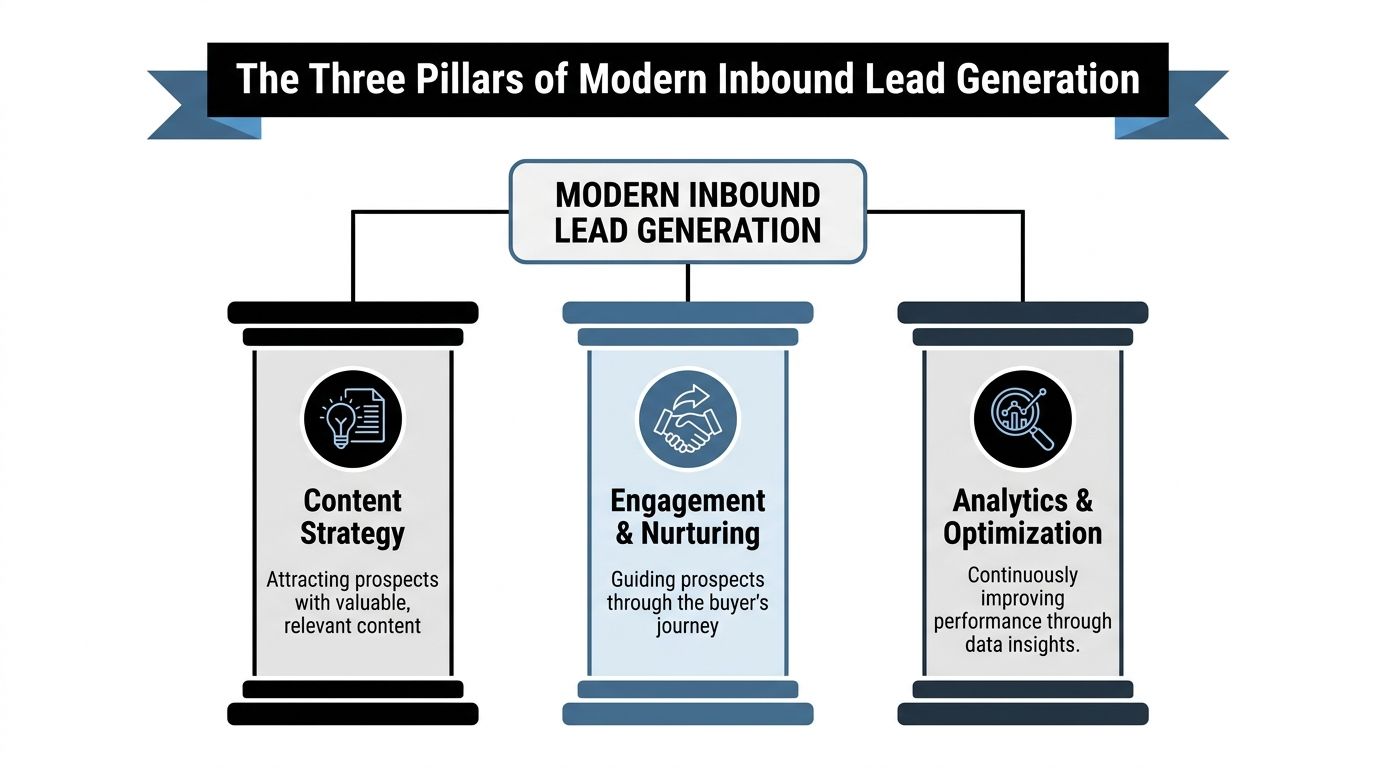
The Three Pillars of Modern Inbound Lead Generation
Inbound breaks when teams treat it like random content production. A blog here, a webinar there, a few social posts when someone remembers. That creates activity, not a system.
A durable inbound engine stands on three connected pillars. Content is the fuel. SEO is the engine. Social and communities are the distribution layer that gets your thinking in front of buyers where they already spend time.
Content is the fuel
Content is where you prove relevance before the buyer ever speaks to sales.
That can mean blog posts, comparison pages, use-case guides, ROI calculators, webinar replays, customer education pieces, or problem-solution landing pages. The format matters less than the job it does. Good inbound content answers a question your ICP is already asking.
At this stage, many teams fail. They publish broad educational material that attracts attention from the wrong audience. Traffic goes up. Lead volume may even rise. Pipeline quality does not.
A better standard is simple. Every major content asset should map to one of these:
-
Pain-point education: Clarify the problem your buyer is dealing with.
-
Solution framing: Explain how categories, methods, or workflows solve that problem.
-
Vendor selection: Help buyers compare options and evaluate trade-offs.
-
Decision support: Reduce risk with proof, FAQs, implementation details, and objections.
The content strategy gets much sharper when you build it from actual buyer personas instead of assumptions. This resource on persona development is a useful reference point: https://www.fypionmarketing.com/post/master-the-basics-how-to-create-buyer-personas-for-better-outreach
SEO is the engine
Content without discoverability is a library no one visits.
SEO gives your content an advantage because it captures demand already present in the market. According to Databox lead generation statistics, content marketing accounts for 51.5% of all lead acquisition methods, and SEO is identified by 35% of marketers as the source of their highest-scoring leads.
That matters for a skeptical operator because SEO traffic is not just cheaper attention in theory. It is often better-filtered attention. Search behavior reveals intent. A buyer looking for “best CRM” is early. A buyer searching “CRM migration checklist for multi-region SaaS team” is telling you much more.
Social and communities are the distribution layer
Social is often misunderstood in inbound. It is not just a brand-awareness channel. It is where you pressure-test messaging, distribute new assets, and create repeated exposure around the same commercial themes.
LinkedIn is the obvious example for B2B, but communities matter too. Slack groups, niche forums, founder communities, product communities, and webinar partner audiences can all move the right people toward your site. The key is not to dump links. The key is to turn expertise into a conversation.
A simple way to think about the three pillars together is this:
| Pillar | Job | Common mistake |
|---|---|---|
| Content | Give buyers value and a reason to trust you | Writing for volume instead of fit |
| SEO | Make that value discoverable at the moment of intent | Chasing broad terms |
| Social and communities | Extend reach and reinforce authority | Treating promotion like one-off posting |
Strong inbound lead gen does not begin with publishing. It begins with choosing whose attention is worth earning.
A Practical Roadmap to Building Your Inbound Engine
Most inbound programs fail long before promotion. The failure starts in planning. Teams publish before they define fit, create offers before they decide what the sales team will accept, and launch capture pages without deciding how leads will be triaged.
That is how “more leads” turns into worse pipeline.

Start with ICP before content
Your inbound engine should begin with a narrow ideal customer profile. Not a broad market category. A usable target.
For a B2B SaaS company, that usually means defining:
-
Firmographic fit: Industry, size, geography, maturity, tech environment
-
Buying role: Who feels the pain, who signs, who influences
-
Trigger events: Hiring growth, tool consolidation, expansion, compliance pressure
-
Commercial fit: Budget reality, sales cycle tolerance, implementation complexity
Often, teams widen too early. They want more traffic, so they write broader content. Then they pull in students, consultants, tiny businesses, or job seekers. Those contacts fill forms and inflate dashboards, but they never had buying potential.
That is the “garbage lead” problem. TechnologyAdvice notes that a common inbound failure is attracting the wrong leads and that less than 33% of B2B leaders meet their lead quality goals, which is why smart teams use ICP-gated CTAs and triage high-intent actions after capture rather than treating every conversion the same: https://solutions.technologyadvice.com/blog/9-reasons-inbound-lead-generation-failing/
Map content to buyer pain, not your site structure
Once the ICP is clear, build a topic map from real buyer questions.
Do not start with “we need ten blog posts this month.” Start with issues your market is trying to solve:
-
Operational pain: What slows them down or costs them money?
-
Decision anxiety: What do they need to understand before they buy?
-
Vendor comparison: What alternatives are they evaluating?
-
Implementation risk: What would stop them from moving forward?
Then create assets that match those stages. One deep pillar page can support several shorter articles, a webinar topic, a sales follow-up email, and a downloadable checklist. That gives your team message consistency across channels.
If you need a broader framework for turning target-market clarity into repeatable pipeline, this playbook is a useful complement: https://www.fypionmarketing.com/post/lead-generation-blueprint-build-a-predictable-b2b-pipeline
Build offers that filter
Most companies obsess over conversion rate and ignore qualification rate. That is backward.
Your CTA should not maximize form fills. It should attract the right next step from the right buyer.
A few examples:
-
A broad educational blog might offer a diagnostic checklist.
-
A commercial comparison page might offer a demo or strategy call.
-
A product-use article might offer a customized walkthrough.
-
A high-intent pricing page might route directly to sales.
The more intent the page shows, the more direct the CTA can be.
The goal is not to capture every visitor. The goal is to make the best-fit buyer comfortable taking the next step.
Design landing pages for clarity
A strong landing page is plainspoken. It explains the problem, the outcome, the audience, and the next step without forcing the visitor to decode your positioning.
Good landing pages usually include:
-
A concrete headline: State the result or problem clearly
-
Buyer-specific language: Show who the offer is for
-
Proof elements: Testimonials, use cases, implementation notes
-
A single CTA path: Avoid clutter and competing asks
Do not ask for more information than you need to route the lead correctly. If your team needs richer data, enrich after capture through your CRM and enrichment tools rather than forcing long forms.
A short walkthrough helps clarify how the pieces fit together.
Add nurture before you think you need it
A large share of inbound leads will not be ready for a call on day one. That does not make them bad leads. It means they need context, timing, or internal alignment.
Your first nurture sequence should be simple:
| Purpose | |
|---|---|
| Email 1 | Deliver the promised asset or confirm the request |
| Email 2 | Expand on the problem and offer a useful next step |
| Email 3 | Share proof, examples, or implementation guidance |
| Email 4 | Present a direct conversion path for buyers with intent |
Keep the tone practical. The sequence should sound like a competent operator helping a buyer make progress, not a marketing automation script trying to force urgency.
Build triage rules early
Every inbound handoff needs routing logic. Not every lead deserves the same speed, rep attention, or follow-up path.
Use high-intent signals first. Demo requests, pricing-page visits, product-specific comparisons, and repeat visits to decision-stage pages should move faster than a low-intent content download. That is how inbound becomes a pipeline system instead of a contact collection exercise.
Key Metrics and Tools for Inbound Success
Inbound gets dismissed when teams report vanity metrics. Traffic, impressions, and top-line lead volume are not enough. A skeptical leadership team wants to know whether inbound is producing qualified demand, improving pipeline efficiency, and lowering acquisition waste.
That requires a tighter scorecard.
Measure progression, not just volume
The most useful inbound dashboard follows the lead from first touch to revenue stages. Different companies name stages differently, but the logic stays the same.
Track these core measures:
-
Visitor-to-lead conversion: Are your pages turning attention into identifiable demand?
-
MQL creation: Are marketing-captured leads meeting your initial fit threshold?
-
SQL progression: Is sales agreeing that those leads are worth active pursuit?
-
Lead-to-customer conversion: Are your inbound leads closing at an acceptable rate?
-
Cost efficiency: Are you acquiring qualified demand at a level the business can sustain?
If your team needs a practical framework for reporting these consistently, this KPI guide is a helpful reference: https://www.fypionmarketing.com/post/kpis-lead-generation-8-essential-kpis-lead-generation-metrics-for-2026
One metric deserves extra care: cost per lead. It is easy to lower CPL by broadening targeting and relaxing qualification. That often creates the illusion of efficiency while harming downstream performance. Teams that want to understand and lower your Cost Per Lead (CPL) without destroying lead quality should separate raw lead cost from qualified lead cost.
Watch the operational indicators
The best inbound operators do not wait for quarterly results to spot problems. They monitor leading indicators that explain why the funnel is improving or breaking.
According to Leadium’s guide to inbound lead generation, marketing automation tools can drive up to 80% improvement in inbound lead generation, and high-growth firms repeatedly monitor six core metrics: traffic, engagement, CTR, conversion, response time, and rankings.
That list is useful because it ties content performance to commercial outcomes.
Here is how to read it in practice:
| Metric | What it tells you | What to question if it drops |
|---|---|---|
| Traffic | Whether discovery is growing | Keyword targeting, distribution, page indexing |
| Engagement | Whether visitors find the asset relevant | Message match, depth, readability |
| CTR | Whether offers and copy create movement | CTA strength, page intent, offer clarity |
| Conversion | Whether traffic becomes leads | Form friction, landing page alignment |
| Response time | Whether your team acts while intent is fresh | Routing, ownership, notification flow |
| Rankings | Whether SEO momentum is compounding | Topic selection, authority, content quality |
Choose tools by workflow, not trend
A practical inbound stack usually includes four categories.
Analytics tools Use Google Analytics and your CRM reporting to understand traffic sources, conversion paths, and funnel movement. The CRM is the source of truth for what became pipeline.
SEO tools Platforms like Ahrefs and Semrush help with keyword research, content gaps, internal linking opportunities, and ranking movement. They are planning tools first, not just audit tools.
Marketing automation HubSpot, Marketo, Pardot, and ActiveCampaign are common choices. Their real value is not sending emails. It is tying capture, segmentation, nurture, and reporting together in a way the sales team can act on.
Behavior and enrichment tools Clearbit-style enrichment, intent platforms, form enrichment, and visitor identification tools help add context after capture so reps can prioritize correctly.
The right stack reduces delay and ambiguity. It should tell marketing what is attracting fit, and tell sales who deserves attention now.
Inbound Lead Gen in Action B2B Examples
Theory becomes useful when you can see the operating model behind it. The following examples reflect common B2B patterns that show where inbound lead gen works, where it breaks, and how teams correct it.
Example one SaaS company fixes lead routing
A SaaS team invests in content and starts generating form fills from guides, webinars, and comparison pages. Sales complains within weeks. Too many leads are educational. Too few are ready for a call. Reps start cherry-picking only the obvious demo requests.
The fix is not “more content.” The fix is lead management.
The company separates low-intent conversions from high-intent actions and adds predictive scoring on top of its CRM history. According to Default’s inbound lead generation guide, predictive lead scoring uses AI to analyze historical customer data, and AI-summarized enrichment data can accelerate qualification by up to 31%.
In practice, that means the team can prioritize a visitor who repeatedly engages with commercial pages over someone who only downloaded a broad educational asset. Sales gets fewer random handoffs. Marketing gets cleaner feedback on what is producing buying intent.
Example two Tech firm turns expertise into demand
A B2B tech firm has knowledgeable subject matter experts but weak market visibility. Their website explains the product but does little to educate buyers. Prospects who do speak with sales need too much context before a real evaluation can begin.
The company builds a focused content set around specific operational problems, then repurposes those assets into webinar sessions and sales follow-up material. The primary gain is not volume alone. It is sales cycle quality.
When buyers reach out after consuming educational content tied to real implementation questions, the opening conversation changes. Sales spends less time explaining the category and more time diagnosing fit.
Example three Startup uses inbound signals to sharpen outbound
A startup running outbound campaigns notices that some target accounts are already interacting with content. Instead of treating outbound and inbound as separate systems, the team uses inbound behavior to prioritize outreach.
An account that viewed product-specific content, visited pricing, or engaged with a webinar replay moves higher in the outbound queue. Messaging also changes. The cold email is no longer purely cold. It references the problem space the buyer has already explored.
That is where hybrid execution starts to matter. Inbound reveals interest. Outbound capitalizes on it before timing fades.
The Hybrid Model Scaling with Inbound and Outbound
The strongest B2B teams do not argue about whether inbound or outbound is better. They decide how each channel should support the other.
Inbound is excellent at capturing existing demand. Outbound is excellent at creating conversations inside defined accounts. Used alone, each has a weakness. Used together, they create a more controllable pipeline system.

Why inbound alone stalls
Inbound often looks strong at the top of the funnel and messy in the handoff.
Marketing LTB’s lead generation analysis reports that 60% of leads are not qualified, only 15% to 25% of inbound leads are sales-ready, and responding within 5 minutes makes qualification 9x more likely: https://marketingltb.com/blog/statistics/lead-generation-statistics/
Those numbers explain why so many teams feel disappointed after investing in inbound. The issue is rarely that interest does not exist. The issue is that capture and follow-up are disconnected.
A buyer downloads a useful asset. No one responds quickly. A demo request lands after hours and sits untouched. A high-fit lead gets mixed into the same nurture sequence as everyone else. By the time sales reaches out, the moment is gone.
Why outbound alone hits a ceiling
Outbound creates control, but it has limits.
Cold outreach works best when targeting is tight, the message is sharp, and the team can sustain testing and deliverability discipline. Even then, you are still introducing yourself to buyers who may not have active intent right now.
That means more effort goes into education, objection handling, and timing risk. Outbound is strongest when it has context. Inbound creates that context.
What the hybrid system looks like
The hybrid model uses inbound to surface intent and outbound to act on it with speed.
A working version usually includes these motions:
-
Inbound captures demand: SEO pages, webinars, guides, comparison content, and product education pull in buyers already researching.
-
Scoring and triage separate signal from noise: High-intent actions route fast. Lower-intent leads enter nurture.
-
Outbound prioritizes warm accounts: Sales reaches target accounts that engaged with content, visited decision-stage pages, or match the ICP closely.
-
Messaging becomes more relevant: Outreach references the problem area or use case the account already signaled interest in.
-
Feedback improves both channels: Sales responses sharpen content topics. Content engagement sharpens outbound targeting. Effective execution requires active sales coverage. If inbound reveals who is interested, outbound discipline makes sure those opportunities do not cool off in a queue.
A practical division of labor
The easiest way to implement the hybrid model is to define ownership by buyer state.
| Buyer state | Best motion | Why |
|---|---|---|
| Actively researching a problem | Inbound | The buyer is already pulling information |
| Comparing vendors or methods | Inbound plus sales assist | They need proof and guidance |
| High-fit account with no visible action yet | Outbound | You need to create a conversation |
| High-fit account showing engagement | Outbound informed by inbound | Timing and context are now on your side |
One more detail matters. Sales and marketing need one shared definition of a qualified lead. Without that, inbound will optimize for form fills and outbound will optimize for replies, while leadership keeps asking why pipeline quality is uneven.
For teams building SDR-led demand generation alongside content and SEO, this perspective on outbound motion is a useful complement: https://www.fypionmarketing.com/post/outbound-cold-email-sdr-led-demand-generation
The hybrid model works because it removes the false choice. Inbound tells you who is leaning in. Outbound makes sure the best opportunities receive immediate, relevant attention.
The result is a pipeline system that is more predictable than pure outbound and more commercially responsive than passive inbound alone.
If you want that kind of hybrid pipeline without taking on upfront agency risk, Fypion Marketing is built for it. They run performance-driven B2B lead generation with no upfront fees, no retainer, and no setup costs, so you pay for booked qualified meetings rather than activity. For SaaS and B2B teams that already know their market and want a more accountable growth model, that structure is worth a close look.