
Market vs industry: Market vs Industry: Master B2B Strategy

You can have a solid product, clean copy, and a capable sales team and still miss pipeline targets for one simple reason. You aimed at an industry when you needed to aim at a market.
That mistake shows up every day in cold outreach. A SaaS company says it sells to “financial services.” A lead gen team pulls a giant list, launches sequences, and gets weak reply quality. The problem usually isn’t email. It’s targeting.
In practice, market vs industry decides who makes your list, what goes into your personalization, and whether your ICP is broad enough to sound generic or sharp enough to book qualified meetings. If you get the distinction wrong, your campaign scales the wrong thing. You don’t build pipeline. You automate waste.
Your Biggest B2B Targeting Mistake
A familiar example looks like this.
A founder has a workflow product for finance teams. They decide to target the “finance industry.” The team builds a list of banks, fintech firms, insurers, investment groups, and accounting software companies. The emails mention efficiency, automation, and visibility. Nobody replies with urgency.

The issue isn’t effort. It’s that “finance industry” is a supply-side bucket. It groups companies that operate in a similar sector. It doesn’t tell you which buyers feel the problem badly enough to respond now.
A sharper approach would define a market inside that broad space. For example: finance teams at mid-sized B2B companies that are dealing with slow month-end close, approval bottlenecks, or scattered reporting workflows. That’s a market because it’s shaped by a shared need, not just a shared label.
Teams usually lose months by confusing company classification with buying intent. Then they build lists that are technically relevant but commercially messy.
You can see the same issue in outreach aimed at “all manufacturers,” “all healthcare companies,” or “all SaaS firms.” Those categories are too blunt to drive a consistent cold email program. They’re useful for sorting accounts, not for deciding who deserves a message first.
If your current targeting still starts with broad vertical labels, revisit your B2B customer segmentation approach. The fix is simple in theory and demanding in execution. Start with the industry to narrow the universe. Then define the market by pain, trigger, and buying context.
Broad industries create big lists. Specific markets create booked conversations.
Defining the Core Concepts Market vs Industry
Another textbook definition isn’t needed. What is needed is a working distinction applicable in list building and message writing.
What an industry actually means
An industry is the group of companies producing similar goods or services. It’s a supply-side view. It tells you who the producers are, how the sector is structured, and who competes with whom.
A good example comes from smartphones. The smartphone industry shipped 1.53 billion units globally in 2017 according to LivePlan’s explanation of industry vs market research. That shipment number is an industry metric because it describes output inside a specific sector.
Industry analysis answers questions like these:
-
Who are the main players? Apple, Samsung, and other producers.
-
How is the sector organized? Product categories, business models, cost structures.
-
How large is the supply side? Production volumes, sector growth, competitive concentration.
That matters when you’re deciding whether a vertical is big enough to pursue or crowded enough to avoid.
What a market actually means
A market is the group of buyers with a shared need, problem, budget, or use case. It’s a demand-side view. A market can stretch across multiple industries if the same job needs to get done.
A simple example from the same source is the difference between a narrow industry like pulp and paper and a broader market like stationery. The industry is defined by what producers make. The market is defined by what buyers want to purchase.
For B2B outreach, this distinction is everything. “SaaS” is an industry category. “Revenue teams that need more qualified demos without adding SDR headcount” is a market.
If you want a helpful framework for gathering the right demand-side signals, this guide to market intelligence is useful because it pushes you beyond static firmographics and into buyer conditions that directly shape campaigns.
A fast litmus test
Use this test before you approve a target list.
| If your description answers | You’re looking at |
|---|---|
| What kind of company is this? | Industry |
| What problem is this buyer trying to solve? | Market |
Practical rule: If your target definition can’t explain why someone would reply now, you don’t have a market. You have a list category.
Why This Distinction Drives B2B Go-To-Market Success
A lot of bad go-to-market plans look reasonable on paper. They fail because they use the wrong lens at the wrong time.
Industry analysis helps you decide where to play. Market analysis helps you decide who to target first, how to message them, and what offer angle will convert. If you swap those jobs, your GTM gets blurry fast.
Industry tells you if a space is worth entering
A broad industry can be large, active, and attractive without being the right initial target for your campaign.
Take fitness. The U.S. fitness industry had over 93,874 institutes as of 2025, and revenue was expanding at a 7.1% CAGR, according to Upmetrics on industry analysis vs market analysis. That tells you the sector is substantial and growing.
That’s useful. It helps validate whether the space deserves attention.
But it still doesn’t tell you which slice of the sector should get your first thousand emails.
Market tells you where response quality comes from
If you sell software into fitness businesses, “fitness industry” is too broad for a serious outbound program. Gyms, boutique studios, franchise operators, and digital-first fitness brands may all sit inside the same industry while buying for very different reasons.
One buyer may care about member retention. Another may care about staffing. Another may care about class utilization. Another may care about local expansion.
That’s why industry-level targeting tends to create one of two problems:
-
Diluted copy. The messaging stays generic because the buyers are too different.
-
Weak qualification. You get replies, but they’re from companies that fit the category, not the buying condition.
A clean GTM plan uses both views. It starts with the sector because that’s efficient. Then it narrows into a market where the same pain, urgency, and operational context show up repeatedly.
For a practical way to connect that targeting work to execution, this guide to a modern B2B marketing strategy is a strong next step.
What works and what usually fails
What works is choosing a target set where the message can stay consistent across dozens or hundreds of accounts.
What fails is treating sector labels like buying signals.
A vertical is not an ICP. It’s only the first filter.
If your outbound motion isn’t producing a reliable pipeline, check the campaign brief. The mistake usually sits there. Not in the subject line. Not in the CTA. In the target definition itself.
A Practical Comparison for B2B Strategists
Here’s the simplest way to use market vs industry without overcomplicating it. Use industry analysis to shape your account universe. Use market analysis to shape your campaign strategy.
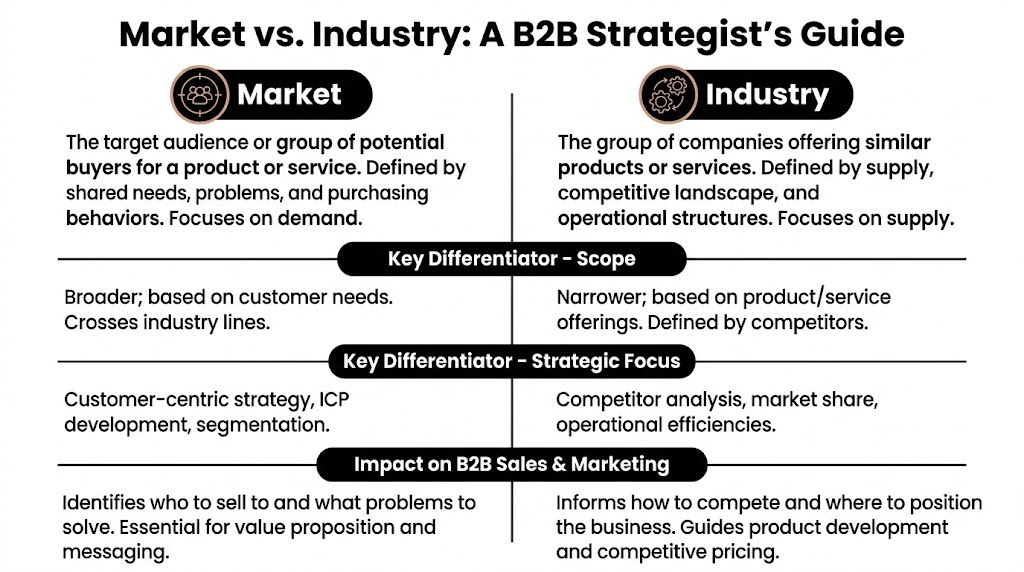
Market vs Industry At a Glance for B2B Targeting
| Dimension | Industry Analysis | Market Analysis |
|---|---|---|
| Primary focus | Producers, competitors, sector structure | Buyers, needs, behaviors, triggers |
| Main question | Which companies operate in this space? | Which buyers feel this problem enough to act? |
| Useful data | NAICS categories, competitor sets, sector reports, LinkedIn industry filters | Call notes, lost deal reasons, CRM patterns, buying triggers, website language |
| Best use in outbound | Building the first account pool | Prioritizing segments and writing messages |
| What it improves | Coverage and category selection | Reply quality and meeting quality |
| Typical mistake | Treating the whole vertical as one audience | Ignoring competitive context and over-narrowing too early |
| Output | TAM view, category map, account universe | ICP, segment logic, personalization angles |
How strategists should split the work
A B2B strategist usually needs both. The mistake is expecting one to do the other’s job.
Use industry analysis when you need to:
-
Choose a vertical to enter. This step involves assessing sector relevance, competitor density, and whether the category is big enough to matter.
-
Map account pools. LinkedIn Sales Navigator, Apollo, ZoomInfo, and Crunchbase all make this easier because industry labels are standard filters.
-
Understand competitive positioning. If everyone in a sector leads with compliance, you may need to lead with speed, integration, or implementation simplicity instead.
Use market analysis when you need to:
-
Refine the ICP. Not “software companies,” but product-led SaaS teams with a messy handoff from free users to sales.
-
Build messaging angles. Not “we help logistics firms,” but “we help ops teams cut manual vendor follow-up.”
-
Prioritize outreach. Not every account in the same industry deserves equal attention.
The difference also changes research workflow. Industry data is easier to collect at scale. Market data is harder, but it pays off more in copy and qualification.
What this looks like in practice
A clean outbound build often looks like this:
-
Pull a broad list by industry.
-
Break it into likely markets based on use case, maturity, or pain.
-
Check which segment has the clearest trigger.
-
Write one sequence per market, not one sequence per industry.
-
Measure positive replies by segment, then scale the winners.
If you need a sharper method for this narrowing process, this guide on how to identify target market for B2B precision gets into the mechanics.
Industry gets you into the right neighborhood. Market gets you to the right door.
From Insight to Action Building Your Ideal Customer Profile
An effective ICP isn’t built from firmographics alone. It’s built by layering industry context with market-specific need.
If you stop at industry, your ICP is too broad to guide outbound. If you ignore industry entirely, your targeting loses structure and becomes hard to scale.
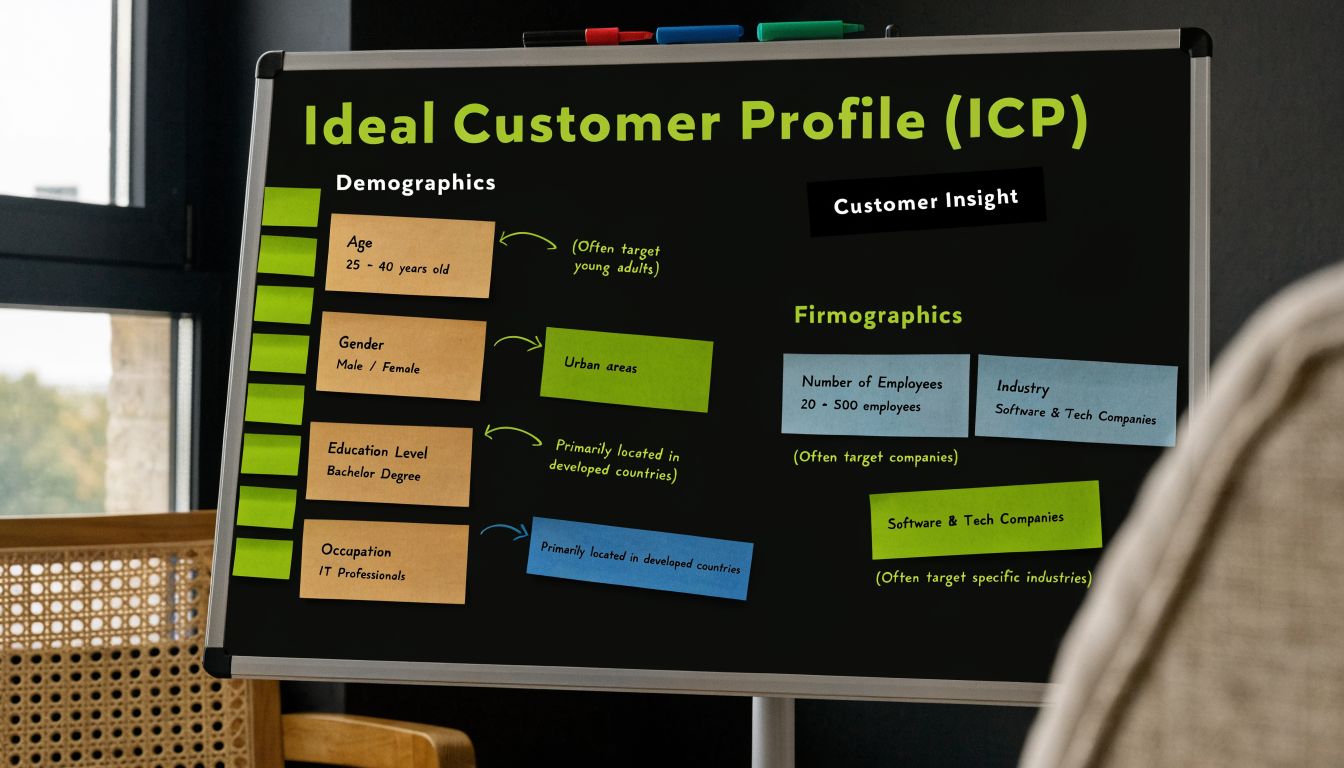
Start with the account shell
Industry is still useful. It helps define the account-level boundaries of your ICP.
For example, if you sell a workflow product with a clear fit in logistics, your industry lens might shape filters like:
-
Business model
-
Operational complexity
-
Common systems in use
-
Org structure and likely stakeholders
That gives your sales team a workable universe. It also helps your data team avoid random list sprawl.
But that’s only the shell.
Add the buying conditions
The market layer is what turns a broad ICP into a real outbound target.
Inside the same industry, some accounts are calm and some are actively feeling pain. The latter group is where cold outreach performs.
Your market layer should include points like these:
-
Problem intensity: What operational issue is visible enough to create urgency?
-
Trigger events: Has the company launched a new product, expanded, hired new leadership, or changed process?
-
Desired outcome: Does the buyer want speed, cost control, reliability, visibility, or reduced manual work?
-
Internal friction: Who feels the pain first, and who signs off?
This is also why need-based segmentation often beats pure vertical segmentation. Bain notes that vertical industry segments have limits, and that small businesses represent a $50 million profit upside opportunity for providers who segment by needs such as reliability or budget rather than industry alone, according to Bain & Company’s analysis of underserved small business segments.
Markets inside an industry often buy for different reasons. The company label stays the same. The buying motive does not.
For teams managing named accounts, a simple strategic account planning framework can help connect those motives to actual outreach priorities.
Turn the ICP into campaign assets
Once both layers are clear, the ICP should produce campaign decisions, not just a nice slide.
That means you should be able to answer:
-
Which accounts go into sequence A versus sequence B?
-
Which contacts get pain-led messaging versus ROI-led messaging?
-
Which signal qualifies an account for immediate outreach?
-
Which accounts should be excluded because they fit the industry but not the market?
This short video gives a useful visual on how to think about audience definition before you push campaigns live.
If your ICP still reads like a broad category label with a few company-size filters, it needs more work. A better one describes who the buyer is, what pressure they’re under, and why your outreach will make sense this quarter instead of next year.
For a deeper build process, use this B2B ideal customer profile guide.
Optimizing Cold Outreach with Market and Industry Data
Cold email gets stronger when list logic and message logic come from different layers of research.

Build lists in two passes
First, use industry filters in tools like LinkedIn Sales Navigator, Apollo, or ZoomInfo to collect a broad but relevant account pool.
Second, qualify that pool using market signals. Look for pain keywords on the website, role language in job posts, product pages, expansion cues, or messaging that reveals a current need. That second pass is where mediocre lists become useful.
Personalize to the market, not just the vertical
Strong cold emails usually mention the buyer’s operating context, not just their sector.
A weak opener says you work with “SaaS companies.” A stronger one points to a shared situation, such as messy handoffs, slow pipeline coverage, or pressure to source qualified meetings without hiring more SDRs. If you need help tightening that copy, this guide on how to write a cold mail is practical.
Benchmark with industry context
Benchmarking still matters. For B2B lead generation, CPA Exams Mastery notes that top-quartile agencies see profit margins of 20-30% and use targets such as CAC < $200/meeting** and **LTV:CAC >3:1. Those are useful benchmarks.
But performance usually improves when targeting shifts from broad industry outreach to precise market-level outreach. Better targeting doesn’t just affect reply rates. It affects meeting quality, qualification consistency, and how fast you learn what messaging proves effective.
Frequently Asked Questions About Modern Targeting
What if a company operates across multiple industries
Then don’t force it into a single-box view. Use the company’s industry footprint for account selection, but segment outreach by the specific market problem each business unit is likely solving.
A multi-product company may look like one account in your CRM and three different markets in reality. Outreach should follow the market logic, not the org chart.
Can a market exist without a neat industry label
Yes. That happens often in B2B.
A market can form around a shared need that cuts across categories. Budget-conscious operations teams, companies trying to replace manual reporting, or sales leaders who need qualified meetings without adding headcount can span several industries at once. Those markets are often more commercially useful than broad vertical labels because the messaging can stay focused on one job-to-be-done.
How is AI changing market vs industry in practice
AI is making it easier to target micro-markets inside broad categories. According to this discussion of underserved market segments and AI-driven targeting, AI tools now enable hyper-personalized outreach to micro-markets within industries, such as budget-constrained e-commerce B2B teams shifting toward tech-enabled solutions.
That matters because traditional industry filters flatten real differences. AI-assisted research can group prospects by pain language, offer fit, maturity, or buying conditions that old vertical lists miss.
The old assumption was that scale required broad targeting. Modern outbound can scale while staying narrow.
Should outreach start with industry or market
Start with industry if you need structure. Start with market if you need conversion.
In practice, most strong campaigns use both. The industry filter helps you find candidate accounts quickly. The market filter decides which accounts deserve custom messaging, priority sequencing, and SDR attention first.
If your team has to choose where to spend extra effort, spend it on market definition. That’s usually where the reply quality comes from.
If you want a cold email program that targets the right buyers instead of blasting broad verticals, Fypion Marketing can help. They build outbound systems around precise market research, customized lists, personalized messaging, and pay-per-meeting execution, so your pipeline grows from qualified conversations rather than inflated list size.