
Master Cold Email Personalization to Boost Responses
Look, let’s be real - cold email personalization is simply about making your outreach feel human. It’s about showing the person on the other end that you’ve actually done your homework before landing in their inbox.
You’re using specific, relevant details - like their name, a recent company milestone, or maybe a shared connection - to turn what could be an annoying interruption into a genuinely welcome conversation.
Why Generic Cold Emails Are a Dead End

The days of blasting out generic, one-size-fits-all email templates are long gone. Your prospect’s inbox has become a battlefield, completely flooded with low-effort, AI-generated messages that everyone has learned to spot and delete on sight. Sending a generic email today is like shouting into a hurricane and expecting someone to hear you clearly.
Decision-makers have developed an almost sixth sense for filtering out anything that feels automated or impersonal. They’re busier than ever and have zero patience for emails that don’t respect their time or intelligence. A generic pitch isn’t just ineffective anymore; it’s a liability that can tarnish your brand’s reputation and get your domain blacklisted.
It’s All About Psychology and Relevance
The real problem isn’t just the sheer volume of emails; it’s a psychological one. When a prospect gets an email that just drops in their and , their brain instantly flags it as junk mail. It’s just another ad, another interruption.
But when an email opens with a specific, thoughtful reference, it triggers a powerful pattern interrupt.
An email that says, “I saw your team is hiring for a new RevOps leader and thought of you,” lands completely differently than, “I help companies like yours achieve their goals.” The first one starts a conversation; the second one is a tired sales pitch.
That small shift changes everything. It proves you’ve invested a few minutes of your time, shows you actually understand their world, and transforms your message from background noise into a signal they might want to pay attention to. You’re moving the interaction from a cold, transactional request to the start of a potential relationship.
The Hard Data on Personalization
The game has gotten tougher. Spam filters are more aggressive, and buyers are more skeptical than ever. Even so, cold email is still an incredibly powerful tool when you do it right.
A recent survey of over 500 outbound professionals showed that campaigns with 1:1 cold email personalization crush generic blasts, pulling in two to three times higher reply rates.
This isn’t just a minor improvement - it’s a massive change in effectiveness. We’re talking about the difference between a 1% reply rate and a 5% reply rate, which can completely change the economics of your entire sales pipeline. There’s a reason effective personalization is at the heart of the best B2B email marketing best practices for 2025.
To really drive this home, let’s look at how different levels of personalization can impact your results. The deeper you go, the better your chances of getting that coveted reply.
How Personalization Levels Impact Reply Rates
This table breaks down how different degrees of personalization directly affect your chances of getting a reply, based on what we’re seeing across the industry.
| Personalization Level | Description | Expected Reply Rate Increase |
|---|---|---|
| Basic | Using only the prospect’s name and company name. This is the absolute minimum. | Baseline |
| Intermediate | Referencing their job title, industry, or a recent company-wide announcement. | 30-50% |
| Advanced | Citing a specific project they worked on, a quote from an article they wrote, or a shared connection. | 100-200% |
| Hyper-Personalized | A highly detailed, 1:1 message crafted around their specific pain points, recent achievements, and personal interests. | 200-300%+ |
As you can see, the effort you put in directly correlates with the results you get back. Moving beyond basic mail-merge fields is where the real magic happens.
Ultimately, genuine personalization isn’t just a “nice-to-have” tactic anymore. It’s the new baseline for anyone serious about cold outreach. It’s the only reliable way to cut through the clutter, build that initial spark of trust, and earn the right to your prospect’s time.
Laying the Groundwork for Powerful Personalization

Exceptional cold emails don’t just happen. The real magic isn’t in some fancy writing trick; it’s in the prep work you do before you even think about typing a subject line. This is where you separate an email that feels genuinely helpful from one that’s just another slightly customized template.
The aim is to move past the obvious, generic data points like or . We’re hunting for impactful triggers - the specific, timely events that give you a legitimate reason to pop into their inbox right now. These triggers are the hooks that turn a cold pitch into a warm conversation.
Finding Insights That Actually Matter
Your prospect’s digital footprint is a goldmine, but you need to know where to dig. The trick is to ignore the fluff and focus on information that signals a recent change, a new challenge, or a shared professional interest.
These little nuggets of information help you build a real picture of your prospect, turning them from a name on a list into a person with actual business pains and goals. Getting this right is fundamental, and it’s a core principle behind most effective cold email best practices for scaling your outreach.
Here are the places I always look to find these game-changing details:
-
LinkedIn Activity: Don’t just glance at their job title. Go straight to their “Activity” tab. Did they just post an article, drop a comment on an industry debate, or share a company milestone? Mentioning this shows you’re paying attention to what they think, not just who they are.
-
Company News & Press Releases: Did their company just land a new round of funding, launch a flagship product, or announce an expansion? These are powerful, time-sensitive triggers that create immediate context for your offer.
-
Job Postings: A company’s careers page is basically a public roadmap of their biggest headaches. If they’re suddenly hiring a whole team of SDRs, you can bet they have a pipeline problem. If they’re looking for engineers with a specific tech stack, you know exactly what tools they’re committed to.
-
Podcasts and Webinars: This one’s my favorite. Has your prospect been a guest on a podcast or a panelist at a webinar? Quoting a specific insight they shared is one of the most flattering and effective personalization tactics out there. It shows you genuinely value their expertise.
Pro Tip: I set up Google Alerts for all my top-tier prospects and their companies. It’s a simple, automated way to get fresh personalization fuel - like news articles or company mentions - sent right to my inbox.
From Data Points to Conversation Starters
Okay, so you’ve gathered a few solid insights. Now what? The next move is to weave them into your opening line. You need to build a logical bridge between your observation and your reason for reaching out. This connection is what makes your pitch feel earned, not random.
Let’s look at the difference.
The Generic Approach: “Hi Sarah, I help marketing leaders like you increase their lead generation.”
This is all about you, it’s generic, and it’s incredibly easy to delete.
The Trigger-Based Approach: “Hi Sarah, I saw your comment on LinkedIn about the rising costs of paid ads. It’s a huge challenge right now. Many B2B marketers we work with are shifting focus to outbound to create a more predictable pipeline.”
See the difference? This one works because it starts with their world. You’re showing you understand a problem that’s actively on their mind, which makes your solution feel relevant and timely.
A Practical Research Workflow
To keep this from becoming a huge time sink, you need a repeatable process. A simple checklist for researching each high-value prospect will do the trick. Consistency is what matters here.
Here’s a quick workflow I use:
-
LinkedIn Profile Review (5 minutes): Quick scan of their job history, recent activity, and any shared connections.
-
Company Website & Blog (3 minutes): Look for the latest announcements, case studies, or thought leadership articles.
-
Google News Search (2 minutes): A quick search for can uncover recent press you might have missed.
Just 10 minutes of focused research per prospect can give you enough ammunition to write an email that blows past the noise. That initial time investment pays for itself over and over again with higher reply rates, turning personalization from a chore into your most powerful sales weapon.
Writing Opening Lines That Stop the Scroll
Think of your first sentence as the audition for your entire email. In a sea of unread messages, it’s the one thing that decides whether a prospect keeps reading or hits delete without a second thought. The goal isn’t just to be polite; it’s to create an immediate and powerful pattern interrupt.
You need to craft an opening so specific and relevant that it shatters their “generic email” filter. It has to instantly prove this message was written just for them. A great opener makes your email feel less like a sales pitch and more like a conversation that was meant to happen.
Mastering the Hyper-Personalized Opener
The secret to a killer opening line isn’t magic - it’s in the research you’ve already done. It’s all about taking those gold nuggets of information you found - a recent LinkedIn post, a company milestone, a shared connection - and weaving them into a genuine, compelling hook.
Your opener should feel like you’re picking up an existing conversation, not starting a cold one. This isn’t about empty flattery; it’s about showing you’ve done your homework. For instance, instead of a bland “I saw your company is in the SaaS industry,” try something with real impact.
Here’s an example referencing their content:
“Hi Alex, I just finished reading your article on the challenges of scaling remote engineering teams. Your point about asynchronous communication being a ‘superpower, not a setback’ really stood out to me.”
This works because it validates their expertise and shows you’ve actually engaged with their ideas. Right away, you’ve positioned yourself as a thoughtful peer, not just another vendor trying to sell something.
Frameworks for Crafting Unforgettable Openers
Staring at a blank screen is tough. Instead of trying to pull a perfect line out of thin air, lean on a few proven frameworks to guide your personalization. These are less like rigid templates and more like strategic starting points to turn your research into compelling conversation starters.
Let’s look at a few that we use all the time:
-
The Shared Experience: Mention a mutual connection, an event you both attended, or a professional group you’re both part of. This creates an instant sense of familiarity and trust.
-
The Recent Achievement: Congratulate them on a recent company win, like a funding round, a new product launch, or a major award. It shows you’re paying attention and have a timely reason to reach out.
-
The Insightful Observation: Reference a specific point they made in a podcast, webinar, or social media post. This is one of the most powerful forms of personalization because it directly engages with their professional thoughts.
These frameworks are your launchpad. To see how they play out in full campaigns and get more inspiration, check out these effective cold email examples that boost outreach.
The Data Behind Relevant Outreach
It’s easy to think a clever opening line is just a nice-to-have, but the numbers tell a different story. According to a massive analysis of over 11 million cold emails, email is still the top choice for outreach, with 71% of U.S. decision-makers preferring it over other channels.
But here’s the catch: the average reply rate is a shockingly low 4.1%. The number one reason for the poor performance, cited by 71% of those same decision-makers, is a lack of relevancy. You can dig into all the findings on the state of cold email yourself.
The data paints a clear picture: decision-makers are open to getting your email, but they have zero tolerance for messages that waste their time. Your opening line is your first - and often only - chance to prove your email is worth their time.
Making that opener count is the first real step in successful cold email personalization. A generic opening like “I hope this email finds you well” is a one-way ticket to the trash folder.
On the other hand, an opener like, “Congrats on the recent acquisition of Company XYZ - that’s a huge move in the fintech space,” immediately shows you’re informed. It signals that the rest of your email is likely to be just as thoughtful, earning you the right to their attention and, hopefully, a reply.
Connecting Your Pitch to Their Reality

A killer opening line gets your foot in the door. But it’s the pitch - the core reason you’re even in their inbox - that actually gets you a reply. This is where all that research you did pays off, where you connect what you know about them to what you can do for them.
So many salespeople drop the ball right here. They write a great, personalized opener and then immediately pivot to a generic spiel about their product. It’s a jarring shift that completely breaks the connection you just worked to build, making the prospect feel like they were bait-and-switched into a demo.
The point isn’t to list features. It’s to form a sharp hypothesis about a problem they’re likely wrestling with right now, then position your solution as the most logical fix. This isn’t selling; it’s problem-solving. It shows empathy and frames you as a potential partner, not just another vendor trying to hit a quota.
From Observation to Hypothesis
You’ve done your homework. You know they’re hiring a new sales team, just pushed a major product update, or their VP of Sales just posted about pipeline anxiety on LinkedIn. The magic happens when you connect that observation to a probable pain point. This is the absolute core of cold email personalization that actually works.
Think like a consultant. You’re not just stating a fact you found online; you’re interpreting what that fact means for their business and their bottom line.
Here’s how that thought process breaks down:
-
Observation: “I see your company is hiring five new Business Development Representatives in Austin.”
-
Hypothesis (The Implied Problem): “When sales teams grow that fast, they almost always struggle with inconsistent messaging and new reps taking forever to ramp up. It can crush pipeline goals before they even get off the ground.”
-
The Bridge (Your Pitch): “Our platform helps B2B teams standardize their outreach playbooks and cut ramp time by 40%, ensuring new reps hit their quota faster.”
See how that flows? It starts with their world, diagnoses a pain they’ll immediately recognize, and then offers a clear, tangible outcome. It proves you get it.
The Problem-Centric Pitch Framework
To do this over and over again without burning out, you need a simple framework. This isn’t about fancy words; it’s about connecting your research directly to your value. For a moment, forget your product and focus completely on the prospect.
Here’s a structure that we’ve found works wonders:
-
The Trigger: Kick off by referencing the specific detail you found.
-
The Implied Pain: Connect that trigger to a common business challenge it creates.
-
The Solution Bridge: Briefly introduce how you solve that specific problem.
This simple shift changes your pitch from, “Here’s what our product does,” to, “I saw you’re dealing with X, and we specifically help with that by doing Y.” The whole conversation is about them, which is exactly how it should be. If you want to go deeper on this, our guide on how to use cold emails to get more customers has more strategies.
A pitch that says, “I see you’re using HubSpot for marketing automation,” is just an observation. A pitch that says, “I noticed you’re using HubSpot. Many scaling teams find they hit a wall with its native outbound sequencing and struggle with deliverability. We specialize in fixing that,” is a conversation starter.
Putting It All Together in Practice
Let’s look at a couple of real-world scenarios. This is where the rubber meets the road.
Scenario 1: Prospect’s company just raised a Series B.
-
Generic Pitch: “Hi Jen, congrats on the funding! At Fypion, we help companies grow their revenue. Can we chat?”
-
Problem-Centric Pitch: “Hi Jen, huge congrats on the Series B! That’s massive. Usually, after a new funding round, the pressure is on to scale the sales pipeline immediately. We help newly funded SaaS companies build a predictable outbound engine, so they can hit those aggressive board expectations without burning through their new capital on expensive ads.”
Scenario 2: Prospect is a VP of Engineering at a company that just acquired a smaller startup.
-
Generic Pitch: “Hi Mark, I help engineering leaders like you. I’d love to show you our platform.”
-
Problem-Centric Pitch: “Hi Mark, I saw the news about the acquisition of Tech-XYZ - congrats on the move. Integrating two different tech stacks and engineering cultures can be a huge headache. Our platform helps VPs of Engineering streamline post-acquisition workflows and get unified visibility across teams in under 30 days.”
In both examples, the second version is light-years better. Why? It’s not about the sender or their product. It’s laser-focused on the recipient’s immediate, high-stakes business challenges. This is the kind of personalization that gets replies from decision-makers who ignore 99% of their inbox.
How to Scale Personalization Without Sounding Robotic
Let’s be real. Hyper-personalizing every single email with a 30-minute deep dive into someone’s life history just isn’t going to fly when you need to reach hundreds of prospects. The real trick isn’t about working harder; it’s about being smarter with your effort.
The goal is to build a system that lets you maintain that authentic, human touch without sacrificing volume. It’s about moving past the basic and tags and getting into more dynamic, segment-based personalization that actually connects.
Adopt a Tiered Personalization Strategy
One of the most effective ways I’ve found to manage this is with a tiered personalization approach. The core idea is simple: not all prospects are created equal. You should invest your most valuable time where it will generate the highest return.
Think of your prospect list like a pyramid:
-
Tier 1 (The Top 5-10%): These are your dream clients. The ones that could change your year. For this small, high-value group, you pull out all the stops. Spend 10-15 minutes digging deep. Look for unique angles like podcast appearances, insightful LinkedIn comments, or specific company initiatives they’ve championed.
-
Tier 2 (The Solid Fits - 30-40%): This group is your bread and butter - solid, ideal-fit prospects. Here, you can be more efficient. Spend a few minutes finding one strong, relevant personalization point. A recent funding announcement, a major product launch, or a key new hire are all great hooks.
-
Tier 3 (The Broad Audience - The Bottom 50%): This is your widest net. For this tier, personalization is all about smart segmentation. You group prospects by industry, role, tech stack, or company size and craft messaging that speaks directly to that segment’s shared experiences.
This tiered system ensures your best efforts are focused on your most valuable prospects, but you still maintain a high degree of relevance across every email you send.
To help you visualize this, here’s a framework we use to decide how much effort to apply to each prospect.
A Tiered Approach to Scaling Personalization
This framework helps you decide how much personalization to apply based on how valuable a prospect is to your business.
| Prospect Tier | Personalization Level | Example Tactic | Time Investment Per Email |
|---|---|---|---|
| Tier 1 | Deep, 1-to-1 Research | Referencing a specific quote from their recent podcast interview. | 10-15 minutes |
| Tier 2 | Relevant Company/Role Insight | Mentioning their company’s recent Series B funding and its goals. | 2-5 minutes |
| Tier 3 | Segment-Based | Using a snippet about a common pain point for their specific industry. | < 1 minute |
By allocating your time this way, you create a scalable process that doesn’t compromise on quality where it matters most.
Go Beyond Basic Custom Fields
To make a tiered system truly work, you have to think beyond the obvious custom fields. Forget just names and companies. You need to build templates that use more advanced, segment-specific snippets. This is how a semi-automated email can feel like a one-to-one message.
Try creating custom fields in your outreach tool for things like:
-
: A common challenge you know their industry faces (e.g., “managing high-churn rates for SaaS startups”).
-
: A link to a success story from a similar company in their space.
-
: A key competitor you know they’re up against.
-
: A tailored value proposition for their specific job function (e.g., “for CTOs, we help streamline dev pipelines…”).
When you start combining these snippets, you can create surprisingly powerful messages at scale. A Tier 3 email could suddenly sound very personal: “Saw you’re a CTO in the fintech space. I know many in your role are struggling with . We actually helped tackle this exact issue.”
The goal is to make every email feel relevant, even if it wasn’t written entirely from scratch. When you personalize based on shared context - like industry challenges or job responsibilities - you’re showing them you understand their world.
The data backs this up. Even small moves toward more thoughtful personalization drive huge results. Just look at the difference it makes across the board.
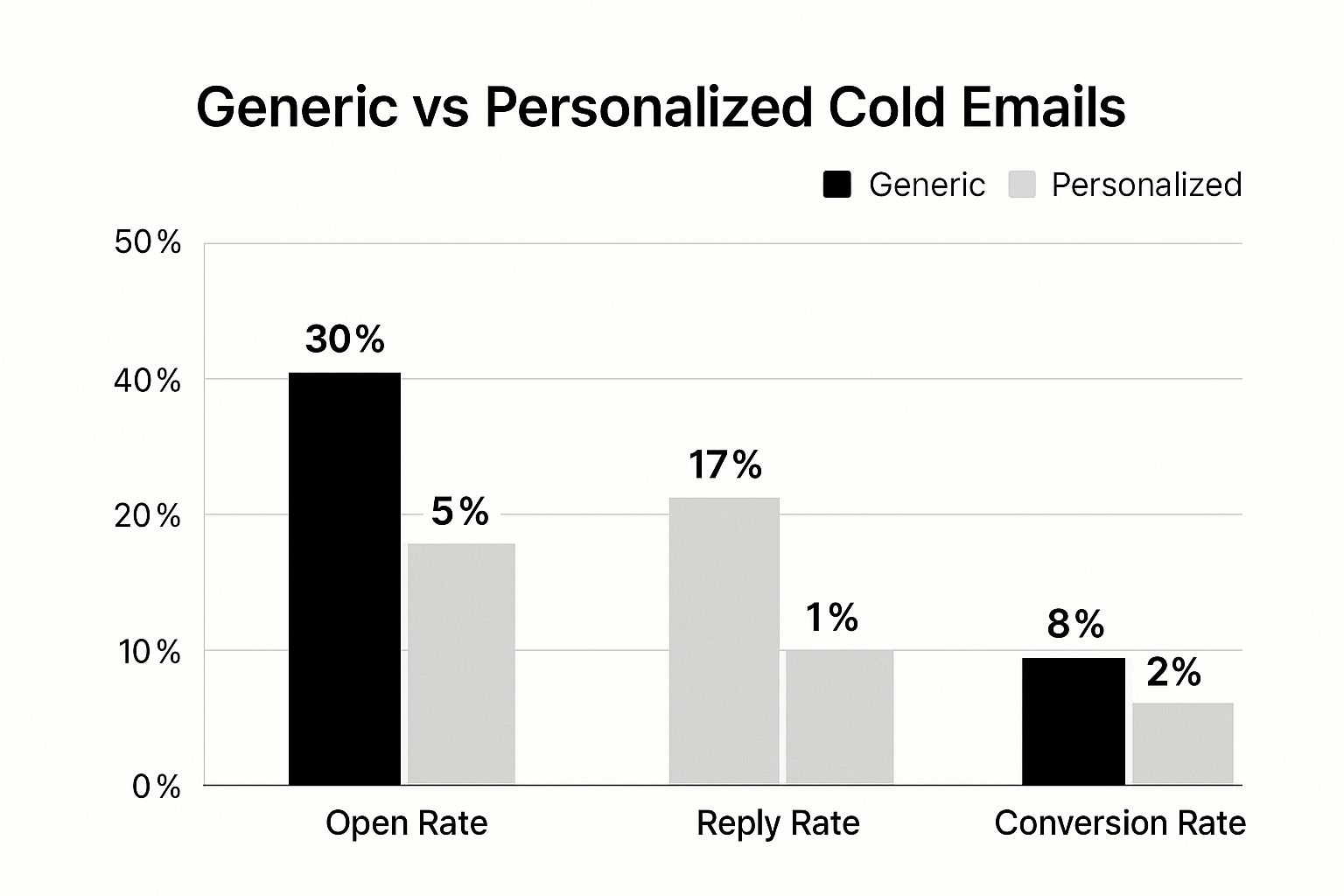
This really brings home how investing in relevance directly boosts engagement at every single step.
The numbers don’t lie. According to research from Stripo, emails with zero personalization get a bleak 9% reply rate. Just adding basic personalization bumps that to 14%. But when you use advanced techniques like referencing specific pain points, it climbs to a much healthier 18%.
Ultimately, scaling cold email personalization comes down to having a smart system. By combining a tiered approach with intelligent, segment-based snippets - and of course, sending them at the right time - you can reach a much larger audience without losing the genuine feel that actually gets replies.
Speaking of timing, if you want to dial in that part of your process, you might want to check out our guide on the best time to send cold emails in 2025.
Of course. Here is the rewritten section, crafted to sound like it was written by an experienced human expert.
Your Top Questions About Personalizing Cold Outreach, Answered
Alright, let’s get into the nitty-gritty. Once you start moving beyond generic templates, the practical questions start popping up fast. You understand the theory, but what about when the rubber meets the road?
This is where most people get stuck. They wonder if they’re doing too much, or not enough, or just wasting time. We’re going to tackle the most common hurdles people face when they start personalizing outreach for real.
How Much Personalization Is Actually Enough?
There’s no magic formula, but here’s a great rule of thumb I use: the “Pattern Interrupt” test. Does your email contain a detail so specific that the person reading it knows it couldn’t have been sent to anyone else? If you can honestly say yes, you’ve earned their attention for the next few seconds.
For your top-tier, “whale” accounts, you should be aiming for two or three of these unique, well-researched personal touches. Maybe you reference a specific point they made on a podcast, congratulate them on a recent company acquisition you read about, and then tie it all back to a shared connection on LinkedIn. That’s a powerful combo.
For broader campaigns, a single, highly relevant point is often plenty. A nod to a significant company announcement or a shared industry challenge can be more than enough to stand out. The real key is quality over quantity - one killer insight will always beat three weak, generic ones.
Where Do I Even Find This Personalization Gold?
Your first stop is almost always LinkedIn, but you have to know how to dig deeper than just a quick glance at their job title. It’s a goldmine if you know where to look.
-
The “Activity” Tab: This is my favorite spot. It shows you exactly what they’ve recently posted, commented on, or shared. It’s a direct window into what’s on their mind right now.
-
Company “Posts” Tab: Don’t forget to check their company’s page for official announcements, product news, or recent press. These are perfect, timely triggers for your outreach.
-
Profile History: Don’t just look at their current role. Scan their past jobs. You might find a connection to a company you’ve worked with or see experience that perfectly aligns with what you offer.
Beyond LinkedIn, company press releases, industry news sites, and podcast appearances are fantastic sources. A quick Google News search for their name and company can uncover some real gems you won’t find anywhere else.
I always tell my team to think like a journalist. Ask yourself, “What’s the most recent, significant thing that happened to this person or their company?” The answer is almost always a killer opening line.
Isn’t This Way Too Time-Consuming to Do at Scale?
It absolutely would be if you gave every single prospect the same white-glove treatment. That’s precisely why a tiered personalization strategy isn’t just a good idea - it’s non-negotiable if you want to do this without burning out. You can’t spend 20 minutes researching every name on a list of 500. It’s just not sustainable.
You save that deep, 15-minute research dive for your absolute highest-value, dream-client prospects. These are the accounts that could literally make your quarter. For them, the ROI on your time is massive.
For everyone else, you get efficient by getting smart with your segmentation. Group prospects by their industry, a specific pain point they all share, or even a technology they all use. From there, you craft semi-personalized templates that speak to that group’s reality. This is how you balance quality with quantity and spend your time where it will actually move the needle.
Can AI Help with Personalization?
Yes, but you have to be careful. AI tools can be a fantastic research assistant. They’re great at quickly summarizing a prospect’s recent LinkedIn posts, pulling key points from a long article, or flagging recent company news.
The biggest mistake I see people make is copying and pasting AI-generated lines directly into their emails. Prospects are getting scary good at sniffing out that slightly-off, robotic tone. It feels fake, and it kills trust instantly.
The right way to use it? Let AI find the “what,” but it’s your job to provide the “so what.” Take the facts the AI uncovers and rewrite them in your own voice. Add your own insight, make it sound like a real human wrote it, and connect it back to why you’re reaching out in the first place.
Ready to scale your B2B pipeline without the guesswork? At Fypion Marketing, we specialize in performance-driven cold email outreach. You only pay for qualified meetings, so our success is tied directly to yours. Book a free consultation to see how we can build your predictable sales engine.