
What Is a Lead in Business? A Complete Guide for 2026
Let’s get straight to it. You hear the term “lead” thrown around all the time, but what does it actually mean for your business?
A lead is any person or company that shows even a flicker of interest in what you sell. It’s not a done deal or a signed contract. Think of it as the very first handshake - a signal that a conversation might be worth having.
What Is a Business Lead in Simple Terms
Let me break it down with an analogy. Imagine you run a B2B software company. Someone who just happens to see your ad on LinkedIn is a stranger. But the moment they click that ad, land on your website, and start reading your pricing page? They just became a lead.
That “flicker of interest” is the key. In the B2B world, it could be someone downloading your latest case study, signing up for a webinar, or filling out a contact form.
A lead isn’t just a random name in a spreadsheet. It’s a real person or organization that has raised their hand, showing they might have a problem you can solve. The first step is often collecting visitor information to understand who they are and what they’re looking for.
The Anatomy of a Lead
A real lead is more than just an email address. It’s a mix of information and action that points toward a potential sale. This is exactly why effective B2B lead generation is the lifeblood of any growing company.
The numbers don’t lie. A whopping 80% of B2B marketers say lead generation is mission-critical, and they put their money where their mouth is, dedicating 37% of their budgets to it.
With sales cycles often stretching past 11 months, properly nurturing these initial signals can spike your sales opportunities by a solid 20%.
To really understand what separates a random contact from a genuine lead, let’s look at the core components.
Anatomy of a Business Lead
This table breaks down what truly makes up a business lead.
| Component | Description | Example |
|---|---|---|
| Contact Data | The basic info you need to actually reach the person or company. | John Doe, john.doe@acmecorp.com |
| Implicit Action | A passive behavior that hints at interest without them directly telling you. | A prospect spent 3 minutes on your “Features” page. |
| Explicit Action | A direct, deliberate action showing they want to engage with you. | A visitor downloaded your “Ultimate Guide to Sales” ebook. |
When you have this combination of contact data plus a clear action - either implicit or explicit - you no longer have just a name. You have a real, tangible business opportunity sitting in front of you.
The Journey from Stranger to Customer
Knowing what a lead is isn’t enough. The real magic happens when you understand how that lead actually becomes a paying customer. People don’t just stumble upon your website and immediately sign a contract. It’s a journey - a process that turns a complete stranger into someone ready to talk business.
Let’s walk through a real-world example. Imagine ‘Alex,’ a Marketing Director who’s trying to find a tool to automate her team’s outreach. Her path from a simple Google search to becoming a customer is what we call the lead lifecycle.
This is the first, most crucial step in any sales funnel: turning an anonymous visitor into a known contact.
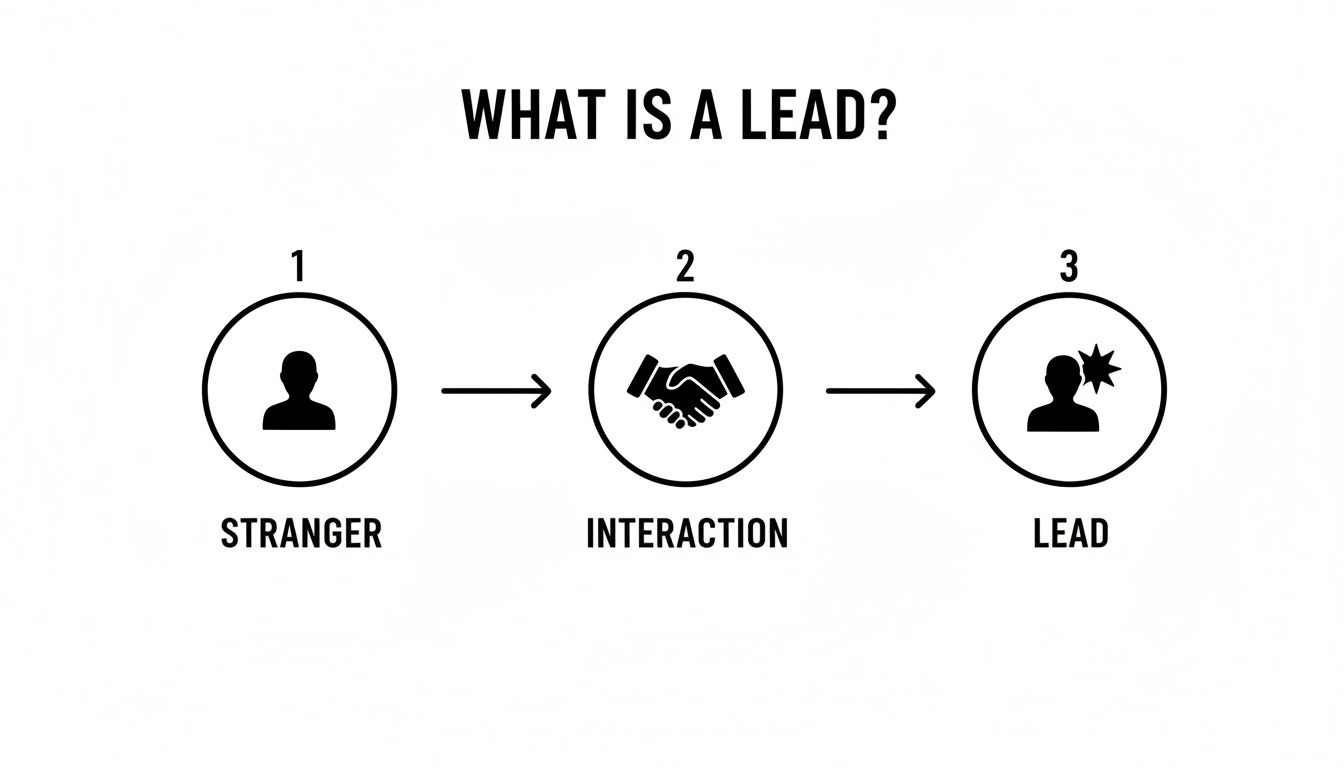
The image here breaks it down simply. A stranger interacts with your brand and - bam - they’re now a lead. This is where your marketing starts to connect, grabbing their attention and starting a conversation.
From Initial Interest to Sales-Ready
As a lead like Alex moves through the lifecycle, her actions tell a story. They show how interested she really is and signal she’s getting closer to making a decision.
-
Visitor: Alex’s journey starts with a Google search. She clicks a link and lands on your blog. Right now, she’s just an anonymous visitor.
-
Lead: She spots an ebook, “The Guide to Automated Outreach,” and drops her email to get it. Alex is now officially a lead.
-
Marketing Qualified Lead (MQL): Over the next few days, Alex opens your emails, checks out your pricing page, and even attends a webinar. Your marketing system sees this, recognizes she fits your ideal customer profile, and flags her as an MQL. She’s engaged and looks like a good fit.
-
Sales Qualified Lead (SQL): Her high engagement score triggers an alert, and a sales rep (SDR) reaches out. Alex replies, saying she’s interested in a call to talk about her team’s needs. She is now an SQL - a lead who is ready for a real sales conversation.
A shocking 79% of marketing leads never actually convert into sales, and the main reason is a lack of good nurturing. For sales teams, this is a huge wake-up call to focus on SQLs, where the MQL-to-SQL conversion rate jumps to a much healthier 16%.
From Opportunity to Closed Deal
This is where the sales team takes the wheel. It’s the final leg of the journey, where a well-qualified lead becomes actual revenue for the business.
-
Opportunity: The discovery call goes well. The salesperson confirms Alex’s company has the budget and she has the authority to buy. The deal is now officially logged as a qualified opportunity in the CRM.
-
Customer: After a product demo and some back-and-forth on the proposal, Alex’s company signs on the dotted line. She’s made it through the entire journey and is now a customer.
Understanding this lifecycle is what separates organized, high-growth companies from the rest. When marketing and sales are on the same page about each stage, the handoff is seamless. No more letting great leads fall through the cracks.
For more hands-on advice to sharpen your own strategies, you can find more articles on our blog.
Understanding MQL vs SQL
Alright, let’s get into two of the most critical stages in any sales pipeline: the Marketing Qualified Lead (MQL) and the Sales Qualified Lead (SQL).
Getting this wrong is one of the fastest ways to burn out your sales team and waste your marketing budget. Not all leads are created equal, and knowing the difference is the bedrock of a well-oiled sales and marketing machine.
Think of it this way: An MQL is someone window shopping. They’re looking at your content, maybe downloading a guide, showing some general interest. They’re curious, but they aren’t pulling out their wallet just yet.
An SQL is the person who walks up to the counter, product in hand, and asks, “How much?” They’ve stopped browsing and are now showing clear intent to buy. This distinction tells your teams exactly where to focus their energy.
What is a Marketing Qualified Lead (MQL)?
A Marketing Qualified Lead (MQL) is a prospect your marketing team flags as someone who’s more likely to become a customer than the average person who stumbles upon your site. This judgment call is based on who they are (their company, their role) and how they’ve interacted with your marketing materials.
An MQL has definitely shown interest, but they are not ready for a sales call. They’re still in the early research phase, figuring things out.
Common actions that signal you have an MQL on your hands include:
-
Downloading a top-of-funnel asset like an ebook or whitepaper.
-
Signing up for and attending one of your webinars.
-
Visiting key pages on your site multiple times, like case studies or pricing.
-
Subscribing to your company newsletter.
These are all good signs, but they are signals of interest, not intent. The marketing team’s job is to keep engaging these MQLs, nurturing them with valuable content to guide them toward being sales-ready.
MQL vs SQL Head-to-Head Comparison
To make the distinction crystal clear, it helps to see them side-by-side. The handoff from marketing to sales hinges on understanding these differences, ensuring sales reps spend their time on prospects who are actually ready to talk business.
| Attribute | Marketing Qualified Lead (MQL) | Sales Qualified Lead (SQL) |
|---|---|---|
| Stage | Early Funnel (Awareness/Interest) | Mid-to-Late Funnel (Consideration/Decision) |
| Primary Signal | Interest in your content or brand | Intent to purchase or evaluate a solution |
| Engagement | Passive (e.g., downloads, webinar views) | Active (e.g., demo requests, contact forms) |
| Team Responsible | Marketing Team | Sales Team |
| Next Step | Nurturing with more targeted content | Direct follow-up from a sales rep |
| Key Question | ”Are they a good fit for us?" | "Are they ready to buy?” |
In short, marketing nurtures MQLs to educate them, while sales engages SQLs to close them. Mistaking one for the other leads to frustrated teams and lost deals.
What is a Sales Qualified Lead (SQL)?
A Sales Qualified Lead (SQL) is a prospect who has been properly vetted and is deemed ready for a direct conversation with your sales team. This is someone who has moved past the initial research and is now actively evaluating their options. Crucially, they’ve raised their hand and asked to talk.
The moment an MQL becomes an SQL is where the magic happens. This is the handoff point where a lead signals clear purchase intent and moves from marketing’s care into the hands of the sales team for direct engagement.
An SQL is a hot lead. They have a problem they need to solve, and they’ve indicated that they think you might have the solution.
Actions that typically flip the switch from MQL to SQL include:
-
Requesting a product demo or a personalized quote.
-
Filling out a “Contact Sales” or “Get a Price” form.
-
Asking specific questions about pricing or implementation via a chatbot or email.
Once a lead becomes an SQL, the clock is ticking. You need a sales rep on it - fast. This is where high intent meets opportunity, and a quick response is absolutely essential to convert that interest into a real sales conversation. Ignoring this is how promising leads go cold.
How to Identify Your Best Leads with Lead Scoring
So, you have MQLs and SQLs coming in. That’s great, but it brings up a new problem: not all leads are created equal. Even within the same category, some are ready to talk now, while others are just browsing. How do you tell your team who to call first?
This is exactly where lead scoring comes into play. It’s a straightforward, data-backed method for ranking your prospects based on how ready they are to buy.
Think of it like a points system. Every time a lead takes an action or has a characteristic that makes them a great fit for your product, they earn points. The higher the score, the hotter the lead.

Combining Who They Are with What They Do
A solid lead scoring system doesn’t just look at one thing. It blends two key types of data to create a full picture of a prospect’s potential, telling your sales team exactly where to focus their time.
-
Demographic & Firmographic Data (Who They Are): This is all about the person and their company. You give them points based on how well they fit your Ideal Customer Profile (ICP).
-
Behavioral Data (What They Do): This tracks how they interact with your brand. High-intent actions, like visiting your pricing page, earn more points than passive ones, like just opening an email.
For example, imagine a “Director of Sales” (+15 points) at a “500+ employee company” (+10 points) who then “requests a demo” (+30 points). With a total of 55 points, they’d rocket straight to the top of your team’s priority list.
The goal here is simple: lead scoring automatically surfaces the hottest prospects. This ensures your sales team spends their valuable time talking to people who are most likely to convert, which means more efficiency and more closed deals.
A Practical Lead Scoring Model
Let’s break down what a real-world model might look like. A lead’s total score is simply the sum of how well they fit your criteria and what actions they’ve recently taken.
Demographic/Firmographic Scoring:
-
Job Title: Director or VP (+15), Manager (+10), Specialist (+5)
-
Company Size: 500+ employees (+10), 50-499 employees (+5)
-
Industry: SaaS or Tech (+10), Other B2B (+5)
Behavioral Scoring:
-
Requested a Demo: +30 points
-
Visited Pricing Page: +15 points
-
Downloaded a Case Study: +10 points
-
Opened an Email: +2 points
This system takes the guesswork out of prioritization. A lead hitting a score of 40 or more could be sent directly to a sales rep for an immediate follow-up. Meanwhile, a lead with a score of 15 might get placed into a long-term nurturing campaign to warm them up over time.
Of course, this all hinges on good data. In fact, 42% of sales reps say a lack of quality data is their single biggest challenge. It’s why starting with clean, well-researched contact lists is so critical for any successful campaign. Discover more insights about the state of lead generation on Snov.io.
By putting a system like this in place, you give your team the clarity they need to act decisively. Many businesses now use specialized AI-powered tools to run this process on autopilot, transforming their CRM into a powerful lead prioritization engine.
Alright, you’ve got a grip on what a lead is and how to sort the good from the bad. But that only gets you so far. The real question is, how do you go out and actually find them?
While inbound leads are great, one of the most direct and repeatable ways to fill your pipeline is cold email outreach.
Let’s get one thing straight: when done right, cold email is not spam. It’s a strategic, one-to-one introduction to a hand-picked prospect who fits your Ideal Customer Profile to a T. Think of it less like shouting in a crowded stadium and more like passing a well-researched, personal note to a specific decision-maker.
This whole approach hinges on precision, not just spraying and praying. It all starts with digging deep into market research to build a custom list of contacts - people who are actually dealing with the exact problems your solution can fix. The goal isn’t just to get opens; it’s to start real conversations with people ready to talk business.
The Anatomy of a Campaign That Works
A solid cold email campaign is way more than just hitting “send.” It’s a whole process built on a foundation of smart research and genuine personalization. Every piece has to be in place to turn a cold contact into a warm, qualified lead.
Here’s what goes into it:
-
Deep Market Research: Before a single email goes out, you have to know your market inside and out. This means defining your Ideal Customer Profile (ICP) down to the nitty-gritty details - job titles, company sizes, and industries that get the most value from what you’re offering.
-
Building a Custom Contact List: Forget about buying those generic, stale lists. Effective outreach depends on a fresh, verified list of contacts who are a perfect match for your ICP. This is how you make sure your message lands in the right inbox, every time.
-
Crafting Personalized Messages: The email itself has to hit home. Great cold emails talk directly to the prospect’s world - their industry, their role, or even their company’s recent activity. It shows you’ve done your homework and aren’t just blasting out another generic template.
The whole point of strategic cold outreach is to kick off a relevant business conversation. When you focus on their specific problems and offer a clear path to a solution, you turn an interruption into a welcome opportunity.
From Outreach to Qualified Meetings
Let’s be clear on the goal here. The primary objective of cold email isn’t to close a deal in the first message. It’s to get a positive reply and book a qualified meeting for your sales team. That’s the win.
And this isn’t just a hunch; the data backs it up. Email is still a top channel for lead generation, used by 32% of marketers. Get the personalization right, and you can see a solid 5.1% cold reply rate, which proves that a specialized approach really works. You can dig into more lead generation stats over at Snov.io.
Many businesses are now shifting to performance-based models, like paying per meeting. This takes all the risk out of the equation because you only pay for qualified appointments that hit your pre-agreed criteria. It makes sure your agency is 100% focused on the same goal you are: filling your pipeline with real sales opportunities.
By focusing on a well-managed cold email process, you’re building a predictable and scalable engine for generating high-quality leads. This frees up your team to do what they do best - talk to interested prospects and close deals. Check out our guide on professional cold email management to see exactly how we make this work.
Your Action Plan for Lead Generation
Okay, we’ve broken down what a lead really is in the business world - from MQLs and SQLs to the nitty-gritty of cold email outreach. Knowing the definitions is one thing, but turning that knowledge into a predictable stream of sales opportunities is another game entirely.
This is your game plan for building a lead generation engine that actually delivers results. It all starts with getting crystal clear on who you’re even trying to talk to. Your Ideal Customer Profile (ICP) is your North Star here, guiding every single decision you make. Once you know who your perfect customer is, you can start figuring out where to find them.
Building Your Lead Generation Engine
Let’s get practical. Moving from theory to actual revenue requires a structured, step-by-step approach. This plan makes sure you not only find potential customers but have a real system for moving them closer to a sale.
-
Define Your Ideal Customer Profile (ICP): Get granular. What industry, company size, and specific job titles get the most value out of what you sell? This is the foundation of any targeted marketing that works.
-
Select Your Lead Generation Channels: Where will you place your bets? Will you play the long game with inbound marketing and creating killer content, or go on the offense with outbound tactics like strategic cold email? Honestly, a smart mix often works best.
-
Implement a Lead Qualification System: You need clear rules of engagement. Set up a system to sort the curious MQLs from the conversation-ready SQLs. A solid lead scoring model helps automate this, so your sales team only spends time on the hottest prospects.
-
Create a Nurturing Process: Here’s a hard truth: most leads aren’t ready to buy the second they hear from you. You need an automated email sequence that keeps your brand top-of-mind by providing real value, warming them up until they’re ready to talk.
Executing this plan takes more than just good intentions. Research shows that while only 16% of marketers believe outbound is their source for the highest quality leads, a massive 80% admit their overall lead gen efforts are just ‘somewhat effective’. That’s a huge gap between strategy and success, and it’s exactly where having a specialized partner can change everything.
This framework is how you build a reliable flow of qualified meetings. If you’d rather spend your time closing deals than tinkering with campaigns, you can book a free consultation to see how our performance-based model can build this engine for you.
Your Top Questions About Business Leads, Answered
Even when the main concepts are clear, a few practical questions always seem to pop up. Let’s tackle the most common ones we hear to make sure you’re ready to hit the ground running.
What Is the Difference Between a Lead and a Contact?
Think of it this way: a contact is anyone whose information you have. It could be a newsletter subscriber, someone you scanned a badge from at a trade show, or just a name in your CRM.
A lead, on the other hand, is a contact who has shown some kind of interest in what you sell. They’ve signaled they might actually be in the market for your product or service.
The bottom line? All leads are contacts, but not all contacts are leads. The key difference is commercial intent.
How Much Does a Business Lead Cost?
This is the “how long is a piece of string?” question. The cost of a lead changes dramatically based on your industry, who you’re targeting, and how you’re getting their attention.
A typical Cost Per Lead (CPL) can be anywhere from under $100 to well over $900 for certain high-stakes B2B roles.
But focusing only on the initial cost is a mistake. It’s far more effective to look at the quality of the lead and how likely they are to convert. This is why we’re big fans of performance-based models where you only pay for qualified meetings - it lines up your spending directly with real results.
While there are many ways to increase inbound leads for long-term growth, targeted outbound is often the most direct path to filling your pipeline right now.
Should I Buy a List of Leads?
The short answer is no. We strongly advise against it, and for good reason.
Buying contact lists might seem like a shortcut, but it’s a recipe for disaster. These lists are almost always old, full of bad data, and sold to dozens of your competitors. You’re not the only one cold-emailing them, believe me.
Worse yet, the people on these lists have shown zero interest in you or your company. This approach guarantees terrible engagement rates, a flood of spam complaints, and can do serious, lasting damage to your domain’s sending reputation. The FTC has even gone after companies for shady lead generation, which just goes to show you need to stick to ethical, transparent methods.
Building your own list through smart, targeted research will always give you higher quality and protect your brand. It’s more work, but the results speak for themselves.
Ready to fill your pipeline with genuinely qualified meetings, not just names on a list? Fypion Marketing specializes in performance-based lead generation where you only pay for results. Book your free consultation and see how we build a predictable sales engine for you.