
Build High-Performance B2B Lead Generation Websites

Most advice about b2b lead generation websites starts in the wrong place. It starts with design trends, homepage polish, and broad inbound tactics. That produces attractive sites that look credible in a board meeting and underperform in the pipeline.
A B2B website has a harder job. It needs to validate outbound messaging, support paid traffic, educate skeptical buyers, and help sales turn interest into booked meetings. If it only works when someone discovers you organically and arrives ready to talk, it isn’t a sales asset. It’s a brochure with a form.
That distinction matters because conversion rates on B2B sites are modest even when teams do solid work. The practical implication is simple. Small lifts compound, and wasted clicks are expensive. The website has to reduce doubt, route people by intent, and make the next step feel obvious.
Beyond a Digital Brochure Your B2B Website as a Sales Engine
A passive website assumes buyers will show up, read a few pages, and convert on their own. That isn’t how most B2B demand works. Your SDR sends a cold email. A prospect clicks your domain from LinkedIn. Someone from a paid campaign lands on a solution page and tries to verify whether your offer is credible. In all three cases, the website is part of the sales motion.
That means the site can’t just explain your company. It has to help a buyer progress. It has to answer the questions that come up right after interest starts. What is this? Is it relevant to my situation? Is this vendor credible enough to justify a call?
A lot of teams still build sites around brand expression first and sales execution second. That order creates friction. Strong b2b lead generation websites are built around commercial intent, not internal preferences. They give sales a destination for outreach traffic. They give paid campaigns segmented pages instead of dumping everyone onto the homepage. They give marketing a place to capture and qualify interest across multiple touchpoints.
Your website should help close the gap between curiosity and conversation.
That also changes how inbound should be viewed. Inbound isn’t separate from outbound. The two reinforce each other. A useful framework is in Stamina’s lead generation guide, which shows how content and conversion paths support demand capture over time. If you’re thinking more broadly about modern acquisition strategy, this guide to B2B lead generation is also a practical companion.
The companies that get the most from their sites treat them like shared infrastructure. Marketing uses it to attract and segment. Sales uses it to validate and convert. Leadership uses it to judge whether traffic is turning into pipeline, not whether the homepage won design praise.
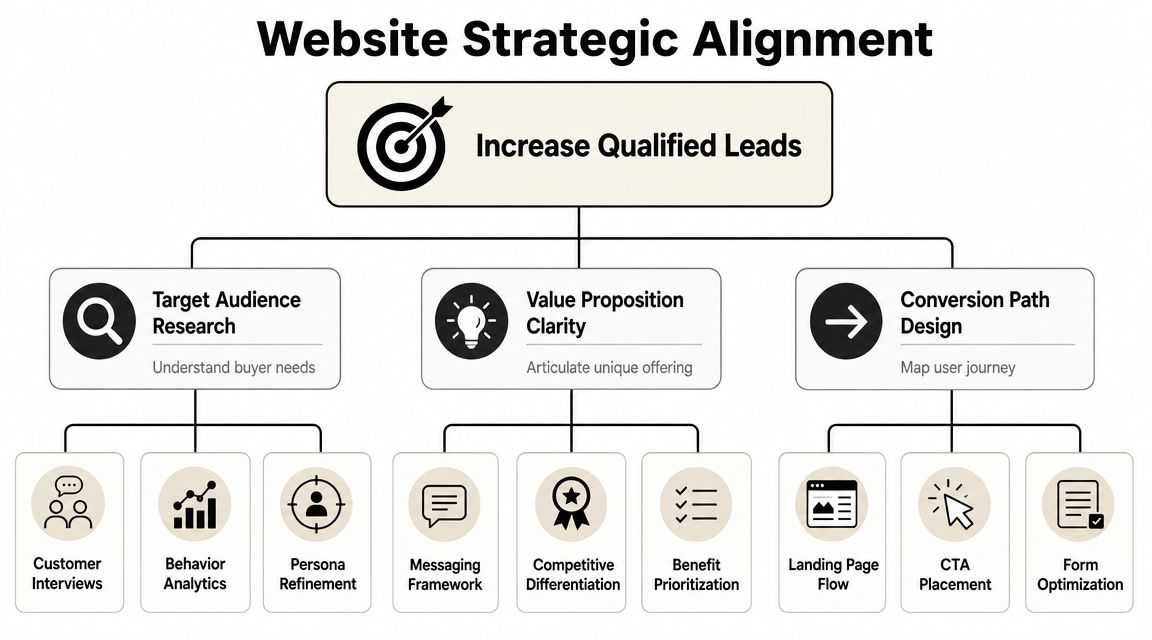
Aligning Your Website with a Single Business Goal
Most websites underperform because they try to do too many jobs at once. They want to attract investors, recruit talent, support current customers, impress peers, and generate leads. Those goals aren’t equal. If pipeline matters most, the website architecture needs to reflect that.
Research compiled in Email Vendor Selection’s lead generation statistics notes that 90.7% of marketers use their websites to generate leads and sales, 96.45% of visitors aren’t ready to buy on the first visit, and SEO-driven leads close at 14.6% compared with 1.7% for outbound leads. The takeaway isn’t that outbound matters less. It’s that the website has to support trust-building before the meeting and capture intent when it appears.
Pick one primary conversion event
Start with one main business action. Not three.
For most B2B companies, that primary action is one of these:
-
Book a meeting: Best when sales needs direct conversation to qualify fit.
-
Request a demo or assessment: Best when the offer needs context before pricing or rollout.
-
Capture a lead for nurture: Best when buying cycles are long and education matters before sales involvement.
Everything else should support that primary action, not compete with it. If your homepage asks visitors to read the blog, watch a webinar, join a newsletter, explore careers, and book a demo, you’ve built confusion into the interface.
Structure the site around visitor questions
Good information architecture doesn’t start with page names. It starts with buyer uncertainty. The site should answer two questions fast: What is this? and Is this for me?
That usually leads to a simpler structure than companies expect:
| Page type | What it must answer | Sales impact |
|---|---|---|
| Homepage | What you do and who it’s for | Reduces bounce from first-touch traffic |
| Solution pages | How the offer solves a specific problem | Improves message match for campaigns |
| Industry or audience pages | Why it’s relevant to this segment | Helps visitors self-qualify |
| Resource pages | Why they should trust your thinking | Supports buyers who aren’t ready yet |
| Conversion pages | What happens next | Increases form completion and meeting intent |
It is positioning that does the heavy lifting. If your headline is vague, no page design will save it. If your navigation hides the commercial path behind generic labels, buyers won’t hunt for relevance. Teams that struggle here usually need sharper messaging before they need a redesign. If you’re refining that layer, these value proposition statement examples for B2B SaaS are useful reference points.
Practical rule: If a first-time visitor can’t identify the problem you solve and the audience you serve within a few seconds, the site is doing brand theater, not lead generation.
Design for the second visit too
Because most visitors won’t convert immediately, the site needs depth behind the first click. That means resource hubs, comparison content, implementation pages, use-case pages, and proof elements placed where buyers hesitate.
A single polished homepage won’t carry the load. The better model is a layered system. The first page establishes relevance. The second page builds confidence. The conversion page removes friction.
That’s how strategy turns into a site that produces qualified meetings instead of anonymous traffic.
Architecting Pages That Guide and Convert
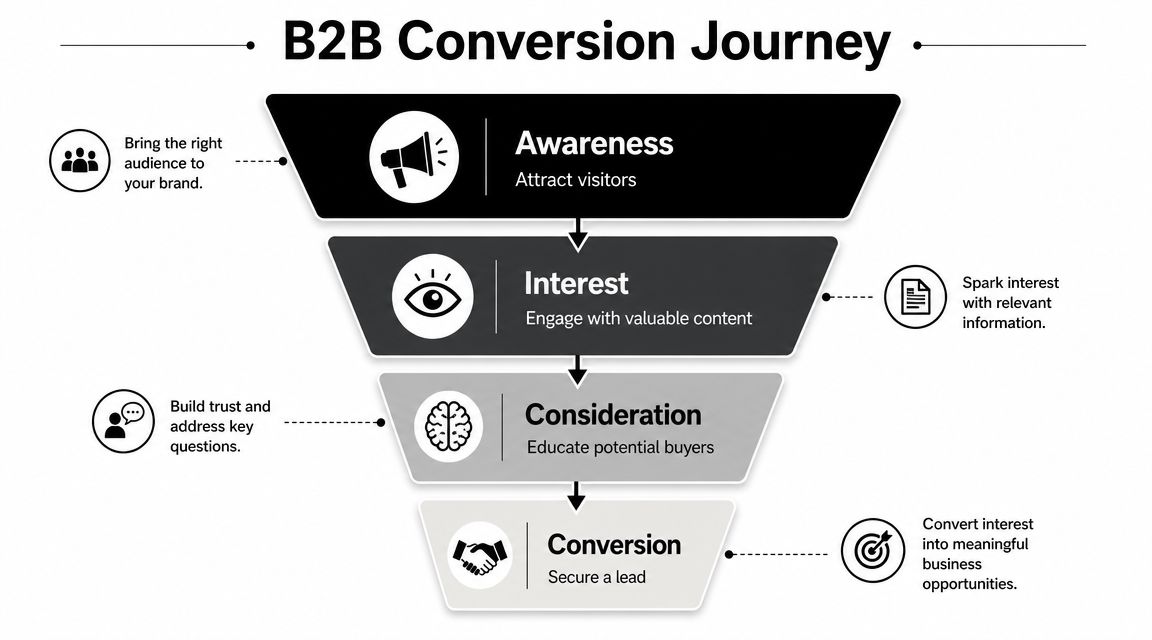
The most expensive mistake in conversion design is sending all traffic to the same place. Homepage traffic behaves differently from branded search traffic. Paid traffic behaves differently from outbound clicks. High-intent visitors should land on pages that continue the exact conversation that brought them there.
Benchmarks summarized by Snov’s lead generation statistics place average B2B website conversion rates between 2.23% and 3.6%, and report that companies with 10 or more landing pages generate 55% more leads. That isn’t just a volume insight. It’s an architecture insight. Segmented landing experiences outperform generic routing.
Match the page to the click
If someone clicks an email about pipeline visibility for RevOps leaders, don’t send them to a homepage with broad product messaging. Send them to a page that repeats the problem, expands on the outcome, and offers a next step specific to that audience.
The page should feel like a continuation, not a reset.
A strong landing page usually includes:
-
A headline with direct message match Repeat the category, pain point, or use case that triggered the click.
-
A short proof layer near the top Use logos, testimonials, process summaries, or trust signals you already have available.
-
A clear CTA with low ambiguity “Book a strategy call” tells people more than “Contact us.”
-
A secondary path for lower-intent visitors Think downloadable guides, comparison content, or webinar registration.
Here’s a useful walkthrough for page flow and funnel design:
Build forms for qualification, not punishment
A form should collect enough information to route and prioritize the lead. It shouldn’t interrogate visitors before you’ve earned the ask.
That creates a real trade-off. Sales wants detail. Conversion suffers when the form demands too much too early. The practical answer is progressive qualification. Ask for the minimum needed to respond intelligently, then gather more context through follow-up or scheduling flows.
A few principles tend to hold up:
-
Use fields that change action: If a field won’t affect routing, priority, or follow-up, question whether it belongs.
-
Make the button specific: “Get pricing guidance” or “Request a demo” usually outperforms vague copy because it clarifies value.
-
Support the form with reassurance: A short note about what happens next reduces hesitation.
-
Test friction with behavior tools: Session recordings often reveal where users stall, scroll back, or abandon.
If your team is refining this area, this guide to optimizing form UX is worth reviewing because it focuses on friction points people miss in B2B forms.
Use CTAs like route markers
A CTA isn’t just a button. It’s a routing decision. On b2b lead generation websites, there should be primary CTAs for high-intent visitors and secondary CTAs for people who need more confidence first.
A simple model looks like this:
| Visitor intent | Better CTA | Weaker CTA |
|---|---|---|
| Ready to evaluate | Book a demo | Learn more |
| Comparing options | See how it works | Submit |
| Early research | Download buyer guide | Talk to sales |
| Returning from outbound | Schedule a meeting | Contact us |
If you want a broader view of how these pieces fit together, this guide to high-converting B2B sales funnels maps the relationship between page design and downstream sales action well.
Creating Content for Buying Committees Not Just Individuals
The weak version of content strategy assumes one person arrives, reads one page, and decides. That’s not how most B2B purchases work. Multiple stakeholders inspect the vendor from different angles. One cares about implementation risk. Another cares about budget control. Another wants to know whether your team understands their vertical.
That changes what content needs to do. It can’t just attract traffic. It has to help people inside the account build internal agreement.
Guidance from Infuse on B2B lead generation highlights a common pitfall. Many sites are built like single-user funnels even though purchases are made by groups. Their recommendation points toward role-specific content and orchestrated engagement across multiple channels to support consensus.
Build a content map by stakeholder, not just keyword
Keyword research still matters. But on its own, it can produce a library of articles that rank without helping sales. A better approach is to map content to both search intent and stakeholder role.
For example:
-
Economic buyer content: Budget justification pages, pricing approach pages, implementation scope, risk-reduction FAQs.
-
Operational buyer content: Workflow explanations, onboarding expectations, process diagrams, integrations, handoff details.
-
Technical evaluator content: Product detail pages, security overviews, architecture explanations, compatibility answers.
-
Internal champion content: Comparison pages, one-page summaries, objection-handling content they can share internally.
The website functions as a sales enablement system. A rep can send a role-specific page after a call. A cold email can link to a concise industry page instead of the homepage. A paid campaign can route finance leaders and practitioners to different proof points without changing the offer.
Organize resources for real buying behavior
Most resource centers are libraries. Buyers don’t need libraries. They need quick paths to relevant evidence.
A more useful content structure often includes:
Solution clusters
Group pages around the problem your offer solves. Keep supporting content nearby so people can move from overview to depth without re-searching the site.
Audience clusters
Create pages for industries, company stages, or job functions when your messaging materially changes across them.
Decision support assets
Comparison pages, implementation FAQs, evaluation checklists, and sales decks adapted for web use help internal champions circulate your message accurately.
When a prospect forwards your page internally, that page becomes part of the deal team.
Content that supports outbound
This is the part many inbound guides miss. Sales teams need pages that work as follow-up assets. That means concise pages with tight positioning, clear proof, and one obvious next step. Not every asset needs to rank. Some pages exist to make outbound stronger.
The practical test is simple. Can an SDR or AE drop a page into an email and feel confident that it will answer the immediate question in the buyer’s mind? If not, the page may be useful for publishing but weak for pipeline.
Connecting Your Site to Outbound and Pay-Per-Meeting Models
A website reaches full value when it supports active selling. That’s especially true in outbound-heavy programs and pay-per-meeting models, where the commercial goal isn’t raw lead volume. It’s qualified conversations.
A lot of B2B teams still separate these motions. Marketing builds the site. Sales runs email. Appointment setters book meetings. The prospect experiences all of it as one brand. If the website doesn’t continue the outbound conversation, performance drops.
Callbox’s discussion of B2B lead generation challenges pinpoints a key bottleneck in many programs. Leads are often lost after conversion because of weak nurturing and slow sales response. That matters even more in pay-per-meeting environments, where the wrong handoff destroys efficiency.
Send outbound clicks to campaign pages, not general pages
Outbound traffic has context. The recipient just read a specific problem statement, use case, or offer. The destination page should continue that thread.
A good outbound landing page usually does three things well:
-
Reinforces the outreach angle: Same pain point, same audience, same category language.
-
Removes extra navigation pressure: Keep distractions low when the page has one campaign purpose.
-
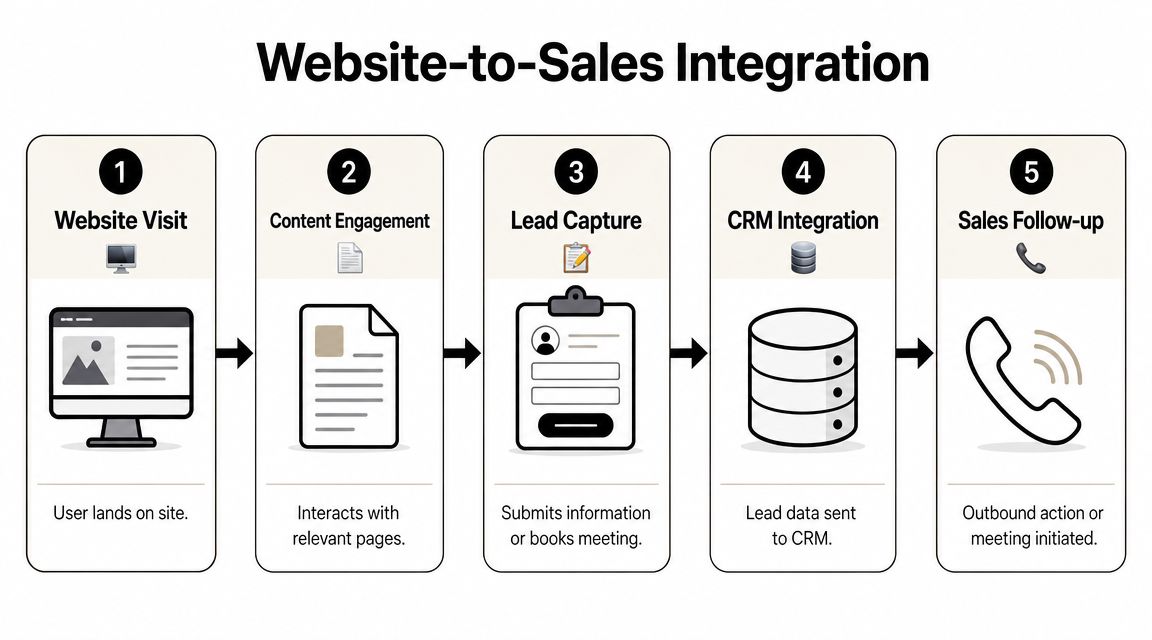
Captures source context: Hidden fields, campaign parameters, and CRM syncs give sales the backstory they need.
This is also where deliverability affects website performance. If prospects never see the message, they never reach the page. Teams troubleshooting poor response rates should first verify inbox placement. A practical reference is MailGenius on how to check if emails are going to spam, because weak deliverability can make a strong website look ineffective.
Build the handoff before traffic arrives
Most companies launch pages before they define what happens after the form fill. That’s backward. You need routing rules, ownership, enrichment logic, and response expectations before campaigns go live.
The handoff should answer:
| Question | Why it matters |
|---|---|
| Who owns follow-up by source? | Prevents delays and internal ambiguity |
| What data enters the CRM? | Gives reps context for outreach |
| Which leads book directly vs need qualification? | Protects calendar quality |
| What content supports nurture if no meeting is booked? | Keeps qualified interest warm |
This is also the right place to mention operating model choices. Some teams run outbound in-house with tools like HubSpot, Apollo, Clay, and a scheduling layer. Others use agencies that own prospecting and meeting generation. In that category, Fypion Marketing’s B2B marketing funnel approach is relevant because it aligns website behavior with cold email and booked-meeting workflows.
Personalization matters when velocity matters
You don’t need invasive complexity. But basic personalization can improve continuity. Industry-specific headlines, role-based proof blocks, and campaign-aware CTAs make the page feel intentional.
A fast outbound engine without a matching website creates distrust. A polished website without process creates lead leakage.
The best b2b lead generation websites don’t sit beside outbound. They help close it.
Measuring Pipeline Impact Not Just Website Traffic
Traffic reports can hide commercial weakness. A page can attract visits, rank for useful terms, and still contribute little to revenue. That’s why mature teams stop asking whether the website is getting attention and start asking whether it is creating qualified sales activity.
Attribution is the sticking point. A methodology discussed in this YouTube session on B2B attribution and conversion optimization notes that 85% of B2B marketers report difficulty connecting marketing performance to business outcomes. The same discussion emphasizes measuring landing page and traffic source combinations, using session recordings to find friction, and pairing that analysis with fast follow-up.
Track the chain, not isolated events
A form fill is not the finish line. Neither is a booked meeting if the meeting is weak. Pipeline measurement has to follow the lead through stages that sales respects.
That usually means tracking:
-
Traffic source to landing page combination: Which entry paths produce serious conversations.
-
Lead quality by page path: Which pages create qualified demand versus low-fit inquiries.
-
Meeting rates after conversion: Whether forms are producing calendar activity.
-
Sales acceptance: Whether the leads match the standards sales agreed to.
-
Opportunity creation: Which website paths contribute to real pipeline.
If you’re tightening your reporting model, these lead generation KPIs for 2026 provide a practical set of metrics to align around.
Read behavior with context
Session recordings, CRM notes, and source tagging become powerful when reviewed together. A high bounce rate alone doesn’t tell you much. A recording that shows visitors repeatedly hovering over pricing language, opening trust elements, and abandoning at a long form tells you where friction lives.
The same goes for campaign analysis. Looking only at page conversion rates can mislead you. One landing page may convert modestly overall but perform well for one source. Another may look strong in aggregate while attracting lower-quality leads. Source-plus-page analysis is the useful unit.
A practical review cadence often looks like this:
-
Identify strongest source and page pairings
-
Watch recordings from those sessions and failed sessions
-
Review sales outcomes tied to those conversions
-
Adjust messaging, form flow, or routing
-
Re-test with the same source context
Separate vanity wins from pipeline wins
This distinction clears up a lot of debate inside B2B teams.
| Vanity metric | Better pipeline metric |
|---|---|
| Pageviews | Qualified leads by page |
| Time on page | Progression to booked meeting |
| Click-through rate | Sales-accepted lead rate |
| Total form fills | Opportunity creation from web leads |
| Traffic growth | Conversion by source and segment |
Some optimizations increase surface-level engagement but don’t improve sales outcomes. Others may reduce total lead volume while improving meeting quality. The second outcome is often better, especially for high-consideration offers.
The website should be judged like any other revenue asset. Did it help create qualified conversations? Did those conversations move? Did the underlying data tell you what to improve next?
If your team wants a website that supports outbound, captures qualified intent, and ties performance to booked meetings, Fypion Marketing works with B2B companies on performance-driven lead generation built around qualified meeting outcomes.