
B2B Lead Generation Funnel A Practical Guide (2026)
Some months your pipeline looks healthy on paper. Marketing is handing over names, SDRs are sending follow-ups, sales calls are happening. Then the quarter slips, forecast confidence drops, and everyone realizes the same thing: you have activity, not a system.
That’s the situation most SaaS and tech teams are in when they start taking the b2b lead generation funnel seriously. The problem usually isn’t a total lack of leads. It’s that the wrong accounts enter the funnel, strong accounts get weak follow-up, and handoffs are loose enough that intent gets lost before a meeting ever happens.
A good funnel fixes that. It turns lead generation from a collection of campaigns into an operating model. You know which channels create discovery, which messages earn replies, which signals indicate real buying intent, and which actions sales must take immediately. That’s what makes pipeline more predictable.
Your Blueprint for Predictable B2B Growth
Broken funnels are easy to spot. Sales says leads aren’t qualified. Marketing says volume is fine. RevOps builds dashboards that show motion but not momentum. The result is wasted list spend, weak conversion, and a team that keeps changing tactics before any one system has a chance to work.
The fix isn’t “more marketing.” It’s a tighter b2b lead generation funnel built around fit, timing, and measurable progression. In practice, that means each stage needs a job. Top of funnel creates awareness. Middle of funnel qualifies and nurtures. Bottom of funnel converts intent into booked meetings and real pipeline.
What predictable growth actually looks like
Predictable growth starts when you stop treating all lead sources as equal. Some channels create broad awareness. Others create direct conversations. Some are useful for demand capture. Others are better for demand creation. Teams that understand those trade-offs build far better systems than teams that chase volume.
If you’re pressure-testing channel mix, this breakdown of methods of lead generation is useful because it shows the range of approaches available beyond the usual SEO-versus-paid debate.
A working funnel also needs clear ownership:
-
Marketing owns input quality: traffic, targeting, offer clarity, and message-market fit.
-
Sales owns speed and conversion: response time, discovery quality, and meeting progression.
-
Ops owns integrity: routing, reporting, attribution, and lifecycle definitions.
Practical rule: If no one owns the transition between stages, the funnel will leak at that transition.
The companies that get this right don’t just “generate leads.” They build a system that repeatedly creates qualified conversations. If you want a practical model for that, this lead generation blueprint for a predictable B2B pipeline is a strong reference point.
What Is a B2B Lead Generation Funnel
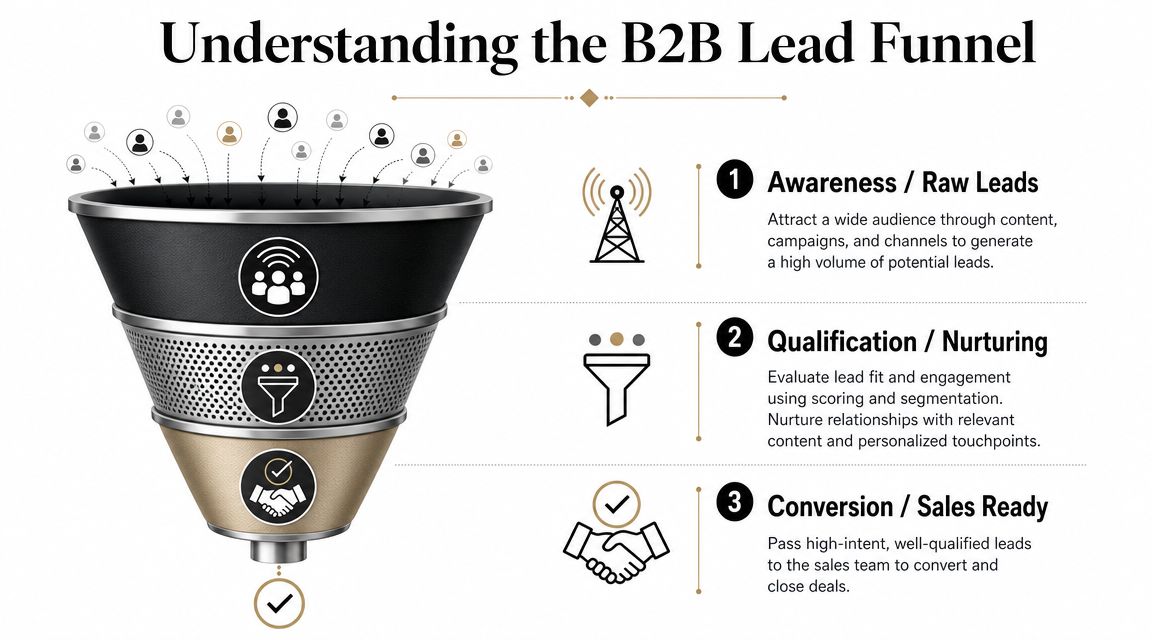
A b2b lead generation funnel is a qualification system. It takes a large pool of possible buyers and filters them into a smaller set of accounts that are ready for a sales conversation, much like a multi-stage water filtration setup. The first layer catches broad interest. The middle layers remove poor fit and weak intent. The last layer passes only the accounts worth sales time.
That distinction matters because too many teams treat the funnel as a contact collection machine. It isn’t. Its real purpose is to align outreach, content, qualification, and follow-up around how business buyers move.
A simple visual helps anchor that idea.
Why the top of funnel still matters
Most B2B buyers are still captured at the top of the funnel. One funnel benchmark shows measured ROI and break-even timelines across early-stage channels, including SEO at 748% ROI with a 9-month break-even and public speaking at 856% ROI with a 6-month break-even according to First Page Sage’s B2B lead generation funnel analysis.
That doesn’t mean every company should pour budget into content or events first. It means awareness input still shapes downstream output. If the top of funnel is weak, the rest of the system runs dry. If it’s full of poor-fit traffic, sales wastes time on noise.
Modern funnels move accounts, not just contacts
The old model tracked individual leads in isolation. That misses how B2B buying happens. In most deals, multiple people touch your website, open emails, view case studies, and evaluate vendors. If you only look at one contact record, you miss the account-level signal.
That’s why it helps to define a lead properly before you build lifecycle stages. This explanation of what a lead in business actually means is useful for teams whose marketing and sales definitions still don’t match.
A modern funnel is also less linear than most diagrams suggest. Prospects jump between channels. They see a cold email, visit your site later, compare you with competitors, then reply after a remarketing touch or LinkedIn view. The funnel still matters, but you need to manage it as a guided system, not a rigid straight line.
For a quick walkthrough of the concept in action, this video gives a helpful overview.
The 6 Essential Stages of the Modern B2B Funnel
Most funnels fail because teams skip straight from awareness to “book a demo.” Buyers usually aren’t ready for that. They move through a sequence of questions, and each stage changes what they need from you.

Awareness
At this stage, the account either doesn’t know you or barely recognizes the category. The buyer’s internal question is simple: What is this, and is it relevant to a problem I care about?
For SaaS and tech companies, awareness often comes from content, paid search, founder-led thought leadership, events, LinkedIn distribution, or outbound introductions. Cold email belongs here too when it’s used to create first-touch discovery instead of pushing for an immediate hard sell.
Your job is to make the problem and the audience fit obvious.
Interest
Interest starts when the prospect engages beyond the first touch. They read the page, reply to an email, click into a case study, or visit your site more than once. Now their question changes: Is this worth more of my attention?
During this phase, weak messaging shows up fast. Generic value propositions lose people here. Strong messaging names the pain clearly, shows who the offer is for, and gives the buyer a reason to continue.
Common signals in this stage include:
-
Repeat engagement: multiple visits, multiple opens, or several touchpoints from the same company
-
Content depth: time spent on solution pages, use case pages, or comparison content
-
Early response: a reply that asks a real question instead of a polite brush-off
Consideration
Consideration is the comparison phase. Buyers now ask: How does this stack up against the alternatives, including doing nothing?
This is the stage where many outbound programs stall. The first email got interest, but there’s no structured follow-up that helps the buyer evaluate. Teams send another pitch instead of answering likely objections.
What works better is layered proof:
-
Use cases by segment: industry, company size, team function
-
Specific outcomes: framed qualitatively if you can’t support a numeric claim
-
Operational clarity: what implementation, onboarding, or workflow looks like
Buyers don’t move forward because your offer sounds interesting. They move because the next step feels low-risk and relevant.
If your team needs a sharper view of how these stages connect to conversion paths, this guide to high-converting B2B sales funnels is worth reviewing.
Intent
Intent is where the account starts behaving like an active buyer. They may revisit pricing, engage with a booking page, respond with timing questions, or bring another stakeholder into the conversation. The question here is: Is this the right choice for us now?
Many teams under-react at this stage. A prospect shows intent, but the handoff is delayed, or sales doesn’t have enough context to continue the conversation properly.
Intent should trigger action. Not another passive nurture step.
Purchase or meeting
In many B2B motion types, the immediate conversion event isn’t the purchase itself. It’s the qualified meeting. That’s the moment the account moves from marketing-qualified interest into direct sales evaluation.
This is why I prefer performance models tied to meetings instead of raw leads. A lead record doesn’t prove much. A booked conversation with the right account, right persona, and right problem does.
Retention
Most funnel diagrams stop too early. Retention belongs here because the quality of your lead generation affects downstream expansion, referrals, and pipeline efficiency later.
A poor-fit customer often started as a poor-fit lead. A strong customer usually showed fit signals long before the deal closed. Funnel design isn’t only about acquisition. It shapes customer quality from the first touch.
KPIs for Measuring Funnel Performance
Many teams say they track funnel performance, but what they really track is top-line lead volume. That’s not enough. If 79% of marketing leads never convert into sales and the average MQL-to-SQL conversion rate is only 16%, as reported in ZoomInfo’s B2B lead generation statistics, stage-by-stage measurement stops being optional.
What to track instead of vanity metrics
A healthy funnel measures progression, not just accumulation. That means each stage should have one primary KPI tied to movement and one tactical indicator tied to execution.
| Funnel Stage | Primary KPI | Example Tactic |
|---|---|---|
| Awareness | Qualified traffic or target-account reach | SEO pages, paid search, outbound list segmentation |
| Interest | Engagement from fit accounts | Lead magnets, educational emails, landing page relevance |
| Consideration | Sales-meaningful engagement | Comparison pages, nurture sequences, objection-handling content |
| Intent | Meeting request or hand-raise quality | Demo pages, reply qualification, routing rules |
| Purchase or Meeting | Booked qualified meetings | Calendar workflows, SDR follow-up, sales discovery |
| Retention | Expansion or customer quality feedback | Closed-loop reporting between sales and customer success |
How I evaluate KPI quality
A KPI is useful only if a team can act on it. “Website sessions” is broad. “Qualified traffic from ICP accounts” is more useful. “Email volume sent” is operational. “Positive replies from target accounts” is directional.
Use this filter:
-
Can the metric identify a bottleneck?
-
Can one team own improving it?
-
Does it connect to pipeline quality, not just activity?
If the answer is no, it belongs in a dashboard somewhere, but not in the operating scorecard.
Stage metrics should expose handoff failure
The biggest misses usually happen between lifecycle labels. Marketing calls something an MQL. Sales ignores it. The contact sits untouched. Weeks later the same account books through another path, and attribution gets messy.
That’s why progression KPIs matter more than static counts. If interest is high but intent is low, your nurture is weak. If intent is high but meetings are low, your handoff is broken. If meetings happen but deals are poor-fit, your qualification criteria are off.
For teams building a tighter reporting model, this lead generation KPI guide for 2026 is a practical complement.
Operator’s view: The best funnel dashboards don’t try to impress leadership. They tell the team exactly where prospects are slipping away.
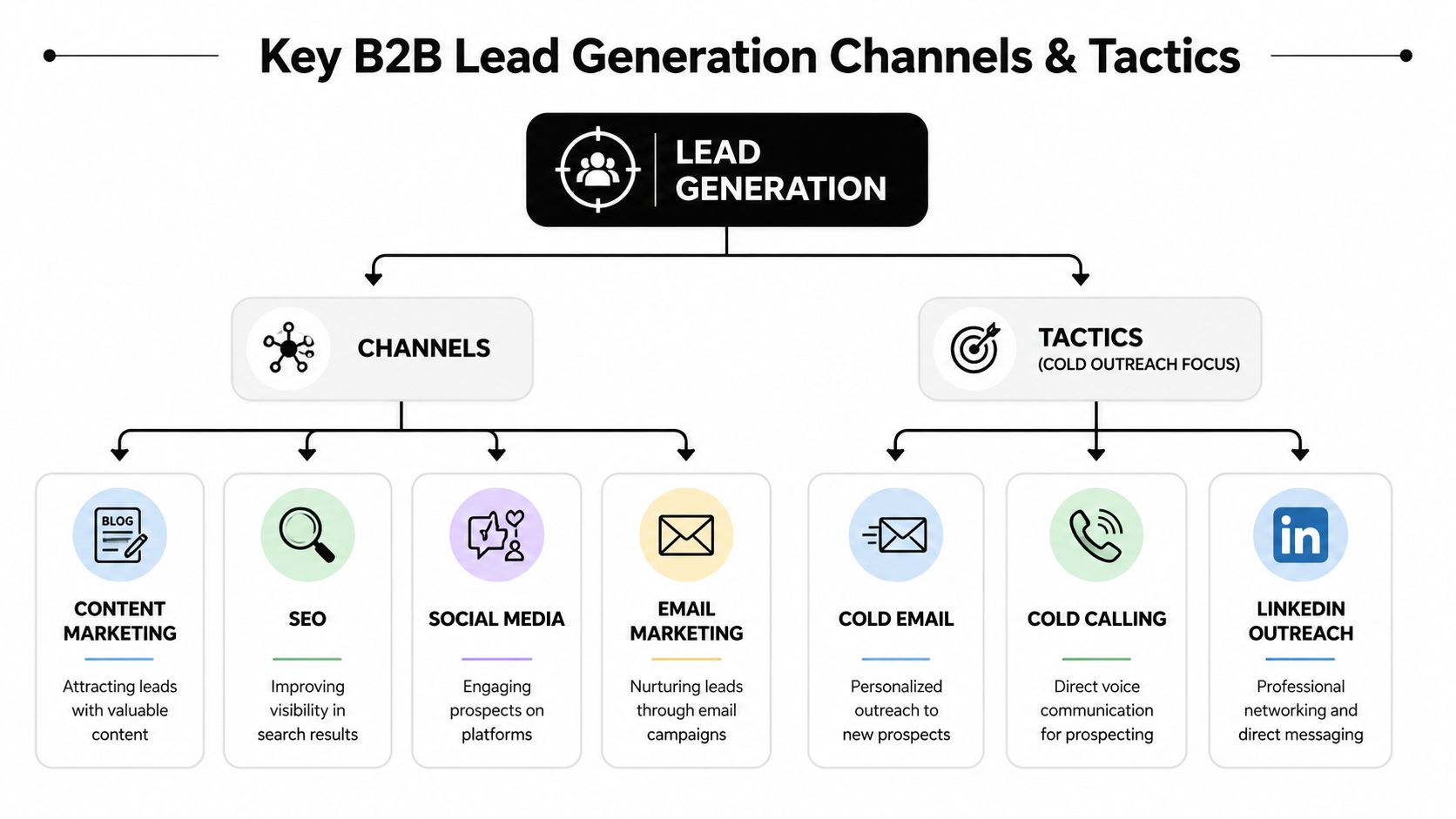
Channels and Tactics with a Focus on Cold Outreach
Single-channel funnels are fragile. If all your demand depends on SEO, a ranking shift hurts pipeline. If all of it depends on paid acquisition, efficiency can swing fast. Strong funnels combine inbound and outbound so one channel captures existing demand while another creates conversations that wouldn’t happen on their own.
That’s why I rarely recommend content-only or outbound-only thinking. For B2B SaaS, the better question is which channel should lead the motion right now.
Where cold outreach fits
Cold email works best when you already know your ICP, your offer solves a real business problem, and your team needs a controllable way to create pipeline. It’s especially strong when search demand is limited, paid acquisition is expensive, or your market is narrow enough that precision matters more than reach.
What doesn’t work is treating cold email like a volume game. Massive sends to loose lists don’t build pipeline. They create inbox problems and low-signal data.
A better outbound motion has four parts:
-
Tight list construction: company fit, buyer role, and practical trigger relevance
-
Message-to-market alignment: one pain point, one angle, one clear next step
-
Sequencing discipline: enough follow-up to earn attention without sounding automated
-
Fast qualification: once someone replies, a human has to take over quickly
The copy rules that actually matter
The strongest cold emails are usually plain. They don’t try to sound clever. They don’t summarize your whole product. They don’t stack claims. They identify a likely problem and make the reply easy.
A practical sequence usually needs:
-
A first email with a narrow angle tied to the role or account context.
-
A follow-up that adds relevance instead of repeating the first message.
-
A third touch that lowers friction by offering a simpler next step.
-
A final closeout that gives the prospect an easy way to opt in later.
If you’re exploring workflow support or automation ideas around outbound execution, Robotomail’s AI sales solutions are one example of how teams are trying to structure and scale sales outreach processes.
Why data quality changes everything
Good outreach starts before the first send. The Insight Collective notes that good-quality data is essential for B2B lead generation, and DemandZen adds that predictive lead scoring can improve conversion rates by up to 30% according to The Insight Collective’s lead generation overview.
That matters because outbound teams often waste their best copy on poor-fit accounts. Better data and scoring let you prioritize the segments most likely to convert, then tailor offers and timing around those signals.
One operating model that fits this well is pay-per-meeting. Instead of paying for activity, you pay for qualified conversations that meet agreed criteria. Providers in this category include agencies built around outbound execution, such as Fypion’s SDR-led outbound cold email demand generation approach. The appeal is straightforward. Commercial incentives stay tied to meetings, not vanity output.
The Tech Stack for Tracking and Automation
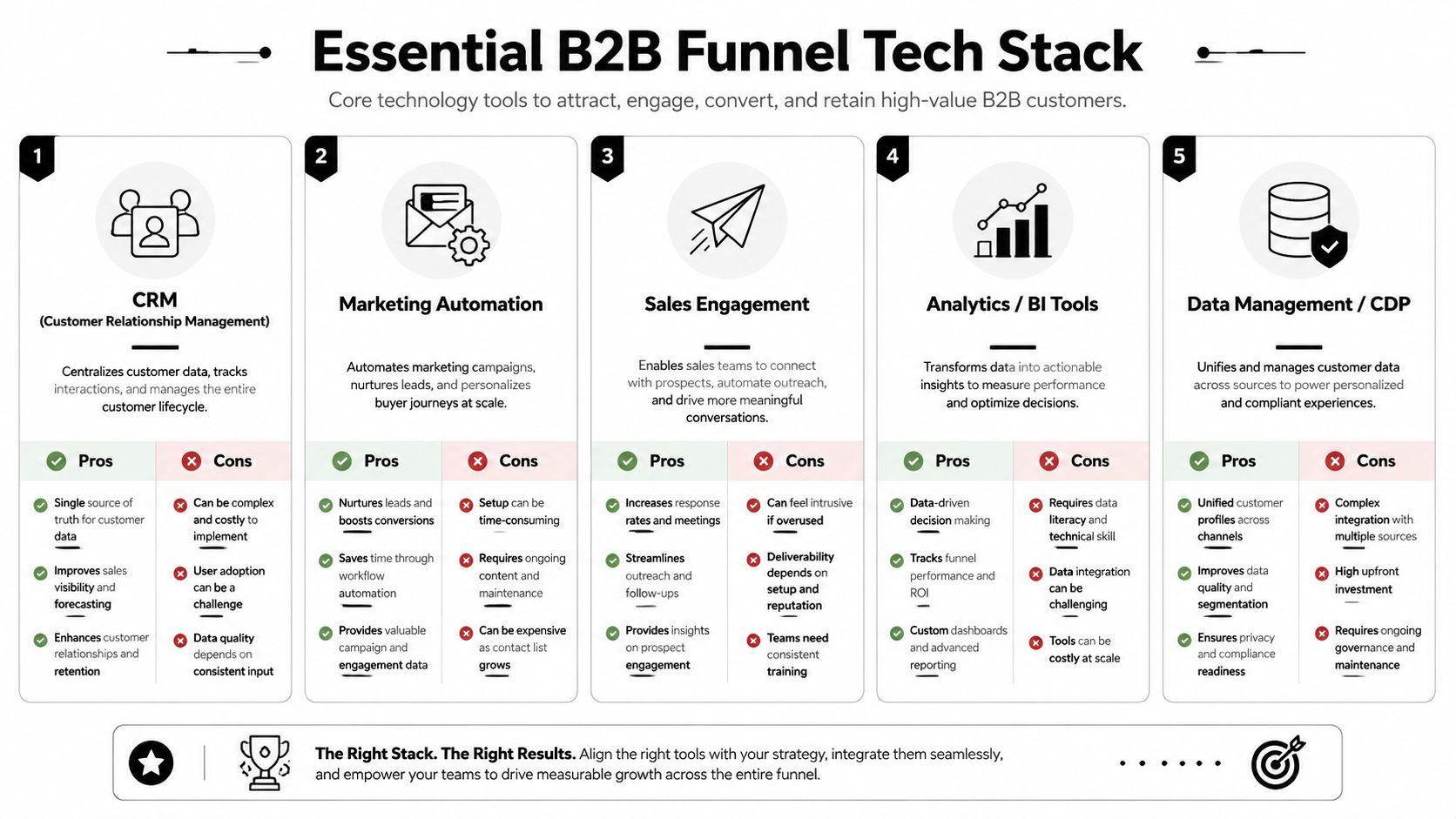
A modern b2b lead generation funnel runs on coordination between systems, not on one platform doing everything. At minimum, you need a CRM as the source of truth, a marketing automation layer for nurture and lifecycle movement, a sales engagement tool for outbound execution, and analytics that can show what’s happening at the account level.
What each layer should do
A simple stack often looks like this:
| Tool layer | What it handles |
|---|---|
| CRM | lifecycle stages, ownership, pipeline history, meeting outcomes |
| Marketing automation | nurture logic, form capture, routing triggers |
| Sales engagement | cold email sequencing, task management, follow-up execution |
| Enrichment and prospecting | contact data, company data, segmentation inputs |
| Analytics or BI | account-level reporting, conversion analysis, channel comparisons |
The issue isn’t just tool count. It’s whether the handoffs between tools preserve signal. If website visits, demo requests, outbound replies, and meeting outcomes live in separate silos, your funnel reporting will stay partial.
Account-level reporting and speed-to-lead
Directive recommends tracking intent at the account level, not just the contact level, and reports that response times under five minutes are associated with higher meeting conversion rates in its B2B demand generation funnel guide.
That changes how you design routing. One person visiting pricing doesn’t always matter. Three stakeholders from the same company engaging across a week usually does. Your stack should consolidate that activity into a real buying signal and push it to sales immediately.
If your system can detect intent but can’t route it fast, the stack is organized but not operational.
Data collection matters upstream too. For teams building target account lists or enrichment workflows, tools that scrape LinkedIn profiles can support research and segmentation when used carefully inside a compliant process.
Common Funnel Pitfalls and How to Avoid Them
A lot of B2B teams assume the answer is more leads. Often it isn’t. A common mistake is relying on a single acquisition channel, which limits reach and creates fragility, while the actual bottleneck for many tech firms is poor ICP alignment and fragmented handoffs between marketing and sales according to Callbox’s overview of B2B lead generation challenges.
The mistakes I see most often
-
Chasing volume over fit: teams celebrate lead counts while sales ignores half the list.
-
Loose qualification rules: anyone who downloads something becomes “sales-ready.”
-
Weak handoffs: marketing passes a name. Sales gets no context.
-
Channel dependency: one source drives most pipeline, so any disruption hits hard.
-
Slow follow-up: intent exists, but no one acts while it’s fresh.
What to do instead
Use tighter ICP filters even if lead volume drops. Build qualification around account fit and buying signals, not around a single form fill. Make sales acceptance criteria explicit. If a meeting isn’t qualified, define why in terms both teams can work with.
Then diversify your acquisition mix. Keep one channel for broad discovery and another for direct demand creation. In many SaaS motions, that means pairing inbound education with outbound cold email so pipeline doesn’t depend on a single system.
The last fix is operational. Every serious hand-raise needs clear routing, ownership, and timing. Funnels don’t usually fail because the strategy is mysterious. They fail because the transitions are sloppy.
If your team wants a cleaner path from target account selection to qualified meetings, Fypion Marketing offers a performance-based B2B lead generation model centered on cold email outreach, where payment is tied to booked meetings that match pre-agreed criteria. For SaaS and tech companies that need pipeline without building the whole outbound engine in-house, that structure can be a practical way to add predictable meeting flow while keeping incentives aligned.