
Align Sales and Marketing: Align Sales & Marketing: Master

Companies that get sales and marketing right don’t just collaborate better. They grow faster. According to SalesGenie’s alignment benchmark, companies with highly aligned sales and marketing teams achieve 19% faster revenue growth and 15% greater profitability than less aligned peers.
That should reframe the whole discussion. This isn’t about making two departments get along. It’s about stopping preventable revenue loss.
The problem gets sharper in B2B companies that rely on outbound, cold email, SDR teams, or pay-per-meeting partners. In those setups, misalignment isn’t abstract. It shows up as bad targeting, weak qualification, confused handoffs, rejected meetings, inconsistent follow-up, and pipeline reports no one trusts.
Why Sales and Marketing Misalignment Is Costing You Revenue
Teams typically don’t notice misalignment in strategy docs. They notice it in the weekly pipeline call.
Sales says the leads aren’t qualified. Marketing says the leads weren’t followed up fast enough. Leadership sees activity, spend, and meetings booked, but not enough clean pipeline moving toward closed revenue. That’s the operating cost of a disconnected go-to-market motion.
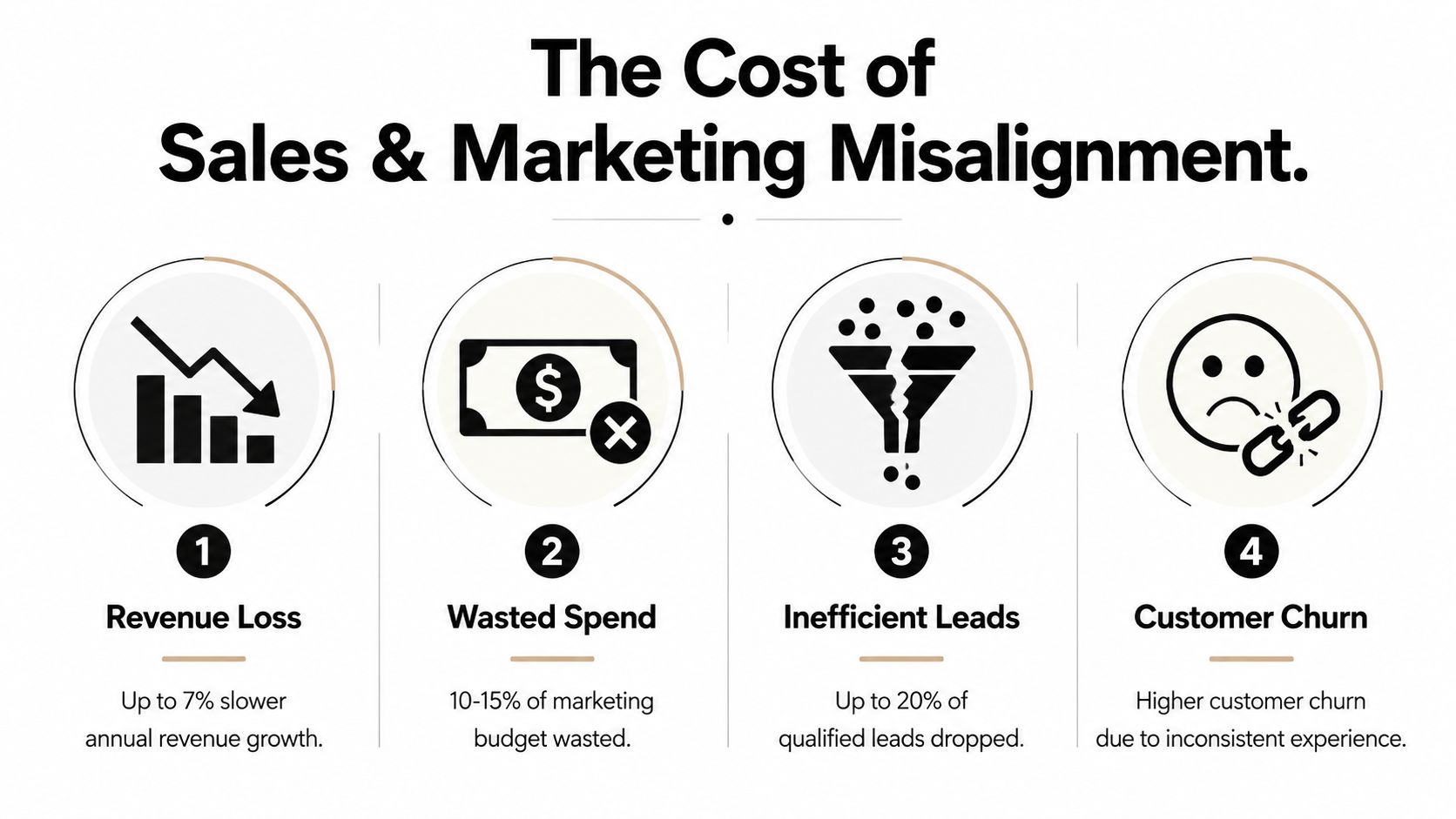
What misalignment looks like in practice
In real RevOps work, the pattern is usually the same:
-
Marketing optimizes for volume: More form fills, more contacts, more booked calls.
-
Sales optimizes for short-term acceptability: Reps work only what looks immediately closeable.
-
No one owns the gap: Targeting, qualification, context, and follow-up standards sit between teams.
That gap gets worse when an outside agency is involved. An outbound partner can generate meetings, but if the ICP is loose or the meeting standard is vague, sales starts rejecting what marketing or the agency sends over. Then marketing responds by tightening volume goals or changing messaging without hearing real call outcomes.
Practical rule: If sales and marketing can’t agree on what a good lead is, they aren’t aligned. They’re just sharing a CRM.
This is also why teams need more than content and campaigns. They need process discipline and seller readiness. If you’re working on empowering sales teams with enablement, the handoff between message, content, and rep execution has to be designed, not assumed.
The cost shows up before close
Misalignment usually starts with a basic definition problem. One team counts a lead when a contact matches a list. The other counts it only when a buyer shows intent and fit. If you haven’t standardized what counts as a lead, your funnel math is already compromised. This guide on what a lead means in business terms is a useful reminder that lead definitions aren’t semantics. They shape every downstream KPI.
A company can have decent traffic, active outreach, and a full calendar, yet still run an inefficient pipeline. That’s why the growth and profitability gap matters so much. Alignment affects speed, margin, and whether your revenue engine compounds or leaks.
Build Your Foundation on Shared Goals and KPIs
Most alignment projects fail because teams try to improve communication before they redefine success.
If marketing is measured on MQL volume and sales is measured on quota, they can work hard and still work against each other. The fix is to align sales and marketing around shared revenue-stage metrics instead of siloed departmental outputs.

Use revenue-stage metrics instead of vanity metrics
A practical methodology from Monday.com’s sales and marketing alignment framework is to replace siloed KPIs with conversion rate, sales-cycle length, and pipeline velocity. Those metrics reveal whether the full system is working, not whether one team hit an isolated target.
A few examples:
-
Lead-to-opportunity conversion rate: Tells you whether targeting and qualification are producing real buying conversations.
-
Sales-cycle length: Shows whether the handoff and messaging are helping reps move deals efficiently.
-
Pipeline velocity: Exposes whether opportunities are progressing or stalling across stages.
These are stronger than top-of-funnel counts because they punish bad inputs. A bloated lead number can still look good on a dashboard. A weak conversion rate cannot.
Set one commercial target and work backward
The cleanest way to align sales and marketing is to start with the revenue number leadership cares about, then reverse-engineer the contribution required from each stage.
For example, both teams should be able to answer these questions in one meeting:
-
What pipeline target supports the revenue plan
-
What opportunity volume is required
-
What conversion standard makes that realistic
-
Which channels produce those opportunities
-
Who owns each stage transition
That creates accountability without forcing both teams to do the same work. Marketing can still own demand creation and audience building. Sales can still own discovery, qualification depth, and close execution. But both are tied to one commercial model.
Teams get into trouble when marketing reports “success” at the top of the funnel while sales reports failure at the bottom.
The KPI set that usually works
The best dashboards are boring. They don’t try to measure everything. They keep both teams focused on the few numbers that reflect shared performance.
A practical set often includes:
| Shared KPI | Why it matters | Primary users |
|---|---|---|
| Pipeline velocity | Shows whether deals are moving through the funnel efficiently | Sales, marketing, RevOps |
| Lead-to-close conversion rate | Measures quality of targeting and qualification | Sales, marketing |
| Sales-cycle length | Reveals friction in handoff, messaging, and follow-up | Sales, RevOps |
| Opportunity acceptance rate | Flags whether sales trusts what’s being handed over | Sales, marketing |
| Stage-by-stage conversion | Identifies exactly where leakage happens | RevOps, leadership |
If your team still spends most of its time arguing about MQLs, it’s worth revisiting a more practical KPI structure like this guide on mastering lead gen KPIs for business growth.
Define the Rules of Engagement with an SLA
Once goals are shared, you need rules. Not informal expectations. Written rules.
That’s what a service level agreement, or SLA, should do for sales and marketing. It defines what marketing hands over, what sales must do next, how fast follow-up happens, and what counts as accepted or rejected. Without that agreement, alignment stays political. Everyone can claim they did their part.
Why the SLA matters
Clear handoff and qualification rules improve outcomes. According to INFUSE’s alignment best practices, aligned sales and marketing organizations can achieve up to 38% higher sales win rates, tied to having clear lead qualification and handoff protocols defined in an SLA.
That tracks with what happens operationally. Reps perform better when they know why a lead was created, what the buyer context is, and whether the lead meets agreed standards. Marketing performs better when it knows exactly why sales accepted, worked, stalled, or rejected a handoff.
What your SLA should define
A real SLA needs more than “marketing sends qualified leads” and “sales follows up fast.” It should spell out:
-
Lead definitions: What counts as MQL, SQL, opportunity, and disqualified
-
Qualification criteria: The fit and intent signals required before handoff
-
Routing rules: Which rep, segment, region, or queue receives the lead
-
Follow-up expectations: Channel, time window, and attempt standards
-
Disposition reasons: Approved rejection categories so feedback is usable
-
Recycling logic: When a lead returns to nurture, outbound rework, or no-contact status
For internal teams, qualification might use BANT or MEDDIC as a reference point. For outsourced outbound or pay-per-meeting models, the SLA shifts slightly. The central object is no longer just a lead. It becomes a qualified booked meeting.
That means you need explicit acceptance rules such as:
-
buyer role or seniority
-
company fit
-
use case relevance
-
geography or market coverage
-
no existing active opportunity conflict
-
confirmation that the prospect agreed to the meeting purpose
Sample Sales & Marketing SLA Template
| Component | Marketing’s Commitment | Sales’ Commitment |
|---|---|---|
| ICP definition | Build campaigns and lists only against the agreed ICP | Review ICP quality and flag mismatch patterns |
| Qualification standard | Pass only leads or meetings that meet documented criteria | Accept or reject using approved disposition reasons |
| Handoff data | Include source, message used, account context, and key notes | Review full context before outreach or meeting |
| Follow-up timing | Trigger assignment immediately after qualification | Follow up within the agreed response window |
| Feedback loop | Review rejection trends and update targeting or messaging | Log outcome reasons consistently in CRM |
| Recycling process | Re-nurture or rework leads that don’t convert yet | Return stalled but relevant leads with clear notes |
A weak SLA creates arguments. A strong SLA creates evidence.
If your team still blurs the line between inquiry, lead, and qualified pipeline, tighten definitions first. This guide to what makes a sales qualified lead is a useful starting point before you lock the SLA.
For companies using an agency model, this document should also govern rejection rights. Sales shouldn’t be able to reject meetings based on rep preference alone. They should reject only against pre-agreed criteria. Otherwise, alignment collapses into opinion.
Create Joint Processes That Actually Work
Most alignment problems don’t come from bad intent. They come from missing operating detail.
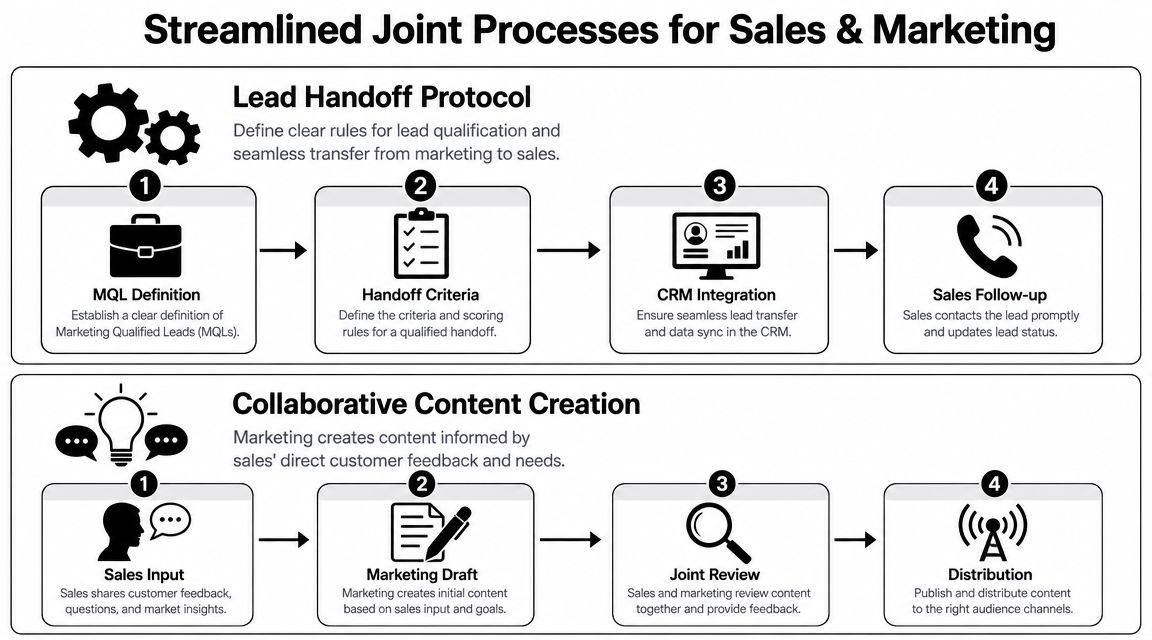
A lead gets generated. Someone marks it qualified. It lands in the CRM. Then the rep opens the record and sees almost nothing useful. No campaign context. No outreach angle. No account notes. No signal about why now. That’s where pipeline quality drops.
One benchmark captures how widespread this is. Outfunnel reports that 89% of companies have not successfully aligned their marketing and sales audiences or created an effective handoff process.
Build the handoff as a workflow, not a notification
The handoff should be treated like a process map with required fields, ownership, and next actions.
A simple flow looks like this:
-
Campaign or outbound touch creates response
-
Marketing or agency applies qualification standard
-
CRM record is enriched with mandatory context
-
Lead or meeting is routed to the right owner
-
Sales acts using a documented follow-up sequence
-
Outcome is logged in structured fields
-
Marketing reviews acceptance and conversion patterns
For outsourced cold email, the handoff must include more than contact details. Sales needs to know:
-
Which message angle got the reply
-
What the prospect agreed to discuss
-
Any exclusions or objections already surfaced
-
Whether the meeting fits the SLA acceptance rules
-
Whether the account is already in an active sales motion
That’s why generic booking notifications are useless. A booked meeting is only valuable if the rep can continue the conversation without making the buyer repeat themselves.
A short explainer can help teams align on the pipeline mechanics behind this process:
Make feedback structured and unemotional
The best feedback loops remove blame. Reps shouldn’t send Slack messages saying “these leads are bad.” Marketing shouldn’t respond by defending campaign volume.
Use structured feedback categories inside the CRM:
| Feedback field | Example values |
|---|---|
| Acceptance status | Accepted, rejected, recycled |
| Rejection reason | Wrong persona, poor timing, no active need, out of ICP |
| Meeting quality | Strong fit, partial fit, low fit |
| Message match | Accurate expectation, overstated, unclear |
| Next action | Continue, nurture, disqualify, rework targeting |
When sales says a lead is bad, ask which field proves it.
That keeps the conversation operational. It also lets marketing, RevOps, and agency partners improve targeting and messaging from evidence rather than anecdotes.
If you need a cleaner framework for managing these transitions, this guide to sales pipeline management best practices is worth using as a process checklist.
Joint process also applies to content
Alignment isn’t only about leads. It also applies to the content sales uses.
A practical workflow is simple. Sales shares call objections, repeated buyer questions, and deal blockers. Marketing turns those into sequences, one-pagers, objection handling assets, and meeting prep materials. Sales then reviews drafts before distribution. That loop keeps messaging grounded in live conversations instead of assumptions.
The Tech Stack for a Single Source of Truth
Alignment breaks when different teams trust different systems.
Marketing trusts the automation platform. Sales trusts the CRM. The agency trusts its outreach platform. Leadership trusts a dashboard exported into slides. Once that happens, every pipeline review turns into a data dispute.
Put the CRM at the center
The CRM has to be the system of record for account status, ownership, lead disposition, opportunity stage, and meeting outcomes. Everything else can feed into it, but nothing should override it informally.
That means your stack should support:
-
Bidirectional data flow: Marketing engagement and outbound activity should land in the CRM with usable context
-
Standard fields: Source, campaign, qualification reason, disposition, and meeting outcome need consistent values
-
Unified dashboards: Sales, marketing, and leadership should read the same funnel view
-
Auditability: You should be able to trace why a record was created, routed, accepted, or rejected
This matters even more with outsourced outbound. If an agency books meetings but the meeting source, status, and outcome aren’t visible in your CRM, you can’t tell whether the model is creating real pipeline or just calendar activity.
One option in this category is Fypion Marketing, which operates as a pay-per-meeting B2B cold email partner and works against pre-agreed qualification criteria. In that model, the CRM and SLA need to stay tightly connected so accepted meetings, rejection reasons, and downstream opportunity outcomes are visible to both sides.
AI creates a new governance problem
There’s a newer issue many teams still ignore. As teams use AI in prospecting, enrichment, sequencing, and lead scoring, they also need rules for who owns message quality and qualification logic.
Allego’s guide on sales and marketing alignment makes that gap clear. As teams adopt AI for prospecting and outreach, a new alignment challenge emerges: governance. Most guides don’t address who owns message quality and qualification when AI is involved.
That shows up in cold email first. AI can generate variants fast, but if no one reviews how offers are framed, qualification thresholds drift. One campaign starts targeting loosely related personas. Another starts making claims sales would never use on a call. Deliverability, trust, and conversion all suffer.
A practical governance model usually includes:
-
Marketing owns message standards
-
Sales validates real-world relevance
-
RevOps owns workflow rules and field integrity
-
Agency partners follow the same approval system
-
No AI-generated copy goes live without human review
AI can speed up outbound. It can also scale bad assumptions faster than your team can catch them.
If you’re evaluating tooling around data enrichment, sequencing, and outbound execution, it helps to study real stack decisions such as this Salesforge customer success story. It’s a useful example of how teams think about data quality inside a broader outbound system. For a wider tooling review, this comparison of Apollo alternatives for modern outbound teams can help frame what belongs in your stack versus what should stay in process design.
Common Pitfalls and How to Measure Long-Term Growth
Alignment usually doesn’t fail in a dramatic way. It decays.
Teams launch with shared enthusiasm, clean up definitions, run a few good meetings, then slowly slide back into habits. Marketing starts chasing easy volume. Sales starts working around the process. Dashboards drift. Messaging forks. The weekly sync gets canceled often enough that it stops mattering.
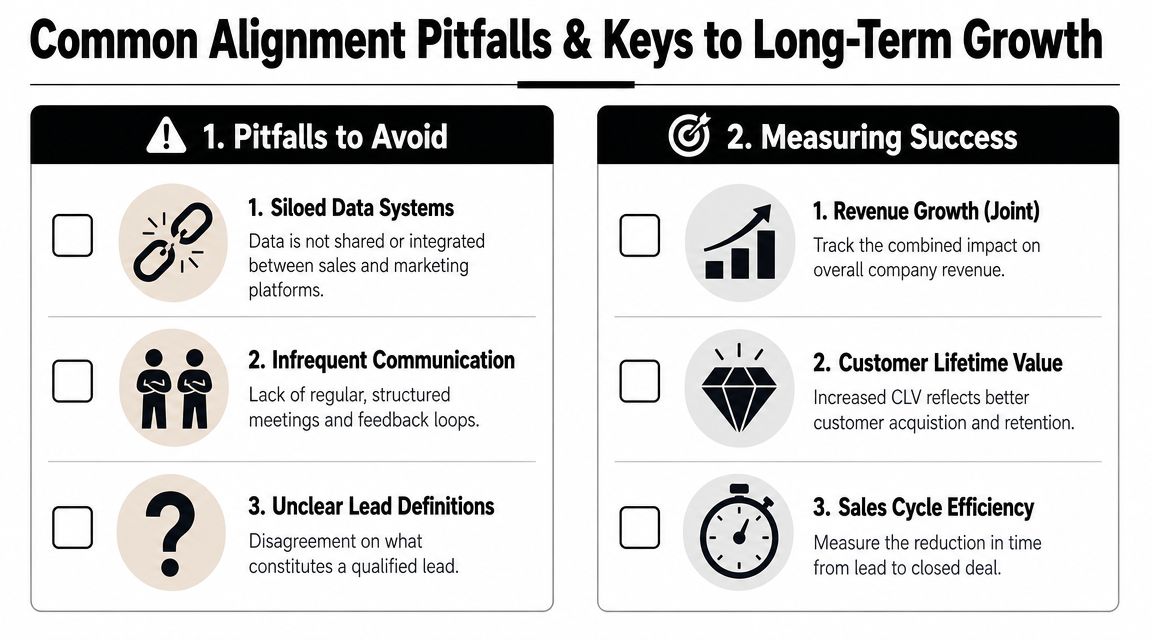
The pitfalls that show up most often
Only 41% of companies rate their sales and marketing alignment as “very good,” according to the benchmark cited by Outfunnel in the earlier handoff discussion. That low confidence makes sense when you look at the patterns that break alignment over time.
The most common ones are:
-
Siloed data: Marketing, sales, and agency activity live in separate tools with weak CRM discipline.
-
Unclear lead definitions: Teams think they agree until rejection rates start rising.
-
Inconsistent communication: Meetings happen only when there’s a problem.
-
Channel-level optimization: One team chases email replies, another chases demo volume, while pipeline quality gets ignored.
-
Message drift: Paid campaigns, cold email copy, and sales talk tracks start saying different things.
What to measure if you want durable improvement
Long-term alignment should show up in operational and commercial metrics, not just team sentiment.
Track a focused set:
| Metric | What it tells you |
|---|---|
| Sales-cycle length | Whether handoffs and buyer context are improving deal progression |
| Win rate | Whether targeting, qualification, and messaging are producing better-fit opportunities |
| Opportunity acceptance rate | Whether sales trusts what marketing or an agency sends |
| Pipeline velocity | Whether the system moves revenue efficiently |
| Average deal quality by source | Whether outsourced and internal channels produce the right kind of pipeline |
The point isn’t to create a larger dashboard. It’s to keep a small set of metrics stable enough that both teams can learn from them quarter after quarter.
Good alignment still allows disagreement. It just forces disagreement into shared data, shared definitions, and shared decisions.
The companies that align sales and marketing well don’t aim for permanent harmony. They build a disciplined operating model. They know where teams must stay tightly connected, and where independent testing still makes sense. That balance matters even more when outbound is outsourced, because the handoff quality determines whether booked activity becomes real revenue.
If your team relies on cold email, outbound SDRs, or a pay-per-meeting model, alignment has to be built into the engagement from day one. Fypion Marketing works with B2B companies on performance-based cold email outreach tied to booked, qualified meetings, which makes SLA design, handoff criteria, and CRM feedback loops especially important. If you need a partner that can operate inside that structure, it’s worth starting with a conversation about your ICP, qualification rules, and what sales will accept.