
What Is B2B Demand Generation: Top SaaS Strategies for 2026

Your pipeline probably feels uneven right now. One month, demo requests come in, outbound replies look healthy, and sales thinks marketing has finally found the formula. The next month, volume drops, the team starts changing messaging again, and everyone slips back into short-term fixes.
That feast-or-famine pattern is usually a signal that you don’t have a demand generation engine. You have a collection of tactics.
If you’re asking what is b2b demand generation, the simplest answer is this: it’s the work that creates awareness, trust, and buying intent before a prospect is ready to book a call. In SaaS, that matters because pipeline doesn’t come from forms alone. It comes from repeated exposure, useful education, strong positioning, and well-timed outreach that meets buyers when their interest is real.
For founders, this is less about adopting another marketing label and more about building a system. Demand generation is what turns scattered activity into a pipeline strategy.
Beyond Random Leads The Case for Demand Generation
Your sales team books six meetings one week, then sits on a thin calendar the next. Marketing keeps shipping activity, but pipeline still swings. That usually means the company is collecting ingredients without running a kitchen.
Demand generation fixes that by connecting awareness, education, outbound, and conversion into one system built to produce revenue. In SaaS, the goal is not to pile up names in a CRM. The goal is to create enough familiarity and intent that the right accounts take meetings, show up informed, and move toward closed won business at a healthy rate.
That distinction matters even more in a pay-per-meeting model. If meetings are the priced outcome, quality control matters at every step. A booked call only has value if the account fits your ICP, the problem is real, and sales can carry the conversation forward. Demand gen improves those odds because it warms the market before outreach tries to cash in on attention.
Teams that skip this work usually end up over-relying on isolated B2B lead generation tactics. They get bursts of replies, a few demos, and a lot of noise. Then sales starts saying the leads are weak, marketing blames follow-up, and nobody addresses the underlying issue. The market has not been prepared.
Here is what random activity tends to create:
-
Low recognition: cold email hits an inbox, but the company name means nothing, so reply rates stay fragile.
-
Weak meeting quality: prospects may accept a call out of curiosity, not active pain or buying interest.
-
Pipeline volatility: one campaign works for a month, then results drop because there is no broader market demand supporting it.
I have seen this trade-off repeatedly. Cold email can book meetings fast, and it should be part of the mix. But cold outbound performs better when it follows signals that demand generation creates, such as repeated content exposure, category education, founder visibility, or account engagement from paid and organic channels. That is the bridge between big-picture demand gen theory and execution. Podcast appearances, social content, webinars, retargeting, and outbound are not competing motions. They are different stages of the same revenue system.
A useful reference on that overlap is this guide to automated outbound and demand generation. It explains the operational side well, especially for teams trying to connect awareness efforts to booked meetings and pipeline performance.
The practical shift is simple. Stop judging marketing by whether it produced contacts. Judge it by whether it helped create qualified conversations that turn into pipeline. That is the case for demand generation. It makes the meal easier to serve because the market already wants to eat.
Demand Generation vs Lead Generation What’s the Difference
The confusion starts because both functions sit in the same revenue motion. But they do different jobs.
Use a cooking analogy. Demand generation gathers ingredients, preps the kitchen, builds the aroma, and makes people want the meal. Lead generation serves the plate and takes the order. If nobody wants to eat, taking reservations won’t help. If the restaurant is packed but nobody can book a table, you still lose revenue.
Demand gen creates the appetite. Lead gen captures the action.
The real difference in plain terms
Demand generation focuses on awareness, education, trust, and preference. It reaches buyers before they’re ready to raise a hand.
Lead generation focuses on conversion. It turns active interest into a known contact, meeting, trial, or demo request.
Both matter. But they break when teams treat them as the same thing. That’s one reason 41% of B2B marketers report difficulty aligning marketing-generated leads with sales expectations, according to The Insight Collective’s demand generation statistics. Usually, the issue isn’t that marketing produced nothing. It’s that the contacts arrived without enough context, intent, or qualification.
Demand Generation vs. Lead Generation at a Glance
| Aspect | Demand Generation | Lead Generation |
|---|---|---|
| Primary job | Create awareness and buying interest | Capture and convert existing interest |
| Buyer stage | Early and mid-journey | Mid and late-journey |
| Typical content | Thought leadership, educational content, ungated resources | Demo pages, forms, comparison pages, booking flows |
| Channel style | Broad but targeted visibility across multiple touchpoints | Direct response and conversion-focused campaigns |
| Success signal | More engaged target accounts and stronger pipeline readiness | More qualified contacts, meetings, and opportunities |
| Common mistake | Measuring it only by form fills | Pushing contacts to sales before real intent exists |
Where founders usually get this wrong
The common mistake is overvaluing immediate hand-raisers and undervaluing the work that made them willing to respond. That leads to overinvestment in capture and underinvestment in creation.
It also creates friction between sales and marketing. Sales sees low-intent leads and loses trust. Marketing sees campaign activity and wonders why it isn’t counted.
If your team is focused more narrowly on outbound conversion mechanics, this overview of B2B lead generation is a useful complement. The key is understanding where lead gen starts and where demand gen should already have done its job.
Good lead generation converts demand. It doesn’t manufacture it from nothing.
The Core Pillars of a Modern Demand Generation Engine
A working demand generation program isn’t a single campaign. It’s a system with connected parts. When one part is weak, performance suffers across the board.
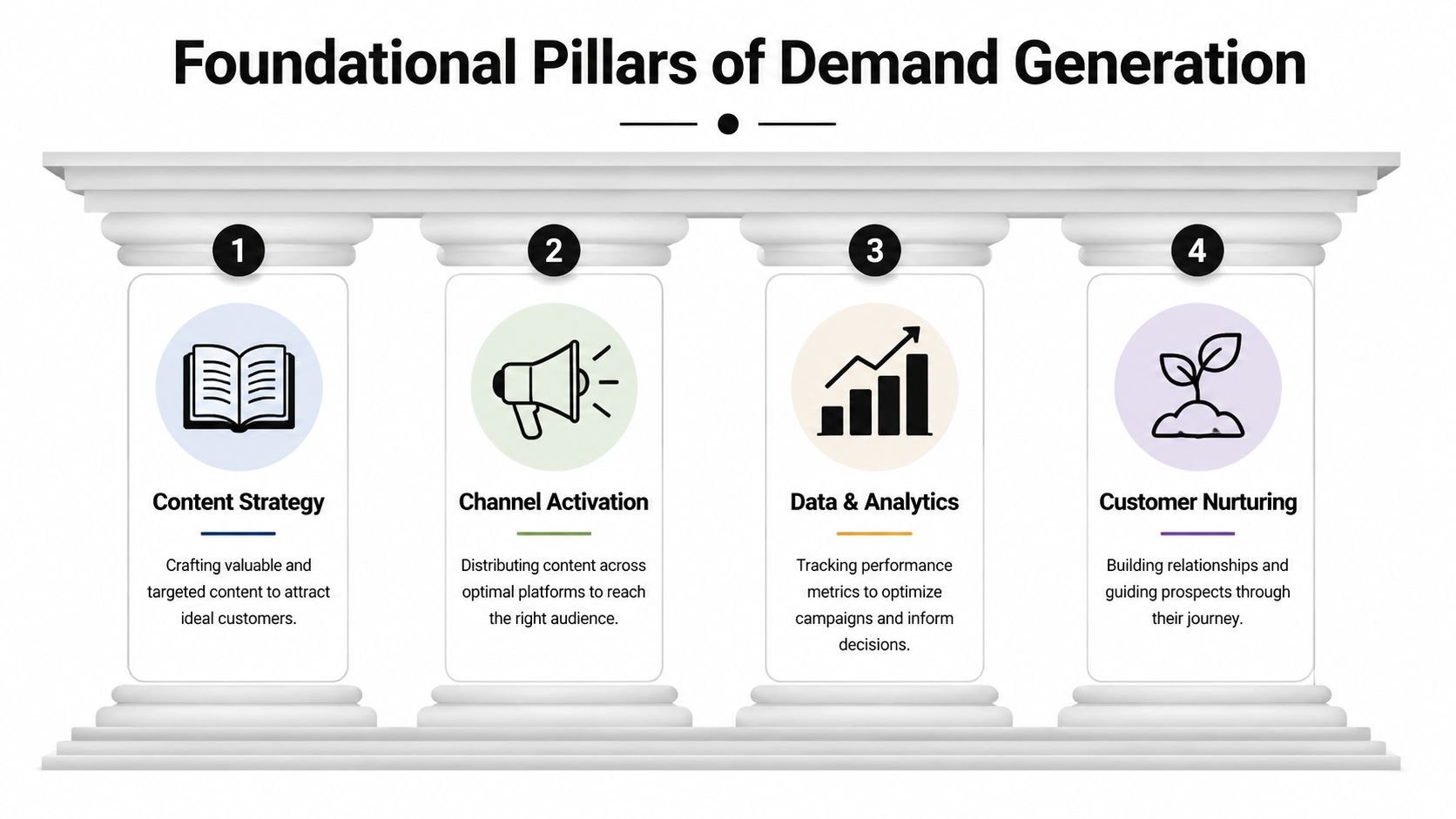
Deep audience insight
Most SaaS teams start with basic ICP filters like company size, industry, and job title. That’s necessary, but it’s not enough.
Modern demand gen works better when you layer fit with behavior. You want to know who matches your market, what problem they likely have, and what signals suggest the account is paying attention. That means combining firmographic clues with what buyers do across your site, content, events, and campaigns.
A static ICP gives you a list. A living ICP helps you prioritize.
High-value content that earns attention
Content carries more weight in demand generation than most founders expect. It’s often the first meaningful proof that your company understands the buyer’s problem.
83% of B2B marketing teams now use content marketing as a core demand gen channel, and that work depends on tight integration across CRM, marketing automation, and analytics so account-level engagement can be aggregated and scored, according to Hey Sid’s complete guide to B2B demand generation.
That’s the practical part founders sometimes miss. Content isn’t just a brand asset. It’s an input into qualification.
Strategic distribution across the right channels
Publishing isn’t distribution. A strong article, webinar, or research piece has to travel.
Many teams underperform, investing in content production but then relying on one newsletter send and a company social post. Demand gen needs repeat exposure through channels that fit the buying journey, not just channels the team already knows how to use.
A solid distribution layer often includes:
-
Organic search: For buyers who are researching problems and categories.
-
LinkedIn: For professional visibility and repeated market exposure.
-
Paid promotion: To put educational assets in front of named accounts.
-
Outbound touches: To start conversations with context, not just volume.
An integrated tech and data stack
Without connected systems, demand generation becomes guesswork. Marketing sees clicks. Sales sees meetings. Nobody sees the full account story.
Your CRM, marketing automation, enrichment, and reporting tools should help the team answer a simple question: which accounts are warming up, and what happened before the meeting request?
If your stack is messy, your strategy will look weaker than it is. Teams often use AI tools for marketing workflows to reduce manual work around segmentation, scoring, messaging support, and performance analysis, but the tools only help when the underlying process is sound.
The best demand gen systems don’t just create visibility. They tell sales when visibility is turning into intent.
Key B2B Demand Generation Channels and Tactics in Action
A SaaS founder sees three things in one week. A useful LinkedIn post from your team. A search result that answers a problem they are trying to diagnose. A cold email that sounds like it understands their situation. By the time they take a meeting, the conversation is not cold. Demand has already been built.
That is the point of channel strategy in demand gen. Each channel does a different job. Some gather ingredients. Some help the buyer smell dinner cooking. A few are built to serve the meal. Lead gen focuses on the hand-raise. Demand gen gets the market ready to have the conversation, then turns that readiness into pipeline.

Content and SEO for problem awareness
SEO is not only for buyers searching vendor names or product categories. In practice, it often shapes demand earlier than that.
Prospects search for implementation risks, team structure questions, pricing model trade-offs, migration headaches, and category comparisons long before they ask for demos. If your site only covers bottom-funnel keywords, you show up after a lot of buying criteria has already formed.
The content that performs here is usually practical and easy to consume. Clear how-to articles, comparison pages, teardown posts, webinar takeaways, and opinionated education tend to work better than vague thought leadership. The goal is not traffic for its own sake. It is getting the right accounts to associate your brand with useful answers.
LinkedIn for repeated exposure and trust
LinkedIn works well because B2B buyers already spend attention there. It is one of the few places where founder perspective, customer insight, category education, and social proof can show up in the same feed.
What performs is rarely polished brand copy. Point of view matters more. Strong posts name a real problem, explain the trade-off, and give the reader a sharper way to assess their own situation. Over time, that repeated exposure shortens the distance between “never heard of you” and “we should probably talk.”
That matters in performance-driven demand gen. On a pay-per-meeting model, LinkedIn is not judged only by likes or follower growth. It helps raise reply rates, lift meeting acceptance, and improve show rates because prospects recognize the company before outbound reaches them.
Paid social and retargeting for account recall
Paid social earns its keep when used to stay present in front of the right accounts, not just to chase form fills.
Promote clips, research findings, customer lessons, or category education. Then retarget people who engaged with a stronger next step. That sequence works because buyers often need several quality touches before they are ready to respond. A single ad click rarely explains the meeting. The sequence does.
A broader look at modern B2B lead gen strategies is useful here because strong programs connect awareness campaigns to conversion plays instead of treating them as separate systems.
Cold email as the bridge from attention to pipeline
Cold email sits in an awkward spot in demand gen because teams often use it like a shortcut. Send enough volume, get enough leads. That approach burns domains, annoys buyers, and fills the CRM with weak intent.
Used properly, cold email does a different job. It converts existing market awareness into conversation. If a prospect has seen your founder on LinkedIn, read one of your articles, or matched an intent signal, outbound can turn that familiarity into a meeting. In that sense, cold email is closer to serving the meal than gathering ingredients.
This is also where demand gen gets tied directly to revenue. If you run a pay-per-meeting program, cold email has to produce qualified conversations with accounts that fit your ICP and have a real reason to talk now. Volume without context looks busy but does not build pipeline. Context gets replies.
Teams that need cold email management for demand generation campaigns usually perform better when messaging reflects what the account has already engaged with, which persona is being targeted, and what sales can realistically close after the meeting is booked.
A quick visual example helps here:
Cold email performs best when it continues a buying conversation that has already started in the market.
How to Measure Demand Generation Success
Numerous teams face a common challenge. They run podcasts, founder posts, webinars, paid awareness campaigns, and educational content, then try to judge all of it by lead form volume. That measurement model breaks fast.
Most B2B content conflates demand gen KPIs with lead gen KPIs, and fails to provide separate playbooks for attributing revenue to awareness-stage activity conducted 6 to 12 months before conversion, according to Mountain’s analysis of B2B demand generation. That blind spot is especially painful in SaaS with longer sales cycles.
Use leading indicators for awareness
Demand generation should be measured first by signs that the right market is noticing you.
Those indicators often include:
-
Branded search and direct traffic trends: More people look for you by name or come back directly.
-
Content engagement quality: Named accounts spend time with relevant assets.
-
Returning visitors from target accounts: The same companies reappear across campaigns and pages.
-
Sales conversation quality: Reps hear “we’ve seen your content” or “your company keeps coming up.”
These aren’t vanity metrics when they’re tied to your ICP. They are early evidence that awareness is turning into recognition.
Use pipeline metrics for business impact
Awareness alone isn’t enough. Eventually, demand generation has to show up in revenue conversations.
A practical model is to track:
| Measurement layer | What to watch |
|---|---|
| Leading indicators | Direct traffic, content engagement, repeat account activity, branded interest |
| Pipeline indicators | Marketing-originated pipeline, influenced opportunities, meeting quality, deal progression |
| Revenue alignment | Sales acceptance, pipeline velocity trends, expansion potential from existing customers |
Demand generation is intended to help pipeline move, not just expand the database.
Separate creation from capture in reporting
One of the cleanest ways to improve reporting is to split your dashboard into two motions:
-
Demand creation: Awareness-building activity that increases familiarity and trust.
-
Demand capture: Conversion activity that turns active interest into meetings and opportunities.
That prevents your team from penalizing top-of-funnel work for not behaving like bottom-of-funnel work.
It also creates better executive conversations. Instead of arguing over whether a webinar “generated leads,” you can discuss whether it increased account engagement and contributed to later pipeline.
If you’re refining the content side of that reporting model, these strategies for 2026 B2B marketing growth offer a useful perspective on how content planning connects to business outcomes rather than pure publishing volume.
If demand generation is doing its job, sales should feel the difference before attribution software can fully explain it.
Common Pitfalls and When to Outsource Your Program
Most demand gen programs don’t fail because the company chose the wrong channel. They fail because execution is fragmented and expectations are unrealistic.

The mistakes that waste time fastest
The first mistake is measuring everything like lead gen. That pushes teams to abandon useful awareness work too early.
The second is creating content without a distribution plan. A good webinar, guide, or founder insight doesn’t create demand if nobody relevant sees it more than once.
The third is sales and marketing misalignment. Marketing celebrates activity. Sales rejects the outcomes. The program weakens because nobody agrees on what “qualified” means.
Where cold email often goes wrong
Cold email is a good example of tool misuse. Many teams treat it like a shortcut to meetings, so they buy a broad list, write generic copy, and hope persistence will compensate for poor relevance.
That misses a key reality. A major challenge is integrating cold email with modern intent-based demand gen, and current guidance often overlooks how to layer intent data into cold outreach so conversations feel contextual before prospects are actively searching, as noted in Leadfeeder’s article on the B2B demand generation funnel.
In practice, that means outbound should be informed by signals. Website engagement, content consumption, category interest, event attendance, and account fit should shape who gets contacted and what message they receive.
When outsourcing makes sense
Outsourcing is worth considering when one of these conditions is true:
-
Your team lacks specialization: You have marketers, but not people who can run the full engine across content, distribution, tracking, and outbound.
-
You need speed: Building internal process takes time. A specialist can launch faster.
-
You need cost clarity: Performance-based models reduce the risk of paying for busywork.
-
Sales needs qualified conversations now: Internal teams often struggle to balance long-term creation with near-term meeting production.
A specialist partner can be especially useful when you want demand generation tied directly to booked conversations and pipeline quality, not just campaign activity. If you’re at that point, a direct book a consultation conversation can help clarify whether outsourcing fits your motion.
Your First Steps in Building a Demand Gen Strategy
You don’t need a massive team to begin. You need a clear operating sequence.
Start with a tighter ICP
Define your best-fit accounts beyond title and industry. Include buying pains, likely triggers, and the signs that an account is becoming active. If your targeting is loose, every downstream tactic gets weaker.
Build one pillar asset
Create one useful resource your market should care about. That might be a webinar, a practical guide, a category teardown, or a founder-led point-of-view piece. Keep it specific. Broad content rarely creates strong demand.
Pick one channel to master
Don’t spread thin across five channels at once. Choose the one most likely to reach your buyers consistently. For many SaaS companies, that’s LinkedIn, search-led content, or tightly targeted outbound.
Create a simple reporting split
Track demand creation separately from demand capture. If you mix the two too early, you’ll misread performance and cut the work that was building future pipeline.
If you want more practical material on execution, the Fypion Marketing blog is a good place to keep learning.
B2B demand generation works best when you treat it like building a kitchen that can produce quality on repeat. Lead generation is serving the meal. You need both. But if you want consistent pipeline, start by making sure the market is ready to eat.
If you want a performance-first way to turn demand generation into qualified sales conversations, Fypion Marketing helps B2B companies do exactly that through a pay-per-meeting model built around cold email execution, targeting, and pipeline outcomes.