
Selecting the Best Marketing Company for Manufacturing
The most common advice on choosing a marketing company for manufacturing is also the least useful. It usually starts with a list of agencies, a checklist of services, and some version of “pick a full-service partner.”
That’s backward.
Manufacturers don’t first need a prettier agency shortlist. They need to decide what kind of commercial outcome they’re buying. Some need market education and long-cycle demand creation. Some need sales enablement for technical buyers. Some need qualified meetings with target accounts now. Those are different jobs, and they require different agency models.
If you skip that distinction, you end up paying for activity that looks professional but doesn’t move pipeline. The reports arrive on time. The dashboard has colors. Sales still says the leads aren’t ready, the buying committee isn’t engaged, or nothing is converting beyond an initial inquiry.
A marketing company for manufacturing should be judged the same way a plant manager judges an outside supplier. Clear scope. Clear process. Clear output. Clear accountability.
Why Most Manufacturers Hire the Wrong Marketing Agency
Manufacturers often hire the wrong agency because they shop for service breadth instead of fit to sales motion. “Full-service” sounds safe. In practice, it often means you’re buying a bundle of tactics before deciding which ones match your revenue problem.
That mistake gets expensive fast because manufacturing budgets usually aren’t loose. Industry benchmarks cited in manufacturing marketing resources place spend at about 6.7% of annual revenue in one commonly referenced benchmark, which is why efficiency matters when selecting a partner, according to manufacturing marketing benchmark coverage.
Full-service sounds efficient. It often isn’t.
A manufacturer selling custom components into long procurement cycles has very different needs from a contract manufacturer trying to fill near-term capacity. Yet both get pitched the same package: website updates, blog posts, paid search, social posting, maybe some email nurture.
That package isn’t automatically wrong. It’s wrong when it’s disconnected from the actual bottleneck in the revenue engine.
Practical rule: If an agency starts by listing deliverables before diagnosing your sales process, they’re selling inventory, not solving a growth problem.
The first question isn’t “Who’s the best agency?” It’s “Do we need market awareness, account penetration, sales enablement, or booked meetings?” That distinction matters more than logo slides and award badges.
Teams that want a stronger operating model between sales, marketing, and handoff stages should also understand how RevOps changes agency fit. MarTech Do’s guide on RevOps agencies is useful because it frames agency selection around process alignment rather than creative output.
Manufacturers usually need tighter accountability
In manufacturing, weak alignment shows up in familiar ways:
-
Broad messaging: The agency writes copy for “decision-makers” when engineers, procurement, and executives each need different proof.
-
Shallow reporting: Traffic goes up, but quote requests, meetings, and opportunities don’t.
-
Loose follow-through: Campaigns launch, then stall once the first quarter’s enthusiasm wears off.
-
Mismatched economics: A monthly retainer keeps running even when the client only values pipeline outcomes.
That’s why many manufacturers should evaluate agency structure before agency brand. A retainer can make sense. So can project work. So can performance-based outreach. But each model fits a different stage of growth and a different level of sales readiness.
If your team is still defining positioning, rebuilding core assets, or fixing CRM hygiene, a broad outsourced function may help. If you already know your market and need a narrower execution partner, a more outcome-tied model may fit better than generic outsourced marketing services for B2B growth.
The wrong hire usually isn’t a bad agency. It’s a bad match.
Define Your True Marketing-to-Sales Objective
Before talking to any agency, define the job. Not the channel. Not the deliverables. The job.
Manufacturing buying cycles commonly run 6 - 18 months and involve engineers, procurement, and executives, so effective marketing starts with role-specific assets that answer different questions at different stages, according to manufacturing marketing strategy guidance.

Start with the sales motion, not the marketing channel
Many leadership teams say they need “more leads.” Usually they mean one of four things:
-
They need more qualified first meetings for an existing sales team.
-
They need better technical content because opportunities stall during evaluation.
-
They need account penetration into a small set of named targets.
-
They need market credibility because buyers don’t yet understand the category or offering.
Those are not the same assignment.
If you sell a technical product with long evaluation windows, marketing has to support the entire buying committee. Engineers want detail. Procurement wants confidence in commercial fit. Executives want business justification. If your future agency can’t explain how content and outreach change by stakeholder, they don’t understand manufacturing demand generation.
A simple self-diagnosis for manufacturers
Use this framework internally before the first agency call.
If sales has enough conversations but poor progression
Your issue probably isn’t top-of-funnel volume. It’s middle-funnel friction. Buyers are entering the process, then disappearing during technical review, internal alignment, or budget discussion.
In that case, your agency needs to produce assets such as:
-
Application-focused pages: Content tied to real use cases, not generic product copy.
-
Technical proof materials: Spec-driven documents, implementation guidance, compliance explanations.
-
Role-based nurture content: Follow-up sequences that change based on the buyer’s role and stage.
A broad lead gen shop won’t fix a sales process that lacks technical buying support.
If sales has capacity but not enough qualified conversations
That’s a different problem. Here, outreach, list building, email sequencing, paid acquisition, or ABM may matter more than a site refresh.
The useful question is: do you need more names in the funnel, or more sales-ready accounts entering active conversation? A strong B2B marketing funnel for complex sales should make that distinction visible.
The agency brief should fit on one page. “Generate pipeline from target OEM accounts” is a real objective. “Improve our digital presence” usually isn’t.
If a few accounts matter more than volume
Some manufacturers don’t need more leads. They need access to a narrow list of strategic accounts. In those situations, account-based marketing, executive outreach, and highly specific messaging often beat broad campaigns.
That requires discipline. The partner must know who the target roles are, what signals indicate real buying interest, and how to coordinate touches across email, LinkedIn, content, and sales follow-up.
Write the brief your agency should answer
A useful internal brief should answer these questions:
-
What are we selling? Standard product, custom solution, engineering service, or contract manufacturing capacity.
-
Who must say yes? Engineers, operations, procurement, finance, executives.
-
Where do deals stall? Awareness, initial meeting, technical validation, pricing, internal approval.
-
What outcome matters most? Meetings, quote requests, better close rates, shorter evaluation cycles, larger target-account penetration.
-
What must marketing own, and what must sales own?
If you can’t answer those clearly, the agency will fill in the blanks with its preferred services. That’s how manufacturers end up with activity plans instead of commercial plans.
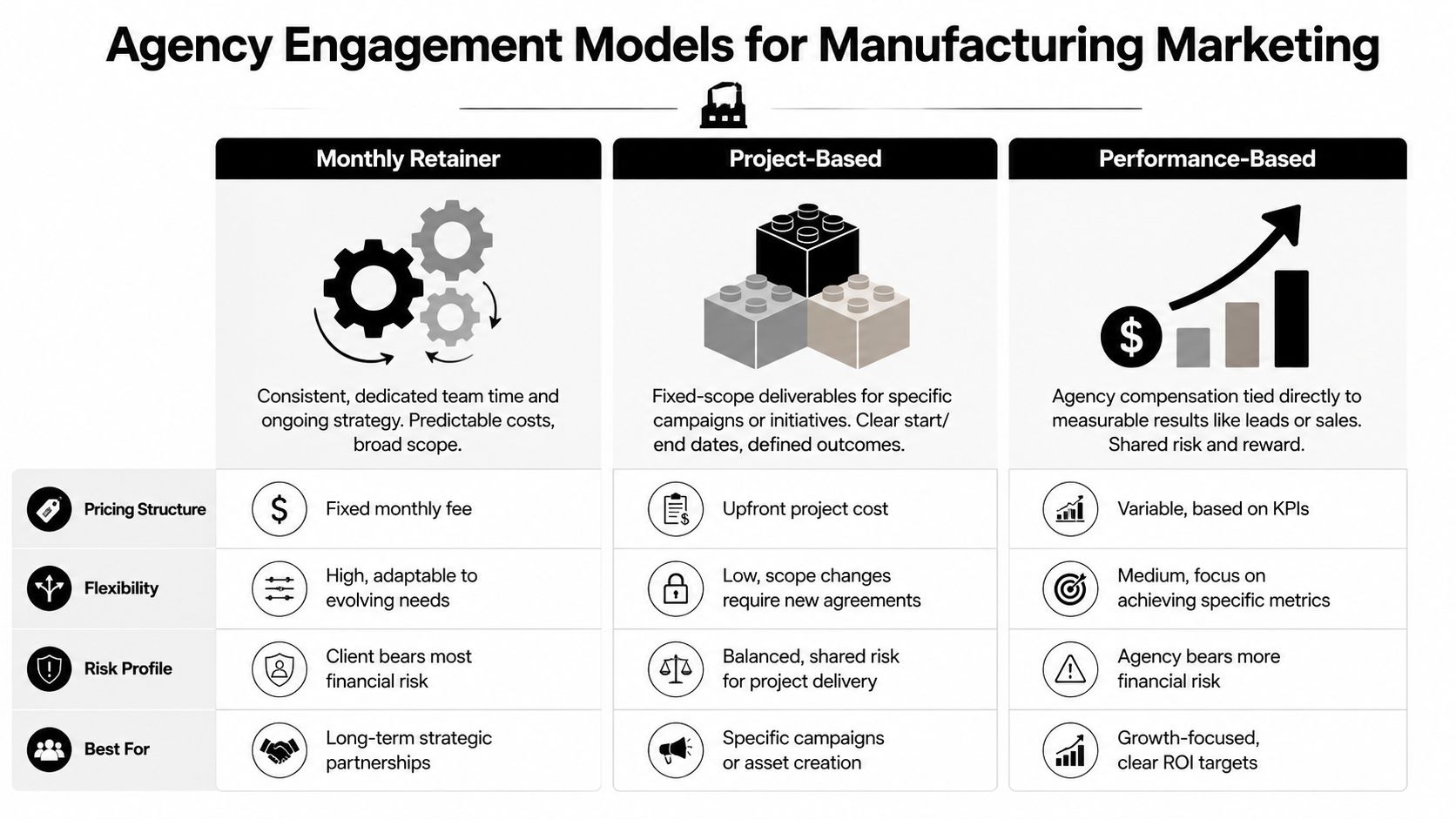
Compare Agency Models Retainer vs Performance-Based
Most content about a marketing company for manufacturing compares agencies by reputation, niche, or service menu. That misses the harder and more important question: how should the agency get paid for the job you need done?
Agency roundups often answer who to hire but not what outcome model fits the manufacturer, which leaves a gap for performance-based options such as pay-per-meeting when predictable pipeline is the real need, as noted in this analysis of manufacturing agency selection gaps.
Monthly retainers work when the problem is broad and ongoing
A retainer is usually the right fit when you need continuous execution across multiple channels. That might include SEO, content, paid media, CRM workflows, email nurture, and reporting.
Retainers fit manufacturers that need a marketing function, not just a campaign. They also fit companies still building the basics: positioning, messaging, website architecture, content library, and operational consistency.
Retainers are weaker when leadership expects direct, near-term meeting volume but hasn’t agreed on what monthly activity should produce.
Project-based work fits defined gaps
Project fees make sense when the need is narrow and time-bound.
Examples include:
-
Website rebuilds
-
Product launch campaigns
-
Trade show follow-up systems
-
Messaging and positioning work
-
Content libraries for a specific product line
This model works well when the manufacturer already has internal execution capacity and only needs a specialist for one piece. It works poorly when the fundamental issue is sustained pipeline generation.
A project ends. Your sales problem usually doesn’t.
Later in the buying process, many teams revisit how compensation affects execution quality. That’s why it helps to understand the trade-offs in pay-for-performance marketing models tied to revenue outcomes.
Performance-based models fit clear pipeline goals
Performance models are strongest when the outcome is narrow, measurable, and commercially meaningful. For example, booked meetings with agreed qualification criteria.
That structure tends to work best when the manufacturer already has:
-
a defined offer
-
clear target accounts or buyer profiles
-
a sales team ready to run calls and follow up
-
confidence that more qualified conversations would convert into revenue
A company like Fypion Marketing can fill this role. It operates on a pay-per-meeting model for B2B appointment setting rather than a traditional monthly retainer. That’s a different answer to a different problem.
Here’s a quick side-by-side view.
| Model | Best use case | Main advantage | Main risk |
|---|---|---|---|
| Retainer | Ongoing multi-channel marketing | Consistent execution across broad scope | Activity may outpace accountability |
| Project-based | Fixed deliverable or initiative | Clear scope and timeline | Limited long-term impact without follow-through |
| Performance-based | Meeting generation or measurable pipeline outcomes | Strong alignment to specific results | Narrower fit, depends on sales readiness |
This video gives a useful overview of performance-oriented thinking in agency relationships.
Choose the payment model that matches the bottleneck. Don’t buy a retainer to solve a meeting problem, and don’t buy pay-per-meeting to fix broken positioning.
Your Vendor Vetting Checklist and Key Questions
Once you know the job and the pricing model, vendor selection gets easier. You’re no longer asking, “Are they impressive?” You’re asking, “Can they execute this exact motion for a manufacturing company?”
An industrial survey found that 98% of manufacturers generate sales-qualified leads through digital marketing and 92% use email to distribute content, which makes digital execution and email capability critical screening points, according to this industrial marketing statistics roundup.

What to verify before you take the first proposal seriously
A good manufacturing agency pitch should answer practical questions quickly. If it stays vague, that’s your answer.
Use this checklist:
-
Manufacturing fluency: Can they discuss engineers, procurement, spec-driven review, and long qualification cycles without sounding like they copied a B2B template?
-
Channel competence: Can they explain how email, search, paid media, content, and outbound play different roles in one buying journey?
-
Commercial understanding: Do they ask about quote quality, sales handoff, follow-up speed, and close rates?
-
Reporting discipline: Do they define success in terms your sales team cares about?
-
Process visibility: Can they show how campaigns are planned, launched, reviewed, and improved?
A useful way to pressure-test expertise is to look outside your vertical for process quality. For example, this piece on improving search rankings for financial practices is about another niche entirely, but it shows what specialized SEO thinking looks like when an agency actually understands a regulated, expertise-driven buying context. That’s the level of specificity manufacturers should expect too.
Questions that expose shallow agencies fast
Ask these in the first call.
How do you handle technical buyers?
A weak answer talks about “decision-makers” and “buyer personas.” A strong answer explains how messaging changes for engineers, procurement, and leadership.
What happens after a lead converts?
If they only talk about form fills, they’re stopping too early. The right partner should discuss qualification, routing, speed to follow-up, and feedback loops from sales.
What channels do you expect to use first, and why?
Good agencies make trade-offs. They’ll tell you why SEO is a longer play, why paid search may or may not fit, why outbound email can work for specific account lists, and where content supports deal progression.
How do you define a qualified result?
Listen carefully here. “More visibility” is not a qualified result. “Booked meetings with target account roles” is. “Quote requests from in-market buyers” is.
Questions for the reference calls
Don’t ask references if they “liked working with” the agency. Ask harder questions:
-
Did the agency stay consistent after onboarding?
-
Did they adapt when the first message or campaign didn’t work?
-
Did they challenge your assumptions, or just take orders?
-
Did sales trust the output?
-
Would you hire the same model again?
If you need support specifically around meeting generation and outbound execution, compare the agency’s process against a specialist lead generation agency model, not against a generic creative firm. Different motions require different operating systems.
“Show me what you measure after the click” is one of the best questions a manufacturing buyer can ask an agency.
Structuring the Deal Onboarding KPIs and Red Flags
A strong agency agreement does three things well. It defines the work. It defines the measurement. It defines what happens if the fit is wrong.
Weak agreements hide behind effort language. They promise optimization, visibility, support, and strategic guidance. Those words aren’t useless, but they’re not enough to manage an external growth partner.
High-performing manufacturing marketing should be measured with pipeline-quality metrics such as form submissions, demo requests, quote inquiries, and MQL volume rather than impressions alone, and campaigns often fail when execution is inconsistent or messaging is too broad, according to manufacturing marketing measurement guidance.
Set KPIs that match the commercial objective
The KPI package should depend on the job you hired the agency to do. Don’t let every engagement default to traffic and engagement metrics.
Use this as a baseline.
| Primary Objective | Primary KPIs | Secondary KPIs |
|---|---|---|
| Generate sales conversations | Demo requests, quote inquiries, booked qualified meetings | Response quality, sales acceptance rate |
| Build qualified pipeline | MQL volume, sales-qualified lead volume, marketing-sourced opportunities | Form submissions, target account engagement |
| Improve mid-funnel progression | Opportunity progression, sales-cycle length, content-assisted conversion movement | Email engagement, repeat visits to technical assets |
| Support account-based growth | Named-account engagement, meetings from target accounts, opportunity creation in target accounts | Stakeholder coverage, account-level activity trends |
A more detailed framework for selecting operational metrics lives in this guide to lead generation KPIs and essential measurement metrics.
What onboarding should include
The first weeks should not be a black box. You want visible decisions, not vague momentum.
A solid onboarding plan usually includes:
-
Commercial diagnosis: target segments, product priorities, deal stages, historical close patterns
-
Message development: problem framing, differentiators, objection handling, role-based angles
-
System setup: CRM access, tracking definitions, routing logic, reporting cadence
-
Approval flow: who signs off on copy, targeting, creative, and changes
-
Review rhythm: weekly or biweekly performance review with clear action items
If onboarding is mostly kickoff calls and file requests with no decision framework, expect drift later.
Red flags in contracts
Some warning signs are obvious. Others hide in the details.
Vague deliverables
If the contract says “ongoing optimization” without naming assets, campaigns, reviews, or output types, expect disagreement later.
No definition of lead quality
If the agency gets credit for any inquiry, while sales only values specific account types or roles, conflict is guaranteed.
The agency controls your core data
Your CRM, reporting dashboards, ad accounts, and campaign history should not become inaccessible if you leave.
No exit clarity
A partner confident in fit doesn’t need to trap a manufacturer in ambiguity. Termination terms should be explicit.
Broad messaging is a contract problem before it becomes a campaign problem. If the audience definition is loose on paper, execution will be loose in market.
Building Your Manufacturing Growth Engine
The right marketing company for manufacturing doesn’t just run campaigns. It plugs into a sales system that can absorb demand, qualify it, and turn it into revenue.
That’s why the framework is simple. Define the job. Compare the model. Vet the operator. Structure the deal. Most hiring mistakes happen when manufacturers skip the first step and jump straight to vendor demos.
Growth comes from alignment, not more activity
A manufacturer with a complex, technical sale rarely needs more random motion. It needs aligned motion. The message has to fit the buyer. The channel has to fit the stage. The agency model has to fit the outcome.
That also means the client has work to do.
Your team still has to provide subject matter expertise, review messaging, clarify target accounts, and follow up on inbound or booked meetings quickly. No agency can compensate for slow internal response, weak qualification, or an unclear offer.
The best partner fits your current stage
If you’re still building foundational credibility, a retainer partner may be the right call. If you need a fixed initiative completed cleanly, project work may be enough. If you have product-market fit and need more consistent sales conversations, a performance structure may be the more rational choice.
For manufacturers running account-based growth motions, signal visibility matters too. Tools that help teams track signals across manufacturing target accounts can strengthen timing, prioritization, and outreach relevance when sales and marketing are focused on named accounts.
A good agency relationship should make your growth engine more predictable. It should reduce guesswork, sharpen handoffs, and create a clearer line between marketing effort and pipeline output.
That’s the standard.
If your team wants a marketing partner tied to qualified meetings instead of a monthly retainer, Fypion Marketing offers a pay-per-meeting B2B lead generation model. It’s a practical fit for companies that already know their market and want more predictable pipeline conversations without paying upfront for broad agency activity.