
Outsourced Sales Company: The 2026 Ultimate Guide

Your product works. Customers stay. A few deals close every month. But pipeline still depends on founder hustle, one strong AE, or a patchwork of outbound efforts that never quite turns into a repeatable system.
That’s the point where many teams start looking for an outsourced sales company. Not because the business is broken, but because the current sales motion can’t carry the next stage of growth. The wrong way to frame the decision is in-house versus outsourced. The better question is simpler: what mix of internal ownership and external execution gives you a more reliable revenue engine with less operational drag?
The strongest companies I’ve seen don’t outsource to avoid building sales discipline. They outsource to build it faster. They keep strategy, positioning, and closing authority inside the business. They bring in outside specialists for prospecting, qualification, channel execution, and process management. And increasingly, they want pricing that rewards outcomes instead of activity.
When to Partner with an Outsourced Sales Company
A lot of companies wait too long.
They keep trying to solve a systems problem with heroic effort. The founder jumps back into outbound. Marketing sends more names to sales. A new rep gets hired before process is clear. For a quarter or two, it feels productive. Then the same issues show up again: weak coverage, uneven follow-up, and a pipeline that depends on who had time that week.

An outsourced sales company makes sense when you already know your offer resonates, but your go-to-market execution is inconsistent. That could mean your internal team is too small, your closers are prospecting instead of selling, or you’re trying to enter a new segment without building a full outbound function from scratch.
The market itself shows this isn’t a fringe move. The global outsourced sales services market is projected to grow from USD 2.71 billion in 2024 to USD 4.21 billion by 2034, at a 4.5% CAGR, according to Zion Market Research’s outsourced sales services market report.
Signs you’ve hit the ceiling
A few symptoms show up repeatedly:
-
Founders are still the top source of pipeline. That works early. It doesn’t scale.
-
AEs are doing SDR work. Expensive closing talent gets consumed by list building, follow-up, and manual outreach.
-
You need speed without permanent overhead. Hiring internally adds recruiting, onboarding, and management burden before results show up.
-
A new market needs testing. You want proof before committing headcount.
If you’re evaluating b2b sales pipeline outsourcing strategies, the key is to treat outsourcing as a capacity and specialization decision, not a surrender of sales ownership.
One practical place to start is this guide to outsourced lead generation for B2B growth, especially if you’re sorting out whether your issue is top-of-funnel production or a broader sales design problem.
Practical rule: Partner when the constraint is execution bandwidth, not product-market uncertainty. If the offer is still unclear, outsourcing won’t fix that.
Understanding the Modern Outsourced Sales Partner
A modern outsourced sales company isn’t a call center with a script. It should operate more like Sales Team as a Service. You plug into an existing system of people, process, tooling, reporting, and management instead of assembling each piece yourself.
The easiest analogy is cloud infrastructure. Most companies don’t build their own data center anymore. They rent specialized infrastructure because it gets them speed, reliability, and flexibility. Sales is moving in the same direction. The right partner gives you trained operators, campaign workflows, QA, list building, deliverability awareness, CRM discipline, and management oversight without forcing you to build the whole machine first.
What separates modern partners from legacy vendors
Legacy providers usually sell labor. Modern partners sell an operating system.
That distinction matters. Labor without process creates noise. Process without accountability creates slide decks. A useful outsourced sales company should be able to show how it handles targeting, sequence design, handoff rules, reporting, objection capture, and optimization cadence.
Mainstream adoption supports that shift. As of 2023, 66% of US businesses outsource at least one department, and 83% of small business leaders plan to maintain or increase spending on outsourced services, according to Emapta’s outsourcing statistics overview.
What you should expect them to own
A serious partner should handle some combination of these functions:
-
Audience definition tied to your ICP, not broad list dumping
-
Outbound execution across email, calling, LinkedIn, or a focused subset
-
CRM hygiene so activity and outcomes are visible
-
Message testing based on market feedback
-
Weekly performance management instead of “we’ll circle back next month”
If your team is still unclear on role boundaries, it helps to define what an sales development representative does in practice. Most failed outsourcing relationships start with fuzzy ownership between SDR work, AE work, and RevOps work.
The right outsourced sales company shouldn’t replace your sales leadership. It should give your sales leadership a cleaner system to manage.
Comparing Common Outsourced Sales Models
Not every outsourced sales company sells the same thing, even when the websites sound identical. In practice, most offers fall into three buckets: SDR-as-a-service, full-cycle sales, and performance-based engagement.
Your choice should follow the sales problem you’re trying to solve. If your closers are strong but top-of-funnel is thin, don’t buy a full outsourced sales team. If you need market validation and don’t want to carry heavy fixed cost, don’t rush into a long retainer.
SDR-as-a-service
This model focuses on prospecting, outreach, qualification, and meeting booking. Your internal AEs or founders take the meetings and run the deal.
It’s usually the best fit when you already know how to close, but your pipeline creation is inconsistent. SaaS firms, agencies, and B2B service companies often fit here because the close requires product depth or executive involvement that shouldn’t be outsourced lightly.
The trade-off is straightforward. You keep deal control, but success depends on tight handoff discipline. If booked meetings sit untouched, the model underperforms and everyone blames the vendor.
For teams comparing outbound structures, this guide to appointment setting outsourcing is useful because it separates meeting volume from actual sales readiness.
Full-cycle sales
Here the outsourced sales company handles more of the funnel, sometimes from prospecting through closing. This can work for simpler offers, transactional sales, or temporary market coverage when internal hiring hasn’t caught up.
The benefit is speed. One provider handles the motion. The risk is loss of control. Once an outside team owns both conversation quality and pipeline progression, weak positioning or sloppy qualification can stay hidden longer than it should.
This model usually works best when the sales process is already well defined and the product doesn’t require constant founder involvement.
Performance-based models
The market is moving in this direction for many growth-stage teams. Instead of paying mainly for effort, you pay for an agreed outcome, often qualified meetings that meet a written standard.
That shifts risk. A legacy retainer asks the client to trust activity. A performance model forces both sides to define what counts. That usually leads to healthier conversations about ICP, disqualification, routing, and follow-up.
It isn’t magic, though. If “meeting” is defined loosely, you can buy a calendar full of bad-fit conversations. Performance pricing only works when qualification rules are specific.
Outsourced Sales Model Comparison
| Model | Best For | Common Pricing | Key Advantage |
|---|---|---|---|
| SDR-as-a-service | Teams with strong internal closers and weak top-of-funnel coverage | Monthly retainer or hybrid structure | Keeps closing in-house while adding prospecting capacity |
| Full-cycle sales | Businesses needing broader external execution across the funnel | Retainer, commission, or blended model | Faster deployment of a more complete sales function |
| Performance-based | Companies that want tighter accountability and lower upfront risk | Pay-per-meeting, pay-per-qualified-meeting, or outcome-based hybrid | Aligns spend more closely to measurable results |
If a provider can’t explain who owns qualification, handoff, and follow-up, the pricing model doesn’t matter. The motion is already broken.
An Evaluation Checklist for Choosing the Right Partner
Most companies evaluate an outsourced sales company like they’re buying software. They look at the site, skim testimonials, sit through a polished pitch, and ask for pricing. That’s not enough.
You’re not buying a dashboard. You’re hiring a team that will represent your brand in live market conversations. Due diligence should look more like hiring a sales manager than buying a tool.

The first questions to ask
Start with operating detail, not outcomes. Ask:
-
How do you define a qualified lead or meeting? If the answer is broad, you’ll fight about quality later.
-
How do you validate ICP fit before launch? Good partners pressure test assumptions early.
-
What does reporting look like inside the CRM? Separate dashboards often hide too much.
-
Who works the account? Senior sellers in the pitch and junior operators in delivery is a common mismatch.
Lead response time deserves special scrutiny. Effective outsourced sales programs are managed by SLAs, and lead response time is a critical determinant of conversion. Leads contacted within minutes are far more likely to convert, according to SupportZebra’s outsourced sales KPI guidance.
That means you shouldn’t just ask whether they book meetings. Ask how quickly they react to inbound hand-raisers, replies, reschedules, and recycling opportunities.
What strong partners are willing to show
Ask for process evidence. A credible partner should be comfortable walking through:
-
Their list-building and enrichment workflow
-
Their QA process for copy and targeting
-
Their SLA dashboard or reporting view
-
Their weekly review format
-
Their escalation path when performance drops
If you’re comparing agencies and managed providers, this overview of what to expect from a lead generation agency helps separate true operators from firms that mostly coordinate freelancers.
A short walkthrough can expose more than a polished proposal. This video gives a useful lens on what to check during partner evaluation:
Red flags that usually show up early
Some warning signs are easy to miss in early calls:
-
They lead with activity metrics instead of qualification standards.
-
They won’t commit to review cadence or named owners.
-
They avoid live system demos and rely on screenshots.
-
They can’t explain failure modes such as low connect rates, poor targeting, or weak handoffs.
Don’t ask only for references. Ask to speak with a current client whose sales motion resembles yours.
The KPIs That Actually Measure Outsourced Sales Success
The easiest way to mismanage an outsourced sales company is to stare at volume.
More calls. More emails. More touches. More meetings booked.
Those metrics matter to the provider’s internal workflow, but they don’t tell you whether the program is producing revenue-quality pipeline. The meaningful layer is funnel economics: qualified lead volume, MQL-to-SQL conversion, cost per qualified lead, cost per sales accepted lead, meeting-to-opportunity conversion, and pipeline sourced relative to spend.
Start with lead quality, not activity
For outsourced B2B teams, a key benchmark for MQL-to-SQL conversion is 15 to 21 percent, and results below that range often point to lead quality or qualification problems rather than simple volume issues, according to Autobound’s SaaS sales metrics benchmark.
That single metric cuts through a lot of noise. A vendor can book plenty of meetings and still create almost no real sales motion if your AEs reject the leads or the prospects never progress.
A practical scorecard should include:
-
Cost per qualified lead so spend stays tied to actual buying potential
-
Meeting-to-opportunity conversion to measure handoff quality
-
Sales accepted lead volume to see whether the sales team trusts what’s being delivered
-
Pipeline sourced versus program cost to keep the conversation commercial
What to review every month
Use a recurring review with one page of numbers and one page of qualitative notes. Track trend lines, not isolated wins or losses.
For email-heavy outbound programs, deliverability still matters because weak inbox placement contaminates every downstream KPI. If you need a refresher on what to watch before replies and meetings even enter the picture, Truelist’s analysis of email deliverability metrics is a helpful reference.
You can also pair your vendor scorecard with a simpler internal framework for lead generation KPI tracking, especially if marketing and sales are using different definitions today.
A full calendar can hide a failing program. The only meetings that matter are the ones your sales team would want again.
Your First 90 Days The Onboarding and Integration Process
Signing the agreement isn’t the starting gun for results. It’s the start of joint execution.
The first ninety days tell you whether the outsourced sales company can integrate into your revenue engine or whether they’re just running parallel activity. This period should be structured, visible, and tightly managed.
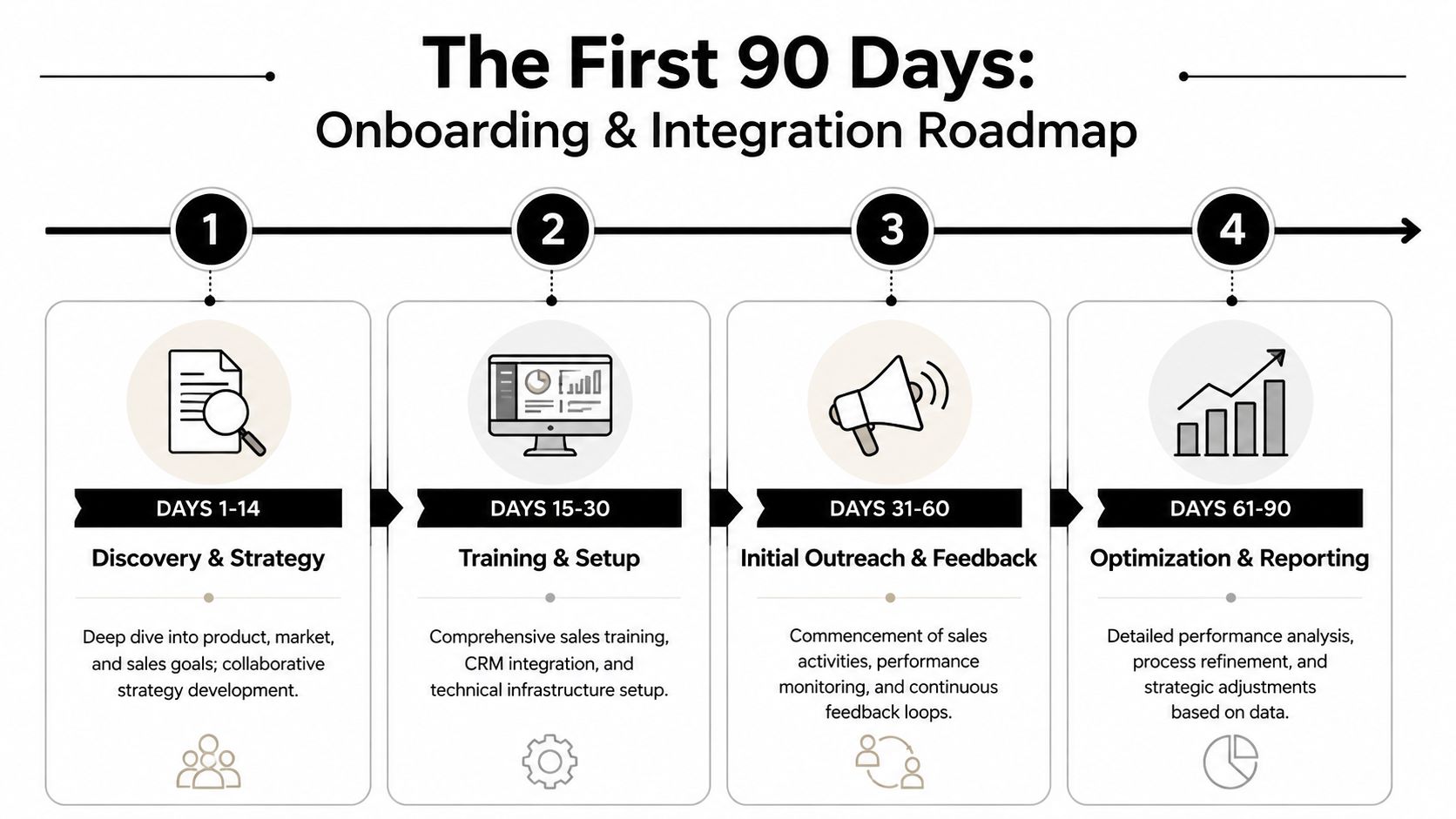
Days 1 to 14
Early work should focus on ICP definition, message alignment, offer framing, disqualification rules, and ownership boundaries. In this initial stage, weak partnerships often pretend to move fast by launching before the basics are agreed.
You need one written source of truth covering target accounts, personas, objections, approved claims, routing rules, CRM stages, and what counts as success. If your internal team can’t explain those clearly, the outside team will improvise.
Days 15 to 30
This phase is operational. The outsourced team should get into your CRM, set reporting expectations, finalize outreach assets, and calibrate outreach based on live feedback.
It also helps to establish communication rhythm now:
-
Weekly working session for live campaign review
-
Daily or near-daily Slack channel for handoff issues and prospect feedback
-
Named owner on both sides for approvals and blockers
Days 31 to 60
Now you should see early outreach patterns, reply themes, objection clusters, and quality signals. Resist the urge to rewrite everything after a few rough conversations. Good teams optimize with evidence, not emotion.
What matters here is whether feedback loops are tight. Are objections being logged? Are rejected meetings reviewed? Are AEs giving precise reasons when leads aren’t accepted?
A provider can only improve the front end if your internal team closes the loop on what happens after the meeting.
Days 61 to 90
This is the point where process hardens. By now, both sides should know which segments respond, which messages fall flat, and where the handoff breaks.
One operational gap shows up constantly in hybrid models: quota and incentive design. A common scaling issue is creating a structure that properly motivates in-house closers to work externally sourced opportunities, a nuance highlighted in ISaless coverage of outsourced sales and marketing.
If your AE gets full credit for self-sourced pipeline but treats outsourced meetings like leftovers, the model will underperform no matter how good the partner is.
How to prevent internal friction
Use simple rules:
-
Shared definitions. Sales accepted means the same thing for everyone.
-
Fast acceptance or rejection. Meetings shouldn’t linger in limbo.
-
Comp clarity. Decide in advance how sourced opportunities count toward quota.
-
One feedback loop. Marketing, SDRs, and AEs should work from the same pipeline reality.
Decoding Pricing Models and Contract Terms
Pricing tells you where the risk sits.
That’s the most useful way to read a proposal from an outsourced sales company. Ignore the packaging language for a minute and ask a blunt question: if results are weak, who feels the pain first?
How the main pricing structures work
A fixed monthly retainer gives you predictable cost, but much of the performance risk stays with you. If the partner misses, you still paid for the month. This model can work when the provider brings significant strategic value and you’re buying more than appointment volume, but it demands stronger oversight.
A pure commission model sounds attractive because payment follows revenue. In practice, it can create problems if the sales cycle is long, attribution is messy, or the provider has little control over closing. Many solid firms avoid pure commission for that reason.
A hybrid model blends some guaranteed fee with variable upside. This often works well when the provider is responsible for meaningful execution but not the full sales outcome.
A performance-based model, such as pay-per-meeting or pay-per-qualified-meeting, is usually the cleanest fit for companies that want lower upfront exposure. It forces both sides to define qualification standards, meeting criteria, exclusions, and acceptance rules early.
Contract terms worth slowing down for
Most mistakes happen in the legal details, not the headline price.
Review these closely:
-
Definition of qualified. If the contract doesn’t define this tightly, expect disputes.
-
Term length and renewal language. Auto-renewals catch more teams than they should.
-
Termination rights. You need an exit if quality drops or internal priorities change.
-
Data ownership. Your CRM records, contact history, and campaign learnings should remain accessible.
-
Replacement and continuity clauses. If the assigned rep changes, what happens to ramp and quality?
-
SLA language. Speed, reporting cadence, and handoff expectations should be written down.
A practical way to compare proposals
Don’t compare offers only by monthly spend. Compare them on three dimensions:
| Lens | What to check | Why it matters |
|---|---|---|
| Incentive alignment | What triggers payment | This determines whether activity or quality drives behavior |
| Operational control | CRM access, review cadence, SLAs | Visibility prevents drift |
| Exit protection | Notice, termination, data portability | Good contracts protect you when priorities change |
One option in the market is Fypion Marketing, which uses a pay-per-qualified-meeting model rather than upfront retainers. That kind of structure can fit companies that want external outbound execution with clearer outcome-based accountability. It still requires a written meeting definition and disciplined follow-up on your side.
Frequently Asked Questions
Should an outsourced sales company replace my internal team
Usually no. The better setup is hybrid. Keep strategy, pricing, closing, and customer insight close to the business. Use the partner for prospecting, qualification, or channel execution where specialization and speed matter more.
What if the partner books meetings but they don’t convert
Treat that as a qualification problem first. Review rejected meetings, compare accepted versus rejected patterns, and tighten the definition of a qualified meeting. If you only measure booked volume, this issue shows up late.
How long should I give a new partner before judging performance
Judge process immediately and outcomes over a reasonable ramp. In the first weeks, look for ICP clarity, reporting quality, speed of execution, and responsiveness to feedback. Don’t wait for months to confront obvious operating issues.
Should I choose a retainer or pay-per-meeting model
It depends on what you’re buying. If you need a broader managed function with strategy, infrastructure, and testing, a retainer or hybrid model may fit. If you want tighter accountability and lower upfront risk, performance-based pricing is often cleaner.
What’s the biggest mistake companies make
They outsource without deciding how the internal team will work with the partner. Most failures come from unclear ownership, weak handoffs, slow follow-up, or bad incentives inside the client organization.
If you’re considering a hybrid outbound model and want a partner that ties compensation to qualified meetings instead of upfront retainers, Fypion Marketing is one option to review. Their focus is B2B lead generation through cold email outreach with a performance-based structure, which can suit teams that want more pipeline without adding fixed sales headcount too early.