
Your Guide to a Top B2B Lead Generation Agency
Trying to find new customers is a tough, full-time job in itself. Keeping that sales pipeline from running dry can feel like a relentless, uphill battle. This is where a B2B lead generation agency comes in. Think of them as an expert extension of your own team, a specialized ‘business matchmaking’ service dedicated to one thing: finding companies that are a perfect fit for what you sell.
They handle all the heavy lifting of prospecting and outreach, freeing up your sales team to focus entirely on what they do best - closing deals.
So, What Is a B2B Lead Generation Agency, Really?
Let’s try an analogy. Your sales team is like a group of highly skilled surgeons. Their magic happens in the operating room - or in this case, on discovery calls and in final negotiations.
But what if those surgeons had to spend half their day searching for patients, running initial diagnostic tests, and scheduling their own appointments? Their most valuable skills would be completely wasted on work that, while crucial, doesn’t need their specific expertise.
This is the exact problem a B2B lead generation agency solves. They are the specialists who handle everything before the surgery. They find the right patients (your ideal prospects), qualify their needs (pinpoint their pain points), and get the appointment on the books (the sales meeting). This allows your sales team to walk into a fully prepared environment, ready to close deals and bring in revenue.
The Grind of In-House Prospecting
For most businesses, keeping the sales pipeline full is a constant source of friction. The internal effort is massive and often pulls focus away from your actual business. This creates a painful cycle of feast or famine, where your sales team is either drowning in low-quality leads or desperately hunting for new ones.
A specialized agency steps in to break that cycle by tackling the three biggest hurdles of doing it all yourself:
-
Time: Let’s be honest, prospecting is a gigantic time-suck. It’s endless research, hunting for contact info, writing outreach messages, and following up relentlessly.
-
Expertise: Great lead generation is its own unique skill. It demands deep knowledge of different outreach channels, persuasive copywriting, data analysis, and the right tech stack to pull it all together.
-
Cost: Building an in-house team isn’t cheap. You’re on the hook for salaries, benefits, software licenses, training, and management overhead - a hefty investment before a single qualified lead ever hits your CRM.
A dedicated agency brings a focused, battle-tested process to the table. They’ve already made the mistakes, fine-tuned the strategies, and built the infrastructure needed to deliver consistent results from day one.
Below is a quick look at the common roadblocks businesses face and how an agency provides a direct fix.
Key Challenges Solved by B2B Lead Generation Agencies
| Common Business Challenge | How an Agency Provides a Solution |
|---|---|
| Inconsistent Lead Flow: The classic “feast or famine” cycle that makes forecasting impossible. | Agencies implement a consistent, ongoing process to ensure a predictable stream of qualified leads every month. |
| Sales Team Burnout: Reps are bogged down with prospecting instead of selling. | They take over top-of-funnel activities, allowing sales reps to focus their energy on closing deals. |
| High Cost of In-House Team: The overhead of salaries, tools, and training is a major expense. | You get access to a full team of experts for a fraction of the cost of hiring them individually. |
| Lack of Specialized Skills: Effective prospecting requires expertise your team may not have. | Agencies are specialists in outreach, copywriting, data analysis, and using the latest lead gen tech. |
| Difficulty Scaling Efforts: You can’t ramp up or down quickly based on market demand. | An agency can scale its efforts up or down as needed, providing flexibility you can’t get with full-time staff. |
By offloading these challenges, you’re not just outsourcing a task; you’re plugging in a system designed for growth.
The Financial Reality of Finding New Customers
The numbers don’t lie - getting in front of new customers is a serious investment. In fact, lead generation is a top priority for B2B marketers, with roughly 50% calling it their primary focus.
But it’s not cheap. The average cost per lead across all industries is a steep $198.44, and a typical organization generates about 1,877 leads per month. When you realize that old-school tactics like cold calling are basically dead - with 97% of prospects ignoring those calls - it shines a spotlight on the risk of wasting a ton of money. A professional agency’s entire goal is to bring that cost down and boost efficiency by zeroing in on quality, not just quantity. You can dig into more of these stats in various recent lead generation studies.
Ultimately, partnering with a B2B lead generation agency isn’t just about outsourcing a task. It’s about investing in a predictable growth engine. They bring the system and the specialists to keep your pipeline consistently full of high-quality opportunities. This move frees up your internal team to focus on what matters most: innovation, delighting customers, and closing the deals that fuel sustainable, long-term success.
The Services That Drive Real Sales Growth

It’s one thing to know you need help with leads, but it’s another thing entirely to understand what a b2b lead generation agency actually does day-to-day. Let’s be clear: this isn’t about just buying a list of names and hitting “send.” It’s a structured, multi-pronged attack designed to connect your business with the people who are genuinely your next best customers.
Think of their services as a modern growth toolkit. Instead of hammering away with a single tactic, they blend multiple strategies into one powerful, coordinated effort. This ensures they’re reaching prospects wherever they are - whether that’s their inbox, a professional network like LinkedIn, or an industry forum.
For example, an agency might be building a super-targeted email campaign for your new SaaS product. At the same time, they could be running a LinkedIn outreach sequence to key decision-makers, all while promoting a new whitepaper to capture interest from a broader audience. It’s this integrated approach that builds real momentum and keeps a steady stream of opportunities flowing.
Multi-Channel Outreach: The Core Engine
The engine driving most agency work is multi-channel outreach. This isn’t about spamming random people from a list. It’s a calculated strategy to engage prospects across different platforms in a way that feels helpful and relevant, not intrusive.
A solid outreach plan usually has several key pieces working together:
-
Strategic Email Marketing: This means crafting personalized messages that actually speak to a prospect’s problems. A good agency handles it all - from building the contact list to writing copy that gets replies and constantly tweaking the approach based on what’s working.
-
LinkedIn and Social Selling: Professionals basically live on LinkedIn. Agencies use it to pinpoint the right people, engage with their posts, and start real conversations that can turn into sales meetings.
-
Intelligent Cold Calling: Mass cold calling is dead, but a well-timed, targeted call isn’t. After a prospect has opened an email or downloaded your content, a call from a specialist can be incredibly effective at locking in that first meeting.
The whole point is to create multiple touchpoints that build familiarity and trust. This layered strategy is just so much more effective than putting all your eggs in one basket. To see how these pieces fit together, check out our guide on effective B2B lead generation strategies for business growth.
Outsourced SDRs and Account-Based Marketing
Beyond direct outreach, many agencies offer specialized services that basically become an extension of your own sales team. Two of the most powerful are outsourced Sales Development Representatives (SDRs) and Account-Based Marketing (ABM).
An outsourced SDR team is exactly what it sounds like. The agency provides the people who handle all the top-of-funnel grunt work - the research, the initial outreach, and the first round of qualification. This frees up your in-house experts to do what they do best: close deals. It gives you instant access to trained talent without the headache and cost of hiring and training them yourself.
Account-Based Marketing (ABM) completely flips the traditional funnel upside down. Instead of casting a wide net and hoping for the best, ABM concentrates all your marketing and sales energy on a handpicked list of high-value companies.
An ABM strategy treats each target company as its own market of one. The agency creates hyper-personalized campaigns, content, and outreach designed to resonate with the specific people at that single organization.
This approach is a game-changer for businesses with a high customer lifetime value, making sure your resources are focused where they’ll make the biggest splash. It’s this combination of services - from outreach to ABM - that allows a B2B lead generation agency to build something that doesn’t just find leads, but creates a predictable and scalable pipeline of real sales opportunities.
The Real Business Impact of a Strong Partnership

So, beyond all the strategies and services, what’s the real, bottom-line impact of bringing a B2B lead generation agency into the fold? The value isn’t just about getting more leads - it’s about fundamentally changing how your business grows. It’s a shift from inconsistent, unpredictable prospecting to a reliable, scalable engine that keeps your sales team fed.
The most immediate and tangible benefit is financial. A lot of businesses hesitate, seeing an agency as just another big expense. But when you stack it up against the alternative - building an entire prospecting team from scratch - the numbers tell a very different story.
The True Cost of Going It Alone
Building an in-house lead generation team is a massive undertaking with huge, often hidden, costs. You aren’t just paying a couple of salaries; you’re building an entire department from the ground up. Let’s get real and break down the costs of hiring just two in-house Sales Development Representatives (SDRs).
-
Salaries and Benefits: The average base salary for a single SDR in the U.S. can easily hit $50,000+. For two, you’re looking at $100,000 before you even touch benefits, payroll taxes, or bonuses.
-
Software and Tools: A modern tech stack is non-negotiable. This means a CRM, sales intelligence platforms like ZoomInfo or Lusha, email automation tools, and more. This stack can easily add another $10,000 - $20,000 to your annual bill.
-
Training and Management: Your new hires need serious training, and the team needs a manager to guide strategy, track performance, and run daily operations. This means another salary on the books and a ton of time pulled away from your senior leaders.
When you add it all up, a small in-house team can run you well over $150,000 in the first year alone - and that’s before they’ve generated a single qualified meeting. An agency partner gives you a full team of experts and their entire tech stack for a fraction of that investment.
Gaining Instant Expertise and Advanced Tech
Beyond the pure cost savings, a partnership gives you immediate access to two things that are incredibly difficult and expensive to build yourself: specialized expertise and a best-in-class technology stack.
Top agencies live and breathe lead generation. Their people are specialists in crafting outreach that actually gets replies, navigating complex data, and understanding the subtle differences between industries. They’ve already perfected the processes your in-house team would spend months, or even years, figuring out through painful trial and error.
The right agency partnership gives you a powerful advantage: your sales reps can spend their time focusing on closing deals, not hunting for them. This shift dramatically increases their productivity and job satisfaction, directly impacting revenue.
This expertise is supercharged by the technology they bring to the table. They’ve already invested in and mastered the best outbound tools needed to run effective campaigns at scale. You get all the benefits of this powerful infrastructure without the price tag or the steep learning curve.
Scalability and Predictable Growth
Perhaps the most powerful impact is finally being able to scale your growth predictably. Business needs are always changing. You might need to flood the pipeline to crush a quarterly target or pull back during a quieter season.
An agency partner offers a level of flexibility that’s just impossible with a salaried in-house team.
-
Adjusting Lead Volume: Need more meetings next month? An agency can scale up campaigns. Need to slow down? They can dial back their efforts.
-
Predictable Forecasting: With a consistent flow of qualified meetings dropping into your calendar each month, you can finally forecast your sales pipeline with real confidence.
-
Targeting New Markets: Thinking about testing a new industry or geographic region? A B2B lead generation agency can quickly build and launch a targeted campaign to see if the market is viable before you commit serious resources.
This model transforms lead generation from a chaotic variable into a reliable, controllable input for your business. The foundation of this success, however, starts with knowing exactly who you’re talking to. For a deep dive, learn more about how to create your B2B ideal customer profile in our complete guide to success.
Picking the right partner to keep your sales pipeline full is a huge decision. Let’s be honest, not all agencies are created equal. You have to look past the slick sales decks and have a solid game plan for vetting them. The goal is to find a B2B lead generation agency that doesn’t just talk about results but has the experience, systems, and transparency to actually make them happen.
What you’re looking for is a true partner, not just another vendor. This means you need to ask the hard questions and know what a good answer sounds like. From their real-world experience in your niche to how they structure their pricing, every little detail counts. A great agency will be an open book; a shaky one will give you vague promises and confusing responses.
Evaluating Industry Experience and Case Studies
Any agency can say they get results. The real proof is in their track record, especially within your industry. An agency that’s already helped SaaS companies will get your buyer’s challenges in a way a team focused on manufacturing just won’t. Don’t be shy about digging in.
When you look at their case studies, go beyond the flashy logos. Get specific:
-
What was the exact problem they were brought in to fix?
-
How long did it take to get those results?
-
Can they show you sanitized examples of the actual messaging they used?
-
Who was their main contact at the company, and could you speak with them for a reference?
An agency that’s confident in its work will have these answers ready to go. If you get vague replies or they’re hesitant to share details, that’s a major red flag. This is how you separate the pros from the pretenders.
Understanding the Lead Qualification Process
This is probably the most critical part of the entire conversation. If your idea of a “qualified lead” is different from the agency’s, the partnership is set up to fail from day one. A lead is completely worthless if your sales team takes one look and tosses it. You absolutely have to get crystal-clear on the definition before you sign anything.
The single most common point of failure in an agency partnership is a misalignment on what constitutes a qualified appointment. Get this defined in writing.
Drill down into their process with questions like:
-
“What specific criteria do you use to qualify someone before booking a meeting?”
-
“At what point do you consider a lead ‘sales-ready’ and hand it over?”
-
“What’s your process if our team disqualifies a lead after the first call?”
A great partner will want to work with you to build a Service Level Agreement (SLA). This document should spell out the ideal company profile, the job titles you’re after, and any other non-negotiable criteria. This ensures you’re only paying for opportunities that have a real shot at becoming customers. For a head start, checking out a list of the top 7 B2B lead generation company choices for 2025 can give you a good sense of what the top players look like.
This chart really drives home how a successful partnership should progress, showing a steady climb in lead volume and conversion rates while the cost per lead drops over time.
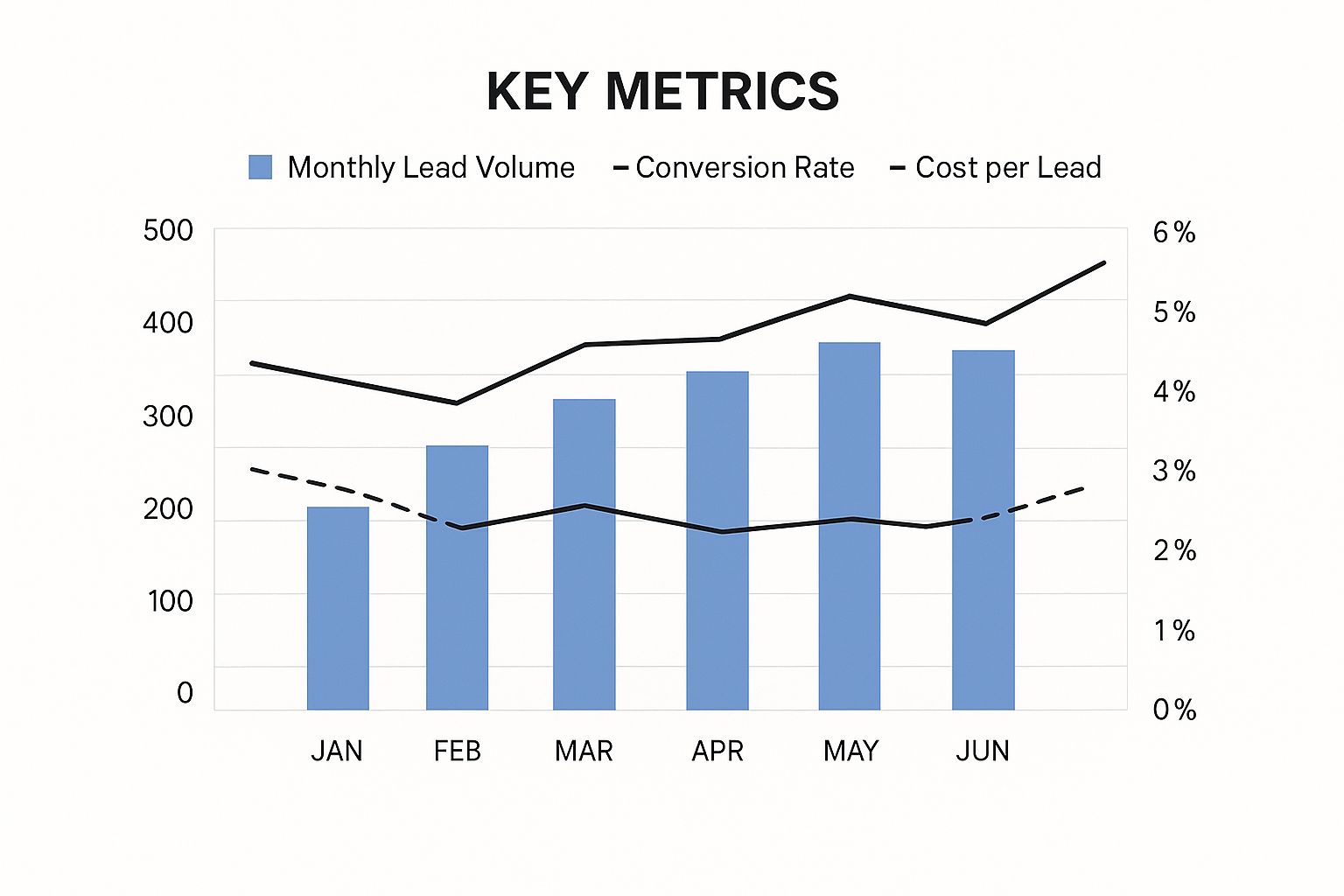
What the data shows is that as the agency dials in its strategy, you don’t just get more leads - you get better leads. That means higher conversion rates and a much healthier ROI.
Analyzing Reporting and Transparency
Finally, you need to know exactly how they’ll track and report on progress. A lack of clear, transparent reporting is a massive warning sign. You should expect regular, easy-to-digest reports that tie their work directly back to your business goals.
Insist on seeing their reporting structure upfront. You should have access to a live dashboard or receive reports covering key metrics like open rates, reply rates, meetings booked, and, most importantly, lead-to-opportunity conversion rates. The best agencies don’t just send this data over; they use it to guide strategy sessions, making you a collaborator in the campaign, not just a client waiting for an update.
Let’s talk numbers. When you bring a B2B lead generation agency into the mix, you’re not just buying a list of names. You’re investing in what should become a predictable engine for revenue. The simple truth of B2B sales is that quality trumps quantity every single time. Throwing money at a huge volume of garbage leads is one of the quickest ways to burn through your marketing budget with absolutely nothing to show for it.
The best partnerships are always built on a clear, shared understanding of what a “good lead” actually is and what it’s worth to your business. This is where your Return on Investment (ROI) becomes your north star. It’s not about the initial bill; it’s about the long-term value each qualified meeting delivers.
The Problem of Wasted Leads
Here’s a painful reality in the B2B space: a staggering number of leads go absolutely nowhere. Even though 34% of companies say lead generation is their top priority for growth, a shocking 80% of those leads never turn into a sale. This giant chasm highlights why smart nurturing is so important, but more than that, it proves you have to get the right leads from the very beginning. This is exactly where a specialized agency proves its worth - by focusing on qualification from the first interaction. You can find more lead generation statistics and trends on DesignRush.
This brutal attrition rate means every unqualified lead isn’t just a missed chance; it’s a real cost. It’s your sales team’s time down the drain, wasted marketing dollars, and a pipeline so clogged with noise that you can’t focus on the real buyers. The goal isn’t to just fill the funnel. It’s to fill it with people who have a genuine problem you can solve.
Why Cost Per Lead Varies So Much
The price you’ll pay for a single lead can swing wildly depending on your industry, and that’s completely normal. The variation is tied directly to how complex the sale is and how big the potential deal size is. A higher Cost Per Lead (CPL) isn’t a red flag if it corresponds to a much larger customer lifetime value.
Here’s a rough breakdown of what you might see for CPL across a few key sectors:
-
Technology & SaaS: Often pushes $200 or more per lead. You’re dealing with savvy buyers in hyper-competitive markets.
-
Finance & Legal: Can sit anywhere from $100 to $300 per lead, which makes sense given the high value of each new client.
-
Healthcare: Typically lands between $150 and $200, a cost driven by complex regulations and long, drawn-out sales cycles.
These numbers are worlds away from B2C eCommerce, where you might see CPLs under $50. The higher price tag in B2B is justified because a single deal can be worth tens or even hundreds of thousands of dollars, making that initial lead cost a very smart investment.
The real metric isn’t just the Cost Per Lead (CPL), but the Cost Per Qualified Opportunity. A cheap lead that never converts is infinitely more expensive than a qualified meeting that turns into a high-value customer.
Proving Worth with Attribution and Scoring
The best agencies don’t operate in the shadows with fuzzy metrics. They prove their value with clear, data-driven reports that tie their work directly to your bottom line. They do this with two powerful tools: attribution models and AI-powered lead scoring.
Attribution models are basically systems that follow a prospect’s journey, tracking every touchpoint and giving credit to the marketing efforts that influenced them. A great agency will show you exactly how their outreach campaigns led to booked meetings and, ultimately, closed-won deals.
AI-powered lead scoring takes things a step further. By chewing on thousands of data points - from a company’s size and industry to a prospect’s online behavior - these systems can predict which leads are most likely to buy. This lets the agency zero in on the highest-potential accounts, making sure your sales team only talks to people who are ready to talk. Knowing how to generate B2B leads that actually convert into sales is a science, and the right partner brings the expertise to master it. This is what turns a simple service into a true growth partnership.
Look, signing the contract isn’t the finish line. It’s the starting gun.
If you want your partnership with a B2B lead generation agency to actually work, you have to treat it like a real alliance, not just another vendor you hired. The effort you put in during those first few weeks is what sets the stage for genuine, long-term growth.
First things first: you need to establish crystal-clear goals that everyone agrees on. This goes way beyond saying, “we want 10 meetings a month.” You need to get granular. What’s the exact criteria for a lead you’d actually be excited to talk to? Think company size, specific industries, key job titles, and the precise pain points they’re struggling with. A good agency will insist on documenting this in a formal Service Level Agreement (SLA) before anything else.
Forging a Rock-Solid Feedback Loop
Once leads start trickling in, the single most important element for success is a tight feedback loop between your sales team and the agency. Without it, even the most promising campaigns will eventually fizzle out. Your sales reps are in the trenches; they know instantly which leads are gold and which are duds. The agency needs to hear that, and fast.
This can’t be a random, “Hey, that last lead was bad” kind of thing. You need a structured process. A system for your team to quickly communicate which leads were great, which were unqualified, and - most importantly - why. This information is pure gold for the agency. It lets them sharpen their targeting and messaging on the fly.
A simple shared spreadsheet or a dedicated Slack channel can do the trick. The key is to make it incredibly easy for your sales team to give feedback, otherwise, it just won’t happen.
A partnership thrives on communication. The agency needs to know what’s happening after the handoff to continuously improve campaign performance and deliver better results month after month.
When you nail this, the agency stops being an outsider. They become a true extension of your revenue team, constantly learning from real-world sales conversations and tweaking their strategy based on what the market is telling you directly.
Mastering the Lead Handoff Process
A clunky handoff process will kill your momentum. You can’t let a hard-won opportunity fall through the cracks because of a bad pass. When a qualified meeting gets booked, your sales team needs all the context, immediately.
This includes the important stuff, like:
-
The specific pain points the prospect brought up during outreach.
-
Which part of your value proposition actually got their attention.
-
Any questions they asked or objections they raised early on.
This context is what allows your sales rep to walk into the conversation warm. It shows they’ve done their homework and builds instant rapport. The smoother you can make this transition, the higher your conversion rate will be. To see how this fits into the bigger picture, you can dig into our complete lead generation in B2B playbook to success.
By setting clear goals, building a tight feedback loop, and perfecting the lead handoff, you stop treating your agency like a simple service provider. They become a true growth partner. This collaborative effort is how you maximize your investment and build a powerful, predictable engine for your business.
Frequently Asked Questions

Even after mapping everything out, it’s natural to have a few lingering questions before you pull the trigger on hiring a B2B lead generation agency. I get it. Let’s tackle some of the most common ones I hear so you can move forward with total confidence.
How Quickly Can I Expect to See Results?
This is the big one, right? While every campaign has its own rhythm, there’s always a ramp-up period. A good agency will spend the first two to four weeks doing the foundational work - deep research, building targeted lists, and getting the tech side buttoned up.
You should expect to see the first meetings hitting your calendar within 30 to 60 days. From there, performance and lead quality should steadily climb as the agency gets more data and fine-tunes its strategy.
Be skeptical of anyone promising you a flood of leads overnight. Real, sustainable lead generation is about building a well-oiled machine, not just flipping a switch. That first month is all about pouring the concrete for long-term growth.
What Is the Difference Between a Lead and a Qualified Appointment?
This is a critical distinction, and getting it wrong can sink your entire campaign. Frankly, a “lead” can be nothing more than a name and an email scraped from a list. On its own, it’s practically worthless.
A “qualified appointment” is entirely different. It’s a confirmed meeting on your calendar with someone who has been vetted against your specific criteria. They fit your ideal customer profile, they know what you do, and they’ve actually agreed to a sales conversation.
Always, always make sure your agreement is built around qualified appointments, not just raw leads. This simple detail forces the agency’s goals to align perfectly with your sales team’s needs.
What Should I Expect to Pay for These Services?
Pricing isn’t one-size-fits-all, but most agencies stick to one of a few common models.
-
Pay-Per-Appointment: This one’s straightforward. You only pay when the agency books a qualified meeting for you. It’s a performance-first model with very little upfront risk.
-
Monthly Retainer: You pay a set fee every month for a specific scope of work. This is pretty standard for more complex, ongoing campaigns that require a lot of strategic oversight.
-
Hybrid Model: This blends the two, usually involving a smaller monthly retainer to cover base costs, plus a bonus for each successful appointment booked.
The right choice really boils down to your budget and how much risk you’re comfortable with. If you’re just dipping your toes into outsourcing, a pay-per-appointment model is often the smartest way to start. It creates a direct line between what you spend and what you get, ensuring you only pay for tangible results. Any B2B lead generation agency that’s confident in its ability to deliver will be happy to work this way.
Ready to fill your sales pipeline with high-quality, qualified appointments without the risk of retainers or setup fees? Fypion Marketing operates on a pure pay-per-meeting model, so you only pay for results. Book a free consultation today and discover how our data-driven outreach can fuel your growth.