
How to Send a Cold Email That Gets Replies: A B2B Playbook

The most popular advice about cold email starts in the wrong place: write a clever subject line, add a first name, and send more follow-ups. None of that helps if your messages reach spam folders or your list contains people who don’t need what you sell. A cold email campaign is a monitored sales process, not a copywriting exercise.
Learning how to send a cold email means connecting targeting, sending infrastructure, useful messages, and reply handling. The result worth optimizing isn’t an open. It’s a qualified conversation that becomes a meeting with someone who could realistically buy.
How the Sequence Runs and When to Stop
Cold email sequence timing and purpose
Use this example calendar as a starting template, not a universal sending schedule. The lengths are drafting constraints, not performance benchmarks.
| Touch | Day | Purpose | Length |
|---|---|---|---|
| Email 1 | Day 1 | Specific reason for contact and one question | 75–125 words |
| Email 2 | Day 4 | New angle or proof point in the same thread | 50–90 words |
| Email 3 | Day 9 | Short bump asking one direct question | 25–50 words |
| Breakup (optional) | Day 16 | Resource offer and clean close | Short enough to offer the resource and close without another pitch |
Plan the whole conversation before loading contacts into your sequence tool. Your opening email establishes relevance, the follow-up adds evidence, and the final question lets the recipient clarify whether there’s a fit. A breakup email is optional, not something every prospect must receive.
Keep the audience tightly defined. In Hunter’s analysis of 11 million cold emails, campaigns sent in 2024 to 50 or fewer recipients averaged a 5.8% reply rate, compared with 2.1% for campaigns exceeding 1,000 recipients, according to Hunter’s cold email report. That comparison supports starting narrow, but it doesn’t prove that reducing list size alone improves performance.
Give every follow-up a job
Reply in the original thread so the recipient can see the context. Add something they haven’t already received: a relevant implementation detail, a useful objection answer, or evidence that addresses their situation.
Say you’re contacting sales leaders expanding into a new region. The opening message might address account selection; the next could explain how you’d separate local buyers from global headquarters. The final message can ask whether regional pipeline belongs to that person’s team.
If a touch adds no information, remove it. A message that merely announces your persistence isn’t useful to the buyer. For wording options, use this follow-up email guide to develop a message with a reason to exist.
Don’t assume a longer sequence is better. In 2025, three-round cold-email campaigns generated the highest reported average reply rate, 9%, in Belkins data cited by HubSpot’s sales statistics. Treat that as directional evidence, not a promise for your vertical.
Put stop rules into the tool
Configure these rules before launch:
- Any reply: Pause automation immediately and assign a human owner.
- Positive reply: Confirm the relevant problem and move toward a meeting.
- Neutral reply: Answer the question or send the requested resource without restarting the pitch.
- Negative reply: Thank the recipient where appropriate and remove them from further outreach.
- Unsubscribe: Honor it immediately and add the address to your suppression list.
- Sequence completed: Suppress nonresponders rather than automatically recycling them.
An out-of-office message needs human review too. Don’t let an automated response trigger an irrelevant sales reply or cause the next scheduled email to arrive during the recipient’s absence.
Practical rule: Persistence earns its place only when the next message makes the decision easier.
For another planning reference, the cold outreach tips from HarvestMyData can help you review your campaign approach before loading the sequence. Keep your own calendar, reply ownership, and stopping conditions explicit rather than copying a cadence unchanged.
Find Prospects and Research Triggers
Build your list around a role with a recognizable business problem, not everyone who might conceivably use your product. A sales director entering a new market needs a different message from a founder still validating demand.
Use company sector, region, operating model, and relevant role as inclusion criteria. This email list segmentation guide can help turn those criteria into separate audiences instead of a mixed spreadsheet.
Record evidence, not decoration
Keep a row per person, with these fields:
- Role and responsibility: Why this person might own the problem.
- Business trigger: A product launch, hiring initiative, market expansion, or office opening.
- Evidence and date: Where you verified the event and when it happened.
- Problem hypothesis: What the change might make harder.
- Address status: Whether the email has been verified and cleared against suppression records.
A trigger isn’t proof of pain. An office opening might create a staffing challenge, but don’t tell the recipient they’re struggling unless you know that.
Verify addresses before sending, remove invalid contacts, and exclude generic role inboxes from a person-led test. Keep opted-out and unsuitable contacts out of future imports. A researched list is useful only if the underlying facts are accurate.
How to Set Up Sending Infrastructure First
Infrastructure comes before copy because a well-written message in spam tells you little about whether the offer works. Start from your verified prospect list, then establish a sending environment you can inspect and control.
Use the flow below as an operational checklist, not a guarantee of inbox placement.
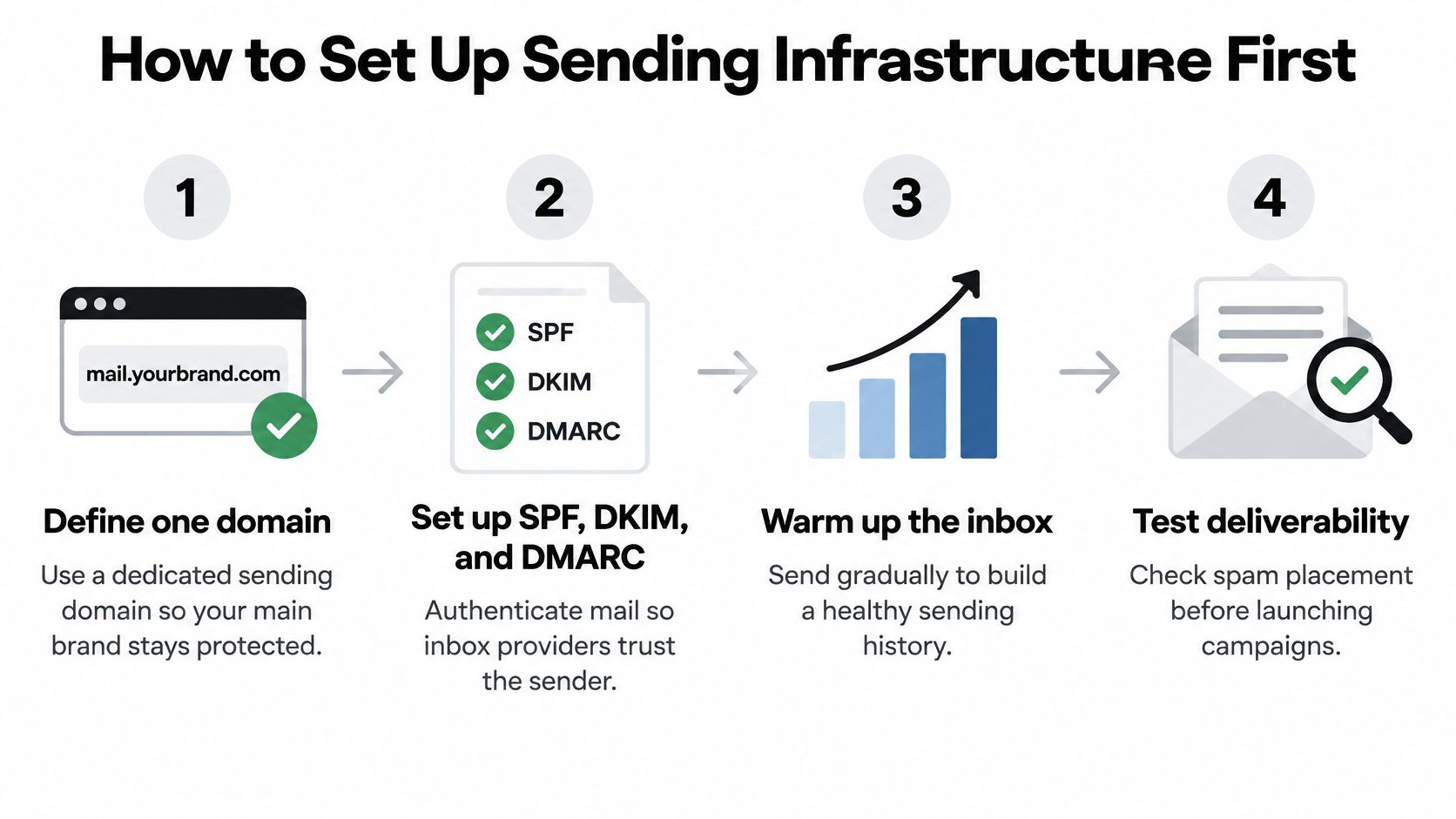
Configure and test before launch
-
Separate outreach from core company email. Use dedicated sending infrastructure with an honest, recognizable sender identity. Our primary company domain is never used to send cold email, and the client’s primary inbox isn’t touched.
-
Authenticate every sending domain. Configure SPF, DKIM, and DMARC, then inspect message headers to confirm authentication and alignment. Google’s authentication guidance reports that correctly configured senders typically achieve at least 95% DKIM and DMARC success, while SPF performance is often lower because third-party senders complicate authorization.
-
Check every authorized sending system. Your sequencing platform may not be the only application sending on behalf of the domain. Inventory the systems involved so you don’t troubleshoot the campaign while overlooking another sender’s configuration.
-
Build sending history gradually. Our new sending domains go through a 21-day warmup sequence before reaching full sending volume. That’s our operating process, not a universal guarantee that a domain becomes ready when the calendar expires.
-
Test delivery before expanding. Send controlled tests to mailboxes you can inspect, review authentication results, and check whether messages reach the inbox or spam. Increase activity only while the actual sending results remain healthy.
Don’t confuse a completed setup task with a healthy campaign. Authentication verifies aspects of sender identity; it doesn’t establish that recipients want your message. Likewise, a successful test inbox doesn’t prove that every prospect’s provider will handle the message the same way.
Make readiness observable
A ready setup has passing authentication, a reviewed sending history, working reply routing, and an initial campaign small enough to inspect manually. Assign someone to review failures and pause sends, rather than assuming the sequencing platform will make that decision correctly.
Keep a record of configuration changes and campaign launches. If performance drops after a new tool, mailbox, or audience goes live, that timeline helps you isolate the cause.
Separate infrastructure reduces operational exposure. It doesn’t give you permission to send irrelevant email or evade provider restrictions.
For a deeper explanation of placement versus simple acceptance, use this guide to what email deliverability means. Also check the outreach rules that apply to your recipients and configure identification and opt-out handling before launch.
Metrics to Track and Fixes When Numbers Drop
Cold email metrics, denominators and reference ranges
Open tracking isn’t a dependable primary scorecard. Use a funnel that starts with accepted deliveries and ends with attended, qualified meetings.
| Metric | Denominator | Reference range |
|---|---|---|
| Bounce rate | Emails sent | Investigate increases and remove hard-bouncing addresses |
| Spam complaint rate | Emails delivered | Keep low and act on any deterioration |
| Reply rate | Delivered emails | Use the external benchmark cautiously and confirm its denominator |
| Positive reply rate | Delivered emails | Track the trend per campaign |
| Qualified meeting rate | Positive replies | Compare against the campaign’s qualification criteria and baseline |
| Show-up rate | Booked meetings | Track attendance by audience and booking process |
Reply.io’s response-rate guide places typical B2B cold-email response around 3%–5% and notes that campaigns relying on variables alone had a 26% lower Interested rate than average. Those figures are useful context, not interchangeable targets for every audience or reporting method.
Our typical cold-email reply rates are 3%–8%+, depending on vertical. That variation is why a benchmark shouldn’t replace an account-level assessment of targeting, relevance, and meeting quality.
Define the denominator before comparing campaigns
For your dashboard, define delivered-to-reply rate as human replies divided by accepted delivered emails. Exclude automated responses, and keep positive, neutral, negative, and unsubscribe replies separate.
An accepted message isn’t necessarily an inboxed message. Also, contacts receiving several follow-ups create a different denominator from unique people reached. Label both clearly if your team reports both, and don’t compare them as if they’re the same metric.
Use the distinctions in this guide to B2B cold email response rates when reviewing vendor dashboards or reconciling campaign exports.
Diagnose the stage that failed
Delivery looks healthy but replies are weak. Inspect audience fit, the business trigger, and the offer before polishing individual words. If the problem isn’t relevant to that role, a smoother sentence won’t rescue it.
Tracked opens look strong but replies are weak. The subject might create curiosity that the body doesn’t satisfy, but tracking artifacts are another possibility. Read the subject and opening together, then test a more faithful promise rather than chasing an even higher open rate.
Replies are plentiful but meetings are scarce. Review what people said. Requests for free material, confusion, objections, and removal requests aren’t equivalent to buying interest.
Meetings are booked but attendance is weak. Inspect the handoff: was the purpose clear, did the prospect agree to it, and did the invitation contain the right context? Don’t solve a booking-process problem by sending more cold email.
Run a provider-level monitoring loop
Track bounces and complaints by mailbox provider and audience segment. When a segment deteriorates, pause it, inspect authentication and address quality, and review the messages before resuming. Maintain suppression records across every list import and sending tool.
A B2B deliverability operations guide from Loud Demand treats this as continuing risk management rather than a completed setup checklist. That’s the useful operating model: protect future sending capacity while evaluating today’s meetings.
A smaller campaign can be commercially better despite a lower raw reply rate. The deciding questions are whether suitable buyers respond, attend, and progress, not whether more people write back.
How to Write Subject Lines That Get Opened
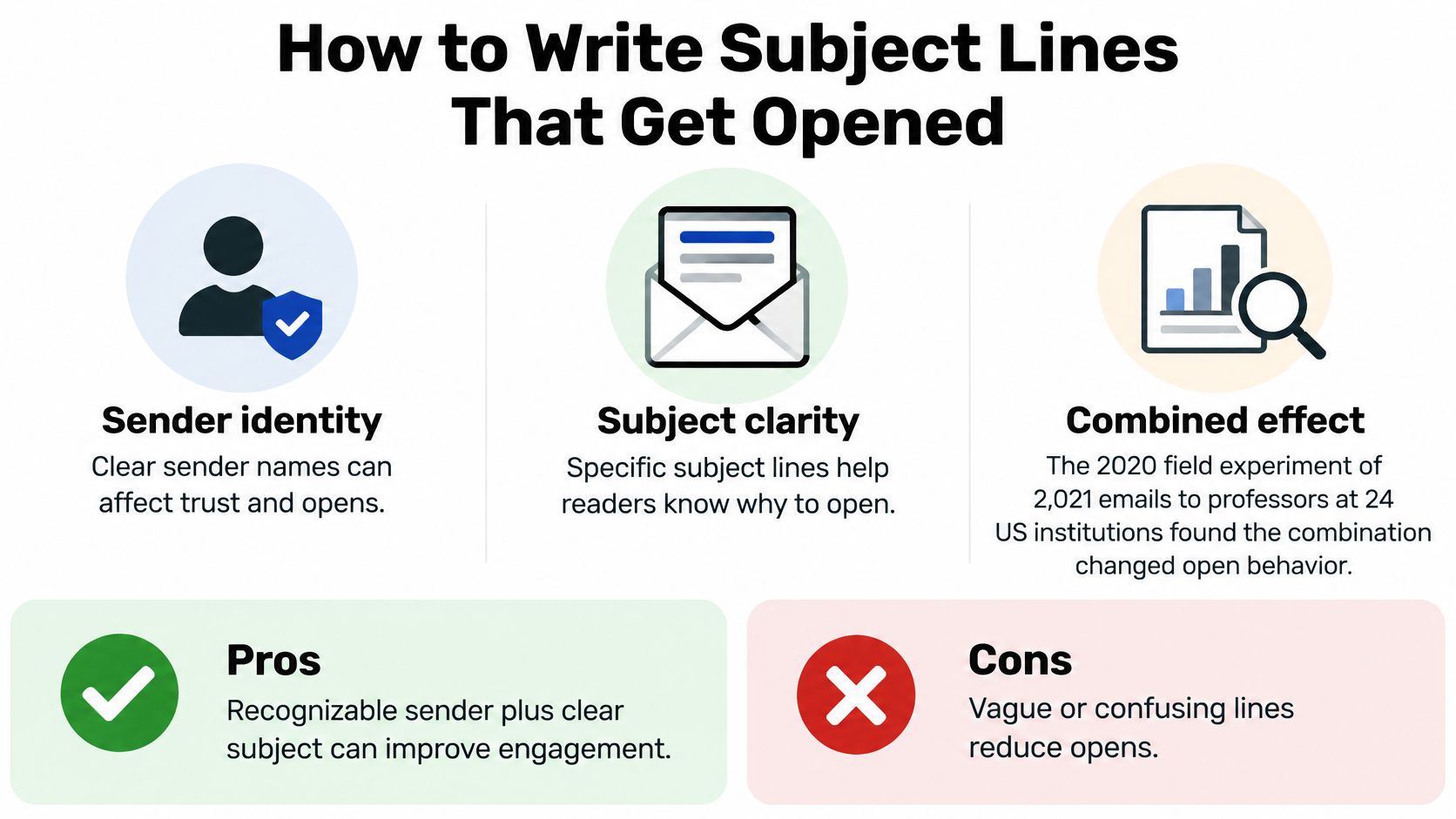
A 2020 field experiment involving 2,021 emails to professors at 24 U.S. institutions found that sender identity and subject clarity affected opening behavior, with a professional address and unclear subject producing the highest opening likelihood in that setting, according to the published first-contact email study. Opening and completing the requested action weren’t necessarily the same outcome.
That isn’t evidence that vague subjects win in B2B sales. The participants were professors receiving requests, not a representative sample of commercial buyers. The useful inference is narrower: test sender presentation and subject choices instead of treating copywriting conventions as laws.
Use this visual as a reminder of the variables, while keeping that study’s counterintuitive result in mind.
Make the subject match the message
Send from a named person with a professional address on your sending domain. Keep the subject compact enough to understand at a glance, and use a concrete noun rather than an inflated promise.
| Before | Better starting point | Why |
|---|---|---|
| quick question | leeds hiring plan | Identifies the business context |
| TRANSFORM YOUR PIPELINE!!! | regional account coverage | Replaces promotion with a specific topic |
| Re: our conversation | new market prospecting | Doesn’t imply a conversation that never happened |
| exciting opportunity | partner onboarding | Names what the recipient will read about |
These are examples, not proven winners. Lowercase can feel conversational, but don’t distort brand names or proper nouns to force a style. Clarity and honesty matter more than cosmetic consistency.
For meeting-focused messages, this meeting request subject-line guide provides additional angles to adapt to the actual purpose of the email.
Test a hypothesis, not random wording
Compare a situation-led subject with a problem-led subject while leaving the sender, body, audience criteria, and sequence unchanged. Split comparable contacts evenly and let the full sequence run before assessing the result.
Judge the variants by relevant replies and booked meetings, not just tracked opens. If a vague subject attracts attention but produces confused responses, it hasn’t improved the campaign.
A subject line should help the right buyer recognize a relevant message, not disguise why you’re contacting them.
How to Write Body Copy and a Clear Call to Action
A first-name merge tag wrapped around a generic pitch isn’t meaningful personalization. Build the message from the recipient’s situation, then use a simple structure:
- Observation: Identify a verified business event.
- Problem hypothesis: Explain a plausible consequence without claiming inside knowledge.
- Credibility: Add relevant evidence you can substantiate.
- Question: Ask for a low-effort response that advances the conversation.
The generic draft below is the habit to avoid: writing the pitch first and searching for a personal detail afterward.

A 2023 study found that first-name personalization didn’t improve performance and was associated with a nonsignificant 3.2% lower opening rate, while title-and-surname personalization increased openings by 11.8%, according to the Marketing Letters study. That doesn’t prove trigger-based copy always wins; it does undermine the assumption that adding a first name automatically helps.
The practical recommendation is to personalize the reason for contact. Explain why your offer might matter to that person’s responsibilities now.
Write an email you can defend
Say a software company has publicly announced a Leeds office, and you’re offering account research for its regional sales team. A hypothetical email could read:
Hi Maya,
Your announcement about the Leeds office caught my attention, particularly the plan to build a regional sales team.
If those reps are prospecting across Yorkshire, distinguishing local decision-makers from head-office contacts may become an early account-planning task.
We build account maps around buying responsibility, rather than company location alone. I can show you the research format so you can judge whether it would help your team.
Is regional account coverage something you’re working through as the office gets established?
Alex
Account research
The email makes a conditional hypothesis rather than announcing that Maya has a problem. It also offers something concrete without inventing a client result.
If you have approved evidence from a comparable company, use it in place of the process explanation. A substantiated result can strengthen credibility, but no proof point is better than fabricated proof. Don’t borrow an industry statistic and imply it’s your customer outcome.
Make the next step smaller
Ask whether the problem is relevant before requesting a large commitment. A question about current priorities lets the recipient qualify themselves without opening a calendar, reading a deck, and evaluating a vendor all at once.
For a complementary sales-focused perspective, CleanMyList’s guide to book meetings through cold outreach can help connect the initial response to the next conversation. Keep the first email focused on earning that response rather than completing the entire sale.
Use the video below as an additional walkthrough while reviewing your draft.
Before sending, remove attachments, unnecessary links, and competing asks. Prefer plain formatting, short paragraphs, and a simple signature. Read the message aloud: if you wouldn’t say it to a colleague, rewrite it.
Launch a Twenty-Prospect Test This Week
Use a small pilot to inspect the process before expanding it. Treat the following as a proposed experiment, not a statistically conclusive test.
- Select the audience. Build a list of twenty verified prospects who share a role, business trigger, and plausible need.
- Prepare the messages. Draft the opening and follow-ups, then create subject variants that change only the angle being tested.
- Confirm readiness. Set up or request dedicated sending infrastructure and finish the warmup process before launching the pilot.
- Run the sequence. Review replies manually, apply your stop rules, and suppress nonresponders when it ends.
- Schedule a review. For the example calendar, review on day fourteen after launch using delivered-to-reply, positive-reply, and meeting outcomes.
With a pilot this small, a single response can change the apparent winner. Keep promising wording as a hypothesis for the next comparable group, not a settled conclusion.
Choose whether to run the test yourself or have a team manage the setup and ongoing operation. Either way, start with a campaign you can inspect, explain, and stop.
Fypion Marketing handles cold email targeting, verified lists, sending infrastructure, copy, testing, and ongoing optimization, with payment only for meetings the client confirms were a good fit. Visit Fypion Marketing to book a free 15-minute call covering your ideal customer profile and current outbound setup, a relevant case study from your vertical, and the engagement structure if there’s a fit.