
B2B Appointment Setting: Master the b2b appointment setting
Let’s be clear: B2B appointment setting isn’t just about filling your sales team’s calendar. It’s the strategic process of scheduling meetings with qualified potential customers - the decision-makers who actually have a problem your solution can solve. This goes way beyond basic lead generation; we’re talking about securing real conversations that move the needle.
The Reality of Modern B2B Appointment Setting

If you’re still thinking about mass cold-calling and generic email blasts, it’s time for a reality check. The old playbook is dead. Today’s B2B buyers are smarter, more informed, and have absolutely zero patience for irrelevant pitches cluttering their inbox.
The whole point of a modern appointment setting strategy is to efficiently build sales pipeline and feed your sales team a steady stream of high-quality opportunities.
This new landscape demands a completely different approach - one built on precision, genuine value, and trust from the very first touchpoint. Modern buyers do their homework, and they expect you to do yours before you ever hit “send.”
To really understand this shift, it helps to see the old way versus the new way side-by-side.
Modern vs Traditional Appointment Setting
Here’s a quick comparison of the outdated tactics versus the effective, modern strategies you need to be using to succeed.
| Focus Area | Traditional Approach (Outdated) | Modern Approach (Effective) |
|---|---|---|
| Targeting | ”Spray and Pray” - casting a wide net | Hyper-targeted, Account-Based Marketing (ABM) |
| Messaging | Generic, one-size-fits-all scripts | Highly personalized and value-driven |
| Goal | Volume of calls/emails sent | Quality of conversations booked |
| Mindset | Transactional, focused on the sale | Relational, focused on building trust |
| Research | Minimal to none | Deep research on company & individual pain points |
As you can see, the modern approach is far more strategic. It’s about quality over quantity, every single time.
Why Personalized Outreach Is Non-Negotiable
Modern appointment setting is really an extension of Account-Based Marketing (ABM) principles. Instead of chasing a massive list of individual leads, you identify your best-fit, highest-value accounts and then focus all your energy on engaging the key people within those companies.
This isn’t just a trend; it’s a fundamental requirement for a few big reasons:
-
Bigger Buying Committees: Big decisions are rarely made by one person anymore. You need to connect with a whole group of people, from a CTO worried about integration to a CFO scrutinizing the ROI.
-
Longer, More Complex Sales Cycles: High-ticket B2B deals don’t close overnight. Building real relationships through personalized, relevant communication is the only way to stay top-of-mind and guide prospects through their decision-making process.
-
Insane Levels of Competition: Your prospect’s inbox is a warzone. The only way to cut through that noise is with a message that speaks directly to their unique challenges and business goals.
For a deeper dive, check out our guide to developing a modern B2B marketing strategy to learn more.
The proof is in the data. A staggering 73% of B2B buyers actively avoid irrelevant outreach. This isn’t just a preference; it’s a clear signal that precision targeting is non-negotiable.
This has created a massive gap in the market. While 90% of B2B marketers agree that appointment setting is effective, industry research shows that only a measly 21% are actually doing it properly.
That gap? That’s your opportunity. It’s a wide-open field for any company willing to adopt a smarter, more targeted, and more human approach to outreach.
Defining Your Ideal Customer and Building Your Target List
Before you even think about writing a subject line, the fate of your B2B appointment setting campaign is already being decided. It all comes down to one thing: knowing exactly who you’re talking to. Guesswork is a surefire recipe for an empty calendar and a lot of wasted time.
The only way to build a campaign that actually works is to start with a meticulously crafted Ideal Customer Profile (ICP). This isn’t just a vague idea of a company you could sell to. It’s a detailed blueprint that goes way beyond basic info like industry or company size. The very first thing you need to do is understand how to create an ideal customer profile that genuinely points you toward sales.
Think of your ICP as a living document, a tool that lets your team spot a perfect-fit account almost instantly.
Beyond the Basics of an ICP
A truly powerful ICP layers in deeper, more actionable data points. If you want a profile that gives you a real edge, you have to dig into these key components.
-
Technographics: What software and tech stack are they already using? Knowing a prospect uses a competitor’s product, a tool that integrates with yours, or even an outdated system gives you a perfect conversation starter.
-
Buying Signals: These are real-time events that signal a company might be ready to make a move. Think a recent round of funding, hiring a new C-level executive, or a big spike in job postings for a specific team. These are green lights.
-
Specific Pain Points: Don’t just guess at generic problems. You have to connect their industry’s challenges to their specific role. A VP of Sales at a tech startup has completely different headaches than a Director of Operations at a manufacturing plant.
For a much deeper dive, our guide walks you through building and using your B2B ideal customer profile from the ground up.
Your ICP is the north star for this entire process. It’s not about finding companies that could buy from you. It’s about focusing all your energy on those that should buy from you because the value is just that obvious.
Building and Verifying Your Target List
Once you have a crystal-clear ICP, you can get to work building a high-quality contact list. This is where so many campaigns fall apart. A brilliant email sent to the wrong person - or worse, a dead email address - is completely worthless.
Your mission is to get accurate, direct contact information for the key decision-makers you identified in your ICP.
A few powerful platforms can help you build this list with serious precision:
-
LinkedIn Sales Navigator: It’s pretty much unbeatable for pinpointing the right people inside your target companies based on their job title, seniority, and department.
-
ZoomInfo & Apollo.io: These data powerhouses give you extensive databases of direct-dial phone numbers and verified emails, often loaded with the technographic and intent data we talked about earlier.
After you’ve built a list, there’s one final step that you absolutely cannot skip: verification.
Email bounce rates over 5% can wreck your domain’s sending reputation, which means your future campaigns will go straight to spam. Use a tool like NeverBounce or ZeroBounce to clean your list before you launch. It’s a small step that protects your domain and makes sure your well-crafted messages actually get seen.
Writing Cold Emails That Actually Get Replies
Let’s be honest: your ideal prospect’s inbox is a battlefield. They get hit with dozens, if not hundreds, of emails every single day. If you want any shot at booking a meeting, your email can’t just show up - it has to cut through the noise, spark some real curiosity, and feel immediately relevant.
This gets even harder when you consider how people buy today. Over 96% of B2B tech buyers are doing most of their homework long before they ever agree to a call with a sales team. This means your email isn’t just an introduction. It’s a critical touchpoint with someone who is already highly informed and has zero time for generic fluff. You can get more insights on how buyers approach the sales process on martal.ca.
Success here really boils down to a simple formula: genuine personalization plus a very low-friction ask.
Deconstructing the Perfect Cold Email
Every single part of your email has a job to do, from the subject line all the way to your sign-off. Getting it right is the difference between an instant delete and a curious reply. Let’s break down what works.
-
The Subject Line: Your goal isn’t to be clever; it’s to be clear and intriguing. Ditch the clickbait. Focus on creating some professional curiosity. Instead of something vague like “Quick Question,” try “Idea for [Company Name]‘s content strategy” or “Regarding your recent post on LinkedIn.”
-
The Opening Line: The very first sentence has to be about them, not you. Generic openers like “Hope you’re having a great week” are dead giveaways of a mass email. Instead, lead with something that proves you’ve done your homework.
A powerful opening line shows you’ve invested more than 30 seconds of your time. Reference a recent article they wrote, a podcast they appeared on, or a company announcement. This builds instant rapport and proves your email isn’t just another automated blast.
Crafting a Compelling Message Body
Okay, you’ve got their attention. Now the body of your email needs to quickly connect their world to what you offer. Brevity is everything. Use short, easy-to-scan paragraphs to explain the problem you’ve noticed and hint at a better way.
And please, don’t just list features. Frame your value around a tangible result. For instance, instead of saying, “Our software has an analytics dashboard,” try something like, “Saw you’re hiring more SDRs - our clients typically cut ramp time by 40% by giving new hires a clearer view of pipeline activity.” This connects a real-world action (hiring) to a specific, desirable outcome. You can check out more practical examples in our article on proven cold email templates that book meetings.
Finally, your call-to-action (CTA) needs to be ridiculously easy to say “yes” to. Stop asking for a “30-minute demo.” To a busy person, that feels like a massive commitment. A much smarter approach is a simple, interest-based question.
CTA Examples That Work
-
“Would you be open to learning more?”
-
“Is this a priority for your team right now?”
-
“Mind if I send over a short video explaining how it works?”
These CTAs are designed to start a conversation, not demand a meeting. They open the door for a reply, and that reply is the first real step toward getting a qualified appointment on the calendar.
Launching and Managing Your Outreach Campaign
You’ve got a verified list and some killer email copy ready to go. Now for the fun part: execution.
Getting this stage right is a mix of technical know-how and being incredibly disciplined with your process. This is where all your prep work pays off and turns into actual booked meetings for your sales team. It’s all about scaling your outreach without torching your sender reputation.
First things first, and you absolutely cannot skip this: warming up your domain. If you just fire off hundreds of emails from a brand-new or cold domain, you’re practically begging to land in the spam folder. The warmup process involves slowly, methodically increasing your sending volume over a few weeks. Think of it as introducing yourself to email providers like Google and Microsoft, showing them you’re a legitimate sender, not some spammer blasting out junk.
This controlled ramp-up is critical for the long-term health of your B2B appointment setting. It’s how you build a solid sender reputation that keeps your emails landing in the inbox for every campaign you run down the road.
The diagram below breaks down the essential parts of a solid cold email - from the subject line that grabs their attention to the final nudge that gets them to act.
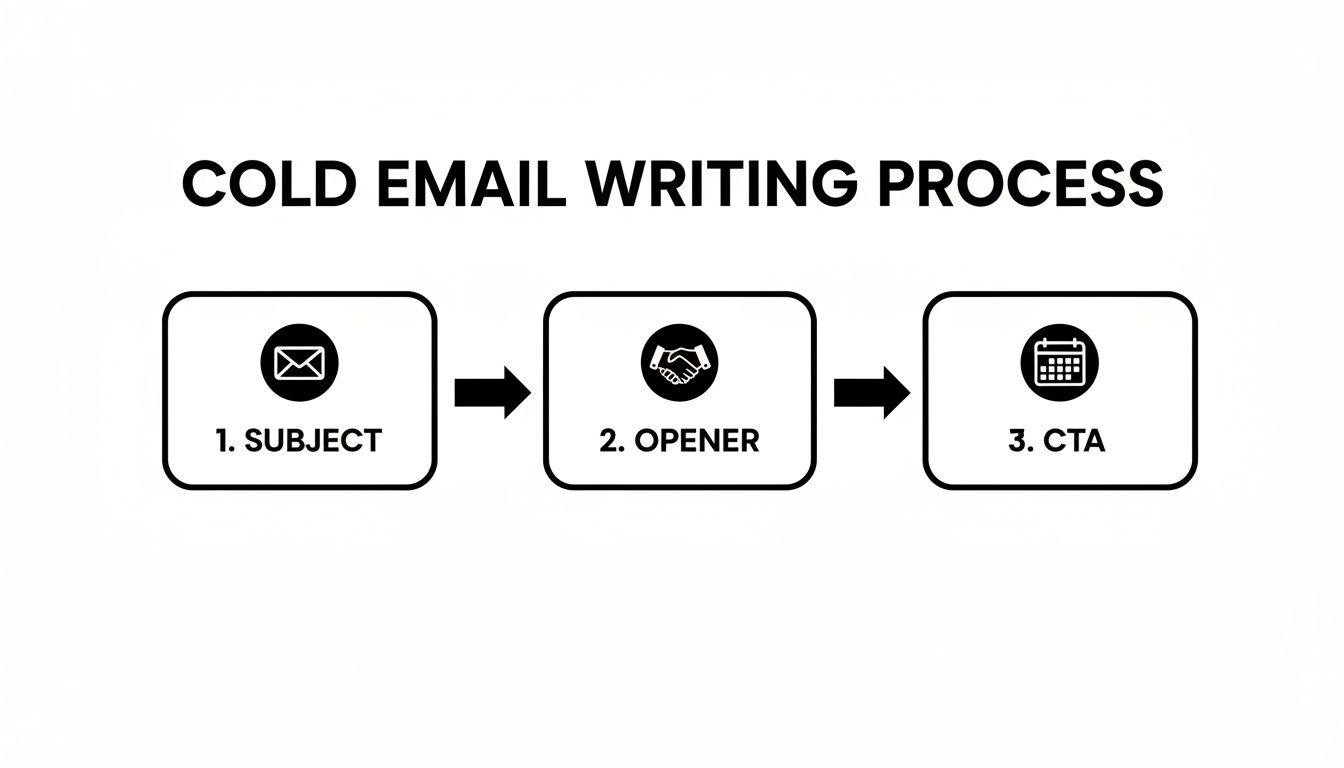
This shows how every piece - the subject, the opener, and the call-to-action - has to work in harmony to take a prospect from being mildly curious to actually booking a call.
Streamlining Campaign Management
Let’s be real: manually sending and trying to keep track of hundreds of follow-up emails is a recipe for disaster. This is exactly why sales engagement platforms like Outreach or Salesloft are non-negotiable. These tools put your entire outreach sequence on autopilot, sending follow-ups at just the right intervals until you get a reply.
This isn’t just about saving a ton of time; it’s about enforcing consistency. Prospects are busy. They often need multiple pings before they even notice you. In fact, some studies show it can take 8 or more touches to get on their radar. Automation makes sure nobody ever falls through the cracks. For a deeper dive, check out our guide on effective cold email management.
A well-structured workflow is your playbook for handling every type of response. It removes guesswork and allows your team to manage conversations efficiently, ensuring every interested prospect is handled correctly and promptly.
Handling Responses and Booking Meetings
Once the replies start rolling in, you need a crystal-clear process for what to do next. Not every positive response is a qualified lead, so your first job is to quickly see if they match your ideal customer profile.
I recommend creating a simple system to categorize every email that comes back:
-
Interested & Qualified: These are your golden tickets. The goal is to get them on a calendar ASAP. Make it ridiculously easy for them by using a scheduling link from a tool like Calendly. Less friction means more booked meetings.
-
Common Objections: You’ll see the same objections over and over - “Not interested right now,” “Send me more info,” etc. Have pre-written (but always customizable) replies ready to go. This lets you send back a thoughtful response in seconds, which can often turn a soft “no” into a “maybe later.”
-
Referrals: If someone emails back and says, “I’m not the right person, you should talk to Jane,” treat that email like gold. That’s a warm intro, and it dramatically spikes your chances of actually booking that meeting.
Having this kind of structure in place means you can capitalize on every single opportunity and keep the momentum going as your campaign scales up.
Measuring Performance and Optimizing for Results
Launching a campaign is only half the work. The real growth happens when you figure out what’s working, what isn’t, and - most importantly - why.
Forget about vanity metrics like open rates. Successful B2B appointment setting is about tracking the numbers that actually lead to revenue. It’s about using that data to make your next campaign even stronger. Your focus should be on the entire funnel, from the moment you hit “send” to the moment a qualified prospect actually shows up for a meeting.
This is how you stop being just busy and start being genuinely productive.
Key Metrics That Truly Matter
To really understand how your campaign is doing, you need to track a few core KPIs. These numbers tell the real story and point you directly to areas that need a tune-up.
-
Positive Reply Rate: This is the big one. It’s the percentage of people who respond with actual interest. This tells you instantly if your message and personalization are hitting the mark.
-
Meeting Booked Rate: This tracks how many of those positive replies turn into a scheduled meeting. If this number is low, you might have friction in your scheduling process.
-
Meeting Show-Up Rate: What good is a booked meeting if no one shows up? This metric reveals the quality of the appointments you’re setting and how committed the prospect is.
Think of these numbers as your campaign’s diagnostic tool. If you want to go deeper on this, we’ve put together a guide on mastering lead gen KPIs for business growth.
The ultimate measure of success is always return on investment. What gets measured gets managed, and a well-tuned appointment setting engine is one of the fastest ways to generate predictable pipeline growth.
Turning Data Into Action
Once you have the data, the real fun begins: optimization. The goal here is to methodically test one variable at a time to see what actually moves the needle. This is where A/B testing becomes your best friend.
You can test almost anything, but I recommend starting with the elements that have the biggest impact on your results:
-
Subject Lines: Try a straightforward, benefit-driven subject line against one that sparks a little more curiosity.
-
Email Copy: Pit a short, punchy email against a slightly longer version that offers more context or a mini case study.
-
Calls-to-Action (CTAs): Compare a soft, interest-based question like “Open to learning more?” against a more direct meeting request.
When you get this optimization process right, the ROI is impressive. In fact, top-performing teams often see a 3 - 6x return on investment within 90 - 120 days when they align lead quality with a solid follow-up game.
This cycle of measuring, testing, and refining is what separates the campaigns that fizzle out from the ones that become a reliable source of high-quality sales opportunities.
Common Questions About B2B Appointment Setting
Even with the best strategy, diving into B2B appointment setting is going to bring up questions. It’s just part of the process. Getting straight, practical answers is what separates a frustrating campaign from a successful one, helping you manage expectations and make smarter moves for long-term growth.
Let’s tackle a few of the most common questions we hear all the time.
How Long Does It Take to See Results?
This is always the first question, and the honest answer is: it depends on your industry and how complex your target market is.
You should expect to see the first positive replies trickle in and book your first few meetings within 2 to 4 weeks. Think of this as the warm-up phase. You’re getting your email domains ready and collecting the very first bits of data on what messaging is landing.
But to get a predictable, consistent flow of appointments? That usually takes about 6 to 8 weeks. By then, your campaigns are running at full steam, and you’ve had enough time to make some data-backed tweaks. For businesses with really complex sales cycles, seeing a strong ROI might take closer to 90 - 120 days as those initial meetings work their way through your pipeline and become real, tangible opportunities.
What Is the Difference Between an Appointment and a Qualified Lead?
Getting this right is absolutely critical. If you don’t, your sales team will waste a ton of time.
An ‘appointment’ is just that - a meeting on the calendar. Nothing more, nothing less.
A ‘qualified appointment’, which you might hear called a Sales Qualified Appointment (SQA), is a totally different ballgame. It’s a meeting with a prospect who has already been checked against a specific, pre-agreed list of criteria.
This checklist usually includes things like:
-
Budget: Does this company actually have the money to buy what you’re selling?
-
Authority: Are you meeting with a real decision-maker, or at least someone who has their ear?
-
Need: Do they have a clear business problem that your product or service is built to solve?
-
Timeline: Are they looking to make a move in a reasonable timeframe?
Focusing your energy on booking qualified appointments isn’t just a good idea; it’s non-negotiable. It guarantees your sales team spends their valuable time only in conversations that have a real shot at becoming customers. That’s how you dramatically improve closing rates and overall ROI.
Should I Build an In-House Team or Outsource?
This is a major strategic fork in the road. Building an internal team gives you total control over your brand and process, but it comes with some serious overhead. You’re on the hook for hiring, training, management, and the expensive tech stack you need to run campaigns the right way.
On the other hand, outsourcing to a specialized B2B appointment setting agency can get you results much faster and often for less money. You get instant access to a team of people who do this all day, every day, along with their proven processes and tech infrastructure - all without the huge upfront investment.
A pay-per-meeting performance model is especially compelling because it completely removes the risk. You only pay when a qualified meeting that meets your criteria shows up on the calendar. For companies looking to scale their sales pipeline without taking on high fixed costs, it’s a powerful way to align an agency’s success directly with your own.
Ready to fill your sales pipeline with qualified meetings without the risk? At Fypion Marketing, we operate on a pay-per-meeting model, so you only pay for results. Book a free consultation today and let us build your predictable outbound engine.