
How to Close Out an Email to Get More Replies

You’ve written the email. The subject line is solid. The opener is personalized. The body is short enough to get read.
Then you get to the last two lines and stall.
Do you end with “Best regards”? “Thanks”? “Looking forward to hearing from you”? Many treat that decision like etiquette. In B2B outreach, it’s a conversion decision. The close is where you either guide the reply or let the thread die in someone else’s inbox.
If you want to learn how to close out an email in a way that books meetings, stop thinking about the ending as a polite wrap-up. Think about it as the final prompt that tells the reader what to do next.
Why Your Email Closing Is Costing You Meetings
A lot of outreach emails fail in the last line.
The sender does the hard work up front, then finishes with a generic sign-off that adds nothing. “Best regards” isn’t offensive. It just doesn’t move the conversation. In cold outreach, that’s a problem.

Most advice online still treats email closings as manners, not pipeline mechanics. One source notes that existing content overwhelmingly focuses on generic sign-offs while under-serving cold outreach, where closings need clear CTAs and can lift reply rates by 20 to 30%, a gap it says 90% of guides still miss (IGPR).
That gap matters when your campaigns live or die by replies.
Generic closings feel safe. They also feel finished.
A neutral sign-off often signals that no response is required. That’s the opposite of what you want in prospecting.
When a buyer scans your message on a phone between meetings, your close has one job. It should reduce friction and make the next step obvious.
Practical rule: If your closing could appear at the end of a resignation email, invoice, and cold prospecting email without changing a word, it’s probably too generic for outbound.
The closing affects more than reply rate
In performance-driven outbound, the wrong close doesn’t just lower engagement. It weakens meeting quality because it attracts vague replies instead of clear next steps.
If your team tracks response benchmarks, this guide to average cold email response rate gives useful context for judging whether your current close is helping or hurting.
A good close turns interest into action. A weak one leaves action to chance.
The Anatomy of a High-Converting Email Closing
Treat the close as three separate parts, not one.
Often, everything is bundled together and called a sign-off. That’s sloppy thinking. High-performing email closings have a final sentence, a sign-off, and a signature. Each plays a different role.

According to Martal Group, the strongest B2B cold email closing uses a single actionable sentence phrased as a question. The same source says the average email response rate is 47.5%, and a branded signature can improve reply rates by up to 22% in cold email.
The final sentence drives action
This is the conversion point.
The best version is usually a low-friction question. Not a paragraph. Not two questions. Not a soft non-ask like “let me know your thoughts.”
Good final sentences do three things:
-
Ask for one action: Reply, confirm interest, or choose whether to continue.
-
Keep commitment low: Ask for a quick yes, no, or short answer.
-
Match the stage: A first cold email shouldn’t ask for the same thing as a post-demo follow-up.
Examples:
-
Cold outreach: “Would it make sense to compare notes for 15 minutes next week?”
-
Follow-up: “Is this still relevant for your team this quarter?”
-
Post-meeting: “Are you good if I send the rollout outline by Thursday?”
The sign-off sets tone
The sign-off comes after the CTA. It doesn’t replace it.
Its job is tonal. It tells the reader whether your message feels warm, formal, direct, or overly stiff. Many senders often overdo professionalism and accidentally sound distant.
A simple sign-off works best when it supports the ask:
-
Thanks in advance when you’ve asked for a reply
-
Thank you when the thread is warmer or more consultative
-
Best regards when the context is more formal
The signature builds credibility
A clean signature reassures the recipient that there’s a real person and a real company behind the email.
At minimum, include:
-
Full name
-
Role
-
Company
-
Relevant contact path: usually LinkedIn or company site
If you’re tightening personalization throughout the message, this piece on mastering cold email personalization to boost responses is worth reading alongside your closing strategy.
A strong closing doesn’t try to sound elegant. It tries to make replying easy.
Choosing Your Sign-Off with Data and Context
Word choice at the end of an email matters more than many people realize.
The strongest evidence comes from a large analysis of email threads. A review of over 350,000 emails found that “Thanks in advance” reached a 65.7% response rate, compared with a 47.5% baseline average. That’s a 38% relative increase. In the same dataset, “Best” reached 51.2% (Prospeo).
That doesn’t mean you should force “Thanks in advance” into every message. It means gratitude-based sign-offs deserve to be your default starting point, then adjusted for context.
What the data is really telling you
The lesson isn’t “copy one phrase forever.”
The lesson is that gratitude and implied reciprocity tend to outperform neutral closings. A sign-off can nudge behavior when it feels natural and connected to a specific ask.
If the email has no real CTA, even a strong sign-off won’t save it. But when the ask is clear, the sign-off can reinforce the response you want.
Email sign-offs by B2B scenario
| Scenario | Recommended Sign-Offs | Rationale |
|---|---|---|
| Cold Outreach | Thanks in advance, Thank you | Gratitude-based phrasing pairs well with a direct question and encourages a reply without sounding pushy. |
| Warm Follow-Up | Thanks, Thank you | Short and natural. Works when the prospect already recognizes your name or thread. |
| Internal Communication | Thanks, Best | Internal messages usually need less ceremony and more speed. |
| Post-Meeting Confirmation | Thank you, Best regards | Adds professionalism when confirming decisions, timelines, or deliverables. |
Match tone to audience, not your habit
A lot of sellers use the same sign-off in every email because it’s saved in their muscle memory.
That’s a mistake. A VP of Sales receiving a first-touch outbound message doesn’t need the same tone as a client contact confirming next steps after a call. The sign-off should fit the relationship, the ask, and the amount of formality the situation requires.
If your signature is still an afterthought, this walkthrough on building a professional signature on Gmail is useful because presentation and trust matter at the bottom of the email, not just the top.
The best sign-off is the one that supports the ask without calling attention to itself.
Email Closing Examples for Every B2B Scenario
Templates help, but only if they show the full closing block.
That means the final CTA sentence, the sign-off, and the signature together. If one part is off, the whole ending feels weak.
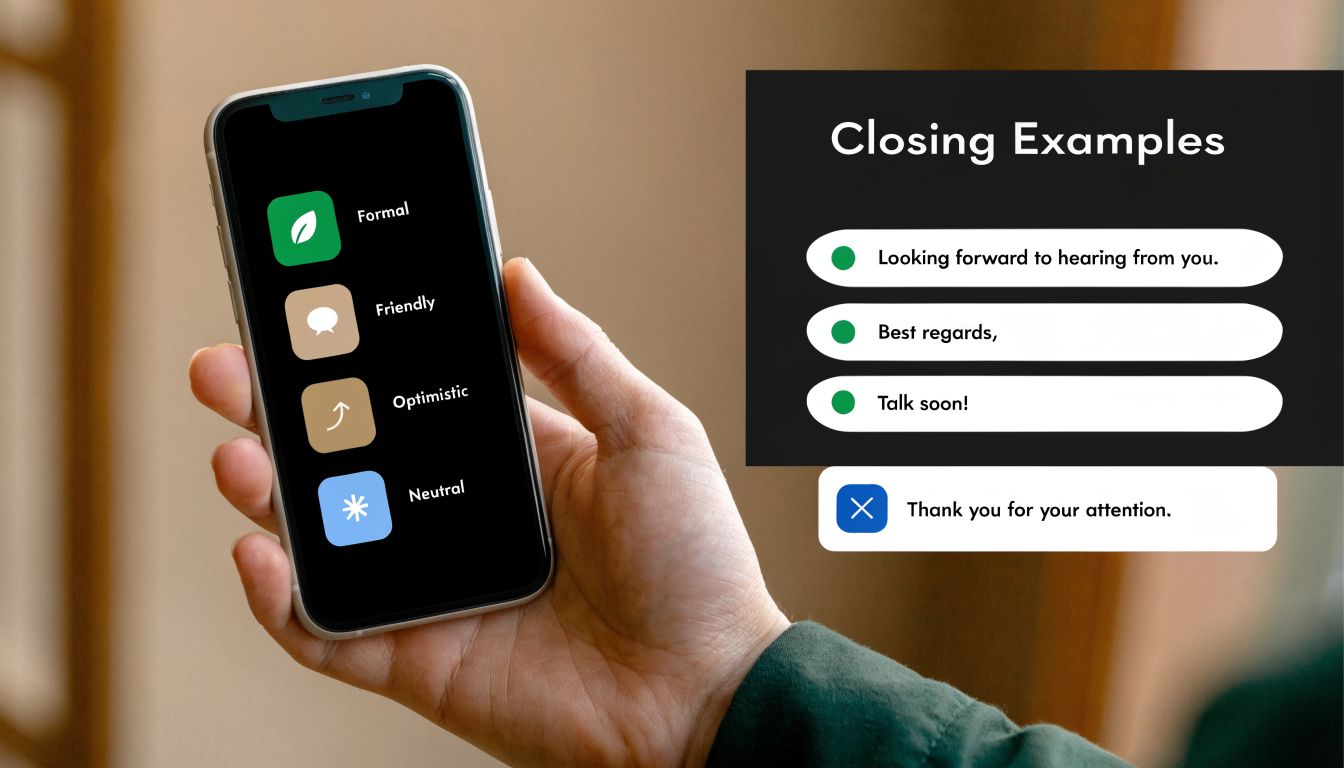
For nurturing sequences, one source recommends a data-driven closing hierarchy and notes that a simple “Thank you” can yield a 65.7% response rate in some contexts, while hyper-personalization can lift open rates to 41.9% and click-through rates to 6.7% (SQ Magazine). That’s why these examples stay specific.
Cold outreach email
You’re contacting a VP of Sales at a SaaS company.
Close like this:
If pipeline coverage is still a focus this quarter, would a short call next week be worth exploring?Thanks in advance, Jordan LeeAccount ExecutiveNorthlane Growthlinkedin.com/in/jordanlee
Why it works:
-
The question is easy to answer.
-
The sign-off supports the ask.
-
The signature is complete without becoming a billboard.
If you need broader sequence ideas around that style, this collection of cold email templates for sales that book meetings is a practical next step.
Follow-up after no response
Many senders get lazy and write “just following up.”
Use the close to create clarity instead:
Worth closing the loop here, or should I reach back out next quarter?Thank you, Jordan LeeAccount ExecutiveNorthlane Growthlinkedin.com/in/jordanlee
This works because it gives the recipient an easy out. Counterintuitively, that often makes replying easier.
Some teams try to get clever with humor in follow-ups. That can work in the right market, but it’s easy to overdo. If you’re curious where the line is, this roundup of funny email sign-offs is a good reference for what feels playful versus what feels unserious.
A quick breakdown helps here:
-
Use humor carefully: Better for warm threads than first-touch outreach.
-
Keep the ask intact: The joke can’t replace the CTA.
-
Protect credibility: If the prospect works in a conservative buying environment, stay straightforward.
Here’s a useful visual example of tone and phrasing choices in action.
Confirmation email after the meeting is booked
Once a meeting is on the calendar, the close should reduce friction and reinforce professionalism.
Use something like:
If anything changes before Thursday, just reply here and I’ll adjust.Best regards, Jordan LeeAccount ExecutiveNorthlane Growthlinkedin.com/in/jordanlee
This kind of close is different from cold outreach. You’re no longer trying to earn a reply from scratch. You’re preserving momentum and making logistics easy.
The pattern across all three examples is simple. The closer the recipient is to action, the less your closing should sound like etiquette and the more it should sound like operational clarity.
Common Mistakes and How to A/B Test Your Closings
Most email closing problems are easy to spot once you know where to look.
The hard part is fixing them with discipline instead of guesswork.
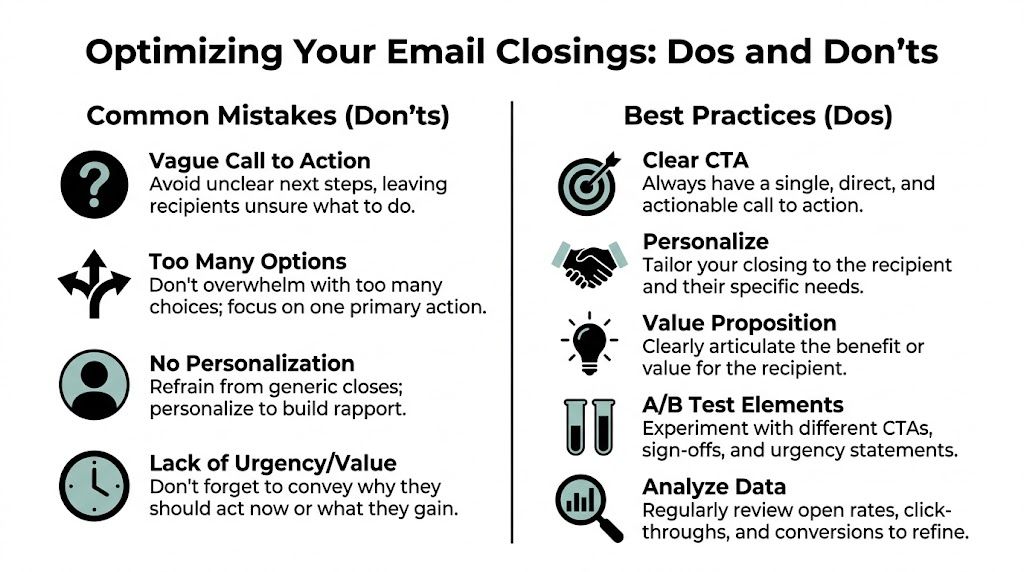
Mistakes that lower response quality
-
Multiple CTAs: “Want to chat next week, or should I send details, or maybe point you to a case study?” Pick one action.
-
Vague language: “Let me know your thoughts” sounds polite, but it doesn’t direct behavior.
-
Tone mismatch: “Cheers” can feel too casual in a formal buying process. “Sincerely” can feel stiff in a fast sales exchange.
-
No signature: If your close asks for a meeting but the bottom of the email lacks identity, trust drops.
-
No personalization in the ask: A generic CTA at the end weakens a personalized opener.
A simple A/B testing plan
Don’t test five things at once. You won’t know what changed the outcome.
Test one variable per round:
-
CTA format Compare a question against a statement.
-
Sign-off wording Compare a gratitude-based sign-off against a neutral one.
-
Signature format Compare plain text against a branded professional signature.
Track outcomes that matter to revenue, not just vanity:
-
Reply rate
-
Positive reply rate
-
Meetings booked
-
Qualified meetings booked
If your team already reviews campaign performance, these email marketing KPIs that actually drive business growth help keep the test tied to business results.
Field note: The best-performing close in one market often loses in another. Test by audience segment, not just at the account level.
What to keep constant during testing
When you test closings, keep the rest of the email stable.
Don’t change the subject line, the opener, the offer, and the close in the same batch. If you do, the result won’t tell you anything useful. Good outbound teams treat the closing like any other conversion variable. They isolate it, test it, then roll the winner into the sequence.
Turn Your Email Closing into a Conversion Tool
The bottom of your email isn’t administrative. It’s where the message either converts or fades out.
The strongest approach is simple. End with one clear question, choose a sign-off that fits the context, and use a professional signature that reinforces credibility. Then test the close the same way you’d test subject lines or copy angles.
If you’ve been treating closings as a formality, that’s the fix. Start treating them like a performance lever. More replies turn into more conversations, and more conversations turn into more qualified meetings. If follow-ups are part of your workflow, these sales follow-up email templates can help you carry that same discipline through the rest of the sequence.
If your team wants more qualified meetings from cold email without paying retainers or setup fees, Fypion Marketing is built for that model. They handle the strategy, targeting, copy, infrastructure, and optimization, and you pay for booked meetings that meet agreed criteria.