
Generation Lead B2B: Your Scalable Growth Engine
Let’s be honest, effective B2B lead generation isn’t about just scrounging up a few contacts here and there. It’s about building a predictable, repeatable system for generating revenue. This is what turns your sales pipeline from an inconsistent trickle into a reliable flow of qualified opportunities - the true growth engine for your entire business.
This systematic approach is the one thing that separates the high-growth companies from those stuck in a frustrating cycle of sporadic success.
Why You Need a B2B Lead Generation Engine

Let’s cut through the buzzwords. A structured approach to B2B lead generation is the bedrock of sustainable growth. Think of it as the machinery that ensures your sales team consistently talks to prospects who are genuinely a good fit for what you offer. That alone is a massive competitive advantage.
Instead of just relying on random acts of marketing or crossing your fingers for inbound leads, a proper lead engine puts you in the driver’s seat. It gives you the power to essentially manufacture opportunities on demand. This shift is critical for business stability and predictable forecasting, turning sales from a reactive, firefighting function into a proactive, strategic operation.
The Shift from Random Tactics to a Real System
So many businesses I see get stuck using a handful of disconnected tactics. They might throw some money at a cold email campaign one month, run a few social media ads the next, and then maybe attend a trade show. While each of these might land a lead or two, there’s no cohesive system tying it all together. The result? Inconsistent performance and a lot of wasted resources.
A true lead generation engine is a repeatable, measurable, and optimizable process. It’s not a one-off campaign; it’s a permanent asset for your business that continuously feeds your sales pipeline.
Building this engine means thinking systematically about every single step:
-
Targeting: Pinpointing exactly who your ideal customers are. No guesswork.
-
Outreach: Crafting messages that actually resonate with their specific pain points.
-
Nurturing: Building real relationships over time, not just pushing for a quick sale.
-
Measurement: Tracking what works and, more importantly, doubling down on it.
This process ensures your efforts compound over time, making your entire sales and marketing operation more efficient and effective.
A Quick Look at Old vs. New
The way we generate leads has changed dramatically. What worked ten years ago (or even three years ago) is often a recipe for wasted effort today. Here’s a quick breakdown of how modern, scalable systems stack up against outdated methods.
Modern vs. Traditional B2B Lead Generation Approaches
| Attribute | Modern Scalable Approach | Traditional Inefficient Approach |
|---|---|---|
| Targeting | Data-driven ICP, buyer intent signals, and micro-segmentation | Broad, generic lists based on firmographics alone |
| Outreach | Personalized, multi-channel sequences (email, LinkedIn, calls) | “Spray and pray” mass email blasts and generic cold calls |
| Message | Value-first, focused on solving a specific prospect problem | Product-centric, focused on features and company praise |
| Technology | Integrated stack for automation, personalization, and analytics | Disconnected tools, heavy manual work, poor data hygiene |
| Measurement | Tracking pipeline velocity, cost per meeting, and conversion rates | Vanity metrics like open rates and clicks |
| Scalability | Designed for predictable growth and easy replication | Unpredictable results, difficult to scale without massive effort |
The takeaway is simple: the modern approach is strategic and system-driven, while the traditional way relies on brute force and luck.
The Market Doesn’t Lie
The value of a well-oiled B2B lead generation machine isn’t just anecdotal; the market growth tells the story. The global B2B lead generation services market was valued at around USD 2.66 billion and is on track to hit USD 2.98 billion in the coming year.
Forecasts show this market expanding at a compound annual growth rate of about 11.91%, which could push its value to an eye-watering USD 7.33 billion by 2033. You can dig into the specifics of the B2B services market growth on businessresearchinsights.com.
This massive investment proves that businesses are waking up to the fact that building or buying a lead engine is a mission-critical function for scaling revenue. When you build your own, you create a powerful, self-sustaining asset. And in this guide, we’re going to show you exactly how to do it.
Defining Your Ideal Customer Before You Act
Launching any kind of B2B lead generation campaign without a crystal-clear Ideal Customer Profile (ICP) is like setting sail without a map. You’ll definitely be moving, but probably in the completely wrong direction.
The most successful outreach I’ve ever seen doesn’t start with a clever email template or a fancy tool. It starts with a deep, almost obsessive, understanding of who you’re actually trying to reach.
This is the foundational work that separates campaigns that limp along with a handful of replies from those that consistently book qualified meetings.
Moving Beyond Basic Firmographics
Most teams start and, unfortunately, stop with the basics: company size, revenue, and industry. While those are useful starting filters, they’re just the entry point. To build a list of prospects who are genuinely ready to buy, you have to layer on much more insightful data points.
Think about what a truly ideal customer looks like for your business. What specific challenges are they wrestling with right now? What technologies are they already using (or struggling with)?
Answering these questions turns a generic target list into a strategic weapon. For instance, knowing a prospect uses a specific CRM that integrates poorly with their marketing automation tool is a powerful entry point if your solution fixes that exact problem. This level of detail is what makes personalization at scale actually work.
Uncovering Actionable ICP Insights
So, how do you find this granular information? It requires a bit of detective work, but the tools and data are all out there.
-
Analyze Your Best Customers: Look at your top 10 happiest, most profitable customers. What do they have in common? Go beyond the obvious stuff. Look for patterns in their business models, the job titles of the people who championed your solution, and the specific events that triggered their buying journey.
-
Leverage LinkedIn Sales Navigator: This is so much more than a simple search tool. Use its advanced filters to find companies based on their technology stack, recent hiring trends, or even specific keywords in employee profiles. If you see a company is hiring a “Head of Sales Enablement,” that’s a massive signal they’re investing in the exact area your product supports.
-
Study Competitor Case Studies: Your competitors often do the hard work for you. Their case studies and testimonials highlight the exact pain points and company profiles that are in the market for solutions like yours. Analyze who they feature and what problems they claim to solve.
A well-defined ICP isn’t just a document; it’s a filter for all your sales and marketing activities. It ensures you only spend time, money, and energy on prospects who have a high probability of becoming successful customers.
The demand for this kind of focused effort is exploding. The B2B lead generation market was valued near USD 10.87 billion and is expected to grow, with forecasts suggesting a compound annual growth rate of approximately 11.33% through 2034. This growth, particularly in tech, healthcare, and finance, underscores the urgent need for precise, effective targeting. You can explore more data on the projected growth of the B2B lead generation market on marketresearchfuture.com.
ICP in Action: A Fintech Scenario
Let’s make this real. Imagine you’re a fintech company that offers a streamlined checkout and fraud prevention solution for e-commerce stores.
A weak ICP would be: “e-commerce companies in North America with 50-200 employees.” That’s way too broad. You’ll just end up with low-quality leads and a lot of wasted effort.
Now, here’s what a strong, actionable ICP looks like:
| ICP Criteria | Specific Target Details |
|---|---|
| Industry | Direct-to-consumer (DTC) e-commerce brands |
| Platform | Businesses using Shopify Plus or Magento |
| Pain Signal | Recently received a spike in negative reviews mentioning “payment issues” |
| Tech Stack | Not currently using a dedicated fraud prevention tool (e.g., Signifyd, Sift) |
| Company Signal | Recently hired a “Director of E-commerce” or “Head of Operations” |
See the difference? This level of precision is a game-changer.
Instead of sending a generic email about your checkout solution, you can now craft a highly relevant message that hits on a specific, timely pain point. For a deeper dive, check out our guide on creating a B2B Ideal Customer Profile for your own business. This specificity is what drives higher reply rates and fills your calendar with genuinely interested prospects.
Building Your Outreach Tech Stack
Let’s be honest, your B2B lead generation is only as solid as the tech it’s built on. You can write the most compelling email in the world, but if it lands in the spam folder, it’s worthless. A proper tech stack is what turns manual, one-off messages into a scalable engine that consistently hits the primary inbox.
I see this mistake all the time: people using their main company domain for cold outreach. It’s a fast track to getting your primary domain blacklisted, which can mess up communication with your actual clients and partners. The smart move is to build a completely separate infrastructure just for your outreach campaigns.
Securing Your Sender Reputation
First things first: protect your primary domain like it’s your most valuable asset. This means you need to set up dedicated domains and email accounts specifically for cold outreach.
Think of it this way. Your main domain () is your corporate headquarters. You wouldn’t run a high-volume direct mail operation from the front lobby, right? You’d set up a dedicated mailroom. For email outreach, this “mailroom” is a set of slightly different domains, like or .
This isn’t just a suggestion; it’s non-negotiable for any serious B2B lead generation effort. Here’s why:
-
Domain Health: It completely isolates your cold outreach. If you hit a deliverability snag, your core business email traffic remains untouched and healthy.
-
Deliverability: New domains need to be “warmed up.” This is a crucial process where you gradually increase the number of emails you send to build a positive reputation with providers like Google and Microsoft.
-
Scalability: Using multiple domains and inboxes is how you scale your sending volume without tripping spam filters. It allows you to send more emails safely without putting the reputation of any single domain at risk.
Setting up dedicated outreach domains isn’t just a best practice - it’s the fundamental requirement for building a sustainable lead gen machine. It’s what separates landing in the inbox from getting blacklisted.
This technical foundation supports a broader, multi-channel strategy where email is just one piece of the puzzle, often working alongside other touchpoints like social media.
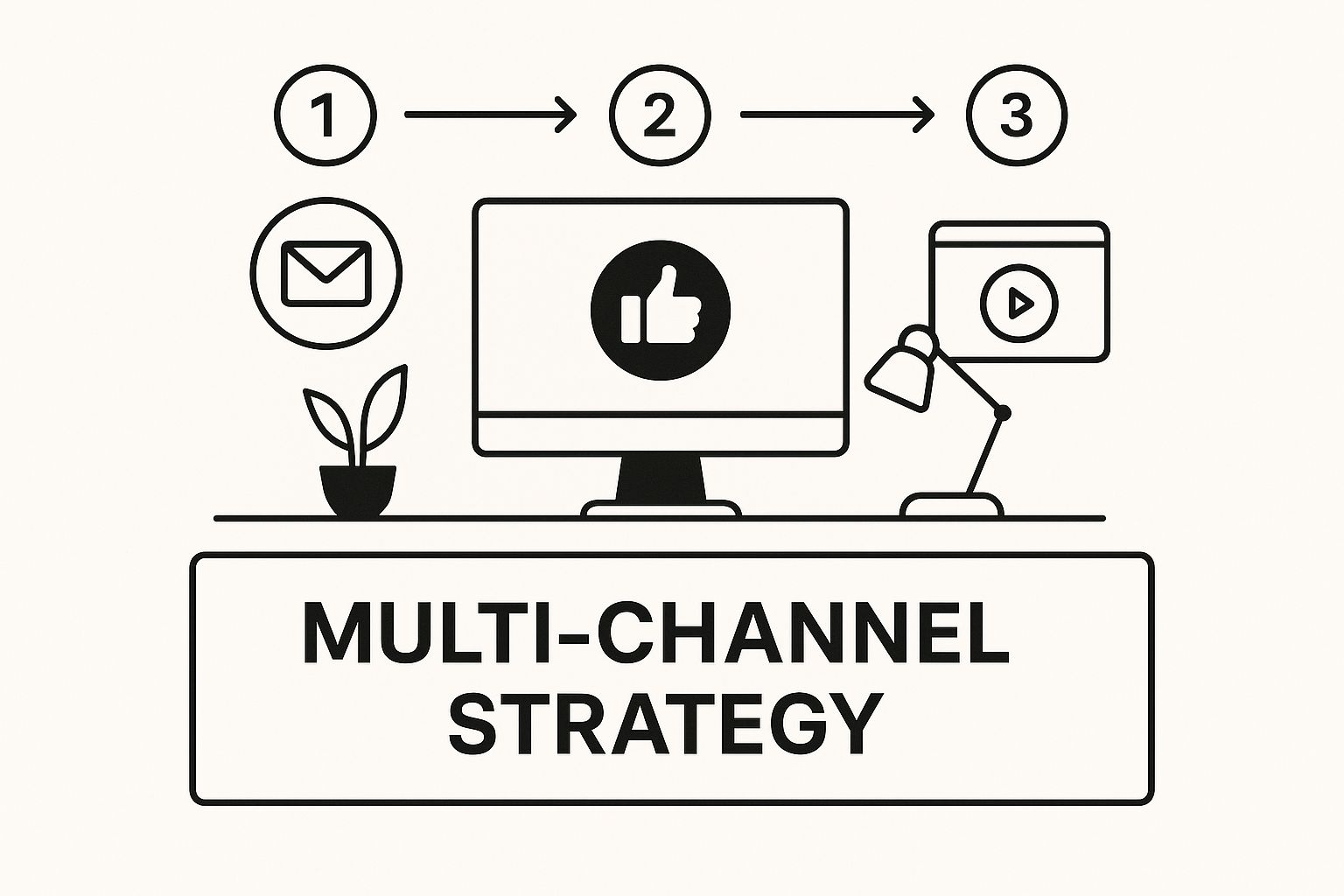
As you can see, a well-oiled system brings all your outreach channels together, making email one component of a much larger, coordinated effort.
Choosing Your Outreach Automation Platform
Once your domains are secured, you need a platform to actually run your campaigns. These tools are lifesavers, automating the sending, personalization, and tracking that would otherwise take hundreds of hours. While there are tons of options out there, a few have become the go-to choices in the industry. For a deeper dive into different tactics, you can check out these effective outbound lead generation strategies that convert.
Here’s a quick look at the top contenders we see most often:
| Tool | Key Strengths | Best For |
|---|---|---|
| Instantly | Unlimited email account warmup, very intuitive interface, and solid campaign analytics. | Teams focusing on high-volume, scalable cold email where deliverability is the top priority. |
| Smartlead | Advanced AI features for personalization, unlimited mailboxes, and a unified master inbox to manage it all. | Agencies and sales teams that need to juggle multiple clients or campaigns from a single dashboard. |
| Apollo | All-in-one platform with a huge B2B database built-in, plus a sequencer and a dialer. | Sales teams who want a single tool for everything - from finding prospects to outreach and engagement. |
While a tool like Apollo offers a tempting all-in-one package, we find that many of the highest-performing teams prefer a more specialized approach. They’ll use a dedicated outreach tool like Instantly or Smartlead and pair it with a separate data provider for list building. This gives you more flexibility and, in our experience, often leads to better deliverability.
This is what a typical campaign dashboard looks like in Instantly. It gives you a clean, immediate overview of your key metrics so you can see what’s working and what’s not. This is what you’re looking for - a tool that turns raw data into clear, actionable insights to guide your next move. Without this technical backbone, you’re just guessing.
Writing Outreach That People Actually Read
You’ve got your tech stack ready and your domains are warmed up. Now comes the hard part - the moment of truth for any B2B lead generation campaign: writing something people will actually open, read, and most importantly, reply to.
In a world flooded with generic, automated noise, the ability to write a human-sounding, valuable message is a genuine superpower. This isn’t about finding some magical template that works for everyone. It’s about understanding the core principles of persuasion to craft outreach that feels personal and delivers immediate value.
Let’s break down how to move from a bland template to a compelling conversation starter.
The Anatomy of a High-Converting Message
Every single part of your email has a job. If one piece fails, the whole thing falls apart. A weak subject line means your message never even gets seen. A confusing call-to-action (CTA) means an interested prospect has no idea what to do next.
Here’s the basic structure of an email that actually gets results:
-
The Subject Line: Its only job is to get the email opened. It needs to be intriguing and specific, not something that screams “SALES PITCH!”
-
The Opening Line: This has to be personalized and immediately relevant to your prospect. Generic openers like “Hope you’re having a great week!” are a one-way ticket to the trash folder.
-
The Value Proposition: Clearly and concisely state the problem you solve and for who. This is where you connect their pain point directly to your solution.
-
The Call-to-Action: Make it incredibly easy for them to say “yes.” You have to avoid high-friction requests like “Can I have 30 minutes of your time?” in a first email.
The single biggest mistake I see in outreach copy is making it all about you. Your prospect doesn’t care about your company’s founding story or your long list of features. They only care about what you can do for them. Frame everything through that lens.
For your B2B lead generation to work, your copy must be relentlessly focused on the recipient. Every word should earn its place by being relevant to their world, not yours.
From Generic to Genuine: A Before-and-After Example
Theory is one thing, but seeing it in action is another. Let’s look at how to transform a common, low-performing email into a personalized message that gets replies.
The “Before” Email (What most people do):
Subject: Quick Question
Hi [First Name],
I’m [Your Name] from [Your Company]. We are a leading provider of innovative HR software solutions designed to streamline employee onboarding and performance management. Our platform helps companies like yours boost efficiency and save time.
Would you be open to a 15-minute demo next week to see how we can help?
Best, [Your Name]
This email is a classic example of what not to do. It’s completely self-centered, vague, and offers zero real value. This will get ignored by 99% of the people you send it to.
The “After” Email (A much better approach):
Subject: Saw you’re hiring a new HR Generalist
Hi [First Name],
Noticed on LinkedIn you’re expanding your HR team at [Company Name]. Typically when companies bring on new generalists, it’s because the manual onboarding process is starting to strain the existing team.
We help HR leaders at SaaS companies like [Competitor Name] automate their onboarding checklists, cutting new hire admin time by about 8 hours per employee. This frees up the team to focus on culture and retention instead of paperwork.
No demo needed - is this something on your radar right now?
See the difference? This version works because it’s built on observation and empathy. It shows you did your homework, understands a likely pain point, provides a specific, juicy outcome, and uses a low-friction CTA. This is the kind of outreach that starts actual conversations. To explore more approaches like this, you can review some proven B2B lead generation strategies for 2025.
The Multi-Touch Sequence: Adding LinkedIn to the Mix
Stopping after just one email is a rookie mistake. The hard truth is that most of your replies will come from the follow-ups. A well-structured multi-touch sequence keeps you top-of-mind without being annoying.
This is where combining email with LinkedIn touches becomes incredibly powerful. LinkedIn is a goldmine for B2B engagement. In fact, over 53% of B2B marketers use it to find prospects and gather intel. It’s a key channel for modern B2B lead generation, and you’re leaving money on the table if you ignore it.
A simple but effective sequence might look something like this:
-
Day 1: Send the personalized email (like our “after” example).
-
Day 1: Send a connection request on LinkedIn with a short, personalized note referencing the email. Something like: “Hi [First Name], just sent you a note about your HR team’s growth. Looking forward to connecting.”
-
Day 3: Send a brief follow-up email. Keep it short and sweet, and try to add more value. Maybe share a link to a relevant case study or a helpful blog post.
-
Day 5: Engage with their content on LinkedIn. Like or comment on a post they shared. This is a subtle, non-intrusive way to stay on their radar.
-
Day 7: Send one final email. This is your “breakup” email where you politely close the loop.
This multi-channel approach makes your outreach feel more like a professional relationship being built, rather than just another sales pitch clogging up an inbox. You’re surrounding the prospect with value in a way that respects their time and attention.
How to Measure and Scale Your Success
Launching your first B2B lead generation campaign is a huge milestone, but it’s just the starting line. The real work - and the real growth - is what comes next. Winning this game isn’t about getting lucky with one great campaign; it’s about being relentless with testing, digging into the data, and smartly scaling what actually works.
This is the point where you stop thinking like a marketer and start thinking like a data scientist. Your campaign dashboards are more than just report cards. They’re diagnostic tools telling you exactly where your outreach is hitting the mark and, more importantly, where it’s falling apart.
Key Metrics That Actually Drive Growth
It’s easy to get sidetracked by vanity metrics. Sure, a high open rate feels good, but it doesn’t pay the bills. For any serious B2B lead generation effort, you have to lock in on the numbers that directly translate to revenue.
Here are the metrics that truly matter:
-
Positive Reply Rate: This is the golden number. It’s the percentage of prospects who reply with genuine interest. A high positive reply rate is the clearest sign that your messaging and targeting are perfectly aligned. It means your copy is striking a chord with the right people.
-
Meetings Booked: This is the ultimate bottom line of your outreach. How many qualified conversations did your campaign actually generate for the sales team? For most pay-for-performance models, this is the main event.
-
Lead-to-Meeting Rate: Of all the people who replied positively, what percentage actually got on the calendar? A big drop-off here might point to friction in your scheduling process or a slow handoff when someone is managing the replies.
You could have an 80% open rate, but if your positive reply rate is hovering near zero, your campaign is a failure. Don’t chase ego-boosting stats; focus on the metrics that build a real pipeline.
Understanding how these data points influence each other is critical. For a deeper dive into tracking these numbers, check out our guide on the most important lead generation KPIs to boost marketing success.
Diagnosing Problems with Data
Your metrics tell a story. If you learn to read that story, you can pinpoint exactly what needs fixing, which saves you from wasting time on random guesses and changes that go nowhere.
Think of it like a doctor diagnosing a patient - you look at the symptoms (the data) to find the root cause of the problem.
Common Scenarios and What They Mean
| Data Point | What It Likely Means | Your Next Move |
|---|---|---|
| Low Open Rate (<40%) | Your subject lines are falling flat, or you have a deliverability issue. | A/B test new subject lines immediately. Run a deliverability test on your domains to check for blacklists or spam folder placement. |
| High Opens, Low Replies | You got them in the door, but the email body didn’t deliver. The message wasn’t relevant or compelling. | The copy is the problem. A/B test your opening line, your value prop, and your call-to-action. |
| High Replies, Low Meetings | People are interested, but they aren’t converting to a call. Your reply handling is slow, or your call-to-action isn’t clear. | Review your reply management process. Is someone responding quickly? Are you making it dead simple to book a meeting? |
| High Unsubscribe Rate | Your targeting is way off. You’re hitting people who have zero interest in what you’re offering. | Go back to your Ideal Customer Profile (ICP). Your list is probably full of poor-fit prospects. Time to refine it. |
This data-driven approach takes all the emotion and guesswork out of optimization. It transforms campaign management from a game of chance into a logical, repeatable system for improvement.
The Power of Systematic A/B Testing
Once you’ve diagnosed a problem, A/B testing is how you find the solution. The key is to be scientific about it. If you change five things at once, you’ll have no clue which change actually moved the needle.
Isolate one variable at a time and test it against a control. Make sure you have a meaningful sample size - I usually recommend at least 1,000 prospects per variation to get reliable data.
Key elements to A/B test in your campaigns:
-
Subject Lines: Pit a straightforward, benefit-driven subject line against something more intriguing or curiosity-based.
-
Opening Lines: Does personalizing based on a recent LinkedIn post work better than mentioning their company’s latest funding round? Test it and find out.
-
The Offer/CTA: Compare a “soft” ask (e.g., “Is this a priority for you?”) against a more direct one (e.g., “Open to seeing a quick case study?”).
-
Follow-up Timing: Test the cadence of your sequence. Does following up in two days generate more replies than waiting four days?
By constantly running these small, focused tests, you methodically improve every single piece of your outreach. Over time, these tiny wins compound into a massive increase in performance, turning a so-so campaign into a highly predictable engine for B2B leads. This disciplined testing is the true foundation for scaling your success.
Common B2B Lead Generation Questions

As you start to build and scale your B2B lead generation engine, you’re bound to hit some practical questions and roadblocks. It happens to everyone. This section tackles some of the most common queries we get, giving you quick, field-tested answers to help you navigate the tricky parts of outreach and grow with confidence.
How Many Follow-ups Are Appropriate?
This is the classic question. The honest answer isn’t a magic number, but a guiding principle: most of your positive replies will come from follow-ups, not the first email. It’s just the reality of busy inboxes.
A sequence of three to five emails spread out over a few weeks is a solid baseline for any campaign. The real key, though, is to make each follow-up valuable. Don’t just send a lazy “bumping this to the top of your inbox” message. Share a new piece of information, a relevant case study, or a different angle on your value proposition.
If you get radio silence after five attempts, it’s probably best to move on. Add them to a long-term nurture list and try again in a few months.
What Is the Best Time of Day for Outreach?
You can find countless studies trying to pinpoint the “perfect” sending time, but the truth is, it completely depends on your industry and the specific person you’re trying to reach. Traditional wisdom often points to Tuesday, Wednesday, and Thursday mornings as prime time. And for many, that works.
But sometimes, a contrarian approach can be surprisingly effective.
Sending an email on a Monday morning or a Friday afternoon might just catch an executive when their inbox is less chaotic. My best advice? Use your outreach tool’s scheduling feature to A/B test different send times and days. Let your own data tell you when your audience is most likely to engage.
The most crucial element isn’t the exact time you send the email, but the quality of the message itself. A hyper-relevant email sent at a “bad” time will always outperform a generic one sent at the “perfect” time.
How Should I Handle Negative Replies?
Let’s get one thing straight: negative replies are a normal and expected part of any cold outreach campaign. The most important thing is how you handle them - gracefully and professionally. Never, ever argue or get defensive.
Here’s a simple way to approach it:
-
Categorize the Reply: Is it a simple “not interested,” a “wrong person,” or an angry “take me off your list”?
-
Act Immediately: For any “take me off your list” request, unsubscribe them on the spot and send a quick confirmation that you’ve done it. This is non-negotiable for compliance and protecting your sender reputation.
-
Be Polite: For a standard “not interested,” a brief and polite reply is all you need. Something like, “Thanks for the heads-up, I’ve made a note not to contact you again. All the best,” works perfectly.
A professional response can sometimes turn a negative into a neutral, and I’ve even seen it lead to a future positive when that person’s circumstances change down the road.
How Do I Measure the ROI of My Campaigns?
Measuring Return on Investment (ROI) is what separates a guessing game from a scalable strategy. The core formula is straightforward: divide the total revenue generated from the campaign by the total cost of running it. This cost should include everything - tools, data, and any agency fees.
The tricky part is that a full B2B sales cycle can take months. So, in the short term, you need to focus on leading indicators. The one I swear by is Cost per Qualified Meeting. This metric tells you exactly how much you’re spending to get a high-quality conversation on the sales team’s calendar.
For a deeper dive into this, we’ve put together a guide on how to qualify B2B leads with proven strategies that can really help you sharpen your measurement. It gives you a real-time pulse on campaign efficiency long before the final deals close.
Ready to fill your pipeline without all the guesswork? At Fypion Marketing, we specialize in performance-based B2B lead generation. You only pay for qualified meetings, so our success is tied directly to yours. Book a free consultation today and let us build your scalable growth engine.