
Your Guide To B2B Cold Outreach for Pipeline Growth

Cold outreach isn’t about blasting a generic message to thousands of strangers and hoping something sticks. Forget that. It’s the art of starting a genuine conversation with specific people at specific companies who have no idea who you are… yet.
Think of it as a strategic process of identifying, personalizing, and delivering real value to a hand-picked audience to kick off a meaningful business relationship.
What Is Cold Outreach and Why It Still Drives B2B Growth

Imagine a skilled diplomat making a first introduction, not an unwanted door-to-door salesperson. That’s good cold outreach. It’s the craft of connecting with decision-makers at companies that perfectly fit your ideal customer profile, even if they’ve never heard of you. The goal isn’t an instant sale - it’s simply to earn a conversation.
This proactive approach is the backbone of outbound sales, where you actively hunt for prospects instead of waiting for them to come knocking. To really get a handle on this, you need to understand what is outbound sales and how it works. It’s all about creating opportunities from scratch.
The Core Channels of Modern Outreach
The idea is simple, but cutting through today’s digital noise requires a smart, multi-channel approach. Each channel has its own strengths, and when you combine them, you create a powerful system for getting noticed.
-
Cold Email: This is the workhorse of B2B outreach. It’s scalable, you can personalize it down to the tiniest detail, and it lands you directly in a professional’s inbox.
-
LinkedIn Messaging: Perfect for building a professional connection. LinkedIn lets you do your homework on prospects, engage with what they’re posting, and slide into their DMs in a more natural, conversational way.
-
Strategic Cold Calling: Far from dead. A well-timed, well-researched phone call can be the fastest way to have a real conversation, tackle objections on the spot, and qualify a lead in minutes.
These aren’t islands. The most successful campaigns weave them together - blending email sequences with LinkedIn connection requests and a timely follow-up call to create multiple, meaningful touchpoints.
The difference between spam and great outreach is one word: relevance. Spam is a generic blast to a faceless crowd. Strategic outreach is a tailored message sent to a carefully chosen person with a specific problem you can solve.
Why Cold Outreach Remains Essential for B2B Growth
In a world where inbound leads can be a rollercoaster - expensive one month and non-existent the next - cold outreach gives you a direct, controllable way to grow your pipeline. It lets you be incredibly precise, targeting the exact industries, company sizes, and job titles that make up your best customers. You’re not casting a wide net; you’re throwing a spear. For a deeper look, check out these powerful B2B lead generation strategies for sustainable growth.
Ultimately, this method puts you in the driver’s seat. You’re not just sitting around waiting for the market to come to you. You’re defining your ideal market and starting conversations on your own terms. That proactive stance is gold when you’re launching a new product, breaking into a new industry, or just trying to build a predictable stream of qualified sales meetings. It’s about creating demand, not just capturing it.
Building Your High-Performance Outreach Engine
A great cold outreach campaign isn’t about luck - it’s engineered. Think of it like building a high-performance race car. You wouldn’t just bolt some parts together and hope for the best. You’d obsess over every detail, making sure the engine, chassis, and aerodynamics work in perfect harmony to create a machine built for speed and reliability.
That’s exactly what we’re going to do here. This is your blueprint for building a predictable lead generation engine. We’ll walk through the essential pillars, from big-picture strategy to the nitty-gritty technical details, so you can consistently book qualified meetings.
Laying the Foundation: Your Ideal Customer Profile
Before you write a single line of copy or pull a single contact, you have to know exactly who you’re talking to. This is where your Ideal Customer Profile (ICP) comes in. An ICP isn’t just a vague idea; it’s a laser-focused description of the perfect company you want as a customer. Getting this right starts with solid sales prospecting best practices to make sure you’re aiming at the right target.
A strong ICP goes way beyond basic info like industry and company size. It gets into the details that signal a perfect fit:
-
Technographics: What software or tech stack are they using? This can be a goldmine, revealing integration opportunities or hinting at frustrations with their current tools.
-
Company Triggers: Did they just get a new round of funding? Hire a new VP of Sales? Announce an expansion? These events create fresh needs and open up budgets.
-
Pain Points: What are the real-world business challenges companies like this are struggling with? Your solution needs to be the answer to that specific problem.
Nailing down your ICP is the most critical step of all. It’s the compass that guides every other decision you make. A fuzzy or non-existent ICP is the #1 reason cold outreach campaigns crash and burn.
Assembling the Parts: Building a Hyper-Targeted Contact List
Once your ICP is crystal clear, it’s time to build a list of people who actually fit that profile. I’m not talking about buying some massive, generic email list. That’s a one-way ticket to the spam folder and a torched domain reputation.
Instead, you need to build a curated list with surgical precision. This means using data tools like ZoomInfo, Apollo.io, or SalesIntel to find the specific individuals inside your target accounts. The goal is a clean, accurate, and highly relevant list of decision-makers. Data hygiene is non-negotiable; you have to verify every contact to keep your bounce rate low and protect your sender reputation. A high-quality list is your premium fuel; a bad one will clog the engine before you even leave the garage.
For a deeper dive into defining your audience, check out our guide on how to create buyer personas for better outreach.
The Technical Tune-Up: Ensuring Email Deliverability
Here’s a hard truth: you can have the world’s best list and the most persuasive message, but if your emails land in spam, none of it matters. This is where the technical setup becomes absolutely crucial. So many businesses skip this part, and it’s the difference between hitting the inbox and being totally invisible.
Think of deliverability as your email’s passport. Without the right credentials and a good reputation, you won’t get past the border guards of spam filters.
To make sure your emails are actually seen, you need to properly authenticate your sending domain. This involves setting up a few key technical records that act as trust signals for email providers:
-
SPF (Sender Policy Framework): This record basically tells the world which servers are allowed to send emails on your domain’s behalf. It’s like an official ID card for your emails.
-
DKIM (DomainKeys Identified Mail): This adds a digital signature to your emails, proving the message wasn’t faked or messed with in transit. Think of it as a tamper-proof seal on a package.
-
DMARC (Domain-based Message Authentication, Reporting & Conformance): This is the final layer. It tells receiving servers what to do with emails that fail the SPF or DKIM checks, giving you more control and security.
On top of the technical records, you also have to “warm up” your email domain. You can’t just fire up a new account and start blasting out hundreds of emails a day. You need to slowly ramp up your sending volume over a few weeks, acting like a real human to build a positive reputation with Google and Microsoft. It’s a methodical process, but it’s what proves you’re a legitimate sender, not a spammer.
Crafting High-Octane Fuel: Personalized and Compelling Copy
Okay, your targeting is locked in, your list is clean, and your technicals are solid. Now it’s finally time to write the actual message. The golden rule of cold email copy is simple: make it about them, not you.
Your prospect doesn’t care about your company, your funding, or your long list of features. They only care about their own problems, their own goals, and their own headaches.
Good copy is built on personalization and value. A structure that works time and time again is to think in terms of a simple conversation. Here’s how the pieces fit together:
| Copy Element | Purpose | Example |
|---|---|---|
| Personalized Hook | Grabs their attention by showing you’ve done your homework. Reference a LinkedIn post, company news, or a specific challenge related to their role. | ”Saw your recent post on scaling your sales team - congrats on the growth.” |
| Problem Statement | Quickly state a relevant pain point that someone in their position faces. This shows you get their world. | ”Many VPs of Sales struggle to maintain lead quality as they scale outreach.” |
| Value Proposition | Briefly introduce your solution as the answer to that problem. Focus on the outcome, not the features. | ”We help B2B companies book qualified meetings with ideal-fit prospects without sacrificing quality.” |
| Clear Call-to-Action | Make the next step easy and low-commitment. Don’t ask to “book a demo.” Suggest a quick chat to see if there’s even a fit. | ”Are you open to a brief 15-minute call next week to see if this could support your goals?” |
Remember, the goal of your first email isn’t to close a deal; it’s just to start a conversation. Offer value, respect their time, and make it ridiculously easy for them to say “yes” to a next step. When you meticulously build each part of this outreach engine, you stop relying on random acts of outreach and start creating a predictable system for generating high-quality leads.
Executing a Multi-Touch Outreach Sequence That Works
Sending one cold email and just hoping for a reply is like buying a single lottery ticket and expecting to hit the jackpot. Sure, it could happen, but it’s not a strategy. The real muscle in cold outreach is the multi-touch sequence - a planned series of interactions across different channels that methodically builds awareness and earns a response.
Think of it as a friendly, professional conversation that unfolds over a few weeks. A single email is incredibly easy to miss, delete, or just plain ignore. But a thoughtful sequence of emails, maybe mixed with a LinkedIn connection request or a timely comment, shows you’ve done your homework and are genuinely interested. It turns a shot in the dark into a strategic dialogue.
This flow chart breaks down the essential groundwork you need to lay before launching any outreach campaign. This is the foundation your multi-touch sequence will be built on.
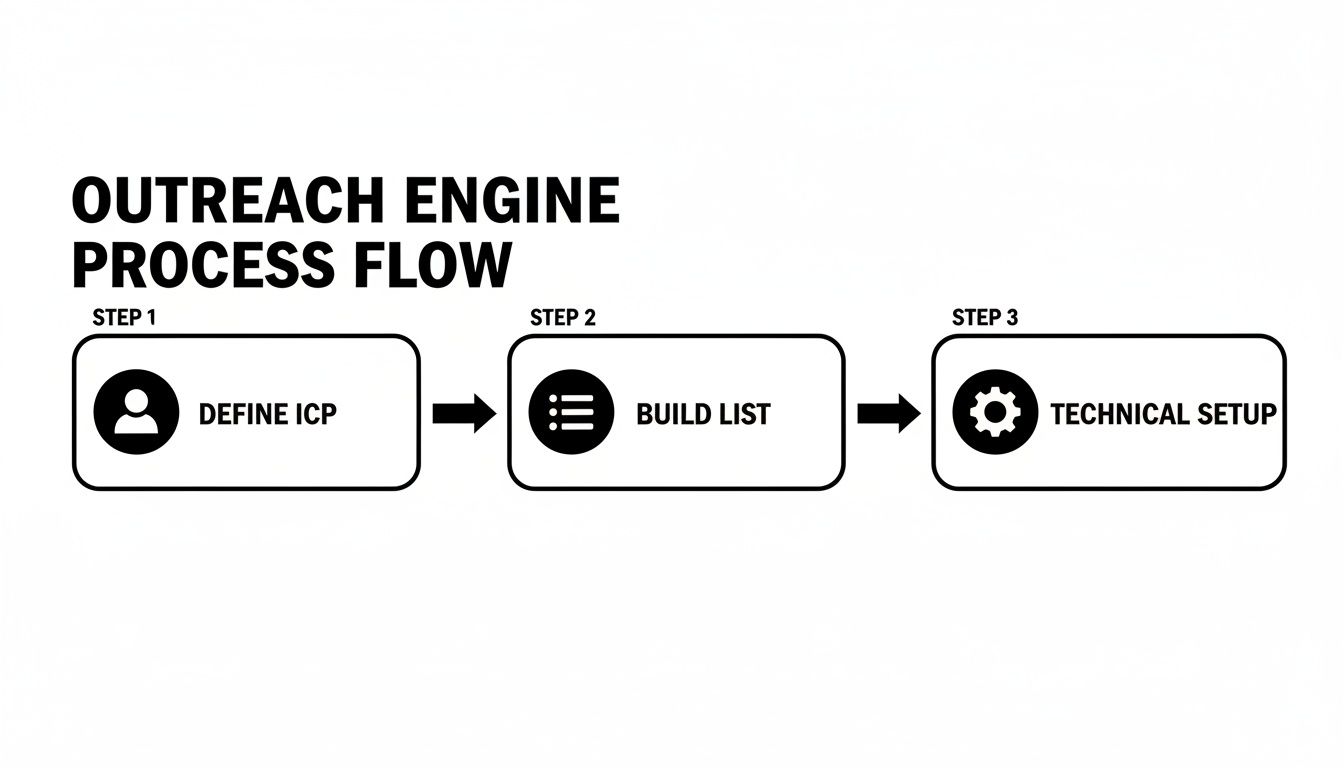
As you can see, every solid sequence starts with the basics: defining your Ideal Customer Profile (ICP), building a clean list, and getting your tech stack in order. You can’t even think about sending emails until that’s handled.
Designing Your Outreach Blueprint
The goal of any sequence is to be persistent without being a pest. That means every single touchpoint needs to feel fresh and add a little bit of value, not just be a lazy “bumping this up” message. A well-designed sequence usually involves 4-7 steps spread out over two to three weeks.
Here’s a practical framework for building a sequence that actually gets replies:
-
Touch 1 (Day 1): The Personalized Introduction (Email) Your first email sets the entire tone. It needs to be hyper-personalized, zeroed in on a pain point relevant to their role, and close with a simple, low-effort call-to-action.
-
Touch 2 (Day 3): The LinkedIn Connection Pop over to LinkedIn and send a connection request. Add a quick, non-salesy note that mentions your email, something like, “Sent you a quick email about [topic] - thought it would be great to connect here, too.”
-
Touch 3 (Day 5): The Value-Add Follow-Up (Email) Your second email should never just say “checking in.” Offer something new. A relevant case study, a link to a helpful article, or a fresh take on the problem you solve works wonders.
-
Touch 4 (Day 8): The Social Engagement Engage with one of their recent LinkedIn posts. A thoughtful comment shows you’re actually paying attention to what they do and not just blasting out templates. For some great message ideas, check out our guide with 7 cold email templates for B2B outreach.
-
Touch 5 (Day 12): The Quick Bump (Email) This is where a shorter email can work. Refer back to your original point, keep it brief, and make it incredibly easy for them to reply.
-
Touch 6 (Day 16): The Breakup Email If you’ve heard nothing but crickets, the final email politely closes the loop. This one often gets a response because it creates a little bit of professional courtesy and a soft sense of urgency.
The Power of Persistence, Proven by Data
It’s easy to get discouraged after one or two tries go unanswered, but the data is crystal clear: the real magic happens in the follow-ups. In the world of B2B sales, persistence pays off. Big time.
The most common mistake in cold outreach is giving up too soon. Most replies come after the third or fourth touchpoint, meaning most people quit right before they would have succeeded.
Recent industry benchmarks drive this point home. While the very first email in a sequence snags 58% of replies, a massive 42% of all positive responses come from the follow-ups. And those elite campaigns that break a 10% reply rate? They almost always use sequences of 4-7 emails to get there. The numbers don’t lie - a multi-channel, multi-step approach isn’t just a nice-to-have; it’s how you build a predictable pipeline.
Ultimately, a great sequence respects your prospect’s time while showing them your value from a few different angles. It takes patience, good organization, and a real commitment to being helpful, but it’s what turns cold contacts into warm conversations.
How to Measure and Optimize Your Campaign Performance
Successful cold outreach is driven by data, not guesswork. If you’re not tracking the right numbers, you’re just flying blind, completely unable to tell what’s working, what’s broken, and where your best opportunities are hiding. It’s the difference between building a predictable growth engine and just hoping for the best.
To really get this right, you have to move beyond vanity metrics. Sure, a high open rate feels good, but it doesn’t pay the bills. The real story of your campaign’s health is told by the numbers that track actual progress toward your ultimate goal: revenue.
Core Metrics That Actually Drive Results
Don’t get bogged down by a dozen different data points. To diagnose and improve your campaigns, you only need to focus on the handful of key performance indicators (KPIs) that connect directly to business outcomes.
Here are the essential metrics you need to live and breathe:
-
Reply Rate: This is your primary gut check for message resonance. If your open rates are decent but your reply rate is in the gutter, it almost always points to a problem with your copy, offer, or targeting.
-
Positive Reply Rate: Not all replies are created equal. This metric cuts through the noise of “not interested” and “unsubscribe” responses, showing you exactly what percentage of prospects are genuinely engaging with your offer.
-
Meeting Booked Rate: For top-of-funnel success, this is the money metric. It measures how effectively your outreach converts interest into actual sales conversations, proving your campaign is generating truly qualified leads.
-
Lead-to-Close Rate: This is the final piece of the puzzle. This KPI tracks how many of those booked meetings eventually turn into paying customers, giving you a crystal-clear picture of your outreach ROI.
By focusing on this handful of metrics, you create a clear diagnostic funnel. For a deeper look, check out our guide on the essential KPIs for lead generation in 2026.
Turning Data into Action Through A/B Testing
Once you’re tracking the right metrics, you can start optimizing. The most effective way to do this is through systematic A/B testing, also known as split testing. The process is simple: change one single variable between two versions of an email to see which one performs better.
Think of A/B testing as a scientific experiment for your sales process. By isolating one variable at a time - the subject line, the call-to-action, the opening sentence - you can definitively prove what resonates most with your audience.
This methodical approach removes all the guesswork and allows you to make data-backed decisions that compound over time. Even tiny, incremental improvements in your reply or meeting-booked rates can have a massive impact on your pipeline down the line.
Key Variables to Test for Maximum Impact
While you can test almost anything, some changes deliver a much bigger bang for your buck. Start by focusing your A/B tests on these high-leverage components of your cold email campaigns:
-
Subject Lines: Test a benefit-driven subject line (“Idea to boost X”) against a highly personalized one (“[Prospect Name] <> [Your Name]”). The goal is to see what best captures attention and curiosity in a crowded inbox.
-
Call-to-Action (CTA): Compare a direct CTA (“Are you free for a call next week?”) with an interest-based CTA (“Worth exploring?”). This tells you whether your audience prefers a clear next step or a lower-commitment question.
-
Opening Line: Pit a personalized opener referencing a LinkedIn post against one that mentions a shared connection or a company trigger. This reveals what kind of personalization is most effective at building immediate rapport.
-
Value Proposition: Test different ways of framing your solution. One version might focus on saving time, while another emphasizes increasing revenue. This helps you hone in on the core pain point that actually drives action.
To give you a clearer picture, we’ve put together a table of the most important KPIs and what good, better, and best look like in the real world.
Essential Cold Outreach KPIs and Benchmarks for 2026
| Metric | Average Benchmark | Top Performer Goal | What It Tells You |
|---|---|---|---|
| Open Rate | 40-60% | 70%+ | Your deliverability is solid and your subject line is intriguing. |
| Reply Rate | 2-5% | 8%+ | Your message, offer, and CTA are resonating with the audience. |
| Positive Reply Rate | 1-2% | 3.5%+ | You’re not just getting replies; you’re starting real conversations. |
| Meeting Booked Rate | 0.5-1% | 2%+ | Your campaign is successfully converting interest into qualified meetings. |
| Lead-to-Close Rate | 15-20% | 30%+ | The leads you’re generating are high-quality and a good fit for your business. |
Use these benchmarks as a starting point. Your numbers will vary based on your industry and offer, but this gives you a solid target to aim for as you begin testing and optimizing your campaigns.
Recent industry data highlights just how critical these elements are. Imagine sending over 2 million emails only to find that just 2.09% of people reply. Of those, only 14.1% show real interest, meaning you need to contact 157 people just to find one hot lead. This same dataset revealed that email length and tone are king, with emails between 50-125 words achieving 42.67% open rates.
By continuously testing and refining, you turn cold outreach from a guessing game into a predictable science.
Common Cold Outreach Mistakes You Need to Avoid
Even a campaign with the best intentions can fall completely flat. It’s almost never bad luck, though. More often than not, it’s a few predictable - and entirely avoidable - mistakes that sink the ship before it even leaves the harbor.
Most campaigns fail before the first email is even sent. The biggest blunders happen in the planning stage, undermining the entire effort from the very start. Getting these right will put you miles ahead of the competition.
Ignoring the Foundational Technical Setup
One of the most devastating mistakes is blowing off email deliverability. You can spend hours crafting the perfect message, but it’s all for nothing if it lands in the spam folder. Skipping the technical setup is like building a house with no foundation - it’s going to collapse.
I’m talking about properly configuring your SPF, DKIM, and DMARC records. Think of these as your email’s passport. They are non-negotiable trust signals that prove to providers like Google and Microsoft that you are who you say you are. If you don’t have them, you look like a spammer, your domain reputation gets torched, and reaching the inbox becomes nearly impossible.
Using Lazy Personalization and Self-Centered Copy
Want to get your email deleted in under three seconds? Make it all about you. Prospects don’t care about your long list of features or your latest funding round. They care about their own problems, their own goals, their own headaches. Copy that leads with “I” or “We” is a massive red flag.
The fix is genuine, thoughtful personalization, and it goes way beyond just plugging in a tag. Real personalization shows you’ve actually done your homework.
-
Reference a recent LinkedIn post: “Saw your post on scaling your engineering team and it got me thinking…”
-
Mention a company trigger event: “Heard the news about your Series B funding - congrats!”
-
Acknowledge a shared connection or interest: “I noticed we both follow [Industry Influencer]‘s work…”
Your email should read like a message from one human to another, not a marketing blast from a faceless corporation. The goal is to show you get their world before you ever ask for their time.
Relying on Low-Quality Data
Building a hyper-targeted list is hard work. That’s why so many people get tempted by cheap, pre-made lists. This is a total campaign-killer. These lists are a cesspool of outdated contacts, inaccurate information, and people who couldn’t care less about your offer. The result? Sky-high bounce rates that get your domain blacklisted.
A high-quality list is built, not bought. It means using reliable data sources like Apollo and, most importantly, verifying every single email address before you even think about hitting send. A clean, targeted list isn’t just about reaching the right people; it’s about protecting the long-term health of your sending domain. Quality over quantity. Always.
Finally, one of the simplest yet most common slip-ups is giving up too soon. The data is clear: the vast majority of positive replies come from follow-up emails, not the first touch. A sequence with only one or two steps is leaving a ton of opportunity on the table. Persistence - when done politely and with value - is what separates a failed attempt from a booked meeting.
Scaling Your Outreach with a Performance-Based Partner

When you have a B2B product that’s clicking with the market, scaling your outreach is the obvious next move. But building an in-house team from the ground up is a huge drain on time, money, and focus. This is exactly where a strategic partner can step in and act as a force multiplier for your growth.
A specialist agency brings more to the table than just extra manpower. They give you immediate access to a pre-built, battle-tested outreach engine - complete with the tech infrastructure, data strategies, and seasoned expertise needed to get campaigns running right, right away.
Aligning Incentives with Performance Models
The old-school agency model often runs on a fixed monthly retainer, meaning you pay for their effort, not necessarily for the results. This setup creates a natural disconnect; you’re shouldering all the financial risk while the agency simply clocks their hours. A modern, performance-based approach completely flips that script.
The pay-per-meeting model is a genuine game-changer for B2B companies. It’s simple: you only pay for qualified sales meetings that meet your exact criteria. This setup completely de-risks your investment and ensures the agency’s success is directly tied to your own. Their incentive isn’t just to be busy - it’s to deliver real, tangible results that fill your sales pipeline. To learn more, check out our complete guide to performance-based lead generation.
This model transforms the client-agency relationship from a simple vendor transaction into a true growth partnership. When an agency only wins when you win, you can be confident their strategies are fully aligned with your bottom-line goals.
Outsourcing to a performance-based partner frees up your internal team to focus on what they do best: closing deals and serving customers. While typical cold email reply rates hover around a modest 1-5%, highly targeted campaigns can absolutely shatter those benchmarks. The secret is data-driven precision, and that’s where an expert partner truly shines. You can find more insights on how personalization drives success in the latest 2026 sales statistics.
Common Questions About Cold Outreach
If you’re considering cold outreach, you probably have a few questions. Here are the straight answers to the ones we hear most often from business leaders.
How Long Until I See Results?
You’ll see opens and replies pop up within a few days, but that’s just the start. A real campaign needs about 3-4 weeks to cook, giving you enough data to see what’s actually working.
To get to a point where you have a predictable stream of meetings coming in, you’re looking at about 60-90 days. This gives your domain time to build a solid reputation and lets you test your messaging properly. It’s all about patience and making small, smart tweaks along the way.
Is Cold Outreach Legal?
Yes, it is. For B2B, regulations like GDPR and CAN-SPAM allow for outreach based on what’s called “legitimate interest.”
But you have to do it right. That means always including a clear way for people to opt-out, being upfront about who you are, and targeting professionals who could genuinely benefit from what you offer. No funny business with sender info, either.
Can AI Replace Human-Led Outreach?
AI tools are fantastic for making your outreach process faster and more efficient. Think of them as a massive amplifier for your team. They can handle the heavy lifting of building lists, suggesting copy ideas, and scheduling everything so you don’t have to.
The best approach combines AI for efficiency with human intelligence for strategy and connection. AI is a powerful amplifier, not a replacement for genuine human oversight.
But replace a human? Not a chance. The strategy, the empathy to understand someone’s real pain points, and the creativity to write a message that actually connects - that’s still a human-only job.
Ready to scale your pipeline without getting locked into risky retainers? Fypion Marketing runs on a performance-based model, which means you only pay us for qualified meetings we book for you. We’ll build your outreach engine so you can do what you do best - close deals. Book a free consultation today.