
Lead Generation B2B: The Ultimate Modern Guide
In the world of B2B, lead generation is all about spotting and attracting potential customers for what you sell. It’s the very first, and most crucial, step in building out your sales pipeline. The focus here isn’t on an immediate sale but on sparking genuine interest.
The end game? To build a predictable, steady stream of qualified prospects who are actually intrigued by your offer.
The Reality of Modern B2B Lead Generation
Let’s be real for a second - the old B2B playbook is gathering dust on a shelf somewhere. High-volume, untargeted cold calls go straight to voicemail, and those generic email blasts? Deleted without a second thought.
The days of just buying a massive list and hammering it with thousands of messages are long gone. Not only is it a waste of time and money, but it actively tanks your brand’s reputation.
Today’s decision-makers are savvier and more skeptical than ever. They don’t want a sales pitch; they want to feel understood. This calls for a complete shift in mindset for anyone serious about getting real results with B2B lead generation.
From Volume to Value
The new game is all about value and authenticity. Success isn’t measured by how many emails you send anymore, but by the quality of the conversations you manage to start. It’s a definite pivot away from aggressive, transactional tactics toward a more human, relationship-focused approach.
Your most valuable currency is now trust.
This means you have to do your homework. You need to understand a prospect’s specific pain points and challenges before you even think about hitting “send.” It’s how you carve out a clear path to sustainable growth through effective lead generation in B2B.
The core principle is deceptively simple: give value before you ask for anything. Whether it’s a sharp piece of content, a helpful observation about their company, or a solution to a problem they didn’t even realize they had - leading with value lays the groundwork for a real business relationship.
Balancing Technology and Authenticity
Let’s not kid ourselves, powerful tech like AI and automation absolutely has its place. These tools are fantastic for handling the repetitive grunt work - sending follow-ups, identifying potential leads at scale - which frees you up to focus on the stuff that actually matters.
The trap, however, is leaning so heavily on technology that you strip all the humanity out of your outreach. It’s a balancing act. Use automation to be efficient, but always inject genuine personalization and authentic messaging. As the market gets flooded with robotic, AI-generated content, the ability to build real trust becomes a massive competitive advantage.
Recent industry analysis for 2025 points to this exact challenge. While AI and automation adoption is on the rise, poorly executed projects can seriously backfire. Experts are now stressing that content has become the “currency for trust,” pushing professionals to double down on an authentic tone and high-value material. This is how you build reliable relationships with prospects. You can explore more about these 2025 lead generation trends on Dux-Soup.
Nailing this balance is the secret sauce to building a lead generation engine that doesn’t just work - it thrives.
Pinpointing Your Ideal Customer Profile

Any lead generation B2B campaign that actually works is built on one thing: a deep, almost obsessive, understanding of the customer. Before you write a single word of an email or even think about building a prospect list, you need a crystal-clear picture of who you’re targeting. And this goes way beyond basic company info.
A classic mistake I see all the time is stopping at surface-level details like company size, industry, or where they’re located. Sure, that’s a start, but it doesn’t tell you who to actually talk to or what they care about. The real wins come from building out a detailed Ideal Customer Profile (ICP).
Think of your ICP as a living document. It’s a data-backed blueprint of the perfect company for your product, not just some vague persona. It becomes the compass for your entire outreach strategy, guiding everything from your messaging to the channels you use.
Digging into Your Existing Data
Believe it or not, the best source of truth is already sitting inside your own business. Your happiest, most successful customers are the key to finding more people just like them. The first place to look is your CRM and sales records.
Start looking for patterns among your best clients. You need to ask some tough questions:
-
What do they have in common? Go deeper than just their industry. Do they all use a specific piece of software? Are they all in a high-growth phase?
-
What was their “aha” moment? Try to pinpoint the exact problem they were facing right before they signed up. What specific pain point did you solve that made them pull the trigger?
-
Who was the internal champion? Figure out the job titles of the people who pushed for your solution versus the ones who actually signed the check. These are often two different people with completely different motivations.
Doing this initial dig will give you a solid starting point. For instance, you might find out your best customers aren’t just “SaaS companies.” They’re “Series B SaaS companies with 50-200 employees who just hired their first Head of Sales.” Now that is a level of detail you can actually work with.
Uncovering Motivations with Customer Interviews
Data tells you what is happening, but talking to people tells you why. The next move is to actually get on the phone with your best customers. Don’t make it a sales call. Frame it as a quick feedback session because you value their experience and want to learn from it.
A simple 15-minute conversation can give you more actionable insights than hours of staring at spreadsheets. You’re trying to understand their world, their daily frustrations, and what triggers them to buy.
Here are a few questions I always use to get the ball rolling:
-
Before you found us, what was the biggest frustration you dealt with when it came to [the problem you solve]?
-
What finally happened that made you start actively looking for a solution like ours?
-
What were the most important things you looked for when you were comparing different options?
-
Who else on your team had to be involved before you could make the final call?
Pay close attention to the exact words they use to describe their problems. That language is pure gold for your email copy because it’s a direct reflection of how your future prospects think and talk.
A powerful ICP isn’t just a description of a company; it’s a story about a specific problem. When you understand the context, pain, and internal politics behind a purchasing decision, you can craft messaging that resonates on a personal level.
Building the Complete Profile
Alright, now it’s time to put it all together. Combine the hard data from your CRM with the real-world insights from your customer interviews. I like to use tools like LinkedIn Sales Navigator to enrich the profile even further, validating things like job titles, company growth trends, and what tech they’re using. Your finished ICP should feel like you’re reading about a real organization.
If you really want to go deep on this, we’ve put together a complete guide to creating a B2B ideal customer profile that breaks down every single step.
When you put in the work upfront to create a precise ICP, you stop wasting time and money on prospects who were never going to buy anyway. Every single part of your lead generation B2B machine gets sharper and more efficient, leading to better response rates, more qualified meetings, and - most importantly - more closed deals.
Alright, let’s transform this section. Here’s a rewrite that captures the voice, style, and expertise of an experienced lead generation professional.
Building a High-Quality Prospect List
So, you’ve locked in your Ideal Customer Profile (ICP). Fantastic. Now comes the real work: finding the actual companies and people who fit that profile. This is the stage in your B2B lead generation where quality absolutely smokes quantity. Every time.
I’d rather have a hyper-targeted list of 100 perfect-fit prospects than a generic, scraped list of 10,000. The goal is to build a list so accurate that your outreach feels less like a cold interruption and more like a genuinely helpful, well-timed suggestion. This takes a smart mix of the right tools and good old-fashioned manual digging.
Honestly, the quality of your list is the foundation for everything that follows. It directly impacts every single metric, from open rates to closed deals.
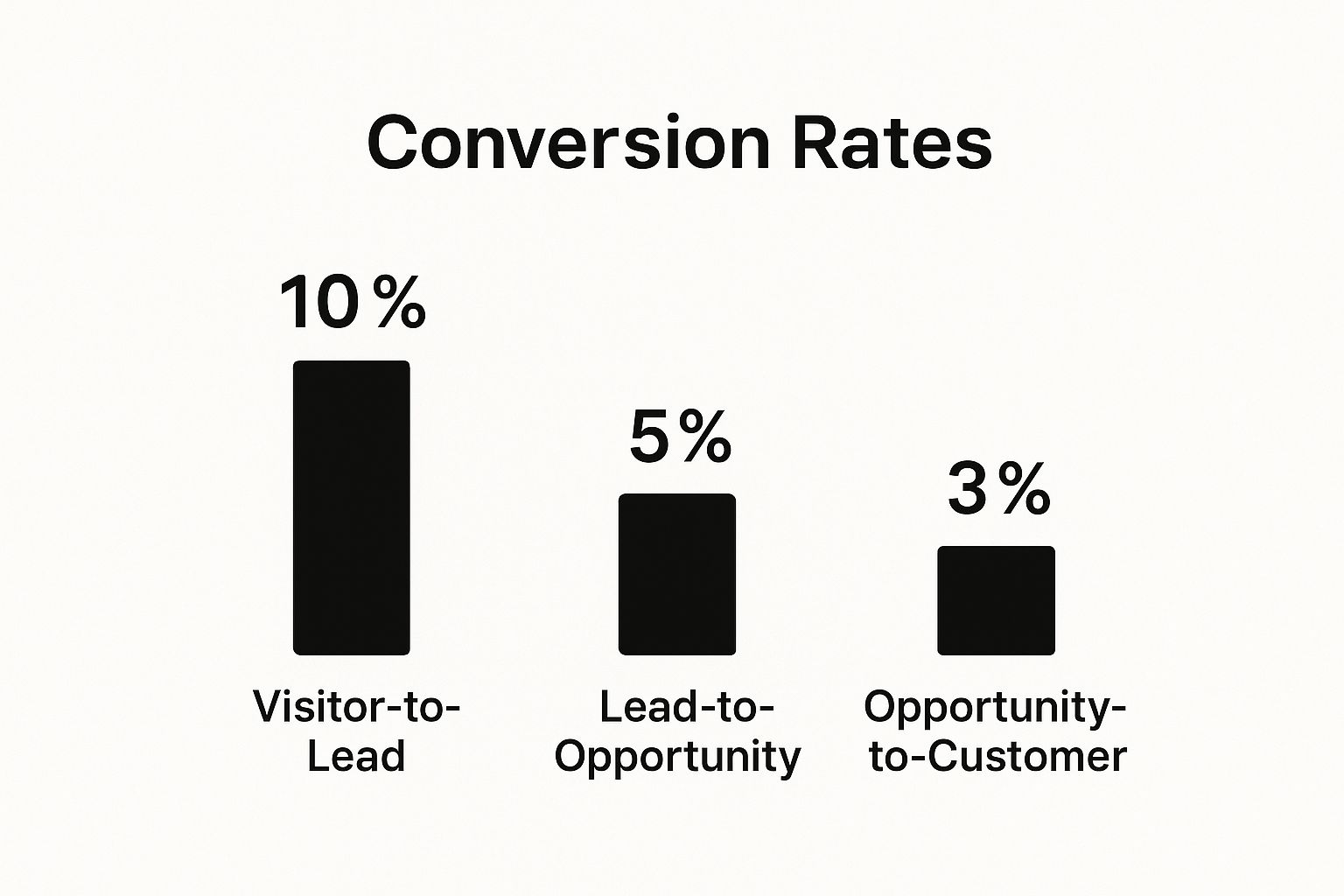
This graphic says it all. The funnel narrows fast. If you start with junk leads, you’ll end up with an empty pipeline. Starting with a high-quality list is the only way to get a healthy conversion rate at the finish line.
Sourcing Your Leads the Smart Way
First things first, you need to decide how you’re going to get your contacts. You can go the manual route, use a B2B data provider, or - my preferred method - do a bit of both.
Let’s quickly look at the options.
To help you decide which path to take, I’ve put together a quick comparison of the most common lead sourcing methods. Each has its place, and the best strategy often involves blending them.
Comparing Lead Sourcing Methods
| Sourcing Method | Pros | Cons | Best For |
|---|---|---|---|
| Manual Prospecting (e.g., LinkedIn Sales Navigator) | Incredibly high accuracy. Great for personalization. You get a real feel for the prospect. | Time-consuming. Doesn’t scale easily. | Targeting high-value accounts, niche industries, and finding unique personalization angles. |
| B2B Data Providers (e.g., ZoomInfo, Apollo.io) | Fast and scalable. Access to millions of contacts. Advanced filtering options. | Data can be outdated or inaccurate. Can be expensive. | Quickly building large, initial lists for broader campaigns or to supplement manual efforts. |
| Hybrid Approach | The best of both worlds: scale and accuracy. Reduces risk of poor data quality. | Requires managing multiple tools and processes. Still takes more time than just buying a list. | Most businesses. This approach provides a balance that maximizes both efficiency and effectiveness. |
As you can see, there’s no single “best” way - it all depends on your goals and resources. But from my experience, the hybrid model consistently delivers the strongest results.
Manual prospecting, especially using a tool like LinkedIn Sales Navigator, is just so powerful. You can hand-pick companies and people who fit your ICP with laser precision. You see their recent posts, confirm their job title isn’t from three years ago, and get a real feel for what they care about. That’s gold for personalization.
On the flip side, B2B data providers like ZoomInfo or Apollo.io give you speed and scale. You can plug in your ICP filters and - boom - get a list of thousands of contacts in minutes. They’re great for building an initial prospect pool, but you have to accept a hard truth: the data isn’t always 100% accurate. People change jobs, and emails go stale.
My advice? Use a hybrid approach. Start with a data provider to get a broad list based on your ICP. Then, use LinkedIn to manually vet each prospect and hunt for that unique angle for your outreach. It’s the perfect blend of automation and human oversight.
Verify and Enrich: Don’t Skip This Step
Sending an email to a bad address is worse than a waste of time - it’s a direct hit to your domain’s sending reputation. Before you even think about hitting “send” on a campaign, you must verify your contact list.
Use a dedicated email verification service like NeverBounce or ZeroBounce. These tools scrub your list and weed out the invalid, misspelled, or dead email addresses. This isn’t an optional step; it’s non-negotiable if you want to protect your deliverability.
But verification is just the baseline. The real magic happens when you enrich that data. This means digging up extra context that turns a generic pitch into a personalized conversation.
What should you look for?
-
Recent company news: Did they just announce a funding round? Launch a new product?
-
LinkedIn activity: Did they just write an article or comment on a post relevant to your service?
-
Their tech stack: What tools are they already using that might integrate with yours?
This extra intel is how you stop being another faceless salesperson and start being a helpful expert. It’s also the secret to figuring out how to generate B2B leads that actually convert into sales.
Writing Cold Emails That Actually Get Replies
This is where the rubber really meets the road in your B2B lead generation. You’ve got a solid ICP and a clean list of prospects. Now what? You have to write an email that doesn’t get immediately trashed.
The goal isn’t just to get an open - it’s to start a real conversation.
Let’s get one thing straight: forget the generic, one-size-fits-all templates you’ve seen online. They’re a one-way ticket to the spam folder. Real success with cold email boils down to three things: a magnetic subject line, a hyper-personalized opening, and a value prop that genuinely solves a problem.
Mastering the Subject Line
Your subject line has one job and one job only: get the email opened. That’s it. It’s the gatekeeper to everything else you’ve written.
The best ones I’ve seen are short, a little intriguing, and feel like they were sent from one human to another, not from some marketing automation sequence. Personalization is your best friend here. In fact, over 60% of people open an email based on the subject line alone.
A generic line like “Quick Question” might get you a few opens, but it’s tired and overused. Instead, try referencing something specific to them.
Here are a few styles that consistently perform well for us:
-
The Specific Question: “Question about [Their Company]‘s sales process”
-
The Reference: “Saw your post on LinkedIn”
-
The Mutual Connection: “[Mutual Connection’s Name] suggested I reach out”
Notice a pattern? They’re specific, personal, and don’t scream “MARKETING EMAIL!” I also recommend keeping them casual - even lowercase - to stand out in an inbox filled with formal, capitalized messages.
The All-Important Opening Line
Once they’ve opened your email, that first sentence is your make-or-break moment. You have maybe three seconds to prove this email is for them and that you’ve actually done your homework. This is where all that effort you put into prospect research pays off big time.
A terrible opening line is anything that could be copy-pasted to a thousand different people. Think: “I was looking at your website, and I love what you’re doing at [Company Name].” It’s lazy and instantly signals that a generic sales pitch is coming.
Instead, your opening line needs to be so specific it could only apply to that one person.
Before (Bland and Generic): “Hi [Name], I noticed you’re the [Job Title] at [Company Name]. I help companies like yours improve their sales efficiency.”
After (Personalized and Impactful): “Hi [Name], I saw your recent LinkedIn post about the challenges of scaling your SDR team. It reminded me of how we helped [Similar Company] cut their ramp-up time by 30%.”
See the difference? The second version shows you’ve done your research, you understand their current world, and you can connect it to a tangible result. That’s how you build credibility from the jump.
Nailing the Value Proposition and Call to Action
Your value proposition should absolutely not be a list of your product’s features. I’ll be blunt: nobody cares about your product yet. They only care about their own problems. Your email needs to connect a problem they’re likely feeling with a clear, desirable outcome you can help them achieve.
Frame your offer around their pain. Instead of saying, “Our software has a feature that does X,” try, “Tired of your team wasting hours on manual data entry? Our clients get that time back.” It’s all about their gain, not your features.
A strong value proposition makes the prospect the hero of the story. You’re not the star; you’re the guide who helps them overcome their challenges and achieve their goals.
Finally, you need a crystal-clear, low-friction Call to Action (CTA). A classic mistake is coming on too strong. Asking for a “30-minute demo” in the first email is a huge commitment to ask from a complete stranger.
Instead, go for a simple, interest-based question.
-
Weak CTA: “Are you free for a demo next Tuesday?”
-
Strong CTA: “Is improving [Specific Outcome] a priority for you right now?”
The second option is much easier to say “yes” to. It opens the door for a conversation instead of demanding a meeting. If you’re looking for more ideas, you can find a variety of high-performing options in these B2B cold email templates for boosting outreach.
Remember, the goal of that first email isn’t to close a deal. It’s just to get a positive reply and earn the right to keep the conversation going. By focusing on personalization, providing clear value, and making your ask small, you’ll dramatically improve your odds of success in any lead generation B2B campaign.
Don’t Just Automate - Automate Smartly
Look, a killer email is great, but it’s only half the battle. If your execution is clunky and manual, even the most persuasive message will get lost in the noise. This is where you bring in smart automation. It’s the secret weapon for turning single email blasts into a persistent, multi-touch sequence that actually gets you replies.
And I want to stress the word smart. This isn’t about “set it and forget it.” It’s about letting technology do the grunt work - the sending, the scheduling, the follow-ups - so you can pour your energy into the human stuff, like personalizing your angles and having real conversations with people who are actually interested.
Let’s lay out the blueprint for an automated campaign that works in the real world.
Building Your Outreach Sequence
Firing off one email and hoping for the best is a rookie mistake. Decision-makers are buried in their inboxes. Your first attempt can easily get ignored, deleted, or just plain missed. A strategic follow-up sequence is what separates the pros from the amateurs.
From running more campaigns than I can count, I’ve found the sweet spot is a sequence of 3 to 5 touches. This gives you enough runway to get noticed without crossing the line into being a pest. Push past five, and you’ll see your returns drop off a cliff while your spam complaints go up.
Here’s a sequence structure that has proven itself time and time again. Feel free to use it as a starting point:
-
Touch 1 (Day 1): Your initial, highly personalized email. This is your best shot, so make it count.
-
Touch 2 (Day 4): A quick, casual “bump.” Just reply to your first email to keep the context. Something simple like, “Just wanted to bring this to the top of your inbox.” works wonders.
-
Touch 3 (Day 8): Time for a new angle. Bring in a different piece of value - maybe a short case study, a helpful tip, or a link to a resource that solves a problem they have.
-
Touch 4 (Day 14): The “breakup email.” This is your final, polite follow-up to close the loop gracefully.
This timing gives prospects enough breathing room so you don’t come off as desperate, but it keeps your name at the top of their mind.
Picking the Right Tools for the Job
Trying to manage this follow-up schedule by hand for hundreds of prospects? It’s not just hard; it’s impossible. This is exactly why specialized cold email platforms like Instantly or Smartlead exist. They’re built from the ground up to help you scale personalized outreach.
With these tools, you can upload your prospect list, map your custom personalization snippets, build out your entire sequence, and set the sending schedule. The software takes over from there, sending the right message to the right person at the right time. Crucially, it automatically pulls someone out of the sequence the second they reply.
This is how you scale your lead generation B2B efforts without needing a massive sales team. But even with great tools, 44% of sales reps give up too early on follow-ups. That’s a huge gap, especially when you consider that 85% of B2B marketers are using content to generate leads but often lack a solid system to convert that interest into meetings. You can find more data behind these lead generation stats from Exploding Topics.
Measure What Actually Moves the Needle
You can’t fix what you don’t track. Once your campaigns are live, you need to become obsessed with a few core metrics. This is how you figure out what’s working and what’s a waste of time.
Forget about vanity metrics. A high open rate feels good, but it doesn’t close deals. Focus on the numbers that signal real, human interest and lead to actual conversations.
These are the only metrics that truly matter:
-
Open Rate: This tells you two things: your emails are hitting the inbox (good deliverability), and your subject lines are grabbing attention. For cold outreach, you should be aiming for above 50%. If you’re seeing low numbers here, you’ve either got a technical domain issue or a boring subject line.
-
Reply Rate: The percentage of people who actually hit “reply.” A solid goal is 5-10%. If your open rates are high but no one is replying, the problem is your email copy or your call to action. It’s not connecting.
-
Positive Reply Rate: This is my personal favorite. It cuts through the noise of “unsubscribe” or “not interested” replies and shows you who is genuinely open to a conversation. Even a 1-3% positive reply rate can build a monster sales pipeline over time. This is the ultimate test of your message.
By pairing a smart, automated sequence with a close eye on these core metrics, you create a repeatable, scalable engine for B2B lead generation. This system frees you up from the tedious stuff and lets you focus on what you’re best at: talking to qualified prospects and closing deals.
Your Top B2B Lead Generation Questions, Answered
Even with the perfect strategy on paper, the real world of lead generation b2b always throws a few curveballs. Over the years, I’ve seen the same questions pop up time and time again, whether from clients or fellow marketers just getting their footing.
Let’s cut through the noise and tackle these common hurdles head-on. Think of this as your go-to FAQ for keeping your campaigns on track and focused on what really moves the needle.
How Long Until I Actually See Results?
This is the big one, and the honest answer is: it takes a little patience.
With a well-tuned cold email campaign, you might see the first positive replies trickle in within a week. But turning those first few sparks of interest into actual, qualified meetings on your calendar? That typically takes about 2 to 4 weeks.
The biggest mistake I see people make is pulling the plug too early. A great campaign isn’t about a one-time burst of activity; it’s about building a predictable pipeline. Other strategies, like content marketing, have an even longer runway - you should be prepared to invest 3-6 months to really build authority and see that steady flow of inbound leads.
Keep your eyes on the leading indicators. Positive reply rates and meetings booked are your early signs that you’re on the right track, long before the deals start closing.
What Are Good Cold Email Benchmarks to Aim For?
Benchmarks are great for getting your bearings, but your own numbers are the ones you should live and breathe. That said, if you’re just starting out, here are some solid targets to shoot for with your cold outreach:
-
Open Rate: You want to be at 50-60% or higher. A strong open rate tells you two things: your technical setup is sound (you’re hitting the inbox), and your subject lines are compelling enough to stand out.
-
Reply Rate: A solid 5-10% reply rate shows your core message is resonating. People are engaged enough to actually respond.
-
Positive Reply Rate: This is the metric that truly matters. It filters out all the noise - the “no thank yous” and auto-replies - to focus on genuine interest. Hitting even 1-3% here can fuel a hugely profitable pipeline.
If your open rates are in the gutter, your first stop should be checking your domain health and technical deliverability. If opens are high but replies are nonexistent, the problem is almost always your email copy or call-to-action.
Benchmarks are a compass, not a map. Use them to find your direction, but your real goal is to beat your own performance month after month. It’s all about constant testing and tweaking.
Is Buying a B2B Lead List a Good Idea?
Let me be direct: I strongly advise against buying static, pre-packaged lead lists. It’s a tempting shortcut, but one that almost always leads to a dead end.
Why? These lists are usually ancient, riddled with bad data, and have been sold to dozens, if not hundreds, of other companies just like yours.
When you email these contacts, you’re just another piece of spam in an inbox that’s already under siege. This will absolutely tank your domain reputation, getting you flagged and sabotaging all your future outreach efforts.
A far better approach is to use B2B data providers like Apollo.io or ZoomInfo to build a fresh list from scratch, using the specific filters from your Ideal Customer Profile. This puts you in control. In my experience, the gold-standard method is combining these tools with a final manual check on LinkedIn to verify details and find those killer personalization angles. For a deeper dive on this, check out our complete guide on lead generation B2B for sustainable growth.
How Do I Actually Measure Lead Generation ROI?
Measuring your Return on Investment (ROI) simply means comparing what you spent to what you earned. It sounds easy, but it requires diligent tracking to get it right.
First, tally up your costs:
-
Software subscriptions (your email tool, data providers, CRM)
-
Any money spent on ads or sponsored content
-
The value of your team’s time invested in the campaign
On the other side, you need a CRM to connect the dots from a lead’s first touchpoint all the way to a signed contract. The basic formula is: (Revenue From Deals - Campaign Costs) / Campaign Costs.
I get it - this can be tough for businesses with long sales cycles. If that’s you, I recommend focusing on pipeline value and cost-per-meeting-booked as your primary metrics. These show how efficiently you’re creating opportunities, giving you a clear snapshot of performance long before the money hits the bank.
At Fypion Marketing, we live and breathe this stuff so you don’t have to. We take the entire B2B lead generation process off your plate - from building hyper-targeted lists to writing copy that converts and booking qualified meetings straight into your calendar. And since we work on a pay-per-meeting model, we only win when you do.
Ready to build a predictable sales pipeline without the risk? Book a free consultation today.