
Lead Generation for Manufacturing: Complete Guide to Growth
Let’s be honest, lead generation in manufacturing used to be a different game. For decades, many companies built their success on a solid foundation of word-of-mouth, long-standing relationships, and a commanding presence at trade shows. Those methods haven’t lost their value, but relying on them alone today is like bringing a vintage engine to a Formula 1 race. The entire track has changed.
This is what lead generation really means for manufacturers now: it’s the process of attracting and converting potential customers - think engineers, procurement managers, and operations directors - into genuinely qualified sales opportunities. It’s about strategically using digital channels to fill your pipeline with high-value prospects who are already out there looking for the solutions you provide.
The New Engine for Manufacturing Growth

The reality is, today’s industrial buyers are digital natives. Long before they ever think about picking up a phone or sending an inquiry, they’re deep into online research. They’re digging up technical specs, comparing vendors side-by-side, reading case studies, and searching for proof of your expertise.
If your company isn’t showing up during this critical research phase, you effectively don’t exist to a huge slice of your potential market. It’s a blunt truth, but a necessary one.
The Modern Buyer’s Journey
Think of your lead generation strategy as a high-performance engine. Every single component - from SEO to content to targeted ads - has to work in perfect harmony to generate power. In this case, that power is a steady, reliable stream of highly qualified leads. This isn’t just a fleeting trend; it’s a fundamental shift in how industrial business gets done.
Building a well-oiled lead generation machine is no longer optional. It is absolutely essential for staying competitive and connecting your company’s deep expertise with growing market demand.
This digital-first approach means you have to meet your audience where they are. It’s less about making cold calls and more about being the answer when a potential client searches online for a solution to their problem.
Why Digital Channels Are Critical
The proof is in the numbers. The global market for lead generation services was estimated at USD 5.59 billion in 2025 and is projected to skyrocket to USD 32.1 billion by 2035. This isn’t just a small uptick; it’s explosive growth. It shows just how critical companies believe it is to acquire qualified leads to fuel their sales pipelines. You can dig deeper into this market expansion in recent industry reports.
A solid lead generation for manufacturing program isn’t about just one thing. It’s a combination of powerful digital strategies working together:
-
Search Engine Optimization (SEO): This is how your website and technical documents get found when an engineer searches for a specific part, a complex process, or a niche solution.
-
Content Marketing: You demonstrate your expertise through detailed whitepapers, in-depth case studies, and blog posts that solve real-world problems for your exact target audience. You become a resource, not just a vendor.
-
Targeted Digital Advertising: This allows you to reach specific job titles within your dream companies on platforms like LinkedIn, putting your message directly in front of the key decision-makers.
When these components work together, they create a powerful engine for growth. Your marketing transforms from a simple cost center into a predictable, revenue-generating machine that consistently brings in new business.
Building Your Digital Foundation

Before you can think about generating a single lead, you need a solid place for them to land. Your digital presence is the foundation of your entire sales pipeline. A flimsy, thrown-together website is like pouring a weak concrete slab - every effort you build on top of it will eventually crack under pressure.
We’re talking about building a powerful online footprint that consistently pulls in the exact audience your manufacturing business needs to grow.
A rock-solid foundation for lead generation in manufacturing really comes down to three things: Search Engine Optimization (SEO), Content Marketing, and targeted Email Marketing. These aren’t just buzzwords; they are the gears that mesh together to attract, educate, and nurture prospects through what are often long and complex buying cycles.
Get Found with Search Engine Optimization
SEO is all about making sure your website shows up when someone searches on Google. But for manufacturers, this isn’t about getting tons of random traffic. It’s about being the #1 result when a procurement manager or engineer searches for a highly specific, technical solution that you happen to provide.
Imagine an engineer typing “high-tolerance CNC machining for aerospace components” into the search bar. If you’ve done your SEO right, your website appears at that precise moment of need. This is less about marketing and more about providing a direct path to a solution. And you’d better make it a good experience - 88% of online consumers say they won’t return to a site after a bad first impression.
To get SEO working for you, concentrate on these key areas:
-
Technical Keywords: Nail down the exact terms, part numbers, and technical specs your ideal customers are actually using. You have to think like an engineer, not a marketer.
-
Product and Service Pages: Every single one of your core offerings needs its own dedicated page. Optimize it with the right keywords, technical data sheets, and a clear call to action.
-
User Experience (UX): Your website has to be dead simple to navigate, load quickly, and work perfectly on a phone. A clunky site will send a hot lead right over to your competitor.
Prove Your Expertise with Content Marketing
So, a potential lead finds your site. Now what? You have to give them a compelling reason to stick around and, more importantly, to trust you. This is where content marketing shines. It’s your opportunity to show off your deep industry knowledge and prove you understand your customers’ most complex challenges.
Instead of just listing what you do, you create genuinely helpful resources that make your audience better at their jobs. This builds incredible credibility and positions your company as a trusted advisor, not just another vendor trying to make a sale.
For manufacturers, content isn’t just about blog posts. It’s about delivering hard proof of what you can do. Think detailed whitepapers, data-heavy case studies, and application notes that show your products performing in the real world.
Here are a few high-impact content types that work wonders for manufacturers:
-
Case Studies: Show, don’t tell. Break down a customer’s problem, explain your solution, and show the measurable results you delivered. This is social proof at its most powerful.
-
Whitepapers & Ebooks: Go deep on a technical subject, an industry trend, or a complex challenge. This is where you let your engineering team’s expertise shine.
-
Video Demonstrations: Nothing beats seeing it in action. A short video of a machine running or a quick facility tour can be far more convincing than a glossy brochure.
This entire approach is central to B2B growth today. To see how these pieces fit into a bigger picture, take a look at our guide on effective lead generation in B2B for business growth.
Nurture Relationships with Email Marketing
Let’s be real: not every visitor is ready to request a quote on their first visit. The manufacturing sales cycle is notoriously long, often involving a whole committee of decision-makers and months of evaluation. Email marketing is your best tool for staying top-of-mind and nurturing those long-term relationships.
When you capture an email address - maybe by offering that valuable whitepaper we just talked about - you earn the right to continue the conversation. From there, you can send targeted, relevant info over time, gently guiding prospects through their journey. Segmenting your email list allows you to send specific content to different roles, ensuring your message always hits the mark.
This isn’t about spamming prospects with generic sales blasts. It’s about delivering real value straight to their inbox, building trust with every send, and making sure that when they are finally ready to buy, your company is the first one they think of.
Choosing Your Lead Generation Approach
Picking the right lead generation strategy is a lot like choosing the right manufacturing process. Are you setting up a high-volume, automated production line that attracts customers through sheer efficiency and value (inbound)? Or are you using precision tooling for a custom, high-value job (outbound)? Both have their place, but they solve entirely different problems.
Truthfully, there’s no single “best” method when it comes to lead generation for manufacturing. The right choice really hinges on your specific goals, who your ideal customer is, and how fast you need to see results. I’ve found that a balanced approach usually delivers the most sustainable growth by combining long-term asset building with targeted, immediate outreach.
The Magnetic Pull of Inbound Marketing
Inbound marketing works like a powerful magnet. Instead of you actively chasing down leads, you create valuable, problem-solving resources that pull potential customers directly to you. Think of it as building the most comprehensive technical library in your niche.
When an engineer or a procurement manager runs into a problem, their first move is to search for answers online. Your content - whether it’s a detailed whitepaper, a blog post comparing material tolerances, or a case study packed with hard data - is the answer they discover. They arrive at your digital doorstep already interested and partially educated on the solution you provide.
Inbound marketing is about earning attention, not buying it. You build long-term assets like SEO authority and a library of expert content that generate leads for years to come.
This strategy is phenomenal for building trust and establishing your company as an industry authority. The leads are often much higher quality because they’ve actively sought you out, which makes for a much warmer sales conversation right from the start.
The Surgical Strike of Outbound Marketing
Outbound marketing, on the other hand, is less like a magnet and more like a laser-guided missile. It’s all about identifying your highest-value potential clients and actively pursuing them with a targeted, personalized message. This isn’t your grandfather’s cold calling; it’s a modern, data-driven approach.
One of the most effective outbound strategies today is Account-Based Marketing (ABM). With ABM, you essentially treat an entire high-value company as a single market. Your sales and marketing teams work in lockstep to identify the key decision-makers within that organization, then create hyper-personalized campaigns designed to resonate with their specific challenges and goals.
Strategic outreach on platforms like LinkedIn, paired with personalized email sequences, lets you get directly in front of the people who can sign the checks. You bypass the usual gatekeepers and kickstart high-level conversations. This approach is perfect for manufacturers targeting large enterprise accounts with long, complex sales cycles.
The chart below really drives home the relationship between content production - a core inbound activity - and actually converting leads.
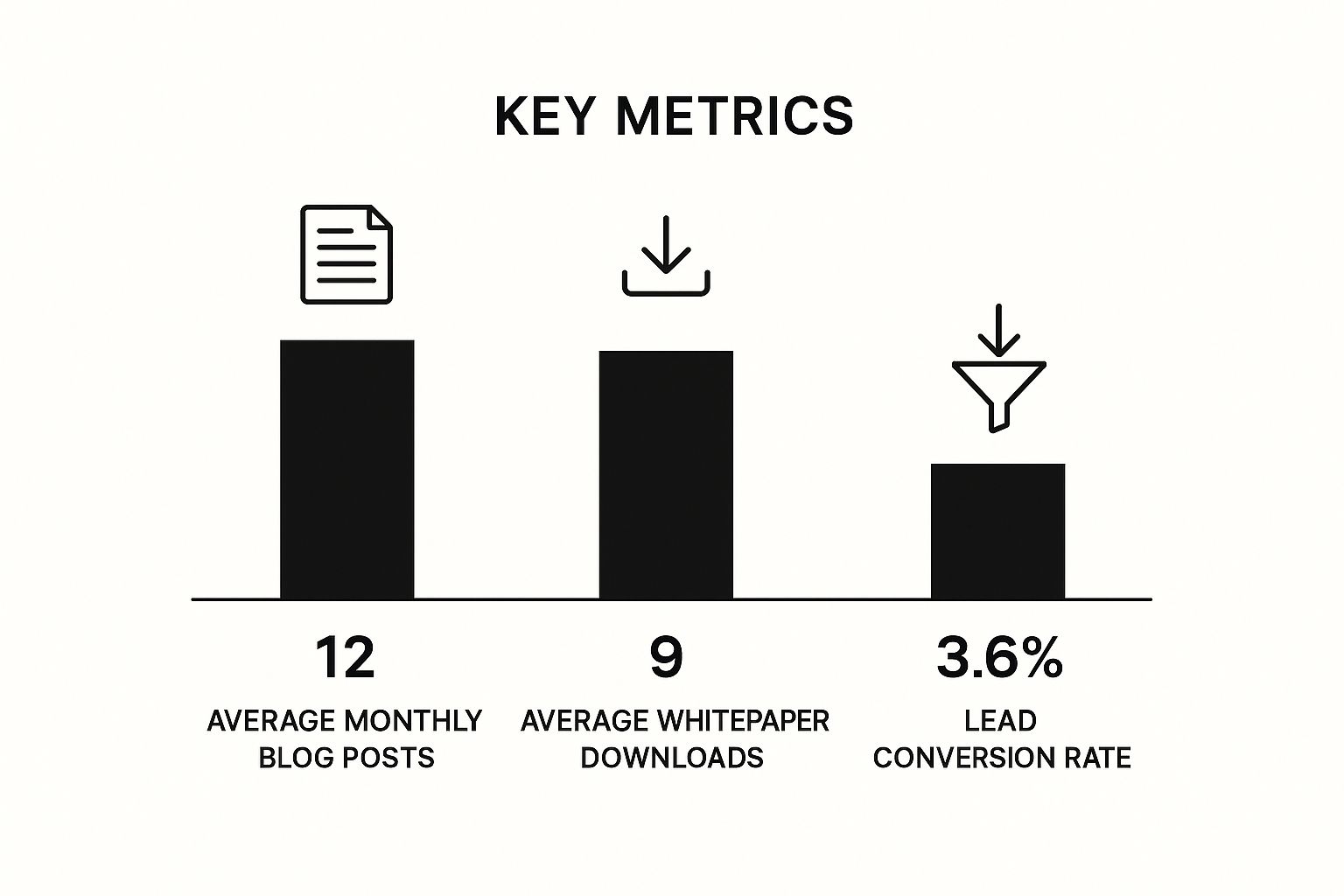
As you can see, the data is clear: higher output of valuable content like whitepapers directly correlates with a stronger lead conversion rate.
Inbound vs Outbound Lead Generation for Manufacturing
Deciding where to put your budget can be tough. Inbound builds a powerful, long-term engine, while outbound can deliver highly targeted results more quickly. Neither is inherently better; they just serve different purposes. The table below breaks down the two approaches to help you see where your investment might be best placed.
| Tactic Type | Example | Lead Quality | Cost Per Lead | Sales Cycle Impact | Scalability |
|---|---|---|---|---|---|
| Inbound | SEO & Content Marketing | High (self-qualified) | Lower (over time) | Shortens (builds trust early) | High |
| Outbound | Account-Based Marketing | Very High (targeted) | Higher (resource-intensive) | Can accelerate (direct outreach) | Moderate |
Ultimately, the goal isn’t just about getting any leads; it’s about getting the right leads that turn into revenue. For a deeper look at separating the tire-kickers from genuine prospects, check out our guide on how to qualify B2B leads with proven strategies to boost sales. It’s a critical step no matter which approach you choose.
Advanced Strategies to Fill Your Sales Pipeline

Once you’ve built a solid digital foundation, you’ve earned the right to get a bit more aggressive. Now it’s time to shift from just attracting leads to actively hunting down the high-value accounts that can genuinely transform your business. These advanced strategies are what give you a serious competitive edge.
This is the point where lead generation for manufacturing stops being a passive activity and turns into a targeted, proactive mission. We’ll get into how you can pinpoint your dream clients, bring your complex operations to life, and scale your follow-up so no opportunity ever gets missed.
Zero In with Account-Based Marketing
Account-Based Marketing (ABM) completely flips the traditional marketing funnel upside down. Instead of casting a wide net and just hoping you catch a few qualified leads, ABM is more like precision spearfishing. You identify a specific list of high-value companies and then focus all of your sales and marketing energy on winning them over.
For manufacturers, this approach is a total game-changer. You stop wasting time and money on companies that will never buy from you. Instead, you create hyper-personalized campaigns aimed squarely at the accounts that matter most.
A successful ABM campaign follows a pretty clear path:
-
Identify High-Value Accounts: Get together with your sales team and build a “dream client” list. These are the companies whose business would have a major impact on your bottom line. Look at things like their industry, revenue, and specific technological needs.
-
Map Key Stakeholders: Inside each of those target companies, figure out who the key decision-makers are. This isn’t just the Head of Procurement. It includes the engineers, plant managers, and C-level executives who all have a say in the final buying decision.
-
Develop Personalized Content: Now, create content that speaks directly to that company’s unique challenges and goals. This could be a case study featuring a business just like theirs or a report analyzing a trend that directly impacts their industry.
-
Execute Coordinated Outreach: Launch a multi-channel attack. Your sales team can use personalized emails and LinkedIn messages, while your marketing team runs targeted ads that show your specialized content only to employees at that specific company.
This approach treats each target account as a market of one. The result is a highly relevant, coordinated experience that cuts through the noise and positions you as an indispensable partner, not just another vendor.
Bring Your Operations to Life with Video
Let’s be honest, manufacturing can be complex and hard to explain with just words and pictures. How do you really convey the precision of a five-axis CNC machine or the sheer scale of your production floor in a static brochure? The answer is video.
Video marketing bridges that gap between your technical capabilities and a prospect’s real understanding. It lets you show them, not just tell them. For buyers who can’t easily visit your facility in person, video is the next best thing. In fact, video is an incredibly powerful tool for building trust and making your value proposition crystal clear.
Consider these high-impact video formats:
-
Facility Tours: Give prospects a behind-the-scenes look at your operations. Show off your technology, the cleanliness of your plant, and the expertise of your team.
-
Product Demonstrations: Show your equipment or components in action. Seeing a process run smoothly is so much more powerful than just reading a spec sheet.
-
Expert Interviews: Put your lead engineers or technicians on camera explaining a complex process. This builds your authority and puts a human face to your brand.
These videos don’t need to be Hollywood-level productions. A well-shot, authentic video can have a massive impact, turning abstract technical details into tangible, compelling proof of your capabilities. Many of these approaches are central to the most effective B2B lead generation strategies for sustainable growth because they build assets that keep working for you long-term.
Scale Your Efforts with Marketing Automation
As you start ramping up your lead generation, trying to follow up manually becomes completely impossible. Leads will inevitably fall through the cracks. This is where marketing automation becomes absolutely essential. It’s the system that makes sure every single prospect gets the right follow-up at the right time, without your team having to lift a finger.
Think of it as your most diligent employee, working 24/7 to nurture relationships. When someone downloads a whitepaper, the system can automatically send a series of follow-up emails over several weeks, each one offering more valuable content.
Automation tools like HubSpot or Marketo let you set up simple “if-then” workflows. For example, if a lead visits your pricing page, the system can automatically notify a sales rep to reach out personally. This ensures your sales team spends their valuable time talking to warm, engaged prospects, which dramatically improves both their efficiency and your conversion rates.
How to Measure What Truly Matters
Running a lead generation strategy without a solid way to measure it is like firing up a high-tech CNC machine without calibrating it first. Sure, you’re making parts, but you have no idea if they meet spec, what they cost you to produce, or if they’ll even fit into the final assembly. You’ve got to cut through the mountain of analytics and zero in on the numbers that actually move the needle.
This means looking past the vanity metrics - things like total website visits or a bunch of likes on a social media post. While they might give you a warm, fuzzy feeling of activity, they tell you absolutely nothing about revenue. A huge spike in web traffic doesn’t mean a thing if none of those visitors are the qualified engineers or procurement managers you need to reach.
Instead, we need to get serious about the Key Performance Indicators (KPIs) that draw a straight line from your marketing efforts to your bottom line.
Moving Beyond Vanity Metrics
The first real step is figuring out which data points connect your marketing actions to actual sales outcomes. For a manufacturer, this means tracking metrics that show the quality of your leads, how efficiently your sales team can work with them, and what the financial return looks like. These are the numbers that tell the true story.
There’s no denying how crucial digital lead generation has become in manufacturing. The US market for it was expected to blow past $3.2 billion by 2023. And yet, a staggering 61% of marketers still say generating leads is their single biggest challenge. This gap just highlights why precise measurement is so critical to getting it right. For more on these trends, you can check out these detailed lead generation statistics and findings.
Core KPIs for Manufacturing Lead Generation
To get a clear picture of what’s working (and what’s not), you need a dashboard of essential metrics. Think of these KPIs as the gauges on your machine, giving you a full view of your funnel’s health from the first click to a signed contract.
-
Cost Per Lead (CPL): This is your bread and butter. Take your total marketing campaign cost and divide it by the total number of new leads you got. It tells you exactly how much you’re spending to get one prospect into your pipeline.
-
Lead-to-Opportunity Conversion Rate: This one is huge. It’s the percentage of leads that your sales team looks at and says, “Yep, this is a real, qualified opportunity.” If this number is low, it could be a red flag for poor lead quality or a disconnect between your marketing message and what sales needs.
-
Customer Acquisition Cost (CAC): This is the big one. Add up all your sales and marketing costs over a period and divide it by the number of new customers you won. This is the ultimate measure of what it costs to land a new piece of business.
-
Marketing-Influenced Revenue: This KPI helps you prove marketing’s worth by showing how much of your total revenue was touched by marketing activities along the way. It directly connects your team’s efforts to closed deals.
Tracking these metrics isn’t optional. It’s the only way you can prove marketing’s ROI, justify your budget, and make smart, data-backed decisions to keep improving your entire lead generation program.
Setting Up Your Measurement System
You don’t need some ridiculously expensive or complicated system to start tracking what counts. For most manufacturers, a combination of your Customer Relationship Management (CRM) platform and Google Analytics gives you a goldmine of actionable data. The trick is just making sure they’re set up to talk to each other correctly.
Here’s a simple framework for a custom parts manufacturer:
-
Goal Tracking in Google Analytics: Start by setting up specific “Goals” for the most important actions on your website. This could be form submissions for a “Request a Quote,” downloads of your technical spec sheets, or even clicks on your main phone number.
-
CRM Integration: Make sure that when a lead comes in through your website, it’s automatically created in your CRM. Critically, the lead source (like “Organic Search” or “LinkedIn Ad”) needs to be captured. This is non-negotiable.
-
Sales Funnel Stages: Define clear, logical stages in your CRM pipeline. Think: New Lead, Contacted, Qualified Opportunity, Quote Sent, and Closed-Won. This setup lets you track the conversion rates between each stage of the journey.
By connecting these dots, you can literally follow a lead from their first click on a Google search all the way to a closed deal. This gives you a clear line of sight into which channels are bringing you the most valuable customers, so you can double down on what works and cut what doesn’t. To get a more granular view, you should explore our complete guide on lead generation KPIs to boost your marketing success.
Answering Your Top Manufacturing Lead Generation Questions
Diving into digital marketing can feel like you’re trying to read a blueprint in a different language, especially in a technical field like manufacturing. It’s natural to have questions and wonder where you should really be putting your time and money. We get it.
That’s why we put together this section. Think of it as a cheat sheet to answer the most common questions we hear from manufacturers every day. Our goal is to give you clear, no-nonsense answers so you can build a lead generation program that actually moves the needle.
How Long Does It Take to See Results?
This is the big one, the question everyone asks right out of the gate. The honest answer? It completely depends on the tools you decide to use. Lead generation isn’t just one big red button you push; it’s more like running different machines on the shop floor. Some fire up instantly, while others need a proper warm-up period.
You have to match your expectations to your tactics.
-
Short-Term Wins (Weeks to a Few Months): If you need to fill your pipeline now, outbound tactics are your go-to. Think targeted LinkedIn ads or a focused pay-per-click (PPC) campaign on Google. These can start pulling in clicks and inquiries almost right away. They’re perfect for hitting a quarterly goal or promoting a time-sensitive offer. The catch? The moment you stop paying, the leads dry up.
-
Long-Term Growth (6-12 Months): This is where inbound marketing like SEO and content creation comes in. This is less of a sprint and more of a long-term investment, like installing a new, top-of-the-line CNC machine. It takes time to get it set up and calibrated, but once it’s humming, it generates value consistently for years. For these efforts, you’re typically looking at 6-12 months before you see a significant, steady flow of organic traffic and leads. You’re building a real asset.
The smartest play is to do both. Use outbound tactics for that immediate hit of momentum while you invest in the inbound foundation for the long haul. This gets you the best of both worlds: quick wins now and a sustainable growth engine for the future.
What Is the Most Common Mistake in This Process?
Hands down, the single biggest mistake we see manufacturers make is creating content that doesn’t speak the language of its audience. So many companies get stuck in a “marketing-speak” trap, putting out generic messages that could apply to just about anyone. For a technical audience, this approach is dead on arrival.
Engineers, procurement managers, and designers don’t care about flashy slogans. They’re looking for data. They want proof. They need to see that you understand their world and their specific challenges.
Your marketing content should be treated like a valuable technical resource. Instead of just claiming your components are “high-quality,” you need to show them. Provide things like:
-
Detailed specification sheets that are easy to find and download.
-
In-depth case studies with real-world performance data and tangible ROI.
-
Application notes and whitepapers that tackle and solve complex engineering problems.
-
Material comparison guides that empower them to make the right choice.
The moment your content pivots from “here’s what we sell” to “here’s how we solve your problem,” you build instant credibility. You start attracting leads who are already halfway through the buying process.
Do I Need a Large Budget to Get Started?
Not at all. This is one of the biggest myths in lead generation for manufacturing - that you need a massive war chest just to get in the game. While a bigger budget obviously gives you more options, you can get fantastic results by starting small, focusing your efforts, and scaling up as you see a return.
The secret is to prioritize activities with the highest ROI first. Don’t try to be everywhere at once. Focus on building your core assets, which often requires more brainpower than cash.
Here’s a practical way to get started on a shoestring budget:
-
Optimize Your Website: Start with the basics. Simple on-page SEO for your key product and service pages is a low-cost, high-impact move that makes your website work harder for you.
-
Create One Killer Content Piece: Don’t feel pressured to launch a massive blog. Just create one incredibly useful piece of content. This could be a comprehensive case study on your most successful project or a detailed guide that solves a common industry headache.
-
Promote It Smartly: Gate that single piece of content behind a simple form to capture leads. Then, push it out on LinkedIn or through some targeted email outreach.
Once you start generating leads and closing deals from these initial moves, you can reinvest a slice of that profit back into your marketing. This creates a self-funding growth engine, allowing you to scale your program without taking huge financial risks. For a deeper dive into how these strategies can work together, check out our ultimate modern guide to B2B lead generation.
At Fypion Marketing, we specialize in building these kinds of scalable lead generation engines for B2B companies. Our performance-based model means you only pay for qualified meetings, eliminating the risk and aligning our success directly with yours. If you’re ready to fill your pipeline without the upfront costs, book a free consultation with us today.