
Master the Basics: how to create buyer personas for better outreach

Let’s be real for a minute: generic cold emails are dead. They don’t work anymore.
The B2B world is drowning in automated, soulless messages that your ideal customers have become masters at ignoring. If you want to cut through that noise, you have to stop broadcasting and start connecting. This is where a solid buyer persona isn’t just a “nice-to-have” marketing doc - it’s your most critical strategic weapon.
The Problem with Flying Blind
Think about a typical Sales Director, let’s call her Sarah. Her inbox is a warzone. It’s cluttered with pitches for software she doesn’t need, services that have nothing to do with her team’s goals, and messages that make it painfully obvious the sender has no clue who she is or what her company does.
Every single one of those emails is a wasted shot, deleted in a flash.

When you send emails without a clear buyer persona, you’re essentially just flinging mud at a wall and hoping something sticks. You’re not hitting on their specific pain points, their day-to-day responsibilities, or the metrics they’re judged on.
The result? Abysmal open rates, even worse reply rates, and a one-way ticket to the spam folder. You’re not just being ignored; you’re actively teaching prospects that your name means “delete immediately.”
A buyer persona isn’t just a profile; it’s the blueprint for every successful cold email you send. It’s the difference between being a nuisance and being seen as a problem-solver.
The Massive Advantage of Knowing Your Audience
When you truly know your buyer, you can write a message that feels like it was crafted just for them. That level of personalization is a complete game-changer.
The numbers don’t lie. Integrating buyer personas into your email strategy can boost open rates by two to five times. On top of that, 24% of businesses using personas generated more leads, and 56% of those leads were higher quality.
Learning how to create buyer personas that actually work is what separates the pros from the amateurs. It completely transforms your outreach, allowing you to:
-
Speak Their Language: Use the industry jargon and reference the daily headaches they actually deal with.
-
Align with Their Goals: Frame your solution around their KPIs and what makes them look good to their boss.
-
Solve Real Pain Points: Show you get their frustrations and have a real answer.
-
Build Instant Credibility: Prove you’ve done your homework and aren’t wasting their time.
Generic vs Persona-Driven Outreach at a Glance
This table lays it out pretty clearly. One approach is a numbers game doomed to fail, while the other is a strategic play designed to win.
| Element | Generic Outreach | Persona-Driven Outreach |
|---|---|---|
| Angle | ”Here’s what our product does." | "I see you’re dealing with [Pain Point], we help with that.” |
| Tone | Formal, robotic, and self-serving. | Conversational, empathetic, and problem-focused. |
| Relevance | Low. A shot in the dark. | High. Directly addresses their role and challenges. |
| Credibility | Zero. Clearly a mass email. | High. Shows you’ve done your research. |
| Result | Ignored, deleted, or marked as spam. | Sparks curiosity, builds trust, gets replies. |
The difference is stark. Persona-driven outreach isn’t just better; it’s the only way to build a predictable pipeline in today’s crowded market.
This targeted approach is the foundation for all effective outbound lead generation strategies that convert. By putting in the work upfront to build accurate personas, you’re ensuring every single email you send has the best possible chance of starting a real conversation and getting that meeting on the calendar.
Gathering Intelligence for Authentic Personas
Let’s be blunt: buyer personas built on guesswork are worthless. An authentic, high-impact persona isn’t something you dream up in a conference room - it’s built on a foundation of hard evidence.
If you base your profile on pure assumptions, you’re setting up your cold email campaigns to fail spectacularly. The good news is you don’t need a massive research budget or month-long surveys to get the real data you need. It’s all about being resourceful with the intelligence you already have at your fingertips.
The goal here is to dig deeper than basic demographics. We need to uncover the why behind a customer’s decision. What lit the fire under them to start searching for a solution? What does a “win” actually look like in their specific role? Getting answers to these questions is how you start building personas that actually get replies.

Mine Your CRM for Hidden Gold
Your CRM is more than just a glorified address book; it’s a goldmine of behavioral data. Think about your best customers - the ones who closed fast, have a high lifetime value, and are genuinely happy with your service. They’ve left a trail of clues.
Start by pulling a list of your top 10-15 clients and begin connecting the dots.
Look for trends across their profiles:
-
Company Size: Are your biggest fans coming from scrappy 50-person startups or massive enterprises with 5,000+ employees?
-
Industry: Do they all seem to be in a specific vertical, like SaaS, manufacturing, or healthcare?
-
Lead Source: How did they find you in the first place? Was it a referral, a specific Google search, or your own cold outreach?
-
Job Titles: Get specific here. Don’t just settle for “Marketing.” Is it “Director of Marketing,” “VP of Demand Generation,” or something more niche like “Head of Revenue Operations”?
This quick analysis gives you a data-backed starting point. You’re no longer guessing who to target; you’re letting your past wins point the way. This is a fundamental piece of effective B2B customer segmentation and ensures you’re aiming your efforts at people who are most likely to convert.
Conduct Revealing Customer Interviews
Data tells you what happened, but only a real conversation can tell you why. A simple 15-minute chat with a happy customer can deliver more actionable insights than a month of internal brainstorming sessions.
The trick is to position it correctly. This isn’t a sales call in disguise. You’re on a fact-finding mission to understand their world. When you reach out, frame it as a request for their expertise. Something like, “We’re doing some research to better understand leaders in your role, and we’d be grateful for your perspective.”
Focus your questions on their journey, not your product:
-
Trigger Event: “Can you take me back to the moment you first realized you needed a solution like ours? What was going on in the business?”
-
Success Metrics: “What does a ‘win’ look like for you personally in your role? What are the key metrics your boss is actually looking at?”
-
Challenges: “What are the biggest day-to-day or week-to-week frustrations you have to deal with?”
-
Buying Process: “When you were evaluating different options, what were the most important factors for you and your team?”
These chats reveal the exact language your prospects use, their true pain points, and the outcomes they genuinely care about. These are the golden nuggets you’ll use to write cold emails that feel like they were written just for them.
“The best way to create a buyer persona is to interview buyers who have already weighed solutions like the one your organization offers. Hearing and relating to your client’s story is critical to understanding your buyer.”
Analyze Sales and Support Conversations
Your sales and customer support teams are on the front lines every single day. They hear the raw, unfiltered objections, motivations, and frustrations straight from the source. This feedback is pure gold for building realistic personas.
Dive into call recordings, sift through support tickets, and review notes from team meetings. Listen for the patterns that keep popping up.
-
Common Objections: What are the top three reasons prospects pump the brakes? Is it always budget, or is it implementation time, or a missing feature?
-
“Aha!” Moments: Try to pinpoint that exact moment in a demo call when a prospect’s tone flips from skeptical to genuinely interested. What feature or benefit caused that shift?
-
Pain Point Language: How do they describe their problems in their own words? Write these phrases down verbatim.
This internal intel helps you get ahead of common concerns in your outreach and frame your solution in a way you know resonates. It validates what you found in your CRM and heard in interviews, adding another layer of authenticity to your persona. By combining these methods, you ensure your persona is a sharp, evidence-based tool, not just a flat caricature.
Alright, you’ve done the hard part. You’ve dug through your CRM, listened to customer interview recordings, and sifted through sales notes. Now you have a pile of raw intelligence. The real magic happens when you structure that data into a tool your team can actually use.
We’re moving beyond a scattered collection of facts to build a coherent B2B buyer persona framework. Think of this less as a document and more as a strategic playbook for your entire sales team, built from the ground up to power high-impact cold email outreach.
We’re going to intentionally skip the fluff. Sure, knowing your persona’s favorite hobby might be interesting, but it’s not going to help you write a subject line that gets opened. We’ll focus only on the details that directly shape your messaging and strategy.
The goal here is a living document that turns research into revenue. To make this tangible, let’s walk through it with a specific example: “Olivia, VP of Operations at a Mid-Sized Logistics Company.”
Defining Core Responsibilities and Mandates
First things first, what does your persona actually do all day? A job title like “VP of Operations” can mean a dozen different things depending on the company. Your framework needs to nail down the specific duties and high-level mandates that define their world.
For Olivia, this might look something like this:
-
Primary Mandate: Ensure seamless end-to-end supply chain efficiency, from the warehouse floor to the final-mile delivery.
-
Key Responsibilities: Overseeing their warehouse management system (WMS), managing carrier relationships and contract negotiations, and pushing process improvements to slash operational overhead.
-
Team Structure: Manages a team of 5 regional logistics managers and reports directly to the Chief Operating Officer (COO).
This level of detail immediately gives your sales reps an angle. They know she’s worried about the WMS, carrier contracts, and overhead - three solid hooks for a compelling email opener.
Mapping Goals and Success Metrics
To write an email that truly connects, you have to understand how your persona is measured. What does a “win” look like in their role? What are the KPIs their boss is grading them on? You need to speak their professional language.
For Olivia, success isn’t some abstract concept. It’s all about the numbers.
A persona’s professional goals are the north star for your messaging. When you can directly connect your solution to their KPIs, you stop sounding like a vendor and start sounding like a strategic partner.
Her goals and metrics might be:
-
Primary Goal: Reduce average cost-per-shipment by 15% within the next fiscal year.
-
Secondary Goal: Improve on-time delivery rates from 92% to 95% quarter-over-quarter.
-
KPIs: Inventory accuracy, warehouse labor costs, and carrier performance scorecards.
Knowing these specific figures is gold. It lets you craft hyper-relevant messages. An email with a subject line like, “Idea for hitting that 95% on-time delivery goal” is going to land a hundred times better than a generic “Logistics Software Demo.”
This is also a great time to think about the bigger picture. To really dial in your B2B buyer persona framework, it’s worth considering how building a HubSpot Fit Score can align your ideal customer profile with a lead scoring model. This ensures you’re not just understanding the person, but also how well their company actually fits your solution.
Articulating Core Business Challenges
Every professional has those persistent headaches and roadblocks standing between them and their goals. These challenges are the most fertile ground for your email copy. This is where you show you get it - you understand their world.
Based on your research, Olivia’s challenges could be:
-
Rising Fuel Costs: They’re eating into her profit margins and making it tough to hit those cost-per-shipment targets.
-
Outdated WMS: The current system is clunky and lacks real-time tracking, causing inventory screw-ups.
-
Carrier Unreliability: A key shipping partner is consistently late, putting customer satisfaction on the line.
These aren’t generic problems. They’re specific, urgent pain points. An email that opens with, “Noticed you’re likely dealing with carrier reliability issues impacting your delivery rates…” instantly proves you’ve done your homework.
Capturing Communication Preferences and Watering Holes
Finally, how does your persona consume information? What influences their decisions? Knowing this helps you pick the right channels and strike the right tone.
-
Information Sources: She follows industry publications like Supply Chain Dive and is active in LinkedIn groups for logistics pros.
-
Communication Style: Prefers concise, data-driven emails with clear bullet points. Hates fluffy, long-winded intros.
-
Decision Influencers: Leans heavily on peer recommendations and wants to see detailed case studies with tangible ROI.
This persona framework becomes the single source of truth for your sales team. Before hitting “send,” they can check it to make sure their message is tailored, empathetic, and speaks directly to what Olivia actually cares about. This is a vital step in building a scalable process, which we cover more in our guide to crafting a B2B ideal customer profile.
And remember, these documents aren’t meant to collect dust. In fact, research shows that over 60% of companies that update their personas within the last six months blow past their goals. Even more telling, a staggering 93% of companies that crush their revenue targets segment their database by buyer persona. The link between well-maintained personas and real financial success is undeniable.
Alright, let’s ditch the AI-speak and rewrite this section. The goal is to make it sound like it’s coming from someone who has actually sent thousands of cold emails, seen what works, and knows how to turn dry data into emails that get replies.
Here’s the rewrite:
Turning Persona Insights into High-Converting Emails
You’ve done the hard work. All that research and framework-building has led to this exact moment. This is where the rubber meets the road - where your strategic persona work turns into cold emails that don’t just get opened, but actually get replies.
Forget about finding some magic template. This is about taking the insights you’ve gathered and using them to craft outreach that feels personal and proves you’ve done your homework. Let’s break down how to transform a generic, easily-ignored email into a genuine conversation starter, with your persona lighting the way.
From Data Points to Persuasive Copy
Every single detail you’ve put into your persona framework is a potential hook for your email. The real magic happens when you connect the dots between what you know about them and what your solution actually does. You stop talking about your features and start speaking their language - addressing their goals, their headaches, and their day-to-day reality.
Let’s bring this to life with our persona, “Olivia, VP of Operations at a Mid-Sized Logistics Company.” We’re going to see how a weak, generic email gets a major upgrade.
The Generic “Before” Email
Here’s the kind of email that lands in Olivia’s inbox and gets deleted in under three seconds. It’s a classic.
Subject: Logistics Optimization Software Hi Olivia, I’m reaching out because my company, InnovateLogistics, has developed a cutting-edge platform to help businesses like yours improve their supply chain. Our software uses AI to optimize routes and manage inventory. We offer a wide range of features that can increase efficiency. Would you be open to a 15-minute demo next week to see how it works? Best, Alex
This email is just plain bad. It’s all about “me” and “my product.” It makes zero connection to Olivia’s world and uses fluffy words like “improve” and “increase efficiency.” It screams zero research and has absolutely earned its one-way ticket to the trash folder.
The Persona-Driven “After” Email
Now, let’s rewrite it using the specific intel we have on Olivia. Quick reminder:
-
Goal: Reduce cost-per-shipment by 15%.
-
KPI: Improve on-time delivery from 92% to 95%.
-
Challenge: Wrestling with an outdated WMS and unreliable carriers.
With this in our back pocket, we can write something that actually connects.
Subject: Idea for hitting that 95% on-time delivery goal Hi Olivia, Saw on your company’s recent quarterly report that improving on-time delivery rates is a key focus. Given the carrier reliability issues common in the industry right now, hitting that 95% target can be a serious challenge with a legacy WMS. Our platform helps VPs of Ops at logistics firms like yours get real-time visibility into carrier performance, flagging at-risk shipments before they become late deliveries. This helps directly address the variables impacting your cost-per-shipment metric. Would you be open to a brief call next week to discuss how we’ve helped similar companies tackle their delivery rate goals? Best, Alex
Night and day, right? The subject line is about her goal, not our product. The first sentence shows we’ve done our homework. The email body ties our solution directly to her KPIs, and the call-to-action is a strategic conversation, not a pushy demo. This is the power of a solid buyer persona.
Infusing Every Email with Persona Insights
To make this a repeatable process, you need to map each part of your email back to your persona framework. Think of it like this:
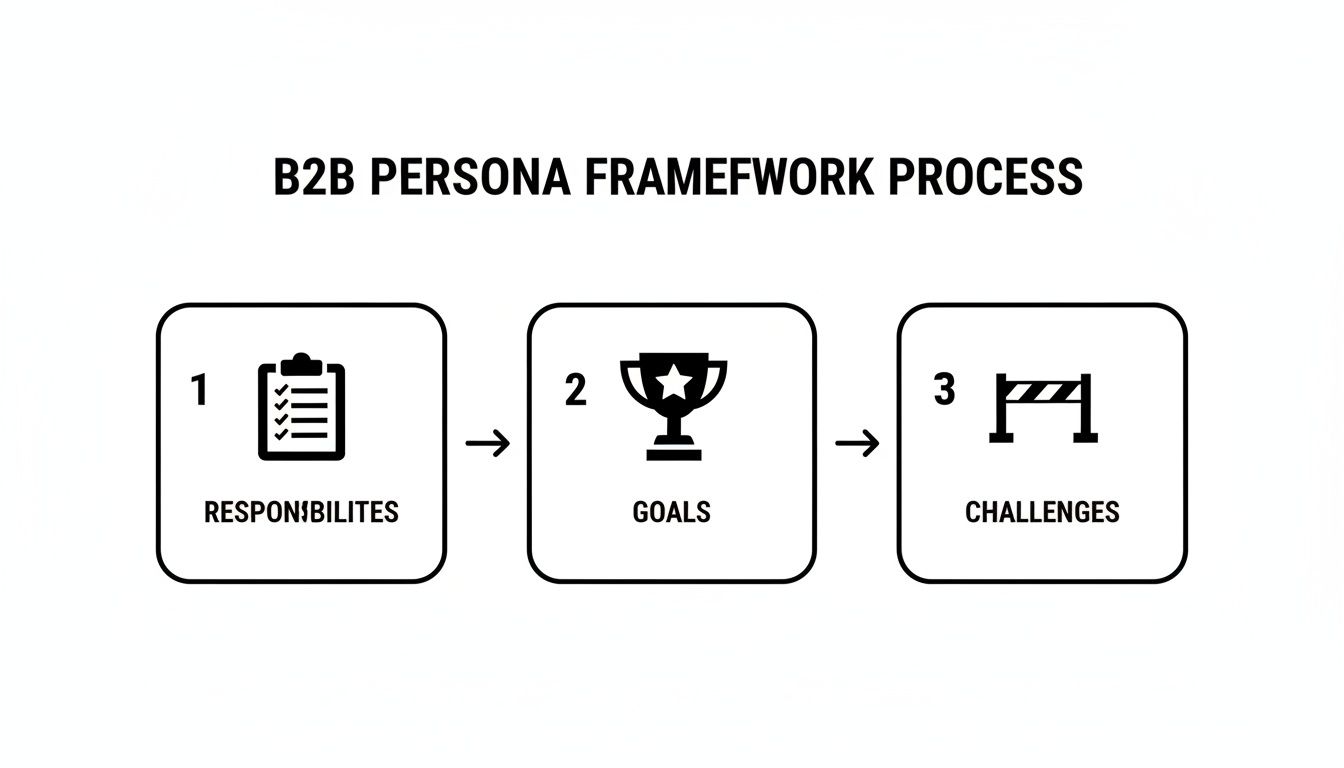
This simple flow is your playbook. Understanding their daily duties, what they’re trying to achieve, and what’s standing in their way gives you all the ammo you need for killer messaging.
Here’s a practical look at how this data translates into compelling email copy.
From Persona Data to Persuasive Email Copy
This table breaks down exactly how to turn what you know about your persona into words that work.
| Persona Insight | Example Data Point | Resulting Email Copy Element |
|---|---|---|
| Primary Goal | Reduce warehouse labor costs by 20% | Subject Line: “Idea re: your warehouse labor cost goals” |
| Top Challenge | Inaccurate inventory data from an outdated WMS | Opening Line: “Saw you’re hiring for warehouse managers; know how tough it is to manage inventory with a clunky WMS.” |
| Key Responsibility | Managing relationships with multiple freight carriers | Value Proposition: “Our platform centralizes carrier data, so you stop wasting hours chasing down updates.” |
| KPI | Increase order fulfillment accuracy to 99.5% | Call-to-Action: “Happy to share a case study on how we helped [Similar Co] boost fulfillment accuracy by 2%.” |
By systematically mapping your insights to your copy, you build a powerful, repeatable engine for writing emails that get replies.
Key Takeaway: Shifting the conversation from what you’re selling to what problems you’re solving is the entire game. This is how you earn a response from busy, high-value prospects.
Ultimately, this whole process is about turning information into empathy. The more you truly understand your buyer persona, the easier it becomes to write emails that feel personal, relevant, and worth their time.
If you want to go even deeper on this, check out our guide to master cold email personalization to boost responses.
Don’t Let Your Buyer Personas Become Expensive Office Decor
https://www.youtube.com/embed/hbKFpYVFpUQ
You’ve invested time and money into building out your buyer personas. But even with the best of intentions, it’s shockingly easy to end up with a glossy document that’s completely useless to your sales team. These common mistakes can turn what should be a powerful asset into a pretty, but pointless, PDF.
The whole point is to create a living, breathing tool that actually guides your outreach. If you can sidestep these all-too-common traps, the effort you pour into understanding your audience will directly translate into more meetings booked and a much healthier pipeline.
Let’s walk through the mistakes I see people make all the time.
Mistake 1: You’ve Created a Persona for Everyone
It’s a tempting thought: more personas must mean more personalization, right? Wrong. In reality, creating a dozen different personas for every tiny variation in your customer base is a recipe for chaos. It completely dilutes your focus and paralyzes your sales team.
When you hand your reps too many profiles, they get stuck. They can’t possibly craft unique messaging for “Startup CEO Steve,” “Enterprise CFO Carol,” and “Mid-Market Marketing Mike” all at the same time. What happens? They fall back on generic, one-size-fits-all emails, and all that work you did goes right out the window.
What to do instead: Start with just one to three core personas. These should represent the 80% of your best customers - the ones who truly move the needle. You can always add more detail later, but nail these first.
Mistake 2: You Built Them in a Vacuum
This is probably the biggest and most fatal error you can make. If you create your buyer personas in a conference room without ever speaking to a real, live customer, you’re not building a persona. You’re writing fiction. And basing your entire sales strategy on a guess is like trying to find your way through a new city with a map you drew from memory.
Sure, your sales team has insights. Your marketing team knows the brand. But their views are, by nature, biased. Nothing - and I mean nothing - replaces hearing a customer describe their own problems, their goals, and their buying journey in their own words.
Without that direct input, your personas will lack the authentic language and specific pain points that make cold emails hit home.
Here’s how you get real, actionable intel:
-
Interview your newest customers. Talk to the people who just signed on the dotted line. Their memory of the process is fresh, and their insights are pure gold.
-
Talk to the ones who got away. Why did a seemingly perfect prospect choose a competitor or, worse, do nothing at all? The lessons here are often the most powerful.
-
Dig through support tickets. Your support team is on the front lines every single day, hearing about real-world frustrations. Use that intel.
Mistake 3: You Confused a Job Title with a Persona
A list of demographic data is not a persona. “VP of Sales, 45-55, lives in the suburbs” tells you absolutely nothing about how to actually sell to that person. It’s just a label.
A real persona tells a story. It dives deep into their daily frustrations, the KPIs they’re judged on, the objections they’ll probably throw at you, and what a “win” actually looks like in their world. Without that context, you can’t write an email that connects on a professional or emotional level.
If you’re having trouble getting past the job title, learning how to master B2B lead scoring to boost sales effectiveness can help you pinpoint the specific attributes that make a prospect truly qualified.
Mistake 4: You Let Them Collect Dust
The final pitfall is the “set it and forget it” approach. You create the personas, email them out to the team with a “ta-da!” and then they’re never spoken of again. But markets change, new challenges pop up, and your customers’ needs evolve. A persona you built two years ago might as well be from a different century.
Your buyer personas aren’t a one-and-done project. They’re living documents that need regular care and feeding to stay sharp.
What to do instead: Put a recurring event on your calendar to review your personas every quarter or, at the very least, twice a year. In that meeting, bring new insights from sales calls, recent customer interviews, and market trends to the table. This keeps your outreach perfectly synced with the current reality of your audience, not an outdated snapshot.
Got Questions About Buyer Personas? We’ve Got Answers.
Okay, so you’ve built out your first buyer persona. You’ve done the interviews, synthesized the data, and now you have a shiny new profile to work with. But what happens next?
It’s one thing to have the document; it’s another thing entirely to weave it into your team’s day-to-day and keep it from gathering digital dust. Let’s tackle some of the most common questions that pop up once the theory meets reality.
How Many Buyer Personas Should We Really Have?
This is a classic. And honestly, the answer is almost always “fewer than you think.”
It’s so tempting to create a unique persona for every little variation you see in your customer base. A “Marketing Manager at a Startup” and a “Marketing Manager at a Mid-Sized Tech Firm”… are they really that different? Often, they’re not. Creating too many just leads to confusion and a totally diluted focus. Your team can’t possibly keep a dozen different profiles straight.
Start with just one to three core personas. These should be the rockstars who represent the top 80% of your best customers - the ones who truly move the needle for your business. Nailing these primary profiles is way more valuable than having a big collection of half-baked ones. You can always expand later as you grow or break into new markets, but simplicity is your best friend when you’re starting out.
What’s the Real Difference Between a Persona and an ICP?
This one trips people up all the time, but the distinction is crucial. While they’re related, an Ideal Customer Profile (ICP) and a buyer persona serve two completely different functions. Mixing them up leads to muddled targeting and copy that falls flat.
-
Ideal Customer Profile (ICP): Think of this as the perfect company you want to sell to. It’s all about the firmographics - industry, company size, annual revenue, where they’re located, even the tech stack they use. An ICP answers the question, “What kind of organization is a perfect fit for what we sell?”
-
Buyer Persona: This is about the actual people inside those ideal companies. It gets into their world: their personal goals, what keeps them up at night, their day-to-day responsibilities, and what motivates them to make a purchase. A persona answers the question, “Who’s the person we need to convince, and what do they actually care about?”
Here’s a simple way to think about it: Your ICP tells you which buildings to walk into. Your buyer personas tell you who to talk to once you’re inside - and what to say to get their attention.
How Often Should We Bother Updating Our Personas?
Buyer personas are not a “set it and forget it” kind of deal. Markets change, customer needs evolve, and new challenges pop up all the time. A persona you built two years ago is probably running on some seriously outdated assumptions.
You should plan to do a formal review and refresh of your personas at least once a year.
But here’s a pro-tip: a quick, informal check-in with your sales and customer support teams every quarter is a game-changer. They’re on the front lines, hearing about new objections, shifting priorities, and emerging trends long before anyone else. This keeps your personas living, breathing documents that evolve right alongside your customers.
What if We’re a New Business and Have Zero Customers?
Building personas when you don’t have a customer base is definitely a challenge, but it’s not impossible - and you absolutely have to do it. Instead of mining data from existing customers, you’ll have to get creative and focus on prospective ones.
Time to get scrappy.
Find people with your target job title on platforms like LinkedIn. Reach out and offer them a small gift card for a 20-minute “industry research” call. Make it crystal clear this isn’t a sales pitch. Your only goal is to understand their world before you ever try to sell to it. This kind of proactive research is what separates a launch strategy based on a hunch from one based on actual evidence.
Ready to stop guessing and start booking meetings with your ideal buyers? At Fypion Marketing, we turn deep persona insights into cold email campaigns that actually convert. We handle everything from the research to the execution, so you only pay for results - guaranteed. Scale your pipeline with Fypion Marketing today.