
A Guide to High-Converting B2B Sales Funnels
A B2B sales funnel isn’t just a marketing buzzword; it’s a visual roadmap of your customer’s journey, from the very first time they hear your brand’s name to the moment they sign on the dotted line. Unlike a quick B2C purchase, the B2B world involves multiple touchpoints, much longer sales cycles, and a whole committee of decision-makers. That’s why having a structured funnel is so critical for guiding prospects without losing them along the way.
Decoding the B2B Sales Funnel
Think of your sales funnel less like a rigid slide and more like a GPS for your customer relationships. It gives your marketing and sales teams a clear, strategic map showing exactly where a prospect is, what they need to know next, and the perfect time to reach out. This approach takes the guesswork out of the equation and helps you build a predictable revenue engine.
This is especially true today. Buyers have done a ton of research on their own before they even think about talking to a salesperson. A well-built funnel meets them right where they are, offering up valuable content and smart solutions that build trust long before anyone tries to make a sale.
The Core Stages of Engagement
While you can slice and dice a funnel into countless micro-stages, it all really boils down to three core phases of the buyer’s journey. Each stage signals a shift in the prospect’s mindset and requires a completely different playbook from your team. Nailing these transitions is the first step to building a system that actually nurtures leads into customers.
The primary stages break down like this:
-
Awareness (Top of Funnel): This is the “first contact” moment. A prospect is feeling the pain of a problem or sees an opportunity, but they probably don’t have the right words for it yet. Your job here isn’t to sell - it’s to educate.
-
Consideration (Middle of Funnel): Okay, now they’ve put a name to their problem and are actively hunting for solutions. They’re weighing different vendors, comparing products, and sizing up various approaches. This is where you have to prove why your solution is their best bet.
-
Decision (Bottom of Funnel): We’re getting close. The prospect is ready to pull the trigger. They’ve whittled down their list and are just looking for the last few details - pricing, implementation plans, a final demo - to feel confident in their choice.
A huge mistake is thinking the funnel is a one-way street. Modern B2B buyers are anything but predictable. They might jump back and forth between stages as new stakeholders pipe in or company priorities suddenly change. The real key is to provide undeniable value at every single touchpoint, no matter where they are.
A one-size-fits-all strategy just won’t cut it. To build a successful model, you have to line up your marketing and sales efforts with what buyers actually need at each of these critical phases. You can learn more about aligning these activities in our guide to Your Guide to Modern B2B Marketing Strategy.
The Anatomy of a High-Converting B2B Funnel
Think of a great B2B sales funnel less like a rigid process and more like a well-guided conversation. You’re leading a prospect from a point of having a vague, nagging problem to feeling confident they’ve found the perfect solution. Each stage marks a big shift in their mindset, and if you can match that shift, you can guide them right to a sale.
To pull this off, you have to align what you’re doing with what they need at that exact moment. This isn’t just about marketing; it’s about understanding the buyer’s psychology. What are they thinking? What are they worried about? What are they really looking for as they move from one step to the next?
This visual breaks down the core stages, showing how a prospect’s journey unfolds from that first “hello” to the final handshake.
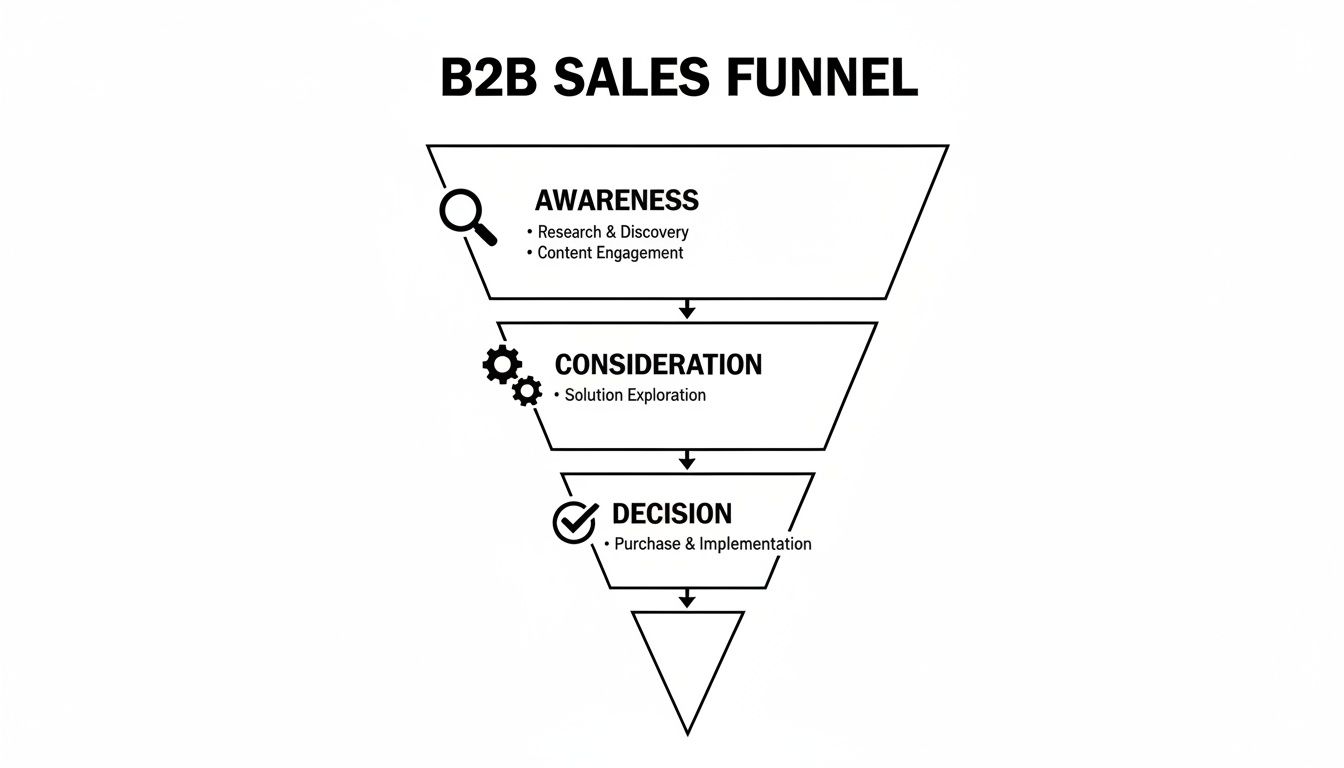
As you can see, the funnel gets narrower for a reason. Your engagement has to get deeper and more personal as prospects get closer to a decision.
Let’s break down what’s happening at each step of the journey. The table below gives a high-level overview of the prospect’s mindset and the kinds of actions you should be taking to meet them where they are.
B2B Sales Funnel Stages and Corresponding Actions
| Funnel Stage | Prospect’s Mindset | Key Activities | Example Content/Action |
|---|---|---|---|
| Awareness (Top) | “I have a problem, but I don’t know what it is or how to solve it.” | Education, brand building, SEO, social media, content marketing. | Blog posts, webinars, eBooks, industry reports, infographics. |
| Consideration (Middle) | “I understand my problem now. What are the best ways to solve it?” | Nurturing, building trust, demonstrating value. | Case studies, white papers, comparison guides, targeted email sequences. |
| Decision (Bottom) | “I’ve shortlisted my options. Which one is the right partner for me?” | Validation, removing friction, closing the deal. | Personalized demos, free trials, detailed proposals, consultations. |
This framework is your roadmap for creating a journey that feels helpful and natural to your future customers, not pushy.
Stage 1: The Awareness Stage (Top of Funnel)
This is the very top of your funnel, where it’s widest. People here don’t even know your brand exists. They aren’t looking for you; they’re looking for answers. They have a business pain point or see a chance for growth, and they’ve just started digging around for information.
Right now, their mindset is purely educational. They’re typing questions into Google like, “How can I improve my team’s productivity?” or “What are the latest trends in my industry?” Your goal isn’t to sell them anything. It’s to educate and build authority.
-
Key Activities: This is where content marketing shines. Think insightful blog posts, genuinely helpful webinars, and slick, shareable infographics that make complex ideas simple.
-
Example Content: A B2B SaaS company might write a blog post titled, “5 Inefficiencies Silently Costing Your Manufacturing Plant Money.” It hits a nerve and addresses a problem without immediately screaming, “Buy our product!”
When you offer real value with no strings attached, you become a trusted resource. That’s the kind of brand people remember when they’re actually ready to start looking at solutions.
Stage 2: The Consideration Stage (Middle of Funnel)
Alright, so your prospect has put a name to their problem. Now they’re in the consideration stage, actively weighing their options. Their thinking has shifted from “What’s my problem?” to “What’s the best way to solve it?”
This is where you start building a real relationship and showing them why your solution is the one they should be looking at seriously. It’s all about trust and credibility. You need to show them, not just tell them, that you can deliver.
A lot of B2B funnels spring a leak right here. This is a critical point where prospects are comparing features, digging through reviews, and hunting for any proof that you’ve helped companies just like theirs.
To keep them engaged, you need to nurture them effectively. Here’s what works:
-
Case Studies: Show, don’t tell. Walk them through how you helped a client solve a specific problem and what the tangible results were.
-
Targeted Email Outreach: Send personalized emails with more in-depth resources - like white papers or comparison guides - based on what they’ve already shown interest in.
-
Product Webinars: Host sessions that dive deeper into your solution’s features and, more importantly, the benefits they deliver.
For example, a tech company could send a case study to leads who downloaded an introductory guide, showing exactly how their software solved the problem discussed in that guide. To learn how to manage these leads, check out our guide on building a sales pipeline to boost revenue.
Stage 3: The Decision Stage (Bottom of Funnel)
We’re at the finish line. The prospect is ready to pull the trigger and has a shortlist of potential vendors - and you’re on it. Their mindset is now about validation and logistics. They’re asking, “Is this the right partner for me?” and “What will it actually be like to get this up and running?”
Your job is to make choosing you the easiest, most obvious decision they can make. This is where your sales team really steps up with personalized interactions that speak directly to the prospect’s unique situation.
The activities that get deals signed include:
-
Personalized Demos: A one-on-one tour of your product that’s all about their specific use case, not a generic feature dump.
-
Free Trials: Let them get their hands dirty and see the value for themselves.
-
Consultations and Proposals: Lay out a crystal-clear plan of action, complete with pricing, timelines, and the ROI they can expect.
The path from a curious visitor to a happy customer is tough, and drop-offs are normal. Industry benchmarks show a typical B2B funnel converts only 2 - 5% of website visitors into paying customers. This breaks down into a visitor-to-lead rate of about 2.0 - 2.3%, an MQL-to-SQL conversion of around 13%, and finally, an opportunity-to-close rate between 15 - 30%.
Tracking Funnel Performance with Key Metrics
A B2B sales funnel isn’t just some theoretical model you draw on a whiteboard and forget about. It’s a living, breathing part of your business that needs constant attention to work properly. Building the funnel is just the start; the real magic happens when you start measuring it.
Tracking the right Key Performance Indicators (KPIs) is how you turn those abstract stages into hard data you can actually use. It’s how you spot the leaks, celebrate what’s working, and make smart decisions that actually drive growth.
Think of it like a doctor checking a patient’s vital signs. A weird blood pressure reading or a low heart rate points to a deeper issue that needs attention. It’s the same with your funnel. A poor conversion rate between two stages is a massive warning sign, and if you ignore it, the health of your entire sales process is at risk.
Top-of-Funnel Health Indicators
The top of your funnel (ToFu) is all about casting a wide, yet relevant, net. Your goal is simple: turn strangers browsing your site into known leads. But success here isn’t just about raw numbers; it’s about getting the right kind of attention from people who actually fit your ideal customer profile.
A go-to metric here is the Lead Generation Rate. This KPI tells you how good your marketing is at turning website visitors or campaign viewers into real, tangible leads.
-
How to Calculate It: (Total Number of New Leads / Total Website Visitors) x 100
-
What It Means: If this rate is low, it could mean your content isn’t hitting the mark, your calls-to-action are weak, or you’re simply attracting the wrong crowd. A high rate, on the other hand, shows your top-funnel content is doing its job and grabbing interest.
Another one to watch is Cost Per Lead (CPL). This tells you exactly what you’re shelling out to get each new contact, which is crucial for figuring out which marketing channels are actually worth the spend. For a deeper look at the numbers that matter, check out our guide on mastering lead gen KPIs for business growth.
Middle-of-Funnel Conversion Metrics
Alright, so you’ve got leads in the system. The middle of the funnel (MoFu) is where the critical handoff from marketing to sales happens. This whole stage is about qualifying those leads to make sure your sales team isn’t wasting their precious time on prospects who are just kicking tires.
The absolute most important KPI here is the Marketing Qualified Lead (MQL) to Sales Qualified Lead (SQL) Conversion Rate. This number is the ultimate stress test for your marketing and sales alignment.
-
How to Calculate It: (Total Number of SQLs / Total Number of MQLs) x 100
-
What It Means: This percentage shows you how many of the leads marketing thinks are “qualified” actually get the thumbs-up from sales. A low conversion rate here is a huge red flag - and a very common B2B problem. It usually means marketing and sales have completely different ideas about what a “good” lead looks like.
Tracking your MQL-to-SQL rate is non-negotiable. If marketing hands over 100 MQLs but sales only accepts 10 as SQLs, you don’t have a lead generation problem. You have a qualification and alignment crisis that’s wasting 90% of your marketing budget.
Fixing this usually involves getting both teams in a room to redefine the lead scoring criteria, open up communication channels, and create a solid Service Level Agreement (SLA) that clearly lays out who is responsible for what.
Bottom-of-Funnel Business Impact
Now we’re at the bottom of the funnel (BoFu). This is where the money is made - where interested prospects become paying customers. The metrics here are tied directly to revenue and show how good your sales team is at turning qualified interest into closed deals.
Two of the most telling BoFu metrics are Customer Acquisition Cost (CAC) and Close Rate.
Customer Acquisition Cost (CAC) Your CAC is the total cost of all your sales and marketing efforts divided by the number of customers you won. It gives you a crystal-clear picture of the investment it takes to grow your customer base.
-
How to Calculate It: (Total Sales & Marketing Costs / Number of New Customers Acquired)
-
What It Means: A high CAC can point to major inefficiencies in your funnel. The goal is always to drive this number down without sacrificing the quality of the customers you bring in.
Close Rate (or Win Rate) This one is pretty straightforward. It’s the percentage of qualified opportunities (like SQLs or formal proposals) that your team successfully turns into a closed-won deal.
-
How to Calculate It: (Number of Closed-Won Deals / Total Number of Qualified Opportunities) x 100
-
What It Means: Your close rate is a direct reflection of how effective your sales team is. If it’s low, you might have issues with your sales process, a shaky product-market fit, or tough competition you’re not prepared for.
By keeping a close eye on these metrics across every stage, you can transform your B2B sales funnel from a passive flowchart into a dynamic, data-driven engine for predictable growth.
Industry-Specific Funnel Strategies and Benchmarks
A B2B sales funnel isn’t a one-size-fits-all blueprint. If you treat it that way, you’re basically using the same map for every city in the world - you’ll get hopelessly lost. How your funnel works, how customers behave, and what good conversion rates look like can change wildly from one industry to the next. Nailing these differences is the key to building a strategy that actually works.
Think about it: the journey a manufacturing prospect takes is completely different from a SaaS buyer’s. A high-stakes legal technology sale might involve just a handful of decision-makers, but it demands an immense amount of trust and credibility. On the other hand, selling CRM software means you’re navigating complex company politics and trying to convince people to abandon systems they’ve used for years.
The best B2B sales funnels aren’t built from generic templates. They’re shaped by the specific market realities, buyer psychology, and competitive pressures of their industry. Ignoring this is a recipe for a leaky pipeline and a lot of wasted effort.
This is exactly why deep market research isn’t just a “nice-to-have” - it’s the absolute foundation of a high-performing sales process.
Navigating Different Industry Funnels
Let’s look at how B2B sales funnels actually perform across different sectors. Data shows that SaaS and technology companies typically see an overall conversion rate of 1 - 3%, while professional services can hit as high as 6 - 10%. These numbers tell a story about sales cycle length, buyer trust, and the nature of the sale itself.
Dive deeper into the SaaS world, and the differences get even sharper. Legaltech businesses can pull off an incredible 42% opportunity-to-close rate, most likely because their solutions solve very specific, urgent problems for a small, well-defined audience. Meanwhile, the crowded Adtech market struggles with a tiny 1.4% visitor-to-lead conversion. CRM software companies often get stuck moving marketing leads to sales, converting only 42% of MQLs because switching systems is such a massive headache for customers. You can dig into more of these B2B sales funnel conversion rates on usermaven.com.
Tailoring Your Strategy by Sector
These benchmarks are great for context, but the real magic happens when you use them to shape your strategy. Every industry needs its own unique approach to finding, nurturing, and closing deals.
Here’s how you can adapt your funnel:
-
For Crowded Markets (e.g., Adtech, Martech): Your top-of-funnel game has to be razor-sharp. Forget casting a wide net. You need hyper-personalized outreach and account-based marketing (ABM) to cut through the noise. Generic blog posts will be ignored; focus on solving a very specific pain point for a clearly defined customer profile.
-
For Niche or Technical Industries (e.g., Legaltech, Manufacturing Tech): The middle of the funnel is where you win or lose. Your buyers are experts, so your content needs to be deeply educational and authoritative. We’re talking detailed white papers, technical case studies, and webinars led by industry veterans. Trust is everything here, so proving your expertise is far more important than any hard sell. For more on this, check out our complete guide on lead generation for manufacturing.
-
For High-Friction Products (e.g., CRM, ERP): The bottom of your funnel needs all your attention. Your biggest enemy is the customer’s resistance to change. You have to make the decision to switch feel as safe as possible. Offer seamless free trials, dedicated implementation support, and ROI calculators that build an undeniable business case. Your job is to de-risk the decision for everyone involved.
By measuring your performance against industry standards and tweaking your funnel accordingly, you stop guessing what works and start building a predictable, scalable revenue engine.
Fueling Your Funnel With The Right Marketing Channels
A high-performance B2B sales funnel is like a powerful engine, but that engine is useless without the right fuel. Your marketing channels are that fuel. Deciding where to sink your time and budget is one of the most critical decisions you’ll make, because not all channels are created equal when it comes to attracting leads and guiding them through your funnel.
The real key is to match the channel to the funnel stage. Think about it: you wouldn’t use a megaphone to have a one-on-one conversation. In the same way, the broad-reach tactics that are perfect for generating awareness at the top of the funnel often fall flat when you’re trying to close a deal at the bottom.
Mapping Channels To Funnel Stages
When you strategically align your channels, you’re making sure the right message lands in the right place at the right time. At the top of the funnel (the Awareness stage), your entire goal is to attract and educate. This is where channels with wide reach and educational value really shine.
-
Organic Search (SEO): Pushing out valuable content that actually answers your audience’s questions builds your reputation as an expert and pulls in prospects who are already looking for solutions.
-
Content Marketing: This is your bread and butter - think blog posts, webinars, and white papers. These assets capture that initial spark of interest and build credibility long before a sales pitch ever enters the picture.
-
Social Media: Platforms like LinkedIn are fantastic for sharing your content and starting conversations with potential buyers in your industry. To keep the top of your funnel full, a solid guide on how to generate B2B leads with LinkedIn can give you the specific strategies needed to attract new prospects.
Once prospects slide into the middle of the funnel (the Consideration stage), your focus has to shift. Now it’s all about nurturing relationships and building trust, which calls for more targeted, personal channels.
A huge mistake we see companies make is continuing to blast broad awareness tactics at leads who are already deep in evaluation mode. At this point, generic content feels impersonal and can make a warm lead go cold. This is where personalization becomes non-negotiable.
The most effective channels for this crucial stage include:
-
Email Marketing: Nurture sequences that deliver case studies, comparison guides, and other high-value content are incredibly effective at guiding leads toward a decision.
-
Retargeting Ads: These ads are perfect for keeping your brand top-of-mind for prospects who’ve already visited your site, gently reminding them of the value you offer.
-
Paid Search (PPC): Targeting specific, solution-focused keywords can capture high-intent leads who are actively comparing their options. Our guide on inbound marketing for B2B dives deeper into strategies for this phase.
Channel Performance By Funnel Stage
The table below breaks down which marketing channels tend to perform best at each stage of the B2B sales funnel. Use it as a starting point to see where your efforts might have the biggest impact, but remember to always test and measure what works for your specific audience.
| Marketing Channel | Best Fit Funnel Stage | Average B2B Conversion Rate | Primary Goal |
|---|---|---|---|
| SEO & Content Marketing | Top/Middle | 2.5 - 3% | Build authority, attract problem-aware prospects |
| Email Marketing | Middle/Bottom | 2.5 - 3% | Nurture leads, build relationships, drive demos |
| Cold Outreach | Top/Middle | 2.4% | Generate initial conversations, book meetings |
| Paid Search (PPC) | Middle/Bottom | 1.5 - 2% | Capture high-intent leads, drive direct response |
| Organic Social Media | Top | <1% | Create brand awareness, engage the community |
| Retargeting Ads | Middle | Varies | Re-engage visitors, stay top-of-mind |
As you can see, the data consistently shows that channels built on trust and authority - like SEO and email - deliver the highest conversion rates. This is why a strong inbound strategy is so foundational to a healthy B2B sales funnel.
Focusing On High-Conversion Channels
When it’s time to allocate your marketing budget, let the data be your guide. The difference in conversion rates between channels is stark and should absolutely inform your strategy. It’s no surprise that the channels that build trust and establish you as an authority tend to win out.
For instance, hard data consistently shows that organic search and email marketing are the heavy hitters, often averaging 2.5 - 3% conversion rates. A well-executed cold outreach campaign isn’t far behind, landing around 2.4%.
On the other hand, paid search (PPC) typically converts in the 1.5 - 2% range, while organic social media often struggles to break 1%. This data makes it crystal clear why a robust inbound strategy, powered by great SEO and smart email marketing, is the cornerstone of any successful B2B sales funnel.
Common Funnel Pitfalls and How to Avoid Them
Even the best-laid plans for a B2B sales funnel can spring a few leaks. These weak spots often fly under the radar, quietly draining potential revenue and wasting good marketing dollars. The difference between a funnel that just exists and one that predictably drives growth is finding and plugging these leaks.
Most of these issues aren’t complex rocket science. They usually boil down to a handful of common, fixable problems that trip up countless companies. If you know the symptoms, you can quickly diagnose the root cause and patch things up before a minor drip turns into a major flood.
Misalignment Between Marketing and Sales
This is the big one. A fundamental disconnect between your marketing and sales teams is one of the most destructive things that can happen to your funnel. When these two teams aren’t on the same page, a massive gap opens up right in the middle of your funnel - and that’s where promising leads go to die.
-
Symptom: Marketing is high-fiving over hitting their MQL targets, but sales keeps complaining that the leads are junk. You’re seeing a ton of MQLs come in, but the MQL-to-SQL conversion rate is abysmally low.
-
Cause: The teams are working with two completely different definitions of what a “good lead” is. Marketing gets bonused on quantity, while sales is judged on the quality of conversations, creating totally misaligned incentives.
-
Solution: Get a Service Level Agreement (SLA) in place. This isn’t just corporate jargon; it’s a formal document where both teams agree on a concrete definition of a Marketing Qualified Lead (MQL) and a Sales Qualified Lead (SQL). It needs to spell out lead scoring criteria, how quickly leads will be followed up on, and the shared business goals that hold everyone accountable for revenue, not just their siloed metrics.
Think about it. A common trap is marketing passing over anyone who downloads an eBook as an MQL. Sales calls them, finds out they have zero budget or buying authority, and immediately marks the lead as dead. An SLA fixes this by defining an MQL as someone who, for example, visits the pricing page and requests a demo. Much better.
Neglecting Lead Nurturing
Another all-too-common mistake is putting all your energy into generating new leads while completely ignoring the ones you already have. Prospects who aren’t ready to pull the trigger today often get tossed aside, but they represent a massive chunk of your future revenue.
This is especially true in the B2B world, where sales cycles can drag on for months and involve a whole committee of decision-makers. A lead who says “not right now” isn’t a lost cause. They’re an opportunity just waiting for the right moment.
Slow or Inconsistent Follow-Up
The speed of your response has a direct, and often dramatic, impact on your conversion rates. In a crowded market, the first vendor to provide a helpful, relevant answer is usually the one who wins the deal. Every minute you delay is a golden opportunity for a competitor to swoop in and steal your lunch.
-
Symptom: Your sales team is constantly playing phone tag with inbound leads, and your demo-to-close rates are stuck in the mud.
-
Cause: There’s no standard process for how quickly leads get contacted. Reps might wait hours or even days to reach out, and by then, the prospect’s initial spark of interest has completely fizzled out.
-
Solution: Implement a “speed to lead” policy and treat it like law. This could be a hard rule that all high-intent leads (like a demo request) must be contacted within five minutes. Use automation to assign leads the second they come in and fire off an immediate confirmation email so no one ever falls through the cracks.
A Few Common Questions About B2B Sales Funnels
Even with a perfect plan on paper, questions always pop up when you’re in the trenches building and tweaking your B2B sales funnel. Getting straight answers to these common worries helps teams put their resources in the right place and set goals that are actually achievable. Let’s tackle the big ones: timelines, priorities, and mistakes to avoid.
How Long Until I Actually See Results?
This is the big one, and the honest answer is: it depends entirely on your typical sales cycle. There’s no magic button you can press for instant revenue.
If you have a shorter sales cycle, say around 30 to 60 days, you could start seeing some genuinely qualified opportunities bubble up within the first quarter. But for businesses with long, complex sales cycles of 6 to 12 months, patience is everything. Your initial focus should be on the top of the funnel. You’ll likely see leading indicators, like an increase in MQLs, improve in a month or two. The lagging indicators - the closed deals and revenue - will naturally take longer, maybe three to six months or more. Think of a well-built funnel as a long-term asset, not a quick hack.
What’s the Single Biggest Mistake Companies Make?
The most common - and most expensive - mistake is the classic disconnect between marketing and sales. It happens all the time. Marketing gets bonused on the volume of leads, while sales desperately needs quality. When these two goals don’t align, your funnel breaks right in the middle.
This is where promising leads go to die. Marketing pops the champagne for hitting a lead quota, and sales wastes precious time chasing prospects who have no budget, no authority, or no real need for another year.
The fix? Create a shared definition of what a “qualified lead” actually is. Formalize it with a Service Level Agreement (SLA) that holds both teams accountable to the same business goals. This forces marketing to focus on generating high-intent leads that sales can actually close. It’s the single most effective way to plug the leaks in your funnel.
Should I Optimize the Top or Bottom of the Funnel First?
I get it. The temptation is to pour more money into the top of the funnel to get a flood of new leads. But that’s almost always the wrong move. It’s far more efficient to fix the leaks at the bottom of your funnel first.
Imagine your funnel is a leaky bucket. If your conversion rates from MQL-to-Opportunity or Opportunity-to-Close are terrible, adding more leads at the top just amplifies the waste. You’re just pouring more water into a bucket riddled with holes, and your marketing budget is draining right out with it.
Start by solidifying your qualification and closing processes. Once you have a reliable system for converting the prospects already in your pipeline, then you can scale your top-of-funnel efforts. You’ll do it with the confidence that those hard-won leads won’t just slip through the cracks.
Ready to stop worrying about lead generation and start closing more deals? Fypion Marketing specializes in booking qualified meetings directly for your sales team through performance-based cold email outreach. You only pay for results. Book your free consultation with Fypion Marketing today.