
Request for Meeting Email: Write Messages That Get Opened and Book More Calls
A great meeting request email is a delicate balance. It needs to show you’ve done your homework and offer genuine value, all while respecting the other person’s packed schedule. Get it right, and you turn a cold email into a warm conversation. Get it wrong, and you’re just more noise in their inbox.
The Anatomy of a High-Performing Meeting Request Email
Before you start typing, you need to understand the psychology behind an email that actually gets a “yes.” This isn’t about finding some magic template. It’s about building a message on a solid foundation of value, credibility, and crystal-clear clarity.
This is what busy professionals respond to.
Quick Guide to an Effective Meeting Request
Here are the essential elements your email needs to succeed, broken down for easy reference.
| Component | What It Does | Pro Tip |
|---|---|---|
| Compelling Subject Line | Earns the click. It’s your first (and maybe only) impression. | Keep it short, specific, and intriguing. Avoid clickbait. |
| Personalized Opening | Shows you aren’t just spamming a list. | Reference their recent work, a company win, or a mutual connection. |
| Clear Value Proposition | Answers the reader’s “What’s in it for me?” question. | Be direct. State exactly how they will benefit from your meeting. |
| Low-Friction CTA | Makes it effortless for them to agree. | Instead of “When are you free?” try, “Open to learning more?” |
Think of these as the building blocks. Nail each one, and you’ve built an email that works.
Despite all the noise about new platforms, email is still king in the B2B world. With the number of global users set to hit 4.73 billion by 2026, its power isn’t fading. In fact, a whopping 77% of B2B consumers actually prefer email for a first touchpoint. That’s more than double any other channel, making this a skill you have to get right.
A great meeting request respects the recipient’s intelligence and their inbox. The goal isn’t to trick them into a call, but to present an opportunity so compelling that they want to talk to you.
From Blueprint to Booked Call
Your opening line is your first real test. It has to signal credibility in seconds to get past the mental spam filter we’ve all developed. For example, mentioning a mutual connection or a sharp observation about their latest project instantly separates you from the generic masses.
This value-first thinking is how you turn cold outreach into a reliable stream of qualified calls. If you want to dive deeper into proven systems, it’s worth checking out how some experts approach Outreach That Books Meetings Daily.
Ultimately, focusing on delivering real value at every turn doesn’t just get your emails opened - it gets you the replies you’re looking for.
Crafting Subject Lines That Get Your Emails Opened
Let’s be honest - your subject line is the gatekeeper. If it doesn’t earn a click, the rest of your carefully written is dead on arrival. The data doesn’t lie: 47% of people open emails based on the subject line alone. It’s your single biggest lever for getting a foot in the digital door.
So, forget the generic, boring stuff. Your goal is to create a subject line that hints at value, sparks a little curiosity, and feels like it was written by a human. It’s a fine line to walk. You want to be compelling, but stray into clickbait territory and you’ve lost their trust before they even open the email.
The Power of Being Direct and Specific
One of the most effective approaches I’ve found is to just be straightforward. Busy people appreciate clarity. A direct subject line cuts through the inbox clutter and tells them exactly what you’re offering and why they should care.
For instance, a subject line like “Quick Question” is lazy and easy to ignore. It screams “I want something from you.” But something specific like, “Idea for improving [Company Name]‘s user onboarding,” immediately signals value and shows you’ve put in the work.
Here are a few direct formulas that consistently get results:
-
[Benefit] for [Company Name]: “New lead gen strategy for Fypion Marketing”
-
Connecting on [Topic/Goal]: “Connecting on Q3 content marketing goals”
-
[Mutual Connection]‘s Intro: “Rami Touzard suggested I reach out”
These work because they’re short, personal, and framed around the recipient’s world, not yours. They make opening your email feel like a good use of their time. If you need more ideas, check out our guide on the top 10 best email subject lines to boost open rates.
Sparking Curiosity with a Personal Touch
While being direct is a solid play, sometimes a little intrigue is the better move. This approach works best when you have a strong, personalized angle to lead with. You want to make them think, “Okay, what’s this about?” in a good way.
A great curiosity-driven subject line often poses a question or makes an observation that proves you’ve done your homework.
A subject line’s job isn’t just to get an open - it’s to set the tone for the entire interaction. Make it about them, not you, and you’ve already won half the battle.
Consider these examples that mix personalization with a bit of curiosity:
-
Your recent post on LinkedIn: It’s simple, shows you’re paying attention, and invites a conversation about their own ideas.
-
Question about your [Project/Initiative]: This implies you have a thoughtful question about their work, positioning you more as a peer than just another salesperson.
Staying Out of Spam and Winning on Mobile
With over 42% of all emails now opened on a phone, your subject line’s length is crucial. If it’s too long, it gets cut off, and your message is lost. I always aim for the sweet spot: 5-7 words or around 40-50 characters.
You also have to be mindful of words that trigger spam filters. Overly salesy language will get your request for a meeting sent straight to the junk folder.
| Words to Use (Value & Urgency) | Words to Avoid (Spam Triggers) |
|---|---|
| Idea, Question, Follow-up | Free, Guarantee, Act now |
| Connecting, Introduction | 100%, Save big, No obligation |
| Your [Goal/Project] | Limited time, Winner, $$$ |
This isn’t a complete list, but the rule of thumb is simple: write like a human talking to another human. The best subject lines feel like they came from a real person with a genuine reason for reaching out. Focus on clarity, personalization, and keeping it brief, and you’ll craft a subject line that doesn’t just get opened - it gets a reply.
The Secret to Personalization That Builds Real Rapport
Let’s get one thing straight: isn’t personalization. It’s a mail merge field, and it immediately tells your prospect they’re just another row in your spreadsheet.
Real rapport - the kind that makes a busy person stop, read, and actually consider your meeting request - comes from showing you’ve done your homework. Generic emails get generic results. If you want to stand out, you have to shift your email from a mass broadcast to a genuine one-to-one conversation. That starts with finding a real reason to connect that goes beyond their job title.
Uncovering Meaningful Connection Points
Your prospect’s online activity is filled with triggers for personalization. The trick is to look for details that show you get their world, their recent wins, and the challenges they’re facing. This isn’t about being creepy; it’s about being observant.
Before I ever write a single word, I spend a few minutes on research. Here’s what I’m always looking for:
-
LinkedIn Activity: Did they just publish an article, share a company update, or post a thoughtful comment? Referencing their specific insights shows you’re actually paying attention.
-
Company News: Check for recent press releases, funding rounds, new product launches, or major hires. You can then frame your outreach around how you can support this new initiative.
-
Podcasts or Webinars: If they’ve been a guest on a show or hosted a webinar, mentioning a specific point they made is an incredibly powerful way to connect. It shows you value their expertise.
-
Shared Connections: A mutual acquaintance is the warmest intro you can get. Mentioning someone you both know instantly creates a bridge of trust.
This kind of detail signals that you respect their time. It proves your is intentional, not just another automated blast. For a deeper dive, we have a whole guide on how to master cold email personalization to boost responses.
Weaving Insights into Your Opening Line
Once you’ve found your angle, the next move is to work it right into your opening sentence. This is your first impression, and the goal is to create an immediate sense of familiarity.
A weak opener like, “I hope this email finds you well,” is a complete waste of valuable screen space. Get straight to the point and lead with your research.
The best opening lines make the recipient feel like they’re getting an email from a peer who’s paying attention, not a salesperson who just wants to pitch them.
Here’s how this looks in practice.
Scenario 1: They just published a LinkedIn article.
-
Before: “I came across your profile and was impressed with your experience.” (Vague and uninspired.)
-
After: “Your recent LinkedIn article on scaling customer support teams was spot on - especially your point about AI-powered chatbots. It got me thinking…” (Specific, complimentary, and starts a conversation.)
Scenario 2: Their company announced a new integration.
-
Before: “I saw your company is doing great things.” (Generic and lazy.)
-
After: “Congrats on the new Salesforce integration your team just launched. Expanding into that ecosystem is a huge move, and it looks like things are heading in an exciting direction.” (Timely, informed, and shows you understand the context.)
These openers immediately answer the recipient’s silent question: “Why me, and why now?”
By starting with a detail that’s relevant to them, you earn the right to briefly explain why you’re reaching out. It’s a fundamental shift from a “me-first” to a “you-first” strategy, and it’s what separates the emails that get deleted from the ones that get meetings.
How to Structure the Body of Your Email for Real Impact
So your subject line worked and they opened the email. Great. Now the real test begins. You have just a few seconds to convince a busy professional that your message isn’t another waste of their time.
A giant wall of text is the fastest way to get your email deleted. To have any shot at a reply, your email body has to be easy to scan and immediately show value.
Think of it as creating a clear path for their eyes, leading them straight from your opening line to why they should care. Good formatting isn’t just for looks; it’s about making your case effectively, especially on a phone where nobody has patience for dense paragraphs.
Use a Copywriting Framework That Just Works
You don’t need to reinvent the wheel. Proven copywriting frameworks are your best friend when structuring a . My go-to is almost always Problem-Agitate-Solve (PAS). It’s effective because it builds a logical argument for why a meeting is the right next step, instead of just asking for one.
Here’s how we adapt it for meeting requests:
-
Problem: Kick things off by pointing out a specific, relevant challenge you know they’re dealing with. This instantly signals that you’ve done your homework. For instance, “Noticed many SaaS leaders are struggling to keep lead quality high as they scale.”
-
Agitate: Next, you gently twist the knife. What are the negative effects of this problem? This creates a sense of urgency. Something like, “This usually means sales teams are wasting time on dead-end leads, pushing CAC through the roof.”
-
Solve: Now, you position a conversation with you as the logical solution. You’re not selling your entire service, just the next step. “I have a few specific ideas that helped another B2B SaaS company cut their CPL by 30%. Worth a quick 15-minute chat to see if it could apply to you?”
This simple structure turns your email from a generic “can we meet?” into a story where the meeting is the obvious next chapter.
Add Social Proof Without Sounding Arrogant
Social proof is crucial for building trust, but there’s a right and a wrong way to use it. Casually name-dropping a big client or a flashy stat out of context just makes you sound like you’re bragging.
The trick is to present social proof as evidence that your solution works, not as a trophy for your company. Frame it as, “Here’s proof this approach helps people who are in your exact situation.”
Instead of a lazy, “We work with Google,” tie it directly to the prospect’s problem.
Here’s an example that actually works: “When we started with [Similar Company], they were dealing with the same lead quality issues. After we implemented the framework I mentioned, they saw a 220% increase in qualified meetings month-over-month.”
See the difference? This connects your success to their potential gain, making the offer feel tangible and real. It shifts the entire conversation from “look at us” to “look what we could do for you.” If you want to see more real-world examples, checking out some effective cold email examples can give you some great ideas.
Make Your Email Scannable, Not a Chore
Let’s be honest: your prospect isn’t reading your email. They’re scanning it. If your formatting fights that behavior, your message is dead on arrival.
Here are a few non-negotiable rules we follow for every campaign:
-
Short Paragraphs: Keep paragraphs to two or three sentences, max. White space is your friend - it makes the email feel less like a chore and easier to process.
-
Use Bullet Points: Anytime you’re listing benefits, stats, or results, use bullet points. They break up the text and help a scanner quickly grab the key takeaways.
-
Bold Strategically: Don’t go crazy, but use bold text to make your most important information pop. This could be a key statistic, a powerful benefit, or their company name. It guides the reader’s eye right where you want it to go.
By combining a simple framework like PAS with relevant social proof and a clean, scannable format, you create an email that does the heavy lifting for you. It respects the reader’s time, which is often the one thing that convinces them to give you some of it.
Nailing the Call-to-Action and Follow-Up Cadence
I’ve seen it happen more times than I can count: a brilliant, personalized email dies at the very last step. The reason? A weak or confusing call-to-action (CTA). This is where the real work gets done, turning a reader’s interest into an actual meeting on the calendar.
Your goal here is to remove every ounce of friction. A vague ask like, “Let me know if you want to chat,” just puts the burden back on your prospect. You have to make saying “yes” the easiest, most logical thing for them to do.
Choosing Your Call-to-Action Strategy
Not all CTAs are built the same. The right one really hinges on your existing relationship with the prospect and how warm the lead is. For a request-for-meeting email, you’ve got two main paths: the interest-based CTA and the direct CTA.
-
Interest-Based CTA: This is your low-pressure move. It’s perfect for that initial cold outreach when you’re still building trust and just want to see if they’re open to the idea.
-
Direct CTA: This is a more confident ask. It works best when you’ve already built some rapport, have a referral, or your value prop is just too good and timely to ignore.
Think of it this way: an interest-based CTA asks, “Are you curious?” A direct CTA asks, “Are you ready?” Both have their place.
The best call-to-action feels less like a demand and more like an invitation. It should be so easy to answer that a busy executive can reply with one word from their phone.
Crafting Effective CTA Phrases
Vague language kills conversions. You have to be incredibly specific. Here are some of the phrases I’ve found work best in my own campaigns, broken down by type.
Interest-Based CTA Examples
These questions are designed to get a simple “yes” or “no.” They don’t force the prospect to check their calendar, which dramatically lowers the barrier to a response.
-
“Open to exploring how this could work for [Their Company Name]?”
-
“Would it be helpful if I sent over a few specific ideas?”
-
“Is improving [Specific Metric] a priority for you in Q3?”
Direct CTA Examples
Use these when you have a warmer lead or a solid referral. The trick is to suggest specific times or give them a direct scheduling link to make it effortless.
-
“Do you have 15 minutes free next Tuesday or Thursday afternoon for a quick call?”
-
“Are you available for a brief chat sometime next week to dig into this?”
-
“I’ve opened up my calendar. Feel free to book a time that works for you here: [Link to Calendar].”
The Art of the Follow-Up Cadence
Let’s be real: most meetings are booked on the follow-up, not the first email. Persistence is what separates the pros from everyone else, but there’s a fine line between being persistent and just being annoying.
Your follow-up sequence should never, ever be, “Just checking in.” Each message has to deliver new, standalone value.
A disciplined cadence keeps you top-of-mind without burning the bridge. This is a simple, value-driven schedule that I lean on.
| Follow-Up Cadence | Timing | Message Focus |
|---|---|---|
| Email 1 | Day 1 | The initial, personalized request for a meeting. |
| Email 2 | Day 3 | Reply to the original email with a short, relevant case study or stat. |
| Email 3 | Day 7 | A new email with a different subject line, sharing a valuable resource (blog, report). |
| Email 4 | Day 14 | A final, friendly “breakup” email to close the loop professionally. |
This approach works because it respects their time while gently reminding them of your value. If you want to dive deeper, you might find our guide with 8 sales follow-up email templates you should know helpful. A structured, value-first follow-up system is how you consistently fill your calendar.
Using Timing and Data to Maximize Your Reply Rate
Crafting the perfect email is only half the battle. If you send it at the wrong moment, it’s like delivering a great punchline to an empty room.
You’ve done the hard work of personalizing your message and packing it with value. Now, you need to make sure it lands at the top of their inbox at the exact moment they’re most likely to read it - not buried under a pile of morning deletions.
The Golden Hours for B2B Outreach
In B2B sales, timing really can make or break your outreach. We’ve seen it time and time again. The data consistently shows the sweet spot for sending scheduling emails is Tuesday through Thursday, between 10 AM and 2 PM in your prospect’s local time zone.
This mid-week, mid-day window cleverly avoids the Monday morning chaos and the Friday afternoon “I’ll get to this next week” mentality. If you want to go deeper on this, we’ve broken down the trends in our guide on the best time to send a cold email.
According to 2026 data, Thursdays pull in reply rates as high as 6.87%. Wednesdays are even stronger, hitting a 7.2% reply rate and a 37% open rate in B2B cold outreach, making it a powerhouse day for your most important requests. You can check out more of the findings behind this data over on Instantly.ai.
This difference in performance also applies to what you ask for. Take a look at the data comparing a direct meeting request to simply gauging interest.
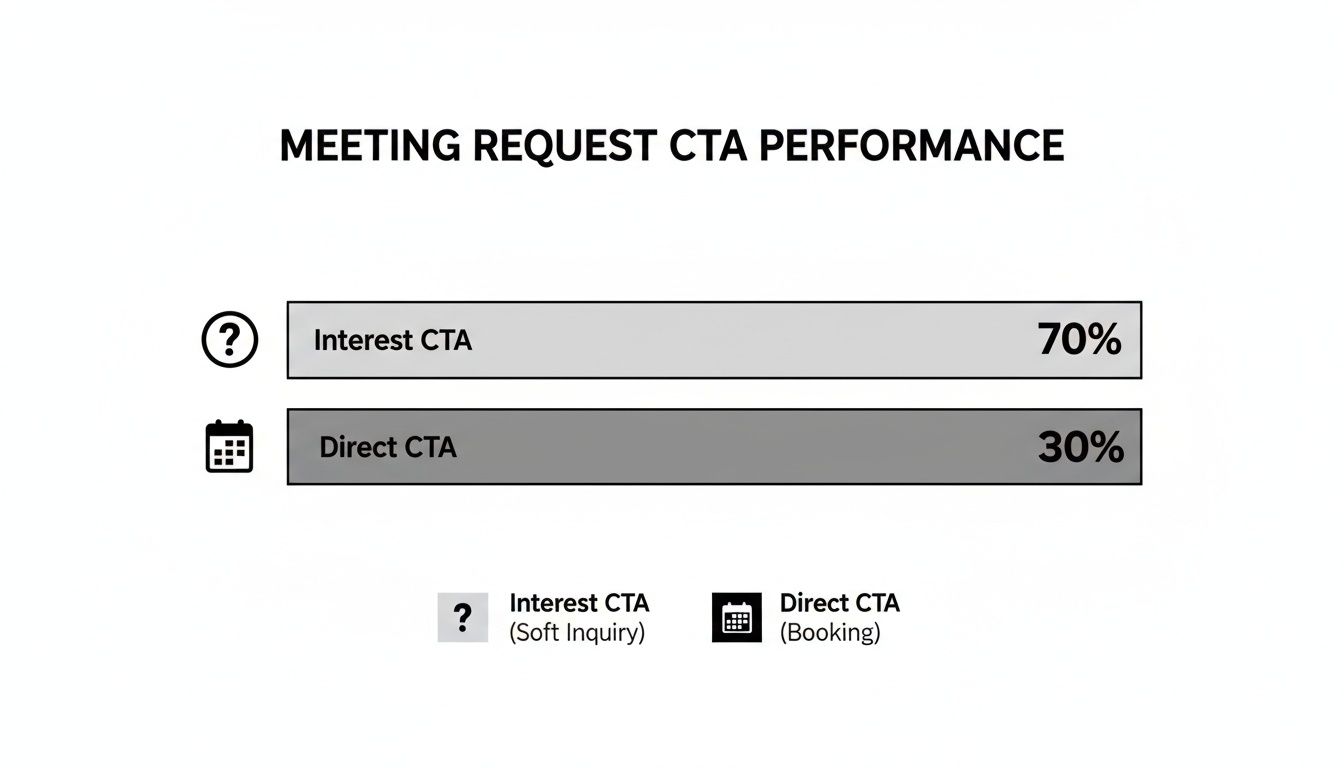
It’s pretty clear. A lower-friction “Interest CTA” is a much safer bet, especially for that first email.
Think Globally, Act Locally
One of the most common - and easily fixable - mistakes we see is people sending emails based on their time zone, not their prospect’s. An email you send at 10 AM might land at 7 AM for them, right in the middle of a chaotic commute, or at 1 PM during their lunch break. It’s a recipe for getting ignored.
Sending an email in your prospect’s local time zone isn’t just a courtesy; it’s a strategic move that respects their workflow. It shows you’re thoughtful and detail-oriented, which builds subconscious trust before they even read your first sentence.
Most modern email platforms make this incredibly simple to automate. Always double-check that your campaigns are scheduled for the recipient’s local time to hit that prime 10 AM to 2 PM window. It’s a small detail that has a huge impact.
And when they do reply? Don’t leave them hanging. The concept of speed to lead is critical here; a prompt follow-up capitalizes on their immediate interest when it’s at its peak. Understanding the importance of speed to lead can dramatically increase your chances of actually booking that meeting.
Frequently Asked Questions About Meeting Requests
Even when you have your strategy and templates down, a few questions always seem to pop up. Let’s tackle some of the most common sticking points I see so you can send your next request with total confidence.
What Is the Best Length for a Meeting Request?
Keep your emails short and to the point. The sweet spot is somewhere between 50 and 125 words.
This gives you just enough room to introduce yourself and show your value, but it’s brief enough for someone to scan quickly on their phone. We’ve found that emails in this range get the best response rates. Go much longer, and you risk losing their attention before they even see your call to action.
How Many Follow-Ups Are Too Many?
There’s a real difference between being persistent and just being annoying. My personal rule is to send no more than three to four follow-up emails over a two-to-three-week period.
Sending more than that can start to hurt your reputation. The key is to make every follow-up count by adding new value each time - maybe share a relevant article, a quick case study, or a different insight. After that last email, it’s time to move on.
Remember, the goal of a follow-up is not to pester but to provide another angle of value. If your first attempt didn’t resonate, a different piece of insight might.
Is It Better to Suggest a Specific Time?
Absolutely. Suggesting a specific time almost always works better than leaving the invitation wide open.
An ask like, “Are you free next Tuesday or Thursday afternoon?” is a simple “yes/no” question. It takes the mental load off the recipient. It’s way easier for a busy professional to check two specific slots in their calendar than it is to think of available times from scratch. This one small tweak can make a huge difference in your reply rate.
Tired of manually crafting every single email? Fypion Marketing specializes in turning cold outreach into qualified meetings on a pay-per-performance basis. Stop guessing and start scaling. Learn how we can fill your calendar.