
How to improve email open rates: Simple tactics for higher opens
Let’s be real - a crowded B2B inbox is a battlefield, and your email is just one of many soldiers fighting for attention. If your open rates are tanking, it’s almost never because of one single mistake. It’s usually a combination of a few common slip-ups that make your message completely invisible.
Before you can fix the problem, you need to play detective and figure out why your emails are being ignored in the first place.
Common Open Rate Killers and Their Solutions
We’ll dig into the specifics, but most open rate issues boil down to a handful of core problems. I’ve seen these trip up marketers time and time again. This table gives you a quick snapshot of what we’re up against and the strategies we’ll use to fix it.
| Problem Area | Direct Impact on Open Rates | Core Solution Strategy |
|---|---|---|
| Subject Line | Fails to grab attention; gets deleted instantly. | Crafting compelling, curiosity-driven subject lines. |
| Audience Targeting | Message feels generic and irrelevant; recipient doesn’t feel seen. | Hyper-segmenting your list for true personalization. |
| Send Timing | Email arrives at an inconvenient time; gets buried in the inbox. | Optimizing send times based on audience behavior. |
| Deliverability | Email lands in the spam or promotions folder, never reaching the primary inbox. | Maintaining a healthy sender reputation and technical setup. |
Think of these as the four pillars of getting your email opened. If one is weak, the whole structure can come crumbling down. Now, let’s look at how to diagnose which pillar is causing you the most trouble.
Diagnosing Why Your Emails Go Unopened
The first and most obvious culprit is almost always a weak subject line. If it’s generic, boring, or overly salesy, you’ve given the recipient a perfect reason to hit delete without a second thought. Without a good hook, even the most brilliant email copy is dead on arrival.
Another huge factor is timing. Sending a B2B email at 8 PM on a Friday just isn’t the same as sending it at 10 AM on a Tuesday. If your send schedule isn’t aligned with your audience’s actual workday, you’re fighting a losing battle for visibility.
This simple flow shows how I typically troubleshoot low open rates. It’s a sequential process - start with the subject, then look at timing, and finally, check your technical foundation.
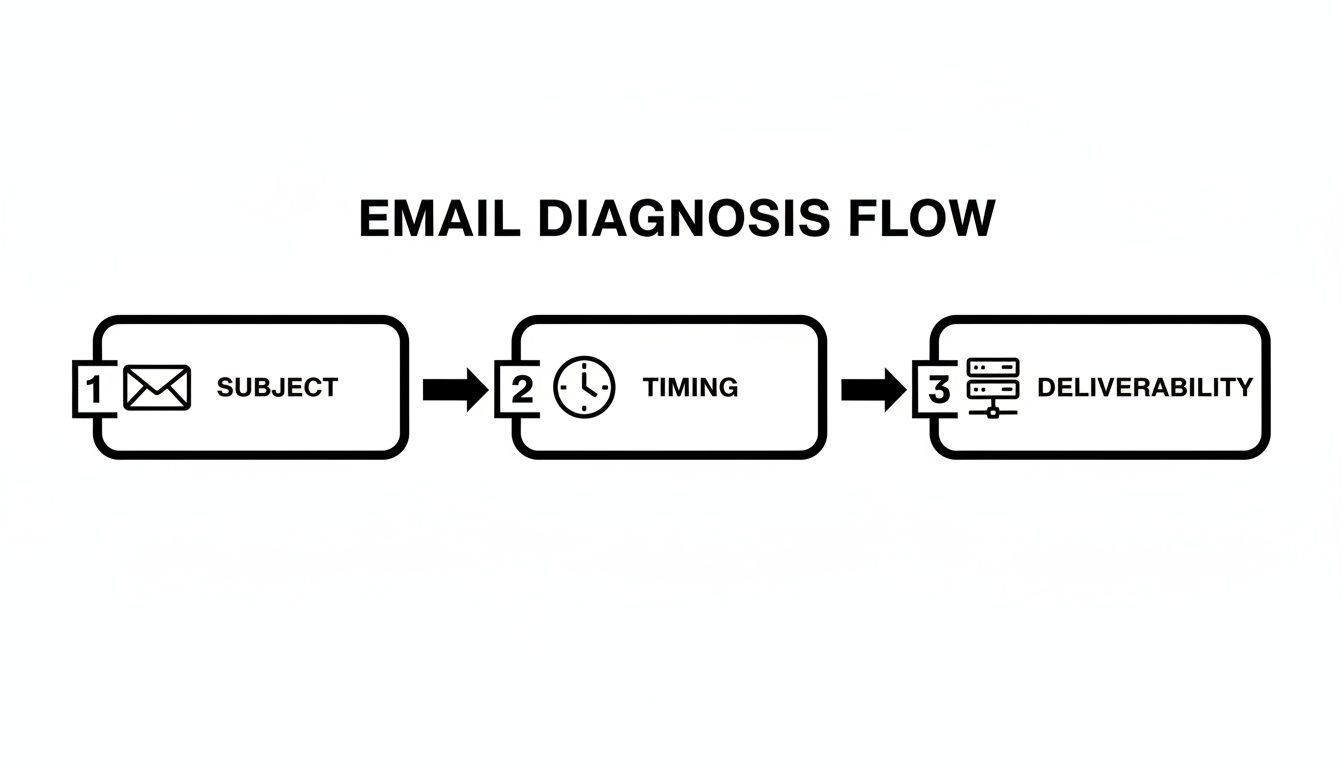
As you can see, a failure at any one of these stages stops the entire process cold.
Email deliverability is the technical bedrock of your entire campaign. If email providers flag you as spam, it doesn’t matter how incredible your subject line is - your message will never even make it to the primary inbox.
Finally, weak personalization is a massive barrier. An email that feels like a generic blast gets dismissed instantly. I’m not just talking about dropping in a tag. Real personalization speaks to the recipient’s specific role, industry challenges, or recent actions.
Getting a handle on the right email marketing KPIs that actually drive business growth will help you measure what’s actually working here.
By systematically working through these areas - subject, timing, deliverability, and personalization - you can pinpoint exactly where things are going wrong. For a deeper dive into tactics that work, this guide on how to increase email open rates offers some fantastic, proven insights.
Crafting Subject Lines That Demand a Click
Think of your subject line as the gatekeeper to your entire email. In a B2B inbox that’s already overflowing, it’s the one thing that decides whether your message gets opened or immediately trashed. Forget about those generic, clickbait phrases you see everywhere. The real art is blending genuine value, smart personalization, and just the right amount of curiosity.
It’s pretty shocking when you see the numbers - with over 376 billion emails sent daily, a huge chunk of them never even get a first look. It’s not always because the content is bad. More often than not, the subject line just didn’t do its one job: earning that click. A great subject line acts like a hook, telling the recipient that what’s inside is actually worth their time.
Personalize Beyond the First Name
Real personalization goes way past just plugging in a token. It’s about showing you’ve actually done your homework and have a specific reason for reaching out. Instead of a generic pitch, try referencing something timely, like a recent achievement or a company event.
For example, we’ve seen a subject line like “A quick thought on [Company]‘s growth” pull in far more opens than a standard marketing message. It feels less like a blast and more like the start of a real conversation.
Another solid tactic is to directly connect your solution to a problem they’re likely dealing with right now.
-
Weak: “Our solution for your team”
-
Strong: “Idea for scaling [Company]‘s lead gen”
-
Weak: “Can we connect?”
-
Strong: “Following up on your recent funding round”
That level of detail instantly cuts through the noise and proves you’re not just spamming them.
Spark Curiosity and Convey Value
A great subject line should create a “curiosity gap” - that little bit of intrigue that makes someone have to open the email to find out more. This isn’t about being misleading or vague. It’s about teasing the value you’re offering without giving the whole story away.
A great subject line is like a movie trailer. It should give a compelling preview of the main event without revealing the entire plot. The goal is to make the audience feel they must see the rest.
Check out these examples that spark curiosity while hinting at real value:
-
“The one thing your competitors are doing”
-
“A question about your Q3 goals”
-
“Is this a priority for you right now?”
See how they’re open-ended? They prompt the reader to look for an answer, which they can only find by opening your email. It’s a powerful little psychological trigger that can make a big difference in your open rates. If you’re looking for more inspiration, check out our guide on the top 10 best email subject lines to boost open rates.
A/B Test Your Way to Success
You can’t improve what you don’t measure. The only way to figure out what really connects with your ideal customers is to continuously A/B test your subject lines. Stop guessing what works and let your data show you the way.
Set up a few split tests to compare different styles. Here are some ideas:
-
Length: A short, punchy subject (like “Quick question”) vs. a longer, more descriptive one.
-
Tone: A buttoned-up, formal tone vs. something more casual and conversational.
-
Content: A direct question vs. a clear statement.
-
Personalization: Using the person’s first name vs. their company’s name.
Keep a close eye on the open rates for each version. Over time, you’ll build a clear picture of the language and style that your audience responds to. This data-driven approach is how you move from guesswork to making smart decisions that consistently improve your campaign performance.
Winning with Hyper-Personalization and Segmentation
Let’s be honest: the era of blasting one generic email to your entire list is dead. If you want to actually get your emails opened today, you have to make every single person feel like you wrote that message specifically for them. And no, just dropping in a token doesn’t count.
I’ve seen it happen time and again. A SaaS startup launches a cold campaign and gets stuck with a dismal 17-25% open rate, which is sadly typical for the marketing sector. But true personalization? That can bump your open rates by up to 29%. In B2B tech, where we at Fypion Marketing live and breathe, a solid average is 38.14% globally. When you tailor your message to solve a specific pain point, you can push that number even higher.
Go Beyond Basic Demographics
Effective segmentation isn’t about sorting contacts by job title. It’s about digging deeper into their behavior and what’s happening in their world right now. You need to build dynamic contact lists that react to real-time data and trigger events - the kind of events that signal a genuine need for your solution.
This is how you turn a cold email into a warm, relevant conversation. When you can point to something that just happened, you instantly prove you’ve done your homework and aren’t just firing off another generic pitch.
A personalized email should feel like a recommendation from a trusted colleague, not an ad from a stranger. It acknowledges the recipient’s world and offers a solution that fits perfectly within it.
So, what kind of triggers should you be looking for? Think about signals that create an immediate opening for your message:
-
Company News: Did they just announce a Series B funding round? That’s your cue to talk about scaling their team or operations.
-
Hiring Trends: Are they suddenly hiring a dozen new sales reps? That smells like a growing pain you can help solve.
-
Professional Wins: Did your prospect just get a promotion or win an industry award? A simple “congrats” is a powerful way to start a conversation.
Build Your Segments Strategically
First things first: map out the key traits and behaviors that define your best customers. This goes beyond a static Ideal Customer Profile (ICP); it should be a living, breathing picture of their professional journey. Once you have that data, you can start building some seriously effective segments.
Here’s a practical example of how you might structure this.
Example Segmentation Strategy
| Segment Name | Trigger Event | Personalization Angle |
|---|---|---|
| ”Recent Funding” | Company secures Series A funding | Your message focuses on managing new growth and scaling operations. |
| ”Tech Stack Change” | Company adopts a new software (e.g., Salesforce) | Your outreach highlights seamless integration with their new tool. |
| ”Key Hire” | New VP of Sales is appointed | Your email is tailored to their likely 90-day goals and challenges. |
When you build lists around these real-world events, your outreach becomes instantly relevant. This is a crucial part of how you can master cold email personalization to boost responses and, more importantly, get replies.
Yes, creating these detailed segments is more work upfront. But the payoff is massive. Instead of one low-engagement blast, you’re deploying a fleet of highly targeted messages, each with a compelling reason to be opened. This is how you stop being inbox noise and become a must-read message.
Mastering Email Deliverability and Sender Reputation
You can write the best email in the world, but if it lands in the spam folder, it’s completely invisible. This is where mastering email deliverability - the actual science of getting your emails into the primary inbox - becomes a non-negotiable part of your strategy.
This isn’t just about dodging spam filters. It’s about building a solid reputation with major providers like Gmail and Outlook.
Think of your sender reputation as a credit score for your email domain. Every time someone opens, clicks, or replies, your score goes up. But when emails bounce, get marked as spam, or are ignored, that score takes a serious hit. A bad reputation tells inbox providers your messages aren’t wanted, and they’ll start burying them.

Getting Your Technical Foundation Right
First things first, you need to prove your emails are legitimate. This involves setting up a few technical records that act like a digital handshake, confirming to the receiving email server that you are who you say you are. The acronyms might seem intimidating, but the concepts are pretty straightforward.
Your team will need to get these DNS records configured:
-
SPF (Sender Policy Framework): This is a published list of all the servers that have permission to send emails from your domain.
-
DKIM (DomainKeys Identified Mail): This adds a digital signature to your emails, which proves the message hasn’t been altered on its way to the inbox.
-
DMARC (Domain-based Message Authentication, Reporting & Conformance): This protocol ties SPF and DKIM together. It tells servers what to do with an email that fails authentication - like sending it to quarantine or rejecting it outright.
Getting these three records set up correctly is a huge step toward looking like a trustworthy sender. For a more detailed breakdown, check out our guide on 8 email deliverability best practices to master.
Don’t Skip the Domain Warm-Up
You absolutely cannot go from sending zero emails one day to thousands the next. A new sending domain needs to be “warmed up” to build a positive sending history. Think of it like an athlete stretching before a big game. Blasting a high volume of emails from a cold domain is one of the biggest red flags for spam filters.
Think of it this way: if a stranger suddenly started shouting at you, you’d probably ignore them. But if they introduced themselves and gradually started a conversation, you’d be more likely to listen. Email providers treat new domains the same way.
The warm-up process involves slowly ramping up your sending volume over a few weeks. It’s a game of patience.
Start by sending to a small, hand-picked list of your most engaged contacts - people you know will open and click, like colleagues or happy customers.
From there, you methodically increase how many emails you send each day. This lets inbox providers see a pattern of consistent, positive engagement building up over time.
All the while, you need to be watching your metrics like a hawk. Keep a close eye on your bounce rates, open rates, and spam complaints. If you notice any negative trends, ease off the volume immediately and reassess. This gradual process proves you’re a legitimate sender and is fundamental to boosting your open rates for good.
Optimizing Your Send Time and Cadence
You’ve got the perfect subject line and a killer email body, but if you send it at the wrong time, it’s just going to get buried. The when is just as critical as the what. Hitting the inbox at the exact moment your prospect is active can make all the difference between getting opened and getting ignored.
This isn’t about throwing darts at a clock. It’s about strategically aligning your outreach with your prospect’s daily grind. For most people in the B2B world, that means you’ve got to connect during their core business hours.
Finding the Golden Window
While every audience is unique, we have a ton of data that gives us a fantastic starting point. For B2B audiences, mid-week and mid-morning consistently come out on top.
Just think about your own work week. Monday mornings are a chaotic mess of catching up and internal meetings. By Tuesday and Wednesday, you’ve hit your stride and are actively working through your inbox.
-
Best Days: We see the highest engagement on Tuesday, Wednesday, and Thursday.
-
Best Times: The sweet spot is usually between 10 AM and 11 AM. This is after the morning coffee and initial email triage, but before the lunch break pulls them away.
This is non-negotiable: Always send emails based on the recipient’s local time zone. Sending an email at 10 AM your time is completely useless if it lands in their inbox at 3 AM.
Of course, these are just guidelines. The only way to know for sure what works for your specific list is to test, test, and test again. Track your results and adjust. If you want to dive deeper into this, check out our full guide on the best time to send a cold email.
Developing a Smart Sending Cadence
Just as crucial as send time is your sending cadence - how often and how far apart you send your follow-ups. Hitting someone’s inbox every day is a surefire way to get flagged as spam. But if you wait too long between touchpoints, they’ll completely forget who you are.
A smart cadence builds familiarity without becoming annoying background noise. Here’s a simple, balanced follow-up schedule that we’ve seen work time and time again:
-
Day 1: Your initial, highly personalized email.
-
Day 3: First follow-up. Add a new piece of value or reframe your ask.
-
Day 7: Second follow-up. Maybe reference a relevant case study or a piece of social proof.
-
Day 14: Third follow-up. Try offering a different resource or a lighter call-to-action.
-
Day 28: The final “break-up” email. A quick, polite message to close the loop.
This rhythm shows you’re persistent, not pushy. It respects their time while keeping your name top-of-mind, a key strategy for winning the long game.
Common Questions About Email Open Rates
Even when you’ve got your strategy dialed in, specific questions always come up. We get them all the time. Let’s run through some of the most common hurdles marketers face with email open rates and give you some straight, no-fluff answers.
How Long Should My Email Subject Line Be?
There’s no magic number, but the data we see day-in and day-out points to a sweet spot: 30 to 50 characters. That’s roughly 6 to 10 words. It’s just long enough to get your point across but short enough for someone to scan in a crowded inbox.
Keep in mind, on mobile, anything over about 40 characters gets cut off. That’s a huge chunk of your audience.
What works best? You have to test it. I always recommend trying a short, punchy subject like “Quick question” against something more descriptive, like “Idea for scaling [Company Name]‘s lead gen.” Let the results tell you what your audience actually responds to.
What Is a Good Email Open Rate for B2B Cold Outreach?
In B2B cold outreach today, hitting a 30-40% open rate is solid. If you’re getting over 40%, you’re doing something very, very right with your targeting and messaging.
But here’s the thing - don’t get too hung up on opens alone. With Apple’s Mail Privacy Protection inflating this number, it’s become more of a vanity metric. What really matters are reply rates and click-through rates. Those are your true indicators of genuine engagement.
The ultimate measure of success isn’t the open rate; it’s the number of qualified meetings booked. That’s the proof that your message didn’t just get seen, but actually drove someone to act.
Do Emojis in Subject Lines Help or Hurt?
This one is all about knowing your audience and your brand. For some modern B2B companies, a single, well-placed emoji (like a chart 📈 or a lightbulb 💡) can really help your email pop in the inbox. It adds a bit of personality and can absolutely boost opens.
But if you’re emailing people in traditional sectors like finance or law, it can come off as unprofessional and sink your credibility before they even open the email.
The only way to know for sure is to test it. Run a simple A/B test. Send half your list a subject line with an emoji and the other half one without. The data will give you a clear winner. For more platform-specific strategies, you can find some actionable tips for optimizing email open rates here.
How Often Should I Clean My Email List?
You need to get into a rhythm with this. Our rule is to verify your email list before every major campaign goes out. Then, do a deep clean of your entire database at least once per quarter.
This means getting rid of invalid addresses, hard bounces, and contacts who haven’t engaged in months. It’s critical for maintaining a high sender reputation.
High bounce rates are a huge red flag to email providers like Google and Microsoft, and it’s the fastest way to get your domain blacklisted. Using an email verification service is a small investment that pays for itself by protecting your deliverability and making sure your emails actually land in front of real people.
At Fypion Marketing, we live and breathe this stuff. We handle all the nuances of email outreach for our clients - from list cleaning and segmentation to writing messages that get opened, read, and replied to. We work on a pay-per-meeting model, so you only pay when we book qualified appointments for your team. Learn more about our performance-driven approach at https://www.fypionmarketing.com.