
Cold Email Template: Win Replies with a Proven cold email template

Let’s get one thing straight about cold email templates. A good one isn’t some rigid, copy-paste script you can just fire and forget. It’s a flexible framework - a proven starting point you can mold and shape with personal details so every email feels like it was written just for that one person.
Why Most Cold Email Templates Fail
Honestly, most of the generic templates you find floating around online are destined for the trash folder. They feel robotic and impersonal because, well, they are. These “fill-in-the-blank” solutions completely miss the entire point of what makes cold outreach work in the first place: a genuine human connection.
A successful template is less of a script and more of a modular system. Think of it like a set of Lego blocks, not a pre-built house. You get the foundation, walls, and a roof, but it’s on you to decide where the windows go, what color to paint the door, and how you want the landscaping to look.
Shifting from a Script to a Framework
The core idea that separates emails that get deleted from emails that actually start conversations is this mindset shift. A script assumes every prospect is the same. A framework gives you the power to adapt to each person’s unique situation. This is the exact approach we use to consistently book qualified meetings.
The goal isn’t to find a magic template that works for everyone. The goal is to build a framework that allows you to create the perfect email for each individual prospect, at scale.
This system is built for what we call “hyper-personalization.” It’s designed to let you quickly swap out components based on the crucial signals you find when you’re researching a prospect.
Key Reasons Generic Templates Don’t Work
-
They lack authenticity: Prospects can spot a mass email from a mile away. A generic compliment like “I love what your company is doing” is completely meaningless without any specifics to back it up.
-
They ignore context: A template written for a SaaS founder is never going to resonate with a marketing director at a Fortune 500 company. Their pain points, the language they use, and their top priorities are worlds apart.
-
They create zero connection: Without a personalized hook that proves you’ve done your homework, there’s absolutely no reason for someone to feel invested enough to hit reply. You’re just more noise in an already crowded inbox.
When you start seeing your template as a flexible framework, you can build a repeatable system that gets results. You can dive deeper into this strategic approach by checking out these cold email best practices for scaling your outreach. This method sets the stage for a process that consistently starts valuable conversations, time and time again.
Crafting Subject Lines That Get Opened
Let’s be honest - your subject line is everything. It’s the gatekeeper. If it doesn’t do its one job, nothing else you’ve written matters. Your brilliant pitch, your carefully researched value prop, your killer CTA… they’ll all go unread.
The goal isn’t to be overly clever or sound like a walking billboard. It’s about sparking just enough curiosity to earn that click. The best subject lines feel personal and relevant, standing out in a sea of generic noise.

This shift towards genuine relevance is clearly paying off. In 2026, the average open rate for B2B cold emails has climbed to a respectable 27.7%. That’s a huge jump from the 16.6% we saw back in 2019, and it’s almost entirely thanks to better personalization and smarter sending practices. If you’re curious about the data, you can discover additional cold email statistics from Snov.io.
Formulas for Different Audiences
A great subject line is never one-size-fits-all. What gets a marketing director to open an email is completely different from what works on a SaaS founder. You have to speak their language.
Here are a few approaches I’ve seen work wonders.
-
For SaaS Founders: They live and breathe growth, efficiency, and metrics. Hit them where it counts. * Example: “Question about [Prospect’s Company] user onboarding” * Example: “Idea for reducing churn”
-
For Marketing Directors: These folks are always looking at campaigns, competitors, and content. Reference something they’re actively working on. * Example: “Your recent post on [Topic]” * Example: “Quick thought on [Competitor]‘s strategy”
These examples feel specific because they are specific. They immediately signal that you’ve done your homework and the email actually contains something relevant to them, not just another generic sales pitch.
Your subject line should be a headline for your email, not a summary. Its only job is to get the email opened. Keep it short, direct, and focused on the prospect.
Critical Mistakes to Avoid
Getting your email opened is just half the battle; first, you have to land in the primary inbox. That means avoiding the common traps that get you flagged as spam or, just as bad, as a boring salesperson.
Be on the lookout for these red flags:
-
Overly Salesy Language: Ditch words like “discount,” “offer,” and “free.” They don’t just trigger spam filters; they kill your credibility before the prospect even opens the email.
-
Vague Compliments: A subject line like “Love what you’re doing!” is totally meaningless. It feels lazy and insincere because it is.
-
Misleading Clickbait: Never, ever use a fake “Re:” or “Fwd:” to trick someone into opening your email. You’ll get the open, but you’ll instantly destroy any trust and guarantee a swift trip to the trash folder.
Focus on sparking genuine curiosity with specific, relevant details, and your subject lines will cut right through the noise. For a deeper dive, check out our list of the top 10 email subject lines to boost open rates in 2026.
Structuring Your Email Body for Readability
Once your subject line gets the open, the real work begins. You have just a few seconds to make an impression before your email gets archived or deleted. An effective cold email isn’t just about what you say - it’s about how you present it.
The way you structure your email guides the reader from your opening line to your call-to-action. If they open it and see a dense wall of text, you’ve already lost. Success comes down to making your message incredibly easy to scan, especially since most people read emails on their phones first.

The Three Essential Components
Every powerful cold email I’ve seen is built on a simple, three-part foundation. Each piece has a specific job, and together, they create a flow that respects your reader’s time. Think of it as a logical path from “Who are you?” to “Why should I care?” and finally, “What’s next?”
-
The Personalized Opener: This is your hook. It needs to prove, instantly, that this isn’t a mass email.
-
The Concise Value Prop: This is the core of your message. It clearly explains the problem you solve.
-
The Low-Friction CTA: This is your ask. It has to be simple and easy for a busy person to act on.
This structure turns a generic pitch into a sharp, relevant message that gets a second look.
Nailing the Opening Line
Your opening line might be the most important sentence you write. It’s where you break away from the 99% of automated spam clogging up every inbox. A generic line like “I love what your company is doing” is an instant red flag - it’s meaningless and shows you did zero research.
Instead, your opener has to prove you’ve done your homework. Reference something specific and recent. It makes all the difference.
-
For a CEO: “Saw your recent interview on the Founder’s Journey podcast - your point about scaling company culture from 50 to 100 employees really resonated.”
-
For a Marketing Manager: “Just read through your new case study on the [Client Name] project. The 35% increase in organic traffic you achieved was impressive.”
This kind of detail immediately shows you’re not just another salesperson blasting a template. It proves you have real context for reaching out, which earns you their attention for the next few sentences. You can find more inspiration by exploring these effective cold email examples that boost outreach.
An effective opener makes the prospect feel seen, not sold to. It should validate their work and create a moment of genuine connection before you ever mention what you do.
Of course, a great opener only works if your email actually gets opened. That’s why it’s crucial to pair it with a strong subject line. To make sure your entire message gets seen, always follow the best email subject line best practices. When you lead with a personalized hook and break your message into short, digestible paragraphs, you create a seamless experience that guides the reader right to your call-to-action.
Mastering Personalization That Feels Human
Personalization is what separates a cold email that gets a reply from one that lands in the trash. It’s the real secret sauce behind any campaign that actually works.
And I’m not just talking about dropping a tag in the greeting. That’s the bare minimum. To really stand out, you need to dig deeper and show you’ve actually done your homework. The most effective way to do this is with signal-based personalization.
Think of a “signal” as your specific reason for showing up in their inbox right now. It’s a trigger that makes your outreach timely and relevant, proving you’re not just another spammer blasting a generic template.
Finding and Using Powerful Signals
So, where do you find these game-changing signals? They’re everywhere if you know where to look. The key is making your research process efficient so you can do this at scale.
-
Company News: Did they just announce a big product launch? Secure a new round of funding? These are gold. Your opener could be something like, “Saw your team just closed a $15M Series B - congratulations. As you scale the sales org, managing outbound data quality often becomes a new headache.”
-
Key Executive Hires: A new VP of Sales or CMO isn’t hired to keep things the same. They’re brought in to drive change. Reaching out with a solution to the exact challenges they were likely hired to solve is incredibly powerful.
-
Prospect’s Recent Activity: This is where you can truly connect on a human level. Reference a specific quote from their latest LinkedIn post, a point they made in a podcast interview, or an article they recently published. This shows you’re interested in them, not just their title.
The goal is to make your prospect feel like the email was written exclusively for them. A single, well-researched sentence is more powerful than five paragraphs of generic fluff.
Once you’ve found your signal, you weave it directly into the opening line. It’s the hook that earns you their attention for the next 30 seconds. If you need more inspiration, you can explore how to master cold email personalization to boost responses in your own campaigns.
The Impact of Deeper Personalization
Not all personalization is created equal. The more effort you put in, the better the results you’ll see. The difference in reply rates between a basic mail merge and a truly researched email is staggering.
This table breaks down how different levels of personalization can directly affect your campaign’s performance.
| Personalization Level | Typical Reply Rate | Example Tactic |
|---|---|---|
| None | < 1% | Generic template sent to a mass list. |
| Basic | 1% - 3% | Using and tags. |
| Segmented | 3% - 7% | Tailoring the message to a specific industry or job role. |
| Signal-Based | 8% - 15%+ | Referencing a specific company event or personal achievement. |
As you can see, investing just a few extra minutes to find a real, human “signal” can dramatically increase your chances of starting a conversation. It’s the highest-leverage activity in cold emailing.
Smart Segmentation for Targeted Messaging
Look, personalizing every single email with a unique signal isn’t always practical, especially with larger campaigns. This is where smart segmentation comes into play.
By grouping prospects who share common traits, you can tailor your base template to resonate with a specific audience. This makes your personalization efforts far more efficient.
Create separate lists based on shared characteristics like:
-
Industry: A SaaS company’s problems are completely different from an e-commerce brand’s.
-
Company Size: A 20-person startup has different needs and buying processes than a 2,000-employee enterprise.
-
Job Role: A CTO worries about tech debt and security; a CFO is focused on ROI and budget impact.
When you segment your lists, you can create a template for each group that already speaks their language and hits on their likely pain points. From there, all you need to do is add that one unique, signal-based sentence to make it feel completely one-to-one.
This is how you transform a cold email from a generic broadcast into a strategic, targeted conversation that gets replies.
Designing a Call-to-Action That Gets Replies
Alright, let’s talk about the most critical part of your email: the last sentence. Everything you’ve written leads up to this moment, and your call-to-action (CTA) can either get you a reply or get your email archived.
A classic mistake is jumping the gun and asking for a meeting right away. Think about it - you’re a stranger. Asking for 15 minutes of their time is a big commitment. The goal of that first email isn’t to close a deal; it’s just to start a conversation.
That’s why your CTA has to be incredibly low-friction. It should be so easy to answer that hitting “reply” feels like less work than ignoring it.
Interest-Based vs. Meeting-Based CTAs
You’ve got two main ways to approach this. The first is the meeting-based CTA, which is a direct ask for someone’s time.
- For example: “Are you free for a 15-minute call on Tuesday or Thursday afternoon?”
This is a high-friction request. It forces the prospect to open their calendar, find a slot, and commit to something with a person they’ve never spoken to. It’s a big ask.
The far better approach is the interest-based CTA. This is a simple, soft question to see if there’s any curiosity at all. You’re not asking for their time, just gauging their interest.
- For example: “Would you be open to hearing how we helped [Similar Company] with this?”
This type of CTA works so much better because it’s a simple yes/no question. A “yes” is an invitation to continue the conversation. Now you have permission to send more details or, at that point, suggest a call.
The best CTA in a cold email doesn’t ask for time; it asks for permission. You’re just asking a simple question to see if they’re interested, making it dead simple for them to say ‘yes’ and start a dialogue.
This ties directly into the power of personalization. The more you tailor your outreach, the more likely they are to be interested in what you have to say.
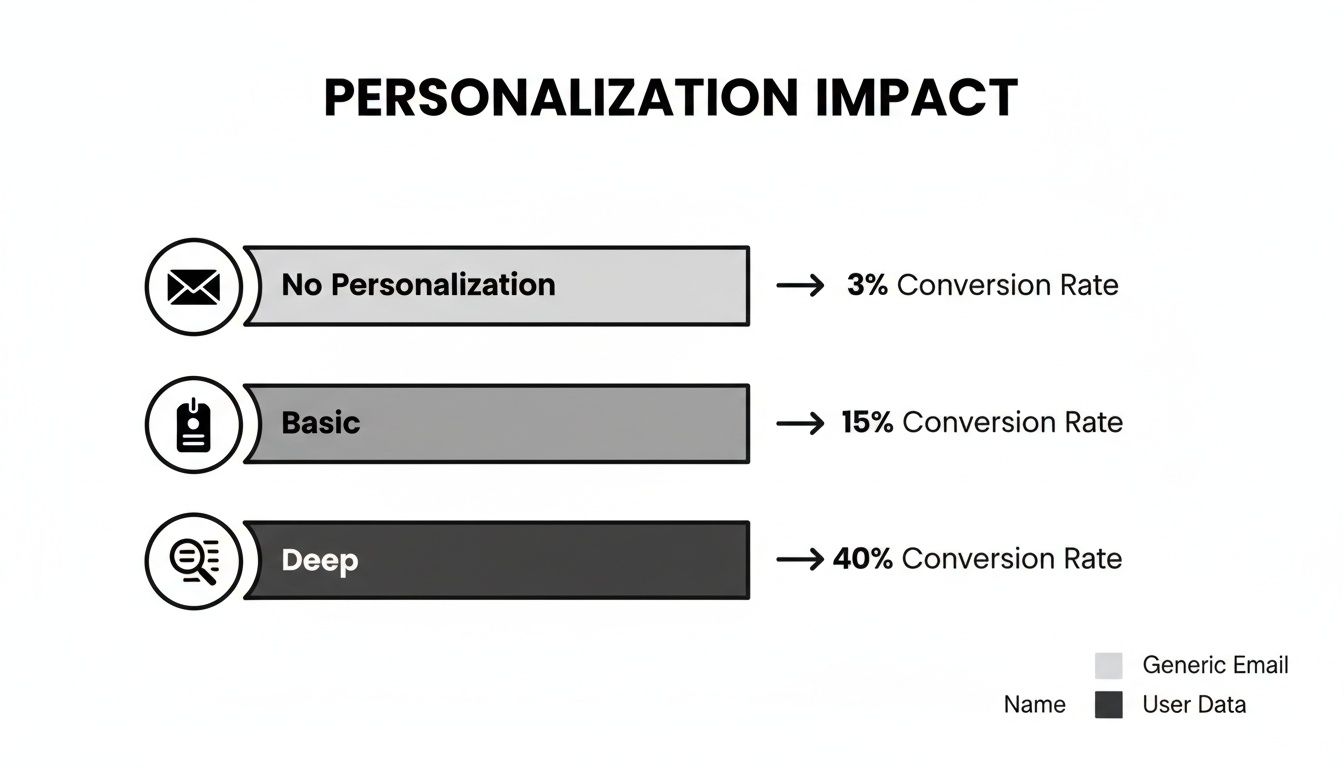
As you can see, moving away from generic templates drastically improves your results. A personalized, interest-based CTA is a core part of that strategy.
Proven CTA Formulas
To make sure your email ends strong, try adapting one of these proven lines for your own use. They’re all designed to make replying feel effortless.
-
The Open-Ended Question: “Mind if I send over a brief document outlining how it works?”
-
The Gated-Value Offer: “Would you be open to seeing a case study on how we achieved [Specific Result] for a company like yours?”
-
The Simple Interest Gauge: “Is improving [Specific Area] a priority for you this quarter?”
Each of these turns a cold ask into the beginning of a warm conversation. They’re simple, direct, and they just plain work.
Testing and Optimizing Your Template
Let’s be clear: a great cold email template is never truly “finished.” Your first draft is just a starting point. Think of it as your best-educated guess about what will get your audience to respond.
The real success comes from testing relentlessly and letting the data guide your next move. This is how you turn that initial guess into a predictable engine for generating leads.
The golden rule here is to isolate one variable at a time. Never test a new subject line and a new call-to-action in the same campaign. If you do, you’ll have no idea which change actually made the difference. You have to start with the things that make the biggest splash.
Focusing on High-Impact Variables
Before you get lost in a sea of metrics, your A/B testing should focus on the handful of elements that have the most direct impact on your results. This is how you make real, meaningful improvements.
-
Subject Lines: This is your highest-leverage test, period. A 5% increase in your open rate means 5% more people see your entire message. Try pitting a question-based subject line against one that teases a clear benefit.
-
Opening Lines: Once they open the email, that first sentence is what determines if they keep reading or hit delete. Test an opener that references something specific, like a recent LinkedIn post, against one that mentions a new company announcement.
-
Call-to-Action (CTA): This is where you convert their interest into an actual reply. You could test a low-friction question like, “Mind if I share a few ideas?” against a slightly more direct ask for a meeting.
Interpreting the Data
Looking at open and reply rates is a good start, but you need to understand the story behind the numbers. A classic example is getting a high open rate but a rock-bottom reply rate.
This almost always points to a disconnect between your subject line and the email body. Your subject line wrote a check that your content couldn’t cash. For a full breakdown on getting all the tracking set up correctly, our guide provides step-by-step instructions for a technical cold emailing setup.
A winning cold email template isn’t found, it’s forged. Each test, whether it succeeds or fails, gives you valuable data that sharpens your next attempt. Embrace this cycle of continuous improvement.
Common Cold Email Questions Answered
Even with a killer template, you’re bound to have questions. Getting these details right is often what separates a campaign that gets ignored from one that actually starts conversations. Let’s run through some of the most common questions we get.
How Long Should My Cold Email Be?
People always ask about length. Keep it short. We’ve found the sweet spot is between 50 and 125 words.
Break your message into tiny, 1-2 sentence paragraphs. This makes it incredibly easy to scan, especially on a phone. The idea is to get your point across and ask your question fast. Respect their time, and you’ll get more replies.
How Many Follow-Ups Should I Send?
Don’t stop after one email. A huge chunk of replies come from follow-ups, so a standard sequence should have 3 to 5 emails in total. Giving up too early means leaving qualified meetings on the table.
To make your follow-ups work, space them out every 2-4 business days. And please, don’t just “bump” your last message. Each email needs to bring something new to the table.
-
Share a new insight: Drop a link to a relevant case study or offer a quick, useful tip.
-
Bring up a recent event: Mentioning a new company announcement or a piece of industry news shows you’re paying attention.
This strategy keeps you on their radar without becoming a nuisance. If you want to see how this looks in practice, you can check out a proven cold email template that builds in these exact principles.
The single most important question is whether you should ask for a meeting or just try to get a conversation started. In your first email, always go for a low-friction, interest-based CTA.
Jumping straight to a meeting request is often too aggressive for a first touch. It feels like a big commitment.
Instead, ask a simple question that’s easy to answer. Something like, “Would you be open to seeing how we helped [Similar Company] achieve [Result]?” makes it easy for them to say “yes” and opens the door to a real dialogue.
Ready to stop guessing and start booking qualified meetings? At Fypion Marketing, we build and manage data-driven cold email campaigns that deliver results, and you only pay for the qualified meetings we book. Schedule your free consultation with Fypion Marketing today.