
Reduce Customer Acquisition Cost: Proven Strategies to Grow
If you feel like you’re spending more to get less from your marketing, you’re not just imagining it. The cost to land a new customer has ballooned, turning what used to be a predictable expense into a serious threat to profitability for a lot of businesses. It’s a fire that needs putting out, and fast.
Why Customer Acquisition Costs Are Unsustainable
The pressure to slash customer acquisition costs isn’t just about a tight budget - it’s a reaction to a massive shift in how the market works. A few years ago, a clever ad campaign could bring in a reliable flow of new business. Today, that same playbook delivers weaker and weaker results, forcing companies to spend a fortune just to stay in the game.
This isn’t happening in a vacuum. The reasons for these soaring costs are tangled together, creating a perfect storm for sales and marketing teams.
The Forces Driving Up Your CAC
One of the biggest culprits is the sheer volume of competition. Digital ad platforms are packed to the rafters, which has kicked off ferocious bidding wars for keywords and audience attention. This saturation means you’re paying a premium just for eyeballs, long before you even get a chance to convert anyone.
At the same time, what customers expect has completely changed. They’re savvier now, demanding personalized experiences and honest communication. They’ve gotten incredibly good at tuning out generic ads, making those broad, one-size-fits-all campaigns both ineffective and a huge waste of money. This new reality forces you to invest more time and resources into creating high-value, focused content that actually connects with people.
The old playbook of “spend more to get more” is officially broken. Success now comes from a strategic pivot - from acquiring customers at any cost to acquiring the right customers as efficiently as possible.
This financial squeeze is well-documented. Research shows that Customer Acquisition Cost (CAC) has shot up by an incredible 222% over the last ten years. To give you some context, e-commerce brands that lost about $9 per new customer back in 2013 are now losing around $29. That’s a dramatic spike. You can dig into more of these CAC statistics and their business impact to see the full picture.
The following chart really drives home how much acquisition costs can vary based on the channels you’re using.
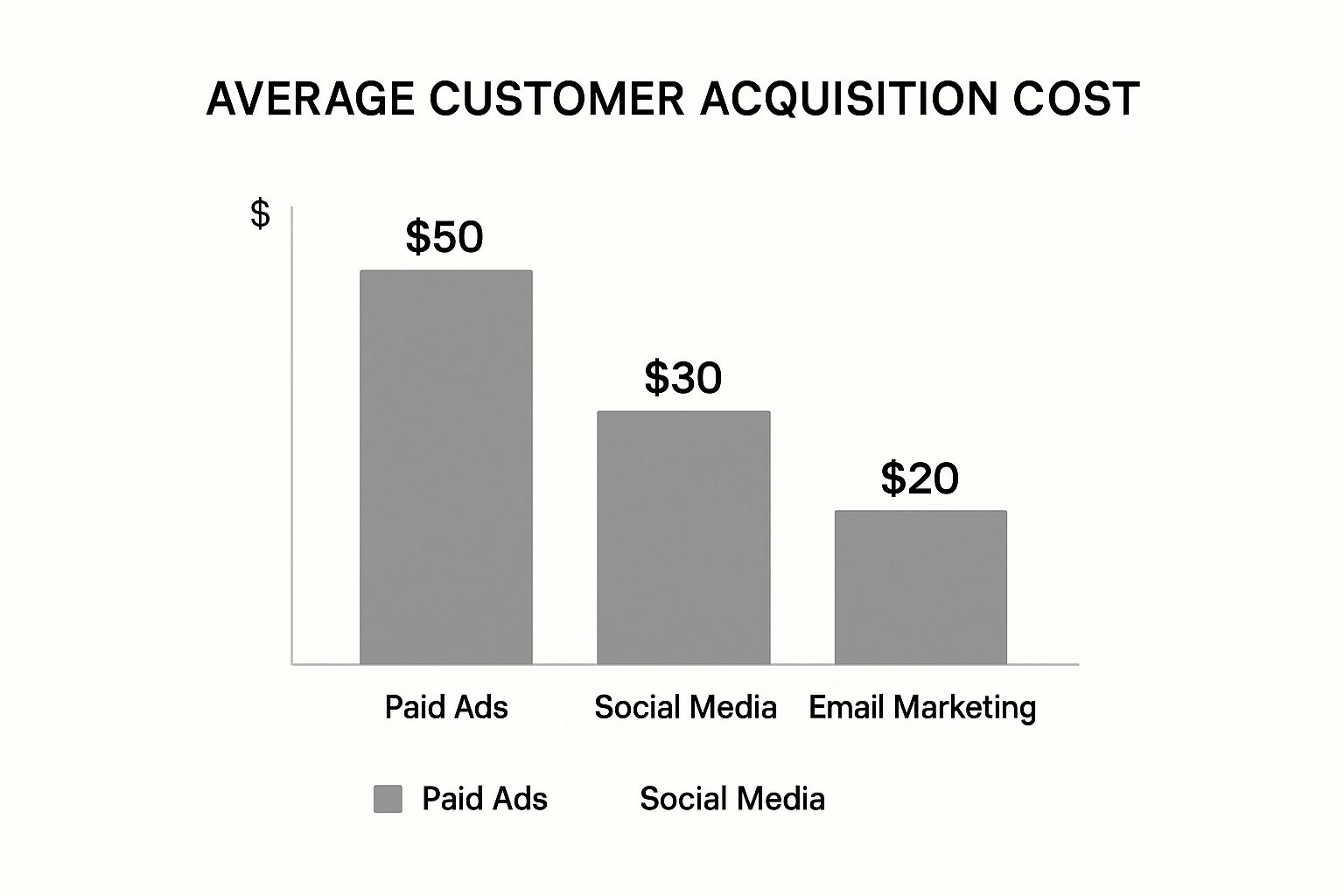
As you can see, channels like paid ads often carry the heftiest price tag. On the other hand, more targeted approaches like email marketing can give you a much more cost-effective way to grow. Getting a handle on these differences is the first real step toward optimizing your spending and building a more durable acquisition strategy.
CAC Benchmarks Across Key Industries
It’s also crucial to remember that what’s “high” or “low” for CAC can look wildly different from one industry to the next. Context is everything. To help you see where you might stand, here’s a look at some average CACs across various sectors.
| Industry | Average Customer Acquisition Cost (CAC) |
|---|---|
| Travel | $7 |
| Retail | $10 |
| Consumer Goods | $22 |
| Manufacturing | $83 |
| Transportation | $98 |
| Marketing Agency | $141 |
| Financial | $175 |
| Technology (Hardware) | $182 |
| Real Estate | $213 |
| Banking/Insurance | $303 |
| Telecom | $315 |
| Technology (Software) | $395 |
Seeing these numbers laid out makes it clear just how much CAC can fluctuate. A software company spending $395 to get a customer is playing a completely different game than a retail brand spending $10. Use these benchmarks as a starting point to gauge your own performance against your industry’s standard.
Plug Leaks in Your Conversion Funnel

Pouring more cash into ad campaigns when your website is hemorrhaging potential customers is like trying to fill a leaky bucket. It just doesn’t work.
Before you even think about new acquisition channels, your first job is to patch up your existing conversion funnel. This whole process is called Conversion Rate Optimization (CRO), and it’s your best defense against sky-high Customer Acquisition Costs (CAC).
Think about it. When you get more value from the traffic you already have, you directly lower what it costs to land each new customer. If you manage to double your conversion rate from a measly 1% to a more respectable 2%, you’ve literally just cut your CAC in half - without spending another dime on ads.
This isn’t just theory. As competition gets fierce, the average CAC for e-commerce businesses has shot up to around $70, with some industries seeing a 40% jump in recent years. Simple CRO tactics, like tweaking your landing pages and making your checkout smoother, are proven ways to push back against these rising costs.
Simplify the Path to Purchase
Every extra click, every unnecessary form field, every confusing step in your checkout process is an open invitation for a customer to leave. Friction is the absolute enemy of conversion. Your goal is to make buying from you feel completely effortless.
Just think about the last time you abandoned an online shopping cart. Was it because they forced you to create an account? Or maybe the shipping costs were a nasty surprise at the very end? These are the classic leaks we see all the time.
Here are a few quick wins to smooth out the process:
-
Offer Guest Checkout: Forcing people to create an account is a massive conversion killer. Let them buy quickly without the commitment.
-
Slash Your Form Fields: Only ask for what is absolutely essential. Do you really need a phone number for a digital download? Probably not.
-
Show Progress Indicators: A simple progress bar during a multi-step checkout is a game-changer. It manages expectations and lets people know exactly how close they are to finishing.
A great real-world example comes from an e-commerce store that was staring down a 65% cart abandonment rate. After adding a few trust badges (security seals, payment logos) and enabling one-click checkout with Apple Pay and Google Pay, they slashed abandonment by over 30%. That’s a huge boost to their return on ad spend.
Sharpen Your First Impression
Your landing page is often your one and only shot to convince a visitor you’ve got the answer to their problem. The message has to be crystal clear and instantly grab their attention, especially “above the fold” - the part of the page they see without scrolling.
If a visitor can’t figure out what you do and why they should care in five seconds, they’re gone. This is where testing becomes your best friend.
Start by A/B testing your headlines. Try framing your offer as a powerful benefit, not just a dry feature. Instead of a headline like “Advanced CRM Software,” test something like, “Close More Deals in Half the Time.” See the difference?
For SaaS companies, simply clarifying your core benefit right under the main headline can dramatically boost sign-ups. And if you’re in B2B, generating the right kind of leads is everything. We actually have a whole guide on how to generate B2B leads that actually convert into sales that digs deeper into building a high-performing funnel.
Fixing these leaks makes every single marketing dollar work harder, which is the fastest way to reduce your customer acquisition cost.
Generate Leads with High-Value Content and SEO
Running paid ads feels like renting an audience. The moment you turn off the spend, the traffic dries up. It’s a constant treadmill. To truly and sustainably reduce your customer acquisition cost, you have to stop renting traffic and start owning your audience. That’s where strategic content and SEO come in.
Think of it this way: every piece of high-value content you create is a digital asset. It’s an investment that works for you 24/7, pulling in organic leads long after you’ve hit publish. Instead of paying for clicks, you’re building a lead-generation machine that delivers compounding returns.
This isn’t about chasing quick wins. It’s about creating genuinely helpful resources - the kind of stuff your ideal customers are actively searching for. Imagine creating a guide so thorough it becomes the go-to resource in your niche, or a video series that builds a loyal community. That’s how you win.
Build Authority with Pillar Content
The bedrock of any solid organic strategy is pillar content. I’m not talking about your average 800-word blog post. Pillar content is the definitive, all-encompassing guide on a core topic that matters to your customers. It covers the subject from every conceivable angle.
Let’s say you’re a B2B SaaS company with a project management tool. A killer pillar page for you might be “The Ultimate Guide to Agile Methodologies for Remote Teams.”
From that one massive asset, you can spin off a ton of smaller content pieces:
-
Blog Posts: “5 Common Sprint Planning Mistakes to Avoid”
-
Social Media: Quick video clips breaking down key agile terms like “scrum” or “sprint.”
-
Infographics: A visual breakdown of the scrum framework.
-
Checklists: “Your Pre-Sprint Planning Checklist” for teams to download and use.
This model, often called the hub-and-spoke, establishes your brand as the expert. When you answer your audience’s biggest questions better than anyone else, Google rewards you. More importantly, potential customers start to trust you.
Target High-Intent Long-Tail Keywords
Broad keywords might get a lot of searches, but they usually attract window shoppers who aren’t ready to buy. The real gold in SEO, especially for lowering CAC, is in long-tail keywords. These are longer, more specific search queries - usually three or more words - that signal serious intent.
Think about it. A person searching for “software” is just browsing. But someone searching for “project management software for small marketing agencies” knows exactly what problem they need to solve. They’re much further down the buying funnel.
Focusing on long-tail keywords means you attract less overall traffic, but the traffic you get is significantly more qualified. This laser-focused approach dramatically improves conversion rates and lowers the cost to acquire each customer.
To find these gems, you have to get inside your customer’s head. What specific problems are they trying to solve? What language do they use to describe their pain points? Use keyword research tools to uncover their exact phrasing, then build content that directly answers their questions.
Mastering this is a core part of developing an effective lead generation strategy for B2B growth that doesn’t burn through your marketing budget. Over time, the organic authority you build creates a protective moat around your business, turning it into a reliable and incredibly cost-effective source of new customers.
Refine Your Ad Targeting for Smarter Spending
Cutting your customer acquisition cost doesn’t mean you have to kill your ad budget. I’ve found it’s rarely about spending less and almost always about spending smarter. The real key is to stop spraying your ads across huge, vague audiences and start aiming them with surgical precision at the people who are actually likely to buy.
This means getting way more sophisticated than basic demographic targeting. We’re talking about strategies that put your message in front of the right person at the exact moment they need what you’re selling. When you stop burning cash on clicks from people who were never going to convert, your Return on Ad Spend (ROAS) shoots up and your CAC naturally drops.
Create High-Fidelity Lookalike Audiences
One of the most powerful tools you have for this is the lookalike audience. Instead of just guessing who your ideal customer might be, you use hard data from your best current customers to find more people just like them.
It starts with uploading a list of your highest-value customers to your ad platform. I’m talking about the ones with the highest lifetime value or those who buy from you again and again. The platform’s algorithm then gets to work, analyzing all their shared traits, online behaviors, and interests to build a brand-new audience of users who are basically their digital twins. This is infinitely more effective than just targeting a broad interest like “marketing” or “software.”
For example, a SaaS company could upload a list of clients who have all upgraded to its premium plan. The lookalike audience that comes out the other side will be packed with prospects who share the same professional DNA and online habits, making them far more receptive to your ads right from the start.
The goal here isn’t just to find similar people. It’s to find people who are on a similar buying journey. When you model your audience after proven customers, you eliminate a massive amount of guesswork and wasted ad spend.
Implement Granular Retargeting Campaigns
Everyone knows retargeting is important, but a generic, one-size-fits-all campaign just doesn’t cut it anymore. If you really want to bring down your CAC, you have to get granular. This means segmenting your retargeting audiences based on the specific actions they took on your website.
Think about creating hyper-specific campaigns for segments like these:
-
Pricing Page Viewers: Someone who spent time on your pricing page is screaming buying intent. Hit them with a targeted ad that tackles common pricing objections or reinforces the core value they get for that price.
-
Cart Abandoners: These people were seconds away from giving you money. You need to remind them what they left behind, maybe with a small, time-sensitive nudge to get them over the finish line.
-
Blog Readers: If someone read a post about a specific problem, they’re clearly interested in that topic. Retarget them with a related content offer - like an ebook or a webinar - to pull them deeper into your world.
This kind of tailored approach makes your ads feel less like creepy interruptions and more like genuinely helpful follow-ups. For B2B companies, getting this targeted messaging right is absolutely critical. To go even deeper on this, you can explore various B2B lead generation strategies for sustainable growth that pair perfectly with precise ad targeting.
When you start combining these smarter targeting methods, you ensure every dollar of your budget is working harder, focused only on prospects who are already warmed up to your brand. That’s a direct line to a much healthier customer acquisition cost.
Build Strategic Partnerships and Referral Programs
Relying only on your own marketing channels is like trying to grow a forest with a single seed. If you really want to drive down your customer acquisition cost, you have to look beyond your own efforts and start tapping into the established, trusted audiences of others.
This is where strategic partnerships and referral programs come in. They’re powerful, low-cost engines for growth that can change the game entirely.
Instead of fighting tooth and nail for every new lead from scratch, you get access to warm, pre-qualified prospects through a source they already know and trust. This “borrowed trust” is the secret sauce. It dramatically lowers the friction and cost of signing up new customers. The trick is finding partners whose audience is a mirror image of your ideal customer profile.
Forge Mutually Beneficial Partnerships
A solid partnership is never a one-way street; it has to be built on mutual value. The goal is to find non-competing businesses that serve the exact same customer base and then create a scenario where everyone wins. Think of it as a value exchange that benefits you, your partner, and - most importantly - the end customer.
Imagine a SaaS company that sells accounting software teaming up with a B2B law firm. The law firm’s clients are all businesses that, guess what, also need accounting services. A simple co-hosted webinar on “Financial and Legal Best Practices for Startups” gives both companies direct access to a highly relevant audience for pennies on the dollar compared to traditional ads.
Here are a few partnership models that we’ve seen work wonders:
-
Co-Marketing Campaigns: This could be joint webinars, co-authored ebooks, or even social media takeovers where you both push the content to your respective audiences.
-
Affiliate Programs: Offer a commission to partners for every new customer they send your way. This is a purely performance-based model, which means there’s zero upfront cost. You only pay for results.
-
Guest Content Collaborations: Write insightful articles for your partner’s blog or jump on their podcast. This is a fantastic way to position yourself as an expert and get your brand in front of a new, engaged audience.
The best partnerships just feel natural. They solve a real problem for the customer. A fitness brand working with a wellness influencer or a tech company collaborating with a marketing agency are perfect examples of these symbiotic relationships that drive low-CAC growth.
Turn Happy Customers Into Your Best Sales Team
While partnerships are great for bringing in new audiences, don’t overlook the goldmine you’re already sitting on: your existing customers. These people have already experienced the value of your product or service firsthand. A formal referral program gives them a structured, rewarding way to spread the word.
Referral marketing is incredibly effective because it’s built on word-of-mouth, which is still the most trusted form of advertising out there. When a friend recommends something, it cuts right through the marketing noise and carries serious weight. Building a great program is all about making it dead simple and rewarding for everyone involved.
A classic “give-get” model works beautifully. Look at Dropbox. They famously offered existing users extra storage for referring a friend, and the new friend also got bonus storage when they signed up. This created a viral loop that was absolutely critical to their early growth. The cost was tiny - just a bit of digital space - but the return in new users was massive.
By combining external partnerships with an internal referral engine, you build a powerful, multi-channel approach to acquisition that isn’t hostage to volatile ad platforms. This strategy is a cornerstone of our own B2B approach, which you can learn more about in our detailed guide to B2B lead generation for sustainable growth.
Unpacking Your Top Questions About Lowering CAC
As you start putting these strategies into practice, a few questions are bound to pop up. I get these all the time. Let’s walk through the most common ones so you can move forward and start cutting your customer acquisition costs with confidence.
What Is a Good Customer Acquisition Cost?
I wish there was a magic number, but the truth is, a “good” CAC is completely relative. It all depends on your business model, your industry, and - most importantly - your Customer Lifetime Value (LTV).
The classic rule of thumb is to aim for an LTV-to-CAC ratio of at least 3:1. In simple terms, for every dollar you spend to land a new customer, you should be making at least three dollars back from them over their entire relationship with you.
But context is everything. CACs swing wildly between industries based on things like average deal size and how long it takes to close a sale. For 2025, the average CAC in fintech is projected to be around $1,450. For insurance, it’s about $1,280, and for medical tech, it’s $921. It’s worth checking out more data on how CAC varies by industry to get a better feel for where you stand.
The bottom line is this: your CAC has to be sustainable compared to your LTV. If you’re paying more to get a customer than they will ever pay you, the business model is fundamentally broken.
How Long Does It Take to See a Reduction in CAC?
The timeline for seeing a drop in your CAC really hinges on which strategies you’re using. Some tactics can give you a quick boost, while others are more of a long game.
-
Quick Wins (Weeks to a Few Months): You can often see a pretty fast impact from things like tightening up your ad targeting or focusing on conversion rate optimization (CRO). A/B testing a landing page headline or smoothing out your checkout process can produce measurable results in a short amount of time.
-
The Long Haul (6+ Months): This is where strategies like SEO and building out a powerful content engine live. It can easily take six months to a year to build enough authority to really move the needle on your CAC, but the payoff is huge. These efforts deliver sustainable, compounding returns that pay dividends for years.
Should I Just Stop Paid Advertising to Lower My CAC?
Not necessarily. The real goal isn’t just to kill your paid ad budget - it’s to make every dollar you spend work smarter and harder. Before you go slashing budgets, focus on making your ads radically more efficient.
Think about sharpening your targeting with lookalike audiences, getting more creative with your ad copy and visuals, and relentlessly optimizing your landing pages for conversions.
Paid ads can also be a powerful partner to your organic efforts. And depending on your business model, there might be more direct ways to get in front of qualified leads. If you’re in B2B SaaS, for instance, check out our guide on how to increase your SaaS customer base using cold emails for a completely different - and often cheaper - approach to lead generation.
At Fypion Marketing, we run on a performance-based model that completely sidesteps the risk of high acquisition costs. You only pay us for qualified meetings that show up in your calendar, with people who fit your ideal customer profile. No retainers, no setup fees, just results.
Ready to scale your pipeline without the risky upfront spend? Schedule your free consultation with Fypion Marketing today.