
What Is Demand Generation Marketing and How It Fuels B2B Growth
Let’s be honest - the term “demand generation” gets thrown around a lot. At its heart, it’s the art of making people want what you sell, long before you ever ask them to buy it. It’s a complete, top-to-bottom strategy focused on building a real, trusted relationship with your future customers.
What Is Demand Generation Marketing Anyway

Let’s cut through the marketing-speak for a minute. Think of it like this: you can’t just show up to an empty plot of land and expect to harvest tomatoes tomorrow. You have to do the work first. You need to till the soil, plant the seeds, water them, and protect them as they grow.
Demand generation is the marketing version of tending that garden. It’s about creating genuine awareness and interest in your solutions by consistently providing value. Instead of just showing up and asking for the sale, you’re patiently and systematically educating your audience. To really dig into this, it’s worth checking out this resource on What Is Demand Generation Marketing and How It Drives B2B Growth.
Building Trust Before The Ask
This approach completely flips the script on traditional marketing. It shifts the focus from a one-time transaction to a long-term relationship. The whole point is to become the go-to authority in your space.
So, when a potential customer finally realizes they have a problem you can solve, your brand is the first one that comes to mind. This is an absolute game-changer, especially in the world of B2B where sales cycles are long and complex.
Think about this: by the time a buyer is ready for a serious evaluation, 92% already have a shortlist built, according to Forrester. Demand generation is how you make sure you’re on that list.
This isn’t about a single campaign. It’s a continuous engine built to attract, engage, and warm up your ideal customers over time.
For a quick overview of what demand generation really entails, this table breaks down the core concepts.
Demand Generation at a Glance
| Concept | Explanation | Primary Goal |
|---|---|---|
| Audience Education | Providing valuable, problem-solving content without an immediate sales pitch. | Establish authority and trust. |
| Awareness Building | Making your target audience aware of a problem they have and your solution. | Become the first brand they think of. |
| Full-Funnel Focus | Engaging prospects at every stage, from initial interest to final purchase. | Create a smooth, continuous customer journey. |
| Relationship Nurturing | Building a connection over time through consistent, helpful interactions. | Turn cold prospects into warm, qualified leads. |
This framework shows that demand generation is a strategic, long-term investment, not a quick fix for lead numbers.
The Core of the Strategy
A solid demand generation program is always built on a foundation of providing real value. It’s a mix of integrated activities that cover the entire buyer’s journey.
It includes things like:
-
Creating genuinely helpful content: Think blog posts, ebooks, and webinars that actually solve your audience’s problems.
-
Optimizing for discovery: Using SEO so your content shows up exactly when potential customers are looking for answers.
-
Engaging on social media: Building a community and sharing useful insights where your audience actually hangs out.
Ultimately, the goal is to make your audience want what you have to offer before you even have to ask.
To see how demand generation fits into the bigger picture, you can also check out our complete guide to modern B2B marketing strategy.
The Difference Between Demand Generation and Lead Generation
This is where a lot of marketers get tripped up. People throw around “demand generation” and “lead generation” like they’re the same thing, but they are two very different - though connected - gears in your marketing machine.
Getting this distinction right is crucial. It’s the foundation for a strategy that actually works.
Think of it this way: demand generation is like farming. You’re cultivating the entire field. You prepare the soil, plant all kinds of seeds, and nurture everything so the whole ecosystem thrives over time. You’re creating the ideal conditions for growth.
Lead generation, on the other hand, is the specific act of harvesting the crops that are ready to be picked. It’s a direct, focused action to collect the contact details of people who have clearly shown they’re interested.
Goals and Focus
The core difference really comes down to their primary goals. Demand generation is a broad, holistic strategy. It’s all about building awareness and creating genuine desire for your solution across your entire potential market. The goal is to educate your audience and build trust, making your brand the obvious choice long before they’re even thinking about buying.
In contrast, lead generation is a much more focused, bottom-of-the-funnel activity. Its one and only job is to capture qualified leads - the people who have raised their hands and identified themselves as potential customers. This means using tactics with a clear call-to-action, like getting someone to fill out a form for an ebook or request a demo. If you want to sharpen your approach here, our ultimate playbook for lead generation in B2B has the targeted strategies you need.
Demand generation creates the environment where leads can grow. Lead generation is the process of collecting them.
Demand Generation vs Lead Generation a Head-to-Head Comparison
To make this crystal clear, let’s break down how these two strategies stack up side-by-side. Nailing this difference helps get your marketing and sales teams on the same page, ensuring everyone is pulling in the same direction.
| Aspect | Demand Generation | Lead Generation |
|---|---|---|
| Primary Goal | Create awareness, interest, and desire for your brand and solutions. | Capture contact information from interested prospects. |
| Audience | Broad, targeting an entire potential market or ideal customer profile. | Narrow, focusing on individuals who have shown specific buying signals. |
| Key Tactics | SEO-driven blog posts, ungated educational content, social media engagement, brand awareness campaigns. | Gated content (ebooks, whitepapers), webinar sign-ups, contact forms, demo requests. |
| Measurement | Website traffic, brand search volume, content engagement, share of voice. | Cost per lead (CPL), conversion rates, number of marketing qualified leads (MQLs). |
Ultimately, lead generation is a critical component of a bigger demand generation strategy, but it’s not the whole strategy itself. One can’t really work without the other.
After all, you can’t harvest crops from an unplowed field.
Building Your Demand Generation Engine
A real demand generation strategy isn’t just a random mix of marketing activities. It’s a well-oiled engine you build piece by piece, all designed for one thing: predictable growth. Every component has a job, and they all work together to pull in, engage, and warm up your ideal customers.
Think of your content marketing - your blog posts, ebooks, and webinars - as the high-octane fuel for this engine. This is what first catches someone’s attention by actually helping them with their problems.
Then you have SEO, which acts as the engine’s GPS. It makes sure your valuable content actually shows up when a potential customer is searching for a solution, guiding them right to you.
Meanwhile, paid media and email marketing are your accelerators. They blast your content out to a wider, but still very specific, audience and keep the conversation going over time.
Integrating Components for a Full-Funnel Journey
A truly effective demand generation engine doesn’t just have these parts; it coordinates them across the entire customer journey. You don’t just write a blog post and cross your fingers. You build a system where one step logically flows into the next.
For example, a high-level blog post optimized for search can grab attention at the top of the funnel. A call-to-action in that post might then invite readers to a more detailed webinar, moving them into the consideration phase. From there, you can use targeted outreach to connect with the most engaged people from the webinar, flagging them as hot prospects for your sales team.
This process is a journey from broad awareness (“farming”) to specific action (“harvesting”).
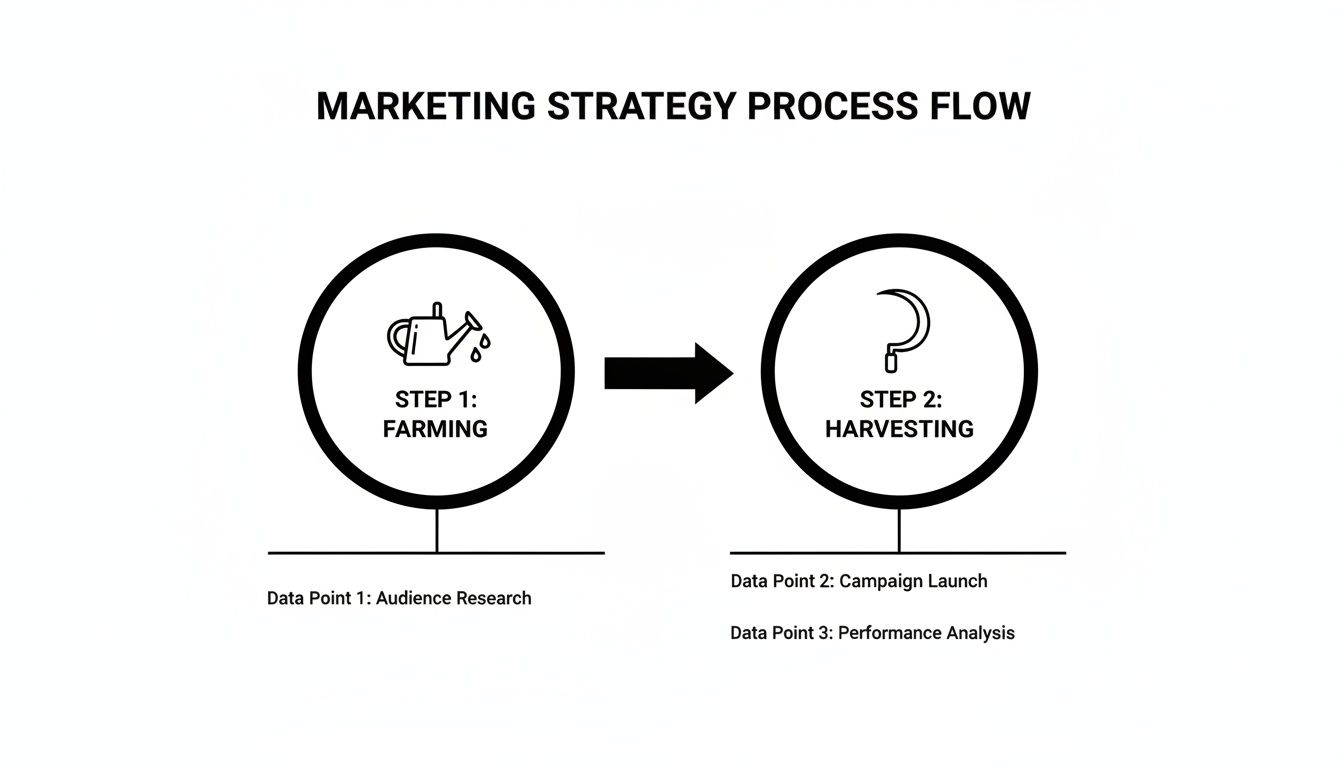
The image breaks it down perfectly. You start by cultivating a wide audience and then systematically find and engage the ones who are actually ready for a sales conversation. This integrated approach makes the whole buyer’s journey feel smooth and natural.
From Tactics to a Holistic System
The end goal is to build a complete system that generates a steady, predictable pipeline. This lets you move beyond the short-term spikes you get from one-off campaigns. It’s a mindset shift from chasing individual leads to cultivating an entire market.
When you get your content, SEO, and outreach all working in harmony, you create a seamless experience that builds trust at every single touchpoint. This synergy is what turns marketing from a cost center into a reliable revenue driver.
A well-built demand generation engine doesn’t just find leads. It creates an environment where your ideal customers naturally find their way to you, already understanding your value before a salesperson ever gets involved.
To make this entire system run even more smoothly, many teams lean on automation. To see how this fits in, check out our guide on building a winning B2B marketing automation strategy that plugs right into your demand engine. It’s all about making every part of the machine work smarter, not harder.
Why Bad Data Creates a Marketing Mirage

Ever had a campaign dashboard that looked fantastic? The numbers were all green - high click-through rates, tons of impressions, and a low cost-per-click - but when you checked the books, it brought in zero actual business.
This is what we call the “Marketing Data Mirage.” It’s a dangerous illusion where you mistake activity for progress. On the surface, your marketing looks like a huge success, but in reality, it’s failing to produce a single dollar of revenue.
This mirage is a silent killer for B2B growth. It’s not just a hunch; the data backs it up. Recent analysis shows this exact problem quietly eats up 25% of marketing budgets on efforts that go nowhere. Even worse, 32% of potential revenue growth gets stuck behind disconnected systems and bad data. It creates a massive gap between what the dashboards promise and what the bank account shows.
You can see just how deep this problem runs in DemandScience’s 2026 Marketing Data Mirage report to see how deep the problem runs.
The Phantom Signals of Vanity Metrics
The marketing mirage is built on a foundation of vanity metrics. These are the flashy numbers that are easy to measure and feel great to report, but they have almost no connection to business success. They tell you something is happening, but not if you’re actually creating demand or getting closer to a sale.
Here are the main culprits:
-
Impressions: Just because someone saw your ad doesn’t mean they were influenced by it.
-
Social Media Likes: A “like” doesn’t pay the bills. It almost never signals real buying intent.
-
Website Traffic: More visitors are nice, but if they aren’t the right visitors, it’s just empty volume.
Relying on these metrics is like driving through the desert and mistaking a heat shimmer for an oasis. It looks promising from a distance, but when you get closer, you realize there’s nothing there. That’s why a core principle of real demand generation is to focus only on metrics that tie directly to revenue.
Siloed Tools and Disconnected Truths
Another huge cause of the marketing mirage is using siloed tools. When your CRM, email platform, and analytics software don’t talk to each other, each one tells a different, incomplete story. Marketing might see high engagement on a campaign, but sales has no idea which accounts are actually warming up.
The result is a fractured view of the customer journey. You have tons of data points, but no unified truth. It’s shocking, but 85% of teams report wasting more time fighting these data fires than actually innovating.
This disconnect makes it impossible to accurately attribute revenue back to your marketing activities. It also poisons your data quality as information gets stale and isn’t updated across your systems.
To fight this, you have to get serious about data hygiene. Learning how to verify accept-all emails and maintaining a clean database is step one. It ensures your outreach is built on solid ground, not a data mirage. For real demand generation, having a single source of truth isn’t just a nice-to-have; it’s non-negotiable.
How AI Is Revolutionizing Demand Generation
Let’s be clear: Artificial Intelligence isn’t some futuristic concept anymore. For demand generation marketers, it’s a fundamental part of the toolkit. AI is here, automating the grunt work and pulling out insights that were impossible to find just a few years ago.
The numbers don’t lie. AI adoption in demand gen has absolutely exploded, with a massive 96% of B2B marketers now using it in their day-to-day. In one survey of over 300 pros, almost half (47%) said AI was the trend they were most excited about. Why? Because 45% see it as the key to making their teams more efficient in a market that’s getting noisier by the day.
Smarter Targeting with Predictive Analytics
One of the most powerful ways to use AI is through predictive analytics. Think of it as your own marketing crystal ball. Instead of just guessing which accounts might be ready to talk, AI sifts through thousands of data points - website visits, content downloads, even third-party intent signals - to find prospects who are actually showing signs of buying.
This lets your team stop wasting time on cold leads and focus their energy on accounts that are truly in-market. You move past basic firmographics and start targeting based on real, timely behavior. For any business, but especially if you’re working on a pay-per-meeting model, this kind of precision is everything. It makes sure your outreach hits the people most likely to turn into a qualified sales meeting.
Personalization and Optimization at Scale
AI also gives you the power to personalize your outreach on a massive scale, something a human team could never manage on its own. It can tweak email copy, suggest the right content, and change up ad creative for different people based on their industry, role, or what they’ve been looking at online.
-
Real-Time Campaign Adjustments: AI can watch your campaigns and make changes on the fly. It will automatically move your budget to the best-performing ads or A/B test subject lines to get more opens.
-
Intelligent Content Distribution: It also makes sure the right blog post or case study gets to the right person at the perfect moment in their buying journey, which keeps them engaged and nurtures them toward a sale.
AI’s real power in demand generation is its ability to chew through huge amounts of data and spot patterns a human would completely miss. This leads to smarter, faster, and way more relevant conversations with potential customers.
And it’s not just about creating new campaigns from scratch. AI is also a game-changer for breathing new life into your old content. You can find some great strategies for AI for marketing content repurposing to get more mileage out of what you already have.
But here’s the catch: AI is only as smart as the data you give it. If your data is a mess - inaccurate, incomplete, or stuck in different systems - you’ll just get bad insights and wasted effort. This is why having clean, organized data is non-negotiable if you want to get real results. To get started, you can check out our guide on the top AI tools for marketing.
Measuring Demand Generation Success the Right Way
Clicks and impressions might look impressive on a dashboard, but they don’t pay the bills. If you want to prove your demand generation efforts are actually working, you need to speak the language of the C-suite: revenue.
This means you have to stop chasing vanity metrics and focus on what directly impacts the business.
Your goal is to draw a straight, undeniable line from your marketing activities to actual sales. Forget counting likes and shares; the only real measure of success is whether you’re creating high-quality conversations for your sales team. This simplifies everything and gets everyone pointing in the same direction.
The most effective way to measure demand generation is to track the number of qualified sales meetings booked. This one metric cuts through all the noise and tells you if your strategy is creating real pipeline opportunities.
Key Metrics That Actually Matter
While booked meetings are your North Star, a few other metrics help tell the full story. Think of them as the supporting cast that shows how healthy your entire strategy is.
-
Customer Acquisition Cost (CAC): This is simply the total cost of your sales and marketing efforts to get one new customer. A healthy demand gen engine should consistently lower your CAC over time by making the path to a sale more efficient.
-
Lifetime Value (LTV): This metric shows you the total revenue you can expect from a single customer over your entire relationship. A strong LTV-to-CAC ratio - ideally 3:1 or higher - is proof that you’re bringing in valuable customers profitably.
-
Marketing-Sourced Revenue: This is the slice of total revenue you can directly point to and say, “Marketing did that.” It’s the ultimate proof that your investment is delivering a clear return.
-
Pipeline Velocity: This measures how fast prospects move through your sales pipeline, from the first touchpoint to a closed deal. Good demand generation warms people up, which should speed up your pipeline and shorten the sales cycle.
When you focus on these revenue-centric metrics, you change the entire conversation. You stop having to justify your budget and start demonstrating how your strategy is a critical engine for the company’s growth.
Your Demand Generation Questions Answered
Understanding the theory is one thing, but actually putting a demand generation strategy to work is where the real questions pop up. Let’s walk through some of the most common ones so you can move from just knowing the concepts to taking confident action.
How Do I Start a Demand Generation Strategy on a Small Budget?
When you’re starting small, you have to be smart and prioritize the things that give you the most bang for your buck. Your best bet is to build a solid foundation with content marketing - specifically, writing genuinely helpful blog posts that actually solve your audience’s problems.
From there, you need to get serious about SEO. This is what brings in long-term organic traffic, which eventually becomes a free, consistent source of potential customers. Use your company’s social media pages, especially LinkedIn, to share what you know and jump into relevant conversations. It’s all about relentless consistency and providing real value. That’s what builds the trust that fuels demand, no massive ad spend required.
How Long Does It Take to See Results from Demand Generation?
Think of demand generation as a marathon, not a sprint. Sure, some tactics like paid ads can give you a quick bump within a few months, but the true impact of a content-driven, organic strategy really takes 6 to 12 months to come into its own.
You are building a predictable engine for growth, not just looking for a temporary spike in leads.
Don’t get discouraged in the early days. Keep an eye out for the right signals: a steady climb in website traffic, more people engaging with your content, and an email list that’s consistently growing. These are the signs that your efforts are gaining traction long before the sales-qualified meetings start hitting your calendar.
Can Cold Email Be Part of a Demand Generation Strategy?
Absolutely. A lot of people see cold email as a pure lead gen tool, but it can be an incredibly powerful way to create demand when you use it the right way.
Instead of hitting people with a hard sales pitch, use cold email to share your best content with a very specific, targeted audience. Think about sending a new industry report or an exclusive webinar invitation to a hand-picked market segment. When your email is personalized and genuinely focused on solving a problem, it’s a brilliant way to spark interest and create demand with an audience that your regular content might never reach.
At Fypion Marketing, we specialize in turning cold outreach into a predictable pipeline of qualified meetings. You only pay for performance, ensuring your budget is spent on tangible results, not just clicks or opens. Book a call with us today to see how we can build your sales pipeline.