
What Is a Sales Development Representative? An Expert Guide
So, what exactly is a Sales Development Representative? At its heart, an SDR is a sales specialist who owns the very first stage of the sales process. Their entire job is to find potential customers, start conversations, and qualify them, teeing up a steady flow of solid opportunities for the rest of the sales team.
The Strategic Role of a Sales Development Representative

Think of an SDR as the professional scout for a sports team. The head coach - your Account Executive (AE) - is focused on signing the star player and winning the game. But the scout? They’re the ones out in the field, finding promising talent, seeing if they have what it takes, and making sure they’re a good fit for the team in the first place.
Essentially, the SDR’s job is to make sure the AE’s calendar is packed with meetings, but only with the most promising prospects.
This specialized focus is what makes the SDR role so powerful. Instead of having one person trying to do it all - prospecting, qualifying, demoing, and closing - the SDR takes full ownership of the top of the sales funnel. They become masters at starting conversations and building that initial pipeline from scratch.
Core Functions and Objectives
Don’t mistake this for a simple cold-calling job. A good SDR is a strategic pipeline architect, responsible for generating a predictable stream of qualified opportunities. Their work is the very foundation of the entire sales motion, which is why they’ve become so essential in modern B2B sales.
In fact, the sales development field has exploded. It’s estimated there are now 677,479 SDRs working today, making up over 25% of the entire inside sales workforce.
At its core, the SDR’s mission is to transform a cold or uninterested prospect into a warm, qualified lead who is genuinely interested in having a sales conversation.
One of the most critical skills any SDR must master is learning how to qualify leads effectively. It’s the one skill that truly separates the top performers from everyone else, ensuring only high-potential buyers get passed along. And if you’re just getting started with the lingo, our guide on what is a lead in business will get you up to speed.
To give you a clearer picture, here’s a quick breakdown of what the SDR role looks like day-to-day.
The SDR Role at a Glance
This table sums up the primary duties, goals, and metrics that define the Sales Development Representative’s world.
| Core Function | Primary Objective | Key Performance Indicators (KPIs) |
|---|---|---|
| Prospecting and Research | Identify potential customers who match the Ideal Customer Profile (ICP). | Number of new contacts sourced and outreach activities (calls, emails). |
| Outreach and Engagement | Initiate conversations through multiple channels to generate interest. | Response rates and positive reply rates. |
| Lead Qualification | Determine if a prospect has the need, budget, and authority to buy. | Number of qualified appointments booked for Account Executives. |
Ultimately, every function an SDR performs is designed to filter out the noise and connect the sales team with people who are ready to talk business.
A Day in the Life of an SDR
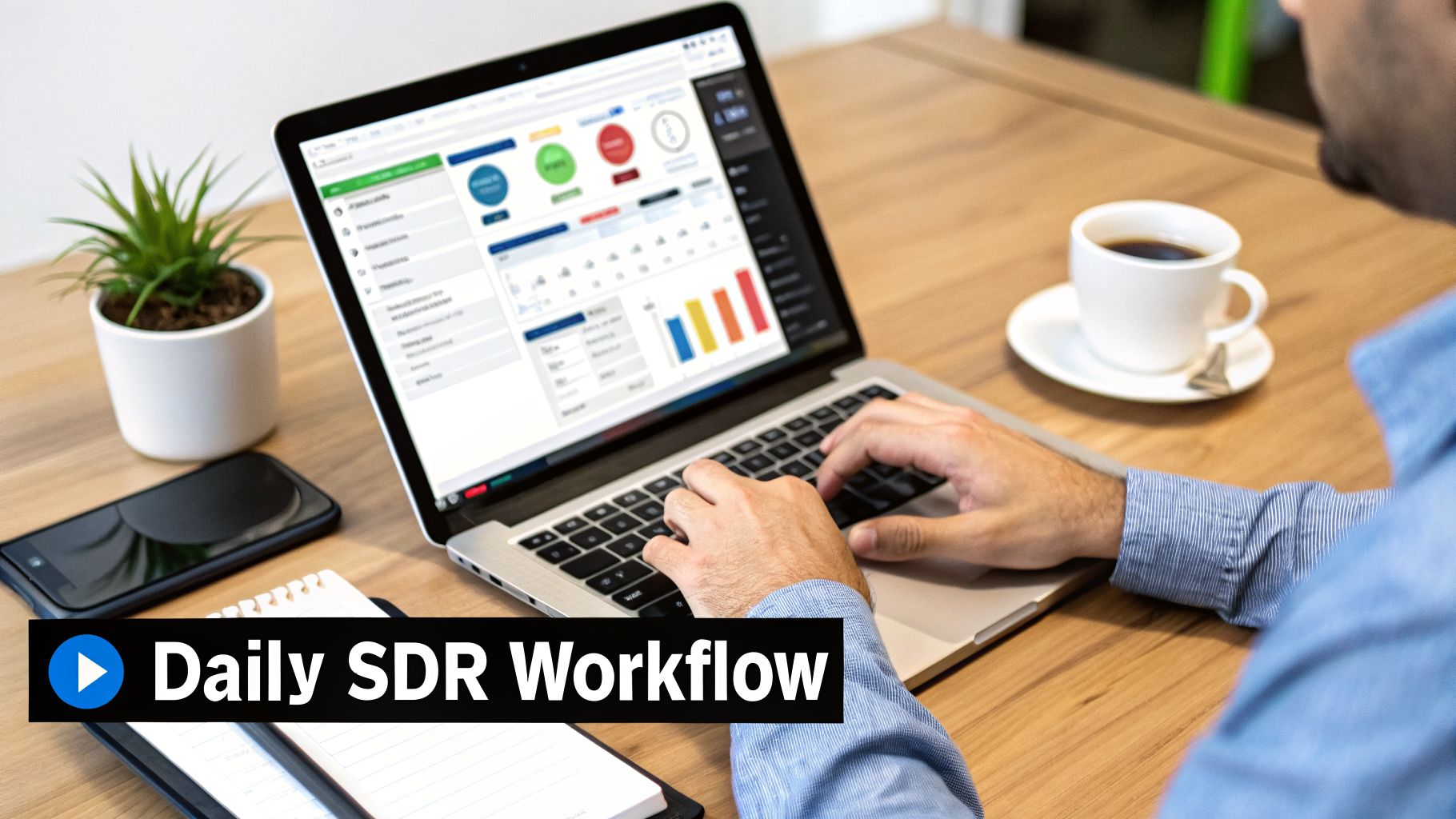
So, what does an SDR actually do all day? It’s a common question.
Let’s bust a myth right away: it’s not just a chaotic scramble of random calls. A great SDR’s day is a highly structured, strategic routine laser-focused on one outcome: generating qualified meetings for the sales team.
The day doesn’t kick off with a phone glued to their ear. It starts with research. The first hour is often dedicated to digging into their territory, pinpointing new target accounts that match their company’s ideal customer profile (ICP).
They’ll live in tools like LinkedIn Sales Navigator, hunting for specific decision-makers. They’re looking for triggers - a recent job change, a new funding announcement, a relevant post - anything that can transform a cold touchpoint into a warm, relevant conversation.
This isn’t just busy work; it’s the foundation of their success. This intelligence is what separates a generic, instantly-deleted email blast from a personalized message that actually earns a reply. They aren’t just grabbing a name and title; they’re searching for an “in.”
The Mid-Day Outreach Blocks
With a curated list of well-researched prospects, the SDR then dives into their first outreach block. This is a dedicated, distraction-free sprint, usually lasting 90 minutes to two hours.
During this time, they’re executing a multi-channel attack.
-
Personalized Emails: For the highest-value targets, they’re crafting unique emails. These messages reference the prospect’s specific role, a recent company win, or a known industry headache.
-
Strategic Cold Calls: They pick up the phone, not with a hard pitch, but with a goal to confirm they have the right person and spark just enough curiosity to get a foot in the door.
-
LinkedIn Engagement: This might involve sending a connection request with a custom note or dropping a thoughtful comment on a prospect’s recent post to build name recognition.
After this first sprint, they’ll take a breather and sync up with their Account Executive (AE). This is a critical feedback loop where they review lead quality, strategize on key accounts, and make sure their messaging is perfectly aligned.
An SDR’s day is a constant cycle: deep research followed by focused, multi-channel outreach. It’s a unique blend of detective work, sharp writing, and fearless communication - all tracked meticulously in a CRM.
The afternoon typically mirrors the morning routine. Another focused outreach block is followed by essential admin work. This means logging every single activity in the CRM, handling any inbound responses that came in, and prepping the prospect list for the next day. This discipline is what prevents leads from falling through the cracks.
By mastering an SDR-led demand generation strategy, sales teams can build a predictable and scalable pipeline.
The day doesn’t end after a certain number of dials. A successful day is measured in progress: booking one or two solid meetings for their AE, nurturing a few key prospects to the next stage, and building a stronger pipeline for tomorrow.
SDR vs BDR vs Account Executive Explained
Walk onto any modern sales floor, and you’ll hear a dizzying array of acronyms: SDR, BDR, AE. It’s easy to get them mixed up, and frankly, a lot of companies use the terms interchangeably. But while they all work toward the same goal, their roles are actually quite distinct and specialized.
Think of your sales process like a relay race. The Sales Development Representative (SDR) and Business Development Representative (BDR) are your opening runners. Their entire job is to get a powerful start by finding and qualifying the right prospects.
Once a prospect is warmed up and qualified, they pass the baton to the Account Executive (AE). The AE is your anchor, the closer who takes that handoff and runs the final leg of the race, focusing all their energy on winning the deal. Understanding this division of labor is crucial, whether you’re building a sales team or mapping out your own career.
The Inbound and Outbound Divide
So, what’s the real difference between an SDR and a BDR? While some companies treat them as the same role, the most common distinction boils down to one thing: where their leads come from.
-
Sales Development Representative (SDR): These folks typically handle inbound leads. They’re fielding interest from prospects who have already engaged with your company - maybe they downloaded a whitepaper, attended a webinar, or filled out a contact form. The SDR’s job is to sift through that interest and qualify who is genuinely ready for a sales conversation.
-
Business Development Representative (BDR): The BDR, on the other hand, is all about outbound prospecting. They are the hunters. BDRs proactively build lists and reach out to accounts that fit your ideal customer profile but haven’t shown any prior interest.
The core difference is simple: SDRs cultivate existing interest generated by marketing, while BDRs create brand-new opportunities from scratch.
This split allows each role to master a very different skill set. You can see this distinction in how various B2B companies are hiring SDRs, BDRs, and ADRs; their job descriptions often spell out this focus. The handoff point from an SDR or BDR to an AE is critical, and it happens once the prospect becomes a Sales Qualified Lead.
Comparing Key Sales Roles
To make it even clearer, let’s lay out how these roles fit together. This table breaks down exactly what each person focuses on and how their success is measured.
| Role | Primary Focus | Key Responsibilities | Main KPI |
|---|---|---|---|
| SDR | Inbound Lead Qualification | Responding to and qualifying leads generated by marketing efforts. | Sales Qualified Leads (SQLs) or Booked Meetings |
| BDR | Outbound Prospecting | Identifying and engaging new target accounts through cold outreach. | Qualified First Meetings Booked |
| AE | Closing Deals | Conducting demos, negotiating contracts, and closing new business. | Closed/Won Revenue ($) |
As you can see, the SDR and BDR roles are all about creating qualified opportunities, while the AE’s world revolves around turning those opportunities into revenue. It’s a beautifully simple system when everyone knows their part.
The SDR Career Path and Future Opportunities
Almost no one plans to be a Sales Development Representative forever. Think of it less as a destination and more as a launchpad - or even a professional bootcamp for a career in tech sales. It’s intense. It can be a pressure cooker. But it’s designed to forge the kind of resilience, business savvy, and sharp communication skills that will serve you in any role you take on next.
This is hands-down one of the best training grounds in the business world. As an SDR, you learn how to handle rejection, think on your feet, and truly understand a customer’s problems from the ground up. There’s a reason so many successful tech executives and sales leaders got their start right here.
From SDR to Sales Leader
For an SDR who consistently hits their numbers, the career path is usually pretty clear and full of opportunity. The skills you master in the role are a direct ticket to more senior positions, both within the sales org and outside of it.
A typical career progression looks something like this:
-
Senior SDR: After you’ve proven you can consistently perform, you might move into a senior role. This often means you’re mentoring new hires, taking on bigger, more strategic accounts, or specializing in a key industry.
-
Account Executive (AE): This is the most common next step, and it makes perfect sense. Once you’ve mastered creating qualified opportunities, moving into an AE role lets you own the full sales cycle and get the satisfaction of closing the deals you helped start.
-
Sales Manager: If you find you have a knack for leadership and big-picture strategy, the manager track is a great option. Former SDRs often make the best managers because they haven’t forgotten the daily grind and know what truly motivates their team.
The SDR position is your entry ticket. It’s where you earn your stripes, build your network, and prove you have the grit to succeed in the competitive world of sales.
Of course, the role isn’t for the faint of heart. The pressure to hit demanding quotas is real, and the learning curve can feel like a vertical wall at times.
This infographic gives you a quick, data-backed look at the realities of being an SDR.
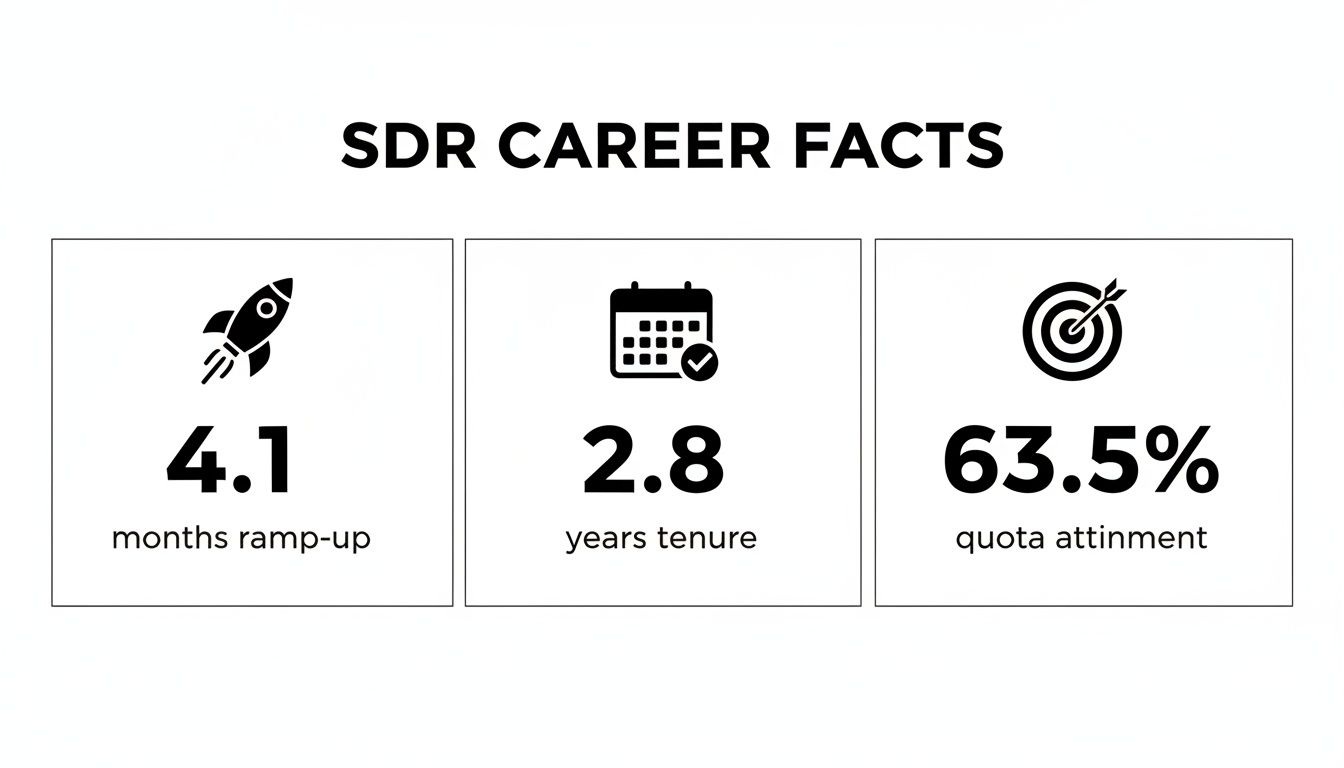
These numbers really tell the story. The data shows quota attainment for SDRs is hovering around 63.5%, and the average person stays in the role for just 2.8 years - which includes a tough 4.1-month ramp-up period to get fully productive.
These stats, which you can dig into deeper in this report on the state of sales development, highlight just how critical excellent training and solid processes are. For companies that want the results without the internal growing pains, exploring B2B sales outsourcing can be a smart alternative.
Essential Metrics for SDR Success

So, how do you tell if an SDR is actually doing a good job? It’s easy to get lost in “vanity metrics” - how many calls they made or emails they blasted out. But any seasoned sales leader knows that being busy isn’t the same as being effective.
The real story isn’t about activity; it’s about outcomes.
Think of it this way: you don’t judge a chef by how many onions they chop. You judge them by the amazing dishes that come out of the kitchen and keep customers coming back. The same goes for SDRs. The effort is the input, but the results are what count.
Of course, a high volume of activity is the fuel for the engine. On average, a single SDR will perform 94.4 activities every day - a constant grind of calls, emails, and social touches. All that hard work typically leads to about 14 real conversations and, from there, shakes out to around 23 booked appointments per month.
Leading vs. Lagging Indicators
To get a clear picture of performance, you have to look at two types of metrics: leading and lagging indicators. Think of them as the ‘effort’ and the ‘result.’
Leading indicators are the day-to-day actions you can control. They’re the early warning signs that tell you if you’re on the right path or headed for a cliff.
- Leading Indicators (The Effort): * Activity Volume: The raw number of dials, emails sent, and social media pings. This is the hustle. * Response Rate: What percentage of prospects actually hit ‘reply’? It doesn’t matter if it’s a yes or no; a response is a sign of life. * Conversation Rate: How many of those activities turn into a real back-and-forth conversation with a human?
Lagging indicators, on the other hand, are the results. They tell you what happened last week or last month, measuring your past performance and its impact on the bottom line.
- Lagging Indicators (The Results): * Meetings Booked: The holy grail for an SDR. This is the total number of qualified first meetings they set for an Account Executive. * Meeting Held Rate: How many of those booked meetings actually happen? A high no-show rate can signal a problem with qualification. * Opportunity Conversion Rate: Of the meetings that happened, how many did the AE accept and convert into a legitimate sales opportunity?
If you only track lagging indicators like “meetings booked,” you’re driving by looking in the rearview mirror. It shows you where you’ve been, not where you’re going. A healthy balance of both is critical. You can get a deeper look by exploring our guide on the most essential lead generation metrics for 2026.
The ultimate measure of an SDR’s success is their contribution to the sales pipeline. A top-tier Sales Development Representative doesn’t just book meetings; they create high-quality opportunities that have a strong chance of becoming closed-won deals.
This is why the most sophisticated sales teams don’t stop there. They also track metrics like Pipeline Value Generated and the Win Rate of the opportunities sourced by their SDRs. These are the numbers that connect an SDR’s first cold call directly to company revenue, proving their true impact.
Common Questions About the SDR Role
Even once you get the gist of what an SDR does, a few practical questions always pop up. It’s only natural.
Let’s tackle the big ones we hear all the time, from aspiring reps to founders thinking about hiring their first one.
How Much Do SDRs Actually Make?
Let’s talk money. An SDR’s pay isn’t just a flat salary; it’s a combination of a reliable base pay plus commission that rewards you for hitting your numbers.
While it can swing a bit depending on your city, industry, or the size of the company, here’s a solid ballpark for the U.S. market:
-
Base Salary: Most SDRs start with a base between $50,000 and $65,000 a year.
-
On-Target Earnings (OTE): When you add in commissions for booking qualified meetings, that total figure - your OTE - jumps to the $75,000 to $95,000+ range. You’ll often find the highest pay packages in major tech hubs and with SaaS companies.
It’s a straightforward system: the better you perform, the more you earn.
Can I Become an SDR With No Sales Experience?
Absolutely. In fact, the SDR role is one of the best ways to break into a tech sales career for this very reason. Great companies know to look for specific traits, not just a stacked sales resume.
Some of the most successful SDRs I’ve ever seen came from completely different fields - hospitality, teaching, customer support, you name it.
Hiring managers are really looking for coachability, resilience, and genuine curiosity. If you’ve got grit, can communicate clearly, and are eager to learn the process, you’re already halfway there. Those raw ingredients are way more valuable than a few years of prior sales experience.
If you can prove you’re hungry and ready to work, you’ve got a real shot.
What Are the Must-Have Tools for an SDR?
An SDR’s toolkit - their tech stack - is their command center. It’s what allows them to work efficiently and at scale. Getting comfortable with these platforms will give you a huge leg up.
Here are the non-negotiables:
-
CRM (Customer Relationship Management): This is the brain of the operation. Think of Salesforce or HubSpot. It’s where every single lead, interaction, and piece of data lives.
-
Sales Engagement Platform: Tools like Outreach or Salesloft are game-changers. They automate email sequences and manage outreach across different channels so no prospect ever gets forgotten.
-
Data Provider: You can’t call or email people without the right contact info. That’s where data providers like ZoomInfo or Apollo.io come in, giving you accurate phone numbers and email addresses.
-
Prospecting Tools: For digging into companies and finding the right people to talk to, LinkedIn Sales Navigator is absolutely essential. It’s the gold standard for prospect research.
Building an in-house SDR team from scratch - with the right tools, training, and management - is a serious investment of time and money. Fypion Marketing gives you a performance-ready alternative to scale your sales pipeline without all that overhead.
You only pay us for qualified meetings we book for you. This means every dollar you spend is directly tied to a tangible result. Find out more about our pay-per-meeting model.