
Outsourced Marketing Services: A B2B Guide for 2026
Your SaaS company probably did the hard part already. You found product-market fit, closed early customers, and built a pipeline from founder-led sales, referrals, partner introductions, and a steady stream of inbound demand.
Then growth flattened.
The website still gets traffic. Demo requests still come in. Sales still closes business. But the volume is no longer enough to support the next hiring plan, the next board target, or the next revenue milestone. That is usually the moment leadership starts debating outsourced marketing services.
The mistake is treating that decision like a cost-cutting exercise. For B2B tech companies, it is usually a capability decision. You are not buying “marketing.” You are buying execution in areas your team does not have the time, systems, or specialist depth to build quickly enough on its own.
When Your Growth Engine Stalls
A common pattern shows up in SaaS after the early traction phase.
At first, the product sells through relationships and reputation. The founder knows the market. A few customers refer peers. Content written by the product team brings in some organic interest. Sales can work those leads manually because volume is manageable.
Then targets change.
Now the CEO wants predictable pipeline. Sales wants more at-bats. Marketing gets asked to produce growth without the budget or headcount to build a full demand generation function, a content engine, outbound infrastructure, analytics, and campaign operations all at once.
That is where outsourcing becomes less theoretical and more practical.
A B2B software company does not need to outsource because it is weak. It often outsources because it has reached the point where generalist marketing is no longer enough. It needs channel specialists, list-building discipline, campaign testing, reporting, and close coordination with sales. Most internal teams cannot assemble all of that quickly.
That is one reason adoption has moved into the mainstream. In 2024, 50% of B2B businesses in the UK outsourced some marketing, and that trend is projected to grow in 2025. B2B companies were also nearly 25% more likely to outsource than B2C firms, according to this UK outsourcing analysis.
For a skeptical CEO, the useful framing is simple. Outsourced marketing services are not a replacement for strategy ownership. They are a way to add a working growth engine faster than you can recruit, train, and coordinate one internally.
The right time to outsource is usually after product-market fit and before revenue pressure exposes every gap in your go-to-market system.
What Are Outsourced Marketing Services Really
Think about how companies use legal support.
They may have an in-house leader who understands the business, the priorities, and the risk appetite. But when a complex transaction appears, they bring in specialists. Not because the in-house team failed. Because the problem demands focused expertise, process discipline, and repetition.
Outsourced marketing services work the same way.

The spectrum of outsourced support
At the light end, you hire a freelancer for one task. That might be a copywriter for landing pages, an SEO consultant for a technical audit, or a paid media buyer for a short campaign.
In the middle, you use a specialist agency. One firm handles paid search. Another runs outbound email. A third manages content production. This can work, but someone internally still has to align messaging, reporting, and priorities.
At the deep end, an agency functions almost like an external marketing department. In a Level 5 model, the partner handles strategy, operations, and analysis under one roof. According to Hinge’s discussion of full outsourcing models, that structure creates a single point of accountability and has led to documented cases of 220% month-over-month lead growth when incentives are aligned with sales outcomes.
If you want a closer look at the operational side of external pipeline creation, this guide to outsourced lead generation for B2B growth is a useful companion.
The pricing models leaders usually compare
Most buying decisions come down to three commercial structures.
Retainer model You pay a fixed monthly fee for a bundle of time, services, or outputs. This works well when you need broad support across channels and want ongoing access to a team.
Project model You hire for a specific deliverable. Good for repositioning work, a website relaunch, a messaging sprint, or a one-off campaign build.
Performance-based model You pay against a defined result, often qualified meetings or opportunities. This is the model many SaaS leaders gravitate toward when they care less about activity volume and more about pipeline outcomes.
What outsourced does not mean
It does not mean “hands off forever.” It does not mean the agency invents your market position for you. It does not mean you stop owning ICP definition, offer clarity, or sales feedback loops.
The strongest outsourced relationships happen when leadership keeps strategic ownership and the external team owns execution with sharp accountability.
If an agency cannot explain where your team’s responsibilities end and theirs begin, the engagement will drift.
A Breakdown of B2B Tech Marketing Services
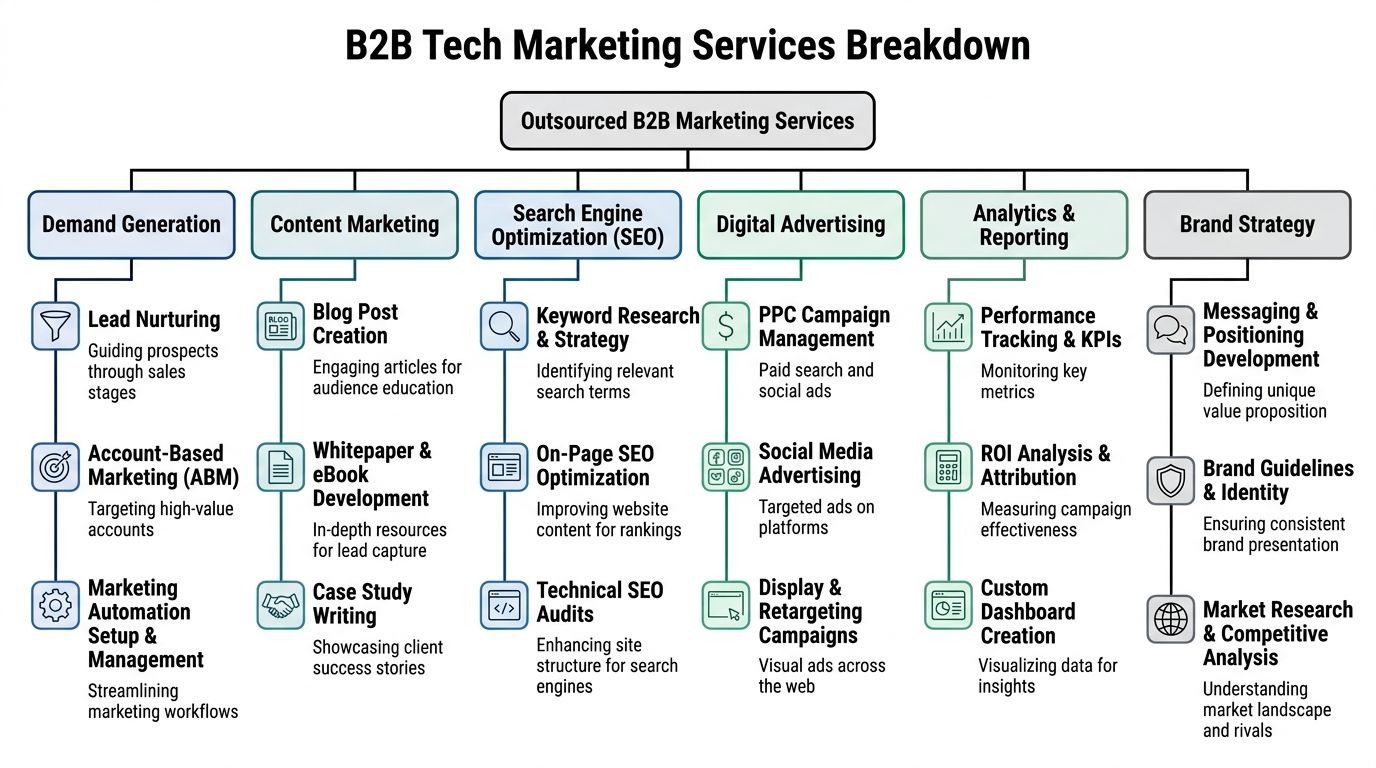
The phrase outsourced marketing services covers too much. For B2B tech, it helps to split the category by job to be done.
Demand generation
Most SaaS leaders begin with demand generation, because demand generation sits closest to revenue.
It includes outbound email, account-based targeting, lead nurturing, campaign operations, offer testing, and meeting generation. In practical terms, this work is about getting the right message in front of the right buying group and turning interest into booked conversations.
For outbound, agencies usually manage several moving parts:
-
ICP translation into lists where your positioning becomes account filters, job-title logic, and exclusions
-
Copy and messaging customized to pains, triggers, and buyer context
-
Inbox operations so campaigns keep running cleanly and responses are handled fast
-
Reply processing to separate genuine interest from noise
-
Meeting qualification so sales does not inherit calendar junk
The operational complexity is why many internal teams struggle to do this well. The MarTech industry expanded to over 11,000 solutions in 2024, according to Datamatics on outsourced marketing services. That makes channel execution, analytics, and campaign coordination hard to manage without specialists.
For companies comparing stack decisions, this guide to enterprise email marketing solutions helps clarify what should stay internal versus what is better outsourced.
Content and SEO
Many CEOs assume outsourced marketing means outbound first. In SaaS, content and SEO are often the quieter long-term engine.
This category includes:
| Service | What it does in practice | Where it helps most |
|---|---|---|
| Blog and thought leadership | Turns product insight into searchable, sales-relevant content | Mid-funnel education |
| Case study development | Gives sales proof assets that answer buyer objections | Late-stage trust building |
| SEO strategy and technical audits | Identifies content gaps, site issues, and ranking opportunities | Compounding inbound demand |
| Whitepapers and gated assets | Supports lead capture and nurturing flows | Category creation and complex sales |
What works here is specificity. Generic thought leadership rarely moves pipeline. Good outsourced content teams interview product, sales, and customer-facing leaders until they can write like insiders.
What does not work is handing an agency a vague brief like “write five SaaS blogs a month” and expecting revenue impact.
Paid acquisition and media buying
This category covers paid search, paid social, retargeting, and landing page optimization.
A specialist agency can help when your internal team lacks the bandwidth to monitor budget pacing, ad fatigue, creative testing, and conversion paths. In B2B SaaS, paid does not usually fail because the platform is bad. It fails because the offer is weak, the audience is broad, or sales follow-up is slow.
Outsourcing paid only works if the agency sees downstream performance, not just click-level data.
Strategy and positioning support
Some outsourced partners do the upstream work that makes every channel better.
That may include messaging, segment prioritization, competitive analysis, category framing, and funnel design. If your outbound is underperforming, the issue may not be list quality or copy. It may be that the market does not understand why your product matters. For this reason, outsourcing should not be viewed as a collection of tactics. Good agencies trace poor results back to the primary bottleneck.
Performance-based lead generation
This deserves its own treatment because it is often the most misunderstood option.
A pay-per-meeting or performance-based model flips the normal agency relationship. Instead of paying mainly for activity, you pay for a result that meets an agreed standard. In SaaS, that usually means a booked meeting with a target account and a decision-maker or relevant stakeholder who matches pre-agreed criteria.
That model can be effective, but only when the details are precise.
Here is what a sound setup usually includes:
-
Clear qualification rules Industry, company profile, role type, geography, and disqualifiers need to be written down.
-
A response handling process Someone must decide which replies count, which should be nurtured, and which should be excluded.
-
Calendar acceptance standards A booked call is not enough. It should fit your ICP and sales motion.
-
Feedback loops from sales If meetings are accepted but weak, the campaign should adjust fast.
One provider in this space is Fypion Marketing, which offers B2B cold email outreach on a pay-per-meeting model and manages list building, messaging, campaign infrastructure, and optimization as part of the outsourced service.
What fails in performance models is not usually the concept. It is vague definitions, poor handoff discipline, and a mismatch between what marketing counts as success and what sales wants.
The Promise and Perils of Outsourcing
The best outsourcing decisions come from seeing both sides clearly.

The promise
The first benefit is capability density.
Instead of hiring one generalist and asking that person to own outbound, analytics, content, paid acquisition, and reporting, you gain access to specialists who already run these motions every week. For B2B tech teams, that usually means faster campaign launches, tighter execution, and fewer avoidable mistakes.
The second benefit is management advantage.
A good outsourced partner brings process. They already know how to turn an ICP into target lists, how to structure test cycles, how to report on message performance, and how to coordinate with sales. Internal teams often underestimate how much overhead sits around the actual campaign work.
Third, outsourcing can reduce the cost of being wrong.
A bad full-time hire in growth marketing creates drag for months. A poor agency choice also hurts, but the scope is usually easier to redefine, pause, or replace.
A lot of CEOs also like the cleaner economics of performance-based engagements. If you want a practical view of that model, this explanation of pay-for-performance marketing aligned with revenue captures the core logic.
The perils
The biggest risk is false alignment.
An agency may optimize for outputs your business does not value. More replies. More leads. More meetings. If those do not convert into pipeline, you have bought motion instead of progress.
Another risk is brand distortion. External teams can write competent copy that still sounds unlike your company. In SaaS, that matters. Buyers respond to sharp language, technical accuracy, and relevance to their operating reality.
There is also a dependency risk. If the agency owns the playbook, the audience intelligence, the campaign history, and the reporting logic, you may end up with a pipeline source you cannot easily transition or audit.
According to Marketri’s analysis of outsourced marketing risks, outsourced campaigns can experience 25% higher churn over a 12-month period when the partnership lacks proprietary data sharing and a clear transition strategy. That is a useful warning for any CEO considering a fully external model.
How to reduce the downside
The practical safeguards are straightforward:
-
Keep message ownership internal even if copy production is external
-
Require shared reporting access so your team sees campaign inputs and outcomes
-
Run recurring sales feedback reviews to tighten qualification and messaging
-
Document campaign learnings in a format your team can retain
This short video gives a useful outside perspective on how leaders weigh these trade-offs before outsourcing.
Outsourcing works best when you externalize execution but keep internal ownership of positioning, qualification standards, and commercial judgment.
How to Select the Right Marketing Partner
Most companies evaluate agencies too loosely.
They look at logos, promises, channel lists, and maybe a few screenshots. That is not enough for any outsourced engagement, and it is especially dangerous in performance-based models.
A major problem in the market is that buyers get very little guidance on how to evaluate these contracts properly. According to Marketwake’s discussion of outsourced marketing evaluation, 30-50% of misaligned performance contracts fail due to poorly defined qualification criteria. That failure point is avoidable.
Start with the business model, not the pitch
Before comparing vendors, answer four questions internally:
-
What does a qualified meeting mean for your sales team?
-
Which segments matter most right now?
-
What does your average sales motion require from an initial conversation?
-
What information must be captured before a meeting counts?
If you do not define those inputs, the vendor will define them for you.
For broader selection criteria, this overview of choosing a lead generation agency is a practical reference point.
Questions that separate real operators from polished presenters
Use your discovery calls to inspect process.
Ask questions like these:
-
How do you define a qualified meeting? Listen for detail, not confidence. The answer should include role fit, account fit, intent signals, and disqualification rules.
-
What does your list-building process look like? Good teams can explain inclusion logic, exclusions, and how they refine targeting after campaign feedback.
-
Who writes the copy, and how do they learn our market? The right answer includes interviews, sales call review, and iteration based on response quality.
-
How do you manage low-quality positive replies? This exposes whether the agency can distinguish between interest, curiosity, and opportunity.
-
What happens when sales rejects meetings? There should be a clear feedback and adjustment process.
-
What data do we retain if we leave? This question matters more than most buyers realize.
Red flags that matter
Some warning signs are obvious. Others are subtle.
| Red flag | Why it matters |
|---|---|
| They avoid defining qualification in writing | You will argue about outcomes later |
| They report mostly on opens and clicks | They may not be tied to pipeline quality |
| They cannot describe their testing process | Execution is likely improvised |
| They promise fit across every industry | Messaging will be generic |
| They resist shared systems or data access | Dependency risk rises |
What a good proposal should contain
A credible partner should show its operating model, not just a price.
Look for:
-
Scope clarity on exactly what they own
-
Meeting qualification rules with examples
-
Target account logic tied to your ICP
-
Campaign review cadence with named stakeholders
-
Exit terms and data handoff language
A skeptical CEO should not ask, “Do I like this agency?” The better question is, “Can this team show me how results are produced, measured, and corrected?”
Measuring Success KPIs and ROI Calculations
Most outsourced campaigns are judged too early and on the wrong metrics.
Open rates, click rates, and reply rates can help diagnose performance, but they are not the final score. In B2B SaaS, the business question is whether the campaign creates sales conversations that move into pipeline.
The KPI stack that matters
Think in layers.
Operational metrics help you manage the channel. These include open rates, reply quality, bounce patterns, and meeting show rates. They matter because they reveal where execution is failing.
Commercial metrics matter more. These include qualified meetings held, opportunities created, pipeline influenced, and revenue closed.
If you are using a performance model, the anchor metric is usually cost per qualified meeting. After that, your team should track progression through the sales process. A cheap meeting that never advances is expensive.
A practical ROI model
You do not need a complicated attribution system to evaluate outsourced lead generation. You need a disciplined chain from spend to outcome.
Use a simple table like this.
Sample ROI Calculation for a Pay-Per-Meeting Campaign
| Metric | Value | Notes |
|---|---|---|
| Total campaign cost | Define internally | Include agency fees and any internal support costs |
| Qualified meetings booked | Define internally | Count only meetings that meet pre-agreed criteria |
| Meetings held | Define internally | Remove no-shows and disqualified bookings |
| Opportunities created | Define internally | Use your sales team’s opportunity definition |
| Closed-won deals | Define internally | Based on actual conversions from the campaign |
| Average contract value or customer value measure | Define internally | Use the commercial metric your finance team trusts |
| Revenue attributed to campaign | Define internally | Closed-won value tied to sourced meetings |
| ROI | Calculate internally | Revenue attributed minus campaign cost, then compare to spend |
For teams that need a refresher on the math, this practical guide on how to calculate marketing ROI is useful.
How to use the model without fooling yourself
A few rules keep the analysis honest.
-
Separate booked from held meetings Calendars can look healthy while buyer engagement is weak.
-
Use your sales definition of qualified Marketing cannot grade its own homework.
-
Track source-to-opportunity lag Some campaigns create good conversations that take time to mature.
-
Review by segment One vertical, persona, or offer often performs much better than the rest.
If a vendor talks mainly about top-of-funnel activity and avoids progression into pipeline, you are not looking at ROI yet. You are looking at campaign motion.
What good reporting feels like
Good outsourced reporting makes decision-making easier.
You should be able to answer these questions quickly:
-
Which audience segments are responding
-
Which messages are producing relevant conversations
-
Which meetings are accepted by sales
-
Which meetings create opportunities
-
Which objections show up repeatedly
Once you can answer those consistently, outsourced marketing services stop feeling like a black box and start behaving like an accountable growth channel.
Your Path to Scalable Growth
The decision is rarely “agency or no agency.”
For a B2B tech company with a working product and revenue pressure, the key decision is whether to build every growth capability internally, buy specialist execution from outside, or run a hybrid model where strategy stays in-house and delivery is outsourced.
For most CEOs, the cleanest starting point is not a giant retainer. It is a scoped engagement tied to a real commercial goal. That could be outbound meeting generation, segment validation, content for one buying motion, or paid acquisition around a narrow offer.
What works
The companies that get value from outsourced marketing services usually do three things well.
They know who they want to reach. They define what counts as success before launch. They keep sales, marketing, and leadership aligned on feedback after the campaign starts.
What does not work is hiring an agency to “fix growth” when the offer is fuzzy, the ICP is broad, and sales rejects anything that is not a perfect inbound lead.
Onboarding and transition checklist
Once you sign, move fast on the first operational steps.
-
Run a sales alignment call Get objections, qualification rules, and call expectations out of people’s heads and into a shared document.
-
Lock the ICP and exclusions Define who you want, who you do not want, and where edge cases should go.
-
Approve messaging pillars Give the partner strong claims, proof points, and words to avoid.
-
Set reporting cadence Weekly works well early because campaigns need fast correction.
-
Create a feedback loop for accepted and rejected meetings. Quality either improves or stalls based on this feedback.
A good outsourced engagement should create learning, not just output. Even if you eventually bring more work in-house, the right partner helps you build a repeatable motion your business understands.
Frequently Asked Questions
How long does outsourced lead generation take to ramp up
It depends on the channel and your readiness.
Cold email and outbound programs usually require setup work before they produce a steady flow of conversations. That includes ICP definition, list logic, messaging, campaign structure, and reply handling. If your team is slow to approve copy, unclear on qualification, or inconsistent in follow-up, ramp time stretches.
Content and SEO take longer because the payoff is cumulative. Paid campaigns can launch quickly, but speed does not guarantee useful pipeline.
The practical rule is to judge early on process quality, then judge later on commercial outcomes.
What happens if booked meetings are not qualified
This should be settled before the contract is signed.
A serious partner will define what counts as a qualified meeting, how disputes are handled, who approves edge cases, and what gets excluded. If that language is vague, expect friction later.
For pay-per-meeting models, this point matters more than pricing. Cheap meetings that sales rejects are not efficient. They just move the waste downstream.
Should we choose a retainer or pay-per-meeting model
Choose based on the problem you are solving.
A retainer works better when you need broad support across strategy, content, paid, reporting, and execution. It is also useful when success depends on many interdependent activities that cannot be reduced to one output metric.
A pay-per-meeting model works better when your goal is narrow and outcome-based. It suits companies that already know their ICP, have a working sales process, and want predictable top-of-funnel conversations without paying mainly for agency activity.
How much internal involvement is still required
More than most CEOs expect, but less than building a team from scratch.
Your company still needs to provide positioning, proof points, objection handling, sales feedback, and timely approvals. The strongest outsourced programs treat the agency as an extension of the revenue team, not a detached vendor.
If your team wants a very light-touch arrangement, choose a partner with a mature process and clear accountability. If your market is complex or changing, a more collaborative model usually performs better.
Can we outsource fully and bring it back in-house later
Yes, but only if you plan for that from the start.
Keep access to campaign data, audience definitions, messaging history, reporting structures, and lessons learned. Ask how assets are documented and what handoff looks like if the relationship ends.
Companies run into trouble when the external partner becomes the only place where campaign knowledge lives. That creates dependence, slows transitions, and makes performance hard to audit.
If your team has product-market fit and needs a more accountable way to build pipeline, Fypion Marketing is one option to evaluate. The agency focuses on B2B lead generation through cold email outreach and uses a pay-per-qualified-meeting approach, so the commercial model is tied to booked meetings that meet agreed criteria rather than a broad monthly retainer.