
Your 2026 B2B Marketing Automation Strategy That Actually Wins
Let’s get one thing straight: a marketing automation strategy is much more than a plan to send a bunch of emails. Think of it as the operational blueprint for your entire B2B lead generation machine. It’s the system that connects your tech, your message, and your sales team to turn strangers into customers, scalably.
This is the engine that drives predictable growth.

Building Your Foundational Marketing Automation Strategy
Forget the generic definitions for a moment. A real marketing automation strategy is how you translate a big-picture goal, like “increase annual revenue,” into a concrete marketing outcome, like “book 48 qualified sales meetings this year.” It ensures every action you take is tied directly to a result.
The explosive growth in this space isn’t a fluke. The global marketing automation market was valued at $7.23 billion in 2025 and is on track to smash $20.12 billion by 2034. Why? Because it works. Data from Fortune Business Insights and others show companies using automation see 80% more leads and can lift revenue by over 10% in just 6-9 months.
Define Your Ideal Customer Profile
Before you even think about writing an email or building a workflow, you need to know exactly who you’re talking to. Your Ideal Customer Profile (ICP) isn’t about the person; it’s a laser-focused description of the company that gets the most value from what you sell.
A vague ICP is a waste of time. For instance, if you sell project management software, a weak ICP is “tech companies with 50-200 employees.” A strong, actionable ICP gets way more specific:
-
Industry: B2B SaaS or professional services firms.
-
Company Size: 50-250 employees.
-
Pain Points: They’re struggling with poor project visibility across departments and are constantly blowing past deadlines.
-
Technology Used: They already use tools like Slack and Google Workspace, signaling they’re comfortable with integrated cloud solutions.
This level of detail is everything. It makes sure your automated messages actually land because they speak directly to a prospect’s real-world problems.
A well-defined ICP is your filter. It stops you from pouring time and money into leads that will never, ever convert. It’s the most critical first step in building a performance-driven automation strategy.
Translate Revenue Goals into Marketing KPIs
Your automation efforts are worthless if you can’t measure their impact on the bottom line. The trick is to work backward from your revenue target to figure out the specific marketing activities needed to hit it. This creates a clear line of sight from effort to outcome.
Let’s run the numbers. Say your goal is an extra $120,000 in revenue this year, and your average deal is worth $10,000. Simple math says you need to close 12 new deals.
If you know your sales team closes 25% of qualified meetings they take, you now have your marketing target: you need to generate 48 qualified meetings. That boils down to four meetings per month. Suddenly, your marketing automation strategy has a crystal-clear objective. To dive deeper, a solid AI marketing automation guide can give you the A-to-Z framework for setup and scaling.
Getting this foundational work right is non-negotiable. For more on how to align all these moving parts, check out our complete guide on creating a modern B2B marketing strategy.
Assembling Your B2B Automation Tech Stack
Picking the right tools is just the first step. The real magic happens when you get them all talking to each other. A powerful marketing automation strategy isn’t about finding one single, do-it-all platform. It’s about building an ecosystem of technologies that work together, each chosen for a specific job.
Your main goal is to create a seamless flow of data. When a lead opens an email or checks out your pricing page, that action should instantly update across your entire system. This gives you a single source of truth and lets you make smarter, faster decisions.
The Core Three Components
For a B2B lead generation machine built on performance, you really only need to nail three types of tools. This is the backbone of your automation, especially when you’re doing cold outreach and qualifying leads.
-
Customer Relationship Management (CRM): Think of this as your central command center. It’s where every lead, contact, and company record lives, along with the complete history of every interaction they’ve had with you.
-
Email Outreach Platform: This isn’t your standard email marketing tool. You need a platform built specifically for high-volume cold outreach with an obsessive focus on deliverability. Its only job is to get your emails into the main inbox, not the promotions tab or spam folder.
-
Tracking and Analytics Tools: These are your eyes and ears. They watch website behavior, track email engagement, and log conversion events, feeding all that critical intel back into your CRM and email platform.
The most common mistake I see is companies blowing their budget on a massive, all-in-one marketing suite when they only need a couple of key functions. Start lean. Get best-in-class tools focused on your #1 goal - booking meetings - and then you can always add more later.
Let’s break down the essential tools you’ll need.
Essential B2B Automation Tech Stack Components
| Tool Category | Primary Function | Key Selection Criteria for B2B Lead Gen |
|---|---|---|
| CRM | Central database for all lead, contact, and company data; tracks the entire customer journey. | Deep integration capabilities (API), sales workflow automation, custom fields for lead scoring. |
| Email Outreach Platform | Sending and automating cold email sequences at scale while protecting sender reputation. | Built-in email warm-up, inbox rotation, high deliverability features, reply detection. |
| Tracking/Analytics Tool | Monitoring user behavior on your website and engagement with your emails. | Website visitor identification, event tracking (e.g., page views, form fills), seamless data sync with CRM. |
Choosing tools with these specific functions in mind ensures you’re building an engine where every part works in sync to drive results.
Selecting Your CRM for Sales Alignment
Your CRM is way more than a digital address book - it’s the critical link between your marketing efforts and your sales team. When picking a CRM, the single most important factor for automation is how well it integrates with your other tools. A clunky setup that needs manual data exports completely misses the point.
Here’s a real-world example: A lead replies to one of your automated emails with a positive message. The system should instantly create a “Qualified Lead” record in the CRM, automatically assign it to the next available sales rep, and create a task for them to follow up. Nobody should have to lift a finger.
Look for CRMs like HubSpot or Salesforce that offer robust APIs and have large app marketplaces full of pre-built integrations.
Choosing an Email Platform for High Deliverability
When you’re doing cold outreach, deliverability is the only metric that matters. An email that lands in spam generates exactly zero results. Standard marketing platforms like Mailchimp are fine for newsletters to an existing list, but they just aren’t built for cold campaigns. Their shared server reputations can be a mixed bag.
You need a platform designed from the ground up for this specific purpose. Tools like Instantly, Smartlead, or Lemlist are engineered with features that actively protect your sender reputation.
Here’s what to look for:
-
Unlimited email account warm-up: This is a process that slowly ramps up sending volume from new inboxes to build trust with email providers. To get this right, there’s a specific technical process you have to follow. You can learn all about it in our step-by-step instructions for a technical setup for cold emailing guide.
-
Automatic inbox rotation: A good platform will spread your daily sending limit across multiple inboxes automatically, keeping you off spam-filter radars.
-
Built-in deliverability monitoring: It absolutely must track metrics like bounce rates and spam complaints in real-time. This lets you spot and fix problems before they do any real damage to your domain reputation.
By assembling your stack with these specific functions in mind, you create a powerful, unified system where data flows effortlessly and every component works to turn cold contacts into qualified sales opportunities.
Designing Automated Workflows That Convert
Okay, you’ve got your tech stack sorted. Now for the fun part: building the engine that turns cold contacts into qualified sales meetings. A real marketing automation strategy isn’t about sending a few emails here and there. It’s about creating a connected journey where every step logically leads to the next, pulling a prospect closer to a real conversation.
This is where your strategy stops being a document and starts becoming a lead-generating machine.
The Four Core B2B Workflows
For the kind of performance-driven lead gen we’re focused on, the entire customer journey boils down to four main automated workflows. Each one has a specific job, and when they work together, they build a predictable pipeline.
-
Lead Capture & Enrichment: This is your starting block. This workflow is all about automatically sourcing and validating contact data, then beefing it up with details like company size, industry, or even the tech they currently use.
-
Cold Outreach Sequence: A multi-step, multi-channel campaign built to educate and warm up prospects who have no idea who you are.
-
Lead Qualification & Scoring: This is the brain of the operation. It’s an automated system that watches how prospects behave and assigns points to figure out who is actually ready for a sales call.
-
Sales Handoff Workflow: The final, crucial step. This workflow seamlessly books those hot leads right onto a sales rep’s calendar without any manual back-and-forth.
Here’s a simple look at how data moves through your tech stack to make these workflows happen.
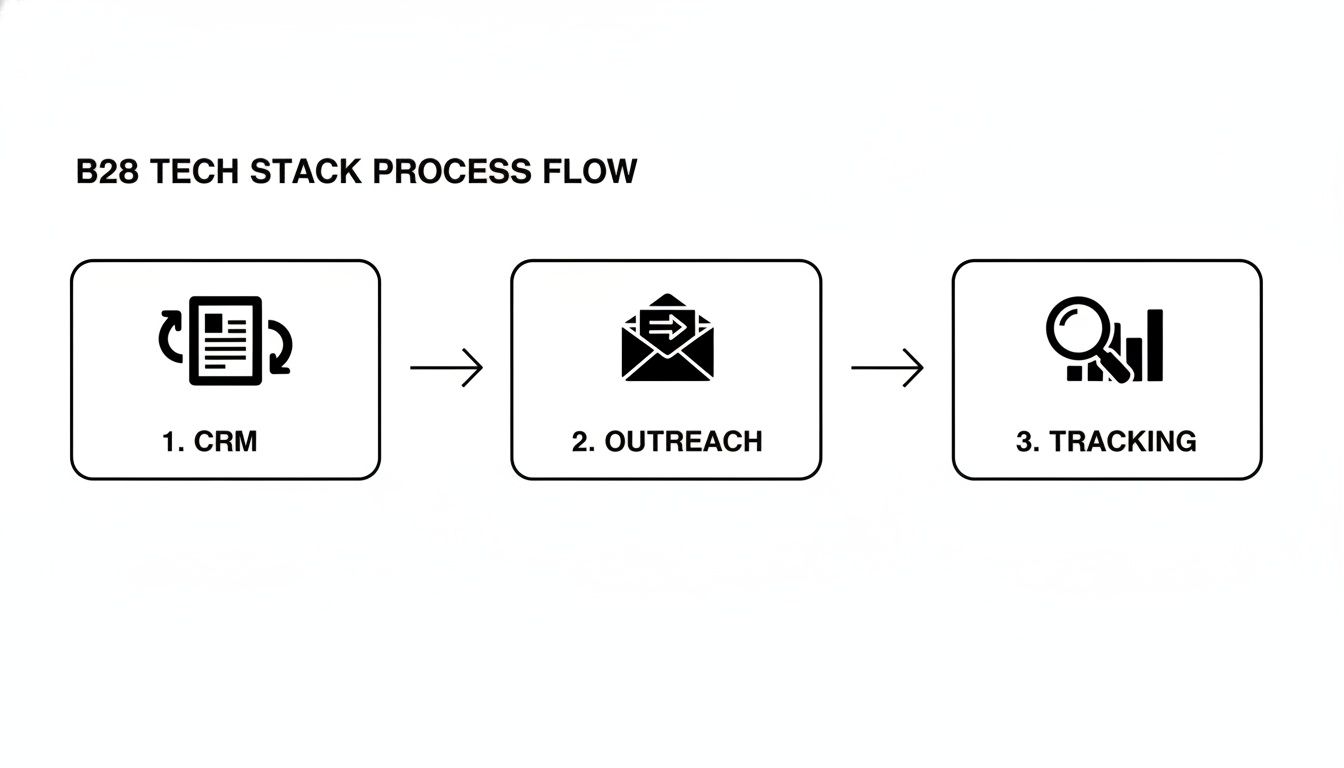
As you can see, the CRM is the heart of it all. It acts as the single source of truth, getting fed information from your outreach and tracking tools, which keeps everything clean and connected.
Mapping the Lead’s Automated Journey
Let’s walk through what this looks like in the real world. Imagine you’re a SaaS company selling cybersecurity software. Your ideal customer is a Chief Technology Officer (CTO) at a mid-sized financial firm.
First, your Lead Capture workflow fires up. You use a data provider to build a list of 1,000 CTOs who fit your ICP. The system then automatically enriches those contacts with firmographic data - think company revenue and maybe even their current security vendors.
Next, you push these contacts into the Cold Outreach Sequence. This isn’t just one email blast; it’s a carefully planned drip campaign.
Your sequence might look something like this:
-
Email 1: Hit them with a common pain point for CTOs in finance, like new compliance risks, and offer a quick, valuable insight. No sales pitch.
-
Email 2 (3 days later): Follow up with a link to a short case study showing how a similar firm crushed that exact problem.
-
Email 3 (5 days later): Keep it simple with a direct, low-friction question. “Is managing compliance risk a priority for you this quarter?”
The trick is to make the automation feel personal and genuinely helpful, not robotic. Each touchpoint should build on the last, giving value long before you ever ask for their time. It’s a conversation, just guided by automation.
While all this is happening, your Lead Qualification workflow is humming along in the background. If the CTO clicks the case study link, the system might add +10 points. If they send a positive reply to Email 3, that’s a big signal - add +50 points. Once a lead hits a threshold, maybe 60 points, they’re flagged as sales-ready.
This is where the Sales Handoff workflow takes over. The system automatically sends that qualified lead a personalized email with a link to the sales team’s calendar, creates a task in the CRM, and pings the assigned rep.
The results are undeniable. Statistics show businesses using automation get 80% more leads and see 77% higher conversion rates. It’s why 83% of sales teams using AI are watching their revenue grow.
Mastering Personalization At Scale

Let’s be blunt: automation without a human touch is just sophisticated spam. If your marketing automation strategy is going to work, every single outreach has to feel like it was written for one person - even when you’re sending it to thousands. This is about way more than just dropping a tag into a generic template.
Real personalization comes from digging into the data to make your message genuinely relevant. Instead of a bland opener, try referencing a prospect’s industry, a recent company milestone, or even a piece of tech you know they use. A simple line like, “Saw your team’s recent funding round on TechCrunch - congrats!” immediately shows you’ve done your homework and aren’t just blasting out a template.
True personalization isn’t about knowing someone’s name. It’s about knowing their problem. Use custom fields to reference their specific pain points, goals, or industry challenges.
Getting this level of detail right hinges on solid data management. When you organize your contacts based on specific criteria, you can create hyper-relevant messages that actually get read. We cover the nuts and bolts of this in our guide to B2B customer segmentation. This whole process ensures your automated messages connect because they speak directly to the recipient’s world.
Protecting Your Email Deliverability
Even the most perfectly personalized email is worthless if it lands in the spam folder. Deliverability - the art and science of actually getting your emails into the primary inbox - is a non-negotiable part of any cold outreach strategy. Email providers are always on the hunt for spammy behavior.
To stay on their good side, you have to get a few technical things right from the start.
-
Use Dedicated Sending Domains: Never, ever send high-volume cold outreach from your main corporate domain. Instead, set up separate (but similar) domains just for your outbound campaigns.
-
Warm Up Your Inboxes: New email accounts need to build a positive sender reputation. This means a “warm-up” period where you gradually ramp up your sending volume over several weeks, mixing in automated replies to look like a real person.
-
Monitor Your Sender Health: Keep a close watch on your open rates, bounce rates, and spam complaints. A sudden nosedive in open rates is a huge red flag that your domain reputation might be taking a hit.
Interpreting Deliverability Metrics
You have to know what your email metrics are telling you to have any long-term success. A high bounce rate (anything over 5%) could mean your contact list is stale or you’re using a low-quality data provider. A low open rate (under 30% for cold outreach is a warning sign) might point to a weak subject line or a deeper deliverability problem.
For example, if you notice one specific inbox in your sending rotation has a dramatically lower open rate than the others, that’s a clear signal. You need to pause sending from that account and figure out what’s wrong.
By making these small, data-driven tweaks, you keep your deliverability high and make sure your carefully crafted messages are actually being seen. This is how you create a powerful, scalable system for one-to-one communication.
How To Measure And Optimize Your Automation Engine
Getting your automation engine up and running is just the first step. The real work - and the real results - come from constant tuning and optimization. If you just “set it and forget it,” you’re leaving money on the table.
Building a solid measurement framework is what separates busy work from predictable pipeline growth. It’s about connecting your email sends to actual business outcomes, not just looking at vanity metrics. You need to know what’s working, what’s not, and why.
Focusing on Metrics That Actually Matter
Don’t get lost in a sea of data. You only need a handful of essential KPIs to get a clear, real-time snapshot of your engine’s health. These are the numbers that tell the story from the first email to a booked meeting.
Here are the core metrics we live by:
-
Positive Reply Rate: This is the big one. It tracks the percentage of prospects who reply with genuine interest. A click is nice, but a positive reply is a real conversation starter and a much stronger signal of a well-crafted message.
-
Lead-to-Meeting Conversion Rate: Of all the leads who raise their hand, how many actually end up on the calendar? This KPI tells you how effective your handoff process is between automation and a human conversation.
-
Cost Per Meeting (CPM): This is your bottom-line ROI metric. Simply divide your total campaign spend (think software, data costs, agency fees) by the number of qualified meetings you’ve booked. It’s the ultimate measure of efficiency.
These metrics go far beyond surface-level stats. To get a deeper understanding, check out our guide on the 8 essential lead generation KPIs for 2026.
It’s easy to get fixated on open rates. But a high open rate with a low reply rate is a red flag. It usually means your subject line was catchy, but the email body failed to deliver. The reply rate tells you if your message truly connected.
To get a holistic view, you need to map your KPIs to each stage of your funnel. This helps you pinpoint exactly where things are breaking down or where you have an opportunity to double down on what’s working.
Here’s a simple framework we use to connect funnel stages with the right performance indicators.
Funnel Stage vs Key Performance Indicator (KPI)
| Funnel Stage | Primary KPI | Secondary KPI | Optimization Goal |
|---|---|---|---|
| Top of Funnel (TOFU) | Email Open Rate | Deliverability Rate | Improve subject lines and sender reputation. |
| Middle of Funnel (MOFU) | Positive Reply Rate | Click-Through Rate (CTR) | Make email copy more compelling and relevant. |
| Bottom of Funnel (BOFU) | Lead-to-Meeting Rate | Cost Per Meeting | Streamline the booking process and lead handoff. |
| Post-Funnel | Sales Qualified Leads (SQLs) | Customer Lifetime Value (CLV) | Ensure leads are high-quality and convert to revenue. |
Using a table like this prevents you from trying to fix the wrong problem. A low meeting rate isn’t a subject line issue; it’s a call-to-action or handoff issue. This clarity is crucial for effective optimization.
Turning Data Into Actionable Insights
With your core KPIs in place, it’s time to start improving them. The key is structured testing - don’t guess what works, let your data guide you. A disciplined A/B testing approach is how you turn raw numbers into real performance gains.
The trick is to test one high-impact variable at a time. If your open rates are in the gutter, don’t start messing with your CTA. Start with your subject lines.
Let’s say you’re running a campaign. You could test two different angles for your subject line:
-
Version A (Benefit-Driven): “A faster way to manage compliance”
-
Version B (Question): “Struggling with compliance reporting?”
Send each version to a statistically significant chunk of your audience. Whichever one gets the better open and reply rate becomes your new “control” version. Then you move on to testing the next variable, like your call-to-action or the first sentence of your email.
This creates a powerful flywheel effect. Each small, incremental win from a successful test compounds over time, dramatically improving your ROI and building a truly optimized marketing automation engine.
The Practical Questions: Cost, Timeline, and a Reality Check
Whenever I talk to founders and marketing leaders about building out an automation strategy, the theory sounds great. But then the practical questions start. It always comes down to the same three things: What’s this really going to cost? How long until I see a return? And can my small team actually pull this off?
Let’s get into it.
What Is the Real Cost to Implement?
The cost can swing wildly, and it really depends on the path you take. If you go the DIY route, you’re looking at software subscriptions and maybe some data acquisition costs. This could be anything from a few hundred to several thousand dollars a month, depending on the tech stack you piece together.
But there’s another way to look at it: a performance-based model. Instead of paying hefty retainers or big upfront fees, you only pay for actual results - specifically, qualified meetings that land on your sales team’s calendar.
This approach flips the entire cost conversation on its head. It gets rid of the risk of pouring your budget into a system before you even know if it works.
With a performance model, your marketing spend is tied directly to your sales pipeline. Every single dollar is accountable from day one, which is exactly how it should be.
How Long Until We See Results?
You need to have some patience, but you shouldn’t have to wait forever. Realistically, plan for a setup and warm-up period of about four to six weeks. This isn’t just dead time; it’s when the crucial technical work happens - getting the infrastructure solid, building a good sender reputation, and launching those initial outreach campaigns.
Once that foundation is set, you should expect to see the first qualified sales meetings hitting the calendar. From there, it’s all about consistent tweaking and optimization to create a predictable flow.
Within three to six months, the system should be a well-oiled machine, generating a reliable stream of qualified meetings. This is how you transform your pipeline from a reactive, feast-or-famine cycle into something predictable.
Can This Work for a Small Business?
Absolutely. This isn’t just a game for enterprise companies with bottomless budgets anymore. The combination of accessible, scalable tools and new performance-based agency models has completely leveled the playing field for small businesses.
The trick is to start lean and focused. Don’t try to automate every single touchpoint right out of the gate. Instead, pick one high-impact channel - like cold email outreach - and master it.
This allows you to build momentum, generate revenue, and then reinvest that cash to scale up your efforts. A focused marketing automation strategy lets you punch way above your weight without needing a massive upfront investment.
Ready to build a predictable sales pipeline without the upfront risk? Fypion Marketing specializes in performance-based lead generation, where you only pay for qualified meetings. Book a free consultation today and see how our data-driven approach can scale your B2B growth.