
Lead Generation For Small Business: Guide To Growth
Effective lead generation for small business isn’t about casting the widest net. It really comes down to two simple things: first, knowing exactly who your best customers are, and second, showing up where they already are.
Getting this foundation right is what stops you from throwing money away on prospects who will never buy. It makes every single marketing dollar you spend work harder to grow your business.
Building Your Lead Generation Foundation
Before you even think about running an ad or sending an email, you have to do the groundwork. It’s a step so many small businesses skip, and they end up wondering why their campaigns fall flat. Your most important asset isn’t a fancy tool or a specific channel; it’s a laser-focused understanding of your audience.
This is way more than just surface-level demographics. A vague idea like “we sell to other businesses” is a surefire way to get zero results. You need to build out a detailed Ideal Customer Profile (ICP). Think of it as a strict filter for every single marketing move you make.
From Vague Idea to Concrete Profile
Your ICP is a living document that describes the exact type of company that gets the most value out of what you sell. It’s not just about what industry they’re in, but the specific traits that make them a perfect match.
To build a solid ICP, you need to get specific. Ask yourself:
-
Company Size: Do you get the best results with scrappy 1-10 person startups or more established firms of 50-200? The way they make decisions and what they need are worlds apart.
-
Industry & Niche: Don’t just settle for “tech.” Get granular. Is it “B2B SaaS companies in the fintech space” or “local construction companies specializing in residential remodeling”?
-
Revenue: Are your dream clients pre-revenue startups, or are they businesses pulling in over $5 million a year? Their budget and priorities will be completely different.
-
Pain Points: What specific, expensive problems are keeping them up at night? Frame it in terms of things they can’t ignore, like operational bottlenecks, lost revenue, or compliance nightmares.
Your Ideal Customer Profile is your most important marketing asset. It’s the compass that guides every decision, from the channels you choose to the words you write.
Once your ICP is nailed down, you can start thinking about the actual people inside those companies. This is where buyer personas come in. If you’re new to this, we have a guide that walks you through how to create buyer personas for better outreach.
Uncovering Insights Through Research
So, where do you find the answers to all these questions? The good news is, you don’t have to guess. The data is usually sitting right under your nose.
Start by looking at your top 5-10 best customers right now. Who are they? Find the common threads in their company size, industry, and the specific problems you solved for them. If you can, interview them. Ask what triggered their search in the first place and why they picked you over the competition.
Next, jump on professional networking platforms and start looking at companies that fit your initial ICP. Pay close attention to the job titles of the people who make decisions. A “Head of Marketing” at a 20-person company wears a lot more hats than a “Chief Marketing Officer” at a 200-person firm.
Putting in this effort up front transforms your lead generation from a scattershot, hope-and-pray approach into a targeted, efficient system. It means every piece of ad copy you write and every email you send is aimed squarely at the people most likely to become your next great customer.
Choosing Your Best Lead Generation Channels
Okay, you’ve nailed down your Ideal Customer Profile. Now what? It’s time to figure out where these people actually hang out online and get in front of them.
The biggest mistake I see small businesses make is trying to be everywhere at once. They spread themselves thin across a dozen platforms, burning cash and energy with almost nothing to show for it. The smarter play is to be deliberate. Pick a couple of channels that make sense for your business and absolutely dominate them.
The right mix for you will depend on how fast you need leads and the kind of relationships you’re trying to build.
Balancing Speed, Cost, and Long-Term Value
Most lead generation channels boil down to three main types: organic, paid, and direct outreach. Each one comes with its own set of pros and cons.
-
Organic Channels (SEO & Content): Think of these as your long game. Writing great blog posts and creating genuinely useful content builds trust and attracts leads over time. The catch? It’s slow. You might be waiting 6-12 months to see real traction. The investment is mostly your time, but it builds a valuable asset that keeps paying you back for years.
-
Paid Channels (PPC & Social Ads): Need leads, like, yesterday? Paid ads are the fastest way to get them. You can fire up a Google or Facebook Ads campaign and have traffic hitting your site within hours. The downside is that it demands a consistent budget, and the second you turn off the spend, the leads dry up.
-
Direct Outreach (Cold Email & Referrals): This is where you take matters into your own hands and contact potential customers directly. It gives you incredible precision because you choose exactly who you talk to. For B2B businesses, a well-run cold email campaign can start bringing in meetings within a few weeks.
A B2B software company, for example, is probably going to lean heavily on SEO and hyper-targeted cold email to get in front of decision-makers. A local plumber, on the other hand, will get much faster results from Google Local Services Ads and a solid customer referral program.
It all comes back to knowing your customer, which is what this decision tree is all about.
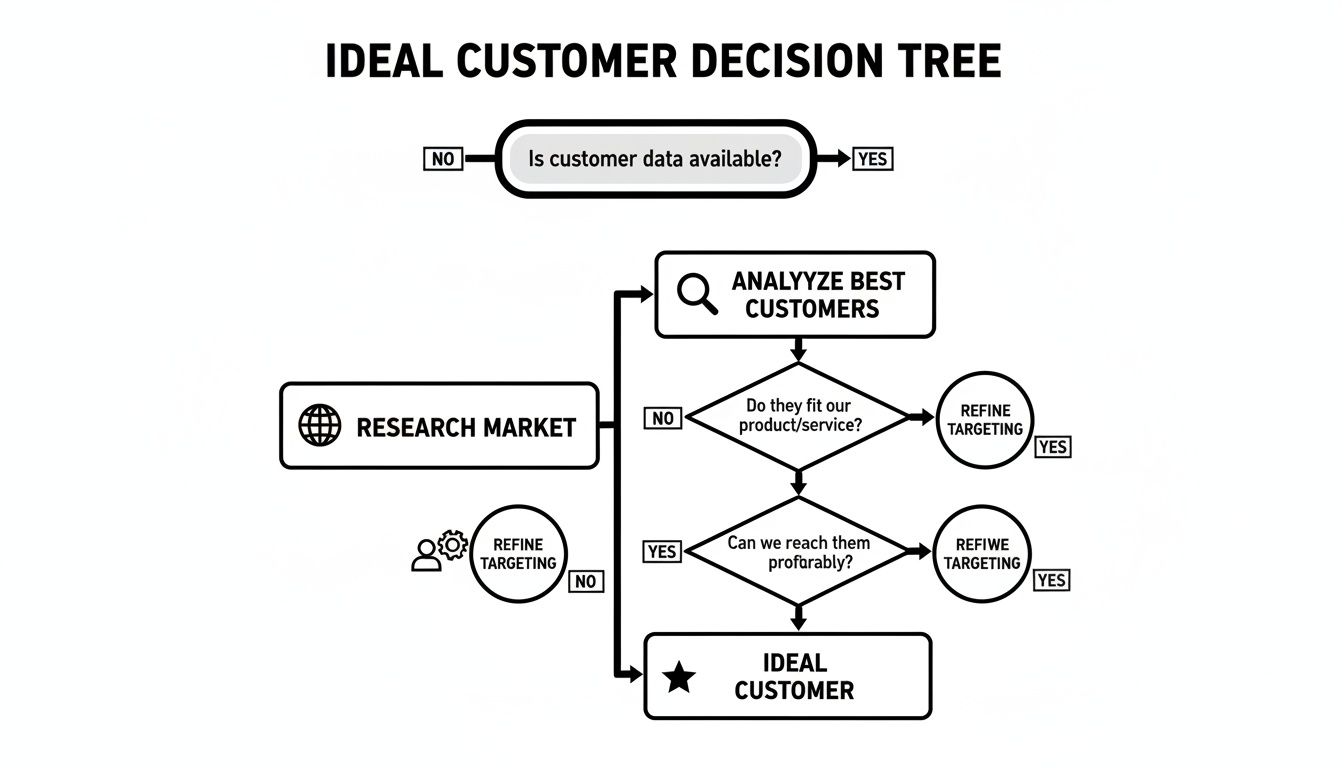
This process shows how your existing customer data is the foundation for everything that follows. Your best channels become obvious once you truly understand who you’re selling to.
Prioritizing Channels for Maximum Impact
Trying to master SEO, run PPC campaigns, and launch cold outreach all at the same time is a classic recipe for burnout. A much better approach is to pick one or two primary channels, get really good at them, and only then start to expand.
Here’s a simple framework to help you choose:
-
Budget: If cash is tight, lean into channels that require more time than money, like asking for customer referrals or writing your first few cornerstone blog posts. If you’ve got capital to deploy, paid ads will give you immediate data and, hopefully, revenue.
-
Time to Results: Need to fill your pipeline this month? Paid ads or direct outreach should be your top priority. If you’re building for the next few years, dedicate a portion of your resources to SEO and content.
-
Industry Norms: Take a look at your competitors. Where are they getting their customers? If they’re all over a certain platform, that’s a pretty strong signal your audience is there, too. Just be aware that some B2B tools come with their own costs, so understanding LinkedIn Sales Navigator pricing is crucial if you plan to use it for prospecting.
To help you visualize the trade-offs, here’s a quick comparison of the most common channels we see small businesses use.
Comparing Lead Generation Channels for Small Businesses
| Channel | Typical Cost | Time to Results | Best For |
|---|---|---|---|
| Cold Email | Low to Medium | 2-4 weeks | B2B companies needing a predictable flow of qualified meetings. |
| Referrals | Low | Varies | Service-based businesses with a happy and established client base. |
| Content/SEO | Low to Medium | 6-12+ months | Building a long-term, sustainable lead source and brand authority. |
| PPC Ads | Medium to High | 1-7 days | Businesses that need leads now and have the budget to spend. |
This isn’t about picking just one and ignoring the others forever. It’s about being strategic with your starting point.
The most effective lead generation strategies combine a short-term channel for immediate wins with a long-term channel for sustainable growth. For instance, run Google Ads for quick leads while simultaneously investing in SEO to build organic traffic.
A Closer Look at Direct Outreach
For a ton of B2B small businesses, direct outreach offers the best combination of precision and ROI. While some people still debate cold calling vs. cold emailing, we find email is far more scalable and less intrusive.
A targeted cold email campaign isn’t about spamming a massive list. It’s about sending a relevant, personalized message to a specific person you know you can help. When you get it right, it’s one of the most powerful ways to get qualified meetings on the calendar. We break down the pros and cons in our guide on cold calling versus cold emailing.
Ultimately, your job is to build a lead generation engine that gives you both immediate opportunities and future stability. Start small, measure what’s happening, and pour more fuel on whatever’s working.
Mastering Cold Email Outreach That Converts
You’ve probably heard it a dozen times: “cold email is dead.” The people who say that are almost always the ones doing it wrong.
The truth is, when you approach it with some strategy and a human touch, cold email remains one of the most powerful and direct ways to generate B2B leads. It gives you a straight line to the exact decision-makers you just identified in your ICP.
This isn’t about blasting a huge, generic list and hoping for the best. It’s about starting a genuine business conversation.
Setting Up for Deliverability Success
Before you even think about writing an email, you have to sort out the technical side. Why? Because even the most perfectly crafted message is worthless if it lands in the spam folder.
Getting your deliverability right is non-negotiable. It involves setting up a few records for your domain that tell email providers like Google and Microsoft that you’re a legitimate sender, not a spammer. Think of these records as your domain’s digital passport.
It’s a one-time setup that pays off with every single email you send. Sending cold emails without doing this is like trying to make a sales call from a “Blocked” number - no one’s going to answer.
Crafting Emails That Actually Get Replies
It’s time to forget the long, cringey templates you’ve seen a thousand times. A great cold email respects the reader’s time and gets straight to the point. The goal isn’t to close a deal in the first email; it’s just to get a response and open the door for a conversation.
Here’s what works:
-
A Non-Salesy Subject Line: The only job of your subject line is to get the email opened. Keep it simple and human. Something like “Quick question” or a reference to their company like “Idea for [Their Company Name]” almost always beats a clever or clickbaity subject line.
-
A Personalized Opening: The very first sentence needs to prove this isn’t a mass email. This is where a few minutes of research pays off massively. Mention a recent company milestone, a podcast they were on, or a post they shared. This simple step can boost reply rates by over 200%.
-
A Clear Value Prop & A Low-Friction Ask: Quickly explain why you’re reaching out and what specific problem you solve for companies like theirs. Then, end with a simple, easy-to-answer question. Ditch “Are you free for a 15-minute call next week?” and try something like, “Is this something you’re focused on right now?”
For those looking to get an edge, new tools for AI written sales emails can help you refine your messaging and come up with fresh angles for your outreach.
The Art of the Follow-Up Sequence
Here’s a secret: most of your replies won’t come from the first email. We consistently see that campaigns with 4-7 touchpoints spread out over a few weeks are the most effective. Your follow-up game is where you either win or lose.
Great cold email isn’t about volume; it’s about relevance. Personalization, a clear value proposition, and a simple call-to-action will outperform a generic blast every time.
Don’t just “bump” your last message. Every follow-up is a chance to add a little more value or try a new angle.
Here’s a simple but effective cadence:
-
Day 1: Your initial, personalized email.
-
Day 3: A short follow-up that references the first email and restates your value prop in a slightly different way.
-
Day 7: Share something genuinely useful, like a short case study or a relevant article. Frame it as “Thought you might find this interesting.”
-
Day 12: The “break-up” email. Politely close the loop. A simple message saying you assume this isn’t a priority and won’t follow up again often gets a response from busy people.
This approach shows persistence without being annoying and keeps you top-of-mind. And if you want a deeper dive, our team put together a guide with a proven cold email template to help you win more replies. Once you master this process, you’ll have a predictable way to keep your sales pipeline full.
Creating Irresistible Offers to Nurture Leads
So you got a reply to your cold email. That little victory dance is well-deserved, but the real work has just begun. The toughest part of small business lead gen isn’t just getting someone’s attention - it’s holding onto it long enough to build real trust.
This is where lead nurturing comes in. It’s the art of turning that flicker of interest into a genuine, sales-ready conversation. Without a smart nurturing plan, you’re just pouring effort into a leaky funnel, and those promising leads will go cold before you know it.
The secret to keeping them engaged? Creating compelling “offers.” And no, I’m not talking about discounts. These are value-first exchanges that give a prospect a damn good reason to take the next step with you.
From Interest to Investment with High-Value Offers
An irresistible offer isn’t a sales pitch; it’s a generous, low-risk way for a prospect to get a taste of the value you provide. You’re essentially moving the conversation forward by helping them solve a small piece of their problem right now.
Think of it as the logical next chapter after your outreach. If your cold email poked at a specific pain point, your offer should be the first step toward the cure.
Here are a few high-value offers that actually work:
-
A Free, Personalized Audit: A “Free 15-Minute SEO Audit” is infinitely more powerful than a vague “Let’s chat about SEO.” It promises tangible, personalized value with a clear time commitment.
-
An Exclusive Guide or Checklist: Offering a “Guide to Reducing SaaS Churn” for an email address gives them a useful tool and immediately flags them as someone focused on that exact problem.
-
A Custom Demo: Ditch the generic tour. Instead, offer a “Personalized Demo to Improve Your Team’s Workflow.” This simple tweak frames the entire conversation around their specific needs.
The goal is to make saying “yes” a no-brainer. You’re trading a slice of your expertise for more of their time and attention, which is the currency of trust. When your offer perfectly aligns with their problem, you’ve already proven you understand their world. We dive deeper into this concept with some powerful value proposition examples in our guide.
Keeping Leads Warm and Engaged
Leads don’t just go cold on their own. It’s usually because there’s a disconnect between their initial interest and what comes next. Maybe they aren’t ready to buy today, a bigger fire just landed on their desk, or - most likely - they just forgot about you.
Your job is to stay top-of-mind without becoming a nuisance. That means consistently delivering value, not just follow-up pings, until they’re ready for a real sales conversation.
A lead isn’t just a contact in your CRM; they’re a person with evolving priorities. Successful nurturing is about being the most helpful resource available when their priority aligns with your solution.
To keep leads from fizzling out, build a multi-touchpoint strategy that delivers something useful every single time. Mix it up. Send them a relevant case study one week, invite them to a webinar the next. This simple shift positions you as a helpful advisor, not just another vendor trying to make a sale.
Using Lead Scoring to Focus Your Efforts
As your nurturing efforts scale, you’ll quickly realize not all leads are created equal. Some will be gobbling up your content, while others are just passively lurking. Wasting your prime sales energy on the lurkers is a recipe for burnout.
This is where a simple lead scoring system becomes your best friend.
Lead scoring is just a way of ranking prospects by their engagement level, assigning points for specific actions. It helps you instantly see who’s hot and who’s not, so you can point your sales team toward the people who are actually ready to talk.
A basic scoring model could look something like this:
| Action | Points |
|---|---|
| Opened an Email | +1 |
| Clicked a Link | +3 |
| Visited the Pricing Page | +5 |
| Downloaded a Case Study | +10 |
| Requested a Demo | +25 |
Once a lead hits a set score (say, 20 points), you can set up an automatic alert for your team to reach out personally. This data-driven approach means you’re striking when the iron is hottest, massively boosting your odds of turning that hard-won interest into actual revenue.
Measuring What Matters to Optimize Your Strategy

Launching campaigns is only the beginning. If you’re not tracking what happens next, you’re just throwing money into the wind and hoping for the best. Real lead generation for small business isn’t about guesswork; it’s about making smart, data-driven decisions that actually improve your results over time.
This doesn’t mean you need to be a data scientist. You just need to zero in on a few key metrics that tell you if your efforts are paying off. Forget “vanity metrics” like social media likes or impressions - they might feel good, but they don’t pay the bills.
Focusing on Business-Critical KPIs
To get a true pulse on your campaign performance, you have to track the numbers that directly impact your bottom line. Think of these Key Performance Indicators (KPIs) as a health check for your entire marketing and sales engine.
Here are the essentials every small business owner should be watching:
-
Cost Per Lead (CPL): This is your most direct measure of efficiency. Simply divide your total campaign spend by the number of leads you got. A low CPL means you’re generating interest without breaking the bank.
-
Lead-to-Customer Conversion Rate: This metric tells you how good your sales process really is. It’s the percentage of leads that turn into actual, paying customers. If this number is low, it might mean your sales funnel has a problem or your leads just aren’t a good fit.
-
Customer Acquisition Cost (CAC): This is the big one. It’s your total marketing and sales cost divided by the number of new customers you signed in a specific period. The goal is simple: keep your CAC way lower than the lifetime value (LTV) of your customers.
You don’t need fancy software for this. A simple spreadsheet is more than enough to track these figures and give you a clear, honest picture of what’s working and what’s not.
Don’t get lost in a sea of data. If you can only track three things, track your Cost Per Lead, your Lead-to-Customer Conversion Rate, and your Customer Acquisition Cost. These three numbers will tell you almost everything you need to know about the health of your lead generation.
Watching these numbers empowers you to make confident decisions. Is your cold email campaign bringing in leads for $50 a pop, while your PPC ads are costing you $300 per lead? It becomes dead simple to see where you should double down and where you need to pull back.
We dive deeper into these numbers in our guide on the most essential lead generation KPIs for your business.
From Data to Actionable Insights
Just collecting data isn’t enough. The real magic happens when you use that data to make strategic tweaks that improve your results. Your numbers are a roadmap telling you exactly what to do next.
Here’s how you can turn those metrics into profitable action:
-
Find the Leaks in Your Funnel: Getting a ton of leads but seeing a low lead-to-customer conversion rate? You’ve got a “leaky funnel.” Something is going wrong after that first point of contact. Maybe your offer isn’t strong enough, or your follow-up game is weak.
-
Scale Your Winners: When you find a channel or campaign with a low CAC and high conversion rate, it’s time to pour some fuel on the fire. This data-backed confidence means you can scale your budget without feeling like you’re gambling.
-
Test and Iterate Constantly: Use your baseline metrics as a benchmark to try new things. A/B test a different subject line in your emails or new creative in your ads. If the new version improves your CPL or conversion rate, you’ve just found a new winner.
This cycle of measuring, interpreting, and acting is what separates the businesses that thrive from those that merely survive. It transforms your marketing from a frustrating expense into a predictable engine for growth.
Common Questions About Small Business Lead Generation
Even with the best playbook in hand, you’re going to have questions. That’s just part of the process.
Let’s tackle some of the big ones we hear all the time from small business owners just like you.
How Much Should a Small Business Spend?
This is the million-dollar question, isn’t it? While there’s no universal answer, a solid rule of thumb is to earmark 5-10% of your total revenue for all your marketing and lead gen efforts.
If you’re a brand-new business fighting for every eyeball, you might lean toward the higher end of that range. A more established company with good brand recognition can often get by with less.
The most critical thing to track is your Customer Acquisition Cost (CAC). You have to know what it costs to land a new customer. If you’re spending $500 to get a client who only brings in $400, your model is broken. Simple as that.
What Is the Fastest Way to Get Leads?
When you need results now, nothing gets the job done quicker than paid advertising (like Google Ads or targeted social media campaigns) and direct cold outreach.
With these methods, you can put your offer in front of ideal customers almost immediately. We’ve seen clients start filling their sales pipeline in a matter of days or weeks, not months.
SEO and content marketing are powerful, but they’re a long game. Think of them as a slow burn for sustainable, long-term growth. You should realistically expect it to take 3-6 months before you see a predictable flow of leads coming from those organic channels.
How Many Follow-Ups Are Too Many?
This is a classic for a reason. Our own data, and plenty of industry studies, point to a clear sweet spot: cold email sequences with 4-7 touches (including that first email) tend to perform best. A staggering number of positive replies come from the follow-ups, not the initial outreach.
The trick is to add value each time you land in their inbox. Don’t just “check in” or “bump” your last message. Share a new resource, offer a quick insight, or re-angle your value proposition.
If you hit seven attempts with zero response, it’s time to stop. Move that contact to a long-term nurturing list for a much less frequent touchpoint down the road. Continuing to spam them just burns the bridge for good.
Are you a B2B business ready to scale with a predictable flow of qualified meetings? The team at Fypion Marketing specializes in pay-per-meeting cold email outreach, so you only pay for results. Learn more and book a free consultation.