
A Modern Guide to Marketing in B2B
Let’s be honest, the old picture of B2B marketing - think steak dinners and endless cold calls - is fading fast. B2B isn’t just about a single sale anymore. It’s about forging a real business partnership. We’re talking higher stakes, longer sales cycles, and convincing entire committees, not just one person.
What Is B2B Marketing and Why It Matters Now
At its core, business-to-business (B2B) marketing is simply how one company sells its products or services to another company. It’s the difference between selling a single hammer to a weekend DIYer (that’s B2C) and selling 1,000 industrial-grade hammers to a national construction firm (that’s B2B). The second one is a completely different ballgame, built on relationships and a much deeper level of trust.
While those relationships are still king, how you build them has been turned on its head. Today’s B2B buyers act a lot more like consumers. They expect to do their own research online, want digital convenience, and demand a personalized touch. They’re checking out your company’s reputation and your product’s specs all at once.
The New Digital-First B2B Buyer
The B2B buying process now starts long before anyone ever talks to a salesperson. Buyers are armed with more information than ever before, doing their own deep dives online to create a shortlist of who they might want to talk to. This shift to a digital-first approach is changing everything.
Trust is the ultimate currency in modern B2B marketing. Your digital presence - from your website to your social media profiles and content - is your primary tool for building that trust at scale, long before you ever speak to a prospect.
The numbers don’t lie. The global B2B ecommerce market is projected to hit a massive $36.16 trillion by 2026. Think about that. Even more telling, the share of B2B sales interactions happening online is expected to reach 80% in 2025 - a jaw-dropping leap from just 13% back in 2019. In fact, a recent B2B ecommerce report shows that 83% of B2B buyers would rather use self-service options for placing orders.
Why This Shift Is Critical for Your Business
Getting a handle on this new reality is non-negotiable if you want to build a marketing engine that actually grows your business. Your marketing now has to wear multiple hats, going way beyond just handing off leads to the sales team:
-
Be the Educator: You need to provide genuinely helpful content that helps potential buyers understand their problems and what the solutions look like.
-
Be the Guide: You have to create a smooth, easy-to-navigate digital experience so prospects can find what they need without hitting a wall.
-
Be the Partner: Every single interaction is a chance to build credibility and show you’re a trusted advisor, not just another vendor.
If you don’t adapt, you’ll become invisible to the modern buyer who does all their homework online. In today’s world, effective B2B marketing isn’t just a “nice to have” - it’s the very foundation of a predictable revenue pipeline.
Merging Brand Building with Demand Generation

In the world of marketing in B2B, there’s long been a wall between two critical functions: brand building and demand generation. For years, companies treated them like separate departments with totally different goals. Brand was seen as the fluffy, hard-to-measure “air cover,” while demand gen was the gritty, ground-level work of filling the sales pipeline.
That old way of thinking just doesn’t cut it anymore. Today’s B2B buyers are far too savvy. They’re looking at your product’s features (demand) and your company’s reputation (brand) at the same time.
Think of it like a high-stakes job interview. An impressive resume gets a candidate in the door, but their references and reputation are what seal the deal. A weak brand creates friction at every single step of the buying process, forcing your demand generation efforts to work twice as hard for every lead.
Brand as a Demand Multiplier
A strong, trusted brand is a powerful multiplier for everything you do to generate leads. When a potential customer already knows, respects, or has heard good things about your company, they’re instantly more receptive.
This means your cold emails feel warmer. Your ads have more credibility. Your content is more likely to be read and trusted. The result is a much more efficient marketing engine that attracts higher-quality leads and can seriously shorten those notoriously long B2B sales cycles. Every dollar you spend on demand gen simply goes further when it’s backed by a solid brand.
A strong brand doesn’t just create awareness; it builds a ‘trust surplus.’ This surplus makes future buyers more likely to engage with your marketing, believe your claims, and ultimately choose your solution over a competitor they’ve never heard of.
This isn’t just a hunch; it’s a strategic shift we’re seeing across the industry. A recent study found that 62.7% of B2B marketers now see brand building as critical for hitting long-term business goals. Because of this, 40.0% are planning to increase their brand marketing budgets.
Even more telling? If money were no object, 45.5% said they would put over half their budget into brand initiatives. That shows you just how important it’s become. You can check out the full breakdown of these B2B brand marketing trends to see how priorities are shifting.
Aligning Brand and Demand for Growth
So, how do you actually tear down that wall and get these two functions working together? The key is making sure every single marketing activity serves two masters: building long-term trust and generating immediate pipeline. It’s all about creating a unified approach.
This alignment takes a change in mindset. Instead of teams working in silos, they need to collaborate to create one cohesive customer experience. Building a modern B2B marketing strategy means weaving these functions together from the very start.
Here’s a practical way to think about alignment:
-
Content That Sells and Serves: Your blog posts, case studies, and webinars shouldn’t just answer a buyer’s immediate questions. They also need to reinforce your company’s mission and expertise. Every piece has to provide real value while subtly showing why your brand is the right choice.
-
Performance Marketing with a Story: Your paid ads shouldn’t just scream “Book a Demo!” They should tell a micro-story that reflects your brand’s unique point of view and what you stand for.
-
Sales Enablement as Brand Reinforcement: Don’t just give your sales team feature lists. Arm them with compelling brand narratives, customer success stories, and industry insights that position them as trusted advisors, not just vendors.
When you merge these two powerful forces, your marketing in B2B becomes more than a string of campaigns. It becomes a sustainable growth engine that builds a loyal customer base and a market position that’s tough for anyone to compete with.
Essential B2B Marketing Strategies to Master
Alright, let’s move from theory to action. This is where the real growth starts. Effective marketing in B2B isn’t about jumping on every shiny new trend. It’s about mastering a handful of proven strategies that actually build trust, fill your pipeline, and drive revenue. Winning comes from running these fundamental plays with precision, over and over again.
Here, we’ll break down three powerhouse strategies that are the bedrock of any solid B2B marketing plan. We’ll look at how each one works and give you some practical examples you can start using right away.
Become the Go-To Expert with Content and SEO
Content marketing in the B2B world is so much more than just churning out blog posts. The real goal is to become the trusted, go-to authority your ideal customers think of first when they have a problem. You want to answer their biggest questions so thoroughly that your brand name becomes the solution in their minds.
Think about it like this: when a homeowner has a burst pipe, they don’t search for “Bob’s Plumbing.” They search for “emergency plumber near me” or “how to fix a leaking pipe.” Your B2B buyers do the exact same thing. They search for their business problems, not your company name.
Search Engine Optimization (SEO) is what gets your helpful content in front of them at that exact moment. By creating high-quality, deep-dive content that solves those specific problems, you pull qualified prospects right to your website. Over time, this builds a powerful asset that generates leads for you 24/7.
A classic example of this in action is the “pillar page” - a massive, ultimate guide on a core topic. You then support it with smaller, related blog posts that all link back to that main guide. This signals to search engines that you’re a true expert, helping you climb to the top of the search results for the keywords that matter.
Treat Key Accounts Like a Market of One with ABM
Account-Based Marketing (ABM) completely flips the traditional marketing funnel upside down. Instead of casting a huge net and hoping to catch a few good leads (marketing to many), ABM focuses all of your energy and resources on a hand-picked list of high-value companies (marketing to one).
It’s the difference between throwing a giant, open-to-anyone house party versus hosting an intimate dinner for a few VIPs. The dinner allows for deeper conversation, a personalized menu, and a much stronger connection. That’s ABM in a nutshell.
With ABM, you stop waiting for your dream customers to find you. You identify them first and then wrap a completely personalized marketing and sales experience around them. It’s a proactive play to land the exact clients you want.
This approach demands that your sales and marketing teams are in lockstep. Together, they pick the target accounts, dig into the key decision-makers at those companies, and launch coordinated campaigns designed to get their attention.
A practical way to get started is with a tiered ABM model:
-
Tier 1 (Strategic 1:1): Your top 5-10 dream accounts. They get the full white-glove treatment with completely bespoke, resource-heavy campaigns.
-
Tier 2 (Scaled 1:Few): Small groups of similar accounts get campaigns personalized to their industry or a shared challenge.
-
Tier 3 (Programmatic 1:Many): Broader lists of good-fit accounts are targeted with lighter, automated personalization.
This tiered system lets you practice ABM without burning out your team, ensuring your biggest efforts are aimed at the biggest opportunities.
Build Relationships with Strategic Outreach
Finally, let’s talk about strategic outreach. This is about starting real conversations, not just blasting out thousands of generic emails. Cold email can be an incredibly powerful channel, but its magic is in the personalization, the relevance, and a genuine intent to help. It’s less about volume and more about the intelligence behind each send.
This means you have to do your homework. Before you even think about hitting “send,” you should know the company’s latest news, understand the contact’s role, and have a good guess at a problem you can solve. A great outreach email feels like it was written just for them because you took the time to understand their world. While it sounds like a lot of manual work, modern pay-per-lead models can make this a surprisingly efficient channel. You can learn more about this performance-based approach in this guide to pay-per-lead B2B marketing.
The goal of that first email isn’t to close a deal. It’s to open a door. It’s to provide a little value upfront and start building the rapport that might one day turn into a trusted business relationship. In today’s noisy B2B world, that human touch is everything.
2. Executing a Performance-Driven Content Strategy
In the world of B2B marketing, content can’t just be a creative side project. It has to be a core business asset that pulls its weight and generates a real return. The best way to make that happen is to adopt what I call a “content supply chain” mindset.
This approach treats every single piece of content - from a big-ticket research report down to a simple social media post - as part of a system engineered for performance.
What does that look like in practice? It means data is in the driver’s seat for every decision. Instead of guessing what your audience wants to read, you use research and tools to figure out their most urgent problems and the exact words they use to describe them. Your content engine is then built specifically to answer those needs, making it infinitely better at grabbing the attention of the right people.
A content supply chain is simply a strategic framework that guides your content from a rough idea all the way to measurable impact. It’s about visualizing how audience insights directly feed the content you create and how you get it in front of them.
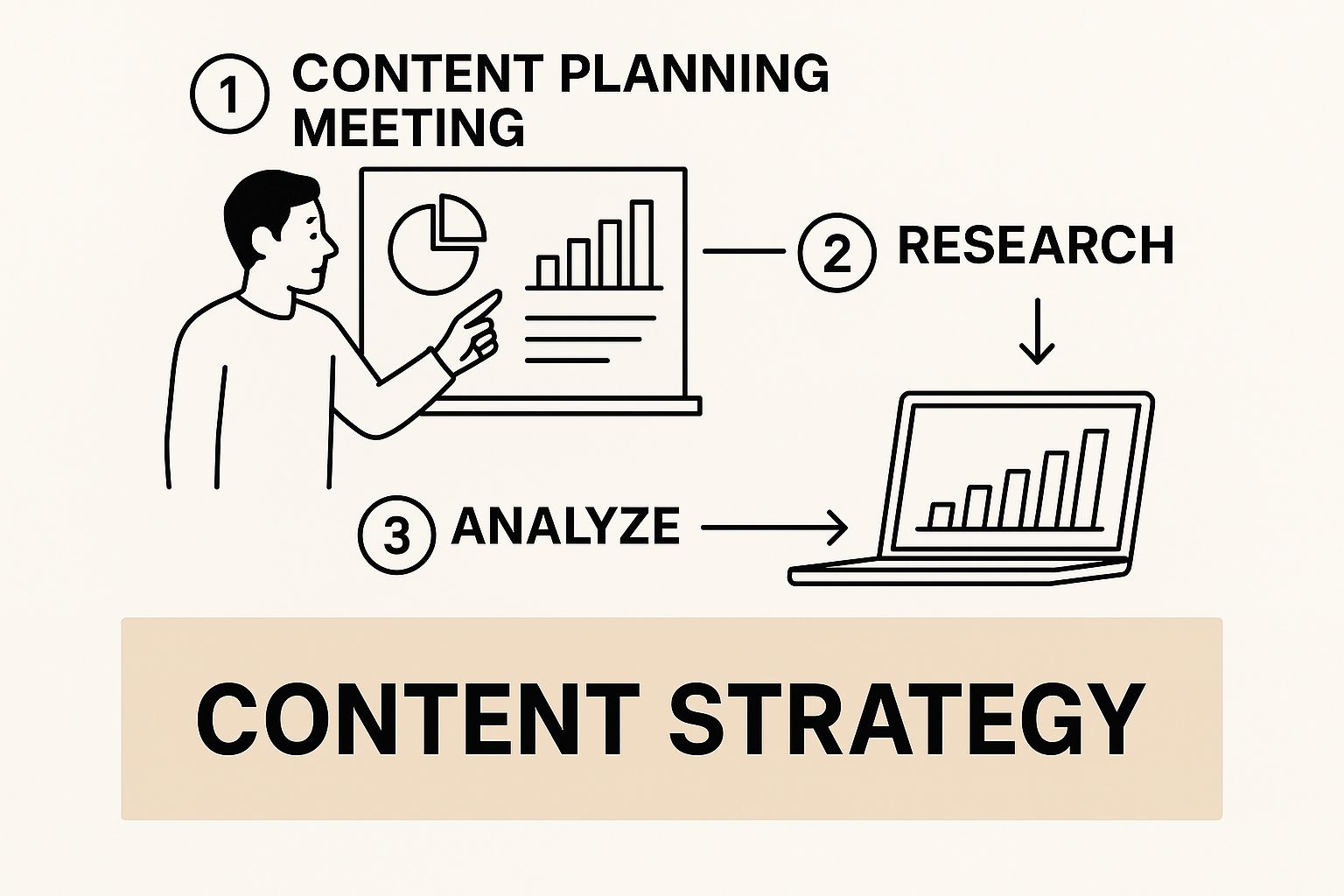
As you can see, a winning strategy starts by plugging data analysis directly into the planning phase. This grounds every idea in what your audience actually cares about and what your business needs to achieve.
Maximizing ROI Through Content Repurposing
A core principle of this performance-driven model is efficiency. You don’t need to reinvent the wheel for every new campaign. Smart marketers focus on creating one high-value “pillar” asset and then strategically slicing and dicing it across multiple channels.
Think of a comprehensive research report as the sun in your content solar system. This single, authoritative piece can be broken down into countless smaller assets that orbit around it, each one fine-tuned for a different platform and audience.
Here’s a quick example of what that could look like:
-
One Core Asset: A deep-dive industry report on “The Future of AI in Logistics.”
-
Blog Posts: Ten different articles, each digging into a key finding from the report.
-
Video Content: A short, animated video summarizing the report’s main takeaways for LinkedIn.
-
Social Snippets: Twenty shareable graphics pulling out compelling stats for Twitter and Instagram.
-
Webinar: A live Q&A with the report’s author to discuss the findings in more detail.
This method lets you dominate a topic from every angle, squeezing maximum reach and impact from a single investment of your time and resources. It also keeps your messaging consistent and reinforces your expertise across the entire buyer journey.
To make this even more effective, it’s crucial to align different types of content with where your prospect is in their buying process. Some formats are great for grabbing initial attention, while others are better suited for nurturing a lead who’s close to making a decision.
Here’s a table to help you map content formats to each stage:
Table: Mapping Content Formats to B2B Buyer Journey Stages
| Buyer Journey Stage | Primary Goal | Effective Content Formats |
|---|---|---|
| Awareness | Attract attention, educate on a problem or opportunity. | Blog Posts, Infographics, Social Media Content, Short Videos, Podcasts |
| Consideration | Provide in-depth solutions, build trust and credibility. | Case Studies, White Papers, Webinars, Ebooks, Comparison Guides |
| Decision | Validate the purchase decision, showcase your specific solution. | Product Demos, Free Trials, Customer Testimonials, ROI Calculators, Implementation Guides |
Using a map like this ensures you’re delivering the right message in the right format at the right time, guiding your prospects smoothly toward a sale.
Building a Scalable Content Machine
Building a scalable content machine is non-negotiable as the lines between marketing activities continue to blur. We’re seeing a massive shift where nearly all marketing in B2B is becoming performance marketing, judged by its direct impact on the bottom line. It’s predicted that by 2025, more than half of all large B2B transactions - we’re talking deals over $1 million - will happen through digital channels.
This trend underscores the urgent need for a content strategy that’s both measurable and tightly woven into your sales goals.
This data-first approach to content creation directly fuels the multi-channel outreach you need to succeed. The insights you gather don’t just inform your blog; they sharpen your video scripts, add depth to your syndicated articles, and make your audio content hit harder.
A performance-driven content strategy transforms your marketing from a cost center into a predictable revenue engine. It systemizes creativity, ensuring that every piece of content you produce has a clear purpose and a measurable path to generating qualified leads.
Ultimately, this methodical approach is what allows you to scale your efforts without quality taking a nosedive. By starting with data, you create a repeatable process for finding high-value topics, creating content that truly connects, and getting it in front of the right people. This is how you stop throwing “random acts of content” at the wall and start building a cohesive strategy that fills your pipeline.
Of course, a crucial part of this is knowing how to properly vet the leads your content brings in. You can explore our proven strategies for qualifying B2B leads to make sure your hard work translates directly into sales opportunities.
Measuring The B2B Marketing Metrics That Actually Matter

Let’s be honest. Marketing in B2B isn’t about collecting social media likes or bragging about website traffic. While those numbers might look good on a surface-level report, they don’t actually pay the bills.
If you want to prove your marketing team’s value and earn a seat at the leadership table, you have to track the metrics that connect directly to revenue. It’s time to move past the “vanity metrics” and focus on numbers that tell a clear story of business impact.
Top of Funnel Metrics: Going Beyond Raw Traffic
At the top of the funnel, the game is all about attracting the right audience. A million website visitors who aren’t your ideal customers are ultimately worthless. One hundred visitors who fit your customer profile perfectly? That’s where the magic begins.
Instead of just counting heads, you need to measure the quality of the traffic you’re bringing in. Think of these metrics as early indicators that you’re attracting potential buyers, not just random clicks.
Here are the key numbers to watch at this stage:
-
Traffic by Source: Where are your best people coming from? Is it organic search, a specific social channel, or referrals? Knowing this tells you where to double down on your efforts.
-
Keyword Rankings for High-Intent Terms: Are you showing up for searches that signal someone is actively looking for a solution? Ranking for “B2B CRM features” is infinitely more valuable than “what is CRM.”
-
Bounce Rate on Key Landing Pages: If people land on your page and immediately leave, it’s a huge red flag. A low bounce rate suggests your message is hitting the mark with the right audience.
Mid-Funnel Metrics: Tracking Real Intent
Once you’ve attracted a qualified audience, the real work starts. This is where you convert passive interest into tangible action. The middle of the funnel is where prospects effectively raise their hand and show they’re ready to learn more.
The middle of the funnel is the crucial bridge between marketing’s audience-building and sales’ deal-closing. Success here isn’t measured by how many people you reach, but by how many of the right people take a meaningful step forward.
This stage is all about tracking conversions that signal genuine buying intent. These are the leads your sales team will actually be excited to call.
Your focus should be on:
-
Marketing Qualified Leads (MQLs): This is the total count of leads that fit your predefined criteria - things like company size, industry, or specific actions like downloading a key case study.
-
Conversion Rate (Visitor-to-Lead): What percentage of your quality traffic is actually turning into leads? This number is a direct reflection of how compelling your offers and landing pages are.
-
Demo or Consultation Requests: This is one of the most powerful buying signals you can get. Tracking these requests is a crystal-clear indicator of pipeline generation.
A steady stream of high-quality MQLs is the absolute lifeblood of any B2B sales team. For a much deeper dive, check out our guide on how to generate B2B leads that actually convert into sales.
Bottom-Funnel Metrics: Proving Your ROI
This is where your marketing efforts hit the bottom line. Bottom-of-funnel metrics are the language your C-suite speaks - they translate all your hard work into dollars and cents. When you track these numbers effectively, you prove that your budget is a smart investment, not just an expense.
These are the metrics that show the true efficiency and profitability of your marketing in B2B.
-
Customer Acquisition Cost (CAC): Simply put, how much does it cost in marketing and sales spend to land one new customer? A consistently low CAC is a sign of a healthy, scalable business model.
-
Pipeline Velocity: How fast are leads moving from that first touchpoint to a closed deal? Speeding this up means you generate revenue faster. It’s a critical measure of efficiency.
-
Customer Lifetime Value (CLV): What’s the total revenue you can realistically expect from a single customer over their entire relationship with your company? When your CLV is way higher than your CAC, you’ve found the winning formula.
Putting It All Together: Your B2B Marketing Growth Plan
Alright, we’ve covered a lot of ground - from definitions to specific strategies. But theory is only half the battle. Real growth happens when you put a solid plan into action. This final section is your blueprint for doing just that.
This isn’t just a recap. It’s a practical guide to building and executing a modern B2B marketing plan that actually drives predictable revenue. The goal is to move beyond “random acts of marketing” and build a focused, cohesive strategy that establishes your brand as an authority. Think of this as the architectural drawing for the revenue engine you’re about to build.
First, Audit Your Current Strategy
Before you can map out where you’re going, you need an honest look at where you are right now. A quick audit helps you find what’s working (so you can do more of it) and what’s falling flat.
You don’t need to overcomplicate this. Just get your team together and ask some blunt questions to get a baseline:
-
Brand vs. Demand: Are our brand-building efforts and lead-gen activities working in tandem, or are they operating in separate silos?
-
Content Check-Up: Does our content actually answer our customers’ most pressing questions and rank for valuable keywords? Or are we just publishing stuff to fill a calendar?
-
Metrics That Matter: Are we obsessed with vanity metrics like website traffic, or are we tracking the numbers that directly impact revenue, like Customer Acquisition Cost (CAC) and pipeline velocity?
-
Channel Performance: Which channels are bringing in our best, highest-quality leads? And which ones are just sucking up time and budget with little to show for it?
This quick reality check gives you the context you need. It’s the “You Are Here” pin on the map that makes the rest of the journey possible.
Set Realistic Goals and Priorities
With your audit done, you can now set goals that actually mean something. Forget vague ambitions like “get more leads.” Get specific and measurable. For example, a much better goal is, “Increase MQLs from organic search by 25% in the next quarter by creating four new pillar pages.”
A great marketing plan doesn’t try to do everything at once. It forces you to make smart choices, prioritizing the initiatives that will have the biggest impact on your most important metrics. This focus is your competitive advantage.
Once you have your main objectives, break them down into a phased roadmap. This turns a big, intimidating strategy into manageable steps. For instance, your first phase might focus entirely on improving your outreach process to boost effective lead generation in B2B for business growth, while the next phase is all about building out your content engine.
A Phased Roadmap for Implementation
Here’s a simple framework for a phased rollout that you can tweak for your own business. It’s all about building momentum.
-
Phase 1 (The Foundation - Months 1-3): Focus on the quick wins and fixing the most obvious leaks. This is where you’ll refine your Ideal Customer Profile (ICP), optimize your best-performing landing pages for conversion, and set up accurate dashboards to track the right metrics.
-
Phase 2 (The Expansion - Months 4-6): Now it’s time to start scaling what you know works. This could mean ramping up content production, launching a small, targeted ABM pilot program, or carefully increasing your budget for paid ad campaigns that have proven their worth.
-
Phase 3 (Optimization & Scale - Months 7+): Double down on what’s working and start experimenting with new channels. Use the data from the first two phases to make smarter budget decisions and drive sustainable, long-term growth.
Following a structured approach like this turns your strategy from a static document into a living, breathing growth engine for your business.
Of course. Here is the rewritten section, formatted with a human touch and aligned with the provided style examples.
Your B2B Marketing Questions, Answered
Alright, let’s tackle some of the most common questions that come up when you’re in the trenches of B2B marketing. These are the things people wonder about but don’t always ask.
How Long Does This Stuff Actually Take to Work?
It’s the million-dollar question, isn’t it? The honest, no-fluff answer is: it depends. B2B isn’t like a B2C flash sale where you see results overnight. You’re building relationships and trust with multiple people in a company, and that just takes time. Think of it as playing chess, not checkers.
But “it depends” isn’t a strategy. A better way to look at it is through the lens of early signs versus bottom-line results.
You can - and should - start seeing early signs that things are moving in the right direction within the first 90 days.
-
Early Signs (Months 1-3): These are your smoke signals. Are more people from your target companies visiting your site? Are people actually engaging with your social posts? Are your cold email open rates climbing? These are the breadcrumbs telling you you’re on the right path.
-
Bottom-Line Results (Months 6-12+): This is where the rubber meets the road. It usually takes at least six months to see a real, predictable uptick in qualified demo requests, solid leads in your pipeline, and - most importantly - signed contracts.
It’s like planting a tree. You don’t get fruit in the first month, but you can see sprouts and healthy leaves. Those early metrics are your sprouts. Patience is a must, but it has to be paired with tracking the right early signs.
What’s the Single Biggest Mistake People Make in B2B Marketing?
Easy. It’s failing to truly understand the customer. So many companies get caught up talking about themselves - their product features, their company history, their fancy new office. The hard truth is, buyers don’t care about you. They care about their own problems.
This mistake shows up in a few ugly ways:
-
Inside-Out Messaging: Content that screams, “We do this!” and “Our product has that!” instead of showing the customer, “Here’s how you’ll solve your biggest headache.”
-
Spray and Pray: Blasting the same generic message to everyone. This is the opposite of segmenting your audience and personalizing your outreach based on their specific industry, job title, or challenges.
-
Jumping the Gun: Pushing for a demo on the very first touchpoint. You have to earn the right to ask for their time by providing value and building trust first.
The best B2B marketers I know are almost obsessive about their customer’s world. They understand their daily frustrations, they speak their language, and they even get the internal politics. Everything else is just a byproduct of that deep empathy.
To avoid this, just shift your entire mindset. Before you launch anything, ask yourself one simple question: “What specific problem does this solve for my ideal customer?” If you don’t have a crystal-clear answer, head back to the drawing board.
How Can a Small Business Compete When Budgets Are Tight?
It’s tough feeling like you’re bringing a knife to a gunfight when giants have million-dollar marketing budgets. But here’s the secret: a small budget forces you to be smarter, more focused, and way more creative. You can absolutely win by being more precise, not just louder.
Your biggest advantage is your agility. You can pivot on a dime and build genuine, one-on-one relationships while bigger companies are stuck in approval meetings.
Here are three ways to punch above your weight:
-
Own a Niche: Don’t try to boil the ocean. Instead of going after a huge industry, find a tiny sub-niche and become the undisputed, go-to expert there. Your content will hit so much harder because it’s hyper-relevant.
-
Go All-In on Organic: Your time is your biggest asset, so invest it in SEO and content that solves real problems. A genuinely helpful blog post or guide is an asset that works for you 24/7, generating leads for free long after you’ve written it.
-
Get Hyper-Personal: You can’t out-spend them on ads, but you can out-care them. Take the time to deeply research a small list of dream clients. Craft outreach so personal and insightful it’s impossible to ignore. That’s something massive companies simply can’t do at scale.
For a small business, marketing in b2b is about surgical precision, not brute force. Use your size as a weapon to build the kind of authentic connections big players can only dream of.
Ready to scale your pipeline without the upfront costs? Fypion Marketing specializes in performance-driven cold email outreach, where you only pay for qualified meetings. We handle the research, targeting, and execution so you can focus on closing deals. Book a free consultation today and see how we can build your revenue engine.