
Your Guide to Pay Per Lead B2B Marketing
Think about your typical marketing campaigns for a moment. You pour money into ads, content, and team hours, all while crossing your fingers that the right kind of leads will eventually roll in. The risk? It’s all on your shoulders.
A pay-per-lead B2B model completely flips that script.
What Is Pay Per Lead B2B Marketing?

Imagine working with a specialized marketing partner but only paying them when they hand you a prospect who actually meets your criteria. That’s pay-per-lead, or PPL, in a nutshell.
It’s a straightforward performance-based model where you pay a fixed price for each qualified prospect a partner delivers. This approach makes your costs predictable and directly links your marketing budget to tangible results. The financial risk of the campaign - the “what if it doesn’t work?” - shifts from your company to your lead generation partner.
Suddenly, their success is directly tied to yours. That creates one powerful incentive for them to deliver high-quality, relevant contacts your sales team will actually want to talk to.
Defining a “Qualified Lead”
This entire model lives or dies on one thing: a crystal-clear, shared understanding of what makes a lead “qualified.” Without a precise definition, you’ll end up paying for contacts who have zero chance of ever becoming a customer.
This is where you need to get specific. Generally, leads fall into two buckets:
-
Marketing Qualified Leads (MQLs): These are folks who’ve shown some interest, maybe by downloading an eBook or joining a webinar. They’re on the radar but aren’t ready for a sales call just yet.
-
Sales Qualified Leads (SQLs): These are the real deal. They’ve been vetted, show clear buying intent, and match specific criteria like company size, industry, or job title.
In a solid PPL deal, you’re almost always paying for SQLs - the prospects who are truly ready for your sales team to engage.
The Verification Process
So, how do you make sure you’re getting what you pay for? Everything is governed by a Service Level Agreement (SLA). Think of this document as the rulebook for your partnership. It spells out, in no uncertain terms, the exact criteria a lead has to meet to be considered valid and payable.
A strong SLA is your quality control. It clearly defines disqualification rules - like leads from competitor companies or outside your target country - and gives your team a set window to review, accept, or reject each lead.
This verification process isn’t just about rejecting bad leads; it creates a transparent feedback loop. When you explain why a lead was rejected, you’re actively helping your partner sharpen their targeting. This collaboration is what improves the quality of every lead you get over time.
For a deeper dive into building a pipeline that lasts, our guide on **lead generation for B2B** can help you put these strategies into practice. Ultimately, this structure makes PPL a highly predictable and scalable way to fuel your growth without the financial gamble of traditional campaigns.
Decoding the Real Cost of B2B Leads

When you start looking into a pay per lead b2b model, the first thing everyone wants to know is the cost. Why is one agency quoting $50 a lead while another says it’ll be $500? The answer isn’t just about finding the “cheapest” price tag. It’s about understanding what you’re actually paying for.
Think of it like buying a car. A basic sedan gets you from A to B, and so does a high-performance sports car. But their prices are worlds apart because of the engineering, power, and experience they deliver. The same logic applies directly to B2B leads. The price reflects the real-world effort and precision needed to find and engage that specific prospect.
A lead for a common, low-cost software is going to be far less expensive than a lead for a highly specialized enterprise solution. That second one requires laser-focused targeting and a seriously compelling message to even get a senior decision-maker to nod their head.
Factors That Shape Lead Pricing
Several key variables are always at play, directly influencing the Cost Per Lead (CPL). If you don’t get a handle on these, you’re flying blind when setting a budget or comparing proposals. You have to look past the sticker price and see the mechanics underneath.
The biggest drivers of what you’ll pay are:
-
Industry Complexity: Trying to get leads in technical or highly regulated fields like manufacturing or finance? That requires a ton more specialized knowledge and careful outreach.
-
Target Seniority: It’s a whole lot harder - and therefore more expensive - to get on the calendar of a C-level executive than a junior manager.
-
Company Size: Big corporations have complicated buying committees and are just plain tougher to crack, which naturally pushes the cost up.
-
Geographic Targeting: If you’re targeting a specific, high-demand city or region, you’re competing with more people for the same attention, which increases the price.
All these pieces come together to create a unique cost profile for your campaign.
The Real Numbers Behind B2B Leads
The data doesn’t lie about how much these factors matter. For instance, companies with over 1,000 employees pay a much higher average CPL of $349, while smaller businesses might pay around $47. It’s the same story with revenue - companies earning over $500 million see an average lead cost of $429.
The price also swings wildly between industries. Manufacturing leads, for example, average $553. That number reflects the intense competition and highly specific targeting needed to succeed in that space.
The goal isn’t to find the cheapest lead. The goal is to identify the most profitable one. A $500 lead that closes is infinitely more valuable than ten $50 leads that go nowhere.
This shift in thinking is critical. The true cost of any lead has to be measured against its potential lifetime value (LTV). Smart outreach, like the kind we break down in our **7 B2B cold email templates**, is all about attracting prospects with high LTV potential. That’s what justifies a higher upfront CPL.
Ultimately, a winning pay-per-lead strategy is focused on delivering a strong return on your investment, not just finding the lowest initial cost.
PPL vs. Retainer vs. In-House: A Comparison
Picking the right engine to power your B2B lead generation is a huge decision, one that will stick with you for the long haul. Your choice really boils down to three main models: the performance-driven pay-per-lead (PPL) model, the steady partnership of an agency retainer, or the total control of an in-house team. Each path offers a completely different mix of risk, cost, and the amount of hands-on management you’ll need to provide.
Let’s break it down with an analogy. PPL is like hiring a skilled freelancer for a finished project - you pay when you get what you asked for. A retainer is like hiring a general contractor for ongoing work; you’re paying for their time and expertise, whether or not a specific task is completed that month. Going in-house? That’s like building your own workshop from the ground up. You own everything, but you also carry all the costs and headaches.
The Cost Predictability Spectrum
The biggest fork in the road between these models is how you handle your budget.
With a pay-per-lead setup, your costs are tied directly to results. It’s simple. You pay a set price for every single lead that meets your quality standards, making your spending 100% predictable. If your sales team needs 20 qualified leads this month, you know exactly what that will cost before you even start. No surprises.
An agency retainer, on the other hand, runs on a fixed monthly fee. This fee covers the agency’s brainpower, strategy, and legwork, but it isn’t directly connected to a specific number of leads delivered. You’re paying for the team and their effort, which can provide great strategic value but offers less direct accountability on a cost-per-result basis.
Building an in-house team is the most expensive route, both upfront and over time. You’re on the hook for everything: salaries, benefits, software licenses, ongoing training, and all the little operational costs that pop up. While this gives you ultimate control, it also packs the biggest financial punch and has the least predictable return on investment in the short term.
Analyzing The Real-World Cost Per Lead
No matter which model you choose, the channel used to actually find the leads will dramatically impact your final cost. It’s not just about the payment structure; it’s about where the leads are coming from.
Take a look at this breakdown of average B2B lead costs across some of the most common channels.
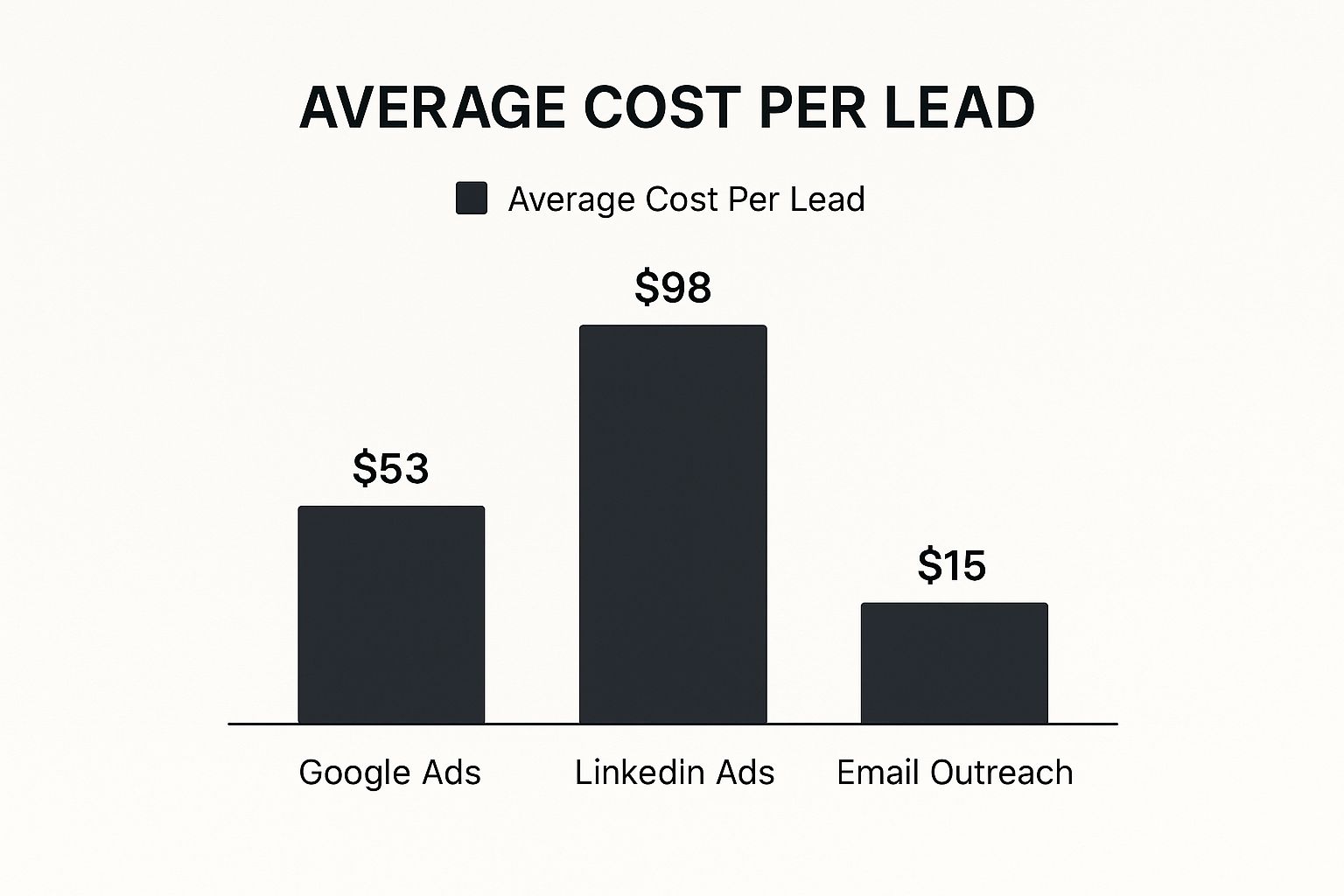
As you can see, the numbers are all over the place. This just goes to show how critical it is to pick a model that truly aligns with your company’s financial strategy and how much risk you’re comfortable taking on.
Comparing Lead Generation Models: PPL vs Retainer vs In-House
To make this even clearer, let’s put these three models head-to-head. Each has its own strengths and weaknesses depending on what you’re trying to achieve, your budget, and how fast you need to move.
| Factor | Pay Per Lead (PPL) | Agency Retainer | In-House PPC |
|---|---|---|---|
| Cost Structure | Pay for verified results only. Highly predictable. | Fixed monthly fee for time and expertise. | High overhead (salaries, tools, benefits). |
| Risk Profile | Low. No results, no cost. | Medium. Pay fee regardless of performance. | High. Major upfront and ongoing investment. |
| Scalability | High. Easy to scale up or down on demand. | Medium. Scaling requires contract renegotiation. | Low. Scaling is slow and very expensive. |
| Control | Medium. Define lead criteria but cede process control. | Medium. Collaborate on strategy, but agency executes. | High. Full control over strategy, team, and tools. |
| Speed to Results | Fast. Can start delivering leads quickly. | Medium. Requires ramp-up and strategy time. | Slow. Requires hiring, training, and setup. |
Ultimately, there’s no single “best” answer - only the best fit for your business right now. A startup might find the low risk and fast results of PPL perfect, while a large enterprise might have the resources to build a powerhouse in-house team. The retainer model often sits in the middle, offering dedicated expertise for companies ready to invest in a long-term strategic partnership.
Risk and Scalability Trade-Offs
Let’s dig a bit deeper into risk. The pay-per-lead model is about as low-risk as it gets in marketing. You only open your wallet for real, verified results that meet the criteria you set from day one. This makes it incredibly flexible - you can crank up the volume when your sales team is hungry or dial it back during a slow quarter.
A retainer model carries more of a calculated risk. You’re locked into a contract, and if a campaign doesn’t hit the mark, you’ve still paid that monthly fee. Scaling up or down usually means sitting back down at the negotiating table to rework the entire agreement.
The in-house approach? That’s where the risk is highest. Hiring, training, and equipping a team is a slow and costly marathon with no guarantee of a finish line. Of course, a successful in-house team can deliver incredible results and be perfectly aligned with your company culture, but getting there is a major undertaking.
Industry benchmarks really drive this point home. The average cost per lead (CPL) in the B2B tech space hovers around $208, while in financial services, it can easily top $160 per lead. This huge variance shows why it’s absolutely critical to connect your lead costs to your potential revenue - a crucial step we dive into in our guide on how to qualify B2B leads.
For a wider view, you can see how these costs stack up across different industries in these comprehensive lead generation statistics.
So, what’s the bottom line? The best choice really depends on your company’s stage and immediate goals. For businesses that need predictable pipeline growth without a massive upfront gamble, a PPL model offers a lean, efficient, and purely results-driven path forward.
Building Your First Pay Per Lead Campaign

Alright, let’s move from theory to action. This is where a pay per lead B2B strategy really comes alive. Getting your first campaign off the ground isn’t about just flipping a switch and hoping for the best. It’s about methodically building a well-oiled machine with a clear playbook.
Think of it like building a house. If you skip the blueprint and just start nailing boards together, you’re going to end up with a wobbly, expensive mess. Nailing down the fundamentals from the get-go saves you a ton of time, budget, and headaches down the road.
Define Your Ideal Customer Profile
Before you even think about buying a single lead, you have to know exactly who you’re looking for. This is where your Ideal Customer Profile (ICP) comes in. Your ICP isn’t a suggestion; it’s a non-negotiable checklist of traits a lead must have to even be considered qualified.
You need to get granular here. Seriously. Think about:
-
Company Size: Are you targeting startups or enterprises? Specify the number of employees or annual revenue.
-
Industry: Which specific sectors feel the most pain that your product solves?
-
Geography: Where can you actually sell? Be specific about countries, states, or even regions.
-
Job Titles: Who are the real decision-makers and influencers your sales team needs to talk to?
Your ICP is the heart of your agreement with any PPL partner. A vague definition like “we want tech companies” will get you garbage leads. A sharp definition like “SaaS companies in North America with 50-250 employees” will deliver real value.
Establish a Rock-Solid Service Level Agreement
Your Service Level Agreement (SLA) is the official rulebook for the campaign. It’s where you formalize your ICP and lay out all the terms of engagement. This simple document is your best friend for preventing disputes and making sure everyone is on the same page about what a “good lead” actually is.
An effective SLA is your primary quality control lever. It should explicitly list the criteria for an accepted lead and, just as importantly, the specific reasons for rejecting one (e.g., out of territory, wrong job title, is a competitor).
A strong SLA also needs to define a lead review window - usually 24 to 48 hours. This gives your team enough time to vet each lead while it’s still hot. Finding the right partner who gets this is key, and our list of the **top B2B lead generation companies** is a great place to start your search.
Set Up Your Follow-Up Process and Feedback Loop
Getting the lead is only half the battle. Your ROI is determined by what happens next. A lead’s value decays shockingly fast, so an immediate and persistent follow-up process isn’t just nice to have - it’s absolutely critical. Your sales team needs to be prepped and ready to jump on every single qualified lead the moment it hits their inbox.
At the same time, you have to create a tight feedback loop with your lead provider. Don’t just reject a bad lead in your system and move on. Tell your partner why it was a bad fit. This constant stream of communication helps them fine-tune their targeting on their end. Over time, this makes your entire pay per lead B2B campaign more efficient, more profitable, and a whole lot less frustrating.
How to Choose the Right PPL Partner
Your pay-per-lead campaign is only as good as the partner running it. Let’s be clear: choosing the right one isn’t about pinching pennies or finding the absolute lowest cost. It’s about finding a true partner who lives and breathes your specific corner of the market. Going with a generic, one-size-fits-all provider is a surefire recipe for wasted time and a pile of useless leads.
Industry specialization is completely non-negotiable. Think about it. A partner with a proven track record in your vertical - whether you’re in SaaS, manufacturing, or professional services - already gets it. They know the lingo, the pain points, and the buyer personas. You won’t have to waste your time teaching them the basics of your own industry.
Evaluate Their Lead Generation Methods
Next, you need to pop the hood and see how they actually get their leads. Transparency here is a massive green flag. A quality partner will have zero problems walking you through their exact methods, whether that’s cold email outreach, content syndication, or hyper-targeted ads.
This step is critical for protecting your brand. You have to make sure their approach aligns with your company’s values. The last thing you want is a partner using spammy or overly aggressive tactics that could tarnish your hard-earned reputation. Ask them directly about their process and what quality control they have in place.
A partner’s hesitation to discuss their methods is a major red flag. True partners are confident in their process and welcome scrutiny because they know it builds trust and sets the stage for a successful campaign.
Their answers will tell you everything about their level of sophistication. For instance, a great partner will talk about how they refine targeting based on feedback and how they verify contact info to ensure accuracy. This is worlds away from a vendor who just buys and resells stale, static lists.
Vet Their Track Record and Results
Finally, it’s time to do some digging into their past performance. Don’t just skim the testimonials on their homepage. Look for detailed case studies that lay out concrete results for businesses like yours. A good case study will break down the client’s initial problem, the strategy the partner implemented, and - most importantly - the real, measurable outcomes.
It’s also smart to get a feel for industry benchmarks. The reality is, B2B lead quality varies wildly across different sectors. For example, professional services like law and marketing see some of the highest conversion rates at 4.6%, while B2B e-commerce is a bit tougher at 1.8%. Knowing this helps you set realistic expectations with any potential partner. You can get a deeper look at lead generation benchmarks to see how industries compare.
When you’re talking to a potential partner, ask them specifically about the quality of the leads they provide. Are they MQLs or are they true SQLs? For a refresher on the difference, you can check out our complete guide to Sales Qualified Leads. At the end of the day, a partner who delivers real, tangible sales opportunities is the only one worth your investment.
Answering Your Pay Per Lead B2B Questions
Even after getting the hang of the pay per lead B2B model, it’s totally normal to have some questions pop up. I see it all the time. Concerns about cost, lead quality, and whether it’s the right fit for your specific business are part of the process. So, let’s tackle the most common ones I hear.
Think of this as the final walk-through before you kick things off. You’ve seen the blueprint, you know the basics - now it’s time to handle those practical “what if” scenarios that can make or break your campaign. Getting these answers straight ensures you’re not just buying names on a list, but actually investing in a reliable growth engine.
What Is a Realistic Price for a Quality B2B Lead?
There’s no single price tag for a B2B lead. It just doesn’t work that way. The cost really comes down to how hard it is to track down and connect with your ideal customer. As we’ve touched on, a lead for a niche manufacturing solution might run you over $500, while a lead for more common B2B software could be closer to $200.
A “realistic” price isn’t about finding the absolute cheapest option. It’s about finding a price that gives you a profitable Cost Per Acquisition (CPA) when you weigh it against your Customer Lifetime Value (LTV).
The biggest mindset shift you have to make is moving from “what’s the cheapest CPL?” to “what CPL gets me leads who actually close?” A cheap lead that goes nowhere is infinitely more expensive than a premium one that turns into a high-value, long-term client.
The best approach is to work backward from your own numbers. Figure out your target CPA first, then find a partner who can deliver qualified prospects within that budget. This grounds your pay per lead B2B strategy in real profitability, not just superficial cost-cutting.
How Do I Ensure the Leads I Buy Are Actually Good?
Quality control is the absolute backbone of a solid PPL campaign. This is all managed through a detailed Service Level Agreement (SLA). Your SLA is where you take your Ideal Customer Profile (ICP) and turn it into a set of non-negotiable rules.
This document has to be crystal clear about what makes a lead qualified. Get specific with criteria like:
-
Firmographics: Industry, company size, annual revenue, and geographic location.
-
Demographics: The exact job titles or seniority levels you need to reach.
-
Disqualification Rules: Be explicit about what you don’t want. This could be contacts from competitor companies, students, or leads outside your sales territory.
But the SLA is only half the battle. Your internal process is just as important. You need a system to review leads quickly, ideally providing feedback within 24-48 hours. This creates a tight feedback loop with your provider, allowing them to adjust their targeting on the fly and improve the quality of every lead that follows.
Is PPL a Good Strategy for a Startup on a Tight Budget?
Yes, absolutely. A PPL model can be a game-changer for startups. The main advantage is predictable, outcome-based spending, which is a lifesaver when you’re managing tight cash flow. Unlike a retainer that locks you into a fixed monthly payment no matter the results, PPL means you only open your wallet for a tangible outcome - a qualified lead.
This structure slashes your financial risk. It lets you test the waters, generate real sales opportunities, and build pipeline momentum without the heavy cost of hiring a full-time marketing team or getting locked into a long-term agency contract.
The trick is to find a PPL partner who is cool with starting at smaller volumes and to make sure your sales process is ready to jump on those leads the second they come in. That kind of efficiency makes every single dollar you spend on a pay per lead B2B campaign count.
What Are the Biggest Mistakes to Avoid in a PPL Campaign?
While PPL is a fantastic model, a few common slip-ups can sink a campaign before it ever gets going. Sidestepping these classic mistakes is crucial if you want to see a positive return.
Here are the top mistakes I see businesses make:
-
A Vague Lead Definition: This is the #1 campaign killer. If your ICP is fuzzy, you’ll get poor-quality leads, end up in disputes with your partner, and burn out your sales team.
-
A Slow Follow-Up Process: Leads have a ridiculously short shelf life. If your sales team isn’t ready to engage with a new lead within hours, its chance of converting plummets.
-
Choosing a Partner on Price Alone: Picking a vendor just because they have the lowest CPL is a classic false economy. You almost always end up with junk leads from questionable sources that frustrate your sales team and can even hurt your brand.
Always prioritize clear agreements, sales team readiness, and a partner’s proven track record over chasing the lowest price.
Ready to grow your pipeline without the risk of retainers or upfront fees? At Fypion Marketing, we specialize in performance-based lead generation. You only pay for qualified meetings that show up on your calendar. Learn more and book your free consultation today.