
B2B Marketing Funnel: A Guide to Predictable Revenue
A lot of teams are doing marketing without really running a funnel.
They publish blog posts, launch LinkedIn ads, send nurture emails, sponsor a webinar, and maybe test outbound on the side. Activity looks healthy. The CRM looks busy. But when leadership asks a simple question like “How many qualified meetings should this generate next month?” the answer gets vague fast.
That’s usually the core issue. Not a lack of tactics. A lack of flow.
In B2B, growth doesn’t come from isolated campaigns. It comes from a system that turns attention into qualified conversations, then turns those conversations into pipeline and closed revenue. If your model depends on booked meetings, the funnel matters even more. Every stage has to do real work. Every handoff has to be defined. Every channel has to earn its place.
Why Your B2B Marketing Funnel Is More Than Just a Model
The b2b marketing funnel gets treated like a slide in a deck. Awareness at the top, consideration in the middle, decision at the bottom. Nice visual. Not very useful on its own.
In practice, the funnel is an operating system for revenue. It tells marketing what kind of demand to create, tells sales which leads deserve fast action, and tells leadership where pipeline is leaking. Without that structure, teams confuse motion with progress.
B2B buying is harder than most internal planning assumes. The average buying committee has grown to 11 members in 2024, and some buying groups reach 20 buyers or more, while the average B2B sales cycle has increased by 22% in the past five years according to HubSpot’s B2B marketing funnel analysis. That changes everything about how a funnel has to work. You’re not persuading one person in one moment. You’re helping a group reach confidence over time.
What the funnel actually does
A working funnel does four practical things:
-
Creates shared definitions so marketing, SDRs, and account executives aren’t arguing about what “qualified” means.
-
Controls timing so good leads don’t sit untouched while buyer interest cools.
-
Shapes messaging for different stakeholders, not just one champion.
-
Improves forecasting because conversion rates become visible stage by stage.
Practical rule: If your team can’t explain why leads stall between stages, you don’t have a funnel. You have a traffic report.
Many B2B teams get stuck, building campaigns for clicks, content for traffic, and outbound for replies. But revenue comes from coordinated movement, not isolated metrics.
Why this matters in a pay-per-meeting model
If you only get paid when qualified meetings happen, weak funnel design gets exposed quickly.
A meeting that isn’t tied to the right account, buying context, urgency, or stakeholder fit doesn’t help sales. It just creates calendar noise. That’s why the funnel can’t stop at lead capture. It has to govern qualification, outreach timing, routing, and what happens after the first response.
The teams that treat the funnel as a revenue engine usually make better decisions. They know which channels support awareness versus intent. They know when outbound should educate versus convert. They know a booked meeting is not the finish line unless it enters the pipeline with real buying potential.
Mapping the Buyer Journey Through Four Funnel Stages
Buyers don’t move through the b2b marketing funnel because your campaign calendar says they should. They move when internal urgency, budget logic, risk tolerance, and vendor confidence finally line up.
A useful way to think about the journey is to picture a company planning a major infrastructure upgrade. No one approves that project because they saw one ad. The operations lead spots a problem. Finance wants cost clarity. IT cares about implementation risk. Leadership wants confidence that the vendor won’t create disruption. The funnel has to support all of those questions in sequence.
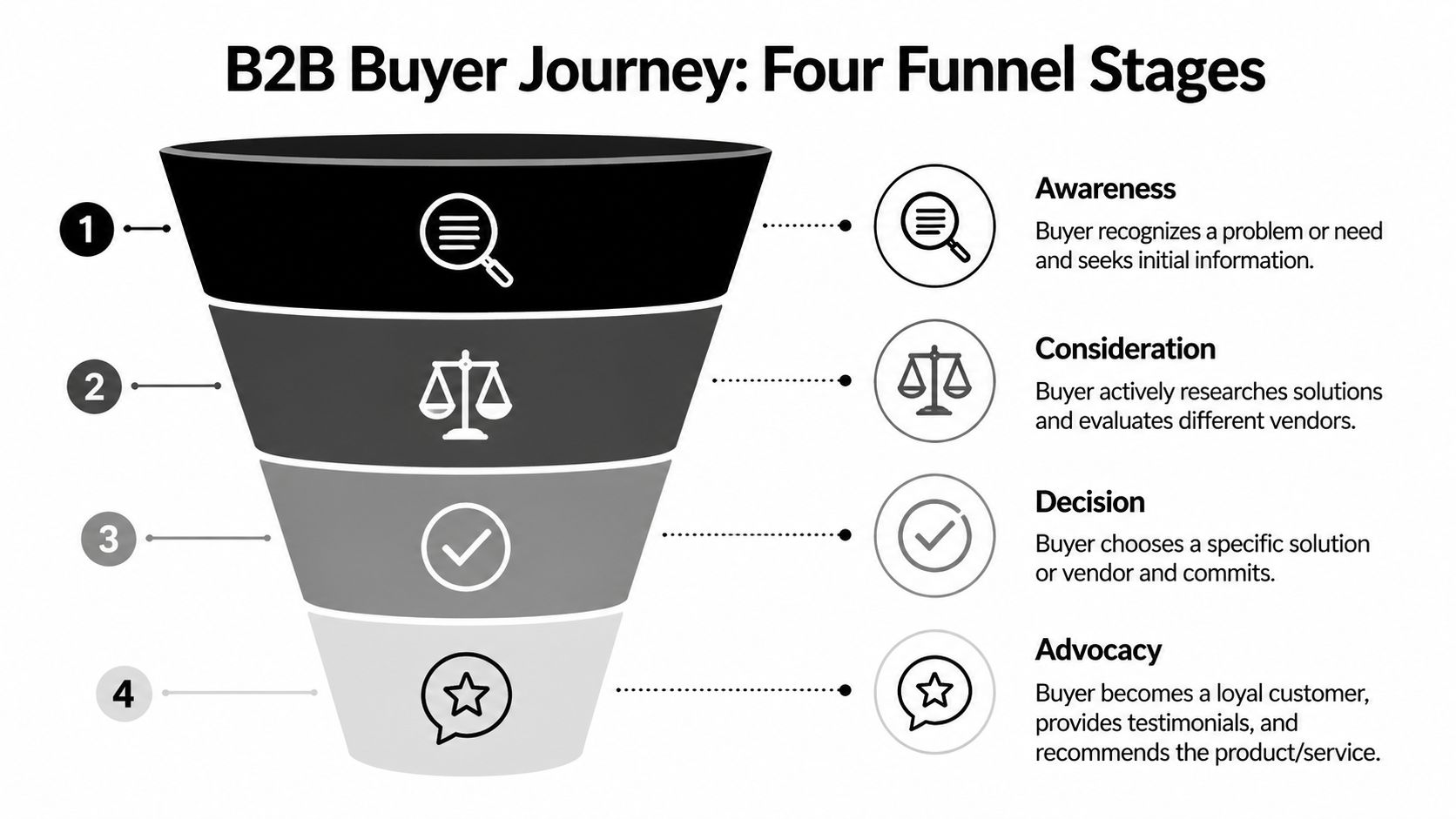
Awareness
At the top of the funnel, the buyer usually isn’t looking for your company specifically. They’re trying to understand a problem, frame it correctly, and decide whether it deserves attention now.
That means your job isn’t to push for a demo too early. It’s to help the buyer name the issue in business terms. Good awareness content creates clarity. Weak awareness content chases clicks and says nothing memorable.
Typical awareness questions sound like this:
-
What’s causing this problem
-
How serious is it
-
Is this common in companies like ours
-
What happens if we keep ignoring it
Journey mapping becomes useful, especially if your team struggles to connect campaigns to actual buyer behavior. A practical way to identify pain points with journey mapping is to map the questions, objections, and actions buyers take before they ever fill out a form.
Consideration
Once the problem is accepted internally, buyers start comparing approaches.
Now they want detail. They’re evaluating categories, vendors, implementation paths, and internal trade-offs. A buyer in this stage doesn’t need broad thought leadership alone. They need evidence that your approach fits their context.
That changes what marketing should produce. Instead of general education, this stage needs sharper assets:
-
Comparison pages that explain when your solution fits and when it doesn’t
-
Use-case content tied to roles, industries, or operational pain
-
Webinars and deeper guides that answer technical and strategic questions
-
Outbound messaging that references the buyer’s situation with enough specificity to earn a reply
A lot of demand generation work lives here. If your team wants a stronger bridge between market education and pipeline creation, this guide on what demand generation marketing is and how it fuels B2B growth is a useful companion.
Buyers in consideration are not asking, “Who has the loudest message?” They’re asking, “Who understands our risk?”
Decision
At this point, many funnel diagrams get too simplistic.
In B2B, the decision stage isn’t one final yes. It’s a series of internal approvals. The champion may already prefer your solution, but procurement, leadership, finance, and implementation stakeholders still need answers. The funnel narrows here because the burden of proof rises.
A strong decision-stage experience usually includes:
| Buyer concern | What your funnel should provide |
|---|---|
| Commercial fit | Clear pricing logic, packaging, and buying steps |
| Operational risk | Implementation detail, onboarding expectations, support process |
| Internal confidence | Customer proof, stakeholder-specific messaging, objection handling |
| Purchase readiness | Fast access to demos, follow-up, and next-step clarity |
If you’re still sending generic nurture emails at this stage, you’re slowing deals down.
Advocacy
The fourth stage is often called retention. In practice, advocacy is the more useful lens because it turns customer success into pipeline support.
A customer who renews seamlessly is valuable. A customer who shares proof, joins a case study, refers peers, or brings in another team amplifies impact throughout the funnel. In B2B, credibility compounds through real user experience.
That’s why the funnel shouldn’t stop at signed contract status. It should keep working after the deal by collecting feedback, surfacing wins, and giving satisfied customers simple ways to speak on your behalf.
Bridging the Gap Between Marketing and Sales Handoffs
A lot of pipeline disappears at the exact moment teams assume the hard part is over.
Marketing generates interest. A prospect downloads something useful, replies to outbound, or requests more information. Everyone marks it as progress. Then the lead sits in a queue, gets routed without context, or reaches a rep who doesn’t know why the person engaged in the first place.
That’s the handoff problem. And in most B2B funnels, it’s where revenue slips through your fingers.

According to Leadfeeder’s analysis of the B2B marketing funnel, the MQL-to-SQL transition is the primary leakage point, where misalignment on qualification or handoff delays can cause up to 80-90% of qualified interest to dissipate before sales engagement. The same analysis notes that improving this stage by just 5 percentage points can yield up to 18% total revenue uplift. That’s why handoff design deserves as much attention as demand generation.
Treat qualification like a relay exchange
The terms MQL, SQL, and SAL only matter if they reflect operational reality.
Here’s the cleanest way to use them:
-
MQL means marketing has enough evidence that the account or contact fits your targeting and has shown meaningful interest.
-
SAL means sales has reviewed the lead and accepted it for active follow-up.
-
SQL means a salesperson has confirmed that a real sales conversation is justified.
The common mistake is pushing names into SQL status too early. That makes reporting look healthier than it is, but it pollutes the pipeline and erodes trust between teams.
A better model is to define each stage around observable behavior and next actions, not internal optimism.
What a real handoff agreement includes
Most companies say they want alignment. Fewer document it.
A workable service level agreement between marketing and sales should answer five things clearly:
-
What counts as qualified Use both firmographic and behavioral criteria. Firmographics tell you whether the account fits. Behavior tells you whether timing may be real.
-
Who owns first response Assign this to a person or role, not a generic queue.
-
How fast follow-up happens If speed matters in your market, codify it. Don’t leave it to rep preference.
-
What context gets passed The rep should know the source, the message that triggered engagement, the content consumed, and any relevant account notes.
-
What happens to rejected leads If sales declines a lead, define whether it goes back into nurture, outbound recycling, or suppression.
Field note: A lead doesn’t become better because it was handed to sales. It becomes better when the handoff preserves context and triggers the right next move.
Lead scoring only works when both teams trust it
Marketing teams often overbuild scoring models. Sales teams often ignore them. Both reactions make sense.
A practical scoring system should stay simple enough that reps believe it. For example, account fit, role relevance, and recent engagement should carry more weight than vanity actions. Visiting a career page means less than replying to a cold email with a problem statement. Downloading a broad guide means less than requesting pricing context.
If your SDR or AE can’t look at the score and understand why the lead reached them, the model needs work.
A sales development structure also matters here. If your organization is refining role boundaries, this breakdown of what a sales development representative does is useful because it clarifies where qualification should sit before an account executive takes over.
Don’t let disqualified leads vanish
Some of the best future opportunities get marked unqualified too quickly.
Not every rejected lead is a bad lead. Some are early. Some lack urgency. Some need a different stakeholder involved. If your team sends these contacts into silence, you force future demand creation to start from zero again.
Build a return path:
-
Too early goes into a nurture path tied to the original pain point
-
Wrong contact triggers stakeholder expansion within the same account
-
No current priority gets a lighter-touch follow-up cadence
-
Poor fit gets suppressed so the team stops wasting effort
That process looks operational, but it’s strategic. It protects pipeline quality without throwing away market interest.
Aligning Marketing Channels to Each Funnel Stage
Channel strategy gets expensive when teams ask the wrong question.
They ask, “Which channel works best?” The better question is, “Which channel fits this stage, this account type, and this meeting objective?” A b2b marketing funnel only performs when channels play different roles on purpose.
That matters because conversion by source varies sharply. Based on Spotio’s B2B sales funnel benchmarks, referrals convert to opportunity at 10.99%, partner channels at 4.54%, inbound at 3.82%, and paid marketing at 2.98%. By contrast, email prospecting converts at 0.55% and sales prospecting at 0.90%. That doesn’t mean outbound is broken. It means outbound has to be precise, well-timed, and integrated into the rest of the funnel instead of being treated as a volume play.

Top of funnel channels should create recognition
Awareness channels are there to make the right buyers familiar with your problem framing before direct outreach begins.
That usually includes:
-
SEO content around category problems, operational bottlenecks, and market shifts
-
LinkedIn thought leadership from founders, operators, or subject matter experts
-
Podcasts, newsletters, and guest content where your buyers already spend attention
-
Ungated educational assets that lower friction and widen reach
The mistake here is demanding immediate attribution from every awareness effort. Some of the value shows up later when outbound lands in a warmer environment and buyers recognize your angle.
This is especially important in markets where several vendors sound interchangeable. If your awareness content doesn’t create a distinct point of view, your outbound has to work much harder.
Middle funnel channels should reduce uncertainty
Consideration is where channel mix should get narrower and more account-aware.
Buyers in this stage need help evaluating options. That’s where richer assets and targeted touches matter most:
| Funnel stage | Useful channels | What they should accomplish |
|---|---|---|
| Awareness | SEO, social, thought leadership, ungated content | Build familiarity and define the problem |
| Consideration | Webinars, comparison content, email nurture, targeted cold email | Help buyers evaluate approaches and engage the right stakeholders |
| Decision | Demos, tailored follow-up, objection-handling content, sales enablement emails | Remove friction and support internal approval |
| Advocacy | Customer marketing, review requests, referral motions, success communications | Turn delivery into proof and expansion |
Cold email belongs in the middle of this table for a reason.
A lot of teams still use cold email like a blunt top-of-funnel instrument. Big list. generic pitch. repeated follow-ups. That model creates noise. In a pay-per-meeting setup, cold email works better as a strategic channel for accounts already showing likely fit and contextual relevance.
That means cold email should do more than “introduce the company.” It should:
-
Reference a specific operational pain
-
Match the message to the stakeholder’s role
-
Support consideration by clarifying why a meeting is worth taking
-
Multi-thread into an account when one contact isn’t enough
-
Hand responses into a clear booking and qualification process
Cold email is strongest when it enters a buying conversation already in progress, even if that conversation is still informal and mostly internal.
One specialized option that applies here involves Fypion Marketing running cold email for B2B teams on a pay-per-meeting basis, which aligns the outreach channel directly to meeting quality rather than lead volume. That model only works if the campaign is tied to qualification rules and sales readiness, not just reply generation.
Bottom funnel channels should help sales close, not restart education
Once buyers are near a decision, the wrong channel behavior can slow everything down.
This isn’t the stage for broad nurture. It’s the stage for removing friction. Reps need assets that support live deals:
-
Follow-up emails after demos that summarize value and next steps
-
Procurement-friendly materials that reduce internal back-and-forth
-
Role-specific proof for finance, operations, and technical reviewers
-
Meeting recaps and mutual action plans that keep momentum visible
Bottom-funnel channel strategy is mostly about precision. One relevant follow-up often does more than a full sequence of generic automation.
Building a Dashboard to Measure Funnel Performance
If your reporting only shows leads generated, your dashboard is describing activity, not control.
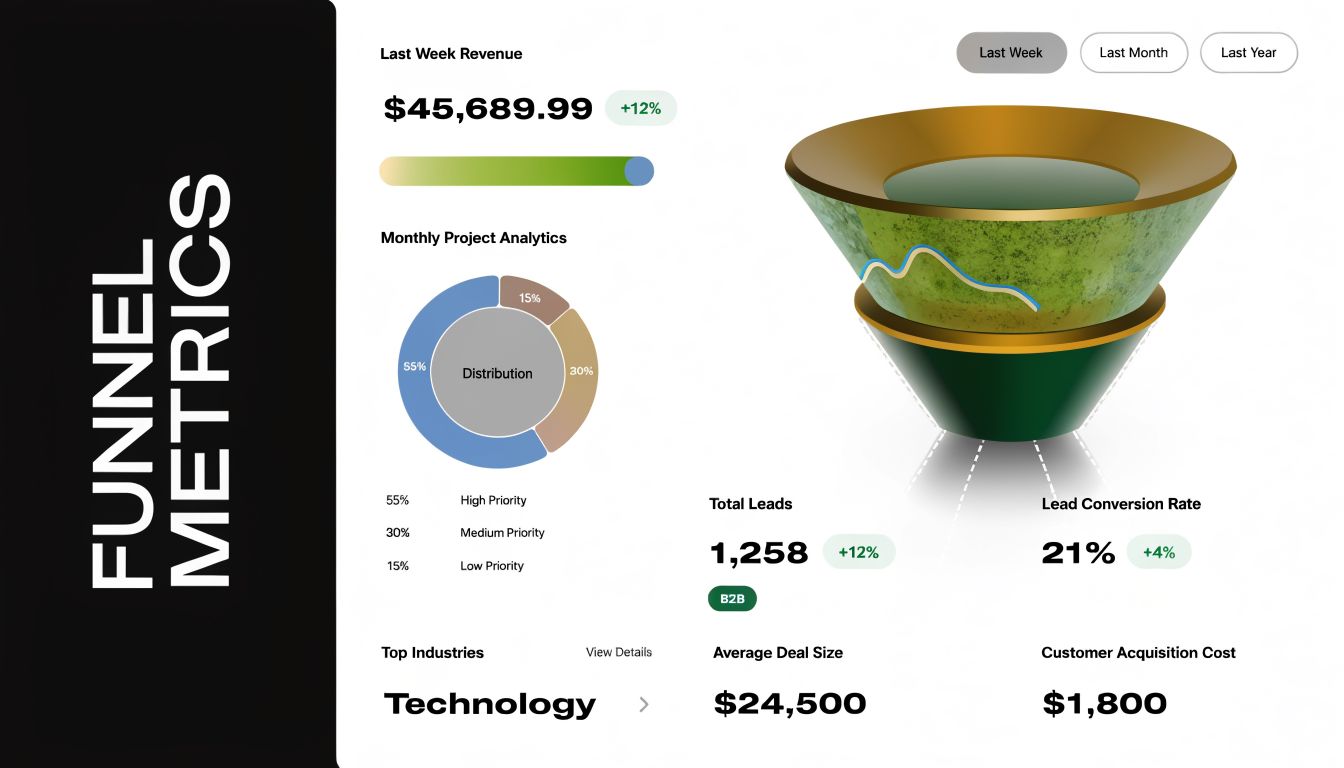
A useful b2b marketing funnel dashboard helps a marketing director answer three questions fast. Are we generating the right kind of demand? Where is movement slowing down? Which channels are producing meetings and pipeline that sales needs?
One more reality check matters here. Most funnel reporting only captures visible actions, but Sagefrog’s explanation of the dark funnel notes that the majority of buyer persuasion happens invisibly through peer conversations and ungated content consumption before a prospect ever enters your tracked systems. A good dashboard needs to respect that limit instead of pretending attribution is complete.
Daily view for operational control
The daily layer should help the team catch issues before they become missed pipeline.
Track items like:
-
New inbound and outbound responses so no live interest sits unattended
-
Meetings booked and meetings held because booked volume alone can hide poor qualification
-
Lead routing status to spot delays between capture and first touch
-
Inbox and campaign health for outbound programs
-
Sales feedback flags on low-fit meetings or repetitive objections
Operations and execution intersect here. If your team is connecting website behavior with funnel reporting, a tool layer like Google analytics mcp can help centralize the data you use for performance review and workflow automation.
Weekly view for stage movement
Weekly reporting should focus on conversion and friction.
A practical weekly dashboard usually includes:
| Weekly metric group | What to review |
|---|---|
| Funnel movement | Lead to meeting progression, accepted leads, stalled opportunities |
| Stage leakage | Where prospects stop advancing and whether the issue is volume, fit, or speed |
| Message quality | Common reply themes, objections, no-show patterns, meeting acceptance quality |
| Sales alignment | Accepted versus rejected meetings and reasons tied to qualification rules |
Don’t overload this view with vanity metrics. Leadership doesn’t need another chart on impressions if the actual problem is that responses aren’t turning into qualified conversations.
Here’s a useful rule. If a metric doesn’t trigger a decision, it probably belongs in an appendix, not the main dashboard.
Monthly view for strategic decisions
Monthly reporting is where the dashboard becomes a planning tool.
This is the right place to review source quality, sales cycle patterns, contribution to pipeline, and whether your funnel assumptions still hold. It’s also where marketing should combine numeric performance with qualitative insight from sales calls, lost deals, and customer conversations.
To tighten the KPI framework, this resource on essential lead generation metrics for 2026 is a practical reference for deciding what belongs on the scorecard.
A short walkthrough can help teams think about dashboard design with more discipline:
Measurement warning: Don’t punish channels for weak attribution when their real job is to create recognition before the buyer becomes trackable.
That’s the balance. Measure rigorously. Interpret carefully. A dashboard should sharpen judgment, not create false certainty.
A Practical Playbook for a Pay-Per-Meeting Model
A pay-per-meeting model forces clarity.
You can’t hide behind lead volume. You can’t count vague engagement as success. Either the campaign creates qualified sales conversations or it doesn’t. That pressure is useful because it forces the b2b marketing funnel to connect all the way from targeting to calendar.
Step one starts with meeting quality
Before list building, copywriting, or tooling, define the meeting.
That means sales and marketing need a written agreement on what qualifies. Usually that includes account fit, role relevance, business problem, and readiness for a meaningful conversation. If the sales team would reject the meeting after hearing the context, it shouldn’t count.
Many outbound programs frequently fail. They optimize for positive replies instead of sales-worthy conversations.
Use a simple qualification checklist:
-
Account fit means the company matches your ICP in a way sales agrees matters
-
Role fit means the contact can influence or route the buying process
-
Problem fit means there is a relevant pain point, initiative, or trigger
-
Conversation fit means the meeting has a real business purpose, not curiosity alone
If your team needs tighter process design around this handoff, mapping it inside a sales process flowchart helps expose where quality breaks down.
Step two builds the list around buying reality
List quality isn’t just about finding job titles. It’s about building accounts the campaign can penetrate.
Start with the ICP, then refine around likely use cases, role groups, and account signals that suggest the problem exists. In complex B2B sales, one contact rarely represents the whole opportunity. Build contact sets across the same account so outreach can support multi-threading when needed.
A strong prospecting list usually reflects:
-
Industry and company context
-
Relevant department or function
-
Seniority tied to the problem
-
A message angle that makes sense for that segment
That last part matters. If the list and the messaging aren’t built together, personalization becomes cosmetic.
Step three writes sequences for the stage, not for the channel
Cold email should map to buyer stage.
If the account is early in awareness, the message should sharpen the problem and make the pain concrete. If the account is already evaluating options, the email should lower the cost of taking a conversation. The channel is the same. The job is different.
A practical sequence often includes a few kinds of touches:
-
Problem-led opener tied to a clear operational issue
-
Value clarification that explains why your approach is worth discussing
-
Credibility touch such as a relevant use case or implementation angle
-
Low-friction close that asks for a short, specific conversation instead of a vague “let me know”
Don’t overstuff the sequence. The goal isn’t to win the whole deal in the inbox. The goal is to earn a meeting that sales wants to take.
The best outbound emails don’t sound like mini brochures. They sound like someone who understands the account’s situation and knows why a conversation would be useful.
Step four manages responses like pipeline, not admin
Response handling is part of funnel execution, not back-office coordination.
Someone has to triage replies, identify fit, route objections, and get meetings booked without losing context. If a prospect asks a timing question or mentions the wrong stakeholder, that information needs to shape the next move immediately.
Operationally, this means:
-
Classify replies by fit, interest, objection, and timing
-
Route qualified responses fast with context attached
-
Recycle soft interest into follow-up instead of closing the loop too early
-
Track meeting outcomes so the campaign learns from accepted and rejected conversations
That feedback loop is what turns pay-per-meeting from a tactic into a scalable revenue motion.
Transforming Your Funnel into a Predictable Revenue Machine
A b2b marketing funnel isn’t valuable because it looks organized. It’s valuable because it gives revenue teams control.
When the funnel is working, every stage has a job. Awareness creates recognition. Consideration reduces uncertainty. Decision support removes friction. Handoffs preserve context instead of dropping it. Reporting shows where momentum slows. Outbound doesn’t operate as a disconnected lead source. It works as a targeted mechanism for creating qualified conversations at the right point in the journey.
That’s what predictable revenue looks like in practice. Not perfect attribution. Not a flood of unqualified leads. A managed system that consistently turns market interest into sales-ready meetings and then into pipeline.
The trade-offs are real. If you focus only on top-of-funnel volume, sales gets noise. If you focus only on bottom-funnel demand capture, you miss buyers before they enter the market visibly. If you run cold outreach without stage awareness, conversion stays weak even when activity looks high.
Teams that improve those trade-offs tend to outperform because they stop treating marketing and sales as separate machines. They run one engine with shared rules, shared metrics, and faster feedback. For broader insights for B2B growth leaders, it’s worth reviewing how funnel discipline shapes both conversion and pipeline confidence.
Lead quality also improves when qualification gets stricter earlier. That’s why a clear scoring model matters. This guide on mastering B2B lead scoring to boost sales effectiveness is a strong next read if your team needs better criteria for deciding which prospects deserve fast action.
Expert implementation is usually the final gap. While the stages are common knowledge, fewer execute the routing, messaging, qualification, and outbound timing well enough to make the funnel predictable.
If you want help building a b2b marketing funnel that produces qualified meetings instead of loose lead volume, Fypion Marketing is worth a look. Their focus is performance-based B2B lead generation through cold email outreach, with meeting qualification defined upfront so marketing activity stays tied to sales outcomes.