
Email Deliverability Services: A B2B Cold Email Guide

You launch a cold email campaign that should work.
The list is tightly targeted. The offer is clear. The copy sounds human. Sales is ready for replies. Then the campaign stalls. Open rates look weak, positive replies barely show up, and the sequence that looked strong in the doc turns into silence in the inbox.
Teams often misdiagnose the primary issue. They rewrite subject lines, swap CTAs, buy a new list, or switch sequencing tools. Sometimes, the underlying problem is simpler and harsher: the emails never had a fair chance to be seen. The message didn’t lose because the pitch was bad. It lost because the mailbox provider didn’t trust the sender.
That’s the part many sales directors only notice after wasted weeks. The global average email deliverability rate is 83.1%, which means nearly 17% of emails fail to reach the primary inbox, according to EmailTooltester’s deliverability statistics. In cold outreach, that gap is expensive. You’re paying for targeting, data, copy, sequencing, and SDR time, yet a chunk of the campaign disappears before a prospect can ignore it.

For performance-based outreach, deliverability isn’t a side task. It’s the operating system underneath the campaign. If you only get paid when qualified meetings get booked, inbox placement stops being a technical hygiene item and becomes a revenue lever.
That’s why serious teams spend as much time on infrastructure and sender reputation as they do on messaging. Better copy helps when an email gets read. Deliverability decides whether that chance exists in the first place. If you’re trying to improve response without fixing inbox placement, you’re tuning the script while the microphone is unplugged.
If your current campaigns feel inconsistent, this guide will help you diagnose the engine room behind the result. For message-level fixes, these simple tactics for higher opens are useful. But first, the emails need to arrive where buyers can see them.
Introduction When Your Perfect Email Never Gets Read
A lot of cold email problems get mislabeled as copy problems.
Sales leaders see low output and assume the market is saturated, the targeting is off, or the offer needs another round of edits. Those can all be true. But when a campaign underperforms across multiple sequences, multiple reps, and multiple offers, the deeper issue is often email placement. Good campaigns die unseen when mailbox providers route them to spam, promotions, or nowhere useful at all.
That’s why email deliverability services matter. They handle the parts most revenue teams don’t have time to manage closely: sender identity, domain reputation, warm-up, inbox testing, throttling, complaint control, and the daily maintenance that keeps a campaign alive long enough to produce meetings.
Practical rule: In cold outreach, “sent” is not the same as “seen.”
In a performance model, this matters even more. If the goal is qualified meetings, every layer before the reply has to hold. List quality matters. Copy matters. Follow-up logic matters. But deliverability sits underneath all of them, like the postal system underneath direct mail. If the mail truck never reaches the building, the creative doesn’t matter.
The hidden cost of silence
Silence creates false negatives. Teams conclude that a market doesn’t respond, when the underlying issue is that mailbox providers never trusted the sending setup. That leads to bad decisions: scrapping good segments, changing offers too early, or replacing reps when the infrastructure is what failed.
It also creates reputation debt. Every weak send teaches inbox providers something about your domain. If complaint signals rise or bounce rates get loose, future campaigns start from a worse position.
Why services exist in the first place
Most B2B teams can learn deliverability basics. Fewer teams can run them well every day while also building pipeline. Email deliverability services exist because cold outreach is no longer forgiving. The technical work now directly affects revenue output.
For a sales director, that’s the primary focus. This isn’t about geeky email settings for their own sake. It’s about preserving the conditions that allow a campaign to book meetings consistently.
Why Deliverability Is The Foundation Of Cold Outreach
Think of cold email deliverability like the postal service behind your outreach.
You can write a sharp letter, put the right offer inside, and address it to the exact buyer you want. If the postal system loses one out of every several letters, misroutes another chunk, and flags your return address as suspicious, you don’t have a messaging problem. You have a delivery problem.
Cold email works the same way. The inbox provider is the gatekeeper. Gmail, Microsoft, Yahoo, and other providers decide whether your message gets accepted, delayed, filtered, or buried. Sales teams tend to focus on what happens after a prospect opens the email. Deliverability determines whether the email earns that chance.
Why this became non-negotiable
The old playbook of “buy domains, connect a tool, and start sending” doesn’t hold up anymore. The 2024 enforcement of strict sender rules by Gmail and Yahoo, including full authentication and spam rates below 0.3%, changed the situation, as noted in Robly’s overview of email marketing statistics for 2026. Once those requirements tightened, weak infrastructure stopped being a minor inefficiency and became a direct threat to pipeline generation.
For teams running high-volume prospecting, poor compliance now shows up as fewer conversations, thinner calendars, and rising frustration from sales. If a provider doesn’t trust your setup, it won’t matter how polished the sequence looks in your outreach platform.
A campaign can look healthy inside your sending tool and still be unhealthy where it counts, inside the recipient’s mailbox.
The business cost is broader than missed replies
Poor deliverability wastes more than send volume. It burns money and time across the entire outreach chain.
-
List investment gets diluted: You pay for data enrichment and list building, then a portion of those contacts never see the message.
-
Copy testing becomes unreliable: You can’t judge offer-market fit cleanly when inbox placement is unstable.
-
Domain reputation weakens over time: Repeated poor sends teach mailbox providers to trust you less.
-
Sales planning gets distorted: Pipeline forecasts become noisy because campaign output reflects technical friction, not actual market response.
That last point hits hard in a pay-per-result setup. If meetings are the unit that matters, every hidden deliverability issue pushes the cost of each booked conversation higher.
Deliverability is the floor, not the ceiling
A lot of teams treat deliverability as a cleanup project. It isn’t. It’s the base layer that allows targeting and messaging to perform. Without it, even strong SDR work can look average.
If you want a practical checklist for the basics that support inbox placement, these email deliverability best practices for 2025 are a useful reference. But the larger point is simple: cold outreach stops being predictable when deliverability isn’t actively managed.
That’s why the strongest programs don’t ask, “How many emails did we send?” They ask, “How much trusted mail did we place in front of the right buyers?”
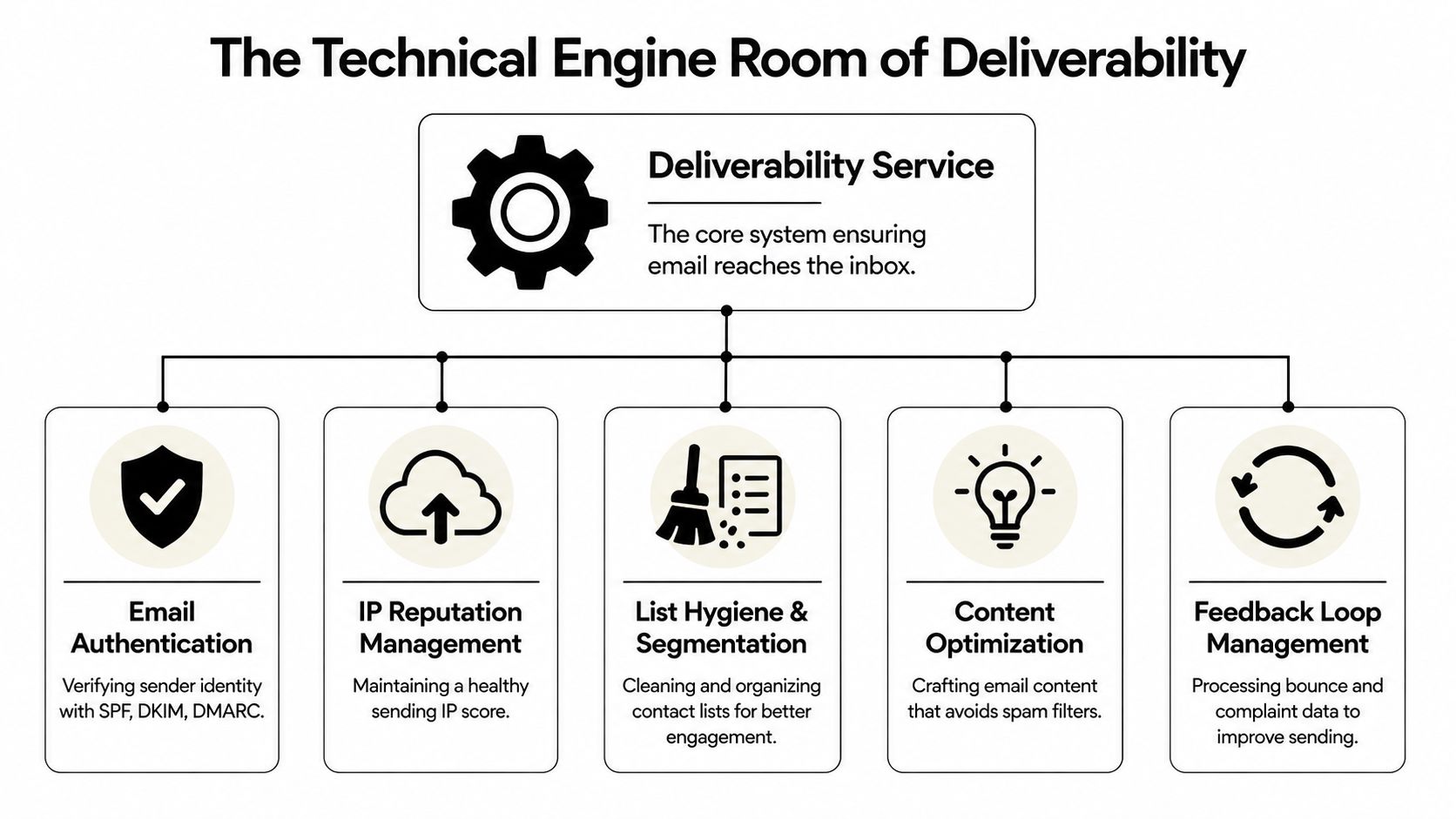
The Technical Engine Room Of Deliverability Services
Most email deliverability services do three jobs under the hood. They prove you are who you say you are. They control the infrastructure you send through. They build trust with mailbox providers over time.
If that sounds abstract, use a simple analogy. Deliverability is like getting access to a secure office building. Authentication is your ID badge. Infrastructure is the company vehicle you arrive in. Warm-up is the guard learning that you show up every day, behave normally, and belong there.
Authentication proves sender identity
Authentication is the first checkpoint.
SPF, DKIM, and DMARC tell mailbox providers that your domain authorizes the mail being sent and that the message hasn’t been tampered with. In practical terms, they work like a passport, a signature, and a border control check. Without them, your cold email is asking for trust without proof.
For performance-based programs, this is not optional admin work. It’s the minimum required to get providers to treat your traffic as legitimate. If that identity layer is weak, every other optimization gets built on sand.
A strong deliverability service handles this setup cleanly and checks alignment regularly. It doesn’t assume records were configured once and forgotten forever.
Infrastructure decides whose reputation you inherit
The next layer is sending infrastructure. This includes domains, mailboxes, and the pathways used to send outreach.
There’s a major trade-off here. Shared infrastructure is easier, but it exposes you to other senders’ behavior. Dedicated infrastructure gives you more control, but it requires more discipline. For cold outreach, control usually wins. If another sender on shared infrastructure triggers trust issues, your campaigns can feel the impact even when your own copy and targeting are solid.
That’s why many specialized services lean toward dedicated setups and reputation isolation. Oracle notes that email deliverability services using dedicated IP addresses and automated warm-up protocols can achieve inbox placement rates up to 97%, compared with an industry average of 85%, in its write-up on key deliverability factors and KPIs.
In plain English, more of your email gets seen.
If you want a practical outside explanation of the common causes behind filtering, this guide on why your emails go to spam and how to fix it is worth reading because it connects technical errors to actual mailbox behavior.
Warm-up builds trust like a credit score
Warm-up is where impatient teams usually damage a good setup.
A new domain or mailbox has no sending history. To mailbox providers, that’s a stranger. If you suddenly send at aggressive volume from a fresh environment, the provider sees risk. A deliverability service avoids that by ramping carefully, watching engagement, and adjusting velocity before problems compound.
It’s comparable to building credit. Responsible behavior over time earns trust. Abrupt, noisy activity raises alarms.
This is one reason specialists outperform DIY setups. They don’t just “turn sending on.” They sequence trust-building across domains and mailboxes, often with tools like Smartlead, Mailtrap, or similar platforms that support warm-up and sender control.
Cold email infrastructure should feel boring when it’s healthy. Stable, gradual, controlled, and documented.
The five gears that keep the machine moving
Even though authentication, infrastructure, and warm-up do most of the heavy lifting, real services watch several connected systems at once:
-
Authentication health: SPF, DKIM, and DMARC stay aligned as domains and tools change.
-
Reputation separation: Good setups isolate risk so one weak stream doesn’t poison another.
-
List quality: Bad contacts can ruin a healthy sender faster than mediocre copy can.
-
Content signals: Spam-heavy phrasing, broken formatting, and misleading personalization create friction.
-
Feedback handling: Bounces, complaints, and provider-specific patterns guide what to slow down, pause, or rewrite.
For teams building from scratch, setting up cold email infrastructure for high deliverability gives a practical picture of what that stack looks like before the first real campaign goes live.
The key thing to remember is this: email deliverability services aren’t selling magic. They’re managing trust at the infrastructure level so the campaign can compete on messaging.
Ongoing Operations That Protect Your Sender Reputation
Setup gets you into the game. Ongoing operations keep you there.
A lot of teams treat deliverability like a one-time migration project. They configure domains, warm a few mailboxes, run a test, and move on. Then they’re surprised when performance slips weeks later. Sender reputation changes in real time, and mailbox providers react to live signals, not your intentions.

Reputation monitoring
Think of sender reputation as your campaign’s credit score with inbox providers. It shifts based on how recipients and mailbox systems react to your traffic.
Complaint rates need to stay below 0.3% and bounce rates under 2%, and AI-driven filters can cause a 10-15% drop in inbox placement when those signals aren’t managed closely, according to Mailreach’s deliverability statistics roundup. That’s why true email deliverability services monitor reputation continuously rather than checking performance after the damage is already done.
They watch for patterns such as:
-
Complaint spikes: Even small increases can change how providers treat future sends.
-
Provider-specific weakness: Microsoft may react differently than Gmail, so broad averages can hide the issue.
-
Engagement deterioration: If opens and clicks soften over time, inbox providers may trust you less.
-
Bounce drift: A list that looked fine on export can degrade fast if data collection was loose.
List hygiene is not optional maintenance
Bad data is one of the fastest ways to poison a healthy setup.
When teams get aggressive with list volume, they often lower their guard on verification. That creates hard bounces, hits old or risky addresses, and sends poor trust signals to providers. A deliverability service acts like a filter before the send, not a cleanup crew after the damage.
Here’s the practical sequence most strong operators follow:
-
Verify before launch: Check lists before they ever touch a warmed mailbox.
-
Segment carefully: Don’t treat every contact source as equal.
-
Remove fast: If a source, segment, or title cluster underperforms in a way that threatens reputation, cut it.
-
Refresh often: Data ages. A list isn’t “clean” forever.
For the broader security side of protecting mail systems and sender trust, this overview of email security best practices is useful because it shows how operational discipline and technical protection overlap.
Analytics should change sending behavior
Most outreach teams have data. Fewer teams use it to make provider-level decisions.
A deliverability service should tell you more than “campaign A beat campaign B.” It should tell you where trust is weakening, which domains need relief, whether throttling is required, and when message testing should pause until infrastructure stabilizes.
This kind of walkthrough helps explain the moving parts visually:
Field note: The best deliverability dashboards don’t impress with charts. They trigger decisions early enough to prevent reputation damage.
That includes actions like reducing velocity on one mailbox cluster, pausing a shaky segment, rotating infrastructure, or rewriting copy that attracts low-quality engagement. Some teams use dedicated consulting for this layer. One option in the market is email delivery consulting to fix inbox placement, which focuses on diagnosing and correcting delivery issues rather than just adding more send volume.
The main point is simple. Deliverability is maintenance work. If nobody owns monitoring, hygiene, and analytics every week, sender reputation drifts until meetings dry up.
How To Evaluate Email Deliverability Providers
Once you know what deliverability controls, the next question is who should manage it.
Many B2B teams often get burned. A provider says they “handle inboxing,” shows a few screenshots, mentions warm-up, and promises better results. That’s not enough. In cold outreach, a good provider should be able to explain exactly how they protect sender reputation under current mailbox rules and what trade-offs they make when performance starts to slip.
One test matters immediately. Ask how they manage one-click unsubscribes and DMARC for clients sending over 5,000 emails daily. If the answer is vague, that’s a red flag because non-compliance can cause immediate 20-30% inbox drops, based on 4SiteStudios’ analysis of modern deliverability risks.
Vendor Evaluation Checklist
| Area of Evaluation | What to Look For | Red Flags |
|---|---|---|
| Infrastructure management | Clear explanation of dedicated vs shared environments, mailbox rotation, and how risk is isolated | ”We use the same setup for everyone” |
| Authentication handling | Specific process for SPF, DKIM, DMARC alignment and ongoing checks | They treat authentication as a one-time task |
| Warm-up operations | Gradual ramping process, monitoring during ramp, and rules for when to slow down | They push new domains to volume too quickly |
| Compliance readiness | Direct answers on one-click unsubscribes, spam complaint control, and bulk sender requirements | They speak in generalities or dodge provider-specific questions |
| Reporting transparency | Provider-level visibility, bounce and complaint reporting, and action steps tied to metrics | Reports focus only on sends and opens |
| List hygiene process | Verification standards, suppression logic, and how risky segments get handled | They accept any list without screening |
| Response to issues | Written process for drops in inboxing, provider changes, and domain recovery | ”We’ll monitor it” with no decision framework |
| Alignment with outcomes | Success measured in qualified meetings and sales conversations, not vanity metrics alone | They optimize for volume over meeting quality |
Questions worth asking in the sales call
Don’t ask generic questions like “Do you do deliverability?” Everyone says yes. Ask questions that force operational detail.
-
How do you isolate client risk? If one campaign performs badly, what stops it from damaging the rest?
-
What signals trigger throttling or pause decisions? A real operator should have a clear answer.
-
How do you handle Microsoft separately from Gmail? Provider differences matter.
-
What happens when copy performs but inbox placement drops? Good teams know the difference between a content issue and a trust issue.
-
How do you define success in a pay-per-result model? Booked meetings require more than just high send counts.
A practical comparison of common tooling categories can help here too. Mailtani’s overview of email deliverability features is useful because it shows the kinds of capabilities vendors often advertise. The important part is separating feature lists from actual operating discipline.
Red flags that should end the conversation
Some claims sound attractive because they remove uncertainty. That’s exactly why they’re dangerous.
No provider can honestly promise perfect inbox placement across every provider, every market, and every list.
Walk away if you hear things like guaranteed universal inboxing, no need for list verification, instant scale from fresh domains, or “our software fixes everything automatically.” Strong email deliverability services are process-heavy because trust with mailbox providers is earned, monitored, and defended. It isn’t bought in one click.
Real-World Impact Case Studies For B2B Sellers
The easiest way to understand deliverability is to see what changes when it’s handled properly.
In B2B cold email, a campaign can look technically “delivered” and still miss the buyer. A key challenge is that 15-17% of delivered emails are dropped or sent to spam, and specialized services can improve inbox placement from a potential 40% to 95%+ by optimizing for engagement, according to Prospeo’s discussion of email deliverability services.
That gap shows up in real selling situations.

SaaS company with strong copy and weak pipeline
A SaaS team can have a solid product, clean ICP, and decent outbound messaging, yet still see almost no demo traction. Sales often assumes the angle is off. But if mailbox trust is weak, the market never properly evaluated the pitch.
The pattern usually looks like this: early campaigns start with some activity, then performance fades as volume rises. The fix is rarely “write better copy” by itself. It’s more often a combination of cleaner sending infrastructure, slower scaling, list verification, and provider-specific monitoring. Once inbox placement stabilizes, the same offer starts producing conversations because it’s finally being seen.
Tech startup targeting enterprise buyers
Enterprise outreach is less forgiving than broad SMB outreach. Buyers get more mail, internal filters are tighter, and trust signals matter more. A startup that sends from a rushed setup often mistakes low visibility for market rejection.
What changes the result is operational discipline. Strong deliverability service turns outreach into a controlled program instead of a volume gamble. Mailboxes get warmed properly. risky contacts get filtered out. Sending cadence matches reputation. Replies improve because the campaign reaches the inbox consistently enough to be judged on its merits.
B2B brand that cares about meetings, not send counts
Performance-based outreach creates a healthier decision frame. You stop asking whether the system can send more and start asking whether the system can book qualified conversations reliably.
That’s why deliverability matters so much in pay-per-meeting models. The provider has to care about the same outcome you do. If inbox placement slips, booked meetings slip. The cost of technical neglect becomes visible fast.
For a practical example of how performance-led outreach connects operational work to pipeline creation, this case study on building a $6.7M pipeline in a tough market is worth reading.
Better deliverability doesn’t create demand on its own. It removes the hidden friction that stops real demand from responding.
That’s the practical takeaway for B2B sellers. Deliverability services don’t replace targeting or positioning. They make those efforts count.
Your Next Steps To Ensuring Your Emails Get Delivered
Email deliverability services are useful because cold outreach is now an operational discipline, not just a messaging channel.
The work doesn’t end after setup. Authentication needs to stay aligned. Infrastructure needs to be protected. List quality needs constant control. Sending velocity needs adjustment. Provider behavior needs monitoring. If nobody owns those moving parts, the campaign eventually starts leaking performance.
For a busy sales director, the decision usually comes down to bandwidth and cost of distraction. You can build this function internally, but someone still has to manage the engine room every week. If your team’s real job is selling, not maintaining sending systems, outsourcing often makes more sense.
That’s especially true in a performance-based model. When the commercial structure is tied to qualified meetings, the outreach partner has an incentive to protect deliverability because weak inbox placement hurts the same outcome both sides care about.
A good next step is simple. Audit your current outreach setup with a hard eye. Look at sender trust, complaint control, bounce management, and whether your campaigns are reaching buyers across major providers. If the answer is unclear, that’s already a warning sign.
The teams that win with cold email usually aren’t the loudest senders. They’re the ones who treat inbox placement like core sales infrastructure.
Frequently Asked Questions About Email Deliverability
Can I manage email deliverability myself instead of using a service
Yes, you can. Many teams do some of it in-house.
The question is whether your team has the time, tooling, and judgment to manage it continuously. Deliverability isn’t only about setting things up. It involves monitoring sender reputation, handling list hygiene, adjusting velocity, diagnosing provider-specific issues, and deciding when to pause campaigns before damage spreads. Most sales teams can learn the basics. Fewer can operate the system consistently while also hitting pipeline targets.
How long does it take to warm up a new domain
It depends on the setup, list quality, and how carefully volume is increased.
A healthy warm-up is gradual. The mistake is rushing because the sales team wants output immediately. New domains need trust-building time. If you push too much volume too early, mailbox providers may treat the traffic as suspicious and the domain can struggle long after the initial launch. In practice, patient scaling usually beats aggressive sending.
Will switching my ESP fix deliverability issues
Usually not on its own.
Teams often hope a platform change will reset performance. Sometimes better tooling helps with monitoring or infrastructure control, but reputation issues usually follow the sender behavior, not just the software. If the underlying problem is weak authentication, poor list quality, bad warm-up, or rising complaints, a new ESP won’t magically fix that.
What should I watch first if campaigns start slipping
Start with reputation signals and recent changes.
Look at complaint behavior, bounce trends, list sources, sending velocity, and whether any new domains or mailbox groups were pushed too hard. Also check if the problem is broad or isolated to certain providers. A drop at one major provider can make the whole campaign look weaker than it is, even when other providers are stable.
Are email deliverability services worth it for smaller outbound teams
They can be, especially if the team relies heavily on cold email for booked meetings.
A smaller team often has less room for failure because each campaign carries more weight. If one sending environment gets damaged, there may not be enough spare infrastructure or operational capacity to recover quickly. In that situation, strong deliverability support can protect consistency more than raw scale.
If your team wants qualified meetings from cold email but doesn’t want to spend internal time managing domains, reputation, warm-up, and provider-specific troubleshooting, Fypion Marketing is one option to evaluate. The model is straightforward: no upfront fee, no retainer, and payment tied to booked meetings that match agreed criteria. That structure fits companies that want outreach handled as a performance channel, not a monthly experiment.