
B2B Lead Generation Strategies for Sustainable Growth
Let’s get one thing straight: B2B lead generation isn’t about hawking your wares or bombarding strangers with sales pitches. Strip away all the jargon, and it’s simply the art of starting meaningful business relationships. It’s the engine that finds, attracts, and qualifies prospects who are a perfect match for what you sell, fueling your company’s growth.
What Is B2B Lead Generation Really About?

Think of it like this: a great lead generation strategy is like being a master gardener. You don’t just throw seeds everywhere and hope for the best. Instead, you carefully select the most promising seeds - your ideal prospects. Then you give them exactly what they need to grow, like helpful content and personalized advice, until they’re ready to blossom into fantastic, long-term customers.
This is a world away from the old-school, disruptive tactics that just don’t work anymore. The days of hammering the phones are over. In fact, a staggering 97% of people now ignore cold calls, which tells you everything you need to know. People want value, not interruptions.
The new era of B2B lead generation is built on a simple exchange of value. You provide expertise and solve a prospect’s problem before asking for the sale, building trust and authority from the very first interaction.
When you get this right, you create a predictable, repeatable system for growth. It’s not just about filling a list with names; it’s about attracting the right names and building a pipeline of future customers who are actually excited to hear from you.
How The Modern B2B Game Is Played
The shift in B2B marketing is impossible to ignore, and content has become the star player. By 2025, a massive 85% of B2B marketers will rely on content to generate leads. This isn’t a small bet, either. With the average cost per lead hitting $198.44, every dollar needs to count, which makes having a sharp, efficient strategy absolutely critical.
Today’s best lead generation isn’t a one-trick pony; it’s a multi-channel effort designed to meet your prospects where they already are. It breaks down into three core jobs:
-
Identifying Prospects: This goes way deeper than just company size or location. It’s about building a detailed Ideal Customer Profile (ICP) that maps out the specific challenges, goals, and buying signals of your target accounts.
-
Attracting Interest: This is where that value-first approach really shines. By creating insightful blog posts, detailed guides, or engaging webinars, you pull in businesses that are actively looking for the very solutions you offer.
-
Qualifying Leads: Not every hand-raiser is ready to buy. A huge part of the process is figuring out which leads are a good fit and which ones are just kicking tires. This ensures your sales team spends their time on conversations that are actually going somewhere.
Pulling this off consistently requires a deep understanding of your audience and the right blend of strategies. It’s a lot to handle, which is why many companies turn to specialists. If you’re thinking about getting some help, our guide on finding a top B2B lead generation agency is a great place to start.
Ultimately, a strong lead generation process isn’t just a marketing function - it’s the fundamental driver of revenue and sustainable growth for any B2B company.
To put it all together, here’s a quick look at the most common channels today and what they’re best used for.
Modern B2B Lead Generation Channels and Their Purpose
| Channel | Primary Purpose | Best For |
|---|---|---|
| Email Marketing | Direct outreach & nurturing | Starting targeted conversations and guiding leads through the funnel. |
| Content Marketing | Attracting inbound interest | Building authority, solving problems, and drawing in prospects organically. |
| Networking & social selling | Engaging with decision-makers and building professional relationships. | |
| Paid Ads (PPC) | Driving immediate traffic | Targeting specific keywords and demographics for quick lead capture. |
| Webinars | In-depth education | Demonstrating expertise and generating high-intent, qualified leads. |
Each channel has its own strengths, and the real magic happens when you combine them into a cohesive strategy that works for your specific audience and goals.
Building Your Foundational Lead Generation Framework

Effective B2B lead generation isn’t about luck or just winging it; it’s an engineered process. If you want to move from a trickle of random inquiries to a predictable flow of qualified meetings, you need a solid framework. Think of it as your strategic blueprint, making sure every piece of content and every campaign you launch has a specific, measurable job.
It all starts with getting crystal clear on who you’re talking to.
Saying you target “tech companies” is far too broad to be useful. The real first step is crafting a laser-focused Ideal Customer Profile (ICP). This isn’t just a list of industries. It’s a detailed sketch of the company that is a perfect fit for what you sell. You have to dig into the data to build this profile with real precision.
Go beyond the basics like company size and revenue. A truly powerful ICP includes the deeper, actionable details that signal a genuine need for your solution. What specific pain points are they dealing with every day? What behavioral triggers - like hiring for a certain role or adopting a new technology - show they’re ready to start looking for a fix? Answering these questions turns your targeting from a wide, hopeful net into a sharp, accurate spear.
To really nail this down, check out our guide on creating a B2B ideal customer profile that actually drives results.
Mapping The B2B Customer Journey
Once you know exactly who you’re after, the next step is to map out the path they take from realizing they have a problem to becoming a paying customer. This customer journey isn’t a straight line. It’s more of a winding road with distinct stages, and understanding this progression is key to meeting them with the right message at exactly the right time.
The B2B journey typically breaks down into three key phases:
-
Awareness: The prospect knows they have a problem but doesn’t have a name for the solution yet. They’re researching their challenges, not your product.
-
Consideration: Now they’re solution-aware and actively weighing different approaches and vendors. They’re comparing features, hunting for reviews, and looking for proof.
-
Decision: The prospect has narrowed their options and is ready to pull the trigger. They just need that final nudge, like a compelling demo, a free trial, or a personalized quote.
Think about a SaaS company selling project management software. In the Awareness stage, their ICP might Google “how to manage remote team workflows.” In the Consideration stage, that search evolves to “best project management tools for agencies.” Finally, in the Decision stage, they’re searching for “[Your Brand] vs. [Competitor] pricing.” Your content has to match each of these mindsets.
Creating High-Value Lead Magnets
The final piece of your foundational framework is the lead magnet - the high-value content you offer in exchange for a prospect’s contact info. Generic, low-effort checklists won’t cut it here. The best lead magnets solve a real problem for your ICP at a specific stage of their journey.
Your goal is to create something so genuinely useful that your ideal customer feels like they’re getting an absolute steal just by giving you their email address. This isn’t just about capturing a lead; it’s about starting a relationship built on trust and demonstrating your expertise right from the get-go.
Here are a few examples of how you can tailor lead magnets to different journey stages:
-
Awareness Stage: A deep-dive whitepaper like The Ultimate Guide to Scaling Agency Operations that helps them fully understand the problem they’re facing.
-
Consideration Stage: An exclusive webinar showcasing How Top SaaS Companies Use Our Platform to Cut Churn by 30%, providing concrete proof of your solution’s impact.
-
Decision Stage: An interactive ROI calculator or a free, no-strings-attached strategy call to give them a personalized glimpse of the benefits.
By building out this framework - defining your ICP, mapping their journey, and creating targeted lead magnets - you’re not just hoping for leads. You’re building a strategic and repeatable engine for high-quality B2B lead generation.
Mastering Inbound Strategies to Attract Quality Leads

While outbound tactics like cold email can certainly get you quick wins, a truly solid B2B lead generation strategy needs a powerful inbound magnet. You have to attract prospects who are already looking for a solution. Think of it like this: instead of chasing ships all over the ocean (outbound), you’re building a lighthouse that guides them directly to your harbor (inbound).
The entire goal is to stop interrupting what your prospects are interested in and become what they’re interested in. You’re not an annoyance; you’re the answer they were searching for. This magic happens when you get three things working together: content, search engine optimization (SEO), and a smart social media presence.
Let’s break down how this trio works to pull in high-quality leads.
Build Authority With Strategic Content Marketing
“Create great content” is probably the most common - and most useless - advice out there. What does that even mean in practice? A much smarter way to think about it is building a topic cluster. This is basically a web of interconnected content that proves you’re the go-to expert on a specific subject.
Let’s say you’re a SaaS company that sells financial planning software for agencies. Instead of just writing random blog posts, you’d start with a massive “pillar page,” like an ultimate guide to “Agency Financial Management.” This is your anchor.
Then, you build smaller, more focused “cluster” posts that all link back to that main guide. These could be articles like:
-
“5 Common Invoicing Mistakes Agencies Make”
-
“How to Forecast Your Agency’s Quarterly Revenue”
-
“A Guide to Choosing Project-Based vs. Retainer Pricing”
This structure accomplishes two critical things. First, it signals to search engines that you have deep authority on this topic, which helps you rank higher. More importantly, it gives your ideal customer incredible value. They came looking for one answer and suddenly realize you have all the answers they need, building trust and keeping them on your site.
Capture Intent With Precision SEO
Effective B2B SEO isn’t about going after huge, generic keywords. A CEO isn’t just Googling “marketing software.” Their searches are way more specific and tied to a problem they’re trying to solve right now.
Your job is to get inside their head and target the long-tail keywords that scream purchase intent. These are the longer, more detailed phrases that reveal a prospect’s real pain points.
For instance, forget targeting “CRM software.” A much more valuable keyword is something like, “how to integrate crm with accounting software for smbs.” The person searching for that has a real, urgent problem. If you have a guide that answers that exact question, you instantly become their hero.
By focusing on the language of your customers’ problems, you meet them at their exact moment of need. This transforms your website from a simple brochure into a vital resource, dramatically increasing the quality of the leads you attract.
Remember, every piece of content should be a direct answer to a question your ideal customer is typing into Google. That’s how you win the search game and attract actual buyers, not just window shoppers. If you want to see how this translates to revenue, our guide digs into how to generate B2B leads that actually convert into sales.
Transform LinkedIn Into a Lead Generation Engine
For any B2B company, LinkedIn is far more than just a place for online résumés - it’s a goldmine for leads. Your company page should act like a resource hub, consistently sharing content that tackles your industry’s biggest headaches. Don’t just dump links to your blog; pull out key stats, ask sharp questions, and get conversations started.
But you can’t just post and ghost. You have to be an active participant. Find the industry groups where your ideal customers hang out and contribute to the discussions. The key is to offer genuine advice, not a sales pitch. This builds your reputation and makes people curious enough to check you out on their own terms.
The numbers don’t lie. LinkedIn is the undisputed king for B2B, with 40% of B2B marketers calling it their most effective channel for high-quality leads. And people are paying attention - 40% of LinkedIn visitors engage with a company page every week. Even better, LinkedIn Lead Gen Forms have an average 13% conversion rate, which blows most website landing pages out of the water. When you use it right, you turn passive networking into a predictable lead-gen machine.
Master the Mid-Funnel with Advanced Nurturing
Getting a lead’s attention is just the opening act. The real magic in B2B lead generation happens in the often-neglected middle of the funnel. This is where you have to do the heavy lifting - transforming a flicker of interest into genuine, sales-ready intent. Forget generic email blasts; it’s time to adopt smarter nurturing tactics that build unshakable trust and prove your value.
It really comes down to shifting your mindset from casting a wide net to expertly throwing a spear. Standard inbound marketing plays a numbers game, hoping to catch anyone who might swim by. Advanced strategies, on the other hand, are incredibly deliberate. The most potent of these is Account-Based Marketing (ABM).
Go All-In on a Precision ABM Approach
Think of ABM as hosting an exclusive, VIP-only event. Instead of sending out a mass invitation, you carefully curate a guest list of high-value accounts that are a perfect fit for what you offer. From there, every single piece of content, every email, every touchpoint is crafted specifically for the key players within those companies. It’s a complete reversal of the old funnel model.
Instead of generating a ton of individual leads and hoping some work at the right companies, ABM starts with the companies you want and works backward to engage the right people inside them. This focus means your marketing and sales efforts are only spent on opportunities with the highest possible revenue potential.
So, how does it work in practice? The whole thing kicks off with some serious analysis. You’ll dig into firmographics, technographics, and buying intent signals to hand-pick your ideal target accounts. With that list in hand, you build hyper-personalized campaigns that speak directly to their unique challenges and business goals. This could mean anything from custom landing pages and industry-specific case studies to old-school direct mail that lands on a CEO’s desk.
The payoff for this level of precision is huge. Gartner points out that ABM isn’t just a buzzword; it’s evolving fast and effective strategies can boost pipeline conversions by up to 14%. They also found a 25% jump in the conversion rate of MQLs to sales-accepted leads. That’s hard proof that a targeted approach delivers much higher-quality opportunities. For a deeper dive, check out these insights on the top B2B lead generation trends of 2025.
While different content types all have their place, their impact can vary. This chart gives you a clear picture of what’s actually converting in the B2B world.
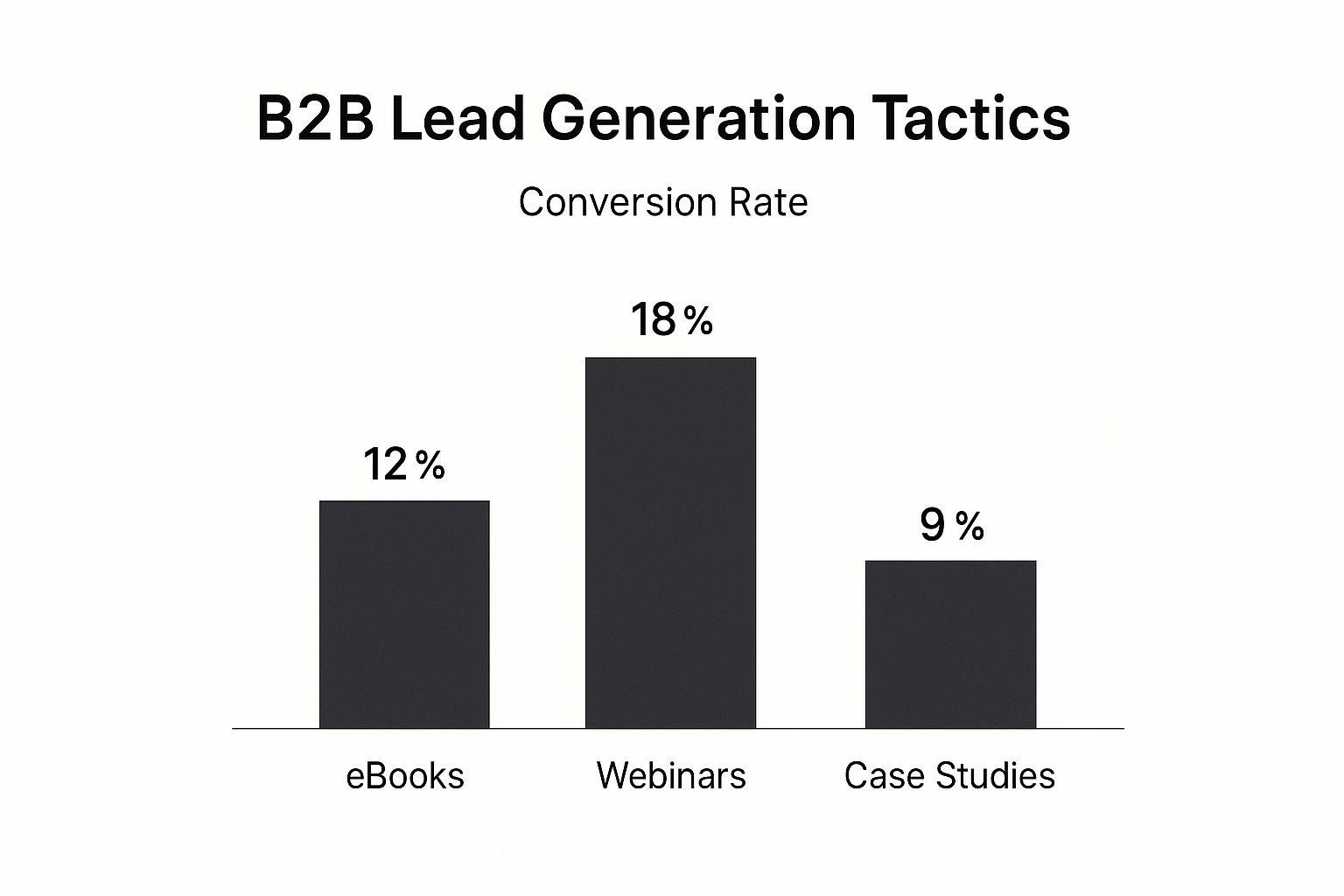
As you can see, webinars often come out on top. It makes sense - they provide a much deeper, more interactive way to connect with and educate prospects who are already in that crucial consideration phase.
To make things even clearer, let’s break down how ABM stacks up against the old way of doing things.
Traditional Lead Gen vs Account-Based Marketing
| Attribute | Traditional Lead Generation | Account-Based Marketing (ABM) |
|---|---|---|
| Philosophy | ”Casting a wide net" | "Spearfishing” |
| Primary Goal | Generate a high volume of individual leads | Engage and convert specific, high-value accounts |
| Targeting | Broad, based on personas and demographics | Narrow, based on a pre-defined list of target companies |
| Communication | One-to-many, often generalized | One-to-one or one-to-few, highly personalized |
| Key Metrics | Cost Per Lead (CPL), MQL volume | Account engagement, pipeline velocity, deal size |
| Sales & Marketing | Often operate in separate silos | Tightly aligned and collaborative from the start |
The table really highlights the fundamental shift: ABM is about quality over quantity, depth over breadth, and turning your sales and marketing teams into a single, cohesive unit focused on landing the big fish.
Use AI and Automation to Amplify Your Nurturing
Here’s the good news: you don’t have to do all this manually. Modern technology makes these advanced nurturing tactics scalable and razor-sharp. AI and automation aren’t just for massive enterprises anymore; they are essential tools for any B2B company that wants to get ahead.
These technologies are the engine running under the hood, making your nurturing smarter and more efficient. For example:
-
Predictive Analytics: AI algorithms can sift through mountains of data - from website visits to social media chatter - to pinpoint accounts showing “ready-to-buy” behavior. This lets your sales team swoop in at just the right moment.
-
Automated Personalization: You can set up outreach sequences that feel completely personal, without the manual effort. Using dynamic content, emails can be automatically populated with a prospect’s name, company, industry, and specific pain points.
-
Behavior-Triggered Workflows: Automation platforms can launch specific actions based on what a lead does. If a prospect from a target account downloads a case study about your SaaS platform, the system can instantly trigger a follow-up email from a sales rep inviting them to a custom demo.
The secret is finding the right balance. Technology gives you incredible power and efficiency, but the goal isn’t to build a fully robotic sales machine. The most successful B2B strategies use automation to handle the repetitive work, freeing up your team to do what they do best: build authentic, human connections with your most important prospects. It’s this blend of tech-driven precision and genuine interaction that turns mid-funnel interest into real, bottom-line revenue.
Turning a Handshake into a Partnership: Optimizing the Handoff
Generating a lead is like getting a phone number at a networking event. It’s a promising start, but the real work - building a genuine connection - has just begun. I’ve seen it time and time again: the single most common failure point in any B2B lead generation funnel is the handoff. This is that critical moment when a marketing-nurtured lead gets passed over to the sales team.
Get this transition wrong, and all the momentum you’ve built vanishes. A slow or clumsy handoff can instantly kill a hot lead. It’s how promising opportunities get lost in a CRM, go cold, or are flat-out ignored.
The solution isn’t just a faster notification. It’s about building a smart, seamless bridge between your teams that automatically flags the best opportunities and keeps the rest of your prospects engaged. You need a system that doesn’t just say “new lead,” but tells your sales team exactly who to call right now.
Build a Smart Lead Scoring Model
Let’s be honest, not all leads are created equal. A CEO who downloads your pricing guide is infinitely more valuable than an intern who grabbed a top-of-funnel ebook. Lead scoring is how you quantify that difference. It’s a system for assigning points to leads based on who they are and what they do, creating a clear pecking order for your sales team.
Think of it as a triage system for your sales pipeline. It automatically sorts the incoming flow so your reps can focus their energy where it’ll have the biggest impact. A solid lead scoring model usually looks at two things:
-
Demographic Fit: How well does this person match your Ideal Customer Profile (ICP)? You’d assign points for things like company size, industry, and especially job title (+25 for a C-level exec is a good starting point).
-
Behavioral Engagement: What actions have they taken? This is where intent shows. You’ll want to give more points for high-value actions like visiting the pricing page (+15), requesting a demo (+50), or opening multiple follow-up emails (+10).
Once a lead hits a certain score - say, 100 points - they are automatically flagged as a Sales Qualified Lead (SQL) and shot over to a sales rep for immediate follow-up. No guesswork needed.
Create an Ironclad Service Level Agreement
One of the biggest sources of tension I see between marketing and sales is a simple lack of clear expectations. A Service Level Agreement (SLA) fixes this. It’s a formal pact between your teams that defines everyone’s responsibilities and sets firm rules for how leads are managed. It’s the rulebook that stops leads from falling through the cracks.
An SLA isn’t just some document that sits in a shared drive. It’s a mutual commitment. Marketing promises to deliver a specific number of high-quality leads, and sales promises to follow up on them within a specific timeframe.
Your SLA should spell out, in no uncertain terms:
-
The exact definition of an MQL and an SQL, based on your lead scoring rules.
-
The maximum time allowed for a sales rep to act on a new SQL (e.g., within 4 hours).
-
The minimum number of contact attempts a rep must make before they can disqualify a lead.
-
The process for recycling leads that aren’t quite ready to buy back to marketing for more nurturing.
This agreement takes the “I thought you were…” out of the equation and ensures every single lead is handled with the right level of urgency. If you’re looking to build a process that truly drives revenue, check out our guide on effective lead generation in B2B for business growth.
Deploy Strategic Nurturing Sequences
So what happens to all the leads who are interested, but not quite hot enough to talk to sales yet? Don’t just let them sit there in silence. That’s a surefire way to lose them to a competitor who is talking to them. This is where automated lead nurturing sequences become your best friend.
These are pre-built campaigns, usually a series of emails, designed to keep cooler prospects engaged and educated over weeks or months. By setting up workflows in your marketing automation tool, you can automatically send them relevant case studies, webinar invites, and helpful articles that gently guide them toward being sales-ready.
This automated follow-up ensures no one gets forgotten. It turns your marketing database from a simple list into a valuable, long-term asset that keeps producing results.
Measuring the KPIs That Actually Drive Revenue
A B2B lead generation machine doesn’t run on gut feelings. It runs on data. While it’s tempting to get excited about vanity metrics like website traffic or social media likes, those numbers don’t pay the bills. If you want to prove your value and make smart decisions, you have to focus on the Key Performance Indicators (KPIs) that connect your marketing spend directly to revenue.
Think of it like the dashboard in your car. It shows you more than just how fast you’re going - it shows your fuel level, engine temperature, and oil pressure. These are the vital signs. In lead generation, KPIs do the same thing, giving you a crystal-clear view of what’s working, what’s broken, and where to invest your time and money.
The real goal of measurement isn’t just to make fancy reports. It’s to build a closed-loop system where sales outcomes directly inform your next marketing move. This creates a powerful cycle of continuous improvement.
It’s the difference between guessing which channels are best and knowing for sure.
Core Metrics for B2B Lead Generation
To get a true picture of performance, you need to track a handful of core metrics that tell the full story, from the initial cost all the way to the final sale. These KPIs are the language that gets marketing and sales on the same page, working toward the shared goal of growing the business.
Here are the essential metrics you need on your dashboard:
-
Cost Per Lead (CPL): This is the most fundamental financial metric. You calculate it by dividing your total campaign spend by the number of leads you generated. It tells you exactly how efficient your campaigns are at grabbing that initial interest.
-
Customer Acquisition Cost (CAC): This is the big one. CAC rolls up your total sales and marketing costs over a set period and divides it by the number of new customers you won in that same timeframe. This number reveals the true, all-in cost of landing a new client.
-
MQL-to-SQL Conversion Rate: This KPI is all about lead quality. It shows the percentage of Marketing Qualified Leads (MQLs) that your sales team actually accepts as Sales Qualified Leads (SQLs). If this rate is low, it’s a huge red flag signaling a disconnect between your marketing message and what sales actually needs.
-
Sales Cycle Length: This is simply the average time it takes to turn a brand-new lead into a paying customer. A shorter sales cycle means your pipeline is flowing smoothly and your nurturing efforts are working to push prospects toward a decision.
Creating a Closed-Loop Reporting System
Just tracking these numbers is only half the battle. The real magic happens when you create a closed-loop reporting system. This is where your CRM and marketing automation platform are connected and actually “talk” to each other, feeding sales outcomes right back to the marketing team. For a complete overview, you can explore our in-depth guide to the top lead generation KPIs to boost your marketing success.
When this loop is closed, you can finally see which blog post, ad campaign, or webinar didn’t just generate a lead, but generated a customer. This is game-changing. It lets you double down on the strategies that deliver the highest return on investment (ROI) and cut the ones that only bring in junk leads, making your entire B2B lead generation process smarter and much more profitable.
Answering Your Top B2B Lead Generation Questions
Jumping into B2B lead generation always stirs up a ton of practical questions. When you’re putting real time and money on the line, you need straight answers, not vague theories. Let’s break down some of the most common questions we hear from B2B leaders and marketing teams.
How Long Does It Really Take to See Results?
This is the million-dollar question, isn’t it? And the honest-to-goodness answer is: it all comes down to your strategy.
Think of it like investing your money. Paid campaigns are the day-trading of lead gen - they can bring in leads almost overnight, but you’ll pay a premium for that speed. With paid ads, you could see the first flicker of results within the first few days or weeks.
Then you have organic strategies like SEO and content marketing. These are more like building a real estate portfolio. They take more sweat equity and patience upfront, usually three to six months before they really start picking up steam. But once they do? You’ve built an asset that generates a steady flow of high-quality, low-cost leads that just keeps growing in value.
What Is The Difference Between an MQL and an SQL?
Getting this right is absolutely crucial for keeping your marketing and sales teams on the same page. When you don’t have a clear line, sales ends up chasing leads that aren’t ready to talk, and marketing wastes effort nurturing the wrong people.
Here’s a simple way to think about it:
-
A Marketing Qualified Lead (MQL) is like someone who raises their hand at a networking event. They’re interested - maybe they grabbed your e-book or sat in on your webinar - but they haven’t asked to talk business. They’re curious about the conversation.
-
A Sales Qualified Lead (SQL) is the person who walks right up to you after that same event and says, “I need to book a time to talk about how you can help my company.” They’re not just curious; they’re asking for a sales conversation.
This simple split makes sure that only leads with genuine buying intent get passed to your sales team. The whole process just runs smoother.
What Are The Best B2B Lead Generation Tools For a Startup?
For a startup, it’s all about finding tools that punch above their weight without destroying your budget. You absolutely do not need a massive, enterprise-level tech stack to get things moving.
Focus on the essentials first:
-
CRM (Customer Relationship Management): You need a place to keep your contacts and deals from getting messy. Start with a free or cheap option like HubSpot or Zoho to get organized from day one.
-
Email Outreach: For getting your message out there, a tool like Lemlist or Mailshake is perfect for automating personalized emails without a ton of complexity.
-
Analytics: This one’s a no-brainer. Google Analytics is free and non-negotiable. It gives you the raw data on who’s visiting your site and what they’re doing.
That’s it. This lean toolkit gives you everything you need to manage relationships, run smart campaigns, and see what’s actually working - all on a startup’s budget.
Ready to scale your pipeline without the guesswork or upfront costs? Fypion Marketing specializes in performance-based B2B lead generation. We book qualified meetings for you, and you only pay for results. Learn how we can fill your sales calendar at https://www.fypionmarketing.com.